Benching in dating · professionals · low-pressure weekends
Protect your weekend without turning a maybe into a test
A vague weekend invite does not need your whole Saturday. Set a low-pressure plan, protect rest and decide from a clear answer and follow-through over time.

A bounded plan can leave space for dating and recovery without turning the weekend into a test.
Written and edited by Adwoa Boateng · Dating Safety Editor
Benching is an informal label for intermittent attention without a clear shared next step; it cannot reveal another person's motive. If you want to meet, offer one bounded plan with a time and activity that work for you, and say when you need to leave. Keep your other plans until the details are confirmed. If the answer stays vague, make the weekend yours. A single missed plan proves little; repeated uncertainty can still be a poor fit without anyone being diagnosed or blamed.
Modern dating terms · Professionals
How can I respond to a vague weekend invitation without waiting all day or creating a hidden test?
Weekend-first dating can make a vague invitation feel larger than it is because it competes with rest, errands, friends and work recovery. Benching is an informal way some people describe intermittent contact without shared plans. It does not establish why a person has not confirmed. You can ask for one practical detail and decide whether to hold the time you offered.
Illustrative scenario: A professional receives “maybe we can do something Saturday” after a demanding week. They would enjoy a short outing but need time to recharge, so they suggest a walk late morning and say they will head home before lunch. If the other person confirms, they can choose to go; if not, they keep their plans for rest and errands without reading a motive into the delay.
Name the pattern carefully
A vague invitation is not a promise you must wait for
A message such as “we should do something this weekend” can sound promising while leaving the practical decision unresolved. The other person may be busy, unsure, spontaneous or interested in a different kind of plan; you cannot know from the phrase alone. What you do know is that you do not yet have an agreed time, activity or end point, so you can decide how long you are willing to keep the option open.
Professionals often use weekends to recover from work, handle errands, see friends or simply have unscheduled time. Wanting to protect that space is not a sign that you are unavailable for a relationship. You can be interested and still ask for enough notice to plan. A weekend plan should add something you want, not require you to suspend your day while another adult decides.
This guide's movement check is an editorial reflection aid, not a validated measure of romantic intent. It asks whether a suggestion became a confirmed plan and whether that plan suited you. It does not assign meaning to a response time, prove someone is benching you or set a universal cutoff for Saturday invitations.
Set a boundary that fits your day
Offer a bounded plan instead of holding every hour
Choose the part of the weekend you would actually like to share. That might be a short walk, a public event or another activity that fits your energy and budget. State a start time or window and a natural end time. If you only have an hour, say so. You do not need to give the other person your full calendar or justify why the rest of the weekend matters to you.
For example: “I can meet late Saturday morning for a short walk and need to be home by one. Does that work?” The message is direct without creating a test. If they cannot make that time, they may offer another option. You can accept it if it suits you, or say that this weekend no longer works. An open invitation is not an obligation to negotiate until both schedules align.
Work and family time-use research often focuses on established couples in a specific national sample. It can illustrate that work demands shape shared time, but it cannot prescribe how much weekend availability two adults who are dating should offer. Protecting sleep, rest and existing commitments is a personal choice, not a dating tactic.
Handle a maybe without pressure
Ask once whether the plan is becoming concrete
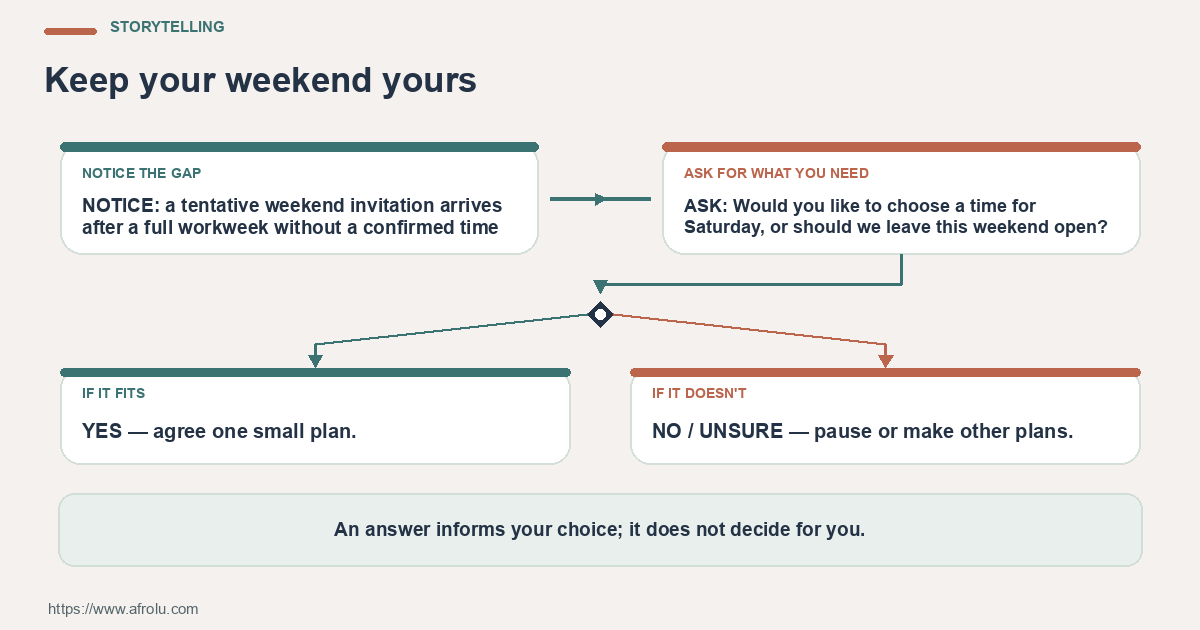
If you want to meet, you can ask, “Would you like to choose a time for Saturday, or should we leave this weekend open?” This makes the choice clear and gives both adults room to answer. You can also offer one specific plan and stop there. A reply of “maybe” does not require a second invitation, a countdown or a test of whether the person will chase you.
If you do not hear back by the time you need to plan your day, make other plans. That is a calendar decision, not a punishment. If the other person replies later, you can check whether you still want to meet and whether another time works. You are not required to apologize for using your weekend after the possibility stayed unresolved.
A work week can shift unexpectedly, and a missed reply may have several explanations. You do not need to label the person to notice that the current plan is not confirmed. If this happens repeatedly, say that last-minute uncertainty does not suit you and ask whether they want to plan another day with more notice.
Read follow-through fairly
Use repeated planning behavior as information about fit
After a plan is proposed, observe whether a time is chosen, whether changes are shared when possible and whether an alternative is offered if both adults still want to meet. You can also notice your own energy: did you feel free to make other plans, or did you wait longer than you wanted? Those details give you a fair account of the experience without turning a weekend into an investigation.
If someone cancels once and proposes a new time that suits you, you can decide to accept it. If tentative plans keep appearing without details, you may stop reserving weekends for them. Neither response requires certainty about whether the other person is busy, disorganized, unsure or not interested. You can make a decision based on the arrangement you have, not an imagined explanation.
Avoid message counts and universal confirmation rules. Different adults organize time differently, and many people have obligations that change. The relevant question is whether the notice and planning you receive feel respectful and workable to you. If the answer is no, state your preference or step back rather than waiting for a researcher or a dating label to tell you what your limit should be.

Review four observable details when deciding whether keeping low-pressure weekend dating compatible with rest and professional recovery fits your needs.
Protect rest and other plans
A full life is compatible with being interested
A demanding week can leave you needing quiet, movement, household time or company outside dating. Decide what you have capacity for before responding. If you want a short meeting, offer it. If you would rather rest this weekend, say that and suggest another day only if you mean to. You are not required to accept a late plan simply because the other person has become available.
You can keep your precise routine private while describing your availability: “This weekend is full, but I could do Tuesday after work.” A new date does not need your work location, exact commute, home address or account access. If you meet in person, choose terms and a setting that feel appropriate to you, and keep a way to change or end the plan.
Wellbeing guidance from the U.K. NHS discusses personal time and communication in relationships, but it does not prescribe a dating schedule or speak for every Kenyan adult. Use it as general context only. If work pressure or dating uncertainty is making rest impossible, consider support from someone you trust or a qualified local professional.
Use clear, low-pressure language
A practical message can invite an answer without demanding one
You might say, “I would enjoy meeting Saturday morning. I can stay for about an hour; should we choose a time?” Or, if your weekend has already filled, “I did not hear a confirmed plan, so I made other arrangements. I am open to another day if you want to choose one.” Keep the message in your own voice and avoid adding blame that you do not actually feel.
If the person says they are unsure, you can answer, “No problem; let us leave this weekend open.” If they suggest a time that does not suit you, decline it and offer a different one only if you want to. A respectful no is a complete answer. You can also ask whether a different planning style would work better for both of you.
Do not create a false deadline, post something to provoke jealousy or accept a plan you do not want just to see what happens. Those tactics make your own choice harder to read. A direct question gives you current information; repeated behavior gives you more context. Neither guarantees a future outcome, so make a decision that remains comfortable if nothing changes.

Adapt one short question to discuss keeping low-pressure weekend dating compatible with rest and professional recovery without pressure.
Choose the weekend you want
You can meet, reschedule, rest or stop
If a confirmed plan sounds enjoyable, go if you still want to. If it no longer fits, change it. If the invitation remains vague, make other plans. If repeated uncertainty drains more energy than the connection gives you, reduce contact or end it. These are ordinary choices, not verdicts about the other person's character or a judgment on your own ability to date.
After a date, ask whether you felt present, whether the time boundary worked and whether you want another meeting. You can stay open to the next step without promising it. You can also decide that a spontaneous style is fun for you, or that you need more notice. A preference becomes useful when you communicate it, not when you use it as an unspoken test.
This article is general editorial information, not therapy or an assessment of your relationship. If ongoing stress is affecting sleep, work or daily functioning, seek support that is qualified and available where you live. The goal is not to optimize every weekend; it is to make the next choice in a way that respects your time and the other adult's freedom.

Keep these four route-specific choices available when keeping low-pressure weekend dating compatible with rest and professional recovery.
Common moments in keeping low-pressure weekend dating compatible with rest and professional recovery
A vague suggestion
For keeping low-pressure weekend dating compatible with rest and professional recovery: An adult mentions a possible plan without a time or place.
Ask whether they want to choose one concrete option.A work change
For keeping low-pressure weekend dating compatible with rest and professional recovery: A meeting or deadline changes the time someone can offer.
Share the update and suggest another time only if it works.A clear invitation
For keeping low-pressure weekend dating compatible with rest and professional recovery: One adult names an activity and a realistic window.
Accept, decline or suggest a different plan.A delayed reply
For keeping low-pressure weekend dating compatible with rest and professional recovery: A response arrives after you have made other plans.
Decide whether you still want to meet; do not treat timing as a score.An uncertain answer
For keeping low-pressure weekend dating compatible with rest and professional recovery: The other adult is unsure about the next step.
Ask what they want now and choose your own limit.A changed location
For keeping low-pressure weekend dating compatible with rest and professional recovery: The venue shifts after an initial agreement.
Pause and decide whether the new plan still suits you.Different expectations
For keeping low-pressure weekend dating compatible with rest and professional recovery: Each adult uses the same dating label differently.
Clarify the term before relying on it.A boundary
For keeping low-pressure weekend dating compatible with rest and professional recovery: One person says a time, place or activity does not work.
Respect the boundary without repeated pressure.Notice choices and actions, not imagined motives
You can describe the current agreement in plain language.
You can ask what a dating term means to the other adult.
The next invitation includes details you can accept or change.
The pace fits your work, rest and other commitments.
A change is communicated when reasonably possible.
Either person can decline without guilt or punishment.
You do not use reply speed as a measure of care.
A privacy boundary is heard without repeated pressure.
You keep your own money, route and support network.
A shared plan is chosen rather than assumed.
A feeling is separated from an agreement.
A mismatch can be named without diagnosing motive.
The next step for keeping low-pressure weekend dating compatible with rest and professional recovery remains voluntary.
You can pause or leave without proving the other adult is wrong.
Choose a response that fits the moment
| Situation | What it may mean | What to do next |
|---|---|---|
| A vague suggestion | An adult mentions a possible plan without a time or place. | Ask whether they want to choose one concrete option. |
| A work change | A meeting or deadline changes the time someone can offer. | Share the update and suggest another time only if it works. |
| A clear invitation | One adult names an activity and a realistic window. | Accept, decline or suggest a different plan. |
| A delayed reply | A response arrives after you have made other plans. | Decide whether you still want to meet; do not treat timing as a score. |
| An uncertain answer | The other adult is unsure about the next step. | Ask what they want now and choose your own limit. |
| A changed location | The venue shifts after an initial agreement. | Pause and decide whether the new plan still suits you. |
| Different expectations | Each adult uses the same dating label differently. | Clarify the term before relying on it. |
| A boundary | One person says a time, place or activity does not work. | Respect the boundary without repeated pressure. |
| An answer is uncertain | The other adult may be unsure or want different terms; one answer does not establish a motive. | Ask whether a later conversation would help, then choose your own limit. |
| Your comfort changes | A changed feeling can be enough reason to revise or stop a plan. | Say what you want now and keep the next choice voluntary. |
Words you can adapt to your own voice
“I am interested in keeping low-pressure weekend dating compatible with rest and professional recovery, and I want to be clear about what works for me.”
“Would you like to plan one bounded weekend activity with a natural end time?”
“Would you like to choose a time for Saturday, or should we leave this weekend open?”
“I can share the time you can meet, not your full weekend or work calendar, but I am keeping other details private.”
“Can we agree on a short weekend window that leaves time for rest and your existing plans before I change my plans?”
“That time no longer works for me. I can suggest another option if I still want to meet.”
“It sounds as if we want different things right now. Have I understood you correctly?”
“My feelings or availability have changed. Would you like to revisit what we agreed?”
“I am not comfortable with that plan, so I will not go ahead with it.”
“I can meet for about an hour, then I need to head home.”
“I want to think about that before I answer. I will get back to you if I decide to.”
“I have appreciated meeting you, but I do not want to continue dating.”
Know the difference
Compare a bounded weekend plan with a weekend left on hold
The time and activity fit your energy, and both adults can confirm or decline without pressure.
A vague invitation keeps one person waiting while rest and other plans remain unsettled.
Set a clear time limit for the invite, then make your weekend plans.

Compare a shared agreement with an assumption in keeping low-pressure weekend dating compatible with rest and professional recovery without diagnosing intent.
Compare a bounded weekend plan and a weekend left on hold
| Type or dimension | What it describes | Best next question |
|---|---|---|
| A feeling | Interest, uncertainty or disappointment describes an experience, not a shared agreement. | Notice it and choose whether to talk or wait. |
| A stated goal | Each person can explain what they hope for without guaranteeing an outcome. | Ask what the goal means in current choices. |
| A clear plan | A time, activity and practical details have been agreed by both adults. | Confirm the details and keep the choice voluntary. |
| A boundary | A person names what they will or will not do. | Respect it without asking repeatedly. |
| A changed plan | Someone's schedule, location or comfort has shifted. | Offer or accept an alternative only if it works. |
| An open possibility | A future idea has been mentioned but no present step is agreed. | Separate hope from what is available today. |
| A mismatch | Two adults want different terms, pace or contact. | Decide whether the actual offer suits you. |
| A repeated pattern | Several interactions show how plans or limits are handled. | Describe observations without diagnosing motive. |
| A new choice | Either adult wants to revise or end the arrangement. | State the change and let both adults respond freely. |
Six practical ideas to keep nearby
No universal movement score
A reflection prompt cannot measure intent, safety or relationship quality.
Messages are not terms
Contact and affection do not define exclusivity or commitment.
Small steps count
For keeping low-pressure weekend dating compatible with rest and professional recovery, a modest next action may give you useful information.
Boundaries stay yours
You can protect time, privacy, money and comfort while dating.
Use observable details
Compare what was agreed with what happened without guessing motive.
Choose again
Continue, clarify, pause or stop as your needs change.
Questions for planning and reflection
Choose a few prompts that fit the moment. This is a reference library, not a list to complete.
Before you meet
Choose the conditions that fit your real life.
- What do I want from this interaction?
- What detail or boundary matters?
- What is one step I actually want?
During the conversation
Ask the question that affects your next choice.
- What do I mean by this dating term?
- What does the other person want now?
- Can we both say no freely?
Afterward
Notice your experience without turning it into a verdict.
- Was I able to be myself?
- Did the plan and boundary hold?
- Do I want another step?
If something changes
Revisit the plan without assigning motive.
- What changed?
- What do I want now?
- Would a pause or ending fit better?
What research and practical guidance can—and cannot—tell you
What a narrow survey can tell us
A survey of 647 emerging adults in Canada examined remote communication in dating and relationships.
Evidence limit: It cannot set a message quota for Kenyan professionals or show that more texting causes satisfaction.
Why schedules vary
U.S. time-use research examined work and family demands among people in established couples.
Evidence limit: It cannot prescribe a dating schedule or explain one person's availability.
Why direct questions can help
A study of relationship-status talk followed 244 emerging adults in a defined U.S. sample.
Evidence limit: It does not provide a universal timeline or represent every adult in Kenya.
Why a dating word is not a diagnosis
Terms such as casual, serious and benching can mean different things to different adults.
Evidence limit: This guide does not diagnose attachment, motive or mental-health conditions.
Agreement applies to each current choice
A meeting plan does not imply agreement to another activity or a later date.
Evidence limit: This editorial guide does not replace local law, clinical advice or support services.
Share personal information deliberately
Kenya's ODPC describes rights and consent in personal-data processing.
Evidence limit: Data-protection guidance does not authenticate a profile or guarantee confidentiality.
Common assumptions that add pressure
Treating benching as a diagnosis
The informal label describes an experience but cannot establish another person's motive.
Treating a date as a promise
One good interaction does not establish future commitment.
Using a label as a contract
People can mean different things by the same dating term.
Explaining a boundary at length
A respectful no does not need to persuade someone before it counts.
Reading one delay as proof
Timing has many possible explanations; ask for what you need.
Giving up ordinary support
Friends, routine, rest and professional care can remain part of life.
Keep the weekend open until a plan is clear
These information links are clearly labelled, non-commercial and do not promise a relationship outcome.
Explore the guide library
Show more related guides
Continue with Afrolu
Show more Afrolu guides
Research and practical guidance used for this guide
Afrolu reviewed these health, research, safety, or public guidance resources while editing this page. They support the behaviour and safety guidance; they do not diagnose any individual described by a reader.
Questions about keeping low-pressure weekend dating compatible with rest and professional recovery
Should I keep Saturday open?
Only while you want to. Ask for a confirmed plan and keep other plans if it stays vague.
What if an invitation says maybe?
You can ask once whether they want to choose a time, then make your own plans.
Is there a universal reply deadline?
No. Choose a planning limit that suits your calendar and needs.
Does one cancellation prove benching?
No. One change has many explanations; notice updates and alternatives over time.
Can I set an end time?
Yes. You can plan a short date and decide whether to stay longer.
Does being busy mean I am not interested?
No. You can be interested and still protect rest and existing commitments.
Should I rearrange my day for a late invite?
Only if you freely want to; you do not owe an open weekend.
What if spontaneous plans suit me?
That can be your preference. Share it and see whether the style works for both adults.
Is the movement check validated?
No. It is an editorial reflection aid, not a research measure.
Can I stop after a good date?
Yes. A pleasant meeting does not create an obligation to continue.
One thing to do now
Choose the next step that fits your actual needs
Offer one plan that fits your real weekend; keep the rest of your day available to yourself until the details are mutual.