Benching in dating · parents · weekend safety
Make a child-free weekend first date clear and easy to leave
A date can fit around parenting without sharing children’s routines. Agree on a public place and time, keep transport independent, and leave room to stop.

A public weekend date can fit parenting while protecting a child's privacy and each adult's freedom to leave.
Written and edited by Grace Mutiso · Kenya Guides Editor
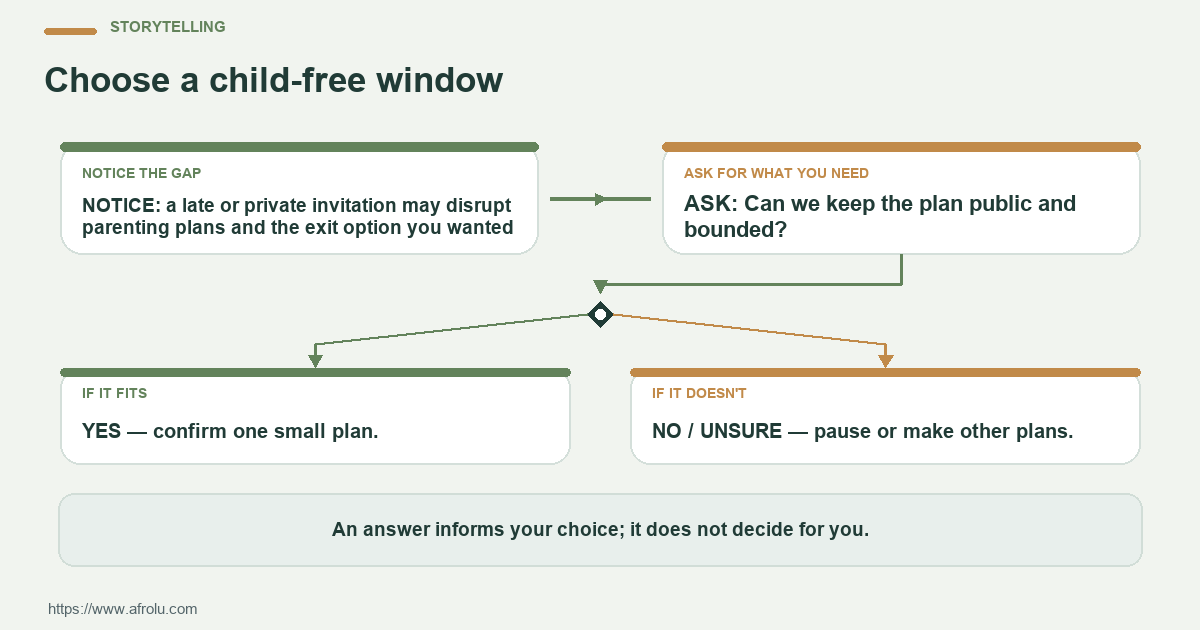
Choose whether you want to meet, then offer a specific public time that works with your own care arrangements. Keep the first plan child-free, share only the availability needed to confirm it, arrange a route that suits you and decide what would make you leave or reschedule. A public venue does not guarantee safety. One changed plan is not proof of intent; repeated last-minute changes can still be a poor fit for your life.
Modern dating terms · Parents Returning To Dating
How can a parent make a weekend first date clear and practical while protecting a child's privacy and retaining the choice to leave?
Benching is an informal label for intermittent attention without a clear mutually chosen step. This guide's movement check is an Afrolu reflection aid, not a validated test of anyone's intentions. For a parent planning a weekend date, the useful questions are practical: was a time and place agreed, did both adults have room to choose, and did the plan protect the family privacy each person wanted?
Illustrative scenario: A parent has a free Saturday afternoon after arranging care. They suggest a one-hour meeting at a busy outdoor food market and keep the child's schedule private. The other adult proposes changing to a late private gathering. The parent declines that change and offers another public afternoon; if the offer is not accepted, they keep their original weekend plans rather than reorganizing care again.
Start with the weekend you have
Your availability does not need a full explanation
Weekend availability can depend on work shifts, shared care, family help, rest or a child's changing needs. You may be able to meet Saturday but not Sunday, or have a short opening that changes from week to week. Choose from the time you can genuinely offer instead of promising a routine you do not have. Your adult dating life can remain private from children while you explore it.
A short explanation is enough: “I am free Saturday afternoon for about an hour.” You do not need to give a new date the child's name, school, handover point or detailed care schedule. You may say that family commitments make another time unavailable without explaining who is responsible for each hour. A respectful person can respond to the option without needing access to your whole calendar.
A study of 747 single parents in a nationally representative U.S. probability sample described dating attitudes and behavior among adults aged twenty-one and older with children under eighteen. Its findings are descriptive and specific to the United States; they do not prescribe when Kenyan parents should date or involve children. Use your own family circumstances and values to choose how much time is available.
Make the plan specific
A clear day and place reduce last-minute negotiation
Choose an activity and public location that suit your own budget and route. A daytime market, public courtyard or another staffed place may make a first meeting feel more manageable, but preferences differ. Agree on the exact location and a time before arranging care or leaving home. If you cannot confirm the details, keep your weekend flexible for yourself rather than treating a maybe as a reservation.
You can state a natural end time, such as “I can stay until four.” That gives both adults a shared expectation and lets you keep another obligation private. If you decide to extend the date, make that choice in the moment because you want to. You can also end earlier. A time limit is not a promise to disclose what you are doing afterward.
The Australian eSafety Commissioner recommends meeting in a public place when moving from online dating to an in-person meeting. This is general Australian advice, not a guarantee or Kenyan-specific instruction. Adapt it to the venue and transport conditions that you can verify locally. Do not rely on a location as proof that someone is safe or as a reason to ignore discomfort.
Keep children out of early logistics
Dating plans do not require access to a child's identity
A new adult can know that you have family responsibilities without knowing the details that identify or locate your child. Avoid posting a child's image on a dating profile, describing a predictable pickup time or inviting someone to a place where a child is present. Keep social accounts separate if they reveal family photographs or locations you would rather not share. Decide what can be discussed before a conversation becomes personal.
Kenya's Office of the Data Protection Commissioner published guidance for organizations processing children's personal data, including principles of data minimization and privacy by design. That document concerns legal and organizational responsibilities; it does not create a personal dating rule or verify a platform's safeguards. It is a useful reminder that children's identifying information deserves care and should not be shared casually for someone else's reassurance.
The eSafety Commissioner also cautions online daters about sharing information and images related to children. Its advice reflects an Australian context and should not be mistaken for Kenyan law. You can choose to introduce a partner to a child later, when the relationship and family circumstances support it. There is no need for a first date to include children or for a new match to learn their routines.
Keep your exit available
Plan a meeting you can end on your own terms
Decide how you want to get to and from the venue. If independent transport is important to you, arrange it before the date and keep the fare or booking under your control. You may tell a trusted person where you are going, but only share what you want with someone you trust. Keep your phone charged and avoid depending on a new date for the only way home.
If the plan changes after you arrive, you may say that the new venue does not work and leave. If you are enjoying yourself but need to go, use the end time you set. You do not owe a detailed account of your childcare arrangements or next destination. You can decide to keep chatting another day after you have returned safely and considered how the meeting felt.
RAINN's safer-dating advice makes clear that practical planning cannot guarantee safety and does not shift responsibility for harm onto the person who was harmed. It is a U.S.-based education resource with U.S. support details, not an emergency guide for Kenya. Use the choices that fit, and verify current local contacts if you want them. A public venue, a friend and transport are options, not guarantees.
Keep consent current
A date does not create permission for touch or another plan
You may agree to meet and still say no to a ride, a photograph, a change of venue or physical contact. Consent is specific to what is happening now; agreement to one activity does not authorize another. If the other adult seems unsure, pause and ask. You can also change your own mind after the date starts. A respectful interaction leaves both adults free to stop without penalty.
RAINN's consent education describes agreement as voluntary and ongoing, with the right to withdraw it. This is general U.S.-based information and is not a statement of Kenyan law or a substitute for local services. The useful practice is to ask rather than infer, respect a no and avoid pressure. The same principle applies to sharing private stories, contact information or family photographs.
If someone dismisses a limit because you are a parent, says you owe them a longer date after they made time, or pressures you to change the plan, you can restate your choice once or leave. One clumsy moment may be clarified if you want; repeated pressure after a clear boundary is information about the interaction. You can end the date without debating whether the person deserves another chance.

Review these four observable details when deciding whether a clear, child-free weekend first date for a parent fits your needs.
Use the movement check carefully
A pattern can guide your choice without proving intent
For a weekend date, the movement check asks whether messages led to a time and place both adults accepted, whether a change was shared and whether you still wanted to go. It does not score affection or predict a relationship. Write down only what you know: the original plan, what changed, whether another time was offered and the effect on your own weekend.
A single cancellation can happen for many reasons. If a person communicates and suggests an alternative, decide whether that alternative suits you. If tentative plans repeatedly arrive late or remain vague, you can stop arranging care or reserving time for them. You do not have to call the person manipulative to decide that the current pattern is too uncertain for your life.
A parent can have valid reasons to protect weekend time and still want to meet someone. Those facts can coexist. If the other adult has a different schedule, ask whether there is another time that fits both lives. If there is no shared window, it may be a practical mismatch rather than evidence that either person is uncaring. Choose based on the arrangement you can actually have.

Adapt a question or boundary line to a clear, child-free weekend first date for a parent; no script guarantees a response.
Choose again after the date
Continue only if the real pace works for you
After the meeting, notice whether you felt listened to, whether the agreed time was respected and whether you want another conversation. A pleasant hour can be enough to learn that you are not interested. A date that went well does not create a promise, and one awkward exchange does not define either person's future. Give yourself room to reflect before reorganizing care or changing a weekend routine.
If you want to continue, make another plan only when you know it fits. If you want more clarity, ask what the person hopes to build now rather than inferring it from the date. If you want to stop, a short message can close the interaction. You may also choose no further contact when that is the safest or simplest option for you.
The NHS offers broad guidance on communication, boundaries, personal time and trusted support, but it is U.K. wellbeing information rather than a local dating forecast. Keep your family routine, friendships and rest in view as you decide. The key question is not whether you completed a perfect checklist; it is whether the next step remains freely chosen, practical and consistent with your own priorities.

Use these four voluntary steps to decide what to do next with a clear, child-free weekend first date for a parent.
Common moments in a clear, child-free weekend first date for a parent
A specific invitation
For a clear, child-free weekend first date for a parent: An adult proposes a day, time and activity.
Decide whether you want that plan before accepting; you may offer a different time.A busy or difficult day
For a clear, child-free weekend first date for a parent: A reply arrives later while someone handles ordinary responsibilities.
Treat timing as context, ask for a workable plan if you want one, and avoid guessing motive.An open-ended promise
For a clear, child-free weekend first date for a parent: The conversation turns to a future possibility without a current step.
Ask what each person wants today and keep hope separate from an agreement.A changed plan
For a clear, child-free weekend first date for a parent: A date or call moves after it was discussed.
Notice how the change is communicated and decide whether the alternative works for you.A boundary is named
For a clear, child-free weekend first date for a parent: One person asks for a public venue, more time or fewer details.
Acknowledge the limit and make the next choice without pressure.Your capacity shifts
For a clear, child-free weekend first date for a parent: Work, care or comfort changes the time you can offer.
State what changed and suggest another option only if you want to keep the plan.A private detail is requested
For a clear, child-free weekend first date for a parent: Someone asks for information that is not needed for the next step.
Share only what you choose; a brief no is enough.Two adults want different terms
For a clear, child-free weekend first date for a parent: One person wants more commitment or contact than the other currently does.
Clarify the difference and decide whether the arrangement fits you.Notice choices and actions, not imagined motives
You can name what you want from the next interaction.
The invitation has a detail you can accept, decline or change.
The pace fits your work, sleep, care and other commitments.
You can ask a question without demanding a particular answer.
Either person can say no without guilt or punishment.
A change is communicated when reasonably possible.
A new plan is chosen by both adults rather than assumed.
Your privacy boundary is heard without repeated pressure.
You can keep your own friends, money and transport choices.
The connection leaves room for interests outside dating.
You distinguish a feeling from an agreement.
A mismatch can be named without a diagnosis or label.
The next step for a clear, child-free weekend first date for a parent remains voluntary.
You can pause or leave without proving that the other person is wrong.
Choose a response that fits the moment
| Situation | What it may mean | What to do next |
|---|---|---|
| A specific invitation | For a clear, child-free weekend first date for a parent: An adult proposes a day, time and activity. | Decide whether you want that plan before accepting; you may offer a different time. |
| A busy or difficult day | For a clear, child-free weekend first date for a parent: A reply arrives later while someone handles ordinary responsibilities. | Treat timing as context, ask for a workable plan if you want one, and avoid guessing motive. |
| An open-ended promise | For a clear, child-free weekend first date for a parent: The conversation turns to a future possibility without a current step. | Ask what each person wants today and keep hope separate from an agreement. |
| A changed plan | For a clear, child-free weekend first date for a parent: A date or call moves after it was discussed. | Notice how the change is communicated and decide whether the alternative works for you. |
| A boundary is named | For a clear, child-free weekend first date for a parent: One person asks for a public venue, more time or fewer details. | Acknowledge the limit and make the next choice without pressure. |
| Your capacity shifts | For a clear, child-free weekend first date for a parent: Work, care or comfort changes the time you can offer. | State what changed and suggest another option only if you want to keep the plan. |
| A private detail is requested | For a clear, child-free weekend first date for a parent: Someone asks for information that is not needed for the next step. | Share only what you choose; a brief no is enough. |
| Two adults want different terms | For a clear, child-free weekend first date for a parent: One person wants more commitment or contact than the other currently does. | Clarify the difference and decide whether the arrangement fits you. |
| An answer is uncertain | The other adult may be unsure or want different terms; one answer does not establish a motive. | Ask whether a check-in would help, then choose your own limit. |
| Your comfort changes | A changed feeling can be enough reason to revise or stop a plan. | Say what you want now and leave the next choice voluntary. |
Words you can adapt to your own voice
“I am interested in a clear, child-free weekend first date for a parent, and I want to move at a pace I can sustain.”
“Would you like to plan a short daytime conversation at a busy outdoor food market?”
“Can we keep the first meeting public and finish by the time we agreed?”
“I can share the time you can meet, not the child's schedule or care handover details, but I am keeping other details private.”
“Can we agree on one child-free hour that fits the care plan you have chosen before I change my plans?”
“That time no longer works for me. I can suggest another option if I still want to meet.”
“It sounds as if we want different things right now. Have I understood you correctly?”
“My feelings or availability have changed. Would you like to revisit what we agreed?”
“I am not comfortable with that plan, so I will not go ahead with it.”
“I can meet for about an hour, then I need to head home.”
“I want to think about that before I answer. I will get back to you if I decide to.”
“I have appreciated meeting you, but I do not want to continue dating.”
Know the difference
Compare a bounded, child-free date with a plan that changes your family arrangements
The date fits a chosen care window, stays public and leaves each adult free to end it.
The venue or length shifts late, putting pressure on care, transport or personal boundaries.
Use the agreement and what happened next; a label cannot establish another person's motive.

Compare confirmed details with open assumptions in a clear, child-free weekend first date for a parent without diagnosing intent.
Compare a bounded, child-free date and a plan that changes your family arrangements
| Type or dimension | What it describes | Best next question |
|---|---|---|
| A feeling | Interest, grief or uncertainty describes an experience, not a relationship agreement. | Notice it and choose whether to talk or wait. |
| A stated goal | Each person can explain what they hope for without guaranteeing an outcome. | Ask what the goal means in current choices. |
| A clear plan | A day, activity and practical details have been agreed by both adults. | Confirm the details and keep the choice voluntary. |
| A boundary | A person names what they will or will not do. | Respect it without asking repeatedly. |
| A changed plan | Someone's schedule or comfort has shifted. | Offer or accept an alternative only if it works. |
| An open promise | A future possibility is mentioned but has no present step. | Separate hope from what is agreed today. |
| A mismatch | Two people want different terms, timing or contact. | Decide whether the actual offer suits you. |
| A repeated pattern | Several interactions show how plans or limits are handled. | Describe the observations without diagnosing a motive. |
| A new choice | Either person wants to revise or end the arrangement. | State the change and let both adults respond freely. |
Six practical ideas to keep nearby
No universal movement score
A reflection prompt cannot measure intent, safety or relationship quality.
Messages are not terms
Contact and affection do not define exclusivity or commitment.
Small steps count
For a clear, child-free weekend first date for a parent, a modest next action may give you enough information.
Boundaries stay yours
You can protect time, privacy, money and comfort while dating.
Use observable details
Compare what was agreed with what happened without guessing motive.
Choose again
Continue, clarify, pause or stop as your needs change.
Questions for planning and reflection
Choose a few prompts that fit the moment. This is a reference library, not a list to complete.
Before you meet
Choose the conditions that fit your real life.
- What do I want from this interaction?
- What time or boundary matters?
- What is one step I actually want?
During the conversation
Ask the question that affects your next choice.
- What do I mean by this dating term?
- What does the other person want now?
- Can we both say no freely?
Afterward
Notice your experience without turning it into a verdict.
- Was I able to be myself?
- Did the plan and boundary hold?
- Do I want another step?
If something changes
Revisit the plan without assigning motive.
- What changed?
- What do I want now?
- Would a pause or ending fit better?
What research and practical guidance can—and cannot—tell you
What a narrow study can tell us
The cited study followed 244 emerging adults in the United States over two waves seven weeks apart.
Evidence limit: It does not establish a universal timeline, represent Kenyan parents or explain one person's motive.
Why context matters
The cited study describes 747 single parents in a nationally representative U.S. sample.
Evidence limit: Its findings are descriptive and cannot prescribe choices for Kenyan families.
Why a dating label is not a diagnosis
Terms such as rebound, casual or serious can mean different things to different adults.
Evidence limit: This guide does not diagnose attachment, motive or mental-health conditions.
Agreement applies to each current choice
A meeting plan does not imply agreement to another activity or a later date.
Evidence limit: This editorial guide does not replace local law, clinical advice or support services.
Share personal information deliberately
Kenya's ODPC explains rights and consent in personal-data processing.
Evidence limit: Data-protection guidance does not authenticate a profile or guarantee confidentiality.
When a guide is not enough
A trusted person or qualified professional may help when distress affects daily life or safety.
Evidence limit: This article cannot assess mental health, risk or the need for treatment.
Common assumptions that add pressure
Treating benching as a diagnosis
The informal label describes an experience but cannot establish another person's motive.
Treating a date as a promise
One good interaction does not establish future commitment.
Using a label as a contract
People can mean different things by the same dating term.
Explaining a boundary at length
A respectful no does not need to persuade someone before it counts.
Reading one delay as proof
Timing has many possible explanations; ask for what you need.
Giving up ordinary support
Friends, routine, rest and professional care can remain part of life.
Confirm the public plan before leaving
These information links are clearly labelled, non-commercial and do not promise a relationship outcome.
Explore the guide library
Show more related guides
Continue with Afrolu
Show more Afrolu guides
Research and practical guidance used for this guide
Afrolu reviewed these health, research, safety, or public guidance resources while editing this page. They support the behaviour and safety guidance; they do not diagnose any individual described by a reader.
Questions about a clear, child-free weekend first date for a parent
Do I have to tell a date my care schedule?
No. You can offer an available time without sharing a child's routine or handover details.
Should children come to a first date?
This guide focuses on a child-free meeting; you can decide separately if and when to introduce a partner.
What if care arrangements change?
Update the other adult when you can and offer another time only if you want to reschedule.
Does one cancellation prove benching?
No. One change has many possible explanations; look at how the plan is handled over time.
Is a public place a guarantee?
No. It can support choice but cannot promise what another adult will do.
Can I set an end time?
Yes. You may plan a short meeting and decide whether to stay longer.
Do I have to accept a venue change?
No. You can keep the original plan, suggest another public time or cancel.
Can I change my mind during a date?
Yes. Consent and plans remain voluntary and current.
Is the movement check validated?
No. It is an Afrolu editorial reflection tool, not a research-validated measure.
Must I give a reason for ending contact?
You may give a brief reason, but you do not need to prove that your decision is justified.
One thing to do now
Choose the next step that fits your actual needs
Offer one child-free public plan that fits your actual weekend, keep family details private and change or cancel the plan if its conditions stop working for you.