Benching in dating · parents · Nairobi
Dating clarity for parents balancing time and privacy
When dating plans keep changing, protect childcare time and your family’s privacy. Ask what the other person wants before you keep reserving Nairobi weekends.
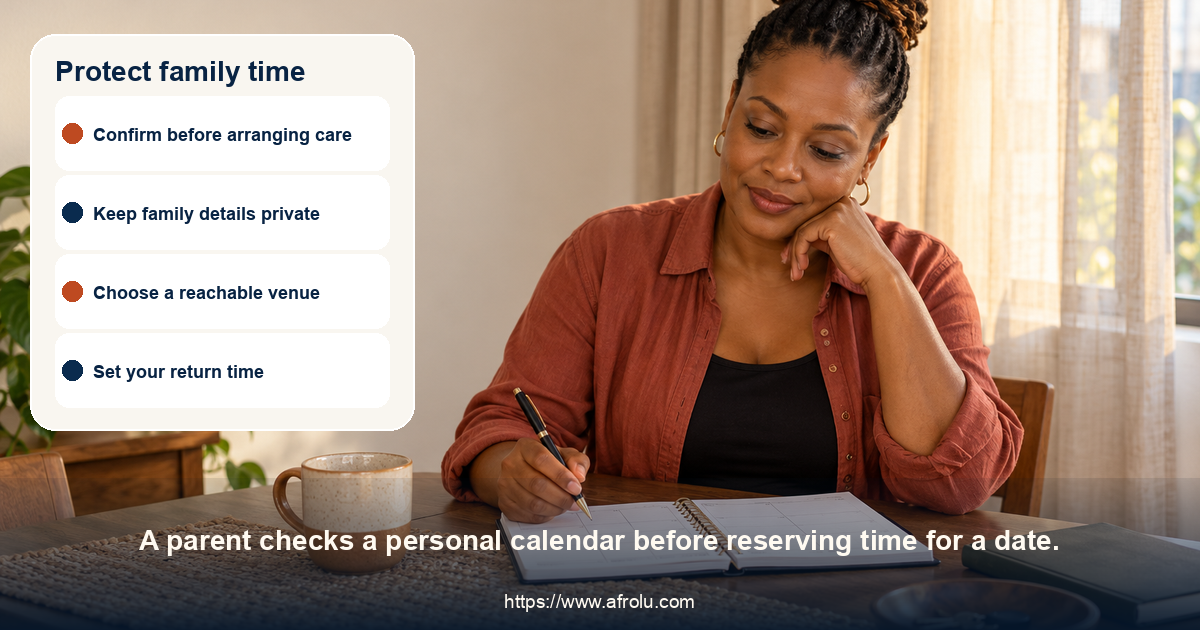
A parent checks a personal calendar before reserving time for a date.
Written and edited by Miriam Otieno · Senior Kenya Editor
Ask for a confirmed plan before changing childcare or family routines, and keep identifying details about your children private while you are getting to know someone. Discuss what each adult wants for the connection and decide whether the actual availability works for you and your family.
Modern dating terms · Parents Returning To Dating
How can I date while parenting when invitations appear but shared plans rarely become clear?
Benching is informal shorthand for intermittent attention without much shared progression. A dating parent may feel the cost of uncertainty in childcare, travel and family time, but that impact alone cannot establish the other adult's motive. Describe the plans and effects, ask directly and choose what works for your household.
In Nairobi, 39-year-old Akinyi enjoys meeting someone new but has limited weekends without childcare. The other person sends warm messages and suggests getting together, then leaves the location open. She asks for a public place and time before arranging care, and keeps her child's name, school and routine off the early dating conversation.
Protect scarce time
A dating invitation must fit the calendar you actually have
Parenting can make an unconfirmed date more complicated than moving one personal errand. You may need to arrange childcare, coordinate another adult, budget for transport or protect time with your child. Ask for the day and place before you make those changes. If the details are still open, keep your current plans until you choose otherwise.
A warm message can be welcome and still leave the practical work with you. Notice who suggests a workable time, who confirms and who updates a change. You do not need to accuse the other adult of keeping you as an option; you can simply say that your calendar needs more notice and see whether the request can be met.
Decide what notice you need based on your household, not on a dating rule online. You might need a few days or a week. State that limit early so the other person can answer honestly. If they prefer spontaneous plans and you cannot offer that, the difference may mean your schedules do not fit.
Keep children's details private
A new date does not need your child's routine or school
You can say that you are a parent without naming your child, school, regular route, co-parent or home address. Kenya's Data Protection Act identifies family details as sensitive personal data, and the ODPC explains data-subject rights. These protections are one reason to consider what details you share; they cannot guarantee that a person will use information responsibly.
Think ahead about when a new partner might meet your child, if that is something you eventually want. There is no single timeline that suits every family. You may choose to build trust in the adult relationship first and keep early dates separate from your child's life. A partner's curiosity does not require immediate access.
If someone presses for a child's photograph, school, live location or private messages before you are comfortable, you may decline without offering a long explanation. Avoid sharing identifiable information in public posts or real-time check-ins if you prefer to keep routines private. The child's safety and privacy are separate from the question of whether you like your date.
Plan locally and clearly
A useful Nairobi plan accounts for travel and timing
Nairobi travel time and cost depend on where each person starts, the hour and the route they choose. You do not need to provide your home location to find a meeting area. Offer a public place that works for you and ask the other adult to suggest an alternative if needed. Confirm before either person begins travelling.
If childcare ends at a set time, say what the date window is and when you need to return. That information lets the other adult decide whether the plan works without disclosing your full family routine. If traffic, work or a changed plan makes the timing impossible, cancel or reschedule rather than forcing the meeting.
A location that is public and convenient for both people can make the date easier to manage, but the setting does not guarantee safety. Use the transport, check-in and privacy options that feel right to you. If the other adult keeps changing to a private address or refuses to agree on a place, you may choose not to meet.

A practical conversation card for a Nairobi parent protecting childcare time and a child's identifying details while dating, with words the reader can adapt.
Discuss what you both want
A family schedule does not answer the relationship question
A parent may prefer a slower pace because family responsibilities are important. That does not mean you are unavailable for commitment, nor does wanting commitment mean you must merge family lives quickly. Ask what the other adult wants now and explain what kind of contact you can realistically offer. A clear answer helps you plan without rushing an introduction.
If you are dating casually, discuss whether either person is seeing other adults and what you mean by casual. If you want a committed relationship, ask whether the other person is interested in moving in that direction. Do not infer exclusivity from regular messages, a dinner paid for or an expression of affection.
The other adult may have a different preference, and you can decide whether to continue. A dating term such as benching can describe the feeling of being kept waiting, but it cannot reveal intent. Focus on whether invitations become mutual plans and whether the pace fits the life you are responsible for.

Observable signals for a Nairobi parent protecting childcare time and a child's identifying details while dating, with context kept separate from assumptions.
Share family context carefully
You can be honest about parenting without sharing everything
You might say, 'I have childcare until seven and can meet nearby after that.' You do not have to explain who is caring for your child, where they live or how your family is organized unless you choose to share. A person who respects your privacy can still understand the limits around your availability.
Do not share passwords, financial accounts or identity documents as proof of trust. If someone requests urgent money for a problem connected to a date or travel, take time to verify independently. Consumer warnings about romance fraud are often written for other countries, so use them as practical prompts rather than a measure of risk for Kenya.
If you decide to introduce a partner to your child later, plan that step around your own family values and your child's needs. A date who asks for immediate contact may be disappointed, but disappointment does not override your choice. You may revisit the decision as the relationship develops and your circumstances change.
Review the real arrangement
Notice whether both adults help make time
A pattern worth discussing may be that you arrange care and travel while the other person proposes vague times, or that plans shift after your childcare is confirmed. Keep a factual note if that helps you see the pattern. Avoid turning it into a scorecard: the useful question is whether the arrangement feels mutual enough for you to continue.
You can ask for a specific change: 'Could we choose the next date by Wednesday so I can arrange care?' Then see whether both of you follow through. One cancellation may be unavoidable. Repeated changes without an update can still make the connection hard to sustain, even when nobody intends harm.
Your own needs matter alongside your child's schedule. You may want companionship, a serious partner, occasional dates or a pause; each is a valid choice. You are not required to accept a connection that uses more family time than you can spare or leaves you uncertain about whether a plan will happen.
Choose a family-respecting next step
You can date, pause or stop on terms that fit your household
If the other person confirms plans and respects your privacy, you may choose another date and continue learning about one another. If you are not ready to date this week, you can say so and suggest a later time. If the pattern does not work, you may end it without introducing the person to your child or explaining every detail of your family life.
A concise message can be: 'My availability needs confirmed plans, and this arrangement is not working for me, so I am going to stop dating.' If the other adult responds with anger, you can end the exchange and seek support from someone you trust. You are not responsible for managing another adult's reaction to a clear boundary.
If a date or conversation ever leaves you feeling unsafe, move to a place you trust and contact local help as appropriate. General safety advice cannot guarantee outcomes, and parenting does not make you responsible for preventing someone else's harmful conduct. Keep the choices that give you room to decide freely.

A short action map for a Nairobi parent protecting childcare time and a child's identifying details while dating, ending with a choice the reader controls.
Three ways this can show up
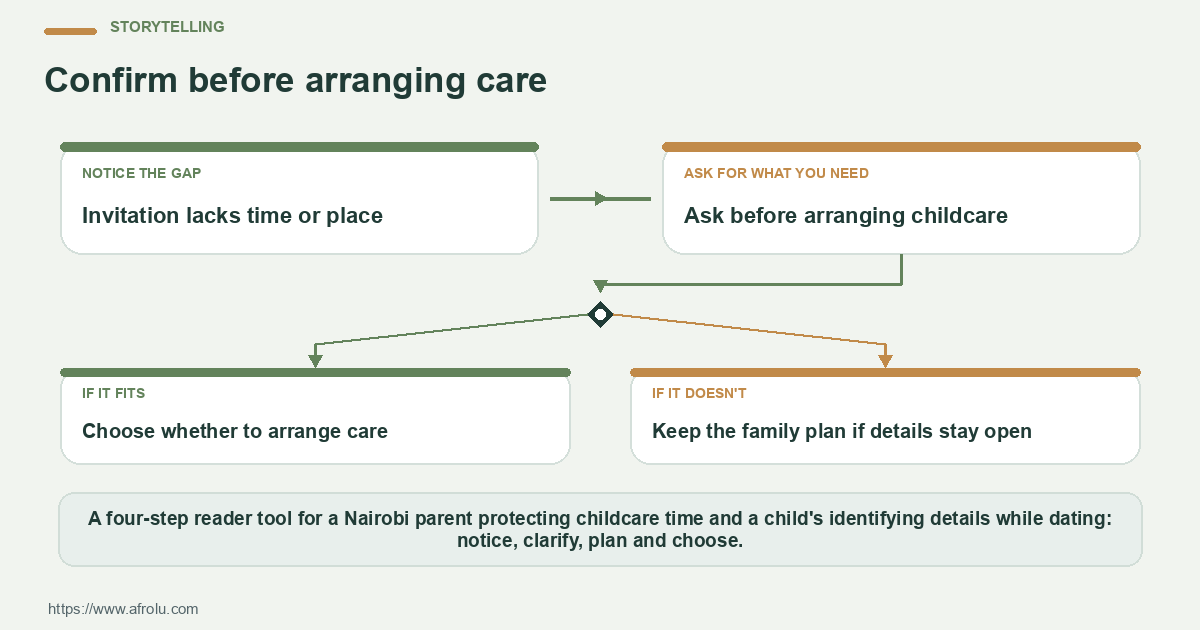
Childcare needed
A date requires care that has not yet been arranged
Wait for a confirmed time before making family changes.Vague invitation
The other adult asks you to keep a weekend open
Ask for a day and public place before you reserve it.Child's school asked
A new date wants identifying family details
Keep names, school, route and routines private until you choose otherwise.Traffic changes
A Nairobi route makes the meeting time impractical
Choose a reachable public alternative or reschedule.Introduction pressure
A date wants to meet your child very early
Decide timing around your family and your child's needs.Family time assumed
Someone expects you to drop a planned family commitment
Keep the commitment or negotiate only if you freely want to.Relationship term unclear
Regular messages are treated as a commitment
Ask what each adult wants and whether you are exclusive.Plan changes
The agreed time changes after care has been booked
Decide if the revised plan still works before rearranging again.What to notice before you react
Childcare needed: A date requires care that has not yet been arranged
Vague invitation: The other adult asks you to keep a weekend open
Child's school asked: A new date wants identifying family details
Traffic changes: A Nairobi route makes the meeting time impractical
Introduction pressure: A date wants to meet your child very early
Family time assumed: Someone expects you to drop a planned family commitment
Relationship term unclear: Regular messages are treated as a commitment
Plan changes: The agreed time changes after care has been booked
Both adults can describe the current agreement in similar terms.
A suggested date becomes a time and place before either person travels.
A schedule change receives an update and a possible alternative when available.
Each adult can keep family, work, money and account information private.
A boundary is heard without repeated pressure or punishment.
One person does not have to remain available while every detail is undecided.
Read the moment without overbuilding the story
| Situation | What it may mean | What to do next |
|---|---|---|
| Childcare needed | A date requires care that has not yet been arranged | Wait for a confirmed time before making family changes. |
| Vague invitation | The other adult asks you to keep a weekend open | Ask for a day and public place before you reserve it. |
| Child's school asked | A new date wants identifying family details | Keep names, school, route and routines private until you choose otherwise. |
| Traffic changes | A Nairobi route makes the meeting time impractical | Choose a reachable public alternative or reschedule. |
| Introduction pressure | A date wants to meet your child very early | Decide timing around your family and your child's needs. |
| Family time assumed | Someone expects you to drop a planned family commitment | Keep the commitment or negotiate only if you freely want to. |
| Relationship term unclear | Regular messages are treated as a commitment | Ask what each adult wants and whether you are exclusive. |
| Plan changes | The agreed time changes after care has been booked | Decide if the revised plan still works before rearranging again. |
| One reply is delayed | A work or family need may affect timing | Use the communication window you discussed or ask once. |
| Your preference changes | The current arrangement no longer fits | Name the new need and decide from the answer. |
Three calm ways to start the conversation
“I can arrange childcare when we confirm a day and time a few days ahead.”
“I am a parent, but I keep my child's school and routine private while dating.”
“Could we choose a public place that works with both of our routes?”
“I enjoy seeing you. What kind of relationship are you looking for right now?”
“That location does not work for me; I am happy to keep the public plan or reschedule.”
“Our schedules and expectations are not working for me, so I am going to stop dating.”
“What would you like us to choose about this connection now?”
“If you want something different, please tell me directly; I will decide what works for me.”
“That time no longer works for me. Could we choose another day, or leave it here?”
“I am not ready to share that detail, but I can suggest a public meeting point.”
“I can hold this time until tomorrow evening; after that I will make other plans.”
“I want to make sure we understand exclusivity and contact the same way.”
Know the difference
A family-aware plan versus Open-ended availability
Time, childcare and privacy boundaries are respected before a date is confirmed.
A parent is expected to rearrange care around an unconfirmed invitation.
A date should fit the family calendar you actually have.

A comparison of A family-aware plan and Open-ended availability for a Nairobi parent protecting childcare time and a child's identifying details while dating.
Compare the closest dating types before choosing a label
| Type or dimension | What it describes | Best next question |
|---|---|---|
| A family-aware plan | Time, childcare and privacy boundaries are respected before a date is confirmed. | Ask what both adults have chosen now. |
| Open-ended availability | A parent is expected to rearrange care around an unconfirmed invitation. | Decide whether the practical arrangement suits you. |
| One delayed reply | A single gap can have many explanations. | Use the agreed contact window or ask once. |
| Repeated unconfirmed plans | Invitations recur without a shared time or place. | Name the pattern and set a confirmation point. |
| A stated constraint | A person explains a limit that affects availability. | Ask what next step, if any, is possible. |
| A future hope | A possibility is described without a present agreement. | Do not treat it as a commitment already made. |
| A changed preference | An adult wants different terms than before. | Revisit the agreement and hear the answer. |
| A respectful no | Someone declines a date, boundary or relationship term. | Accept their choice and make your own. |
| A practical mismatch | Time, location, family or cost prevents the plan you want. | Try a mutual option or decide it does not fit. |
A simple plan you can use today
Office of the Data Protection Commissioner of Kenya: Rights of a Data Subject
Kenya's regulator explains data-subject rights and personal-data principles. Legal protections do not verify a profile or erase every risk after information is shared.
Office of the Data Protection Commissioner of Kenya: Frequently Asked Questions on Data Protection
The regulator describes personal and sensitive data under Kenyan law. The page is legal information, not individualized legal advice or a guarantee about another person's conduct.
PubMed Central: Time for Each Other: Work and Family Constraints Among Couples
A U.S. time-use analysis of established couples describes competing demands; it is not a dating study and cannot explain one person's availability or prescribe a schedule.
PubMed Central: Psychological Correlates of Ghosting and Breadcrumbing Experiences: A Preliminary Study among Adults
An exploratory online survey of 626 adults aged 18–40 studied self-reported breadcrumbing and ghosting experiences. Its associations are not causal, not about every dating context and not a test for an individual's motives.
RAINN: Tips for Safer Dating: Online and In-Person
RAINN's practical advice is U.S.-focused. Options such as choosing a public place can support autonomy but cannot guarantee another person's behavior; use local resources in Kenya.
U.S. Federal Trade Commission: Romance Scams
The FTC explains U.S. consumer guidance, not prevalence in Kenya or diaspora communities. Pause and verify independently before sending money or account information.
Questions organised by purpose and depth
Choose a few prompts that fit the moment. This is a reference library, not a list to complete.
Family calendar
Make space for dating without displacing a commitment you value.
- What childcare is needed?
- How much notice works?
- When must I return?
Privacy
Keep a child's identity and routine protected.
- What can I share?
- What must stay private?
- How will I handle early questions?
Clarity
Ask about the relationship without rushing a family introduction.
- What do I want?
- What does the other adult want?
- What is still too soon?
A changed plan
Choose again if time or location no longer works.
- What changed?
- Is the new option practical?
- Would I prefer to reschedule?
What deserves a closer look
Rights of a Data Subject
Kenya's regulator explains data-subject rights and personal-data principles. Legal protections do not verify a profile or erase every risk after information is shared.
Evidence limit: Read this source within its sample, setting and method; it cannot predict an individual relationship.
Frequently Asked Questions on Data Protection
The regulator describes personal and sensitive data under Kenyan law. The page is legal information, not individualized legal advice or a guarantee about another person's conduct.
Evidence limit: Read this source within its sample, setting and method; it cannot predict an individual relationship.
Time for Each Other: Work and Family Constraints Among Couples
A U.S. time-use analysis of established couples describes competing demands; it is not a dating study and cannot explain one person's availability or prescribe a schedule.
Evidence limit: Read this source within its sample, setting and method; it cannot predict an individual relationship.
Psychological Correlates of Ghosting and Breadcrumbing Experiences: A Preliminary Study among Adults
An exploratory online survey of 626 adults aged 18–40 studied self-reported breadcrumbing and ghosting experiences. Its associations are not causal, not about every dating context and not a test for an individual's motives.
Evidence limit: Read this source within its sample, setting and method; it cannot predict an individual relationship.
Tips for Safer Dating: Online and In-Person
RAINN's practical advice is U.S.-focused. Options such as choosing a public place can support autonomy but cannot guarantee another person's behavior; use local resources in Kenya.
Evidence limit: Read this source within its sample, setting and method; it cannot predict an individual relationship.
Romance Scams
The FTC explains U.S. consumer guidance, not prevalence in Kenya or diaspora communities. Pause and verify independently before sending money or account information.
Evidence limit: Read this source within its sample, setting and method; it cannot predict an individual relationship.
Four mistakes that make this harder
Treating a label as proof
Popular terms describe experiences; they do not confirm another adult's motive.
Counting every message
Contact volume does not establish exclusivity, commitment or follow-through.
Holding every weekend open
An unconfirmed invitation has not become a plan you must reserve time for.
Oversharing to prove trust
Home, child, work and account details can remain private while you date.
Explaining away your own needs
A real constraint may still make the available arrangement a poor fit for you.
Demanding a future guarantee
A present answer and practical next step are more useful than a promise no one can verify.
Plan a date around the family calendar you actually have
These information links are clearly labelled, non-commercial and do not promise a match or relationship outcome.
Explore the guide library
Show more related guides
Continue with Afrolu
Show more Afrolu guides
Sources used for this guide
Afrolu reviewed these health, research, safety, or public guidance resources while editing this page. They support the behaviour and safety guidance; they do not diagnose any individual described by a reader.
Dating clarity for parents balancing time and privacy Questions
Should I arrange childcare before a date is confirmed?
Choose what works for your family, but you can wait for a day and time before making a costly or difficult arrangement.
When should a new date meet my child?
There is no single timeline. Make the choice around your family, your child's needs and your comfort.
Must I share my child's school?
No. You can keep names, school, location and routine private while getting to know someone.
Can I ask for a date in Nairobi with notice?
Yes. Explain what you need to coordinate and let the other adult decide whether the plan works.
Does benching tell me the other person's motive?
No. It is an informal term. Use observable plans and follow-through to make your decision.
Can parenting and dating coexist?
Yes, when the arrangement fits your life and the privacy choices you make for your family.
Can research reveal what the other person intends?
No. Studies describe defined samples; ask the person and decide from the agreement you actually have.
Can I end the connection without proving harm?
Yes. A mismatch in availability, expectations or interest is enough reason to stop dating.
Can our agreement change?
Yes. Either adult can raise a changed need, and both can choose whether the new terms work.
Do I owe a detailed explanation for a boundary?
No. You can state what you will do without disclosing private history or persuading the other person.
One thing to do now
Turn the lesson into a better match pool
Confirm a plan before you commit family time or childcare, and share only the information about your children that is necessary and appropriate.