Benching in dating · casual dating · clarity
Clear terms for casual dating when contact keeps you guessing
Casual dating can still be clear. Ask what the current contact means, discuss exclusivity and plans, then decide whether the arrangement suits you now.
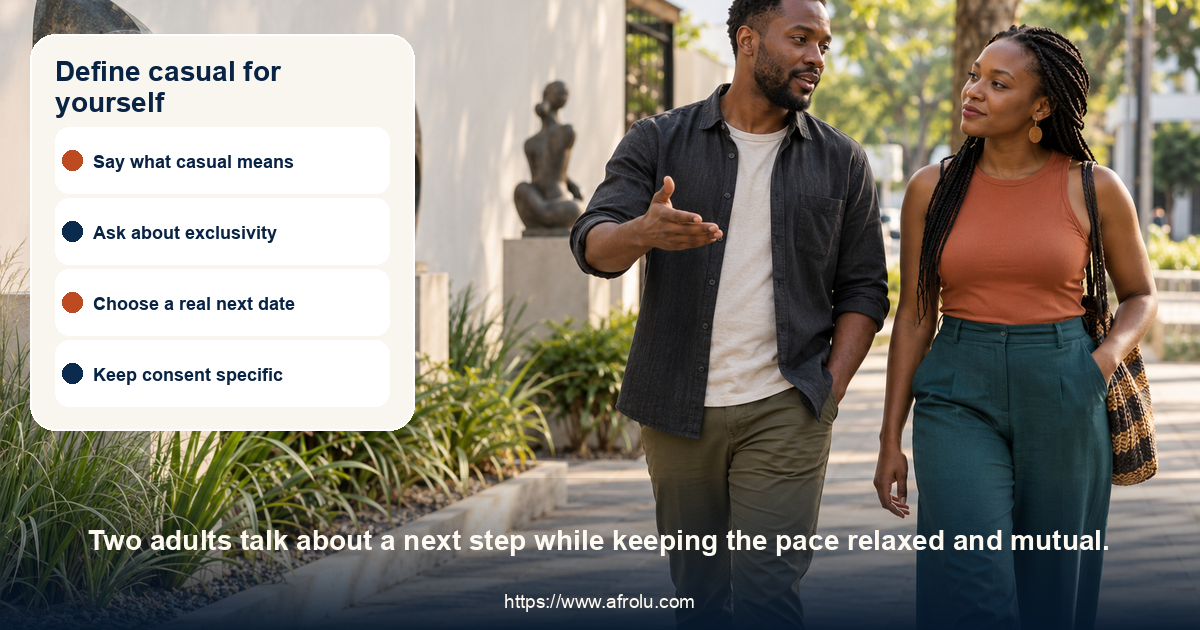
Two adults talk about a next step while keeping the pace relaxed and mutual.
Written and edited by Grace Mutiso · Kenya Guides Editor
Yes. Casual dating does not require a promise of commitment, but both adults can discuss exclusivity, contact, dates and what happens when someone wants to stop. Ask one concrete question, hear the answer and choose whether the agreement you actually have suits you.
Modern dating terms · New Relationship Starters
Can casual dating be clear when messages come and go without much follow-through?
Benching is a colloquial way some people describe intermittent attention that keeps a dating connection available without clear movement. It does not establish intent or wrongdoing by itself. Casual dating is also not a single standard arrangement; people need to say what they mean and agree on the choices that matter to them.
At 31, Kendi is newly dating after focusing on work for several years. She enjoys a relaxed connection and is not seeking a serious relationship right now. The other person sends affectionate messages every few days but rarely confirms a date. Kendi asks whether they both want occasional casual dates and whether either is seeing others.
Define casual for yourself
Casual dating can still include honesty and boundaries
Casual may mean that you are not planning a long-term partnership, that you meet occasionally, or that you are free to date other people. Those are different arrangements, and neither the word nor the length of a connection answers every question. Decide what you want before you ask another person to describe their preference.
Research on casual sexual experiences examines defined samples and situations; it cannot prescribe how every adult should date. You do not need a serious intention to ask for clear plans, honest communication or respect for a no. A limited commitment can still be mutual, and either adult can change their mind about continuing.
Try listing three things that matter now: whether you want exclusivity, how often you want to meet and what kind of notice you need. You may also decide what you do not want to share or promise. That list gives you a more useful starting point than wondering whether your expectations are too much for a casual connection.
Separate contact from agreement
Affectionate messages do not settle the terms
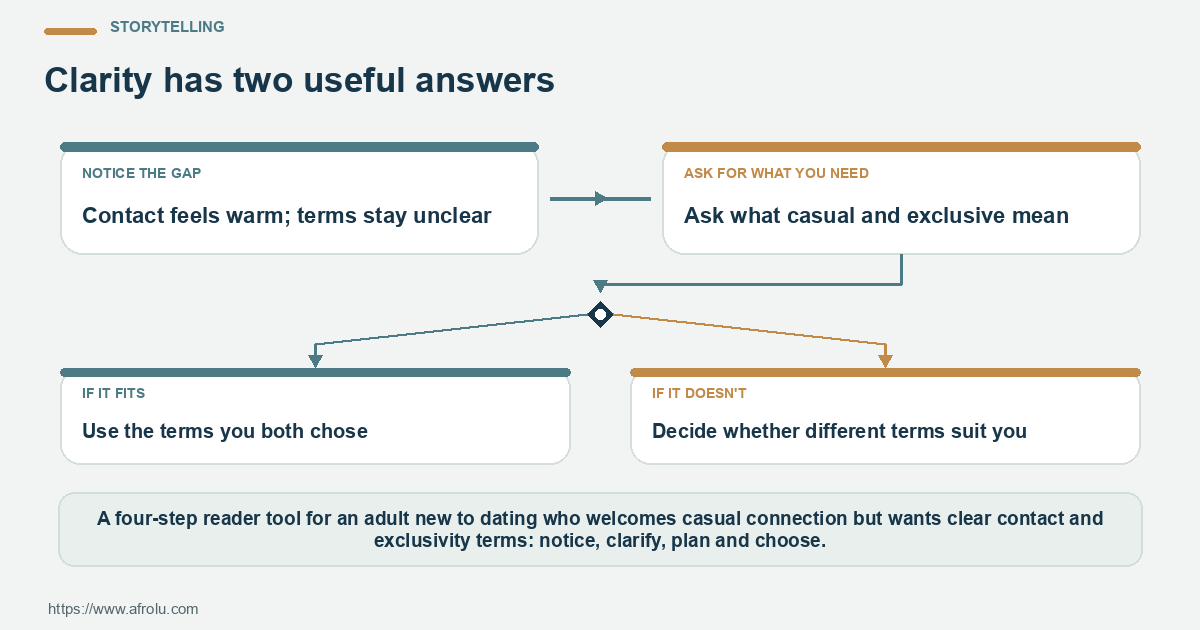
A person can enjoy messaging and still have limited interest or time for dates. You can notice that messages arrive reliably while plans remain vague without turning the gap into proof of a motive. The practical question is whether the level of contact and in-person time works for you, and whether you have discussed what each person expects.
The small research literature on breadcrumbing uses specific definitions and samples. It does not confirm that every intermittent message is manipulation, or that a person who does not want commitment is withholding something owed. Use 'benching' only as a shorthand for your experience, not as evidence about the other adult's character or mental health.
Compare words with the agreement: Have you talked about exclusivity? Do both people initiate plans? Does an occasional date feel enjoyable to you, or do you keep hoping it signals a different relationship? Your feelings are not a verdict on the other person. They are useful information about whether the arrangement you have is the one you want.
Ask what is true now
A direct question can be calm and answerable
You might say, 'I am enjoying seeing you casually. Are you dating other people, and would you like us to keep meeting?' The question covers two distinct choices. If you only need to know whether another date is likely, ask that smaller question first. You can raise future direction later if it becomes relevant to your decision.
Try to ask at a time when neither person is rushing into work or reacting to a conflict. Give the other adult space to answer without supplying the answer for them. A pause can mean they are thinking, not necessarily avoiding you; if the question stays unanswered, you can decide how long you are comfortable waiting.
An honest answer may be less convenient than a hopeful one. If they want occasional dates and you want the same, agree what that looks like. If they do not want to keep dating, you have useful information. If they answer vaguely, you can ask once for the detail that matters and decide whether continued uncertainty fits your preference.

A practical conversation card for an adult new to dating who welcomes casual connection but wants clear contact and exclusivity terms, with words the reader can adapt.
Make a small agreement
Discuss exclusivity and contact as separate questions
Some adults assume that frequent messages mean exclusivity; others consider themselves non-exclusive until they explicitly agree otherwise. Do not rely on the pattern alone. If sexual health decisions are involved, discuss what protection, testing and other partners mean for each of you, and consult a qualified health professional for medical advice that matches your circumstances.
You can make an agreement that is modest and easy to revisit: meet when both calendars allow, share if either person wants to date exclusively, and say when interest changes. The purpose is not to create rules for every moment. It is to avoid one person silently making a decision that the other believes is shared.
Ask whether the other adult can accept your version of casual dating. If they want more or less than you do, neither answer needs to be corrected. You can choose to keep dating with clear limits, change what you are looking for, or stop. Agreement means both adults can say yes or no without pressure.

Observable signals for an adult new to dating who welcomes casual connection but wants clear contact and exclusivity terms, with context kept separate from assumptions.
Keep plans relaxed and real
Low commitment does not have to mean indefinite maybes
A casual date might be a short meal, a walk or an event you already wanted to attend. Choose a day and time that fits, and let each person make a separate way home if that is your preference. You do not need to coordinate a whole weekend to show interest or to make an informal connection feel worthwhile.
If invitations are frequent but never confirmed, ask for the one missing detail and then continue with your day. Avoid using silence as a strategy or waiting by the phone to measure interest. A practical follow-through test is simply whether the other person helps make the plan happen after you ask for a concrete next step.
If your preference changes from occasional dates to more structure, say that plainly. You can ask whether the other adult wants the same shift, but you cannot make the old arrangement carry a new promise. Either person can decline. Your next decision can be based on the answer and the amount of time you want to invest.
Keep boundaries ordinary
Privacy and consent do not depend on relationship status
You may keep your address, work details, finances, family history and social accounts private while you are getting to know someone. Kenya's data-protection regulator explains rights concerning personal information, but those rights do not make every disclosure reversible. You can say 'I am not ready to share that' without turning the conversation into a test of trust.
Meeting for a date, being exclusive or having been intimate before does not create permission for a different activity later. Consent should be freely given and can change. RAINN's guidance is U.S.-focused and its local resources are not Kenya-specific, but its basic communication principles support asking, listening and accepting a changed answer.
If the other person responds to a limit with repeated pressure, ridicule or threats to withdraw basic kindness, you can pause or leave the interaction. That response does not let you diagnose their motives, but it tells you the conversation is not respecting the choice you made. Seek support in the way that feels safe and useful to you.
Choose what you want next
You do not need to prove a label before changing the arrangement
You can enjoy an occasional connection and still ask for more reliable planning. You can decide that casual dating suits you and decline exclusivity. You can also stop because the contact pattern takes more attention than you want to give. The reason does not have to be dramatic, and the other adult does not have to agree with your decision.
If you want to close the connection, a clear message can be brief: 'I have decided this arrangement is not for me, so I will not continue dating.' You may choose not to debate the term benching or provide a detailed account of every message. A short boundary is enough to communicate your choice.
If you want to continue, state what would make the next few weeks workable and set a time to revisit the agreement if needed. Avoid promising that one new plan resolves everything. Notice whether your needs remain compatible and make a new decision when the circumstances change. You are allowed to choose again.

A short action map for an adult new to dating who welcomes casual connection but wants clear contact and exclusivity terms, ending with a choice the reader controls.
Three ways this can show up
Casual means different things
One person assumes exclusivity and the other does not
Ask directly whether either adult is dating others.Warm messages, no date
Contact continues but no shared plan is confirmed
Ask if they want to meet and decide how long you will hold the question.Wanting more
A casual agreement no longer matches your preference
Name the change and ask whether the other person wants the same.Not seeking commitment
You enjoy occasional dates without a serious future plan
Say so clearly and respect the other adult's choice.Consent assumption
A label or prior date is treated as permission
State what you want now; consent remains specific and changeable.Personal detail request
Someone asks for your address or passwords to prove trust
Keep sensitive information private and use a public meeting point.Future promise
A vague future statement replaces the present arrangement
Ask what the person is choosing today.Plan not confirmed
A message says 'maybe later' without a time
Make your own plans unless both adults confirm a date.What to notice before you react
Casual means different things: One person assumes exclusivity and the other does not
Warm messages, no date: Contact continues but no shared plan is confirmed
Wanting more: A casual agreement no longer matches your preference
Not seeking commitment: You enjoy occasional dates without a serious future plan
Consent assumption: A label or prior date is treated as permission
Personal detail request: Someone asks for your address or passwords to prove trust
Future promise: A vague future statement replaces the present arrangement
Plan not confirmed: A message says 'maybe later' without a time
Both adults can describe the current agreement in similar terms.
A suggested date becomes a time and place before either person travels.
A schedule change receives an update and a possible alternative when available.
Each adult can keep family, work, money and account information private.
A boundary is heard without repeated pressure or punishment.
One person does not have to remain available while every detail is undecided.
Read the moment without overbuilding the story
| Situation | What it may mean | What to do next |
|---|---|---|
| Casual means different things | One person assumes exclusivity and the other does not | Ask directly whether either adult is dating others. |
| Warm messages, no date | Contact continues but no shared plan is confirmed | Ask if they want to meet and decide how long you will hold the question. |
| Wanting more | A casual agreement no longer matches your preference | Name the change and ask whether the other person wants the same. |
| Not seeking commitment | You enjoy occasional dates without a serious future plan | Say so clearly and respect the other adult's choice. |
| Consent assumption | A label or prior date is treated as permission | State what you want now; consent remains specific and changeable. |
| Personal detail request | Someone asks for your address or passwords to prove trust | Keep sensitive information private and use a public meeting point. |
| Future promise | A vague future statement replaces the present arrangement | Ask what the person is choosing today. |
| Plan not confirmed | A message says 'maybe later' without a time | Make your own plans unless both adults confirm a date. |
| One reply is delayed | A work or family need may affect timing | Use the communication window you discussed or ask once. |
| Your preference changes | The current arrangement no longer fits | Name the new need and decide from the answer. |
Three calm ways to start the conversation
“I am open to casual dating. What does casual mean to you in practice?”
“Are we both free to date other people, or are we choosing exclusivity?”
“Would you like to meet Thursday evening? If not, what day works for you?”
“I like our conversations. Can we choose a time rather than keep saying maybe?”
“My preference has changed and I would like more structure. Is that something you want?”
“This arrangement no longer suits me, so I will not continue dating.”
“What would you like us to choose about this connection now?”
“If you want something different, please tell me directly; I will decide what works for me.”
“That time no longer works for me. Could we choose another day, or leave it here?”
“I am not ready to share that detail, but I can suggest a public meeting point.”
“I can hold this time until tomorrow evening; after that I will make other plans.”
“I want to make sure we understand exclusivity and contact the same way.”
Know the difference
Clear casual dating versus Unspoken assumptions
Adults discuss contact, exclusivity and what they want now.
Each person behaves as if a different agreement already exists.
Casual can be mutual and clear without promising commitment.

A comparison of Clear casual dating and Unspoken assumptions for an adult new to dating who welcomes casual connection but wants clear contact and exclusivity terms.
Compare the closest dating types before choosing a label
| Type or dimension | What it describes | Best next question |
|---|---|---|
| Clear casual dating | Adults discuss contact, exclusivity and what they want now. | Ask what both adults have chosen now. |
| Unspoken assumptions | Each person behaves as if a different agreement already exists. | Decide whether the practical arrangement suits you. |
| One delayed reply | A single gap can have many explanations. | Use the agreed contact window or ask once. |
| Repeated unconfirmed plans | Invitations recur without a shared time or place. | Name the pattern and set a confirmation point. |
| A stated constraint | A person explains a limit that affects availability. | Ask what next step, if any, is possible. |
| A future hope | A possibility is described without a present agreement. | Do not treat it as a commitment already made. |
| A changed preference | An adult wants different terms than before. | Revisit the agreement and hear the answer. |
| A respectful no | Someone declines a date, boundary or relationship term. | Accept their choice and make your own. |
| A practical mismatch | Time, location, family or cost prevents the plan you want. | Try a mutual option or decide it does not fit. |
A simple plan you can use today
PubMed Central: Psychological Correlates of Ghosting and Breadcrumbing Experiences: A Preliminary Study among Adults
An exploratory online survey of 626 adults aged 18–40 studied self-reported breadcrumbing and ghosting experiences. Its associations are not causal, not about every dating context and not a test for an individual's motives.
PubMed Central: Development and Validation of the BREAD-ASR Questionnaire
This paper develops a measure for a specific research construct and sample. It does not validate every social-media use of benching or diagnose a person from messages.
PubMed: Evaluations and future plans after casual sexual experiences: Differences across partner type
Event-based reports from 192 emerging adults compare experiences by partner category. The sample does not define casual dating for every adult or require any particular relationship choice.
Personal Relationships: The relationship talk: Understanding the transition from casual to committed romantic relationships
The study examines relationship conversations and uncertainty in a defined sample. It does not set a universal timeline for commitment or tell an individual what to choose.
RAINN: Consent 101: Respect, Boundaries, and Building Trust
RAINN is a U.S. organization; its service contacts and local assumptions are not Kenya-specific. The educational page supports ongoing, freely chosen communication and does not replace local support.
Office of the Data Protection Commissioner of Kenya: Rights of a Data Subject
Kenya's regulator explains data-subject rights and personal-data principles. Legal protections do not verify a profile or erase every risk after information is shared.
Questions organised by purpose and depth
Choose a few prompts that fit the moment. This is a reference library, not a list to complete.
My version of casual
Name the terms that matter to your decisions.
- Do I want exclusivity?
- How often do I want to meet?
- What changes if my preference changes?
A clear question
Ask about one current agreement.
- What do I need to know now?
- How can I ask calmly?
- Can I hear a no?
The next date
Keep a relaxed plan concrete.
- Which day works?
- Where is reachable?
- How long do I want to meet?
A boundary
Choose what information and activities stay your choice.
- What is private?
- What do I freely want?
- What response would feel respectful?
What deserves a closer look
Psychological Correlates of Ghosting and Breadcrumbing Experiences: A Preliminary Study among Adults
An exploratory online survey of 626 adults aged 18–40 studied self-reported breadcrumbing and ghosting experiences. Its associations are not causal, not about every dating context and not a test for an individual's motives.
Evidence limit: Read this source within its sample, setting and method; it cannot predict an individual relationship.
Development and Validation of the BREAD-ASR Questionnaire
This paper develops a measure for a specific research construct and sample. It does not validate every social-media use of benching or diagnose a person from messages.
Evidence limit: Read this source within its sample, setting and method; it cannot predict an individual relationship.
Evaluations and future plans after casual sexual experiences: Differences across partner type
Event-based reports from 192 emerging adults compare experiences by partner category. The sample does not define casual dating for every adult or require any particular relationship choice.
Evidence limit: Read this source within its sample, setting and method; it cannot predict an individual relationship.
The relationship talk: Understanding the transition from casual to committed romantic relationships
The study examines relationship conversations and uncertainty in a defined sample. It does not set a universal timeline for commitment or tell an individual what to choose.
Evidence limit: Read this source within its sample, setting and method; it cannot predict an individual relationship.
Consent 101: Respect, Boundaries, and Building Trust
RAINN is a U.S. organization; its service contacts and local assumptions are not Kenya-specific. The educational page supports ongoing, freely chosen communication and does not replace local support.
Evidence limit: Read this source within its sample, setting and method; it cannot predict an individual relationship.
Rights of a Data Subject
Kenya's regulator explains data-subject rights and personal-data principles. Legal protections do not verify a profile or erase every risk after information is shared.
Evidence limit: Read this source within its sample, setting and method; it cannot predict an individual relationship.
Four mistakes that make this harder
Treating a label as proof
Popular terms describe experiences; they do not confirm another adult's motive.
Counting every message
Contact volume does not establish exclusivity, commitment or follow-through.
Holding every weekend open
An unconfirmed invitation has not become a plan you must reserve time for.
Oversharing to prove trust
Home, child, work and account details can remain private while you date.
Explaining away your own needs
A real constraint may still make the available arrangement a poor fit for you.
Demanding a future guarantee
A present answer and practical next step are more useful than a promise no one can verify.
Choose the casual terms that suit you now
These information links are clearly labelled, non-commercial and do not promise a match or relationship outcome.
Explore the guide library
Show more related guides
Continue with Afrolu
Show more Afrolu guides
Sources used for this guide
Afrolu reviewed these health, research, safety, or public guidance resources while editing this page. They support the behaviour and safety guidance; they do not diagnose any individual described by a reader.
Clear terms for casual dating when contact keeps you guessing Questions
Can casual dating have clear boundaries?
Yes. Adults can discuss contact, exclusivity, dates and what to do if either person wants to stop.
Does casual mean non-exclusive?
Not automatically. Ask whether you have both chosen exclusivity.
Does regular texting mean commitment?
No. Messages do not establish a relationship agreement unless both adults discuss and choose one.
What if I want more later?
Say that your preference changed and ask whether the other person wants the same. Both people may choose differently.
Do I owe intimacy after a date?
No. Consent is specific, freely chosen and can change, whatever the relationship label or past plans.
Can I end it without proof of benching?
Yes. A mismatch or lack of interest is enough reason to stop dating.
Can research reveal what the other person intends?
No. Studies describe defined samples; ask the person and decide from the agreement you actually have.
Can I end the connection without proving harm?
Yes. A mismatch in availability, expectations or interest is enough reason to stop dating.
Can our agreement change?
Yes. Either adult can raise a changed need, and both can choose whether the new terms work.
Do I owe a detailed explanation for a boundary?
No. You can state what you will do without disclosing private history or persuading the other person.
One thing to do now
Turn the lesson into a better match pool
Define the parts of casual dating that affect you, then decide whether the other adult’s present answer matches your preference.