Benching in dating · weekend plans · safety
A safer weekend plan when dating feels one-sided
Getting weekend messages but few firm plans? Set a clear public meeting, keep your own way home and decide how long you will hold the time before you travel.

A woman decides what details she needs before making room for a weekend date.
Written and edited by Adwoa Boateng · Dating Safety Editor
Treat each invitation as unconfirmed until the time, public place and basic details work for you. Ask once for what is missing, keep independent transport and decide how long you will wait for confirmation. A repeated pattern can inform your choice, but a label cannot tell you another person’s motive.
Modern dating terms · Late Entrants
How can I respond to last-minute weekend contact without assuming the worst or setting my whole weekend aside?
Benching is a popular dating term for intermittent attention that appears to keep a person available while a connection makes little shared progress. It is not a clinical diagnosis or a verified account of someone’s intentions. Describe what happens, ask what the other adult wants, and decide whether the arrangement suits you.
After returning to dating, 46-year-old Wanjiku receives friendly Friday messages from someone who often suggests meeting but does not settle a time. She likes the conversation and still wants her Saturday plans. She asks for a public venue and confirmation by lunchtime, then makes other plans when no answer arrives.
Name what repeats
A dating term cannot tell you what another person intends
People use benching to describe different experiences. You might notice warm messages followed by long gaps, invitations that never become plans, or contact that returns whenever you stop reaching out. The pattern matters because it affects your time and expectations; it does not establish why the other adult behaves that way or whether they intend to mislead you.
Research has studied related terms such as breadcrumbing, but the evidence is still narrow and does not validate every popular dating label. One preliminary adult survey found associations between reported breadcrumbing and several wellbeing measures; its sample and design cannot explain your experience or predict a particular person's conduct. Treat it as context, not a test.
For one or two weeks, note only what you can verify: who proposed a date, whether a place and time were agreed, whether either person updated a change, and how you felt about the result. Leave guesses such as 'they are keeping me as a backup' out of the record. You can make a decision from the practical effect without proving a motive.
Confirm the invitation
A weekend suggestion needs details before you travel
A message such as 'we should do something this weekend' may be sincere but is not yet a booking in your calendar. Reply with a day and a public area you can reach. If the first suggestion does not work, offer one alternative. A plan becomes usable when both adults know where and when they are meeting and can say yes freely.
If you need to arrange transport, childcare, work cover or a longer journey, choose a confirmation deadline that gives you enough time. You are allowed to make other plans once that point passes. This is a boundary around your schedule, not a punishment or a hidden test designed to measure someone's affection.
Keep the first meeting as short or open-ended as you prefer, and tell the other person what you have chosen. You might say that you can meet for an hour at a busy public place and then need to leave. If a confirmed detail changes, pause and decide again rather than travelling because you already agreed.
Keep options independent
Choose practical precautions because they help you feel in control
You can choose a public location, tell a trusted person the broad plan or arrange your own way home without accusing your date of anything. RAINN's online and in-person dating suggestions are written for a U.S. audience, so its emergency contacts and local assumptions do not transfer to Kenya. Its emphasis on options can still help you decide what would make a meeting workable for you.
Do not share a home address, routine, financial details or a one-time security code just because you have been messaging for a while. Kenya's data-protection regulator describes rights over personal information, but a legal right cannot retrieve every detail after you choose to share it. You can move a conversation to another channel when you feel ready, or keep it where it is.
A preference for a public place is enough reason to keep the plan public. If the other adult repeatedly changes it to somewhere private, pressures you for a ride or becomes angry when you keep your own transport, you may cancel. You do not need to determine whether the person is unsafe before deciding that the revised arrangement no longer works for you.

A practical conversation card for an adult returning to dating who wants confirmed public weekend plans without holding a whole day for intermittent invitations, with words the reader can adapt.
Ask a present-tense question
You can want clarity without asking for a promise
The conversation can be small and specific: 'Are you interested in making regular plans, or would you prefer something occasional?' That question is easier to answer than 'Where is this going?' You are not demanding exclusivity by asking. You are checking whether the current form of dating matches what you want to spend time on.
If you are open to casual dating, say what casual means for you. It may involve seeing each other occasionally, dating other people, or keeping expectations limited; another adult may define it differently. Discuss exclusivity, contact and time together as separate choices rather than treating one label as a complete agreement.
Give the other person space to answer honestly, including 'I do not know' or 'I want something different.' Then decide what you want to do with that answer. You can enjoy a connection and still step back because the timing or structure does not fit. You do not have to convince someone into the kind of relationship you prefer.

Observable signals for an adult returning to dating who wants confirmed public weekend plans without holding a whole day for intermittent invitations, with context kept separate from assumptions.
Protect the time you reserve
Do not keep every Saturday open for an uncertain invitation
When contact arrives late, ask whether the proposed plan fits the day you actually have. If you have errands, friends, rest or family plans, keep them unless you decide to change them. A last-minute invitation can be a genuine attempt to connect, but it still arrives at a time when you get to choose whether it works.
Returning to dating later in life does not mean you need to accept less clarity to prove that you are flexible. Adults have different schedules and histories. Share only the context you want to share, and set limits around how much notice you need. Someone can decline that preference; you can also decide that the difference is not a fit.
Choose a simple cutoff before the next invitation arrives: perhaps you will hold an evening only after details are confirmed by a time that leaves you room to plan. The exact hour is yours. If no plan appears, send a brief close such as 'I have filled my Saturday; let us try again when we can choose a time together.'
Read the response
One missed reply is different from a recurring lack of follow-through
A person may be delayed by work, family, health or an unexpected event. A single unanswered message cannot establish low interest. Over time, however, you can notice whether the person returns with an update, offers another date and helps make the next plan concrete, or whether you repeatedly carry the coordination while nothing changes.
Use observable descriptions: 'We have talked about meeting three times, but we have not chosen a day' is more useful than 'You are a benching person.' The first invites a response and keeps your account accurate. The second assigns a motive and can turn a solvable mismatch into an argument over a label.
Notice your own experience too. Do you feel free to make plans, or do you keep checking your phone and postponing your weekend? Your answer does not prove the other person intended that effect, but it matters when you decide whether to continue. You can ask for a change once and then choose based on what happens.
Choose your next step
You can continue, pause or leave without proving wrongdoing
If the conversation becomes clearer and the invitations start to fit both schedules, you may choose another date. If you would still enjoy occasional contact, name that limit and do not assume it will become more. If the answer leaves you waiting for a kind of connection the other adult does not want, you can step away without making either person a villain.
A short message is enough: 'I have enjoyed talking, but this pattern does not suit how I want to date, so I am going to leave it here.' You do not owe a long explanation, another meeting or access to your weekend. If you want support after a difficult exchange, contact a person you trust or a qualified professional of your choice.
If a meeting ever feels unsafe, move toward a place and people you trust and contact local emergency or support services as appropriate. Practical dating advice cannot make another person responsible for your safety decisions; responsibility for harmful behavior belongs to the person who causes it. Keep the options that help you feel able to choose.

A short action map for an adult returning to dating who wants confirmed public weekend plans without holding a whole day for intermittent invitations, ending with a choice the reader controls.
Three ways this can show up
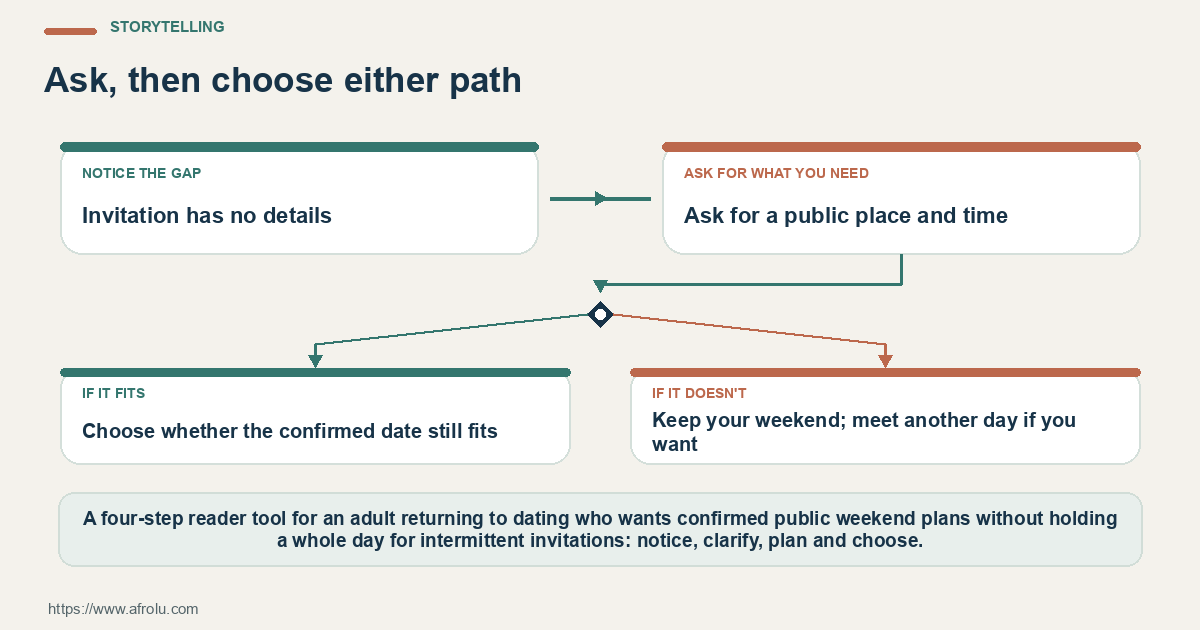
Friday invitation
A weekend message has no place or meeting time
Ask for details and choose a confirmation deadline before you reserve time.Venue changes
A public meeting is moved to a private address
Keep the public plan or cancel if the change no longer suits you.Late confirmation
A date is confirmed after you have made other plans
Keep the plans you already chose; offer another day only if you want.Independent transport
Someone expects to control your ride there and home
Arrange your own route or choose a different meeting plan.Repeated maybe
Several invitations have not become confirmed dates
Describe the pattern and ask whether the person wants to make a concrete plan.Money request
A new date asks for urgent travel funds or a code
Pause and verify independently; do not send money or access codes under pressure.Personal history
A date presses for details about a previous relationship
Share only what you choose; your history is not the price of a meeting.Changed comfort
The plan no longer feels right to you
Change or cancel; you do not need to prove a safety concern.What to notice before you react
Friday invitation: A weekend message has no place or meeting time
Venue changes: A public meeting is moved to a private address
Late confirmation: A date is confirmed after you have made other plans
Independent transport: Someone expects to control your ride there and home
Repeated maybe: Several invitations have not become confirmed dates
Money request: A new date asks for urgent travel funds or a code
Personal history: A date presses for details about a previous relationship
Changed comfort: The plan no longer feels right to you
Both adults can describe the current agreement in similar terms.
A suggested date becomes a time and place before either person travels.
A schedule change receives an update and a possible alternative when available.
Each adult can keep family, work, money and account information private.
A boundary is heard without repeated pressure or punishment.
One person does not have to remain available while every detail is undecided.
Read the moment without overbuilding the story
| Situation | What it may mean | What to do next |
|---|---|---|
| Friday invitation | A weekend message has no place or meeting time | Ask for details and choose a confirmation deadline before you reserve time. |
| Venue changes | A public meeting is moved to a private address | Keep the public plan or cancel if the change no longer suits you. |
| Late confirmation | A date is confirmed after you have made other plans | Keep the plans you already chose; offer another day only if you want. |
| Independent transport | Someone expects to control your ride there and home | Arrange your own route or choose a different meeting plan. |
| Repeated maybe | Several invitations have not become confirmed dates | Describe the pattern and ask whether the person wants to make a concrete plan. |
| Money request | A new date asks for urgent travel funds or a code | Pause and verify independently; do not send money or access codes under pressure. |
| Personal history | A date presses for details about a previous relationship | Share only what you choose; your history is not the price of a meeting. |
| Changed comfort | The plan no longer feels right to you | Change or cancel; you do not need to prove a safety concern. |
| One reply is delayed | A work or family need may affect timing | Use the communication window you discussed or ask once. |
| Your preference changes | The current arrangement no longer fits | Name the new need and decide from the answer. |
Three calm ways to start the conversation
“I can meet Saturday afternoon. Which public place and time work for you?”
“If we have not confirmed by noon, I will make other plans and we can try another day.”
“I will make my own way there and home; let us meet at the entrance.”
“Do you want to keep dating, and what kind of connection are you looking for now?”
“I enjoy talking, but repeated unconfirmed plans do not work for me.”
“I have decided this arrangement is not right for me, so I am going to leave it here.”
“What would you like us to choose about this connection now?”
“If you want something different, please tell me directly; I will decide what works for me.”
“That time no longer works for me. Could we choose another day, or leave it here?”
“I am not ready to share that detail, but I can suggest a public meeting point.”
“I can hold this time until tomorrow evening; after that I will make other plans.”
“I want to make sure we understand exclusivity and contact the same way.”
Know the difference
A tentative invitation versus A usable plan
A friendly suggestion without a confirmed time or place.
Both adults confirm practical details, and either can still change their mind.
You can keep the weekend yours until you choose to confirm a plan.

A comparison of A tentative invitation and A usable plan for an adult returning to dating who wants confirmed public weekend plans without holding a whole day for intermittent invitations.
Compare the closest dating types before choosing a label
| Type or dimension | What it describes | Best next question |
|---|---|---|
| A tentative invitation | A friendly suggestion without a confirmed time or place. | Ask what both adults have chosen now. |
| A usable plan | Both adults confirm practical details, and either can still change their mind. | Decide whether the practical arrangement suits you. |
| One delayed reply | A single gap can have many explanations. | Use the agreed contact window or ask once. |
| Repeated unconfirmed plans | Invitations recur without a shared time or place. | Name the pattern and set a confirmation point. |
| A stated constraint | A person explains a limit that affects availability. | Ask what next step, if any, is possible. |
| A future hope | A possibility is described without a present agreement. | Do not treat it as a commitment already made. |
| A changed preference | An adult wants different terms than before. | Revisit the agreement and hear the answer. |
| A respectful no | Someone declines a date, boundary or relationship term. | Accept their choice and make your own. |
| A practical mismatch | Time, location, family or cost prevents the plan you want. | Try a mutual option or decide it does not fit. |
A simple plan you can use today
PubMed Central: Psychological Correlates of Ghosting and Breadcrumbing Experiences: A Preliminary Study among Adults
An exploratory online survey of 626 adults aged 18–40 studied self-reported breadcrumbing and ghosting experiences. Its associations are not causal, not about every dating context and not a test for an individual's motives.
PubMed Central: Development and Validation of the BREAD-ASR Questionnaire
This paper develops a measure for a specific research construct and sample. It does not validate every social-media use of benching or diagnose a person from messages.
Personal Relationships: The relationship talk: Understanding the transition from casual to committed romantic relationships
The study examines relationship conversations and uncertainty in a defined sample. It does not set a universal timeline for commitment or tell an individual what to choose.
RAINN: Tips for Safer Dating: Online and In-Person
RAINN's practical advice is U.S.-focused. Options such as choosing a public place can support autonomy but cannot guarantee another person's behavior; use local resources in Kenya.
Office of the Data Protection Commissioner of Kenya: Rights of a Data Subject
Kenya's regulator explains data-subject rights and personal-data principles. Legal protections do not verify a profile or erase every risk after information is shared.
U.S. Federal Trade Commission: Romance Scams
The FTC explains U.S. consumer guidance, not prevalence in Kenya or diaspora communities. Pause and verify independently before sending money or account information.
Questions organised by purpose and depth
Choose a few prompts that fit the moment. This is a reference library, not a list to complete.
Before the weekend
Keep the date and your own time separate.
- What details do I need?
- When will I stop holding time?
- What transport do I prefer?
A direct question
Ask what the other adult wants today.
- What kind of dating do I want?
- What answer would help?
- Can I accept a different answer?
My privacy
Choose what stays personal while you get to know someone.
- What can remain private?
- What broad detail helps plan?
- What request feels premature?
After the exchange
Notice the practical effect without guessing intent.
- Was the plan confirmed?
- Did both adults contribute?
- What do I want next?
What deserves a closer look
Psychological Correlates of Ghosting and Breadcrumbing Experiences: A Preliminary Study among Adults
An exploratory online survey of 626 adults aged 18–40 studied self-reported breadcrumbing and ghosting experiences. Its associations are not causal, not about every dating context and not a test for an individual's motives.
Evidence limit: Read this source within its sample, setting and method; it cannot predict an individual relationship.
Development and Validation of the BREAD-ASR Questionnaire
This paper develops a measure for a specific research construct and sample. It does not validate every social-media use of benching or diagnose a person from messages.
Evidence limit: Read this source within its sample, setting and method; it cannot predict an individual relationship.
The relationship talk: Understanding the transition from casual to committed romantic relationships
The study examines relationship conversations and uncertainty in a defined sample. It does not set a universal timeline for commitment or tell an individual what to choose.
Evidence limit: Read this source within its sample, setting and method; it cannot predict an individual relationship.
Tips for Safer Dating: Online and In-Person
RAINN's practical advice is U.S.-focused. Options such as choosing a public place can support autonomy but cannot guarantee another person's behavior; use local resources in Kenya.
Evidence limit: Read this source within its sample, setting and method; it cannot predict an individual relationship.
Rights of a Data Subject
Kenya's regulator explains data-subject rights and personal-data principles. Legal protections do not verify a profile or erase every risk after information is shared.
Evidence limit: Read this source within its sample, setting and method; it cannot predict an individual relationship.
Romance Scams
The FTC explains U.S. consumer guidance, not prevalence in Kenya or diaspora communities. Pause and verify independently before sending money or account information.
Evidence limit: Read this source within its sample, setting and method; it cannot predict an individual relationship.
Four mistakes that make this harder
Treating a label as proof
Popular terms describe experiences; they do not confirm another adult's motive.
Counting every message
Contact volume does not establish exclusivity, commitment or follow-through.
Holding every weekend open
An unconfirmed invitation has not become a plan you must reserve time for.
Oversharing to prove trust
Home, child, work and account details can remain private while you date.
Explaining away your own needs
A real constraint may still make the available arrangement a poor fit for you.
Demanding a future guarantee
A present answer and practical next step are more useful than a promise no one can verify.
Keep your time and meeting choices in your hands
These information links are clearly labelled, non-commercial and do not promise a match or relationship outcome.
Explore the guide library
Show more related guides
Continue with Afrolu
Show more Afrolu guides
Sources used for this guide
Afrolu reviewed these health, research, safety, or public guidance resources while editing this page. They support the behaviour and safety guidance; they do not diagnose any individual described by a reader.
A safer weekend plan when dating feels one-sided Questions
Does benching prove someone is keeping me as a backup?
No. It is a colloquial label, not proof of motive. Describe what repeats and decide whether the effect works for you.
Should I meet if the place is not confirmed?
You can wait for the details you need or choose not to meet. You are not required to travel on a vague invitation.
Is a public date guaranteed to be safe?
No. A public place and independent transport are options that may help you feel more in control, but no checklist guarantees another person's behavior.
Do I need to explain why I want notice?
No. You may state the amount of notice you need without sharing your entire history or schedule.
Does a missed reply mean disinterest?
Not by itself. Consider whether the person follows up and whether the broader pattern suits you.
Can I cancel after agreeing?
Yes. You may change your mind about the date or any activity.
Can research reveal what the other person intends?
No. Studies describe defined samples; ask the person and decide from the agreement you actually have.
Can I end the connection without proving harm?
Yes. A mismatch in availability, expectations or interest is enough reason to stop dating.
Can our agreement change?
Yes. Either adult can raise a changed need, and both can choose whether the new terms work.
Do I owe a detailed explanation for a boundary?
No. You can state what you will do without disclosing private history or persuading the other person.
One thing to do now
Turn the lesson into a better match pool
Keep a weekend slot open only after a plan is confirmed at a time that works for you; then decide about the relationship separately.