Dating later in life · casual dating · honest terms
Dating later in life: keep casual dating clear and kind
Starting to date later? Keep casual dating clear. Ask what each person wants, set boundaries around time and intimacy, then revisit terms as feelings change.
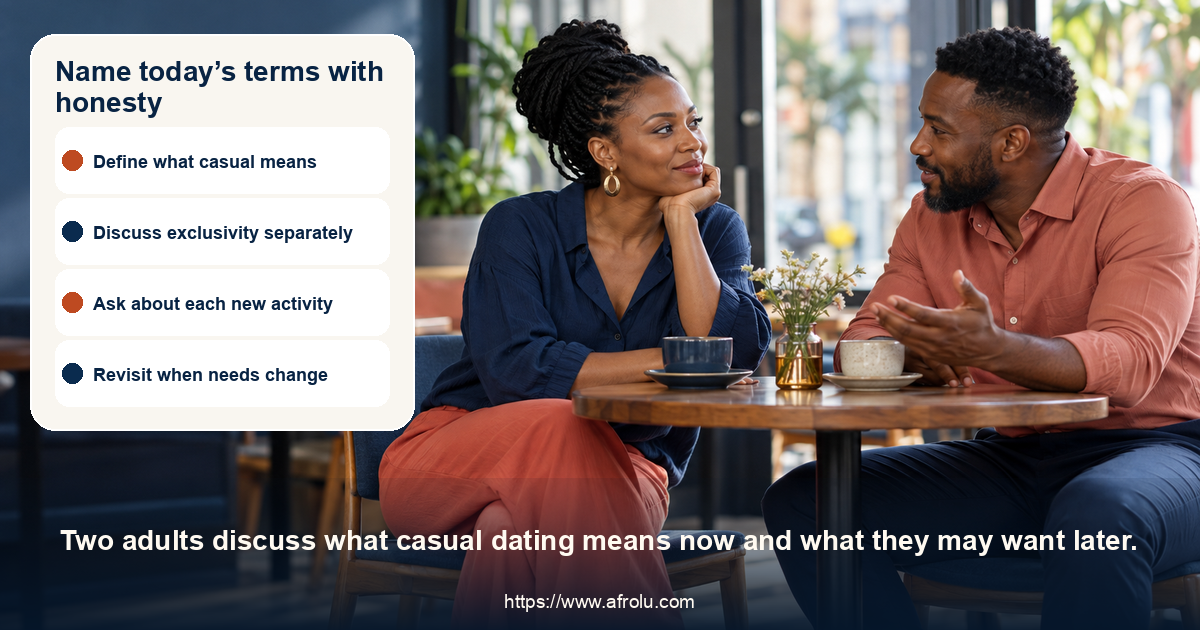
Two adults discuss what casual dating means now and what they may want later.
Written and edited by Nadine El-Sayed · Verification Editor
Ask what casual means in present-day behavior: exclusivity, plans, communication and boundaries are separate questions. Share your own terms, make only agreements you want, and revisit them if your feelings change. A later start does not require a quick relationship label, and a casual agreement never replaces consent.
Modern dating terms · Late Entrants
How can I date casually at my own pace without letting a vague label make decisions for me?
Casual dating describes an arrangement only when the adults involved explain and agree to what it means for them. It does not automatically mean non-exclusive, emotion-free, unsafe or temporary. Benching is an informal label for uncertain attention and cannot prove whether a person wants casual dating or something else.
At 35, Dela begins dating after moving for work and prefers to keep early connections light. A match uses the word casual but messages every day, cancels plans and assumes they are exclusive. Dela realizes the label has been doing too much work. She asks what each of them wants now and names the boundaries she needs.
Translate the label
Casual has no universal rulebook
One person may use casual to mean dating more than one person; another may mean taking time before a label while still meeting regularly. Someone else may want occasional dates without a future plan. None of those definitions is built into the word, so ask before you arrange your life around it.
Start with the decisions that affect you this week: whether either person expects exclusivity, how you will make plans, what communication feels manageable and which boundaries matter. You do not need to settle every possible future question at once. A small, clear agreement is more useful than vague reassurance.
If your date says 'let's see where it goes', ask what they are choosing right now. They may be open to exploring, uncertain about the future or looking for a casual arrangement. You can listen without treating the phrase as a promise that your preferred outcome will eventually happen.
Research about casual sexual experiences uses study-specific categories and participant samples. It cannot define every adult's casual dating life, and it cannot tell you what a particular match wants. Use a source to learn where its evidence applies, then let the people in this connection state their own terms.
Separate messages from agreements
Frequent attention does not settle the terms
A person can send a good-morning text and still not have agreed to a relationship. Another may prefer less messaging while being clear and considerate when you meet. Reply frequency, affectionate names and social media reactions do not make an agreement unless both adults say what they are choosing.
If contact feels like a series of openings with no follow-through, describe the events you can verify. You might mention that you have exchanged messages for weeks but have not chosen a date. Avoid arguing over the word benching; focus on whether a casual arrangement with little planning is one you want.
Try asking, 'Are you hoping to keep this occasional, or would you like to plan dates more regularly?' The answer may be direct, uncertain or different from yours. You can thank the person for saying so and choose whether their current preference works for your own time and emotional energy.
No agreement requires you to continue. If the other adult prefers an undefined connection and you want steady dates, that mismatch can be enough information. Neither person needs to be the villain, and you do not have to wait for a hidden reason before deciding that the arrangement is not right for you.
Keep consent specific
Casual never means automatic access
Agreeing to casual dating is not consent to sex, touch, photos, a private visit or any other activity. Ask and listen in the moment. Each adult can pause, change a mind or leave without having to justify the choice by citing a relationship status or prior conversation.
If a boundary matters to you, state it before the situation becomes difficult. You can say that you prefer public dates, do not share intimate images or want to decide about physical affection as it happens. These are decisions about your own participation, not tests that the other person must pass to prove affection.
A respectful response leaves you room to choose without pressure, bargaining or threats. If someone says that casual dating means you owe them a particular activity, that is their claim, not an agreement you have to accept. You can restate the limit, end the date or leave the conversation.
RAINN's safer-dating guidance says no checklist can guarantee another person's behavior. Its U.S. support channels are not local Kenyan services, but the basic point matters: precautions can support your options and boundaries; they cannot transfer responsibility for someone else's harmful choice onto you. Your boundaries remain yours throughout the interaction.

Ask clearly about current terms and speak up when your needs shift.
Make the pace sustainable
Low pressure still needs practical limits
A later start to dating can bring excitement, but you do not need to turn every match into a full weekend. A short coffee, one planned call or a walk may be enough to learn whether you want another date. Choose a level of time and spending that feels comfortable even if the connection ends.
If the other person proposes only late-night or last-minute meetings, ask whether that is the pattern they intend. You may prefer daytime plans, more notice or a different balance between messages and in-person time. Their preference can be valid while still not matching what you want.
Be clear about cost before agreeing to an activity that stretches your budget. Suggest something simpler rather than paying to appear easygoing. Dating does not require a particular restaurant, gift or trip, and generosity should not be confused with proof that you are serious. A simple plan can still show genuine attention.
Work, care responsibilities and changing energy can affect availability. Share the window you can genuinely offer and avoid promising more frequent contact than you can sustain. A calm pace is built from realistic choices, not from suppressing your needs so that nobody calls the arrangement demanding.

Consent, exclusivity and boundaries are separate conversations.
Leave room to learn
You can be new to dating and clear about values
You may not know every dating-app convention, and that is fine. You can ask how a person understands casual dating, whether they are meeting others and what they hope to do on a first date. Direct questions help you learn the current arrangement without pretending you already know the other adult's rules.
If you have returned to dating after a marriage, caregiving period or long pause, notice which parts feel new. Choose one skill to practise at a time, such as declining an invitation, asking for confirmation or setting a communication boundary. Confidence can grow through repeated decisions that remain yours.
A match who treats your inexperience as permission to set all the terms is not teaching you a universal rule. You can ask for more information, seek a perspective from someone you trust or leave the conversation. Dating experience varies, and nobody has authority to define what you must accept.
Do not rush into exclusivity or intimacy because you worry that a later start has left you behind. You may decide that a casual arrangement suits you for a while, or you may decide it does not. Either answer is valid when it reflects your actual preference rather than fear of missing a deadline.
Protect privacy and money
Trust develops through choices over time
Stay on a dating platform until you choose to move elsewhere, and use its reporting tools if a message becomes coercive or suspicious. Keep identity documents, one-time codes, bank details and private images to yourself. A new match does not need those items to arrange a public date.
The U.S. Federal Trade Commission advises consumers not to send money to an online love interest, including for travel or emergencies. That is U.S. consumer guidance rather than a Kenya-specific prevalence figure, but the practical boundary is simple: pause before transferring money and verify any financial claim independently.
For a first meeting, choose a public place, tell a trusted person your plan and retain independent transport. You can change the venue or cancel if details shift in a way that feels wrong. These choices can help you keep options; they do not guarantee that another person will act safely.
If someone asks you to prove affection through cash, investments, an account login or a private image, do not let the label casual or serious decide for you. You can say no and stop responding. A caring connection does not require financial access, and pressure is reason enough to step back.
Revisit the agreement
Your feelings can change without changing the past
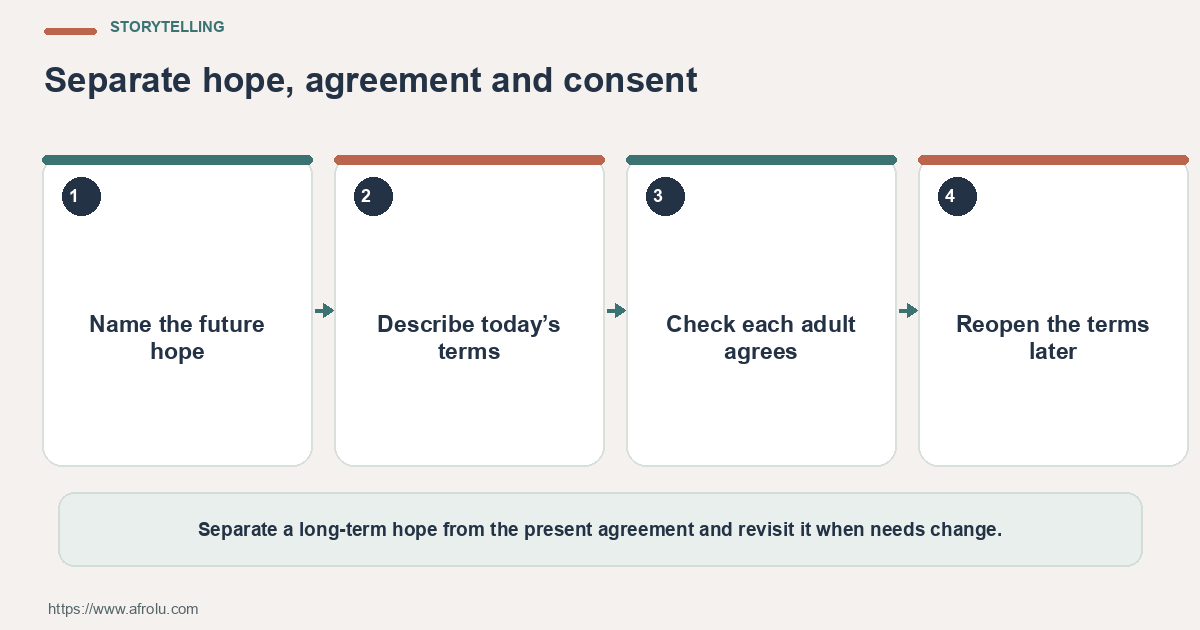
You may start casually and later want more structure, or you may discover that occasional dates feel better than a committed direction. Say what has changed and ask whether the other adult wants the same thing. A previous agreement described an earlier choice; it cannot settle a new question by itself.
If the answer is no, decide whether you can continue with the arrangement as it stands. You may prefer to stop dating rather than hope the other person changes. It is possible to care about someone and still recognize that your current goals have moved apart.
A conversation about change can stay concrete: 'I have realized I want to date exclusively. Is that something you are choosing too?' This gives the other person room to answer freely. If they need time, agree on when you will revisit and decide what you want to do in the meantime.
You are not responsible for making casual dating painless for everyone. You are responsible for communicating honestly and respecting another adult's no, just as they should respect yours. Clear terms do not eliminate disappointment, but they reduce the need to build decisions on guesses. Both people can respond honestly and make a new choice.

Choose from the arrangement both adults understand today.
Eight moments when a casual label leaves terms unclear
‘Casual’ means two things
One person expects exclusivity and the other assumes they are both seeing people
Ask what each person is choosing about exclusivity before relying on the label.A new activity is assumed
A casual arrangement is treated as consent to intimacy
Pause and decide about that specific activity; consent can change.Time is one-sided
You make every plan while the other person remains noncommittal
Ask for shared planning or decide whether the current pattern suits you.Costs feel uncomfortable
A date suggestion is beyond the budget you want to spend
Suggest a lower-cost plan before agreeing; a price is not a measure of care.Feelings change
You begin wanting more commitment than the original arrangement offered
Tell the other adult before treating old terms as current.A boundary is challenged
A match says a limit is incompatible with casual dating
Restate the boundary and choose whether to continue based on the response.A money request arrives
An online match asks for cash to solve an emergency
Do not send money; verify any concern independently and use platform reporting if needed.Private details are requested
You are asked for intimate images or account codes to prove interest
Decline and keep passwords, codes and private material under your control.Check how the agreement handles time, consent and change
‘Casual’ means two things: One person expects exclusivity and the other assumes they are both seeing people
A new activity is assumed: A casual arrangement is treated as consent to intimacy
Time is one-sided: You make every plan while the other person remains noncommittal
Costs feel uncomfortable: A date suggestion is beyond the budget you want to spend
Feelings change: You begin wanting more commitment than the original arrangement offered
A boundary is challenged: A match says a limit is incompatible with casual dating
A money request arrives: An online match asks for cash to solve an emergency
Private details are requested: You are asked for intimate images or account codes to prove interest
Both adults treat a date as confirmed only after agreeing on its details.
A change is communicated as soon as reasonably practical.
Each person can decline without insults, threats or punishment.
Time, money, travel and privacy are discussed before they become pressure.
Planning effort can be shared and adjusted when circumstances change.
Either adult may revisit an arrangement and explain what they want now.
Separate today’s agreement from a future hope
| Situation | What it may mean | What to do next |
|---|---|---|
| ‘Casual’ means two things | One person expects exclusivity and the other assumes they are both seeing people | Ask what each person is choosing about exclusivity before relying on the label. |
| A new activity is assumed | A casual arrangement is treated as consent to intimacy | Pause and decide about that specific activity; consent can change. |
| Time is one-sided | You make every plan while the other person remains noncommittal | Ask for shared planning or decide whether the current pattern suits you. |
| Costs feel uncomfortable | A date suggestion is beyond the budget you want to spend | Suggest a lower-cost plan before agreeing; a price is not a measure of care. |
| Feelings change | You begin wanting more commitment than the original arrangement offered | Tell the other adult before treating old terms as current. |
| A boundary is challenged | A match says a limit is incompatible with casual dating | Restate the boundary and choose whether to continue based on the response. |
| A money request arrives | An online match asks for cash to solve an emergency | Do not send money; verify any concern independently and use platform reporting if needed. |
| Private details are requested | You are asked for intimate images or account codes to prove interest | Decline and keep passwords, codes and private material under your control. |
| A reply arrives later | Timing alone cannot tell you why the person was quiet. | Ask for the information that would change your next choice. |
| The same uncertainty repeats | The reason may remain unknown while the effect on your time is clear. | Choose whether the current arrangement still meets your needs. |
Talk plainly about exclusivity, consent and changed needs
“What does casual mean to you about exclusivity, time together and seeing other people?”
“I hope to build a committed relationship over time, but I am not promising an outcome today.”
“I am comfortable with this, but not the next step. Please check with me again.”
“That plan is more than I want to spend. Would coffee or a walk in a public place work?”
“I am looking for more commitment now. Is that something you want to discuss?”
“These terms no longer work for me, so I am ending the relationship.”
“Would you like to choose a day and public place, or should I make other plans?”
“I like getting to know someone gradually, and I still prefer confirmed plans.”
“That timing does not work for me. I can offer another window if you want one.”
“When you say ‘casual’, what are you choosing about exclusivity and time together?”
“My needs have changed. Can we talk about what we each want now?”
“I do not want to continue dating. Please do not contact me again.”
Know the difference
A casual label versus agreed current terms
A word that may mean different things to each adult
Specific choices about time, exclusivity, intimacy and boundaries
Ask what each person is choosing now.

Compare a label, a mutual term, consent and future intent.
A casual label is not the same as agreed terms
| Type or dimension | What it describes | Best next question |
|---|---|---|
| A casual label | The word can conceal different assumptions about exclusivity. | Ask each adult to describe current terms. |
| A serious hope | A direction can be shared without promising a future outcome. | Say what you hope for while naming today’s agreement. |
| An activity-specific yes | Consent to one activity does not automatically cover another. | Ask and listen again each time. |
| One delayed reply | A single gap can have many explanations and does not establish a pattern. | Look at what happens over time and decide what contact works for you. |
| A confirmed invitation | A date includes details both adults have accepted. | Make plans around the agreement and update each other if something changes. |
| A personal boundary | A limit applies even when the other adult dislikes it. | State the limit and choose whether the response feels respectful. |
| An explanation | A reason may be sincere while the resulting arrangement still does not suit you. | Acknowledge what was said, then decide from the practical outcome. |
| A future possibility | An intention describes a direction, not a guarantee. | Check whether current actions and terms work for you today. |
| A changed preference | Adults can revise what they want as they learn more. | Talk before assuming the other person has accepted new terms. |
A simple plan you can use today
Research categories are not your agreement
Studies of casual sexual experiences describe particular samples, not everyone’s meaning of casual dating.
Consent remains specific
A dyadic study of committed couples does not replace clear consent in a new interaction.
A label is informal
‘Benching’ has no diagnostic authority and cannot establish what another person intends.
A study has a population
Samples, locations and relationship stages limit what research can tell a particular reader.
Uncertainty is not evidence of fault
A mismatch in timing or communication does not prove either adult is immature or deceptive.
Your choice can be present-sized
You can decide whether to keep planning without deciding the whole future of the connection.
Questions organised by purpose and depth
Choose a few prompts that fit the moment. This is a reference library, not a list to complete.
Before agreeing
Write down what the label means to you.
- Do I want exclusivity?
- What contact rhythm suits me?
- Which boundaries matter today?
When needs change
Be honest before relying on new expectations.
- What has changed for me?
- What do I need to say clearly?
- Can I accept a different answer?
Before you reply
Use these privately to locate your own choice.
- What fact do I know?
- What am I assuming?
- Which answer would help me plan?
After the conversation
Review what both people chose and what happened next.
- Were the terms clear?
- Did each adult have room to say no?
- Does this arrangement still fit?
What deserves a closer look
Evaluations and future plans after casual sexual experiences: Differences across partner type
An emerging-adult study compared reported experiences by partner type; its research categories do not define casual dating for every adult.
Evidence limit: Use this evidence only within the study population and limits described in the source note.
Sexual Consent in Committed Relationships: A Dyadic Study
A dyadic study examined beliefs and communication in committed relationships; it does not replace asking for consent in a new dating interaction.
Evidence limit: Use this evidence only within the study population and limits described in the source note.
Tips for Safer Dating: Online & In-Person
A U.S.-based sexual-violence organization suggests privacy, public-meeting and transport precautions while stating that no step guarantees safety; its support channels are not Kenyan services.
Evidence limit: Use this evidence only within the study population and limits described in the source note.
Safety tips
A dating platform’s own guidance covers public first meetings, personal information and money requests; it is not independent verification or a guarantee about a match.
Evidence limit: Use this evidence only within the study population and limits described in the source note.
Romance Scams
U.S. consumer guidance warns against sending money to an online love interest; it is not a Kenya-specific prevalence estimate or legal rule.
Evidence limit: Use this evidence only within the study population and limits described in the source note.
Rights of a Data Subject
Kenya’s regulator describes rights concerning personal information; those rights are not a dating safety certification or a guarantee about an app or individual.
Evidence limit: Use this evidence only within the study population and limits described in the source note.
Avoid assumptions that a label cannot settle
Letting a label decide exclusivity
A broad word cannot tell you what both people agreed.
Treating casual as blanket consent
The label never substitutes for a present yes.
Hiding changed needs
Avoiding the conversation can create new assumptions for both adults.
Diagnosing intent
A slang label turns an incomplete story into a claim you cannot verify.
Treating flexibility as consent
An open calendar or casual label does not make every request acceptable.
Overexplaining a boundary
A short limit can be clear without convincing the other adult to agree.
Explore more about keeping casual dating honest about expectations, time, intimacy and changing needs
This guide is general editorial information. It is not diagnosis, therapy, legal advice or emergency support.
Explore the guide library
Show more related guides
Continue with Afrolu
Show more Afrolu guides
Sources used for this guide
Afrolu reviewed these health, research, safety, or public guidance resources while editing this page. They support the behaviour and safety guidance; they do not diagnose any individual described by a reader.
Questions about clear and consensual casual dating
Does casual dating include consent to sex?
No. Consent is specific to an activity and can be changed or withdrawn.
Can casual dating be exclusive?
Yes, if both adults clearly choose exclusivity. The label does not answer the question.
Can I hope for commitment while dating casually now?
Yes. Describe that hope honestly and make sure both adults understand today’s terms.
Should I pay for a match’s emergency?
Do not send money to an online love interest. Verify any urgent story independently and use official reporting channels.
Can I revise the agreement later?
Yes. Tell the other adult when your needs change before acting on new expectations.
Do I have to share intimate images?
No. You can decline; pressure or threats are reasons to stop and use the platform’s safety tools.
Does the word ‘casual’ mean no one can be hurt?
No. Clear terms cannot remove every disappointment, but honest communication can reduce guesswork.
What if our expectations do not match?
Decide whether the present arrangement works for you. Either adult may decline or end it.
Is ‘benching’ a clinical diagnosis?
No. It is informal language and cannot establish a person’s motive or mental health.
Can a safety checklist guarantee what will happen?
No. Precautions can support your choices, but no plan guarantees another person’s conduct.
One thing to do now
Choose an arrangement both adults can describe
Describe the terms that affect your next choice, ask what the other adult wants, and continue only while the arrangement still fits you freely.