Kenya · Research-backed guidance · For adults
Dating scams in Kenya: can you trust a video call?
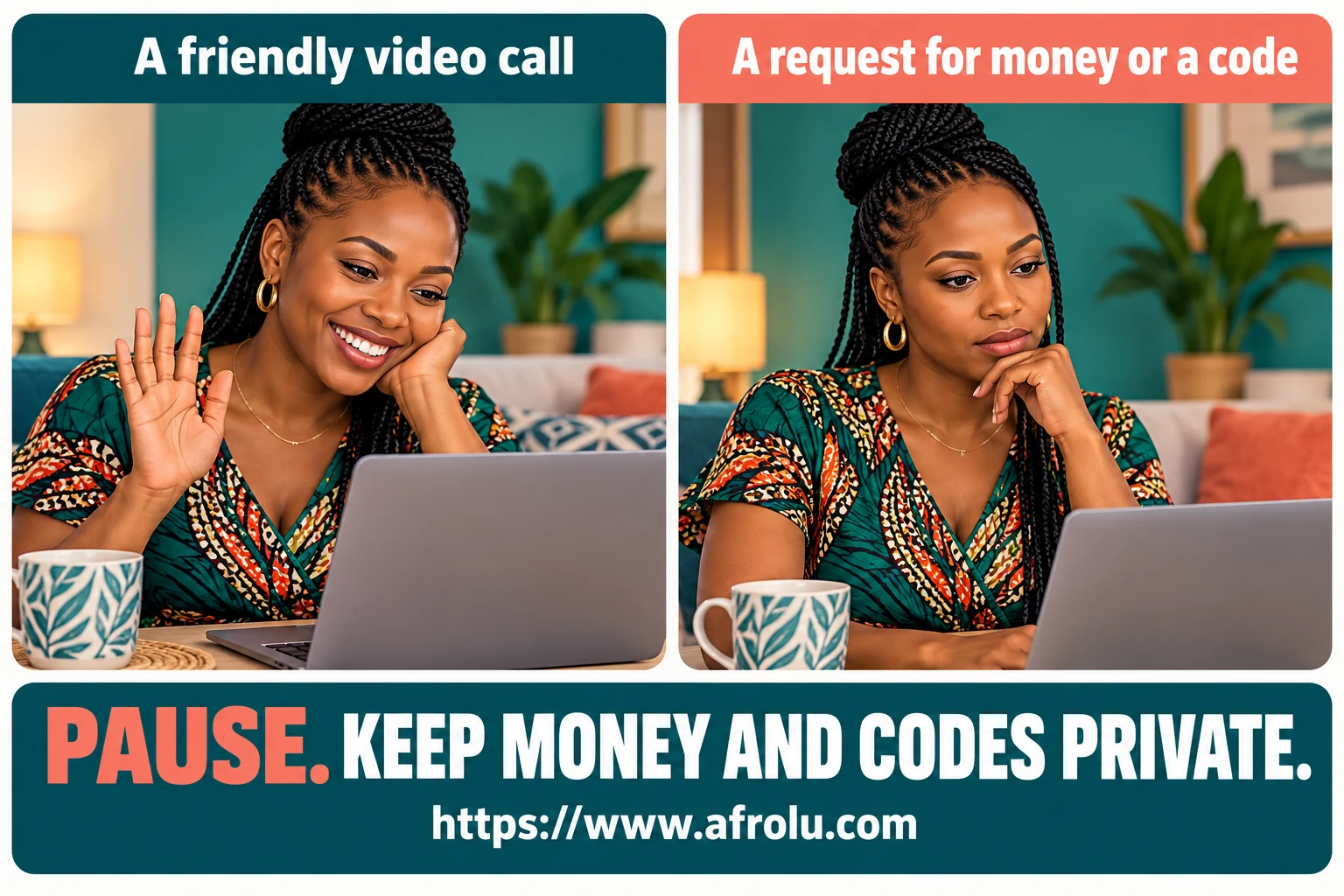
A match is funny on video and seems easy to talk to. A day later, they ask you to send money for an emergency. The call may have felt real, but it does not settle whether the request is safe.
The short answer
A video call can help two people talk; it is not proof of identity, honesty or an emergency. Do not send money or account codes to a new match. If you are pressured, pause, keep the messages and choose a way to check the claim that does not depend on the match's instructions.

What a video call can and cannot show
A live conversation may help you hear how a person speaks and decide whether you enjoy talking. It cannot confirm their full name, relationship status, job, bank details or intentions. A familiar face is also not absolute proof that the person controlling the account is who they claim to be.
INTERPOL warns that artificial intelligence can create or alter a person's face or voice. Its October 2026 public campaign discusses several kinds of fraud around the world, including romance scams. It does not provide a rate for Kenyan dating apps or show that a particular match is using artificial intelligence.
A frozen picture, unusual accent or poor connection cannot reliably tell you that a call is fake. A smooth call cannot prove it is real. Equally, a person may decline a video call for many ordinary reasons. Look at the request and what you are being asked to do, rather than trying to diagnose a stranger from a screen.
When the conversation turns to money
Suppose the match says they need an M-PESA transfer urgently, asks you to keep it secret and says a caring partner would help. An emergency can be real, but you do not need to decide whether the story is true before protecting your money. You can say, ‘I am sorry you are dealing with that. I cannot send money.’
Do not share your M-PESA PIN, banking password, one-time code or identity document, and do not install an app because a new match asks you to. Be wary if the person argues with your boundary, asks you to borrow for them, or sends a link to an investment. Kindness does not require giving someone access to your account.
If you choose to check a claim, use a contact or official website you find independently. For instance, call an institution using its published number, not one supplied in the same message. The institution may be unable to share another person's private information; that does not prove or disprove the story. Do not send money as a test.
If you already paid or shared a code
Contact your bank or mobile-money provider promptly using its official app, website or a number you already know. Tell them what you sent or shared and ask what protective steps are available. A reversal is not guaranteed. Do not pay another person who promises to recover your money for a fee.
Save the messages, profile details, receipts and transaction reference if you can do so safely. Report the account through the dating platform. If someone has your PIN or password, follow the provider's official instructions to secure the account; ask the provider for help if you cannot access it.
If you are threatened or feel in immediate danger, move somewhere safe and contact local emergency services or police. You can also tell a trusted person. Being deceived is not a reason to blame yourself.
Keep the evidence in proportion
Kenya's national cyber-security authority has described the use of artificial intelligence and synthetic voice or video in broader cyber threats. That is useful context for taking impersonation seriously. It does not measure romance-scam losses or establish how common fake dating calls are in Kenya.
You do not need expensive detection software or a perfect verdict to set a boundary. If a request concerns your money, account or safety, make that decision separately from how convincing the conversation felt.
Questions readers ask
Does a dating app's verified badge prove a person is safe?
No. A badge may indicate a particular check by the app; it does not verify every claim or predict behaviour. Check what the app says its badge means.
Can I spot an AI video by looking for glitches?
Not reliably. Connection problems can affect ordinary calls, and synthetic media may not have obvious defects. Protect your money and accounts regardless of how a video looks.
Is every request for help a scam?
No. A request alone does not prove fraud. You can still decline a money request from someone you have only met online, especially when there is pressure or secrecy.
Will my mobile-money provider get my money back?
Recovery depends on the transaction and provider. Contact them promptly through an official channel and ask about your options; do not assume a reversal is guaranteed.
Should I confront the match before reporting?
You do not have to confront anyone. Save relevant evidence if safe, contact your provider if money or account access is involved, and use the platform's report and block tools.
Sources and what they tell us
Research and guidance have limits. Each source below is linked to the point it supports.
INTERPOL launches public awareness campaign highlighting risk of AI deepfake scams
INTERPOL
The October 2026 campaign explains how synthetic faces and voices can be used in several scams, including romance scams.
Limit: This is a global awareness advisory, not a measurement of deepfake dating scams in Kenya or evidence that any particular call is fake.
National KE-CIRT/CC Cybersecurity Report, July–September 2025
Communications Authority of Kenya
The national report discusses artificial intelligence and synthetic media in wider cyber threats and impersonation.
Limit: It covers cybersecurity broadly; it does not establish the prevalence of AI-generated dating calls or romance scams.
Safety tips
Tinder
The dating provider advises against sending money or account information to a match and describes its reporting options.
Limit: This is platform guidance, not a guarantee, a Kenyan prevalence study or advice that replaces your financial provider's instructions.