Four decisions, no hidden syllabus
Choose a Clear Casual Dating Type as an Adult Student
Learn four clear casual-dating agreements for adult students: intention, exclusivity, boundaries and a respectful exit, with campus privacy and budget tips.
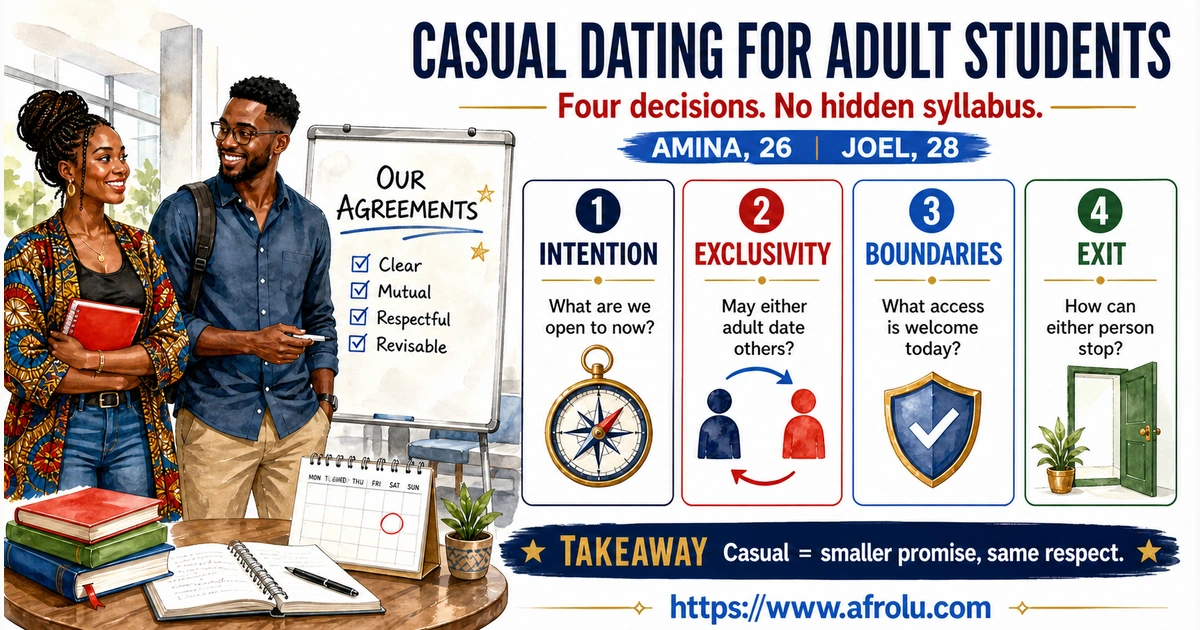
Casual dating makes a smaller future promise, not a smaller respect promise. Name intention, exclusivity, boundaries, and exit.
Written and edited by Thabo Mokoena · Dating Trends Editor
Casual dating usually means the adults are not promising a long-term partnership now. That one word does not answer four other questions. First, name the intention: enjoyment, companionship, or open-ended exploration. Second, name exclusivity: may either person date or be intimate with others? Third, name the boundaries: what contact, touch, privacy, spending, and campus access are welcome today? Fourth, name the exit: how will either adult pause or end the connection clearly? Keep tuition, accounts, room details, coursework, and intimate images protected. Discuss sexual-health information before a relevant decision, not after an assumption. Casual can be light; it cannot make honesty, consent, or care optional.
Dating basics · Students
What exactly are two adults agreeing to when they say a student connection is casual?
Casual dating is a relationship type with no shared promise of a serious future at the present time. It may include one date or repeated dates, and it may be exclusive or non-exclusive. Friends with benefits, hookups, a talking stage, and slow dating are nearby ideas, not automatic synonyms. The useful label is the one both adults can translate into the same current behaviour.
Amina is 26 and attends evening business classes after work. Joel is 28 and completing an architecture qualification. They enjoy inexpensive Thursday dinners and both use the word casual. Amina means, 'I am not planning a relationship this semester, and I may meet other people.' Joel means, 'We are taking commitment slowly, but I expect exclusivity.' The difference appears when a classmate asks Amina for coffee. Instead of arguing about who broke an invisible rule, they use four headings on one page: intention, exclusivity, boundaries, and ending. Their answers do not match. They choose two more non-exclusive dates, agree on health disclosure and campus privacy, and set a Friday check-in after which either person may stop. Clarity does not turn casual dating into commitment. It prevents two private definitions from pretending to be one agreement.
The campus agreement board
Put four answers beside the word casual
A label is only useful when it reduces confusion. Write each answer in present tense, using behaviour that either adult could observe.
Read across the board before changing contact, intimacy, money, or access. If one square changes, discuss that square rather than silently rewriting the whole connection.
What are we open to now?
Name enjoyment, companionship, exploration, partnership, or uncertainty without promising what neither adult has chosen.
May either adult see other people?
Exclusivity needs a direct yes. Frequent dates, sex, jealousy, or campus visibility do not create it automatically.
What access is welcome today?
Separate messages, touch, sex, images, room access, location, money, and public disclosure. Consent can change in each area.
How can either person stop?
Choose a clear message, return belongings, protect privacy, and accept that an ending does not require a courtroom argument.
Start with four sentences, not a perfect label
Ask each adult to finish four sentences alone: 'Right now I am open to...', 'Other dates are...', 'My boundaries include...', and 'If I want to stop, I will...'. Compare the answers without negotiating against a boundary. A mismatch is information, not a failure.
Use current language. 'I might marry someday' does not answer whether either person may date others this month. 'I am easy-going' does not answer whether photos, sleepovers, or daily messages are welcome. Simple sentences make the real choice visible.
Do not bundle every decision. An adult can agree to another dinner and decline sex. Someone can choose exclusivity and keep passwords private. Someone can enjoy casual dating and leave when it no longer fits.

One word cannot carry four agreements. Write present answers for intention, exclusivity, boundaries, and exit, then discuss the square that changes.
Give the connection a place in an ordinary student week
A casual connection still occupies time. Put classes, paid work, commuting, study, sleep, exercise, faith, care, and friends on the calendar first. Then choose contact and dates that fit what remains.
Amina and Joel choose one planned Thursday and flexible messages. During assessment week, either can say 'not this week' without being accused of using the other person. The lighter agreement works because it is small enough to keep.
Repeated late-night summons, missed classes, or demands for instant replies are not made harmless by the casual label. The arrangement should leave both adults able to meet tomorrow's responsibilities.

Keep the date inside two real lives. A light arrangement should leave tomorrow's study, work, sleep, tuition, and transport intact.
Keep privacy and sexual-health decisions in their own columns
Campus life can make private choices visible quickly. Agree on names used with classmates, public affection, residence visits, social posts, and what mutual friends may be told. Silence is not permission to share.
Where sex is relevant, discuss current partners, testing, contraception, barriers, and consent before the decision. Non-exclusive does not mean careless, and exclusive does not prove current health information.
Keep intimate images out of pressure. No one owes a photo because a date was paid for or because distance, exams, or privacy reduce meeting time. Never share another adult's image beyond the specific permission given.
Spend for the date, not for control
Choose a budget before the venue. A walk, lunch, campus event, or shared meal can be a real date. Neither adult should risk tuition, rent, transport, food, work tools, or emergency money to keep a casual connection available.
Paying does not buy touch, sex, extra time, exclusivity, a room invitation, or another date. Receiving a gift does not turn a future no into a debt. If money carries a hidden condition, decline the condition or the money.
Keep student portals, devices, passwords, live routes, residence codes, and coursework under individual control. Access is not proof of trust; it is a separate risk that should follow evidence and genuine need.

Say the agreement, then watch the response. Clear lines about intention, exclusivity, privacy, budget, and ending remove hidden rules.
A clear ending is part of the original agreement
Casual dating does not require a long breakup process, but repeated dates deserve a direct ending when it is safe to send one. 'I do not want to continue dating' is a complete decision. It does not require a list of faults.
Return borrowed items, settle an agreed expense, remove shared access, and keep private information private. If contact becomes threatening, coercive, or persistent after a clear stop, prioritise support and safety over etiquette.
An adult may also ask to change the agreement. The other person is free to decline. Moving from casual to serious works only when two present answers match; time spent together does not create automatic promotion.

An ending does not need a debate. State the decision, close agreed practical items, remove private access, and preserve privacy.
Four campus moments where the hidden agreement appears
Three dates feel exclusive to one person
Kamau stops using apps after three enjoyable dinners. Njeri still accepts other dates because exclusivity was never discussed. Both feelings can be real; only a mutual answer changes the structure.
Ask directly before relying on exclusivity for emotional or health choices.A project week removes the usual Thursday
Amina names the deadline and offers the following week. Joel accepts the small repair instead of demanding proof through constant messages.
Read the specific change and the repair, not one busy week as a verdict.A friend posts both adults without asking
One adult is comfortable being seen; the other is not ready for the campus story that may follow. Casual status does not erase image consent.
Remove the post if possible, agree on future disclosure, and address repeated disregard.One adult wants commitment and the other does not
Hope has changed, but the current answers no longer match. Staying casual to earn commitment would hide the real choice from both adults.
State the new need once; if it is not mutual, end kindly instead of bargaining.Six signs the arrangement is light but not careless
Both adults use compatible words for the current intention without treating uncertainty as a promise.
Exclusivity or non-exclusivity is spoken aloud and updated before either person relies on it.
A no about touch, sex, images, alcohol, money, rooms, or more time is accepted without punishment.
Dates fit study, work, sleep, transport, and essential money instead of repeatedly damaging them.
Private campus, residence, account, health, and image information stays under each adult's control.
Either adult can request a change or end the connection without threats, humiliation, or retaliation.
Match the response to the actual agreement
| Situation | What it may mean | What to do next |
|---|---|---|
| The word casual is agreed, but exclusivity was never discussed. | The label is carrying two different structures. | Ask whether other dating or intimacy is currently part of either person's life. |
| A date is cancelled during a named assessment week and a new time is offered. | Capacity changed while interest and repair remain visible. | Accept, decline, or adjust the alternative without demanding constant access. |
| Every plan arrives after 10 p.m. with no notice and only one person travels. | Convenience is repeatedly one-sided, regardless of the casual label. | Offer one usable planning standard; leave if reciprocity does not appear. |
| Payment is followed by pressure for touch, a room, or more time. | Money is being treated as a purchase of access. | Decline, leave, use independent transport, and seek support if pressure escalates. |
| A partner discloses another partner before a health decision. | The agreement is being updated with relevant present information. | Ask what you need, choose freely, and obtain qualified health guidance where relevant. |
| A clear ending receives repeated contact, rumours, or threats. | This is no longer an etiquette question; safety and harassment may be involved. | Preserve useful records, restrict access, and use appropriate campus or local support. |
Five short lines that remove a hidden rule
“I enjoy this and I am not building toward commitment this semester. What are you choosing now?”
“I am not assuming exclusivity. Are other dates or partners part of either person's life?”
“Please do not post me or discuss this with classmates unless we agree first.”
“I can spend this amount and keep my own transport. Let us choose a plan inside that limit.”
“I do not want to continue dating. Please keep our private information private.”
Know the difference
Casual dating or friends with benefits?
Adults go on dates without a shared serious-commitment goal now. Physical intimacy may or may not be part of the agreement, and friendship is not required.
An existing or intended friendship also includes consensual physical intimacy, usually without a romantic commitment promise. Friendship expectations need their own care.
Neither label answers exclusivity, health disclosure, privacy, pace, or ending. Write those agreements separately.

Casual dating and friends with benefits are different types. Neither label carries the missing agreements about exclusivity, health, consent, privacy, or ending.
Six nearby types that students often combine
| Type or dimension | What it describes | Best next question |
|---|---|---|
| Casual dating | Dates without a shared serious-future promise now. | What are we open to, and what are we not promising? |
| Friends with benefits | Friendship plus agreed physical intimacy without a romantic commitment promise. | What protects the friendship, health information, and a future stop? |
| Hookup | A physical encounter that may not include repeated dating or companionship. | What is agreed for this encounter, including consent and health? |
| Talking stage | Early communication before the relationship type is settled. | Are we moving toward a date or keeping this as conversation? |
| Slow dating | A pace choice; it can sit inside casual or serious intention. | What is moving slowly, and what next step remains real? |
| Exclusive dating | A mutual agreement not to date others while learning compatibility. | What does exclusive cover, and when will we review it? |
Build a one-page casual dating agreement
Write four current answers
Record intention, exclusivity, boundaries, and ending in one or two plain sentences each.
Protect the student floor
Reserve study, work, sleep, tuition, rent, transport, food, accounts, and coursework before dating time or spending.
Choose one usable rhythm
Agree on a modest plan for messages and dates that survives an ordinary week and an assessment week.
Separate health and privacy
Discuss relevant health facts before intimacy and obtain permission before sharing names, images, rooms, or social posts.
Keep the exit available
Use a direct ending, return belongings, remove access, preserve privacy, and prioritise support if contact becomes unsafe.
Questions for the start, the middle, and the ending
Choose a few prompts that fit the moment. This is a reference library, not a list to complete.
Before repeated dates
Choose the questions that affect today's consent and expectations.
- What does casual mean in your own current life?
- Are other dates or partners part of either person's life?
- Which privacy, time, touch, money, and campus boundaries matter now?
- How should either person say stop or ask for a new agreement?
When something changes
Update one square instead of silently rewriting everything.
- Which answer changed: intention, exclusivity, boundary, or ending?
- What present information does the other adult need before choosing?
- Can the new agreement fit both adults' real weeks and budgets?
- What happens if the new answers do not match?
At the ending
Keep the message short and the practical close clean.
- What direct sentence states the decision without an attack?
- Which belongings, expenses, accounts, or access need closing?
- Which private information must remain private?
- What support is appropriate if the boundary is not respected?
Four shortcuts that make casual dating less clear
Assuming casual means non-exclusive
Commitment level and exclusivity are separate decisions. Ask before relying on either for health or emotional choices.
Using spontaneity as one-sided convenience
A light arrangement can still plan, share travel, and respect sleep, work, study, and notice.
Treating payment as access
Meals, tickets, gifts, and transport do not purchase time, touch, sex, rooms, exclusivity, or another date.
Waiting for a casual connection to promote itself
More time does not silently create commitment. Ask for the new agreement and accept the answer.
Use a reviewed resource that matches the decision
This guide focuses on the relationship decision, so it does not rank dating apps. Check current prices, safety tools, and local availability before choosing a service.
Explore the guide library
Show more related guides
Continue with Afrolu
Show more Afrolu guides
Sources behind the agreement and health guidance
Afrolu reviewed these health, research, safety, or public guidance resources while editing this page. They support the behaviour and safety guidance; they do not diagnose any individual described by a reader.
Clear Casual Dating for Adult Students: Questions
Does casual dating always mean dating several people?
No. Casual describes the absence of a shared serious-future promise now. It can be exclusive or non-exclusive, but either structure needs a mutual answer.
Can casual dating become serious?
Yes, when both adults freely choose a new present agreement. Time, sex, jealousy, or repeated dates do not change the type automatically.
Is casual dating the same as friends with benefits?
No. Friends with benefits includes a friendship and agreed physical intimacy. Casual dating may include dates without sex or friendship. Both need separate rules.
Do adult students need to discuss exclusivity before sex?
They should discuss the current structure and relevant sexual-health information before relying on an assumption. A qualified healthcare professional can advise on personal testing and prevention.
How often should casual partners text?
There is no universal quota. Choose a rhythm that supports planning and warmth without harming sleep, study, work, or privacy, then revise it when capacity changes.
Should one person always pay for casual dates?
No universal rule applies. Agree on an affordable plan. Payment never creates a debt for touch, sex, extra time, exclusivity, a room invitation, or another date.
Can I keep a casual relationship private on campus?
Yes. Agree on public affection, posts, names, room visits, and what friends may know. Privacy is different from secrecy used to hide harm or another agreement.
How do I end casual dating respectfully?
When safe, say directly that you do not want to continue, return belongings, remove shared access, and keep private information private. You do not owe an argument.
What if the other person wants commitment and I do not?
State your present answer without keeping them close through possible future promises. They may choose to leave, and you should accept that choice.
When does a casual-dating problem need outside support?
Seek appropriate help when there are threats, coercion, stalking, image abuse, money pressure, blocked exits, academic interference, or contact that persists after a clear stop.
One thing to do now
Write the four answers before the next change
Continue only when both adults can state the present intention, exclusivity, boundaries, and exit in compatible words. Pause when an important answer is unknown; stop when a no is punished, protected information is demanded, sexual-health facts are hidden, or one person is expected to fund access.