Five layers before one career move
Map Serious Long-Distance Dating as a Professional
A five-layer map for professionals: separate distance, serious intent, exclusivity, work-week rhythm and closing-distance decisions safely.
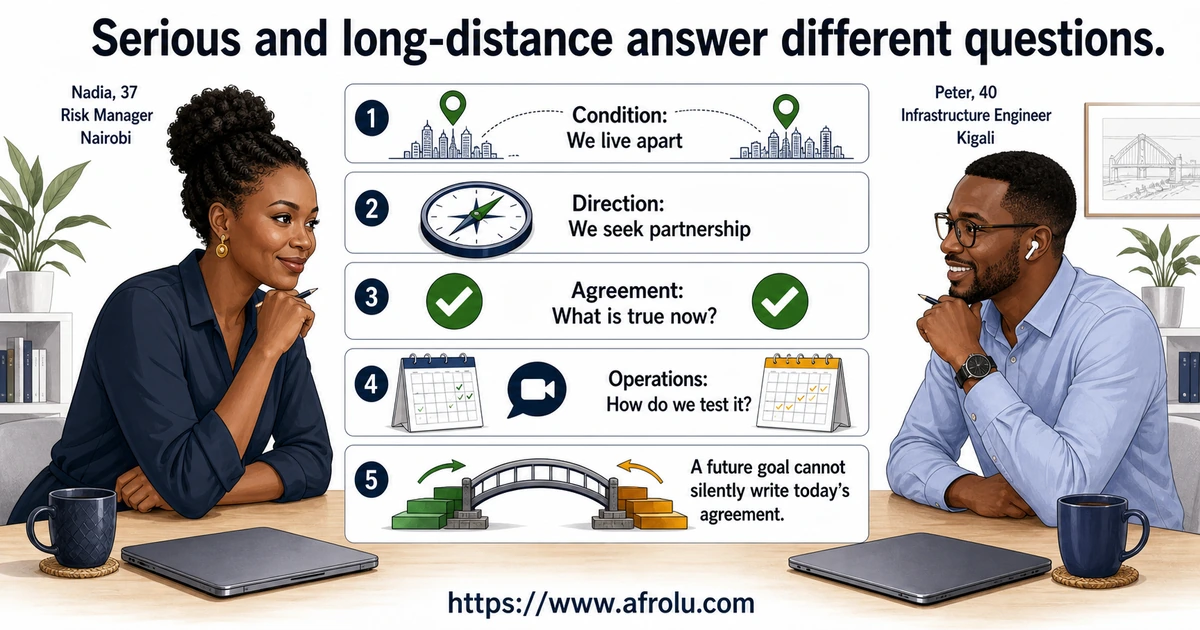
Name the condition, direction, present agreement, operating rhythm and closing-distance hypothesis.
Written and edited by Clarisse Uwimana · Dating Culture Editor
Use five layers. First, name long-distance as the condition under which you meet. Second, state whether both adults are evaluating the connection for a lasting partnership. Third, define the present agreement, especially exclusivity and relevant sexual-health disclosure. Fourth, build an operating rhythm for calls, busy periods, visits, privacy, money and repair. Fifth, treat closing distance as a staged hypothesis involving work, housing, family, health, law and an exit route. Serious hope cannot silently create exclusivity or make relocation safe. Judge repeated conduct while jobs, devices, documents, accounts and return options remain protected.
Dating basics · Professionals
Which part of this connection describes geography, which part describes serious direction, and which present choices have both adults actually agreed?
Professional serious long-distance dating combines several dimensions rather than forming one complete relationship type. Long-distance describes a geographic condition. Serious describes a direction toward possible lasting partnership. Exclusive or non-exclusive describes the current relationship structure. Slow or fast describes pace. Online-first describes a meeting method. Closing distance describes a possible practical transition. A clear relationship can contain several of these terms at once because each answers a different question. The useful task is to give every consequential choice its own present answer.
Nadia and Peter are made-up adults, not reported people. Nadia is 37 and works in risk management in Nairobi. Peter is 40 and works on infrastructure projects in Kigali. They met online, made two independent public visits and agreed that they were exploring a serious exclusive relationship. During a demanding release week, Peter misses their Thursday call. He protects his work systems, sends a limited personal update and offers Saturday. The repair reveals another assumption: Nadia thought their next visit was settled, while Peter had not confirmed leave or cost. They separate the repaired call from the unconfirmed trip, preserve the exclusive agreement and place the visit back behind a complete planning gate. Their serious direction becomes more credible because the present facts get smaller and clearer, not because either professional makes a dramatic sacrifice.
The five-layer distance agreement
Make professional confidence answer the right relationship question
Complex work is often managed by separating decisions. The same discipline helps here, provided the relationship never becomes a corporate performance exercise.
Clarisse reads each moment through one of five layers, then protects free choice, personal warmth and professional privacy while evidence accumulates.
Condition
Name the real geography, travel burden and in-person limits without treating distance as commitment or failure.
Direction
State whether each adult is evaluating this connection for a lasting partnership, with no guaranteed result.
Present agreement
Define exclusivity, disclosures, consent-relevant facts and how either adult can request change or leave.
Operations and transition
Test contact, repair and visits now; assess any closing-distance move later through verified, reversible stages.
Relationship architecture
Write five separate answers before calling the distance serious
Begin with the condition: the adults live far enough apart that ordinary in-person time requires travel, planning or both. That condition may be cross-city, cross-country or cross-border. It says nothing by itself about commitment. Two people can date casually at a distance. They can explore non-exclusively while seeking serious partners. They can be exclusive and unsure about relocation. Naming the condition first prevents the romance of distance from becoming an invented relationship contract.
The second layer is direction. Serious direction means each adult is evaluating the connection as a possible lasting partnership. It does not mean the evaluation has finished, and it cannot guarantee marriage, relocation or a shared household. Say what serious means in behaviour: perhaps prioritising honest assessment, discussing long-term values and avoiding connections known to conflict with that goal. A future orientation deserves clarity without being inflated into certainty.
The third layer is the present agreement. Ask whether either adult dates or seeks other people, what information must be disclosed, and how the agreement can change. Serious intention and exclusivity often appear together, but one does not create the other. If sexual choices become relevant, discuss consent, other partners, testing and prevention before the choice. A professional title, frequent call or expensive trip cannot substitute for shared words.
Layers four and five turn hope into a testable plan. The operating rhythm covers personal contact, busy-period updates, visits, cost, privacy and repair. The transition layer asks whether closing distance is genuinely imaginable, under what conditions and with which reversible stages. Keeping it a hypothesis protects both careers. Nobody should resign, transfer money, surrender housing or expose documents merely to prove that the direction is serious.
An ordinary disruption
Nadia and Peter learn more from a repaired call than from a perfect streak
Nadia and Peter are fictional adults used to make the decisions concrete. Nadia is 37 and manages risk in Nairobi. Peter is 40 and works on infrastructure projects in Kigali. They met online, have made two independent public visits and say they are exploring a serious exclusive relationship. Thursday evening is their longer call. During a demanding project week, Peter misses it. Nadia notices anxiety rising because daily contact had made the connection feel unusually certain.
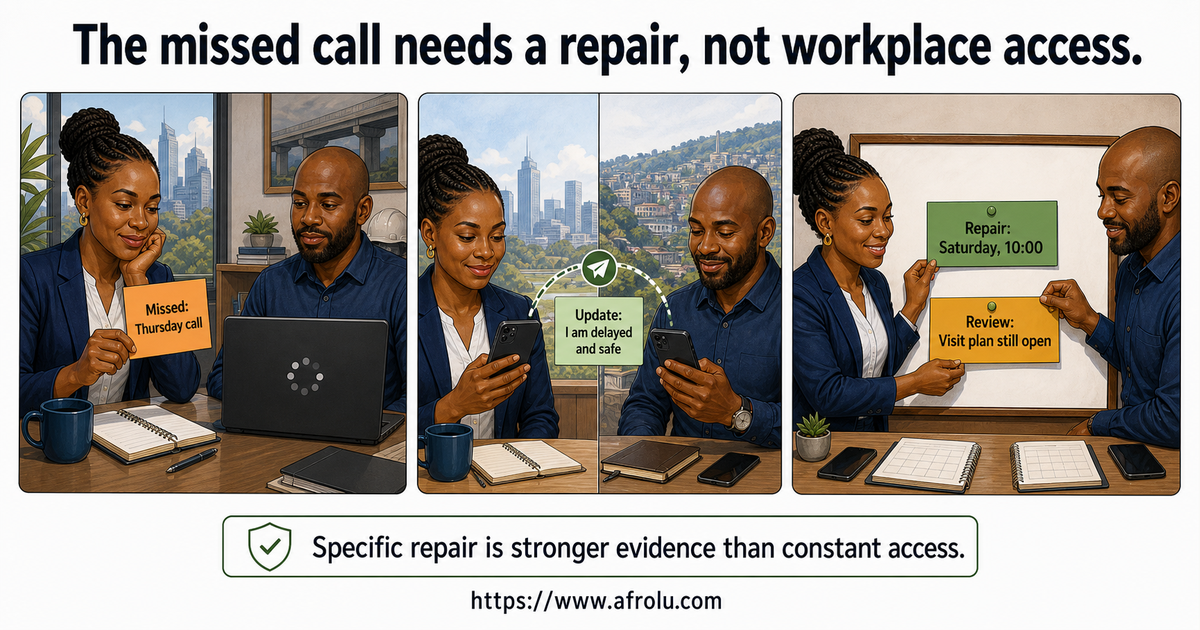
Peter does not send client files, a work-calendar screenshot or a live location to prove the delay. He sends a limited personal update: he is safe, work has run late, and he cannot speak privately. He offers Saturday at ten and asks whether Nadia wants a brief check-in Friday. Nadia accepts Saturday and declines the extra check-in because she has her own deadline. Their repair respects two careers instead of making one person continuously available to soothe the other.
The missed call exposes a different question. Nadia had treated Thursday as evidence that a third visit would happen the following month. Peter had not confirmed leave or cost. On Saturday they separate the contact repair from the visit decision. The call is repaired. The visit remains unbooked until each adult verifies leave, budget, independent accommodation and transport. Nadia does not buy a ticket to turn hope into pressure. Peter does not ask her to pay a fare he cannot yet support.
They also revisit what exclusivity means during the delay. It remains in place; neither adult uses reduced contact as permission to change the agreement silently. Either may request a different structure, but the other may decline. Their serious direction survives one untidy week because they can exchange truthful limits and make a new plan. Repeated silence or indefinite postponement would require a different decision. One repair is evidence, not immunity from later review.
Present structure
Keep serious direction and exclusivity in neighbouring but separate boxes
Professionals are often skilled at reading implication in work settings. Dating still needs direct language. Someone may say they want a serious partner while continuing to meet several people during early evaluation. Another person may choose exclusive dating before knowing whether the relationship has a long-term future. Both structures can be honest. The problem begins when one adult treats their private definition as a contract the other person should have inferred.
Ask a present-tense question: are either of us dating, messaging with romantic intent or seeking other people? Define the scope instead of using a single yes. Discuss which changes should be disclosed and how either person can end the agreement. When sexual activity is possible, make the health conversation specific enough for informed consent. Distance can limit observation, which makes clear agreements more important; it does not justify device searches, passwords or interrogation.
A changed structure needs notice before conduct changes where possible. If Peter no longer wants exclusivity, he should say so before pursuing another date rather than arguing later that reduced calls implied a pause. Nadia can accept a revised structure or end the connection. Neither owes the other a structure that no longer fits. Freedom to leave is part of a meaningful agreement, even when both people still care and the original direction was serious.
Avoid turning exclusivity into broad ownership. It does not grant access to colleagues, assistants, travel systems, messages, cloud accounts or precise location. It does not guarantee every evening or require one career to become secondary. The agreement concerns the behaviour both adults actually named. Other access remains a separate choice. A narrow, understood agreement is safer and more useful than an impressive label with unlimited implied rights.
Evidence without surveillance
Judge serious intent across ordinary work weeks and independently planned visits
A sustainable rhythm is not the largest amount of contact two adults can produce during an exciting month. It is the pattern they can maintain through deadlines, rest, family duties, travel and ordinary low-energy days. A dependable adult may send fewer messages yet keep the agreed call, give useful notice and return with a repair. Another may create constant warmth but avoid every visit, agreement or practical future question. Read the whole pattern rather than rewarding volume.
Visits should become more concrete as their date approaches. Look for independent checking of time, cost, accommodation, transport and return. Each adult controls their booking, documents, device, money and route. Early meetings remain public and low pressure. A work trip near the other person's city does not create personal access to the itinerary or hotel. Employer-funded travel also does not make an employee free to ignore policy or client confidentiality.
Privacy-respecting partners accept limited explanations. They do not ask for a supervisor's contact, security badge, client name, calendar password or video tour of a workplace. They understand that precise travel information may create safety or employment risk. The same boundary works both ways. A professional role is not proof of identity, income or character; verify the person through proportionate independent steps without collecting private systems.
Urgent fare, visa, medical, investment, customs, device or business requests require a safety response rather than relationship negotiation. Do not send money, codes, documents or account access to rescue a romantic deadline. Verify any institution through a channel you find independently. Contact a financial provider quickly after a suspected loss and use suitable local reporting or specialist support. A genuine emergency still does not require a new distant partner to become the bank.

Watch repeatable conduct across work weeks and visits while jobs, devices, money and documents stay protected.
Words that travel well
Use one short question for each layer of the distance agreement
For direction, say what serious means without demanding a guarantee: you are evaluating this connection for a lasting partnership and want to know whether the other adult is doing the same. Ask what evidence each person expects during evaluation. The answer may reveal a genuine match, a difference in goals or a word being used only for emotional intensity. Do not debate someone into sharing your direction. Compatibility includes a freely chosen yes.
For structure, use the present tense and ordinary words. Ask about other dates, active searching and what each adult understands exclusivity to include. Discuss relevant health information before a physical choice. If either person needs more time, name the current structure during that time. Not yet is not a hidden yes. If the available structure does not meet your needs, declining it is clearer than waiting under a private rule.
For operations, plan both the normal week and the difficult week. Name a reliable longer call, a lighter way to stay connected, when silence needs an update and how a missed plan is repaired. Protect sleep and work concentration. A contact plan should not make either adult prove presence all day. When schedules change, the useful message shares the personal consequence and next offer, not confidential evidence.
For visits and closing distance, ask what must be verified before money is spent or a career changes. A good answer includes independent bookings, safe first meetings, ordinary time together, housing, work rights, income, cost, family duties, health, legal requirements and an exit route. The conversation can begin early without making the move immediate. A hypothesis is honest when both adults know which facts could change it.

Ask about the present agreement before discussing a career move, and leave room for yes, no or not yet.
A bounded experiment
Run a thirty-day operating review before expanding emotional or practical dependence
Choose a month that contains ordinary work rather than only leave or celebration. Write the five current answers in plain language. Record the personal rhythm you are testing, one visit milestone if relevant and the date for review. Do not count every message or store private proof. The purpose is to see whether an explicit agreement operates under normal pressure, not to convert intimacy into a dashboard.
At the review, ask what each adult could predict accurately. Did both understand the direction and exclusivity structure? Did contact fit the promised capacity? When something failed, did a specific repair appear? Were professional and financial boundaries accepted? Did visit planning become more realistic, or did urgency and excuses increase? Compare answers without turning one person into the manager and the other into an employee.
Select one proportionate next step. It might be another month under the same agreement, a safer public visit, a revised contact rhythm, a deeper values conversation or a respectful ending. It should not automatically be relocation. A larger transition deserves accumulated in-person evidence and independent practical checking. Small steps are not less serious when they answer the next important question.
If the pattern is repeatedly one-sided, choose from that fact. You do not need to prove bad intent before declining permanent uncertainty, pressure or unaffordable plans. End access clearly, protect accounts and documents, and return belongings through a safe method if needed. If contact becomes deceptive, threatening or financially coercive, shift from relationship review to proportionate safety, platform, financial, legal or local support.

Review whether the agreement was understood, the rhythm worked, disruptions were repaired and the next step stayed reversible.
A vocabulary audit
Compare long-distance, serious, exclusive, slow and closing distance without merging them
Long-distance describes the geography of regular contact. Online-first describes a meeting or communication channel. Neither tells you whether the connection is serious, casual, exclusive or open. A pair may begin online and later live nearby. Another may meet in person and become long-distance after a transfer. The method and condition can change while the relationship agreement remains the same, or the agreement can change while the cities do not.
Serious describes a direction toward lasting partnership. Exclusive describes a current agreement about other romantic or sexual connections. Slow describes pace. These dimensions form combinations: serious, exclusive and deliberately slow; serious, non-exclusive and early; casual, exclusive and frequent; or serious and still undecided about exclusivity. The ethical requirement is not one approved combination. It is shared understanding, consent and freedom to decline.
Closing distance is a practical transition, not a relationship type and not proof of love. It may involve one move, two moves to a third place, a commuter structure or a decision not to relocate. Work, housing, family, health, law, money and personal safety shape feasibility. A pair can have a real serious relationship and still discover that no responsible closing-distance plan fits. That mismatch deserves truth rather than blame.
Use the vocabulary as a living map. Update one box when its answer changes and tell the other adult before acting where possible. Do not rewrite the past to avoid discomfort. The statement that was true last month may no longer fit; a changed answer can be honest. What matters is that each person can make present choices from present facts while essential careers, privacy, money and freedom remain protected.
Eight professional distance decisions in ordinary life
Amara and Joel discover that the same future goal hides two present structures
Amara is 35 and Joel is 38. Both want a lasting partnership. Amara stopped dating others after their third video date; Joel still meets people during early evaluation. Neither had asked. Amara names her private choice without calling it his promise. Joel says he is not ready for exclusivity. Their serious directions match while their available structures do not yet match.
Choose whether the stated non-exclusive period fits. Do not use future hope as silent exclusivity.Salim offers a smaller dependable rhythm during a major delivery
Salim is 42 and cannot maintain nightly calls during a six-week project phase. Kemi is 39 and fears the reduction means retreat. They agree on one Sunday conversation and a short update when a planned call becomes impossible. Salim does not share client files or add Kemi to workplace systems. Kemi does not remain permanently on standby. The smaller rhythm is testable and time-bounded.
Agree on capacity, review it after the busy period and judge whether the promised smaller rhythm is kept.Ruth separates a work itinerary from a personal meeting
Ruth is 34 and travels near a distant match's city for work. Her match asks for the hotel, client site and full itinerary so they can maximise time. Ruth shares only a personal two-hour window after confirming that it fits policy and rest. They meet in a public place; she retains transport and accommodation. Work-funded proximity is not unlimited romantic access.
Plan the personal meeting from personal availability while confidential itinerary and lodging details stay protected.Daniel pauses a resignation that exists only inside a romantic promise
Daniel is 41 and considers leaving a stable role because a partner says they will build a life together. They have spent only one weekend in the same place and have not discussed work eligibility, housing, debt, family support or what happens if the relationship ends. Daniel keeps his job, seeks independent facts and proposes several ordinary visits before any application or move.
Make irreversible decisions late. Build verified, reversible stages and preserve independent advice and return options.Zola verifies the person without requesting a workplace password
Zola is 36. A new match presents an impressive international role but repeatedly avoids live personal conversation. Zola does not ask for confidential documents. She suggests a normal live call, checks publicly available claims through independent sources and keeps identifying data limited. When the person requests a travel payment before meeting, she sends nothing and ends contact.
Use proportionate independent checks; a job title neither proves character nor justifies financial access.Kwesi says exclusivity no longer fits before acting outside it
Kwesi is 44 and Leila is 40. After several months apart, Kwesi no longer wants exclusivity. He tells Leila before pursuing another connection. Leila wants a serious exclusive relationship and declines the new offer. They end sadly but clearly. His changed preference does not make the old agreement fake; acting secretly would have broken it.
Disclose a requested structure change early and allow the other adult to decline without bargaining.Musa keeps generosity separate from control
Musa is 37 and can afford more of an upcoming visit than Esi, who is 35. He offers to cover a public activity, but Esi books and controls her own accommodation and return. Musa does not treat the larger contribution as access to her room, schedule or body. They write down what is a gift and what each adult still controls. Consent remains specific throughout the visit.
Discuss affordability without turning unequal spending into authority, debt or guaranteed intimacy.Binta and Ade choose a commuter structure instead of pretending relocation is imminent
Binta is 46 and Ade is 49. Each has meaningful work and family duties in a different city. They test a predictable commuter pattern and conclude that neither can responsibly move for several years. They can accept that structure, revise the relationship or end it. Calling the relationship serious does not require them to invent a near-term move.
State the real location constraint and decide whether the available relationship remains sufficient for both adults.Evidence that survives distance without workplace surveillance
Both adults can describe long-distance condition, serious direction and current exclusivity in similar plain words.
Contact expectations fit sleep, work, rest and family capacity rather than demanding continuous availability.
A missed call receives useful notice and a specific repair instead of confidential proof or indefinite silence.
Visits become more concrete through independent bookings, public early meetings and controlled return plans.
Each adult protects employer, client, device, account, identity, accommodation and precise-location information.
Money conversations allow an affordable no and do not turn fares, gifts or unequal income into relationship authority.
Exclusivity and sexual-health choices are discussed directly rather than inferred from calls, trips or profile changes.
Closing distance is tested through ordinary time, verified facts and reversible stages before career sacrifice.
Either adult can request a changed agreement or end the connection without threats, tracking or punishment.
Words about a shared future become modest present actions from both adults rather than work performed by one person.
Family and professional obligations are treated as real context, not rivals that must be defeated to prove love.
Urgent travel, investment, visa, device, medical or business money requests trigger independent verification and a pause.
Route each distance moment to the right layer
| Situation | What it may mean | What to do next |
|---|---|---|
| Daily messages are warm, but exclusivity was never discussed. | A contact rhythm is being mistaken for a relationship structure. | Ask directly whether either adult dates or seeks others, then choose from the stated agreement. |
| A planned call is missed during a demanding work period. | Capacity changed; one event cannot establish withdrawal or reliability. | Look for limited honest notice, a specific repair and the pattern across later disruptions. |
| A partner asks for a calendar screenshot or supervisor contact. | Reassurance is crossing into professional privacy and monitoring. | Share personal availability only; refuse system access and judge how the boundary is handled. |
| A work trip brings one adult near the other's city. | A possible personal window exists inside obligations that still need protection. | Confirm a separate public meeting while itinerary, employer and lodging details remain private. |
| One adult privately stops seeing other people. | A personal choice may be mistaken for a mutual exclusivity contract. | Name the choice, ask the present structure question and do not claim an unspoken debt. |
| A visit is discussed before leave, cost or accommodation is verified. | Hope has advanced ahead of a complete plan. | Do not book; assign each fact an owner and confirm independent transport, lodging and return. |
| A distant partner requests urgent fare, visa or emergency money. | Romantic urgency is being applied to a financial claim that needs independent checking. | Send nothing, avoid supplied links and contact the claimed provider through an official channel you find. |
| Serious intent is offered as the reason one adult should relocate. | A future direction is being used to rush an irreversible transition. | Preserve work and housing; test ordinary visits and independently assess feasibility and downside. |
| The rhythm works only when one adult plans and travels. | The connection may contain warmth but not reciprocal operating effort. | Request one concrete contribution, set a review point and choose from the response. |
| One adult wants to change exclusivity. | The old agreement no longer fits; care does not make it permanent. | Discuss the change before acting where possible and allow acceptance, refusal or an ending. |
| Neither career can move in the foreseeable future. | The relationship may be genuine while the desired location future is incompatible. | Describe the available commuter or distance structure honestly and decide whether it is enough. |
| Contact becomes threatening after a boundary or ending. | The task has shifted from relationship clarity to safety and access control. | Reduce access, preserve useful evidence when safe and use suitable platform, workplace, legal or local support. |
Scripts for direction, agreements, work weeks and visits
“I am evaluating this connection for a lasting partnership. What does serious direction mean in your present choices?”
“Are either of us dating or actively seeking other people now? I want our present agreement in direct words.”
“I can keep one longer call and lighter messages around work. What rhythm can you sustain without losing sleep or focus?”
“If a call becomes impossible, a short personal update and a new time are enough. I do not need workplace proof.”
“I keep clients, employer systems, itineraries and devices private. I can share the personal time I am genuinely free.”
“I will book only after leave, cost, public meeting, accommodation, transport and my return are confirmed independently.”
“I do not send urgent travel, business, medical or account money. Any real provider can be checked outside this conversation.”
“Before a physical choice, let us discuss consent, other partners, testing and prevention in terms we both understand.”
“What must be true about work, housing, family, money, law and ordinary compatibility before either person considers moving?”
“I value this connection, but the available structure does not meet my needs. I am not asking either of us to promise what we cannot offer.”
“The exclusivity agreement no longer fits me. I want to tell you before I act, and I understand you may decline a different structure.”
“I will not share that access or make that payment. I am ending this conversation and reviewing my accounts and privacy settings.”
Know the difference
Serious long-distance direction versus a complete professional operating agreement
Both adults say they want a lasting partnership. The phrase describes hope, but leaves exclusivity, contact, visits, work privacy, money and location unanswered.
The pair names geography, direction, present structure, operating rhythm and a staged transition hypothesis. Every answer can be reviewed without inventing a guaranteed future.
Keep the hopeful direction, then add the present facts that let each professional consent, plan and protect an independent life.

Use the smallest accurate label for each decision, then update the map when both adults agree.
Map the neighbouring terms before making a career decision
| Type or dimension | What it describes | Best next question |
|---|---|---|
| Long-distance dating | A geographic condition in which regular in-person contact requires travel or unusual planning. | How often can we meet safely and affordably under our real obligations? |
| Serious dating | A direction in which adults evaluate a connection for lasting partnership without guaranteeing the result. | Which present behaviours express that direction, and what remains undecided? |
| Exclusive dating | A current mutual agreement concerning other romantic or sexual connections. | What exactly is included, disclosed and reviewable in our agreement? |
| Slow dating | A chosen pace for contact, disclosure, visits, intimacy or integration; it does not define seriousness. | Which modest progress should become visible by the next review? |
| Online-first dating | A meeting and communication method that still requires identity, agreement and safe in-person decisions. | Which proportionate checks and public meeting move us beyond profile claims? |
| Commuter relationship | A recurring travel arrangement that may be temporary or a chosen longer-term structure. | Are cost, travel work and recovery shared fairly enough to remain sustainable? |
| Closing distance | A practical location transition involving work, housing, money, family, health, law and downside planning. | What verified facts and reversible stages are required before an irreversible move? |
| Professional privacy | A boundary protecting clients, employers, devices, itineraries, accounts and security-sensitive information. | What personal availability can be shared without opening protected systems? |
| Sexual exclusivity | A specifically defined agreement relevant to sexual partners and health choices; a broad label may be insufficient. | Which disclosures, tests, prevention choices and consent conversations are needed now? |
| Relocation promise | A future claim that remains uncertain until feasibility, willingness and concrete stages are verified. | Is this a hypothesis, a funded plan, or language being used to postpone a present mismatch? |
Build the five-layer agreement in six moves
Draw the five boxes
Write condition, direction, agreement, operations and transition on separate lines. Fill only answers both adults have actually discussed.
Define serious behaviour
Translate the long-term word into current actions such as honest evaluation, values discussion, reciprocal planning and freedom to leave a mismatch.
Protect the work perimeter
Share personal availability, not employer calendars, client information, credentials, precise itineraries, devices or internal explanations.
Test a difficult week
Agree on notice and repair before a deadline period. Judge whether the smaller promised rhythm survives ordinary pressure.
Build one complete visit
Confirm time, cost, identity, public meeting, accommodation, transport, communication, consent and independent return before booking.
Review before sacrifice
Compare the agreement with conduct, then select one reversible next step. Preserve work, housing, money and documents until evidence is much stronger.
Questions for a usable long-distance operating agreement
Choose a few prompts that fit the moment. This is a reference library, not a list to complete.
Direction and present structure
Use these before future language grows larger than today's agreement.
- What does serious mean in the choices you are making now?
- Are either of us dating or actively seeking others?
- Which changes should be disclosed before we act on them?
- What remains genuinely undecided?
- When will we review this agreement?
Work-week operations
Build a rhythm for normal and demanding periods without opening professional systems.
- Which call can each of us reliably keep?
- What brief update is enough when work disrupts a plan?
- How should a missed call be repaired?
- Which work information remains private?
- How do we protect sleep, rest and concentration?
Visits and money
Turn a romantic idea into an independently safe and affordable plan.
- Who confirms leave and by when?
- What can each adult afford without harming essentials?
- Where will each person stay and how will each return?
- Which meetings remain public and time-bounded?
- What happens if the visit is cancelled?
Closing-distance feasibility
Treat relocation as a staged hypothesis with real downside planning.
- Which work and legal facts need independent verification?
- How would housing and ordinary costs work?
- Which family or health duties cannot move?
- What reversible trial comes before resignation?
- What would make us decide not to close the distance?
What the research and public guidance can actually support
Online is a meeting route, not a relationship type
Population research on how adults meet can show that online introductions are common in a studied population. It cannot tell a reader whether a particular match is serious, exclusive, honest or compatible. Afrolu uses the evidence narrowly: separate meeting method from present relationship agreement and move from profile claims toward proportionate verification, public meetings and observed conduct.
Evidence limit: The cited U.S. survey and population work cannot establish one global professional-dating pattern.
Relationship agreements require communication
Research with male couples has examined communication around monogamous and open agreements. Its specific population does not define every couple. The transferable editorial lesson is smaller: do not infer the agreement from appearances. Ask what is allowed, expected, disclosed and reviewable, and preserve activity-specific consent regardless of the label.
Evidence limit: Evidence from one population or relationship context must not be treated as a universal prescription.
Distance is not a diagnosis
Long-distance relationship research has reported both strengths and challenges, and some comparisons do not show a simple quality deficit. That does not prove a distant pairing will work. Geography should be treated as an operating condition whose effect depends on the people, agreement, resources, trust, maintenance and practical future.
Evidence limit: Group associations cannot predict the outcome, safety or fit of one relationship.
Communication quality is not a universal call quota
Research can examine communication, responsiveness and relationship quality without identifying a correct daily frequency for all professionals. Work, time zones, disability, care and preference change capacity. Use direct discussion and observed repair to find a sustainable rhythm; do not present an exact number as evidence-based law.
Evidence limit: Sample, age, country, design and self-report measures restrict transfer to other readers.
Sexual health remains a present conversation
Current public-health guidance encourages respectful partner discussion before sex so people can make informed choices. Serious direction, exclusivity language and travel do not replace specific consent or health information. Use qualified local healthcare for testing, symptoms, prevention or personal medical advice.
Evidence limit: This relationship guide offers general communication support, not diagnosis or individual medical care.
Romance and urgency are a dangerous financial combination
Consumer-protection guidance describes romance scams that build trust before requesting money or gifts. Distance and professional travel can make fare, visa, medical, customs, investment or business stories sound plausible. Do not send money or account access to a person you have not met; independently verify claims and contact a financial provider promptly after suspected loss.
Evidence limit: A warning pattern does not prove a crime. Respond to observable risk and use suitable local support.
Six shortcuts that make a distant relationship less clear
Calling serious a complete contract
Direction does not silently answer exclusivity, contact, sexual health, money, visits, work privacy or relocation.
Measuring care by constant access
An all-day message stream may be unsustainable. Reliable plans and repair often reveal more than availability during every work hour.
Using work proof as reassurance
Screenshots, calendars, badges, client files and supervisor contacts expose systems without proving relationship character.
Booking hope instead of a visit
A fare bought before leave, accommodation, transport and return are confirmed turns uncertainty into financial pressure.
Paying to rescue the future
Urgent romance-linked travel, visa, business, investment or emergency requests need independent verification, not sacrifice.
Treating relocation as the success metric
A move can be unsafe or impractical. The honest result may be a commuter structure, longer distance or a clear ending.
Use a reviewed resource that matches the decision
This guide focuses on the relationship decision, so it does not rank dating apps. Check current prices, safety tools, and local availability before choosing a service.
Explore the guide library
Show more related guides
Continue with Afrolu
Show more Afrolu guides
Research and public guidance reviewed for this agreement
Afrolu reviewed these health, research, safety, or public guidance resources while editing this page. They support the behaviour and safety guidance; they do not diagnose any individual described by a reader.
Professional serious long-distance dating questions
Is long-distance dating a relationship structure?
Geography is better treated as a condition or dating type. It explains why ordinary meetings require travel, but it does not answer serious intent, exclusivity, contact, sexual health or future location. Name those choices separately so each adult can understand the current offer.
Does serious long-distance dating automatically mean exclusive?
No. Serious describes a direction toward lasting partnership; exclusivity is a present agreement. Many adults combine them, but nobody should infer the agreement from frequent calls, profile changes, sex, travel or future language. Ask directly and define what the answer includes.
How often should busy professionals call in a long-distance relationship?
There is no universal evidence-based quota. Choose a rhythm that fits both adults' work, sleep, rest, care and preferences. Include what happens during deadlines and how a missed plan is repaired. Judge whether the agreed pattern is sustainable and reciprocal rather than maximising contact.
Should I share my work calendar to prove I am busy?
No. Share the personal consequence and usable availability, not employer systems, clients, credentials, internal messages or precise security-sensitive travel. A respectful partner can evaluate whether you communicate and repair plans without receiving professional access.
When is it safe to book the first long-distance visit?
Book only after identity checks appropriate to the situation and a complete plan for time, cost, public meeting, independent accommodation, transport, communication, consent and return. Tell a trusted person when useful. Keep documents, devices, money and lodging under your control.
Who should pay for a professional long-distance visit?
There is no universal split. Discuss affordability and fairness without using income or payment to create authority. Protect essential money and avoid harmful debt. Each adult should retain control of core travel, accommodation, documents and a safe return, especially during early visits.
What if a distant partner asks for urgent fare or visa money?
Do not send money, gifts, codes, documents or account access because a romantic deadline feels urgent. Verify the person and any claimed institution through channels you find independently. Contact a financial provider promptly after suspected loss and use relevant reporting support.
How do we know whether slow progress is still serious?
Deliberate progress produces shared answers, kept modest plans, repairs and increasing practical knowledge. Stalling repeatedly avoids identity checks, visits, exclusivity, accountability or future feasibility while one person carries the work. Use a named review point and choose from the pattern.
When should one professional relocate?
Only after substantial ordinary in-person evidence and independent assessment of work, housing, income, debt, family, health, law, safety and what happens if the relationship ends. Use reversible stages where possible. Serious intent alone is not enough reason to resign or surrender housing.
Can a serious relationship remain long-distance for years?
It can if the available structure is freely chosen, sustainable and sufficient for both adults. Some pairs use a commuter pattern or cannot move because of careers and family. State the real constraint and decide honestly; a genuine bond does not make every location mismatch solvable.
One thing to do now
Write the five answers before making one larger promise
Write five present answers and test them through an ordinary month. Keep geography, serious direction, exclusivity, operations and closing distance separate. Expand access or commitment only when shared words and repeated conduct support the next specific step. Do not resign, relocate, borrow, transfer money, expose professional systems or surrender an independent return to prove a future that remains under evaluation.