Six answers before another Saturday
Choose a Clear Weekend Dating Type as a Professional
Compare weekend dating types for busy professionals. Find clarity on direction, agreements, pace, privacy, travel, money, consent, and rest.

https://www.afrolu.com | Name the calendar, direction, agreement, pace, meeting way, and protected choices. One label should never do all six jobs.
Written and edited by Nia Kato · Profile Advice Editor
Weekend dating tells you when most meetings happen. It does not tell you why two adults are dating, whether they see other people, how fast trust should grow, or what they may share. Use six separate answers. First, name the calendar: mostly weekends, mixed days, or irregular shifts. Second, name the direction: open exploration, casual companionship, or a possible lasting partnership. Third, name the current agreement: no exclusivity, exclusivity, monogamy, or another freely chosen arrangement. Fourth, name the pace for messages, dates, touch, introductions, and future plans. Fifth, name the meeting way: in person, online first, long-distance, or a mix. Sixth, protect choices about work, private data, transport, money, sexual health, and consent. A Saturday pattern becomes clear only when both adults can repeat these answers in their own words. Regular dates may show care. They do not silently create exclusivity, seriousness, workplace access, sex, or another date. Ask before a repeated pattern starts making decisions for you.
Dating basics · Professionals
When two adults meet most weekends, which dating type are they actually choosing, and which important questions are still unanswered?
A dating type is a plain description of one important part of dating. Some types describe the relationship direction. Casual dating and serious dating belong here. Some describe a current agreement, such as exclusive dating or a non-exclusive arrangement chosen by everyone involved. Some describe speed, such as slow dating. Others describe where or when people connect, such as online, long-distance, group, or weekend dating. These words can sit together because they do different jobs. Two adults may be serious, exclusive, slow, and mostly weekend daters at the same time. Two other adults may be casual, non-exclusive, online-first, and mostly weekend daters. Neither set of words is complete until both adults agree on its meaning. Weekend dating is best understood as a calendar rhythm. It often suits adults with weekday jobs, shifts, travel, care duties, study, or a strong need for rest. It can support many relationship directions. It should never be used as a quiet substitute for asking what the relationship is.
Njeri and Malik are made-up adults used to show common dating choices. They are not real people. Njeri is 36 and manages supply buying for a regional food company. Her weekday work includes early supplier calls, private prices, and occasional travel. Malik is 39 and works as a civil engineer. His site days can run late, but most Sundays are free. They meet through an app and choose Saturday lunches because each wants a calm start. The first date lasts ninety minutes at a busy cafe. The second includes a gallery and separate rides home. By the fourth Saturday, they take turns crossing town. By the sixth, they know one another's jokes, usual food orders, and broad work roles. They still have not named the relationship. Malik reads the regular pattern as serious and exclusive. He deletes his app and invites Njeri to a work awards dinner. Njeri reads the same pattern as careful exploration. She has paused new app matches but has not agreed to exclusivity. She also does not want a new date meeting colleagues yet. Neither adult has lied. Their mistake is letting one useful calendar answer three other questions. Njeri does not accept the work invitation to avoid an awkward talk. She suggests a Sunday walk in a public park. They draw six spaces on a sheet of paper. Under calendar, both write mostly Saturdays. Under direction, Malik writes lasting partnership, while Njeri writes open to partnership if fit grows. Under agreement, Malik writes exclusive and Njeri writes not agreed yet. Under pace, both choose one or two dates a month for the next six weeks. They agree to direct messages for plans, but no work channels. They keep colleagues, client details, live calendars, home access, and passwords private. Njeri says she needs two more dates before deciding about exclusivity. Malik says exclusivity matters to his sexual-health choices. They agree that he may decline continued dating if the answer remains no. Two weeks later, Njeri chooses exclusivity after a fresh conversation. They define it as no romantic or sexual dates with other people. They do not treat it as phone access, automatic sex, or a promise to marry. The seventh Saturday feels less dramatic than the sixth. It is also more honest because their words now match the calendar.
The six-stamp weekend type passport
Give each dating word one clear job before another Saturday
Think of each answer as a space that must be filled by words and actions. A blank space is not a hidden yes. The passport does not rank relationships. It stops one label from pretending to answer everything.
Read the six cards in order. Calendar says when dates fit. Direction says what future is being explored. Agreement says what applies now. Pace says how quickly closeness grows. Meeting way says how the adults connect. Protected choices keep work, privacy, money, health, consent, and leaving under each adult's control.
When can we meet without harming work, care, sleep, or the rest of adult life?
Name the real pattern. It may be two Saturdays a month, one Sunday morning, mixed shift days, or an irregular window. Both adults stay free to make other plans until a date is confirmed.
What future are we honestly willing to explore now?
Choose open exploration, casual companionship, a possible lasting partnership, or another clear direction. Both adults should describe the purpose of the next few dates in similar words.
Are connections with other people inside or outside our agreement?
Do not guess exclusivity from frequency, spending, sex, app deletion, jealousy, or a work invitation. Each adult should explain the current rule without checking the other's phone.
How quickly should messages, trust, touch, introductions, and plans grow?
Different parts may move at different speeds. More messages do not require faster physical or public steps. Either adult may slow one part without losing every other part.
Will we meet in person, online first, over distance, in groups, or through a mix?
The meeting way shapes planning and risk. It does not prove seriousness, honesty, or fit. A new in-person date needs a clear place, likely end, and route each adult controls.
What stays private, affordable, optional, and easy to stop?
Protect work systems, personal data, return travel, essential money, sexual health, and consent. A no must not bring anger, debt, shame, tracking, or workplace contact.
Friday evening: sort the words before booking
Start with six small answers, not one oversized label
Many professional adults begin with a calendar problem. Their weekdays are full, so dates move to Saturday or Sunday. The calendar solution soon starts sounding like a relationship type. That is not wrong, but it is incomplete. Weekend dating answers when most meetings happen. It does not answer why the adults meet or what they owe each other. The safest way to use the label is to give it one job. Write weekend under calendar. Leave the other five spaces open until both adults answer them.
Direction is the next space. It asks what future is honestly being explored. An adult may want pleasant company without a planned partnership. Another may want to learn whether a lasting partnership could fit. A third may not know yet. Each answer can be honest. Trouble begins when a vague answer keeps another adult waiting for a future that is not truly on offer. Use present words. Saying that marriage might happen someday is not the same as dating toward a partnership now.
Agreement is a different space. It covers exclusivity and any other rule about connections with other people. Two serious daters are not automatically exclusive. Two casual daters may freely choose exclusivity for a time. Adults may also choose a non-exclusive arrangement together. Ethical non-monogamy is a common name for this wider group of arrangements. Secretly breaking an agreement is not ethical non-monogamy. It breaks the agreement.
Pace and meeting way fill two more spaces. Slow dating describes how fast closeness grows. Online dating describes where contact began or continues. Long-distance dating describes a location problem. None answers intention by itself. Finally, add protected choices. These cover work, privacy, money, transport, touch, sex, images, health, and the right to leave. A clear type never cancels these choices.
Saturday morning: read the calendar honestly
A recurring weekend can show effort without creating a promise
A repeated weekend pattern can matter. It shows that two adults are making space in real lives. It can reveal whether they confirm plans, take turns travelling, arrive roughly on time, and handle changes fairly. Those facts help trust grow. They still do not create a shared intention or exclusive agreement. Njeri and Malik had six useful Saturdays. Their calendars matched while their meanings did not.
Professionals can be especially tempted to treat calendar space as proof. Free weekends may be rare. An adult may decline a work event, delay errands, arrange care, or travel across town for a date. That effort deserves respect. It does not buy a particular answer. The other adult does not owe exclusivity, public introductions, sex, or a future because the date required planning. The fair response is gratitude plus a direct question.
Name which weekends are truly free before offering them. Include sleep, faith, family, friendship, exercise, health care, home tasks, and quiet time. A blank square is not empty if an adult needs it to recover from a hard week. Offer a window that can be kept without hidden anger. A two-hour lunch can be more honest than an all-day plan followed by exhaustion.
Choose a confirm-by time for each date. A local Saturday lunch might be confirmed by Thursday evening. A trip or ticketed event may need an earlier answer. The deadline should protect both adults' other plans. If it passes without a usable time, place, likely end, and travel plan, release the weekend. Interest can remain, but the unconfirmed plan does not own the day.
Work can still disrupt a confirmed date. Judge how the person fixes the change without demanding private proof. A fair response includes quick notice, ownership of the effect, and a realistic new offer. It does not require a client name, staff message, site photograph, or screenshot of a work calendar. One hard weekend may be ordinary. Repeated last-minute calls that always consume one adult's time show an unfair pattern, whatever the job title.
Saturday lunch: give each relationship word one job
Separate casual, serious, exclusive, and non-exclusive answers
Casual dating usually means the adults are not working under an agreed serious commitment. It may include companionship, romance, or sex, but those details must be discussed. Casual does not mean careless. It does not remove consent, honesty, sexual-health conversations, or the right to end contact. It also does not always mean non-exclusive. Two adults can choose a casual but exclusive period if both understand the same rule.
Serious dating means the adults are honestly exploring a lasting partnership. It is a direction, not a guarantee. A person can date seriously and later discover a poor fit. Ending after that discovery is not proof that the earlier intention was false. The useful test is what both adults do now. Do they ask about daily life, values, care, conflict, money, location, and future hopes? Can they hear an answer they dislike without forcing a promise?
Exclusive dating is a current agreement about other romantic or sexual connections. It needs a start point and a shared meaning. Ask whether app conversations, new dates, existing dates, flirting, sexual contact, and contact with former partners are inside or outside the agreement. The answer may vary between couples. Privacy can remain. Exclusivity does not give either adult a right to inspect devices, accounts, messages, location, or work systems.
Monogamy is often a wider agreement in which two partners choose romantic and sexual exclusivity. Some adults use exclusive dating as an early stage before calling a relationship monogamous. Others use the words in the same way. Do not fight over the dictionary during a date. Ask which actions are agreed now and when the agreement will be reviewed.
Ethical non-monogamy is a broad name for relationships that allow more than one romantic or sexual connection. Everyone affected must know about and agree to the arrangement. Polyamory often allows more than one loving relationship. An open relationship may allow outside sexual or romantic contact under agreed rules. People use these words differently, so ask. Weekend availability does not make non-monogamy easier or less important to discuss. Time, health, privacy, and sharing rules may need more care because several adults are affected.
A situationship is a common word for a connection that feels like more than a simple date but lacks a clear shared definition. The word can help name confusion. It should not replace the missing talk. Ask what is happening now, what is not offered, and what each adult will do with the answer. A clear no to commitment may hurt, but it is more useful than months of polished uncertainty.
Saturday afternoon: decide what can grow and what stays separate
Set different speeds for messages, touch, home, work, and public introductions
Slow dating means trust and closeness grow through smaller steps. It does not require rare messages, vague plans, or endless review. Two adults can move slowly and still confirm dates, answer direct questions, and decide whether to continue. Fast dating means several parts grow quickly. Speed can feel exciting, but it cannot create consent or reliable knowledge by itself. Either adult may slow one part down.
Set separate speeds. Weekday messages may become frequent while home visits remain later. Physical affection may grow while sexual contact remains off the table. Friends may know about the connection before colleagues do. A serious direction may be named before exclusivity begins. A weekend trip may wait even after several local dates. These mixed speeds are not dishonest when they are spoken and respected.
Online-first dating describes how people meet, not a lower or higher level of reality. Adults may learn much through messages and video calls. They still need to check identity, protect private details, and see how the person acts off screen. A first meeting should have a public place, an end time, and a route home. Moving from an app to private messages may remove some reporting tools, so make that choice with care.
Long-distance dating describes a location gap that changes time, travel, and cost. It can be casual, serious, exclusive, or non-exclusive. A monthly weekend visit may feel intense because much is packed into little time. Do not let a costly trip turn every hour into an obligation. Keep sleep, private space, transport, and consent available. Discuss who pays, where each adult stays, and what happens if the visit ends early.
Public life needs its own pace. A work dinner, conference, client event, staff party, or professional social page can reveal a connection to people outside it. Ask before adding a date to any work setting. Explain the invitation without sharing a guest list or private work detail. Declining a work event does not automatically reject the relationship. It may protect a boundary or avoid giving colleagues a label the couple has not chosen.
Home access is another separate step. A comfortable public date does not grant an address, key, gate code, parking pattern, camera view, or overnight stay. Adults may choose home dates later, but they should keep a way to leave and a clear agreement about who else is present. A private place can change safety and consent choices. Ask again rather than treating the venue change as a small detail.

https://www.afrolu.com | Ask one question at a time. A direct answer is kinder than asking a recurring Saturday to speak for both adults.
Before evening: protect what the relationship does not need
Share enough to plan a date without opening work, accounts, or essential money
A broad work description is usually enough for early dating. An adult can say they work in health, finance, education, transport, construction, law, hospitality, or another field. They can share the hours they are free. They do not need to reveal employer systems, client names, private prices, patient details, legal files, staff records, travel-security plans, internal meetings, or passwords. These details may belong to other people as well as the worker.
Keep personal plans on a personal device and account where possible. Do not hand a work phone to a date. Do not add a new connection to an employer calendar. Avoid sending private images through a work account. Follow the employer's current policy for devices and records. A partner who respects work privacy is not being kept secret. They are accepting a real duty.
Personal data also needs a reason. A full legal name, exact home, routine, photograph, identity document, family detail, and live location can each create risk when shared too early. Ask why the detail is needed. Share the smallest fact that solves the planning need. A nearby meeting area may be enough without a home address. A broad finish time may be enough without a full calendar screenshot.
A job title is not identity proof. A polished profile, uniform, office photograph, conference badge, or claimed title may be true. It may also be incomplete or false. Check important facts outside the private conversation. Use information you find through a source you control. Never ask a colleague to reveal protected records. A kind response to reasonable questions matters more than a grand title.
Set the full date cost before choosing the plan. Count fares, fuel, parking, food, tickets, care, a room if freely chosen, and the route home. A high income does not make waste harmless. A lower-cost date is not low effort when it is planned well. Neither adult should miss rent, food, medicine, debt payments, or safe transport to make a weekend look impressive.
Keep romance separate from urgent money movement. Do not lend, receive, route, invest, guarantee, or unlock money for a new date. Never share a password, PIN, one-time security code, mobile-wallet account, banking screen, or work payment tool. A story about travel, equipment, a client, an emergency, or a delayed salary can sound possible. Possibility is not enough reason to send money. Stop and check outside the relationship.

https://www.afrolu.com | Look for named direction, direct exclusivity answers, fair planning, private work systems, and a respected no.
Saturday night: keep every choice separate
A dating type never decides transport, touch, sex, health, or the route home
Consent requires a free current choice. A yes to a Saturday date covers only that date. It is not a yes to alcohol, another venue, a vehicle, or a home. It is also not a yes to a hotel, touch, photographs, sex, or an overnight stay. A serious label, casual label, exclusive agreement, gift, fare, meal, room, or rare free weekend does not change that rule. An earlier yes can change. Stop when willingness is missing, unclear, or withdrawn.
Alcohol, drugs, fear, sleep, illness, pressure, and some other conditions can affect whether a person can choose. If you are unsure, stop instead of treating doubt as a yes. Move to safety when a free choice is not clear. This article gives general guidance, not a legal finding about an incident. Laws differ by place. Local emergency, medical, legal, or specialist support may be needed.
Talk about sexual health before sexual contact. Ask about current agreements, other partners where relevant, barrier use, testing, vaccination, contraception, and what each adult needs to choose freely. A job, income, education, clean appearance, long courtship, serious intention, or exclusive label cannot reveal STI status. A healthcare professional can help with personal testing, prevention, or treatment questions.
Control the route home. This can mean personal transport, public transport with a known last service, a ride booked on one's own device, or a trusted pickup. Keep enough money and battery for the return. Accepting a lift can be a free adult choice. Check whether it would reveal an address, remove another option, or make a boundary harder to keep.
Early meetings are easier to change in a busy public place. Tell a trusted person enough to support the plan if useful. A live location should go only to a trusted support person by choice, not automatically to the date. Keep the phone in your control. Leave when a venue changes in a way that feels unsafe. You do not owe a long debate before leaving.
Repeated unwanted calls, workplace visits, following, threats, account access, location tracking, or contact after a clear stop need more than a better dating label. Treat them as safety concerns. Save useful records when safe. Review account and device settings. Tell trusted workplace contacts only what they need. Seek suitable platform, specialist, local, legal, or emergency help based on the risk.
Sunday evening: choose the smallest honest next step
Read the whole weekend before stamping another date
Begin with facts. Was the date confirmed? Did the public place, start, likely end, cost, and travel match the plan? Did work change anything? If so, was the message quick, and did the new offer treat both adults fairly? Facts prevent one exciting moment or one awkward moment from becoming the whole story.
Read each passport space. Calendar asks whether the pattern fits both lives. Direction asks whether the future being explored is similar enough. Agreement asks whether exclusivity or non-exclusivity is spoken and understood. Pace asks whether closeness grows without pressure. Meeting way asks whether online, distance, group, or in-person plans are workable. Protected choices ask whether privacy, money, health, consent, and leaving stayed free.
Choose another date when the main answers fit and actions support them. The next date does not need to be larger. A second public lunch may teach more than a rushed weekend trip. Keep the parts that worked. Change one practical part that felt unfair, such as travel, cost, or the confirm-by time.
Choose one question when fit remains possible but an answer is missing. Ask about direction before accepting a work introduction. Ask about exclusivity before making sexual-health choices that depend on it. Ask about pace before sharing a home address. Set a time to revisit a genuine not-yet answer. Do not accept a review date that moves forever.
Pause when the next plan requires money, travel, private space, public attention, or personal data beyond current trust. A pause is not punishment. It keeps a larger choice from being driven by speed or money already spent. The other adult may accept the pause, offer a smaller plan, or decide the fit no longer works.
End when the available type does not fit. An adult seeking casual companionship may be honest and still be wrong for an adult seeking a lasting partnership. End or seek support when pressure, deception, money requests, tracking, workplace intrusion, threats, or ignored consent appear. A label cannot excuse actions that keep taking away freedom.
Njeri and Malik did not find clarity by choosing the fanciest relationship word. They found it by letting six simple answers stay separate. Their weekend rhythm then became useful. It told them when they could meet. Their own words told them why, under which agreement, at what pace, through which meeting way, and with which choices still protected.

https://www.afrolu.com | Keep facts separate from hope. Use the smallest next step that fits the answers and the actions.
Eight weekends where one label tries to make a second decision
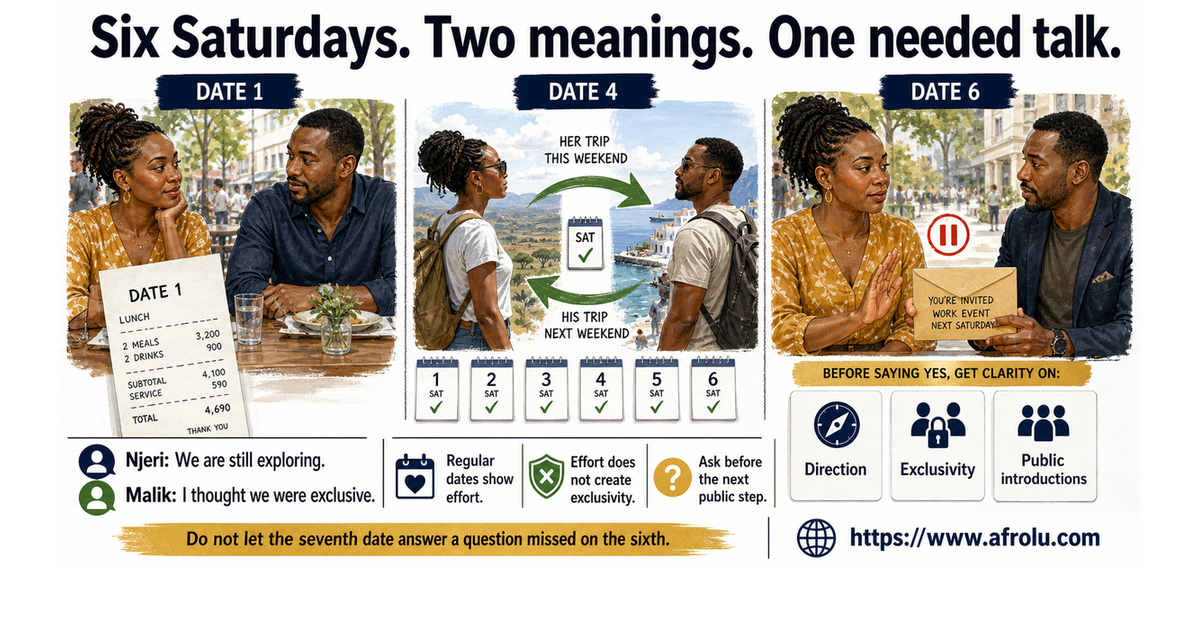
A regular pattern receives two different meanings
Njeri, 36, believes she and Malik, 39, are still exploring. Malik believes six Saturdays mean they are serious and exclusive. He invites her to a work dinner before either question has been discussed.
Pause the public invitation. Name direction and exclusivity separately. Continue only through an answer both adults can repeat.A date asks to inspect a private rota
Lena, 33, is a hospital pharmacist. David, 35, says her changing Sunday window sounds dishonest. He asks for a photograph of the staff rota and the names of colleagues on duty.
Lena can share her free window without revealing staff or work records. David may accept the limit or decline the uncertain plan.Expensive dates are treated as proof of serious intent
Kojo, 41, wants casual companionship with Amina, 38. He books costly weekend activities and says the spending proves he is serious. Amina hears a future promise that Kojo does not mean.
Use direction words, not price, to define the connection. Lower the cost and let Amina decide whether casual dating fits.One private choice is presented as a shared agreement
Tari, 35, deletes a dating app after four dates with Sifa, 32. Tari announces that they are now exclusive. Sifa had not been asked and still has another planned date.
Treat app deletion as Tari's choice. Ask about exclusivity without punishment. Either adult may decline the offered agreement.A costly visit is used to claim every hour
Musa, 37, travels to see Biko, 40, for a weekend. Biko says the fare means Musa should skip rest, stay at his home, and accept every planned activity. Musa wants a hotel break on Saturday afternoon.
Keep time, venue, sleep, and touch separate. Travel cost does not buy the visitor's full weekend or consent.A work photograph gives the relationship a public label
Ada, 31, attends a professional lunch with Kweku, 34. Kweku posts their photograph and calls Ada his partner. They had agreed only to attend together, not to announce a relationship.
Remove or correct the post where possible. Ask before naming another adult's status or sharing a work-linked image.A word is used to dismiss consent
Peter, 42, tells Grace, 39, that casual adults should not make touch complicated. Grace has said no to moving from dinner to a hotel. Peter keeps bargaining because he paid.
Grace's no ends that choice. Payment and a casual label create no consent. Leave and seek help if pressure or danger continues.A missing reply is turned into workplace contact
Wanjiku, 30, ends two dates with Elias, 36, and asks for no further contact. Elias appears at her office on Monday to demand a better explanation. He says serious people deserve face-to-face closure.
Treat the office appearance as unwanted contact, not a status talk. Use workplace and local safety support that fits the risk.Ten signs the words still match adult freedom
Both adults can explain what weekend describes and what it does not describe.
Direction is named with present words instead of a distant promise that never guides current choices.
Exclusivity or non-exclusivity begins through agreement, not through frequency, sex, app deletion, jealousy, or spending.
A not-yet answer has a date to talk again, and either adult may decide the wait no longer fits.
Plans include a usable time, public place, likely end, affordable cost, and route each adult can control.
Travel, planning, payment, and changed plans become fair across several weekends.
Work devices, calendars, client details, staff records, passwords, and live location remain protected.
A public introduction, photograph, home visit, trip, touch, and sexual choice each receive their own yes.
Sexual-health questions can be asked without shame, fake certainty, or pressure to reveal more than the choice needs.
A boundary leads to respect or an honest fit decision, not anger, tracking, debt, threats, or workplace contact.
Find the passport space that changed before choosing the response
| Situation | What it may mean | What to do next |
|---|---|---|
| Two adults have met on four Saturdays but have not discussed direction. | Direction is still blank. The calendar shows repeated interest and effort. It does not show a shared future goal. | Ask what each adult hopes dating may become before making a larger plan. |
| One adult deletes an app and expects the other to do the same. | Agreement is still blank. One adult made a personal choice. No shared exclusivity agreement exists yet. | Discuss exclusivity directly and accept that either adult may say no. |
| A serious dater wants only two meetings a month during a busy season. | Calendar and pace may be limited. That can fit a serious direction when plans are reliable and the busy period has an end point. | Set a date rhythm and review date. Check whether both adults still learn about each other. |
| A casual dater asks for sexual exclusivity for health and emotional reasons. | Direction and agreement have different answers. Casual direction and a current exclusive agreement can exist together by choice. | Define the exact agreement, sexual-health steps, start point, and date to talk again. |
| A work dinner invitation arrives before colleagues know about the connection. | Pace and protected choices have changed. The invitation is a new public step. It does not create partner status. | Agree on the introduction, label, photograph rules, arrival, departure, and work privacy. |
| A date asks for a live work calendar to solve changing shifts. | Protected choices are at risk. Planning needs free windows, not access to employer systems or other people's details. | Share personal availability and use a personal calendar. Follow current workplace policy. |
| A long-distance visitor paid for travel and wants every hour together. | Meeting way, money, and consent need separate answers. Travel cost creates no right to time, private space, touch, or sex. | Keep rest, transport, venue, and each activity optional. Shorten the visit if pressure continues. |
| A venue changes from a public cafe to a private apartment after arrival. | Protected choices changed with the place. The first yes covered the cafe, not the apartment. | Decline the change, use the planned route home, or choose another public place. |
| One adult wants partnership and the other clearly offers casual companionship. | Direction does not match. Both answers may be honest, but the available futures do not fit. | End respectfully unless both genuinely want the same present direction. Do not date a hoped-for future answer. |
| A former date contacts colleagues after a clear request to stop. | This is a safety issue beyond dating type. Repeated unwanted contact and workplace intrusion need a safety response. | Protect accounts and work. Keep records where safe and seek support based on the risk. |
Ten plain sentences for calendar, direction, agreement, work, money, consent, and closure
“Weekends are my main dating time. I can usually offer two planned Saturdays a month. That is my calendar, not a relationship promise.”
“What are you honestly hoping dating could become at this point in your life? I am asking about direction, not a guaranteed ending.”
“I am dating to explore a lasting partnership, but I still need time and freedom to learn whether we fit.”
“Are either of us dating or having sexual contact with other people now? I do not want to guess from app use or silence.”
“For me, exclusive means no romantic or sexual dates with others. What actions would exclusive cover for you?”
“I can share when I am free, but I do not share my work calendar, staff details, login access, or other people's data.”
“I am not ready to meet colleagues or be named online. Let us keep this private while we decide our public pace.”
“My full budget is this amount, including my trip home. Let us choose a plan inside it so my return money stays protected.”
“Dinner is the plan I agreed to. Any new venue or physical step needs a separate yes, whatever either adult has spent.”
“You want casual dating and I want a path toward partnership. I respect both answers, but I am ending this because they do not fit.”
Know the difference
Weekend dating or serious dating: which answer do you need?
This is a calendar answer. Most dates happen on Saturday, Sunday, or another weekend window. It may fit shifts, travel, care, study, faith, or rest. It does not tell you whether the adults seek a lasting partnership.
This is a direction answer. Both adults are honestly exploring a lasting partnership. It does not set the number of dates, create exclusivity, or give access to work, money, a home, touch, or sex.
The answers can sit together. Two adults may date seriously on two Saturdays each month. They still need separate answers about exclusivity, pace, meeting way, privacy, health, money, and consent.

https://www.afrolu.com | A meeting day is not a future direction. A future direction is not a current exclusivity agreement.
Eight nearby dating types sorted by the question they answer
| Type or dimension | What it describes | Best next question |
|---|---|---|
| Weekend dating | This says that meetings happen mainly in weekend windows. Two adults with full weekdays might reserve two Saturday lunches a month. It does not answer casual or serious direction, exclusivity, pace, or consent. | What are we seeking within this calendar? |
| Casual dating | The adults date without an agreed serious commitment. They might enjoy planned weekend company without offering a partnership path. Casual does not mean careless, non-exclusive, sexual, secret, or free from consent duties. | What closeness and future are inside or outside this connection? |
| Serious dating | Both adults honestly test fit for a lasting partnership. Limited Saturday dates may include talks about daily life and future fit. Serious does not guarantee marriage, create exclusivity, or speed up physical access. | What current actions make the serious direction real? |
| Exclusive dating | The adults agree on limits involving other romantic or sexual connections. They may stop dating others while keeping work and phones private. Exclusive does not create device access, sex, public status, marriage, or permanent commitment. | Which actions does our exclusive agreement actually cover? |
| Slow dating | Trust, private sharing, touch, introductions, and plans grow through smaller steps. One public date might happen every other weekend. Slow does not mean low effort, weak intention, rare communication, or endless uncertainty. | Which part should move now, and which part should wait? |
| Online-first dating | Early contact happens through an app, site, or online service. Weekday messages may lead to a short public Saturday meeting. Online contact does not prove identity, honesty, safety, seriousness, or sexual interest. | What must be checked and protected before meeting? |
| Long-distance dating | Distance makes regular meetings harder and gives travel more weight. Adults in different cities may plan one weekend visit with private rest time. Distance does not require exclusivity, serious intent, shared money, or all-day access. | Who travels, pays, stays where, and may end the visit early? |
| Friends with benefits | Adult friends freely agree to sexual contact without assuming a romantic partnership. They may meet on weekends and state what privacy and other dating mean. The type does not remove feelings, health needs, consent, review, or the right to stop. | What happens if feelings, health needs, or outside relationships change? |
Use the six-stamp passport before another repeated Saturday
Sort every label into one of six spaces
Write calendar, direction, agreement, pace, meeting way, and protected choices. Place each word in the space it answers. Weekend belongs under calendar. Serious belongs under direction. Exclusive belongs under agreement. Slow belongs under pace. Online and long-distance belong under meeting way. Consent and privacy stay protected in every type. Start by sorting the words you already use before adding a new label.
Write the same answer alone, then compare
Each adult writes one sentence for direction and one for exclusivity before the talk. This reduces the urge to copy a pleasing answer. Different words are fine when the actions match. A true difference should remain visible. Do not edit away a mismatch just to save Saturday. Compare the two sentences, then circle any action that means different things.
Build a weekend that can be changed safely
Confirm the public place, start, likely end, cost, and route home. Keep a backup plan when confirmation is late. Carry enough charge and money to leave. A plan that depends on one adult for transport, payment, location, and permission becomes harder to change. Fix one weak exit before leaving for the date.
Keep professional proof out of romance
Broad work facts and personal free time can support honest planning. Client files, staff lists, private calendars, passes, work devices, and passwords do not prove love or truth. Follow workplace rules. Check important identity facts through a source you control. Replace a request for work details with a personal planning answer.
Give every larger step its own yes
A public date, work introduction, posted photograph, trip, home visit, gift, touch, sexual act, and overnight stay are different choices. Agreeing to one does not agree to the next. Ask again when the place, cost, audience, or physical activity changes. Name the next choice before asking for it.
End Sunday with one decision, not a score
List the facts and find the missing passport space. Choose another date, one question, a pause, or an ending. A score can hide the reason. A plain decision keeps the reason visible and gives each adult a useful next step. Write one sentence that starts with 'The next honest step is.'
Questions for recurring weekends, public steps, private steps, and Sunday review
Choose a few prompts that fit the moment. This is a reference library, not a list to complete.
Before the first recurring weekend
Give the calendar one job and keep the other answers open for discussion.
- Which weekend time can I offer without borrowing from sleep, care, health, friends, or essential work?
- What direction am I honestly ready to explore now?
- What would I need to ask before agreeing to exclusivity?
- Which parts of closeness may grow now, and which should stay slower?
- What meeting way fits our distance, identity checks, and safety needs?
- Which work, data, money, health, and consent choices remain protected?
Before a work or public introduction
A new audience needs a new agreement.
- What relationship word will each adult use, if any?
- Who may know, and what should remain private?
- May photographs be taken, posted, tagged, or sent to colleagues?
- Can either adult arrive and leave without workplace help?
- Which employer or client details must stay outside the conversation?
- Can the invitation be declined without changing the dating agreement?
Before sex, travel, or private space
Separate every larger choice from the relationship label.
- What exact plan has each adult freely chosen?
- What sexual-health information or care does either adult need?
- Who pays, and can either adult decline without debt or shame?
- Where will each adult sleep, rest, and keep private belongings?
- Can either adult leave early using transport they control?
- What changes if alcohol, fear, fatigue, illness, or pressure affects free choice?
At the Sunday arrivals desk
Choose one next step that the facts can support.
- Which passport answers now match, and which remain different?
- Did words and actions tell the same story?
- Were work, personal data, money, health, consent, and leaving protected?
- What one question would change the next decision?
- Would a smaller date teach more than a larger plan?
- Does the honest next step look like another date, one question, a pause, support, or an ending?
What six official sources support, and where each source stops
A personal date should not open a work system
The U.S. National Institute of Standards and Technology explains security and privacy risks when personal mobile devices are used for work. Its 2023 BYOD guide is written for organizations. The narrow dating lesson is to keep personal plans away from employer systems. Share a free window through a personal account. Do not give a date work-device control, passwords, remote access, or private records. Follow the employer's current policy because the correct control depends on the job and system.
Evidence limit: NIST does not define dating boundaries or promise that one device setup is safe for every workplace. Use qualified security help for a real incident.
People have a right to be informed about how their personal data will be used
Kenya's Office of the Data Protection Commissioner lists rights involving personal data. Its page includes being informed about use, access, objection, correction, and deletion in stated situations. It also lists principles such as lawful and fair use, clear purpose, collecting only what is needed, accuracy, limited storage, and privacy. A simple dating habit follows. Ask why a detail is needed and share less. Ask before passing another adult's details to colleagues, friends, family, or an online audience.
Evidence limit: The legal duties depend on who handles the data and why. This summary is not a complete statement of Kenyan law or advice for a complaint.
A believable job or travel story can still lead to a money request
The U.S. Federal Trade Commission warns that romance scammers may build trust, say work or distance prevents meeting, and later ask for money. Requests may involve travel, medical needs, fees, or investments. The safe dating move is plain. Do not send money or gifts to an online love interest you have not met. Stop when urgent payment pressure appears. Check through contacts or sources you find yourself. Contact the payment provider quickly after suspected fraud and use suitable reporting channels.
Evidence limit: A changed shift, travel job, distance, or money problem does not prove fraud. The pattern supports caution, not a finding about one person's intent.
A first weekend meeting needs privacy, a public place, and a route out
Australia's eSafety Commissioner advises online daters to limit personal details and review privacy settings. It also advises telling a trusted person about a meeting, charging the phone, and meeting in a busy public place. Its guidance notes that leaving a dating service can remove some platform safety features. For adults in this guide, use those ideas as choices rather than a promise. Keep control of the device and route home. Share support details with a trusted person, not automatically with the date.
Evidence limit: eSafety is an Australian authority. Services, laws, and ways to get help differ by place. This Afrolu guide applies these ideas only to adults 25 or older.
Choice must remain free and possible at the time
The Crown Prosecution Service explains the law of England and Wales. Its guidance says sexual consent requires agreement by choice, with freedom and the ability to choose. It also explains that consent is specific and can be withdrawn. A dating label cannot supply that choice. Ask about the exact activity now. Stop when willingness changes or a person cannot choose freely. Payment, travel, exclusivity, a serious direction, or an earlier yes cannot replace a current free choice.
Evidence limit: The cited legal explanation applies to England and Wales. Laws and ways to get help differ elsewhere. Get current local help for a specific incident.
No relationship label can reveal STI status
The U.S. Centers for Disease Control and Prevention provides general information about STI transmission, testing, vaccination, barriers, number of partners, and prevention. It notes that many STIs may have no symptoms and that testing is how a person knows their status. For dating, ask direct health questions before sexual contact. Discuss the current relationship agreement and the prevention choices each adult needs. Do not guess status from profession, income, appearance, serious intention, exclusivity, or time together.
Evidence limit: CDC material is general U.S. public-health guidance. It cannot diagnose anyone or choose a personal testing, vaccination, prevention, or treatment plan.
Six ways a useful dating word becomes an unfair shortcut
Calling every calendar pattern a relationship type
When, why, under which agreement, and at what pace are separate questions.
Using serious as a promise of marriage
Serious dating is an honest direction. Learning may still show that the adults do not fit.
Using casual as permission to avoid care
Casual adults still need honesty, consent, sexual-health choices, privacy, and a clear way to stop.
Treating app deletion as an exclusivity contract
One adult may change app use alone. A shared rule begins only after both adults agree.
Letting a work invitation announce status
A guest place does not name the relationship or give permission for photographs, posts, or colleague questions.
Paying for clarity with a bigger weekend
A trip, hotel, gift, or costly event can increase pressure while leaving the missing answer untouched.
Use a reviewed resource that matches the decision
This guide focuses on the relationship decision, so it does not rank dating apps. Check current prices, safety tools, and local availability before choosing a service.
Explore the guide library
Show more related guides
Continue with Afrolu
Show more Afrolu guides
Six official sources behind the safety and privacy guidance
Afrolu reviewed these health, research, safety, or public guidance resources while editing this page. They support the behaviour and safety guidance; they do not diagnose any individual described by a reader.
Professional Weekend Dating Types: Clear Answers
Is weekend dating a casual type of dating?
Not by itself. Weekend dating describes the usual meeting time. Casual dating describes a connection without an agreed serious commitment. Adults can date casually on weekends, but they can also date seriously, exclusively, slowly, or over distance on weekends. Ask about direction instead of using the calendar as the answer.
Do regular Saturday dates make two adults exclusive?
No. Regular dates may show effort and interest. Exclusivity begins through a clear agreement. Ask whether either adult dates, messages, or has sexual contact with other people. Define which actions the agreement covers and when it begins. App deletion, sex, spending, jealousy, and public introductions do not create the agreement alone.
Can professional adults date seriously only twice a month?
Yes, when the rhythm is honest and both adults still learn about each other. Serious describes direction, not date count. Two reliable dates may fit shifts, travel, care, health, or rest better than weekly exhausted meetings. Choose a date to talk again. Check whether both adults ask useful questions, share effort, handle changes fairly, and make a future plan that the calendar can support.
What if one adult is unsure about relationship direction?
An honest unsure answer can be valid for a limited time. Name what dating can include during that time. Set a date for another conversation. Either adult may decide that waiting no longer fits. Uncertainty becomes unfair when it keeps moving, asks for private access too soon, or hides a future that is not actually on offer.
Should a date see my work calendar to know I am truly busy?
Usually no. Share the personal windows when you are free. A work calendar may reveal colleagues, clients, travel, health details, security routines, or private meetings. Use a personal calendar for dates and follow workplace policy. The other adult may decide an uncertain schedule does not fit, but they do not need protected records to make that choice.
Is meeting colleagues a sign that dating is serious?
It may show growing trust, but it does not define the relationship. A work event might be convenient, social, or important to one adult. Agree on the introduction, relationship word, photographs, online posts, arrival, and departure first. An adult may date seriously while keeping work separate. Declining one event is not an automatic rejection.
Can casual weekend daters choose exclusivity?
Yes. Casual direction and exclusive agreement answer different questions. The adults can agree not to date or have sexual contact with others while not building a serious partnership. Define the rule, sexual-health choices, start point, and date to talk again. Either adult must remain free to decline or end the arrangement.
Does paying for a weekend trip create more relationship rights?
No. Payment does not buy partner status, private time, publicity, account access, touch, sex, or another date. Discuss the budget before booking. Keep rest, private space, transport, and each activity optional. A purchase that cannot be refunded remains the buyer's responsibility when the other adult did not freely agree to it. Reduce the plan when cost creates pressure.
When should weekend daters discuss sexual health?
Discuss it before sexual contact and again when partners, agreements, symptoms, testing, prevention needs, or choices change. Ask about the information needed for a free choice. A serious label, exclusive agreement, profession, income, appearance, or long dating period cannot show STI status. Seek qualified healthcare guidance for personal testing, vaccination, prevention, or treatment.
What should I do when a former date contacts my workplace?
One mistaken contact differs from repeated unwanted contact. You do not need to reopen a relationship talk after a clear stop. Tell trusted workplace contacts only what they need for safety. Keep useful records when safe. Review account and location settings. Seek platform, specialist, legal, local, or emergency support that matches the risk. Keep colleagues out of the relationship dispute.
One thing to do now
Let the calendar say when; let both adults say what it means
Sort the label before judging it. Ask whether it describes calendar, direction, agreement, pace, meeting way, or a protected choice. Then ask what both adults have actually said. Continue when the answers can differ without pressure and become clearer through kind action. Ask one direct question when a useful answer is missing. Pause a public introduction, trip, private venue, sexual step, or shared cost when the next choice is larger than the agreement. End or seek support when a date uses work, money, tracking, threats, repeated contact, or ignored consent to reduce another adult's freedom.