Four lanes before one label
Choose a Clear Dating Type as a Working Parent
A clear dating-type map for working parents covering direction, agreements, family privacy, care schedules, careers, money, consent, and safe next steps.
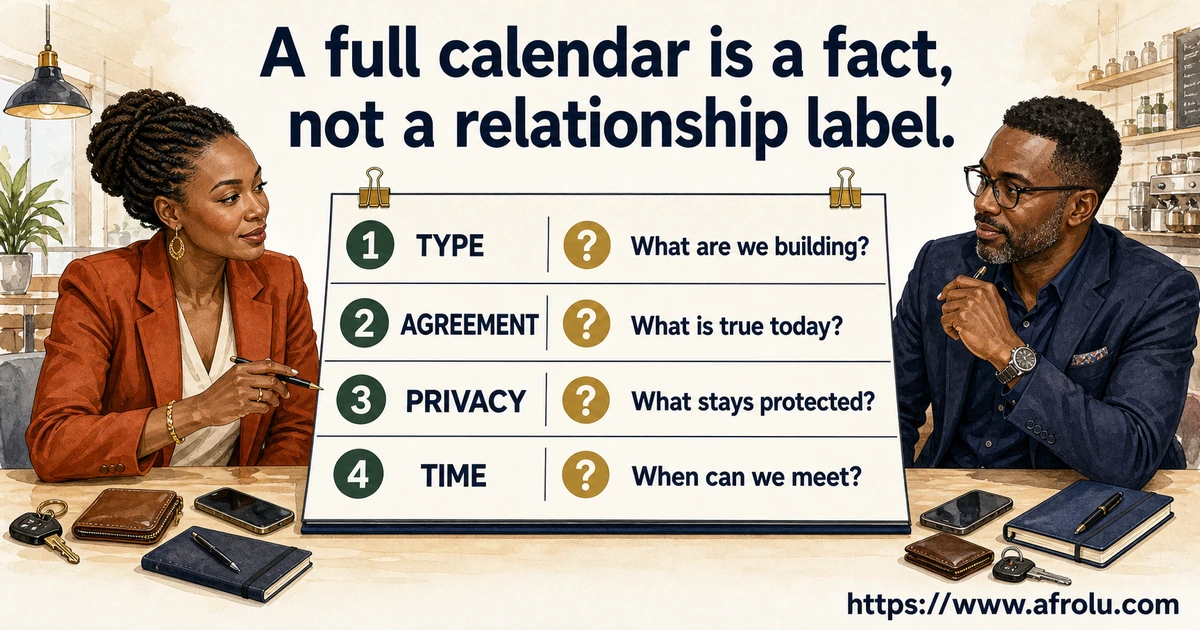
Name four lanes: what this is, what is agreed, what stays private, and when each adult is available.
Written and edited by Grace Mutiso · Kenya Guides Editor
Use four separate lanes. First, name the dating direction, such as casual, exclusive, serious, or still exploring. Second, name the present agreement, including whether either adult dates other people. Third, protect family, home, school, health, and care information. Fourth, name the time each adult can truly offer. A packed week does not prove low interest. A family introduction does not create exclusivity. A helpful gesture does not buy home access. Ask one direct question for each lane, then judge the answer beside later conduct.
Dating basics · Parents Returning To Dating
Which dating decisions have two adults actually made, and which answers are being assumed from a busy calendar or family access?
A dating type describes one part of how adults are relating. Casual dating usually means there is no agreed serious commitment. Exclusive dating adds an agreement not to date other people. Serious dating names a long-term direction, but it does not guarantee a future. Slow dating describes pace, not commitment. Online dating describes a meeting method. Single-parent dating describes life context, not a relationship structure. These labels can overlap because they answer different questions. A working parent might meet online, move slowly, date exclusively, and still delay family introductions. Clear language keeps those answers from collapsing into one.
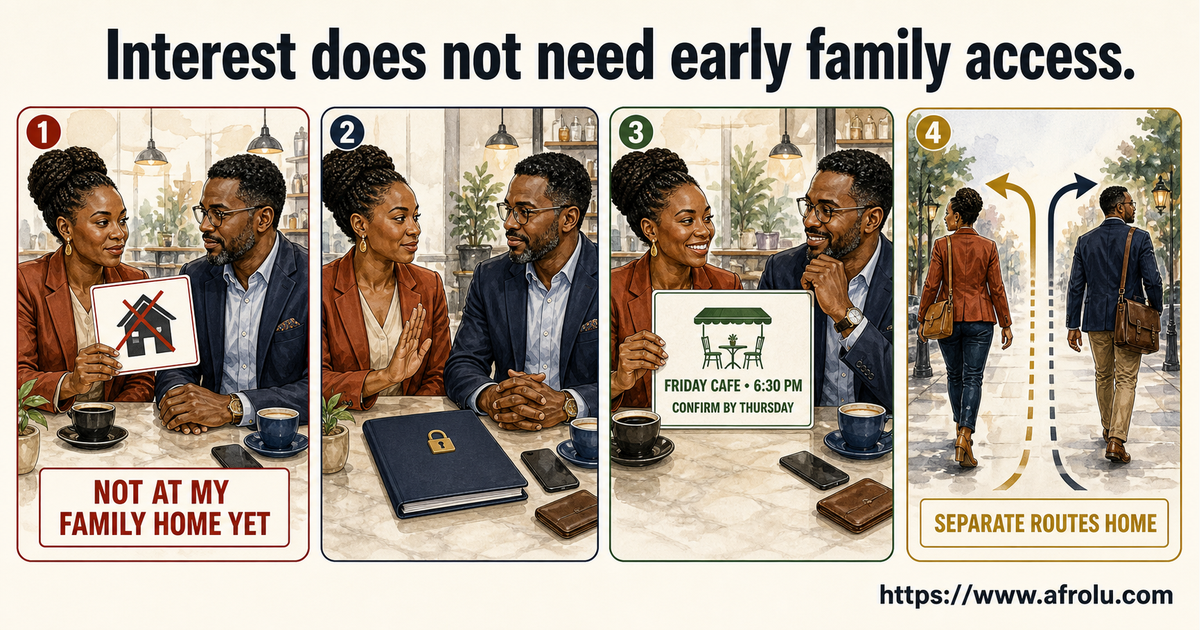
Amina and David are made-up adults used to explain ordinary choices. They are not real people. Amina is 38 and plans regional deliveries. David is 41 and manages a medical laboratory. Both have family responsibilities and changing work weeks. After five dates, David suggests dinner at Amina's home because her Friday became difficult. Amina likes him, yet her home remains family space. She says home visits are not part of early dating. She offers a public cafe near her route the following Friday. David accepts without asking for an address or family proof. They also notice a second missing answer. David has stopped meeting other people, while Amina still understands their dating as open exploration. The scheduling problem did not cause that difference. It merely revealed it. They name the present agreement, keep family access separate, and choose a date to talk again.
The family calendar with four lanes
Keep the adult relationship clear without opening every part of family life
Working parents often solve several problems at once. Dating becomes safer and clearer when four questions stay separate. Each lane can move at a different speed.
Grace reads the page through present facts, freely chosen agreements, protected information, and usable time. Nobody must reveal a child, home, workplace, account, or private schedule to prove affection.
Dating direction
Name whether the adults are exploring, dating casually, dating exclusively, or building toward a serious partnership. Direction is an intention, not a guarantee.
Present agreement
State what is true now. Cover other dates, communication expectations, physical boundaries, sexual-health conversations, and how either adult can change the agreement.
Protected family space
Keep names, photographs, schools, routines, addresses, care arrangements, passwords, documents, and home access private until a separate decision supports sharing.
Usable adult time
Offer honest windows instead of constant access. Confirm one plan, include transport and cost, and release time that remains uncertain after the agreed deadline.
Orientation
Start with four lanes before choosing one relationship label
A working parent's calendar carries work, rest, transport, care, appointments, and family time. It can reveal when a date is possible. It cannot reveal the relationship agreement. Two adults may meet once each month and still have a serious exclusive plan. Two adults may meet every Saturday and remain in open casual dating. Frequency is useful evidence about effort. It is not a substitute for words about direction and exclusivity.
The first lane asks what each adult hopes to build. The answer can be exploration, companionship, casual dating, exclusive dating, or a serious partnership. Honest answers may differ. A difference is information, not a failure. The second lane asks what both adults have agreed today. Future hope belongs in lane one. Present access and obligations belong in lane two. This distinction stops a hopeful future from becoming an invented promise.
The third lane protects family and home information. A date does not need a child's name, school, photograph, timetable, medical detail, or other parent's information. A date also does not need a home address before an adult feels ready. Family introductions should have their own purpose, timing, and boundaries. They should never be used as a test of loyalty or a shortcut around adult uncertainty.
The fourth lane turns a crowded week into a usable offer. Say which evening is open, when confirmation is needed, what cost feels comfortable, and how each person travels home. If that plan fails, repair it without accusing parenthood or work. A new specific offer shows more than constant messages with no meeting. The four lanes make limited time easier to read without punishing either adult for having a full life.
A Friday decision
Amina protects home space without closing the adult connection
Amina's original Friday plan disappears when a family responsibility changes. She does not owe David the private reason. She tells him that Friday no longer works and offers the following week. David suggests visiting her home because it seems convenient. The offer is not automatically wrong. Amina still gets to decide that early dating remains outside her family home. Convenience cannot make a private boundary disappear.
She answers with two facts. Home introductions are not part of their current dating stage. She can meet next Friday at a public cafe near her normal route. David says that works. He does not request the home address, complain about being hidden, or ask for photographs as proof. He confirms by Thursday and arrives through his own transport plan. One respectful response cannot prove permanent character, but it is relevant conduct.
During dinner, they discuss the meaning of five dates. David says he has chosen not to meet other people. Amina says she has not made that agreement. Neither adult treats a private choice as a shared contract. They talk about whether exclusivity fits now. Amina wants two more weeks to decide. David can accept that, decline it, or offer a different boundary. Waiting is not automatically owed because his hope is serious.
They leave with a present answer rather than a dramatic promise. Dating remains open for two weeks. Both will disclose any sexual-health information needed before a relevant choice. No family introduction is planned. They will meet once and talk again on a named date. Their four lanes now contain different answers, yet none is hidden. Clarity lets each adult choose from the real offer instead of the offer they imagined.
Present truth
Build agreements that survive schedule changes and family milestones
An agreement is something both adults understand and choose. It should be simple enough that each person can explain it without guessing. Ask whether either adult dates other people. Ask what contact feels workable between meetings. Ask how plan changes will be communicated. When physical intimacy becomes relevant, discuss consent, sexual health, testing, prevention, and other partners in language suited to the actual choice. A relationship label never replaces consent.
Parent milestones can feel emotionally large. Meeting a sibling, friend, or family member may show growing trust. It does not automatically create exclusivity. Helping with a practical task does not create home access. Paying for dinner does not purchase another date. Being listed as an emergency contact would be a separate serious decision. Every change deserves its own question because the consequence belongs to both adults.
Use a review date when the current answer is temporary. A review date is not a deadline for commitment. It is a promise to exchange updated information. Either adult may decide the present structure no longer fits. The conversation should allow yes, no, not yet, or a different offer. Pressure, repeated bargaining, threats, or punishment make a free answer harder. Pause the decision when freedom is shrinking.
Write down only the adult agreement, not sensitive family details. A simple private note might say that dating is exclusive, weekday replies are flexible, and the next status talk is in four weeks. It should not contain a child's schedule, school, health information, or another caregiver's movements. The purpose is memory, not monitoring. Trust grows through consistent conduct and repair, not through collecting access.
Observable evidence
Read interest through adult conduct, not family or workplace access
Reliable conduct can fit a busy life. An interested adult may offer two possible dates, confirm one, arrive as agreed, and explain a necessary change without sharing private work or family details. A difficult week can reduce contact. The useful question is whether the person returns with a workable repair. Look across several ordinary moments. One perfect date and one missed message are both too small to carry the whole judgment.
Privacy-respecting interest does not compete with a child or mock care duties. It does not demand immediate replies during work. It does not treat a family boundary as evidence of shame. It accepts that introductions happen through a separate decision. It also protects its own limits. Mutual respect means both adults can keep work systems, home information, finances, devices, and existing family relationships outside early dating.
Pressure can arrive dressed as help. Someone may offer to manage a bill, collect a family member, enter a home, or use a work contact before trust supports that access. Gratitude does not require agreement. Use a smaller alternative that preserves control. Meet in public, pay separately, use your own transport, and keep accounts private. If help becomes a reason you owe access, stop and tell a trusted person.
Urgent money requests, account access, one-time codes, identity documents, intimate-image pressure, threats, tracking, or repeated unwanted contact need a safety response. Do not continue a clarity conversation while immediate safety is at risk. Leave, block, preserve relevant evidence, contact a financial provider after a loss, and use suitable local support. A dating-type label cannot make coercive or deceptive conduct safe.

Look for named plans, flexible repair, protected family data, separate money, and a respected no. Pressure is not proof of seriousness.
Words to use
Ask one short question for each family-calendar lane
Begin with direction when the label feels vague. Say what you hope to build and ask what the other adult wants. Do not make a serious answer sound like a demand for immediate commitment. You can want a lasting partnership while still evaluating this connection. You can want casual dating while offering honesty and care. The useful answer describes the present direction without promising a result nobody can know.
Use agreement language for exclusivity. Ask whether either adult is seeing or seeking other people. If the answer differs, decide whether the current structure still fits. Do not infer exclusivity from frequency, sex, gifts, family introductions, or deleted profiles. When sexual choices are relevant, ask the health questions needed for informed consent. A status conversation and a consent conversation support each other, but neither replaces the other.
Use boundary language without presenting parenthood as an apology. Say that family information and home introductions come later for you. You may offer a public adult alternative when one is comfortable. An alternative is not required when you need to decline. The other adult may feel disappointed and still respond respectfully. A boundary is tested by what happens after it is heard, not by how perfectly you explain it.
Use calendar language for time. Offer a real window and a confirm-by point. Include cost, transport, duration, and the return plan when they matter. If care or work changes, communicate the usable fact and offer a repair when possible. Do not promise constant availability to prove affection. A clear small plan gives both adults more information than a week of apologetic messages and no decision.

Ask about the present agreement in plain words. A free answer can be yes, no, not yet, or a different offer.
Practical review
Use four ordinary weeks to decide the next adult step
Choose a short period that includes ordinary life. Four weeks is an example, not a universal rule. Record only adult dating facts. Note whether direction was named, plans became specific, changes were repaired, boundaries remained intact, and the effort felt mutual. Do not record private messages, live locations, or family movements. The purpose is to reduce emotional fog, not to build a surveillance file.
At the review, compare the present offer with your needs. Maybe open exploration still fits. Maybe both adults want exclusivity. Maybe one wants serious direction while the other wants occasional companionship. A mismatch can be sad and still clear. Do not promote the relationship merely because time was invested. Do not end it merely because one busy week looked untidy. Use the repeated pattern and the response to direct questions.
If the connection continues, select one next adult step. It might be a confirmed date, a new contact rhythm, a sexual-health conversation, or a status update. Family introduction is only one possible step. It should not appear automatically. Ask why an introduction would help, what role the person would have, which information stays private, and how the meeting can remain low pressure. Not yet is a complete answer.
If the connection ends, close the adult channel without recruiting family members into the conflict. Return belongings through a safe method. Remove access that no longer fits. Change passwords when access was shared. Seek support if contact becomes threatening, deceptive, or persistent. A respectful ending does not require a trial about every missed date. It requires a clear decision, proportionate safety, and freedom for both adults to move forward.

Review what was named, kept, repaired, and protected. Choose one next adult step without increasing family access by default.
Do not merge these
Compare dating direction with availability, exclusivity, and family access
A dating direction explains what an adult hopes to build. Availability explains when that adult can meet. A parent with two open evenings may want a serious partnership. A parent with several open weekends may want casual dating. Time cannot rank those choices. The respectful question is whether the offered structure fits both adults and leaves room for freely chosen boundaries.
Exclusivity is a present agreement. Serious intent is a direction. Some adults date exclusively while deciding whether long-term fit exists. Others pursue a serious goal while still meeting several people during early exploration. Neither arrangement should be hidden. Ask directly before acting on an assumption. If exclusivity matters to your sexual-health or emotional choices, say so before the relevant decision.
Family access is a boundary and relationship-stage decision. It may happen before or after exclusivity, depending on the adults and family context. An introduction does not assign a parenting role. It does not grant home access, emergency authority, financial responsibility, or permission to contact another caregiver. Those are different decisions with different consequences. Keep the early purpose modest and the private information limited.
Future commitment is another step. A conversation about living arrangements, marriage, or combined finances needs far more evidence than a warm family meeting. Do not use hope to rush practical integration. Do not use parent status to demand a faster promise. Each adult can examine values, repair, money habits, care expectations, location, and safety over time. Clear separation protects children and also gives the adult relationship room to become real.
Eight working-parent moments where the four lanes prevent confusion
Lillian's night shifts leave one reliable Sunday window
Lillian is 44 and works changing hospital shifts. Kojo is 47 and has a weekday office schedule. Their messages are brief during her work blocks. Every Tuesday, Lillian offers one Sunday window. Kojo confirms or declines by Thursday. They are dating seriously and exclusively, although they meet less often than several casual couples they know. Their agreement comes from direct words and conduct. Message volume does not decide it.
Judge the named agreement and reliable offer. Do not use constant access as the seriousness test.Musa meets one friend, not the whole family system
Musa is 35 and co-parents. Ruth is 37 and leads construction projects. Musa invites Ruth to a public lunch with one trusted adult friend. He explains that this is not a family introduction or parenting step. Ruth accepts the modest purpose. They remain in open exploration. The meeting gives each adult social context, but it does not change exclusivity, home access, or family contact.
Name the purpose before the meeting and restate the agreement afterward if the meaning could drift.Tayo protects an older relative's health information
Tayo is 33 and helps an older relative. Zuri is 36 and works in communications. A care emergency cancels their second date. Tayo shares only that a family matter needs attention. Zuri does not demand a diagnosis, address, or photograph. Tayo offers a new date after the situation settles. Their example shows why the four-lane method also serves adult caregivers who are not parents.
Share the scheduling fact. Keep another person's private information outside the dating explanation.David has stopped dating others, while Amina has not agreed
David privately decides to focus on Amina after five dates. He tells her without presenting his choice as a debt. Amina says she remains open to other dates and needs time before exclusivity. David can continue under that structure or leave. He cannot turn his private decision into her promise. They set a date for another conversation and keep sexual-health choices informed meanwhile.
Convert an assumption into a present question. Let each adult choose from the actual answer.Nala and Jo replace a cancelled weekend with a smaller plan
Nala is 40 and travels for technical training. Jo is 42 and has a changing care schedule. Their planned weekend disappears. Neither accuses the other of weak interest. They choose a ninety-minute public lunch two weeks later. They keep their exclusive agreement unchanged. A smaller date repairs the calendar without pretending that every lost weekend is harmless. Repeated cancellations would need a wider review.
Repair with a specific plan, then watch whether disruption becomes a repeated one-sided pattern.Miriam delays a home visit and Sade keeps listening
Miriam is 43 and Sade is 39. They have dated for three months. Sade feels ready to visit Miriam's home. Miriam does not. Sade says she feels disappointed, yet she does not bargain, threaten, or ask for private proof. They plan a quiet restaurant date instead. Sade's feeling is valid. Miriam's boundary also remains valid. Respect is visible in what neither adult tries to force.
Allow honest feelings without turning them into leverage. Choose another adult setting when both want one.Omar declines control of Wanjiku's household bill
Omar is 45 and Wanjiku is 41. Wanjiku mentions an expensive repair while explaining her limited dating budget. Omar offers to take over the bill after four dates. Wanjiku declines and suggests a free walk instead. Omar accepts. If he had tied money to home access, gratitude, or continued dating, the offer would have become pressure. Separate finances keep the next choice free.
Keep early financial problems separate. Choose an affordable date rather than creating a private debt.Esi wants casual companionship and Peter wants a family partnership
Esi is 46 and wants occasional adult companionship without integrating homes or families. Peter is 48 and wants a serious partnership with eventual family integration. Both offers can be honest. They do not become compatible through chemistry or a flexible calendar. After two dates, they thank each other and stop. The ending protects both adults from months spent waiting for the other direction to change.
Treat a clear direction mismatch as decision-ready information, not a project for persuasion.Ten signs that clarity and privacy can coexist
Both adults can describe the current dating direction in similar plain words.
Exclusivity is answered directly rather than inferred from frequency, sex, gifts, or profile changes.
A changed care or work plan receives a specific repair instead of blame or endless uncertainty.
Family names, photographs, schools, routines, addresses, and health details remain protected.
Home access and family introductions happen through separate choices with a clear purpose.
Neither adult uses money, help, transport, or gifts to purchase access or continued contact.
Work devices, calendars, client information, passwords, and location data stay private.
A no, not yet, or different offer is heard without bargaining, punishment, or threats.
Sexual-health and consent conversations happen before the relevant choice and can be updated.
The dating structure can be reviewed or ended without recruiting children or family members into conflict.
Choose from the event in front of you, not the feared story
| Situation | What it may mean | What to do next |
|---|---|---|
| Replies become brief during a demanding work or care week. | Limited capacity is one plausible explanation. It does not prove fading interest or continued commitment. | Ask for one usable contact or meeting window. Judge the specific answer and later follow-through. |
| Dates happen regularly, but exclusivity has never been discussed. | Frequency shows a pattern of time. Each adult may still assign a different relationship meaning. | Ask whether either adult is dating others and what agreement would fit now. |
| A date asks to move the meeting into the family home for convenience. | The request may be practical, but it also increases private access and changes the setting. | Decline when needed. Offer a public alternative only when you genuinely want one. |
| One adult meets a friend or relative and assumes the relationship became serious. | The introduction may show warmth or context. Its meaning was not necessarily shared. | Name what the introduction did and did not change. Ask the separate status question. |
| A date offers money for a household problem very early. | The offer may be generous, controlling, deceptive, or simply too entangling for the stage. | Keep finances separate. Never share account access, codes, documents, or control as proof of trust. |
| A parent declines a family introduction and the other adult feels hidden. | The adults may have different readiness, privacy needs, or ideas about what introduction means. | Discuss the feeling and purpose without forcing access. Decide whether the present boundary still fits both. |
| One adult chooses exclusivity privately and expects the other to match it. | A personal choice is being mistaken for a shared agreement. | State the choice, ask the question, and allow a free answer without claiming repayment. |
| Several plans are cancelled, but warm messages continue. | Real responsibilities may be present. Warmth alone still cannot create a workable relationship. | Ask for one specific repair. If none appears, choose the relationship that is actually available. |
| A date asks for school, care, work, or live-location details to feel secure. | The request turns reassurance into access to private people, places, or systems. | Do not share. Offer a limited adult plan or leave when pressure continues. |
| Future talk grows, but present agreements remain vague. | Hope may be creating emotional momentum without current responsibility. | Return to what is true today. Name the next observable step and a date to reassess. |
Ten plain sentences for direction, family boundaries, and time
“I am dating with a serious partnership in mind. I am still learning whether we fit. What are you hoping to build?”
“I do not want to assume from our regular dates. Are either of us still seeing or seeking other people?”
“I keep family names, routines, photographs, and addresses private during early dating.”
“I am not ready for home visits. I can meet at the cafe on Friday if that works for you.”
“Wednesday from seven to nine is the time I can truly offer. Shall we confirm by Tuesday evening?”
“A family responsibility changed tonight's plan. I cannot meet. I can offer next Thursday instead.”
“I hear that you want exclusivity now. I am not ready to agree today. Does open dating still fit you?”
“Thank you for offering. I keep household money separate from early dating. Let us choose a free plan.”
“Before any introduction, I want us to agree on its purpose and what role it does not create.”
“You want family integration, and I want occasional companionship. Neither offer is wrong, but they do not fit.”
Know the difference
Dating direction is not the same as family access
The adults name whether they are exploring, casual, exclusive, or moving toward a serious partnership. This answer describes their relationship intention and present structure.
An adult decides when a date may enter a home, meet family, receive private information, or hold a practical role. Access can stay limited inside any dating direction.
A family introduction may be meaningful. It still does not create exclusivity, authority, financial responsibility, home access, or a promised future unless separate decisions support those changes.

Do not use one event to answer five questions. Name each decision, respect not yet, and update agreements through conversation.
Dating direction and family access answer different questions
| Type or dimension | What it describes | Best next question |
|---|---|---|
| Casual dating | Adults date without an agreed serious commitment. Honesty, consent, sexual-health choices, money, privacy, and endings still need care. | Ask what casual permits, excludes, and requires today. |
| Exclusive dating | Adults agree not to date other people while continuing to learn whether a longer partnership fits. | Define other contact, relevant health disclosure, and when the agreement will be reviewed. |
| Serious dating | Adults state a long-term partnership direction. Present conduct and practical fit still need evidence over time. | Name the next present action instead of treating future hope as a guarantee. |
| Slow dating | Adults choose a deliberate pace for knowledge, trust, or integration. Slow describes pace, not commitment. | Agree on visible progress and a date to discuss whether the pace still serves both adults. |
| Online dating | An app or website is the meeting channel. It does not define exclusivity, seriousness, safety, or compatibility. | Move through identity checks, limited sharing, a public meeting, and a clear adult agreement. |
| Long-distance dating | Geography shapes calls, visits, cost, and future-location questions. The relationship can still be casual, exclusive, or serious. | Separate the distance plan from the direction and exclusivity answers. |
| Single-parent dating | Parenthood is life context. It changes privacy, scheduling, and integration decisions without defining the relationship structure. | Protect family information and ask the same direct adult agreement questions. |
| Family introduction | This is a boundary and relationship-stage decision, not a dating type or automatic promotion. | Name the purpose, information limits, setting, duration, and role the meeting does not create. |
The four-lane answer for working parents
A label should answer one useful question
Casual, exclusive, and serious describe relationship direction or agreement. Slow describes pace. Online describes a meeting method. Parent describes life context. Ask which question a label answers before using it to make a decision.
Limited availability is not low value
Care and work can create narrow meeting windows. The relevant evidence is whether an adult offers honest time, keeps plans, repairs changes, and communicates the structure without demanding constant access.
Family privacy protects people outside the date
Another person's name, image, school, health, location, or care routine is not yours to trade for reassurance. Share only what supports the adult plan and belongs to you.
Introductions need a purpose
Meeting a friend or relative can add context, but it should not assign a parenting role or create authority. Decide what the meeting means, what remains private, and what happens afterward.
Help is safest when no access is purchased
A gift, ride, meal, or favour should not purchase attention, home entry, passwords, family contact, sex, or continued dating. Keep early finances and essential systems under your control.
A review date protects honest change
People learn new information and may need a different structure. A named review makes change discussable without pretending every agreement is permanent or every uncertainty must remain open.
Twenty questions for clearer adult choices
Choose a few prompts that fit the moment. This is a reference library, not a list to complete.
Questions about direction
Use these before a repeated dating pattern begins answering for both adults.
- What kind of relationship are you hoping to build now?
- What does casual, exclusive, or serious mean to you?
- Which answer is true today, and which answer is only a hope?
- Are either of us seeing or seeking other people?
- When should we discuss this structure again?
Questions about family privacy
Keep the purpose narrow and never request another person's private details as reassurance.
- Which parts of family life stay private during early dating?
- What would a first introduction mean, and what would it not mean?
- Is a public adult alternative better than a home meeting?
- Which photographs, locations, and schedules should never be shared?
- How will we respond if either adult says not yet?
Questions about work and time
Build a real offer without opening work systems or care routines.
- Which date window can each of us honestly hold?
- When should the plan be confirmed or released?
- How much time, travel, and cost can this date use?
- What repair can we offer when work or care changes?
- Does the current rhythm leave both adults with rest and choice?
Questions for a four-week review
Use observable adult conduct and leave private systems closed.
- Were our direction and agreements clear enough to repeat?
- Did specific plans and fair repair appear?
- Did family, work, device, and money boundaries remain intact?
- Could each adult say no or ask for change freely?
- What is the smallest useful next adult step?
Six evidence notes with their limits kept visible
Parent is context, not a relationship model
Single-parent or caregiver dating describes a life situation. It does not tell you whether the connection is casual, exclusive, serious, monogamous, open, local, or long-distance. Treating parent status as a complete dating type hides the agreement questions that matter. Begin with the same adult clarity used elsewhere, then add privacy, care, and integration choices suited to the context.
Evidence limit: No guide can decide a suitable family-introduction timeline for every household. Context and safety vary.
Responsiveness is wider than reply speed
Research on intimacy often examines disclosure and perceived partner responsiveness. That does not create a required texting rate. A working caregiver may respond through a kept plan, careful listening, a later repair, or respect for a boundary. Read the whole exchange. Do not demand access through work or care hours merely because immediate replies feel reassuring.
Evidence limit: Communication studies describe patterns in particular samples. They do not calculate one correct contact rhythm.
Agreements need direct communication
Research on relationship agreements in specific populations supports the value of communication, but it does not define every couple. Afrolu uses a narrower lesson: do not infer agreements from appearances. Ask what is allowed, expected, disclosed, and reviewable. Consent must remain specific to each activity, even when the relationship label sounds committed.
Evidence limit: Evidence from one population cannot be presented as a universal rule for all parents or relationship structures.
Online is a meeting channel
Survey and population research can show that adults meet online for varied reasons. It cannot tell one reader which relationship a match wants. An app profile may name serious dating and still require a direct conversation. Move from profile claims to limited sharing, identity checks, a public meeting, clear agreements, and conduct across time.
Evidence limit: U.S. survey findings describe their respondents. They do not establish one global parent-dating pattern.
Sexual health belongs in the present agreement
When sexual activity becomes relevant, adults need a respectful conversation about consent, other partners, testing, prevention, and any information needed for an informed choice. A serious direction does not answer those questions. Neither does exclusivity unless its meaning is explicit. Use qualified local healthcare for individual advice, testing, symptoms, or prevention decisions.
Evidence limit: This guide provides general communication guidance and cannot replace personal medical care.
Urgency and money deserve a separate safety response
Consumer protection guidance warns that romance fraud can involve trust-building followed by money requests. A parent or caregiver may feel pressure because the request sounds connected to work, travel, health, or family. Do not send money, share financial access, or move funds for a new date. Verify independently. Contact a financial provider quickly after a suspected loss and use suitable reporting support.
Evidence limit: A warning pattern does not prove a crime. Immediate risk and financial loss need qualified local support.
Six shortcuts that make parent dating harder to read
Calling every schedule problem rejection
A changed week can be real. Ask for a specific repair, then judge whether clear alternatives appear over time.
Treating frequency as exclusivity
Regular dates show time and effort. Exclusivity exists only after both adults understand and choose the agreement.
Using a family meeting as a status announcement
An introduction can mean warmth, convenience, or context. Its purpose should be named before wider promises are inferred.
Overexplaining private care details
A date needs the scheduling fact, not another person's diagnosis, address, school, timetable, or family conflict.
Accepting financial entanglement to prove trust
Early money control can reduce freedom and increase risk. Choose an affordable plan while accounts and essential bills remain separate.
Promising family access to prevent an ending
Access offered under fear is weak evidence of readiness. Let the mismatch be visible and keep the boundary intact.
Use a reviewed resource that matches the decision
This guide focuses on the relationship decision, so it does not rank dating apps. Check current prices, safety tools, and local availability before choosing a service.
Explore the guide library
Show more related guides
Continue with Afrolu
Show more Afrolu guides
Sources used for meeting paths, agreements, safety, and health context
Afrolu reviewed these health, research, safety, or public guidance resources while editing this page. They support the behaviour and safety guidance; they do not diagnose any individual described by a reader.
Working-parent dating types: clear answers
What is the best dating type for a working parent?
There is no single best type. The useful structure is the one both adults understand and freely choose. Casual, exclusive, serious, slow, local, and long-distance dating can each fit some adults. Name the present direction, exclusivity, time, privacy, money, consent, and family boundaries. Then decide whether the real offer supports your needs and responsibilities.
Does dating every weekend mean we are exclusive?
No. A regular weekend pattern shows that time is being offered. It does not create exclusivity. Ask whether either adult is seeing or seeking other people. Define what exclusivity means, which disclosures matter, and when the agreement will be reviewed. A deleted profile, physical intimacy, gifts, or repeated dates also cannot replace that conversation.
When should a parent introduce someone to family?
No universal date count can answer that question. Consider trust, stability, purpose, privacy, the household context, and how the adult handles boundaries. Keep the first purpose modest. An introduction should not assign authority, access, financial responsibility, or a future role. Not yet is a valid answer even inside serious dating.
Should I explain every care or work conflict to prove interest?
No. Share the usable scheduling fact and any information that belongs to you. Do not disclose another person's health, school, address, movements, or private history. You can say that a family responsibility changed the plan. Offer a specific repair when possible. The response to your limit gives useful evidence about respect.
Can serious dating move slowly for parents?
Yes. Serious describes direction, while slow describes pace. The pace should still contain visible movement, honest answers, and a way to review fit. A slow structure becomes unhelpful when one adult waits indefinitely while plans, effort, or present agreements remain unavailable. Name the next small step and when both adults will talk again.
What if one parent has much more free time than the other?
Equal free hours are not required. Mutuality can appear through fair planning, travel, cost, communication, flexibility, and repair. Neither adult should remain permanently on standby. Build around time both can honestly hold. If the available relationship remains too small for one person, that is a fit decision rather than proof that either adult is bad.
Is it safe to accept help with household bills from a new date?
Early financial entanglement can reduce freedom and create risk. Keep essential bills, accounts, codes, documents, and financial control separate. Choose a lower-cost date instead. Never send money, move funds, or share account access because a romantic story feels urgent. Contact a financial provider quickly if you suspect a loss.
How can I say that my home is not available for dates?
Use a short direct sentence. Say that home visits are not part of your current dating stage. Offer a public alternative only when you want one. You do not need to reveal family routines or defend the boundary. Disappointment is possible. Repeated bargaining, ridicule, tracking, threats, or uninvited arrival need a stronger safety response.
Does exclusivity give someone access to my family calendar?
No. Exclusivity limits dating with other people according to the shared agreement. It does not grant passwords, live location, work calendars, school details, home entry, or contact with family members. Share only the scheduling information needed for the adult plan. Access should grow through separate choices with a clear purpose and easy boundaries.
When should working parents end a dating mismatch?
End when the present offer does not fit and further discussion is unlikely to change that fact. A clear mismatch may involve direction, exclusivity, available time, family integration, money, consent, or safety. You do not need to invest more months to justify leaving. Use a clear adult ending, protect private access, and seek support when contact becomes threatening or persistent.
One thing to do now
Keep the family protected and make the adult agreement visible
Ask the question that matches the decision. Use direction words for long-term intent. Use agreement words for exclusivity and sexual-health choices. Use boundary words for family, home, work, devices, money, and time. Use calendar words for a real meeting. Then compare the answer with conduct across ordinary weeks. Do not ask family access to prove seriousness.