New beginnings · low-pressure dating · weekend
A Low-Pressure Weekend Date When You Are New to Dating
New to dating or returning after a pause? Plan a short public weekend date, share only what feels relevant, discuss present intent, and choose your next step.
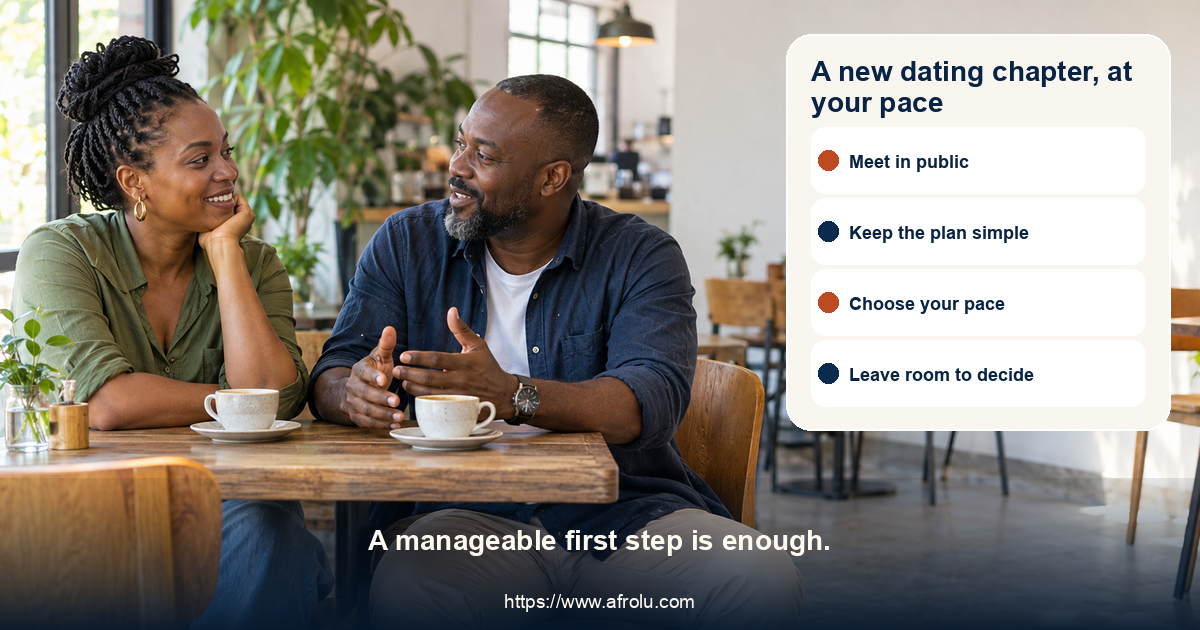
Choose an affordable first meeting with a clear end.
Written and edited by Miriam Otieno · Senior Kenya Editor
Choose a short public plan that fits both budgets and leaves each adult an independent way home. You can be honest about what you want today without explaining your full history or promising a future. Ask and answer questions naturally, keep personal details private, and decide afterward whether you want another date, a pause, or an ending.
Dating basics · New Relationship Starters
How can I plan a first or return-to-dating weekend date that feels low-pressure while keeping intent and boundaries clear?
Low-pressure dating for a new or returning adult is a deliberate way to meet people through manageable plans, present-tense honesty, mutual curiosity, and boundaries that leave each person free to continue or stop.
Asha, 34, is trying in-person dating after several years focused on work and family. She is curious about a relationship but does not want to turn the first meeting into a decision about her future. She suggests a Saturday coffee near a familiar route, keeps her own transport, and says she would like to take things one step at a time. They talk about weekends and relationship goals without exchanging full histories. After an hour, Asha notices she enjoyed the conversation but wants time to reflect. She can send a direct follow-up later, or leave the connection there; neither choice makes the date a failure.
new beginnings · first dates · personal pace
Make room for curiosity without putting yourself on trial
Beginning or returning to dating does not require a perfect performance or a full personal history.
Plan a manageable public meeting, share present intent, and let your own experience guide the next step.
What feels manageable?
Choose a small next step rather than a life verdict.
Can you leave easily?
Set a public venue, a time window, and your own route.
What is true today?
Be honest without promising a future you cannot know.
Would you like another date?
Decide from comfort and interest, not a dating script.
new season · agency · self-definition
A new dating chapter does not need an explanation
Asha is trying an in-person date after spending years focused on work and family. She says she is new to this routine but does not describe every reason. The person she meets can ask a considerate question, and she can decide how much to answer. Her history is hers to disclose when useful, not an entry fee.
You can be honest about current intent without presenting a complete biography. “I would like to meet someone and see how we get along; I am not deciding on a relationship label today” is enough context for an initial date. If another adult needs a different pace, that is compatibility information rather than proof that you are doing dating incorrectly.
People may feel pressure to compensate for limited experience by agreeing to more time, affection, or personal disclosure than they want. Resist turning the date into a performance review. Curiosity can be mutual and ordinary: ask what the other person enjoys, share something you genuinely like, and allow quiet moments without treating them as a failure.
If a past relationship, bereavement, health change, or family situation affects the choices you are making now, share the practical part when it becomes relevant. You do not owe a stranger a chronology. Keep the conversation truthful, avoid misleading someone about a current commitment, and let trust develop through consistent choices rather than rapid disclosure.
first meeting · time · affordability
A good first plan can be short, public, and easy to finish
Asha suggests meeting at a familiar cafe on Saturday afternoon for about an hour. They agree to meet there rather than arranging a pickup. If conversation flows, they can choose whether to extend the date; if either needs to leave, the original plan still has a clear end. No one has to manufacture an excuse.
Choose a place both adults can reach and afford, and be specific about the meeting point and approximate finish. Keep your phone charged and your return route independent. Let a trusted person know the broad plan if that is helpful. These practical steps preserve choices, but no venue or checklist can guarantee another person's behavior.
Avoid letting a match convert a public plan into a private home, car ride, or unfamiliar second venue at the last minute. You can decline the change and keep the original arrangement, reschedule, or leave. Money, travel, and preparation already spent do not create an obligation to stay longer or agree to physical intimacy.
If cost is a concern, propose a simple plan without apologizing for it. Paying for a date is not a test of generosity or seriousness, and accepting a coffee does not create a debt. Agree on who covers what before a costly activity; choose another option if either person's budget would make the date stressful.
pace · relationship direction · present terms
Low pressure still leaves room for direct questions
Asha tells her date she is open to a committed relationship if compatibility grows but wants to meet a few times before deciding whether they are a match. Her date says he is looking for exclusivity now. They have learned something important even if they do not continue; neither person needs to persuade the other that one pace is superior.
Try separating future hopes from today's arrangement. Wanting a partnership someday does not establish exclusivity with a person you have just met. Likewise, a first date does not require someone to promise a second. Ask what a label would change in practice: dating others, contact, physical boundaries, or plans with family and friends.
If you do not know your answer yet, name a reasonable point to revisit it only if both people want another date. Do not offer a timeline you cannot predict to keep someone interested. The other adult can choose not to wait, and you can decide that their requested pace does not fit your own comfort or capacity.
Be attentive when “no pressure” is followed by repeated requests for a label, overnight stay, private photos, money, or a promise to stop seeing other people. You do not need to identify a motive before setting a limit. Restate what you are comfortable with and decide what you will do if that answer is not respected.
conversation · listening · mutuality
Conversation works better as exchange than as a checklist
When Asha asks what her date likes about weekends, he mentions visiting a market and seeing cousins. She shares that she prefers a quieter morning after a busy week. Their answers reveal a difference in energy without turning it into a verdict. They can ask whether there is an activity they would both enjoy.
Useful early topics are ordinary and revealing: how someone likes to spend free time, what kind of communication feels comfortable, whether they are looking for a relationship, and what a good weekend means to them. You do not have to cover every subject during one meeting. Notice whether questions and attention move in both directions.
Avoid treating confidence, silence, eye contact, or a particular style of humor as a universal signal of attraction. People communicate differently, and a first meeting can be tiring. If you are unsure, ask a direct, low-pressure question such as whether they would like to meet again, then accept the answer rather than decoding every pause.
A boundary can be conversational too. “I would rather not talk about my previous relationship on a first date” is clear and does not accuse the other person. A respectful response makes it easier to continue talking; irritation, mockery, or a demand for details is useful information about how that person handles a small limit.

Notice whether attention and questions move both ways.
privacy · consent · practical safety
A pleasant date does not remove the need for boundaries
Asha shares the cafe name but not her home address. She arranges her own transport and tells a friend when she expects to be back. If the other person offers a ride, she can decline without making a judgment about his character. Her plan is about keeping options, not accusing anyone or guaranteeing an outcome.
Consent applies to each physical choice and can change. A good conversation, an accepted drink, a second date, a kiss, or a previous relationship does not decide what someone wants next. Ask clearly, listen for the response, and stop when the answer is no, uncertain, or withdrawn. The same standard protects both adults.
Do not share intimate images or record a private conversation without permission. A request for money, investment, a gift card, account access, or an urgent transfer is a reason to pause and verify independently. Consumer warnings from another country can explain common patterns, but their complaint channels and protections may not apply locally.
If contact becomes threatening or unwanted, preserve messages and profile details when safe, use the platform's reporting and blocking controls, and ask a trusted person or appropriate local service for support. Reporting steps differ by place and circumstance. You are not required to manage a threat alone or to continue speaking with someone who ignores a clear request to stop.

A boundary can be simple and does not need a long defense.
reflection · follow-up · choice
After the date, review how you felt rather than how you performed
Asha enjoys the conversation but realizes she felt relieved when the hour ended. She does not need to label the other person a bad match to decide against another date. If she is interested, she can send a short message and suggest a specific next plan. Either response is enough; she does not need a strategic delay.
If you want to meet again, communicate that plainly and propose a low-stakes next step. If you are unsure, it is fair to say you would like time to think, without implying a promise. If you do not want another date, a brief kind message can close the loop where that feels safe; you do not owe a debate or detailed critique.
Do not use a checklist to decide whether one awkward moment predicts the entire relationship. Look for patterns across meetings: reliability, respect for boundaries, balanced effort, and whether you can disagree without punishment. One date may tell you little, and that is acceptable. The goal is a thoughtful next decision, not instant certainty.
If the experience stirred anxiety or disappointment, take a break before booking another date. Talk with a trusted person if useful, but do not let someone else set a deadline for your romantic life. Starting slowly is compatible with hope; it simply gives your own preferences enough room to become clearer.

Choose another date, a pause, or an ending based on how it felt.
capacity · boundaries · next step
A sustainable dating life leaves room for the rest of your week
Asha chooses one first date on some weekends and leaves other Saturdays unplanned. She checks messages after work rather than throughout the day and takes a week off when she feels overloaded. That rhythm is not a universal prescription; it is a current boundary she can explain and adjust if she wants.
Notice whether you are saying yes because you are interested or because you fear another opportunity will not appear. Fear can push a person to ignore a budget, accept an unsuitable pace, or disclose more than feels right. Pause long enough to decide what you want from this specific interaction, rather than dating according to scarcity.
If you are returning after a difficult experience, give yourself permission to use practical supports: a public venue, a friend who knows the plan, a clear end time, or an app break. These steps support agency; they do not shift responsibility for harmful behavior onto the person dating. Get qualified support if a health, legal, or emotional concern needs more than general guidance.
Choose one next action: send a friendly follow-up, ask a question about intent, schedule a short public date, update a privacy setting, or take a pause. Small choices compound into a dating process that belongs to you. You are not behind, and there is no relationship milestone you must reach to justify being treated with respect.
Eight moments that can make a first date feel bigger than it is
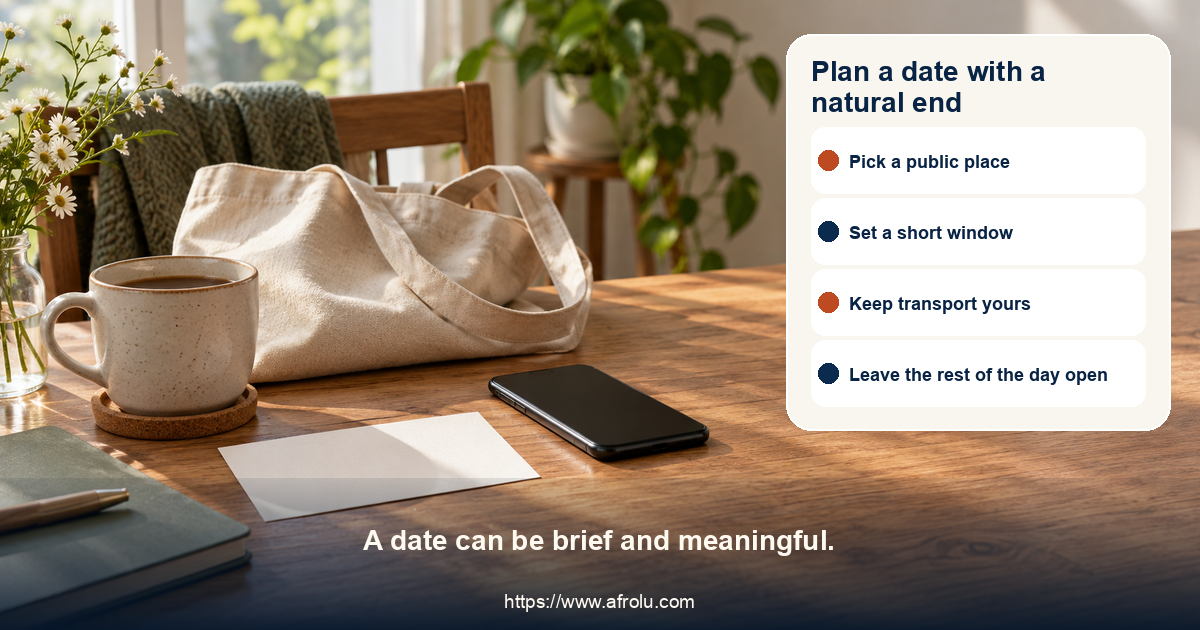
A date asks for the whole backstory
A new match presses Asha to explain why she has not dated recently.
Share only the context relevant to today's choice and decline the rest.A short coffee is extended into the evening
One person assumes that a good conversation means the other has no plans.
Check whether both want more time and preserve an easy way to leave.An expensive venue is presented as proof of effort
The proposed plan is outside one person's weekend budget.
Suggest a lower-cost public option without apologizing for it.A first date is treated as an exclusivity decision
One adult expects a commitment before either has decided about a second meeting.
State what you know today and what you are not deciding yet.Questions feel like an interview
A rapid sequence leaves little room for mutual sharing or pauses.
Ask one open question, answer it yourself, and follow the conversation.A match asks for an address to arrange pickup
The request arrives before the adults have met and built trust.
Meet at the public venue and keep your home details private.A pleasant date is assumed to mean physical intimacy
One person treats time or money spent as an expectation of affection.
Name the boundary and remember that each choice needs current consent.A person delays a reply to appear more desirable
Both adults want another date but wait for a supposed dating rule.
Send a clear message when you are ready; accept the response.Fourteen signs that a new dating pace leaves room for choice
The reader can describe a present preference without explaining an entire history.
The first plan is public, affordable, and mutually chosen.
Each person knows approximately when the date will end.
Either adult can decline a venue change or extension without punishment.
Conversation includes reciprocal questions, answers, and room to pass.
Relationship direction is discussed without forcing instant certainty.
No one treats limited experience as permission to set the other's pace.
A home address, account code, and full work routine remain private early on.
Each person controls their own transport and return plan.
Date costs are discussed without a test of generosity or seriousness.
Consent is asked about in the moment and can be withdrawn.
A request for money or account access is independently questioned.
A follow-up is direct without pretending certainty that is not there.
A break from dating is available without being called a failure.
A map for questions about pace, privacy, cost, and follow-up
| Situation | What it may mean | What to do next |
|---|---|---|
| I am new to dating | You may want more time, but no single pace follows from that fact. | Name what feels comfortable for this particular meeting. |
| They ask about my past | They may be curious, though you control personal disclosure. | Share a relevant piece or say you would rather not discuss it yet. |
| The venue feels too costly | The plan may not fit your budget or preferences. | Offer a public lower-cost alternative or decline. |
| I like them but feel uncertain | Interest and certainty do not have to arrive together. | Choose whether you want another small step or a pause. |
| They want exclusivity now | Their preferred timing may differ from yours. | State your current answer without promising a future change. |
| They suggest a private second location | The plan has changed and your options may have changed too. | Keep the original venue, leave, or reschedule. |
| I am nervous about conversation | The date may feel unfamiliar rather than incompatible. | Try one open question and allow ordinary pauses. |
| They ask for my address | They may be offering transport, but exact home details are optional. | Meet independently at the public place. |
| I want another date | A direct invitation can reduce unnecessary guessing. | Say so and suggest a simple plan. |
| I do not want to continue | A mismatch is enough reason; you do not need a serious fault. | Close kindly if safe, then disengage. |
Twelve ways to say what you want without a performance
“I am happy to meet, and I prefer to take one step at a time.”
“I would rather talk about what I want now than give my full dating history today.”
“I am open to a relationship if we fit, but I am not deciding that on a first date.”
“Are you dating other people right now, or looking to agree on exclusivity soon?”
“Could we meet at the cafe near the station for an hour?”
“That place is outside my budget; would you be up for a simpler coffee instead?”
“Thanks, but I will meet you there and arrange my own way home.”
“I am curious what a good weekend looks like for you. Mine is usually quieter.”
“I am not ready to discuss that; I would rather switch topics.”
“Would you like to kiss, or would you rather leave it here for today?”
“I enjoyed talking and would like to meet again. Are you interested?”
“Thank you for meeting. I do not feel a match, so I am going to leave it here.”
Know the difference
A manageable first step versus treating the date as a performance test
The adults choose a public, affordable plan, ask and answer at a natural pace, and decide later whether another meeting suits them.
One person is expected to disclose everything, stay longer, perform confidence, or promise a relationship before they know what they want.
A small honest step can reveal more than a high-pressure performance.

Notice the difference between curiosity and pressure to prove readiness.
Curiosity and clear limits versus pressure to prove readiness
| Type or dimension | What it describes | Best next question |
|---|---|---|
| Short coffee | Easy to time-box and often affordable. | Choose a public place and agree on a start time. |
| Daytime walk | Conversation unfolds while moving, but weather and access matter. | Pick a busy route and a clear meeting point. |
| Public event | A shared activity can ease conversation but may limit private discussion. | Agree on how long to stay and how to leave separately. |
| Long meal | More time and cost can create pressure to continue. | Use only if both adults want the duration and budget. |
| Video call | Can be a lower-travel first step while still requiring privacy. | Use a channel that does not expose accounts or location. |
| Group gathering | May reduce one-to-one pressure but can obscure romantic intent. | Clarify whether it is a date and who else will attend. |
| Home visit | Less public and harder to leave; usually not needed for an early meeting. | Choose a public venue if either person prefers it. |
| Second date | A chance to learn more, not an automatic commitment. | Decide whether interest and comfort are both present. |
| Pause | Protects capacity when dating feels crowded or uncertain. | Tell matches what you choose to communicate and step back. |
A simple plan you can use today
No biography required
Share relevant present facts; keep personal history at your discretion.
Low pressure is not vague
You can be undecided while still answering honestly about today.
Short can be meaningful
A bounded date can create room to notice comfort and mutuality.
Nerves are not a verdict
A first meeting may feel unfamiliar without proving incompatibility.
Consent is current
Interest, time, money, and a prior yes do not settle the next choice.
A pause is progress too
Taking a break can protect your routines and help clarify what you want.
Questions organised by purpose and depth
Choose a few prompts that fit the moment. This is a reference library, not a list to complete.
Present pace
Name what would make the next step feel manageable.
- How much time do I want to spend?
- What do I know today?
- What am I not ready to decide?
Public plan
Keep the first meeting affordable and easy to leave.
- Can we both reach the venue?
- What is a natural end time?
- How will I get home?
Conversation
Make curiosity an exchange rather than an interview.
- What am I genuinely curious about?
- What am I comfortable sharing?
- Can either of us pass on a topic?
Afterward
Choose from comfort and interest, not a dating rule.
- Did I feel listened to?
- Would I like another date?
- Would a pause feel better?
What deserves a closer look
Keep disclosure under your control
A prior pause, heartbreak, or new beginning may matter later, but the reader chooses when and how much context to share.
Evidence limit: Do not misrepresent a current partner or agreement.
Make the first meeting reversible
A clear venue, duration, and independent route home leave each adult able to continue or finish by choice.
Evidence limit: Practical planning cannot guarantee another person's behavior.
Answer honestly before certainty arrives
An adult can be open to a relationship while still learning whether this person is compatible.
Evidence limit: Do not use uncertainty to hide a current commitment.
Let curiosity be mutual
One thoughtful question and a real answer can build a better exchange than a list of screening prompts.
Evidence limit: Different communication styles are not diagnoses.
Separate precautions from blame
Public venues, privacy, and independent transport support options without making a reader responsible for misconduct.
Evidence limit: Local reporting and support routes vary.
Choose the next step from your experience
Interest, comfort, and capacity can each inform a second date, a pause, or a kind ending.
Evidence limit: No one owes continued contact because a date was polite.
Shortcuts that add pressure without improving compatibility
Explaining a gap on demand
A dating pause is personal context, not something owed to a new match.
Pretending certainty
An invented promise can mislead both people about the present.
Choosing a costly first plan
Expense may add pressure without improving compatibility information.
Treating nerves as failure
New situations can feel awkward even when both people are respectful.
Staying to avoid seeming rude
A prepared exit preserves the choice to end an uncomfortable meeting.
Following a texting game
Direct communication is clearer than a timing rule designed to create anxiety.
Plan a simple date, talk about your pace, or take time to reflect
This guide is general editorial information, not therapy, medical, legal, or emergency advice. Seek qualified local support for personal concerns.
Explore the guide library
Show more related guides
Continue with Afrolu
Show more Afrolu guides
Sources used for this guide
Afrolu reviewed these health, research, safety, or public guidance resources while editing this page. They support the behaviour and safety guidance; they do not diagnose any individual described by a reader.
Questions about starting or returning to dating
How do I start dating if I have never done it before?
Start with a small, public plan and a goal that feels manageable. You do not have to explain your full history or decide what the connection means in advance.
Is it strange to return to dating after a long pause?
No single timeline is required. You can choose a pace that fits your present capacity and share only the context that is useful to a mutual decision.
What should a low-pressure first date look like?
Often a short public meeting with an agreed start, a natural end, and a cost both adults can manage. The right format depends on access, preference, and comfort.
Do I need to say I am inexperienced?
You may if you want, but you do not owe a new match a personal label. You can state practical preferences such as moving slowly or keeping the first meeting brief.
Can I say I want a relationship but am not ready to commit?
Yes. Explain that you are open to a relationship while still learning whether this particular match is compatible; do not imply a guaranteed outcome.
What if the conversation feels awkward?
A pause or nervous moment is not enough to assess either person. Ask one genuine question, share something of your own, and notice whether effort and listening feel mutual.
Is accepting a date an agreement to a second one?
No. Each meeting is a separate choice. You may say no, change plans, or end a date even if the other person paid or travelled.
How can I stay safe on a first date?
Consider a mutually chosen public venue, your own transport, limited early disclosure, and a trusted check-in if useful. These steps support options, not guarantees.
How soon should I reply afterward?
There is no universal timer. If you know you want another date, say so plainly; if you need time or do not want to continue, communicate honestly where it feels safe.
What if I feel overwhelmed after one date?
You can pause before arranging another. Keep ordinary routines, speak with a trusted person if helpful, and seek qualified support for concerns that need personal care.
One thing to do now
Let your next decision belong to you
Make the first meeting public, affordable, time-bounded, and easy to leave. Be truthful about present intent while keeping private history under your control. Notice whether conversation, effort, and boundaries feel mutual. Afterward, choose a second date, a pause, or a respectful ending based on your own comfort and interest, not a rule about how dating should look.