Faith-aware dating · personal values · clear terms
Types of Dating for Faith-Led Daters: Serious Intent and Honest Casual Terms
Map meeting channel, intention, agreement, pace and faith context separately. Compare serious and casual dating with clear boundaries, respect and consent.
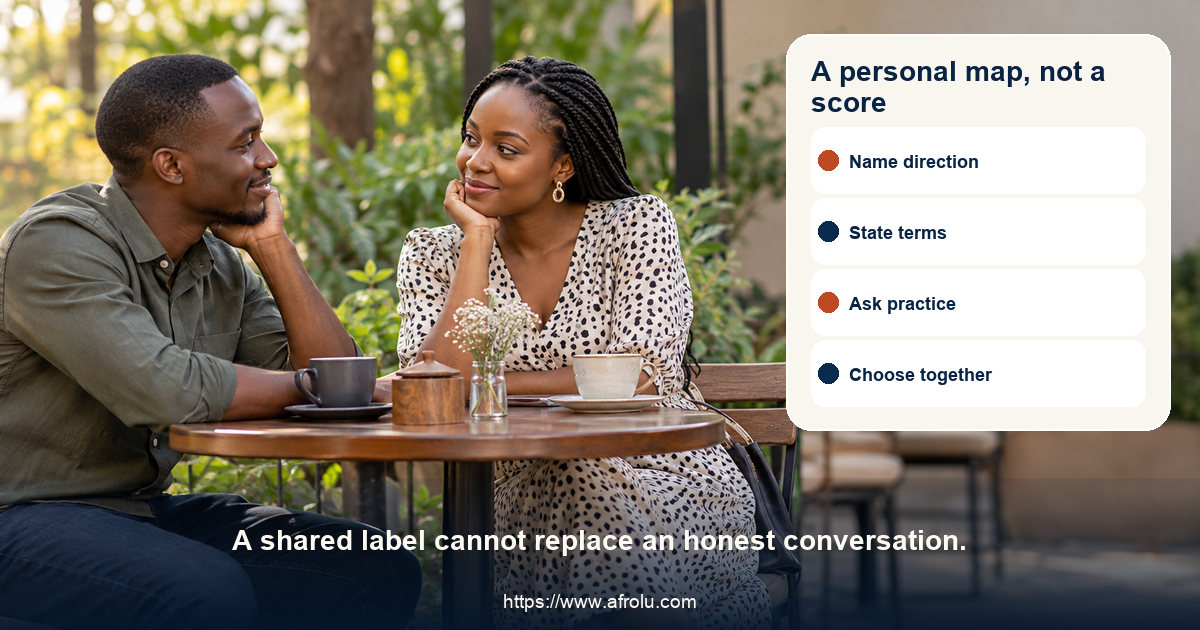
Separate direction, agreement, pace, and personal practice.
Written and edited by Adwoa Boateng · Dating Safety Editor
Use five separate labels: meeting channel, intention, agreement, pace, and life context. Explain what faith means in your own ordinary choices; do not assume a shared religious label proves compatibility. If you want a serious partnership but are dating casually now, say both plainly, define exclusivity and intimacy separately, and set a mutual time to review.
Dating basics · Faith-Led Daters
How can I honour faith and long-term hopes while naming the agreement, pace, and boundaries that exist today?
Faith-aware dating discusses how a person's beliefs or practices shape choices while keeping meeting channel, relationship intention, present agreement, pace, and consent distinct.
Amina hopes for a committed partnership and meets Daniel through a community event. After two dates, she is still meeting other people and wants to wait before deciding about exclusivity. They share some values but follow different weekly routines. Amina describes both facts without asking Daniel to treat her hope as a promise or her faith as proof of character.
Faith · present terms · voluntary pace
Build the map from lived choices
Belief may shape dating decisions, but it never supplies another adult’s answer.
Separate five dimensions, ask in ordinary language, and review what both people choose.
Where did we meet?
An introduction route does not define the agreement.
What do we hope for?
Future goals do not silently create current status.
Which routines matter?
Ask the person instead of assuming from a label.
What fits both now?
Continue only with mutual, current terms.
channel · intention · agreement
Use five separate labels instead of one dating box
Someone might meet through friends, hope for a committed partnership, remain non-exclusive for now, move at a gentle pace, and make choices shaped by religious practice. Those statements can all be true together. Casual does not erase a future hope, and serious does not quietly create exclusivity.
Start with five questions: where did we meet; what is each person seeking; what have we agreed to; how quickly do we want to move; and which parts of daily life matter here? Write each answer separately. If an answer is unknown, call it undecided rather than filling it with a guess about faith or gender.
Amina meets Daniel through a community event and later uses a dating app. She is open to a committed relationship but is not exclusive after two meetings. Daniel also dates intentionally, yet prefers another month of observation. They share a direction without claiming that their current agreement is more settled than it is.
Use labels as a short introduction, then translate them into conduct. Ask how often you expect to meet, whether either person is seeing others, which decisions remain open, and when to revisit them. A title cannot answer every practical question. The useful test is whether both adults understand the same arrangement in ordinary language.
belief · practice · curiosity
Discuss faith as a lived context, not a character test
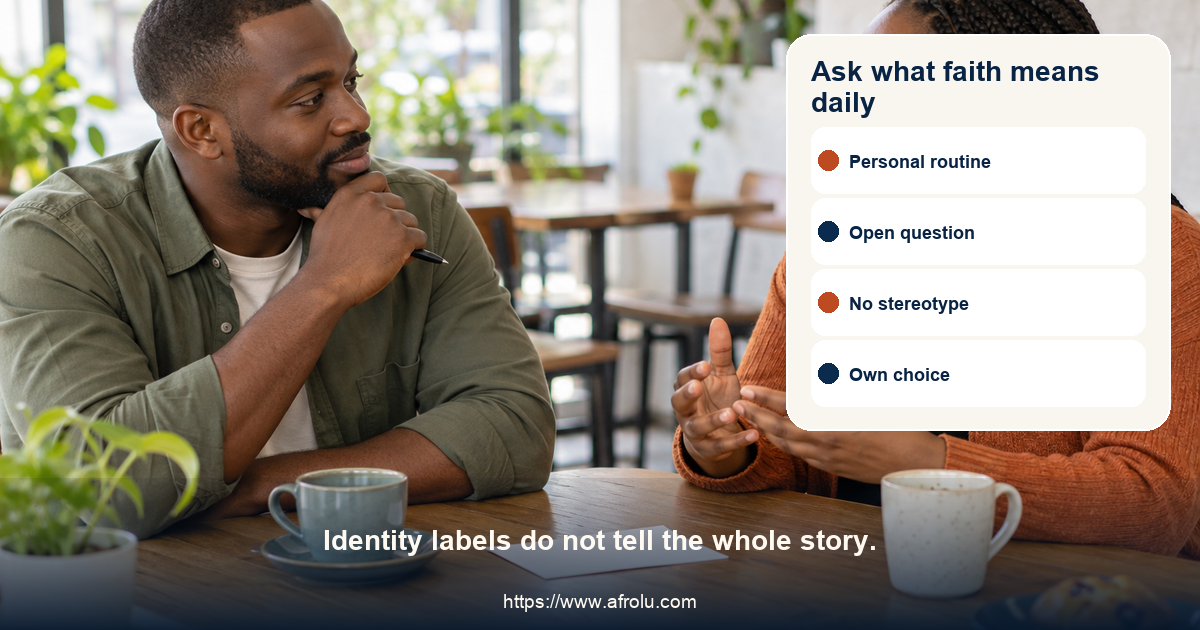
Faith may shape a person’s week, food, community life, family expectations, ceremonies, or decisions about sex and partnership. The details differ within every tradition and between individuals. Ask what matters to this person in this season instead of treating a profile label as a complete description of their practice or a guarantee of shared values.
A useful conversation is specific and reciprocal: “Which parts of your faith do you want a partner to understand?” Then share your own answer, including areas where you are still deciding. Do not ask someone to perform belief as proof. A person may decline a detail, and you can decide whether the unanswered question affects your own compatibility.
Two adults can use the same religious word but expect different weekly routines; that gap is practical rather than a verdict on either person’s sincerity. Two people with different labels may still agree on the choices that matter. Keep the conversation about actual expectations, not a theological scorecard or a profile filter treated as destiny.
Respect includes room to change, question, or practise differently. Do not let a date, relative, or group pressure either person into a belief statement, ceremony, sexual decision, or commitment. Kenya’s legal framework addresses religious freedom and marriage separately; this guide uses those sources as context and does not interpret anyone’s legal status.

Notice curiosity, reciprocity, and acceptance of a no.
direction · current agreement · review
Separate a serious hope from an honest casual agreement
Wanting a life partner someday does not automatically mean you are exclusive with a new match. Casual-but-honest dating can mean enjoying dates without promising a future, or exploring openly while keeping commitment decisions for later. The words vary, so define what they change: meeting others, contact, intimacy, public recognition, and expectations of availability.
A direct statement might be: “I hope to build a committed partnership, and I am currently meeting people without exclusivity. I would like to review how we feel after a few dates.” That is not a hidden contract. The other adult can welcome it, propose another arrangement, or opt out without being cast as unserious.
Keep sexual consent and health conversations independent from a relationship label. Before intimacy, discuss what each person wants, boundaries, testing, prevention, and exclusivity if relevant. A religious identity may inform those choices, but it cannot stand in for another adult’s answer. Either person can pause the conversation or activity at any time.
If the gap between hope and present terms feels too uncomfortable, do not accept a casual arrangement as a down payment on future commitment. Ask what evidence and mutual decisions would need to change. If the answer stays uncertain, decide whether uncertainty fits your needs now. An honest no can protect both people from investing under different assumptions.

Say what commitment exists now before describing future hopes.
family · community · privacy
Choose together how much family or community involvement fits
Some daters value family or faith-community input early; others prefer private discernment first. Neither preference should be assumed from religion, culture, age, or a serious goal. Ask whether the person wants advice, a chaperoned meeting, a group gathering, or no outside involvement yet. Each option has a different level of visibility and consequence.
Before inviting others in, agree who will be told, what they may know, and how either adult can slow the process. An introduction is not consent to disclose private messages, finances, sexual history, or family difficulties. If an elder or relative is involved, both daters still need a direct way to say no without losing control of the decision.
Lina welcomes her aunt’s advice but is not ready to have a new date attend a family celebration. She tells Malik that support is welcome while introductions remain a later step. Malik can respect the boundary or decide that early family involvement is essential to him. Neither person has to pretend the difference is trivial.
Use a smaller step when intentions differ: each person can ask a trusted adviser privately, then return to the conversation as an adult. Avoid asking a faith leader or family member to decide whether the match is suitable on your behalf. Guidance may help you reflect; it cannot supply the other person’s agreement or your own consent.
privacy · money · consent
Keep safety and autonomy in every dating structure
Meet in a public place you select, arrange your own route home, and let someone trusted know the broad plan if that helps you feel secure. Keep account passwords, verification codes, intimate images, home access, money, and religious-community directories private. A new connection does not need sensitive proof of belief, work, or family to earn a first meeting.
Notice urgency around sending funds, paying travel costs, investing, sharing a code, or leaving a platform before you can assess the request. A moving story is not evidence that a person is dishonest, but you can refuse a transfer without investigating their character. Consumer guidance warns against sending money to an online love interest you have not met.
A personal boundary can be calm and final: “I do not share verification codes or lend money in a new relationship.” If the other person repeats the request, changes the story, mocks your limit, or seeks another route to the same access, pause contact. Use the platform’s report tools and seek suitable local help if you feel threatened.
Faith language should never be used to rush intimacy, demand obedience, silence a question, or turn a planned date into a debt. A mutual agreement can be revisited, and consent can be withdrawn. If a conflict involves law, health, coercion, or immediate danger, consult qualified local support rather than relying on an editorial guide.
questions · answers · reciprocity
Ask direct questions without turning a date into an audition
Instead of asking whether someone is good enough for a label, ask how they picture a normal month of dating. What does low pressure mean to them? Are they open to exclusivity eventually, or unsure? Which observances shape their schedule? Would they want a partner to share those practices, understand them, or simply respect them?
Listen for whether an answer is clear enough to guide your decision, not whether it matches your preferred script. People can be sincere and still incompatible. Someone may need time to answer; agree when you will return to the question if it affects consent or planning. Do not treat reluctance to disclose a private detail as proof of deception.
If you share an important boundary, notice what follows. A respectful match can ask what would work instead, state their own need, or decide to leave. Pressure, ridicule, a sudden moral lecture, or repeated attempts to negotiate the same no provide useful information about how future disagreements might feel.
Keep a short note after a date: what did we agree, what did I infer, and what question remains? This protects you from rewriting an ambiguous conversation into a promise. Bring the note back as a conversation starter, not a prosecution exhibit. A calm correction early is easier than silently carrying two different versions of the relationship.
compatibility · change · choice
Review compatibility without ranking anyone’s faith
After several dates, compare the five parts of your map with what has happened. Did the channel feel comfortable? Did each person’s intention become clearer? Was exclusivity discussed rather than assumed? Did the pace respect both adults? Could faith-related practices and everyday routines coexist without one person hiding or surrendering a core choice?
Continue when the arrangement is understood, respectful, and enjoyable for both. Revise when one concrete detail could help, such as the day you meet or how much community involvement you want. Pause when you need reflection. End when the present terms conflict with a non-negotiable value or a boundary keeps being pressed.
Do not convert the number of dates into a required promotion from casual to serious, or serious to exclusive. A review creates a chance to decide; it does not guarantee a particular answer. If your goals change, tell the other person before relying on a new expectation. Each adult deserves an updated choice based on current terms.
A clear ending can stay brief: “I respect your direction, and our current expectations do not fit. I am closing the dating connection.” You do not need to debate doctrine or prove the other person wrong. If shared community spaces remain, choose practical boundaries for future contact and keep private conversations private.

Continue, revise, or close from terms both adults chose.
Eight ways faith and dating terms meet
A community introduction leads to a private date
The meeting route says how you met, not whether the match is serious or exclusive.
Name intent and present terms separately.A weekly observance changes weekend plans
A schedule detail is easier to discuss than a broad test of religious commitment.
Offer a realistic alternate time.One person wants openness while exploring
Casual can describe present commitment without cancelling a future hope.
Define what seeing others means.Both want partnership but disagree on pace
Shared direction does not require identical timing or immediate exclusivity.
Set a voluntary review point.A relative expects an early introduction
Outside support and public relationship status are separate choices.
Agree who knows what and when.Similar faith labels hide unlike routines
Personal observance matters more than a profile category.
Ask about ordinary weekly choices.A faith discussion precedes intimacy
Belief language does not replace current consent or health information.
Talk about boundaries and testing directly.A match cites faith to override a no
A value claim cannot make an unwanted choice voluntary.
Stop, leave, and seek support if needed.Fourteen signs of respectful alignment
Each person explains the five map dimensions in their own words.
A serious goal is not treated as automatic exclusivity.
Casual terms identify present conduct instead of hinting at a future promise.
Faith practice is described through personal routines rather than a stereotype.
Both adults ask questions and have room to decline an answer.
A schedule conflict produces a realistic alternate plan.
Family input is invited rather than imposed.
Community visibility is discussed before anyone shares the relationship.
Differences are explored without grading sincerity or morality.
Sexual health and consent are discussed directly when relevant.
A boundary about money, codes, images, or home access is accepted.
Neither person uses religious language to rush commitment.
Both can request a slower pace without punishment.
A change in intent leads to an updated, mutual conversation.
A decision map for practice and agreement
| Situation | What it may mean | What to do next |
|---|---|---|
| Where did we meet? | The channel explains the introduction, not the agreement. | Describe present terms separately. |
| What does serious mean? | The word may signal hope, exclusivity, or a plan to marry. | Ask what action the person means today. |
| What does casual change? | People use casual for different levels of commitment. | Discuss dates, contact, intimacy, and review. |
| How visible should we be? | One person may want family involvement earlier. | Set a shared disclosure boundary first. |
| Does faith shape the week? | Practice may affect time or future decisions. | Exchange concrete routines without a test. |
| Is the answer still forming? | Uncertainty can be honest and temporary. | Choose a safe point to revisit it. |
| A no is challenged? | The disagreement has become a consent issue. | Stop bargaining and leave if needed. |
| Money is requested online? | The request can expose you to financial loss. | Do not transfer funds; report suspicious behavior. |
| A family member is invited? | The invitation can disclose more than intended. | Confirm purpose, audience, and each person’s choice. |
| Your goals now differ? | The arrangement may no longer be mutual. | Revise terms openly or close the connection. |
Twelve scripts for intention, faith, and boundaries
“I am open to a committed partnership, and I am not exclusive today.”
“When you say serious, what would change in the next month?”
“I am comfortable meeting others for now; is that workable for you?”
“Which parts of your faith affect an ordinary week of dating?”
“I respect your practice; I would like to explain what I personally believe.”
“I value advice, but I am not ready for an introduction yet.”
“Please ask before sharing our names or photographs with anyone.”
“I would like two more dates before deciding about exclusivity.”
“Before intimacy, I want us to talk about testing and prevention.”
“I do not send money to someone I am newly dating online.”
“My answer is no; please do not ask me again tonight.”
“Our current terms do not fit, so I am ending this connection.”
Know the difference
Serious direction is not current exclusivity
An adult hopes for a committed future and states what they can offer while learning about a match.
Two people decide whether they are exclusive, casual, meeting others, or still unsure today.
Keep future direction and present conduct side by side; neither silently defines the other.

Keep future direction beside the present agreement.
Serious direction versus current agreement
| Type or dimension | What it describes | Best next question |
|---|---|---|
| Online meeting | The channel explains where messages began. | Discuss intent before assigning relationship status. |
| Community introduction | A connector may know both people but cannot consent for them. | Talk privately about present terms. |
| Serious dating | Long-term direction need not mean immediate exclusivity. | Ask what commitment exists now. |
| Casual dating | Commitment may be lighter while honesty remains. | Say what casual includes and excludes. |
| Slow dating | Spaced decisions allow observation. | Agree on contact while the pace is measured. |
| Exclusive dating | Both people choose to stop other romantic dates. | Define when the agreement begins. |
| Faith-centered dating | Practice informs choices in an individual way. | Ask which routines matter to each adult. |
| Long-distance dating | Travel and calls become part of the plan. | Keep visits public and costs independent. |
| Dating pause | One adult may need time before offering terms. | State whether contact continues during the pause. |
A simple plan you can use today
One map, five answers
Channel, intention, agreement, pace, and context combine without becoming synonyms.
A goal is not a promise
Serious direction can be named while exclusivity remains undecided.
Faith is personal
Ask about the practices and expectations shaping this adult’s week.
Publicity is separate
Family advice, relationship visibility, and formal commitment each need a choice.
Consent stays current
No label, ceremony, or date history replaces a present yes.
Compatibility is lived
Review ordinary conduct rather than ranking religious identity.
Questions organised by purpose and depth
Choose a few prompts that fit the moment. This is a reference library, not a list to complete.
Five-part map
Describe one current connection without using one label for every answer.
- How did we meet?
- What direction do I want?
- What is agreed today?
Faith in practice
Turn identity into a conversation about the life you actually live.
- Which routines matter to me?
- What am I still deciding?
- What would I ask a partner?
Privacy
Choose audience and timing before involving others.
- Who may know?
- Which images stay private?
- Can either adult change their mind?
Review
Use current conduct and mutual choice instead of a deadline.
- What became clearer?
- Which boundary was respected?
- Do these terms fit both?
What deserves a closer look
Describe direction
A serious hope can orient decisions without claiming the current relationship already has that status.
Evidence limit: This framework cannot predict whether people will stay together.
Ask about ordinary observance
Weekly choices give more context than assuming everyone with the same identity follows the same routine.
Evidence limit: This guide does not interpret theology or assess belief.
Use legal sources carefully
Kenya’s Marriage Act contains formal rules distinct from informal dating labels.
Evidence limit: Consult a qualified Kenyan professional for legal questions.
Keep a direct conversation
Discuss sexual-health testing, prevention, boundaries, and exclusivity before intimate choices together.
Evidence limit: This is general relationship information, not medical advice.
Keep account access private
Strong passwords, multifactor authentication, updates, and caution with unexpected requests can reduce account exposure.
Evidence limit: CISA guidance is general cyber hygiene.
Slow urgent financial requests
Consumer agencies warn that romance-related transfers or investment requests can cause losses, especially online.
Evidence limit: The cited scam guidance is U.S.-based, not a finding about a person.
Shortcuts that confuse identity with agreement
Treating faith as proof
A label cannot establish honesty, compatibility, or safe conduct.
Using serious as a status
The word may conceal that exclusivity was never agreed.
Calling ambiguity casual
A label cannot replace a direct answer about expectations.
Inviting family by default
A third party can learn private information before both adults choose visibility.
Skipping health talk
Beliefs do not reveal another person’s testing or prevention choices.
Explaining away pressure
A moral argument does not turn refusal into consent.
Put present agreement beside your long-term hope
This guide is editorial information, not legal, medical, religious, or emergency advice. Use qualified local support for questions that need professional guidance.
Explore the guide library
Show more related guides
Continue with Afrolu
Show more Afrolu guides
Sources used for this guide
Afrolu reviewed these health, research, safety, or public guidance resources while editing this page. They support the behaviour and safety guidance; they do not diagnose any individual described by a reader.
Questions about faith-led dating choices
Can I want marriage and still date casually?
Yes, if you clearly tell the other person what casual means today and do not present a future hope as a current promise.
Does serious dating mean exclusivity?
Not automatically. Ask whether either person is seeing others and what agreement, if any, has begun.
Should we share the same religion?
That is a personal compatibility choice. Discuss practice and expectations rather than using a label as a character test.
When should family or faith leaders meet a date?
There is no universal timeline. Decide together who may know, what they may know, and whether an introduction feels voluntary.
How do I ask about religious practice?
Ask which parts shape an ordinary week and offer your own answer. Leave room to decline a private detail.
Can I change my mind about exclusivity?
Yes. Tell the other person when your intention changes so each adult can make a current decision.
Does a faith label prove a match is safe?
No. Keep ordinary privacy, public-meeting, money, account, and consent boundaries in every dating structure.
What if a date uses faith to pressure me?
A value statement does not override your no. Stop the interaction and seek suitable local help if you feel unsafe.
Should we discuss sexual health before intimacy?
Yes. Talk about consent, testing, prevention, and exclusivity where relevant; consult a clinician for personal advice.
What if our hopes match but our pace does not?
Choose a mutually workable review point or recognise the mismatch. Do not accept terms you expect the other person to change later.
One thing to do now
Choose the arrangement both adults can describe
Describe the present arrangement accurately, ask what practice and long-term direction mean to each person, and keep consent, family visibility, and exclusivity as separate decisions. Continue only while the real terms work for both. Revise or end when pressure replaces mutual choice.