Four decisions, not one confusing label
Choose a Dating Type That Fits Diaspora Life and Career
A plain-language guide for diaspora adults who want to separate intention, exclusivity, pace, and distance before career pressure turns a promising connection into guesswork.
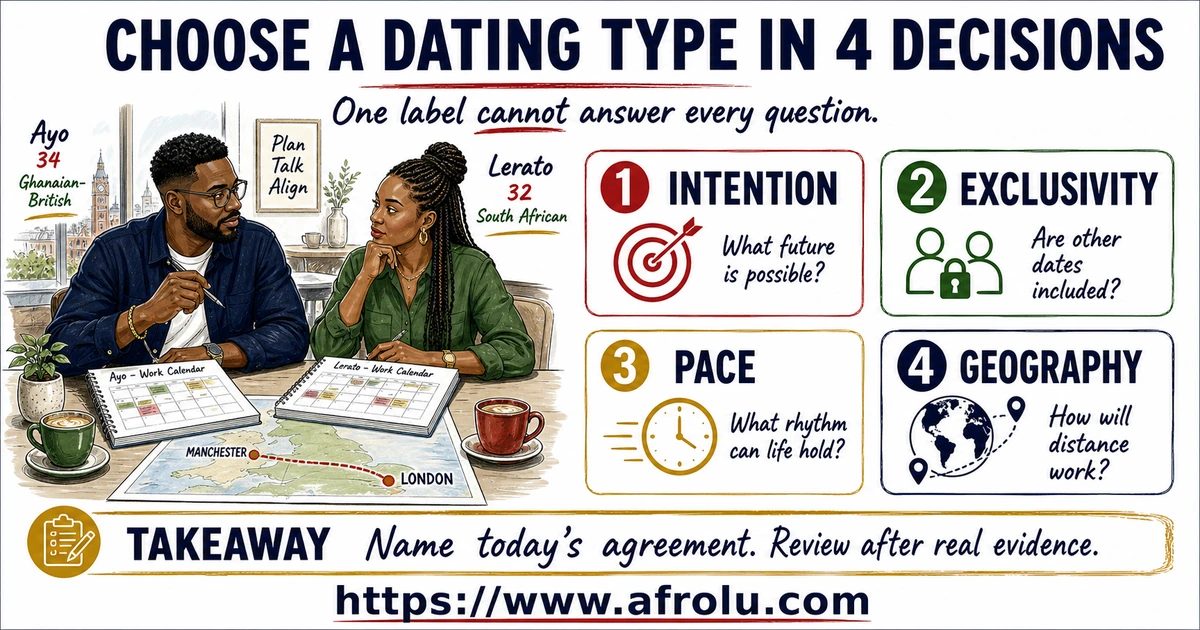
One label cannot answer every question. Name today's intention, exclusivity, pace, and geography, then review after real evidence.
Written and edited by Tariro Ncube · Diaspora Dating Editor
Do not search for one perfect label. Make four smaller agreements. First, name intention: casual company, open exploration, or a possible long-term partnership. Second, name exclusivity instead of assuming it. Third, choose a pace that fits actual shifts, travel, family calls, and rest. Fourth, treat geography as a practical question, not a promise to relocate. A low-pressure connection can still have planned dates, honest replies, sexual-health conversations, and a review point. If a person uses 'easy' to avoid every decision while expecting emotional, sexual, financial, or domestic access, the arrangement is not low pressure; it is unclear and one-sided.
Dating basics · Diaspora Daters
Which dating type fits when interest is real, time is limited, and neither adult wants pressure or vagueness?
A dating type describes one part of an adult relationship. Casual and serious describe intention. Exclusive and non-exclusive describe an agreement about other partners. Slow and fast describe pace. Local and long-distance describe geography. Online dating describes how people met. Low pressure is not a complete type at all: it describes how the connection handles choice, time, and expectations. Two adults may be slow, exclusive, serious, and long-distance at the same time.
Ayo is 34, works in product operations in Manchester, and visits family in Accra twice a year. Lerato is 32, an architect in London, and is studying for a professional exam. They meet at a friend's birthday and agree to keep things low pressure. Ayo thinks that means dating toward a relationship without daily messages. Lerato thinks it means enjoying occasional dates while both remain open to other people. Neither has done anything wrong, but the same phrase is carrying two different agreements. Over lunch, they separate the questions. Both are open to a partnership. They are not exclusive yet. They can alternate cities for one planned date every two weeks. Neither will discuss relocation until there is enough ordinary-life evidence. They choose a review after six dates. The conversation adds clarity without forcing commitment.
The four-decision map
Separate the questions that one label cannot answer
Diaspora life can compress work, travel, family duty, friendships, and dating into the same small calendar. Clear agreements reduce pressure because neither adult has to guess what silence, a weekend trip, or a warm message is supposed to mean.
Write four headings on a page: intention, exclusivity, pace, and geography. Give each one a present answer, an action that supports it, and a date for review. Keep culture, faith, sex, money, and family in their own conversations instead of hiding them inside a label.
What future are we open to?
Casual company, open exploration, and serious exploration can all be honest. Trouble begins when one person presents one direction while privately expecting another.
Are other dates still part of the picture?
Frequent contact, sex, travel, or meeting friends does not create exclusivity silently. Both adults need the same agreement.
What rhythm can ordinary life hold?
A calm pace still has movement: a planned date, a useful reply window, dependable repair, and enough space for work and rest.
What does distance require now?
Travel frequency, cost, documents, family visits, and possible future cities are practical decisions, not proof of affection.
Begin where Ayo and Lerato got stuck
The phrase 'low pressure' can hide two different relationships
One adult may use low pressure to mean serious interest without constant contact. Another may mean casual, non-exclusive dates with no current plan for commitment. Both meanings can be legitimate. Neither meaning should be imposed after the other person has invested.
Ask for the present version, not a lifetime guarantee. 'What are you open to if this continues to go well?' is easier to answer than 'Where is this going?' Then ask whether either person is dating or sleeping with others. Where sex is relevant, discuss testing, prevention, and barriers directly with appropriate health guidance.
A calm answer may still be 'I do not know yet.' Add a time boundary: what evidence are you collecting, and when will you revisit the question? Repeated uncertainty without a review is different from honest early-stage exploration.

The same phrase can hold different plans. Calm clarity turns intention, exclusivity, pace, and review into a shared agreement.
Read the calendar, not the excuse
Low pressure and low effort leave different evidence
Low pressure removes needless acceleration. It can mean modest dates, room for independent lives, no demand for instant replies, and no early promise about marriage or relocation. It does not remove basic planning, honesty, consent, or responsibility for a changed arrangement.
Low effort looks different. Warm messages repeatedly fail to become a date. One adult chooses every venue, restarts every conversation, and absorbs every cancellation. A busy period has no stated end, and requests for clarity are dismissed as neediness. This pattern may reflect limited capacity rather than a hidden motive, but it is still too little structure for many people.
Use one concrete test. Offer a realistic date or contact point that respects both calendars. If the person accepts, adjusts, or offers a workable alternative, there is movement to observe. If vagueness repeats and all repair returns to you, reduce investment. You do not need a diagnosis before deciding the arrangement does not work for you.

Low pressure still includes modest plans, named busy weeks, repair, and respected boundaries. Calm dating still moves.
Build around a real fortnight
Low pressure should protect careers without turning effort optional
Compare real calendars rather than ideal availability. Include shifts, commutes, study, worship, care, exercise, friendships, rest, and calls with family abroad. Then choose a modest minimum: perhaps one planned date every two weeks and one midweek check-in. A minimum is a promise both adults can keep, not a limit on warmth.
Busy people still repair. If a deadline changes a date, the person who changes it acknowledges the disruption and offers a realistic alternative. An unexplained cancellation followed by flirting is attention, not repair. The pattern matters more than one hard week.
Protect confidential work, employer systems, immigration records, bank access, home details, and live location. A career constraint can explain limited time; it does not justify secrecy about relationship status or a request for protected access.

Clear questions about intention, exclusivity, calendars, family, and review are not demands; they are usable information.
Do not force a choice of identity
Culture and family matter, but neither can silently write the contract
Diaspora adults may carry different ideas about introductions, faith, gender roles, money, privacy, marriage, and how quickly family becomes involved. Ask what a practice means to this person now. A nationality, ethnic label, or family background cannot answer for an individual.
Meeting friends may be casual in one circle and a major step in another. A trip home may be private family time rather than an invitation. Remittances or care duties may shape a budget without giving a new partner a right to inspect accounts. Name the meaning before interpreting the event.
No cultural explanation removes consent or basic safety. Either adult can decline sex, money, private lodging, document sharing, family contact, or a relationship role that was never freely agreed.
Review evidence without staging a trial
Use six dates to learn, then make one clear next decision
After roughly six meaningful dates, compare what is now visible: does interest survive ordinary schedules, are plans shared, can differences be discussed, is physical consent easy to change, and do words match action? Six is a conversation point, not a universal rule.
Renew the present agreement, change one dimension, or end kindly. You might keep the pace but become exclusive, keep non-exclusivity but reduce emotional expectations, or continue serious exploration while postponing travel. State what changes today and when the next review happens.
A useful review leaves both adults freer to choose. If someone threatens, shames, monitors, exposes private information, or demands money because a label is questioned, focus on safety and support rather than completing the conversation.

Write four answers, choose a real rhythm, watch plans and repair, protect private areas, and review from evidence.
Four adult moments when one label is not enough
Maya names non-exclusivity before a weekend starts to look committed
Maya, 36, and Daniel, 38, have shared three long Saturday dates. Daniel assumes that the time together means both have stopped meeting others.
Maya says she is open to partnership but has not agreed to exclusivity. They decide whether to make that agreement now instead of arguing about an assumption.Kofi distinguishes a demanding week from a disappearing pattern
Amara warns Kofi that quarter-end reporting will reduce her messages for ten days. She misses one call but sends a brief note and proposes Sunday.
Kofi uses the stated window and offered repair as evidence. He does not turn a known work block into a test of loyalty.Sipho refuses to treat a possible transfer as a relationship promise
After four dates, a match asks Sipho to request an office transfer so they can prove the connection is serious. Neither has discussed money, family, or daily compatibility.
Sipho keeps the career decision separate. They plan more ordinary meetings and revisit location only if the relationship develops enough evidence.Zuri asks what the invitation means before reading it as engagement
A partner invites Zuri, 31, to a large community gathering. In Zuri's family, such an invitation would signal a formal relationship.
Zuri asks directly. The event is a broad social introduction, not an engagement step. They agree on the language each will use when relatives ask.Six signs that a calm connection still has structure
Both adults can describe the current intention in similar everyday words.
Exclusivity, sex, testing, and outside dating are discussed instead of inferred from closeness.
A busy period has a stated reason, a limited window, and a useful next contact point.
Plans alternate fairly across travel, cost, energy, and career demands rather than falling to one person.
Family and culture are discussed with curiosity, without using identity to force a role.
Either adult can slow, revise, or end the arrangement without threats, monitoring, or punishment.
Read each event through the agreement it actually tests
| Situation | What it may mean | What to do next |
|---|---|---|
| You both want partnership but have not discussed other dates | Intention is aligned; exclusivity is still an unanswered, separate question. | Ask whether either person wants exclusivity now and define when it begins. |
| A work deadline reduces contact for a named week | Capacity changed temporarily, especially if a new contact point was offered. | Use a lighter rhythm and review after the deadline instead of demanding constant access. |
| Plans are always warm but never reach a date or time | The connection may offer attention without enough practical availability to date. | Offer one concrete plan. Step back if vagueness repeats without repair. |
| A family invitation is treated as proof of commitment | The same social event may carry different cultural meanings. | Ask what the invitation means and what relationship language will be used there. |
| One person asks for a relocation promise in the first weeks | Future certainty is being requested before ordinary compatibility is visible. | Separate career location from current interest and choose a smaller next step. |
| Low pressure is used to reject every expectation but keep full access | The arrangement may be one-sided rather than relaxed. | State the minimum you need. Leave if clarity itself is treated as unreasonable pressure. |
Five sentences for intention, exclusivity, time, family, and review
“I am enjoying this and I am open to a partnership if we fit. What kind of future are you genuinely open to?”
“I do not want to infer exclusivity from how often we talk. Are either of us still dating or sleeping with other people?”
“My work is heavy until Friday. I can still keep Saturday afternoon, or tell you by Thursday if that needs to change.”
“I would like to join you. Before I do, what does this introduction mean in your family, and how will you describe us?”
“Let us keep this pace for six dates, notice how it works in ordinary weeks, and then decide whether exclusivity makes sense.”
Know the difference
Low-pressure serious exploration or casual dating?
Both adults are open to a partnership, protect a sustainable pace, make dependable plans, discuss exclusivity separately, and review progress.
The present goal is companionship, enjoyment, or connection without a shared expectation of building toward long-term commitment.
Pressure level does not decide intention. A calm connection may be serious, and a casual connection still needs honest agreements.

Pressure level does not decide intention. Serious exploration is open to partnership; casual dating has no shared commitment goal now.
A six-part map of nearby dating types
| Type or dimension | What it describes | Best next question |
|---|---|---|
| Casual dating | Describes present intention without an expectation of long-term commitment. | What connection are we agreeing to now, and what are we not promising? |
| Serious dating | Describes exploration or construction of a committed long-term partnership. | Which real-life evidence do we need before increasing commitment? |
| Exclusive dating | Describes a mutual agreement not to date other people; it does not automatically mean marriage plans. | What does exclusivity include, and when does our agreement start? |
| Slow dating | Describes deliberate pace while interest, honesty, and practical movement continue. | Which parts are moving slowly, and what progress should remain visible? |
| Long-distance dating | Describes geography and the extra planning needed for contact and visits. | What rhythm and travel plan can both adults afford and sustain? |
| Situationship | Describes relationship-like closeness without a clear mutual agreement about status or direction. | Is the missing definition temporary and discussable, or repeatedly avoided? |
The four-decision plan plus one review
Write four headings
Record today's intention, exclusivity, pace, and geography in plain words.
Test the fortnight
Choose a contact and date rhythm that survives real work, travel, family, and rest.
Name cultural meanings
Ask what introductions, home visits, faith, money, and family contact mean to this adult.
Keep protected areas protected
Accounts, employer systems, documents, essential money, home details, location, and consent remain under individual control.
Review after evidence
Use roughly six dates to renew, change, or end the present agreement without forcing certainty.
Questions for the first six dates
Choose a few prompts that fit the moment. This is a reference library, not a list to complete.
Define the present
Choose two questions before the next date.
- What kind of connection are you genuinely open to if this goes well?
- Are either of us dating or sleeping with other people now?
- Which expectations would feel supportive, and which would feel too fast?
- When should we review these answers?
Compare real calendars
Use a normal fortnight, not a holiday week.
- Which work, family, faith, study, and rest times are protected?
- What is the smallest date rhythm that still feels meaningful?
- How will we repair a changed plan?
- How should travel time and cost alternate?
Keep geography honest
Map possibilities without demanding a promise.
- Could either career move in principle, and what would that require?
- Which family or immigration duties are not negotiable?
- What ordinary-life evidence should come before a location decision?
- What is the next reversible step?
Four shortcuts that create avoidable confusion
Assuming frequent contact means exclusivity
Closeness can grow before an exclusivity agreement. Ask directly so sexual-health and emotional choices use current information.
Calling every expectation pressure
A date, reply window, repair, or review point can be reasonable. Low pressure does not make dependable behaviour optional.
Letting family define the relationship first
Introductions carry different meanings. Agree on status and the words used with relatives before the event.
Treating relocation as proof of love
Career and country decisions affect an entire life. Build ordinary compatibility and map facts before asking for a move.
Use a reviewed resource that matches the decision
This guide focuses on the relationship decision, so it does not rank dating apps. Check current prices, safety tools, and local availability before choosing a service.
Explore the guide library
Show more related guides
Continue with Afrolu
Show more Afrolu guides
Research and public guidance behind the four-decision map
Afrolu reviewed these health, research, safety, or public guidance resources while editing this page. They support the behaviour and safety guidance; they do not diagnose any individual described by a reader.
Diaspora dating-type questions for career-focused adults
What is the best dating type for a busy professional?
There is no single best type. Choose an honest intention, explicit exclusivity agreement, sustainable pace, and realistic geography. A career limits capacity; it does not choose the relationship for you.
Can low-pressure dating become serious?
Yes. Low pressure can describe a respectful pace while both adults explore long-term partnership. Seriousness becomes visible through dependable plans, honest agreements, repair, and gradually shared real life.
Does low pressure mean casual dating?
No. Casual describes intention; low pressure describes the way expectations are handled. A casual connection can feel pressured, and serious exploration can remain calm.
When should diaspora daters discuss exclusivity?
Discuss it before either person relies on an assumption, and before sexual-health decisions require accurate information. Daily contact, travel, or meeting friends does not create the agreement silently.
How often should busy adults date?
Use a rhythm both can sustain. One meaningful date every two weeks may work for some adults; others need more or less. Reliability, mutual effort, and repair matter more than a universal number.
Should I date only someone from my culture?
That is a personal choice, but shared identity does not guarantee shared values or relationship expectations. Ask the individual about family, faith, money, marriage, sex, privacy, and home.
When is uncertainty reasonable?
Early uncertainty is reasonable when both adults can name what they are learning and when they will review it. Repeatedly avoiding every definition while expecting full access is a different pattern.
Should we discuss relocation early?
Discuss whether a shared location could ever be possible early enough to reveal a major mismatch. Delay promises until career, family, immigration, cost, and relationship evidence are clearer.
Can we be serious without being exclusive?
Yes, during exploration, if both adults knowingly agree. Serious intention and exclusivity answer different questions. Revisit the agreement as feelings, sex, and expectations change.
When should I leave a low-pressure arrangement?
Leave when it cannot meet your minimum needs or when deception, coercion, money pressure, surveillance, threats, ignored consent, or one-sided access makes the connection unsafe or harmful.
One thing to do now
Write the four answers that are true today
Keep the dating type whose expectations both adults can say plainly and live consistently. Adjust one dimension at a time when circumstances change. Pause when a label creates more obligation than agreement, and leave when pressure, deception, surveillance, money demands, or ignored consent replaces free choice.