Two-key firewall · professional talking-stage safety
Protect Your Career During the Talking Stage
A sourced talking-stage safety guide for professionals: protect work data, avoid fake verification, plan meetings, set consent and choose a clear next step.
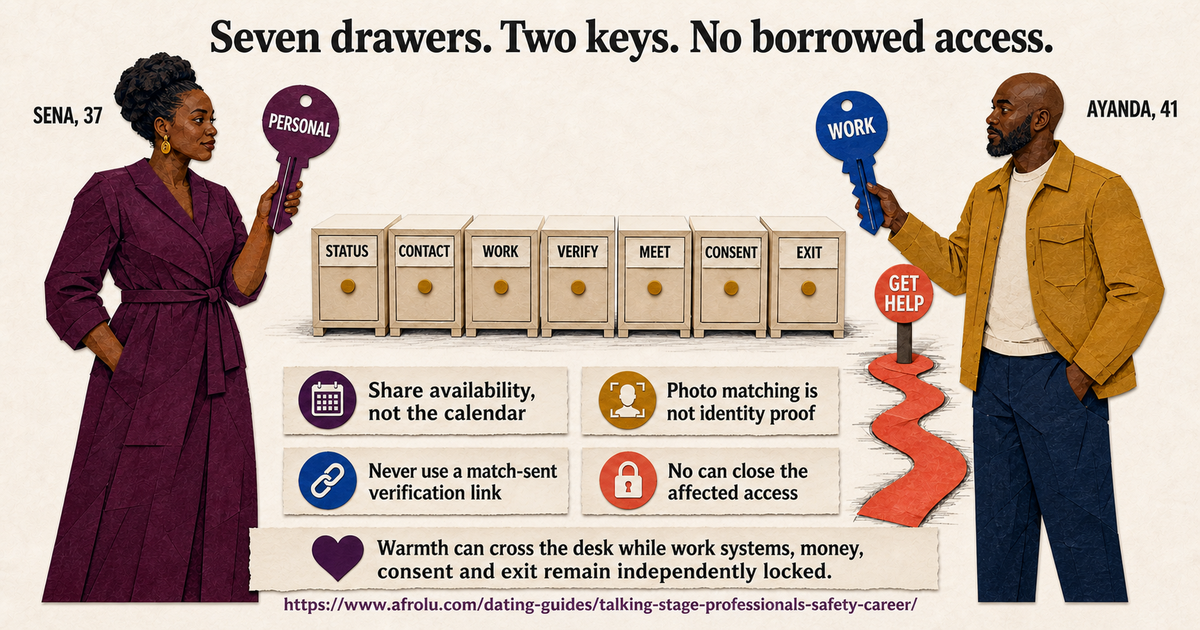
A talking stage may receive a personal answer without receiving the work key.
Written and edited by Adwoa Boateng · Dating Safety Editor
Use two separately held keys and seven drawers: STATUS, CONTACT, WORK, VERIFY, MEET, CONSENT and EXIT. Give the personal answer the next dating question needs, keep employer systems and networks closed, use verification routes you find yourself and meet only when a public, independently leaveable plan is wanted. Then CONTINUE, NARROW CONTACT, RESET PACE, VERIFY INDEPENDENTLY, MEET SAFER, PAUSE, CLOSE or GET HELP.
Early relationship discovery · Professionals
How can a professional let a talking stage develop while keeping personal connection, career infrastructure, independent verification, meeting safety and consent under separate control?
A talking stage is an exploratory period before adults have necessarily agreed a relationship or exclusivity. Professional safety means protecting employer accounts, internal calendars, precise routines, credentials, colleagues, clients, travel details and devices while personal trust remains limited. It is not a background-check promise, a universal meeting clock or a claim that professional status predicts conduct.
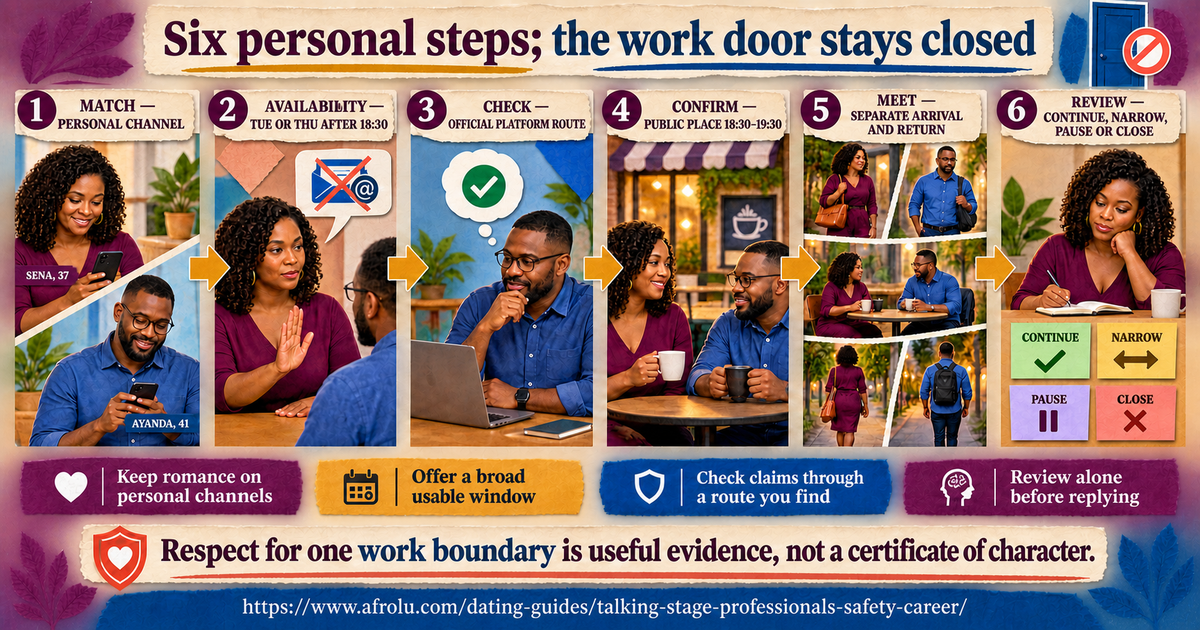
Sena, 37, and Ayanda, 41, keep their fictional talking stage on a personal channel. Sena offers Tuesday or Thursday after 18:30 instead of a live work calendar; Ayanda accepts the work-email boundary. Each checks through a route found independently, and they choose a one-hour public meeting with separate arrival and return before reviewing alone. Neither occupation, city nor income is specified.
The professional talking-stage two-key desk
Let connection move; keep career infrastructure controlled
Adwoa treats professional as a work-responsibility context, not an elite identity, and keeps safety claims within the reviewed official evidence.
Name the personal question, protect the work key, verify through a route you locate and change only the access the evidence affects.
Answer status
Name the present agreement without using a biography as proof.
Protect work
Offer a personal channel and broad hours, not infrastructure.
Check independently
Find the genuine route before entering data or opening a link.
Choose the door
Continue, narrow, reset, verify, meet, pause, close or seek help.
Begin with the unanswered personal question
A talking stage is not a background check or a probation period
A talking stage is the period in which two adults are learning whether they want another conversation, a meeting or a more defined romantic agreement. It does not automatically mean exclusivity, a relationship, sexual access or a deadline. The useful question is present-tense: what are we exploring now, what has been agreed, and what remains a separate choice?
Professional describes an adult who has work responsibilities, not a prestige class. A professional may work shifts, run a small business, freelance, study while employed, care for others or hold a public-facing role. This guide does not assume wealth, seniority, a conventional office, constant busyness or that career ambition matters more than connection. It protects work because work systems can affect other people as well as the dater.
Career safety here means keeping employer accounts, internal calendars, precise routines, credentials, colleagues, clients, travel details and devices outside an early romantic connection unless a legitimate work purpose independently requires them. Broad statements such as ‘I am free Thursday evening’ can plan a date. A live calendar, office address or staff directory is a different category of access and rarely answers a dating question.
Start with the narrowest uncertainty. If status is unclear, ask about status. If a reply rhythm does not fit, compare availability. If identity is uncertain, use a route you locate independently. If work stress is changing capacity, address the occupational problem without turning the match into a diagnosis. Threats, tracking, impersonation, image abuse or defeated exit bypass ordinary compatibility review.
Build the two-key firewall
Let personal connection move without handing over career infrastructure
Picture two keys on a desk. The PERSONAL key can open a chosen name, general interests, a personal contact channel, broad availability and the next dating question. The WORK key protects employer identity, work email, precise schedule, office access, clients, colleagues, documents and travel. One key never becomes proof that the other is owed, even when both adults describe the connection as promising.
Use seven separate drawers: STATUS, CONTACT, WORK, VERIFY, MEET, CONSENT and EXIT. Answer only the drawer that the present choice requires. ‘Are we exclusive?’ belongs in STATUS. ‘Can we meet Thursday?’ needs a broad CONTACT window and a leaveable MEET plan. Neither question requires a résumé, calendar screenshot, professional introduction, employee directory or live route.
Australia's eSafety Commissioner recommends minimising profile details such as full name, address, work and location, avoiding social-profile image reuse and considering platform privacy, location, reporting and account-security features. It also cautions that a photo match does not establish identity. That Australian guidance supports deliberate data boundaries; it does not certify a platform, a profile or any individual dater.
Kenya's Office of the Data Protection Commissioner lists rights to information, access, objection, correction and deletion, and principles that personal data should be limited to what is necessary for specified purposes. Those are Kenyan data-protection rights relevant when services process personal data. They are not a claim that every private exchange between daters has the same legal role. The practical editorial lesson is simpler: ask what a platform collects and volunteer no more than the dating task needs.
Watch one boundary do real work
Sena and Ayanda move forward without using the workplace as proof
Sena, 37, and Ayanda, 41, are fictional adults who match on a dating platform. Their occupations, location and income are deliberately unspecified. They enjoy two conversations and want to consider meeting. Sena says personal messages are easiest after work and offers Tuesday or Thursday after 18:30. Ayanda chooses Thursday. Neither interprets the schedule as low interest or asks to see a calendar.
Ayanda suggests moving the exchange to Sena's work email because it may receive faster replies. Sena answers, ‘Please use this personal channel; I do not use work accounts for dating.’ Ayanda accepts the limit, does not search for colleagues and does not reopen the request through another channel. That response is useful, bounded evidence. It does not prove identity, compatibility or future safety.
Before meeting, both adults use platform information and contact routes they find themselves. Neither opens a match-sent verification page, uploads an identity document to a romantic contact or enters card details as proof of being safe. They choose a staffed public place from 18:30 to 19:30, tell a trusted person the useful plan and arrange separate arrival and return. These precautions reduce some exposure; they cannot guarantee safety.
After the meeting, each reviews privately before replying. The available choices are continue, narrow contact, pause or close. A pleasant hour does not unlock work systems, money, sexual contact, images or a second meeting. If Ayanda had bypassed the personal channel, threatened Sena or contacted the workplace after a no, the question would change from dating fit to access protection and appropriate support.
Read signals by the access they affect
Sixteen observations are more useful in groups than as a trust total
CLARITY asks whether the current status has an answer, availability is real, invitations are complete and changed interest can be said honestly. A person may need time and still be clear. Another may reply quickly and remain vague. Count neither message volume nor polished career language as certainty; look for an understandable present agreement and a usable next choice.
RECIPROCITY asks whether questions return, planning is shared, a busy period can be named without demanding a résumé and repair follows a missed expectation. Equal effort does not mean identical hours or money. It means the connection is not maintained by one adult chasing, scheduling, soothing and interpreting while the other keeps every option undefined.
WORK ACCESS asks whether romance stays on personal channels, broad availability is enough, colleagues remain outside the connection and credentials are not demanded as proof. One accidental mention is different from repeated bypass. A clear redirect followed by respectful adjustment may solve the issue. Searching for an office, messaging a colleague or exploiting a public directory after a boundary changes the safety picture.
SAFETY asks whether verification is independent, money stays separate, consent remains specific and exit is respected. A match-sent ‘safety’ link can itself be fraudulent. The FBI's April 2024 IC3 alert describes fake free verification sites that collect contact and card details and create recurring charges. Its reporting route is U.S.-specific, but the defensive move travels: do not use the link; locate the genuine platform or authority yourself.

Read the affected access first; do not average danger into chemistry.
Give a boundary an exact sentence
Twelve scripts answer the request without opening an argument
A useful professional boundary is specific enough to act on. ‘Please use this personal channel’ names where contact belongs. ‘I can offer Tuesday or Thursday after 18:30’ gives a real alternative without exposing the live calendar. ‘If we have not confirmed by 15:00, I will release tonight’ protects time without treating a busy job as more important than the other adult.
Verification needs its own sentence because safety language can be used as pressure. Say, ‘I will use the platform route I find myself and will not open a verification link.’ Do not upload an identity document, work credential, password, code or payment card to a service sent by a match. A badge or matched photo can be one platform signal; eSafety explicitly warns that photo matching is not the same as identity verification.
Boundary-response evidence has three parts. First, state a modest, relevant limit. Second, watch the action rather than inviting a debate about whether the limit is reasonable. Third, change only the affected access. One respectful adjustment may support another conversation. Repeated pressure may support narrower contact or closure. Threat, tracking, impersonation, image abuse, workplace bypass or a blocked exit calls for a direct safety route.
Closure does not always need a final message. When ordinary interest ends and contact is safe, a concise line can be kind. When another account, colleague or work channel has already been used to defeat a no, further explanation may create exposure. Preserve useful evidence where safe, secure affected accounts, tell trusted support and use current specialist, platform, workplace, legal or emergency help suited to the location and facts.

A boundary includes the channel, the available choice and what happens next.
Take the deadline off the meeting
Professional safety is a complete plan, not a race from chat to offline
There is no universal evidence-based number of days that makes a talking-stage meeting correct. A live call may answer one question without obliging a date. A longer exchange may suit travel, disability, caregiving, shift work or simple preference. Endless postponement can reveal mismatch, but the answer is a direct question and a personal limit—not a rule that every adult must meet within one week.
When both adults want to meet, complete the plan: use a public, populated setting; tell a trusted person useful details; retain independent transport and a practical exit; and avoid home or workplace access while trust is limited. RAINN's current guidance supports these risk-reduction steps and expressly says no action can guarantee safety. Readers outside the United States need support contacts from their own location because the named RAINN services are American.
Keep sexual choices outside the scheduling logic. WHO frames sexual health around physical, emotional, mental and social well-being, respectful relationships and experiences free of coercion, discrimination and violence. That broad global framework supports specific, freely chosen adult conversations. It does not decide an individual's contraception, testing, care or consent, and a date, bill, title or earlier yes cannot authorise a later act.
Work capacity also deserves precision. NIOSH defines job stress in relation to job demands and worker capabilities, resources or needs; its current U.S. page was updated 16 July 2026. A demanding week may change reply or meeting capacity, but this dating guide cannot diagnose health, redesign employment or treat a match as care. Address occupational strain through appropriate work or qualified support while answering the dating question honestly.
Choose one proportionate next action
Eight equal doors keep continuation from becoming the hidden default
CONTINUE when the current status is understood, contact fits, a modest work boundary is respected and the next step is wanted. NARROW CONTACT when the connection can stay on one personal channel. RESET PACE when capacity or scheduling needs a different rhythm. Each choice should name what changes and what evidence will be reviewed rather than demanding unlimited patience.
VERIFY INDEPENDENTLY when a claim matters to the next decision. Use contact information or platform tools you locate yourself; never let a match supply the only route. MEET SAFER when both adults want an offline plan with public context and independent exit. PAUSE when attention is unavailable. None of these doors promises identity, compatibility, consent or a relationship result.
CLOSE when interest, schedule fit or boundary respect is no longer sufficient. A closure message may be appropriate for ordinary mismatch, but it is not a safety ritual. GET HELP when threats, tracking, impersonation, image abuse, workplace bypass or a defeated exit appears. Protect accounts and funds, retain useful evidence where safe and choose current resources for the country and type of harm.
The FTC describes romance fraud as a relationship story that eventually moves toward money, often after contact shifts off-platform. It advises contacting the payment provider promptly and reporting through relevant channels; its named reporting system is American. Do not treat a job story, long distance or affection as proof of fraud. Do treat any request for money, credentials, codes or investment access as a reason to stop and check independently.

Choose the smallest honest action; direct risk does not wait for a relationship verdict.
Eight moments when a personal question reaches for professional access
The impressive biography
A match gives a polished account of education and career whenever the current dating intention is asked, but never answers what the two adults are exploring.
Return to the status question; credentials cannot answer it.The work-email shortcut
A new connection says a professional address will prove identity and make daytime replies more reliable after a personal channel has been offered.
Keep romance on the personal channel and watch the response.The availability audit
Broad Tuesday and Thursday windows are treated as suspicious unless a live calendar, travel plan or office routine is shared.
Offer usable times, not protected infrastructure.The colleague introduction
A match asks for a colleague, client or professional-network connection as reassurance before the adults have chosen a first meeting.
Keep third parties outside early verification and dating access.The safety-link trap
A match sends a page that asks for contact details, identity information or a payment card to complete a supposedly free safety check.
Do not open or enter data; find the platform route independently.The seven-day test
A wanted meeting cannot happen within a week, and the delay is framed as proof of low interest despite a specific later counteroffer.
Reject the universal clock; decide whether the real plan fits.The credential fee
A professional story leads to a request for a registration charge, travel fare, device, code or small investment said to unlock the meeting.
Send nothing, secure affected accounts and check independently.The office bypass
After a clear romantic no, contact resumes through a work account, colleague, business page or new personal profile.
Stop the fit debate, preserve useful evidence and protect access.Sixteen observable signals across clarity, reciprocity, work access and safety
CLARITY · Status has an answer — the present agreement is named without borrowing a future.
CLARITY · Availability is real — a broad usable window replaces vague permanent busyness.
CLARITY · Plans are complete — place type, time, ending and confirmation can be acted on.
CLARITY · Change can be said — interest or capacity may be revised without punishment.
RECIPROCITY · Questions return — one adult does not interview while the other only performs.
RECIPROCITY · Planning is shared — effort can differ while responsibility still travels both ways.
RECIPROCITY · No résumé test — job title, income and credentials are not substitutes for conduct.
RECIPROCITY · Repair is named — a missed expectation receives an answer and a proportionate change.
WORK ACCESS · Personal channel — romantic contact stays outside employer-controlled accounts.
WORK ACCESS · Broad hours — scheduling works without a live calendar or precise routine.
WORK ACCESS · No colleague route — third parties are not recruited to verify or pressure contact.
WORK ACCESS · No credential proof — badges, documents and internal systems remain protected.
SAFETY · Self-found check — verification uses a platform or authority route located independently.
SAFETY · Money stays separate — no fee, fare, code, gift or investment is romantic evidence.
SAFETY · Consent is specific — interest does not pre-authorise images, touch, sex or another date.
SAFETY · Exit is respected — no, pause, block and closure are not defeated through another access point.
Ten desk questions for choosing the smallest proportionate response
| Situation | What it may mean | What to do next |
|---|---|---|
| Can the current status be answered directly? | Fits: The present agreement and unknowns are named. Needs review: One term needs defining. Stop: Career credentials replace every status answer. | Ask once in plain language and decide from the answer. |
| Does contact stay on chosen personal channels? | Fits: A redirect is accepted. Needs review: One accidental use is repaired. Stop: Work or alternate accounts bypass the limit. | Narrow access; route repeated bypass to safety help. |
| Is broad availability enough to make a plan? | Fits: A usable window is accepted or countered. Needs review: One scheduling detail remains. Stop: A live calendar or exact routine is demanded. | Offer the window, never the protected system. |
| Are colleagues, clients and networks left outside? | Fits: Third parties remain uninvolved. Needs review: A casual mention needs a boundary. Stop: Someone is contacted or recruited without consent. | Protect the network and document any intrusion. |
| Is verification independently located? | Fits: Each adult uses an official route found personally. Needs review: A claim still needs checking. Stop: A sent link requests identity or payment data. | Do not use the link; secure any data already entered. |
| Does meeting timing fit both adults? | Fits: A wanted, feasible plan exists. Needs review: One honest counteroffer needs review. Stop: A universal deadline is used as pressure. | Choose by readiness and fit, not a content formula. |
| Is the meeting public and independently leaveable? | Fits: The setting, check-in and separate return work. Needs review: One practical safeguard is missing. Stop: Home, workplace or dependent transport is required. | Do not meet until the exit is usable. |
| Are money, credentials and consent separate? | Fits: Each remains a voluntary distinct choice. Needs review: One adult conversation is unfinished. Stop: Payment, title or affection is treated as access. | Stop the exchange and protect the affected asset. |
| Is reduced capacity mainly an occupational issue? | Fits: Dating and job demands can be discussed separately. Needs review: The source of strain is uncertain. Stop: Severe or persistent wider impairment continues. | Use appropriate work or qualified local support. |
| Is there a direct danger fact? | Fits: Ordinary talking-stage review remains safe. Needs review: Possible fraud or impersonation needs checking. Stop: Threat, tracking, image abuse or blocked exit appears. | Prioritise security, reporting or specialist protection. |
Twelve complete lines for status, channels, verification, consent and exit
“I am getting to know you; we have not agreed exclusivity or a relationship.”
“I answer personal messages after work, not during every workday.”
“Please use this personal channel; I do not use work accounts for dating.”
“I can offer Tuesday or Thursday after 18:30, not my live calendar.”
“I will use the platform route I find myself and will not open a verification link.”
“I can meet in a public place from 18:30 to 19:30 and travel separately.”
“If we have not confirmed by 15:00, I will release tonight.”
“I do not send fees, fares, codes, gifts or investment funds.”
“A good conversation does not authorise touch, sexual contact, pictures or a future meeting.”
“I want another conversation before deciding whether to meet.”
“I am closing this connection. Do not reach me through work or a different profile.”
“This contact is unsafe for me; I am not continuing this discussion and will use support that fits my location.”
Know the difference
Talking-stage uncertainty is not the same as career intrusion, fraud or work stress
Status, interest, contact rhythm or meeting readiness is undecided and can still be answered through a voluntary personal conversation.
Work access, identity data, money, consent or exit is pressured or bypassed and requires a proportionate security, fraud, care or safety response.
Schedule mismatch, identity uncertainty, fake verification, romance fraud, occupational strain, stalking and sexual pressure need different routes even when several coexist.

Name the narrowest supported problem before selecting the route.
Do not confuse an unclear talking stage with career intrusion, fraud or work stress
| Type or dimension | What it describes | Best next question |
|---|---|---|
| Talking-stage uncertainty | The current romantic status or desired next step has not yet been mutually named. | Ask one present-tense question and accept the answer. |
| Schedule mismatch | Both adults may be interested, but their actual contact or meeting windows do not fit. | Offer one feasible rhythm or release the match. |
| Career-boundary conflict | A personal connection is being asked to use work accounts, calendars, colleagues or routines. | Redirect once and restrict the affected access if pressure continues. |
| Identity uncertainty | A relevant claim remains unconfirmed without evidence of a payment or credential scheme. | Use a platform or public route you locate independently. |
| Fake verification | A safety story directs the reader to a supplied link that seeks personal or card information. | Do not enter data; secure affected accounts and report appropriately. |
| Romance fraud | A romantic identity or future narrative is used to seek money, codes, gifts or investment access. | Stop payment, contact providers promptly and use local reporting routes. |
| Work stress | Occupational demands exceed current capabilities, resources or needs regardless of the talking stage. | Use suitable workplace or qualified care support without self-diagnosis. |
| Stalking or coercion | Monitoring, threats, isolation, workplace intrusion or defeated exit restricts autonomy. | Use specialist safety planning and urgent local help when needed. |
| Sexual consent pressure | Affection, status, spending or prior agreement is used to push an unwanted sexual act or image. | Prioritise safety and survivor-centred support; consent stays specific. |
Set out the seven drawers before answering the next request
Two-key inventory
List what belongs to personal dating choice and what belongs to employer, client or business infrastructure before a request blurs them.
Minimum-needed answer
For each question, share only the detail needed for status, contact or a plan; broad availability often does the full job.
Independent route check
Find the platform, organisation or payment provider yourself instead of trusting the link or number inside a romantic message.
Boundary-response note
Record the request, one clear response and what happened next without converting the person into a score or diagnosis.
Leaveable meeting packet
Prepare a public setting, useful trusted-person check-in, controlled spending, separate transport and a practical ending.
Affected-access route
Continue, narrow, reset, verify, meet, pause, close or seek help according to the smallest system the evidence affects.
Questions for the personal key, work key, verification route and next door
Choose a few prompts that fit the moment. This is a reference library, not a list to complete.
Personal key
Name the actual dating question.
- What is agreed now?
- What answer is still needed?
- What detail is freely chosen?
- What remains a separate permission?
Work key
Protect infrastructure, not status.
- Which channel do I control?
- Is broad availability enough?
- Who else could this expose?
- How would I close this access?
Independent check
Do not let the claim supply its own proof.
- What exactly needs checking?
- Where is the official route?
- Does it ask for unnecessary data?
- What will this result not prove?
Next door
Choose by the affected system.
- Continue or narrow?
- Reset pace or verify?
- Meet, pause or close?
- Does direct risk require help?
What seven current official and survivor-support sources can—and cannot—support
eSafety distinguishes platform controls from verified identity
Australia's eSafety Commissioner advises checking profile visibility, contact, location, block and report controls; minimising full name, address, work and location; avoiding reused social images; using account security; and remembering that a photo match does not prove identity.
Evidence limit: It is Australian guidance and does not certify a platform, require an offline deadline, guarantee safety or expressly prescribe independent transport; public-place and transport advice here comes from RAINN.
ODPC sets rights and data-minimisation principles for personal-data processing
Kenya's Office of the Data Protection Commissioner lists rights to information, access, objection, correction and deletion, alongside lawful, transparent, purpose-limited and necessary processing principles.
Evidence limit: This is Kenya-specific data-protection information for data-controller and processor relationships, not a ruling that every private dating disclosure has the same legal status or that another jurisdiction uses identical rights.
IC3 documents a fake free-verification funnel
The FBI's April 26, 2024 public-service announcement describes dating contacts sending apparent safety-verification links that collect names, phone numbers, email and card details and can lead to recurring subscription charges.
Evidence limit: The alert and IC3 reporting route are U.S.-specific. It does not show that every verification request is fraudulent or verify an individual profile; the defensible action is to avoid the supplied funnel and find official routes independently.
FTC separates romantic stories from money evidence
The U.S. Federal Trade Commission describes fake profiles, off-platform movement, inability-to-meet stories and later requests for travel, medical, fee or investment money, and advises prompt contact with a payment provider when funds have moved.
Evidence limit: It is U.S. consumer guidance with U.S. reporting links. A profession, distance, affectionate message or delayed meeting alone is not proof of fraud, and recovery or reporting options differ by country and payment method.
NIOSH keeps job stress tied to work conditions
The NIOSH page titled Stress and Work, updated July 16, 2026, defines job stress around job requirements that do not match a worker's capabilities, resources or needs and describes research and work-design responses.
Evidence limit: This U.S. occupational-health page does not diagnose a reader, explain a talking-stage interaction or prescribe individual mental-health care. Dating capacity and workplace support require separate decisions.
WHO centres well-being, respect and freedom from coercion
WHO's global sexual-health framing includes physical, emotional, mental and social well-being, a positive and respectful approach to sexuality and relationships, and the possibility of safe experiences free from coercion, discrimination and violence.
Evidence limit: The framework does not provide individual consent, testing, contraception, diagnosis or treatment decisions. Adults need specific voluntary communication and current qualified local clinical or survivor support when relevant.
RAINN combines privacy boundaries with leaveable in-person planning
RAINN's current guidance covers protecting work and routine details, avoiding reused profile photos and suspicious links, keeping early contact in-app, meeting only when ready, using a public populated place, telling a trusted person and controlling transport and exit.
Evidence limit: Risk-reduction steps cannot guarantee safety or shift responsibility for harm onto the reader. The named RAINN hotline, emergency and legal services are American, so people elsewhere need location-appropriate support.
Six shortcuts that confuse professional visibility with romantic trust
Using the job as identity proof
A title, directory entry or polished work story can be real and still answer nothing about the romantic account. Verify only what matters through independent routes.
Making the calendar a trust test
Precise routines expose more than a date requires. Broad windows are sufficient for ordinary scheduling.
Treating a badge as a safety certificate
Photo matching, account marks and professional credentials have limited meanings. None guarantees identity, consent or conduct.
Following a safety link supplied by the match
The verification request may be the fraud route. Locate the service yourself and enter no identity or payment data into the sent page.
Turning day seven into a verdict
A universal deadline ignores real capacity and can create pressure. Ask for a feasible plan and decide whether it fits.
Sending every problem to the employer
HR or security may be appropriate when work systems or people are affected, not for an ordinary dating mismatch that belongs on personal channels.
Answer one personal question without opening a protected system
Start with the affected drawer: current status, a contact rhythm or a wanted first meeting. Use one released Afrolu guide, then choose whether contact continues, narrows, pauses or closes before adding access.
Explore the guide library
Show more related guides
Continue with Afrolu
Show more Afrolu guides
Live official and survivor-support sources with dates, geography and limits
Afrolu reviewed these health, research, safety, or public guidance resources while editing this page. They support the behaviour and safety guidance; they do not diagnose any individual described by a reader.
Professional talking-stage questions about privacy, timing, verification and safety
What does talking stage mean for a professional?
It means two adults are still learning whether they want another conversation, a meeting or a defined romantic agreement. Professional only adds work responsibilities that deserve protected boundaries; it does not create a faster timetable, higher status or special relationship rules. State what is agreed now and keep exclusivity, work access, money and consent separately answerable.
How much should I say about my job in an early talking stage?
Share only what you freely judge useful. A broad field, ordinary interest in the work or general availability may be enough. You do not need to give an employer, office, client list, live calendar, travel route, credential or colleague contact. Public professional information is still personal context; being searchable does not make further access owed.
Should I verify a match through their employer or colleagues?
Do not recruit colleagues or use internal work routes for an ordinary dating check. If a public professional claim genuinely matters, use lawful public sources you locate yourself and keep the conclusion narrow. A real employment record does not verify romantic intent or private conduct. If impersonation or workplace intrusion appears, protect access and use appropriate platform, employer, legal or specialist routes.
Do professionals need to meet within one week of matching?
No universal evidence-based deadline fits every adult. Shift work, travel, disability, care, workload or preference can support another timetable. Ask for one feasible next step and decide whether it meets your needs. A repeated refusal to make any plan may show mismatch, but a seven-day content rule cannot create identity, consent, readiness or safety.
Why keep talking-stage messages away from work email?
Work accounts may be retained, monitored, administered or visible under employer policies, and a romantic message can expose colleagues or clients to a private conflict. Use a personal channel you control and can close without affecting employment. If contact accidentally lands at work, redirect it. Repeated use after a clear no is no longer an ordinary scheduling mistake.
Does a platform verification badge prove a match is safe?
No. Features and meanings differ, and eSafety specifically notes that matching a profile photo to a live image does not mean identity has been verified. Even a genuine identity result cannot guarantee intent, consent or future conduct. Learn what the platform actually checks, use official routes you locate yourself and keep money, meetings, work access and exit protected.
What should I do with a verification link sent by a match?
Do not open it or provide a name, phone number, email, identity document, code or card information. Locate the platform's official safety or support route yourself. If you already entered credentials or payment data, change affected credentials, contact the relevant provider promptly, check for charges and use current fraud-reporting options for your country.
How do I distinguish work stress from low interest?
Ask whether the strain exists across the job regardless of this match, and whether the adult can still give a clear dating answer or counteroffer. NIOSH keeps job stress in an occupational context. A hard week can reduce capacity without proving low interest, while permanent vagueness may still be a fit problem. Severe or persistent wider impairment needs qualified support, not diagnosis by a guide.
Does a promising talking stage change consent or sexual-health duties?
No. Interest, status language, professional standing, money spent and a prior yes cannot authorise touch, sex, images or another date. Discuss the specific consent, sexual-health information and protections relevant to the adults before the act, using qualified local guidance where needed. Either adult may slow, change or decline without proving a safety concern.
What if someone contacts my workplace after I end the talking stage?
Treat the affected access rather than reopening a compatibility debate. Preserve useful messages where safe, secure personal and work accounts, tell a trusted person and follow appropriate workplace security or reporting procedures if work systems or people are involved. Threats, tracking, impersonation, image abuse or blocked exit may need specialist, legal or emergency help suited to your location.
One thing to do now
Return each key to its owner before deciding what opens next
Answer the smallest current dating question without opening a protected system. Continue only while status becomes clearer, contact is reciprocal, work boundaries are respected, verification is independent and meeting, money, sexual health, consent and exit remain distinct choices. Narrow, reset, pause or close for ordinary mismatch; send fraud, workplace bypass, coercion and direct danger to appropriate protection routes.