Three-card intent map · new talking-stage journey
Is This Talking Stage Serious or Casual?
A sourced guide for new daters to define serious intent, casual dating, exclusivity, safer first dates, sexual health, boundaries and a clear next step.
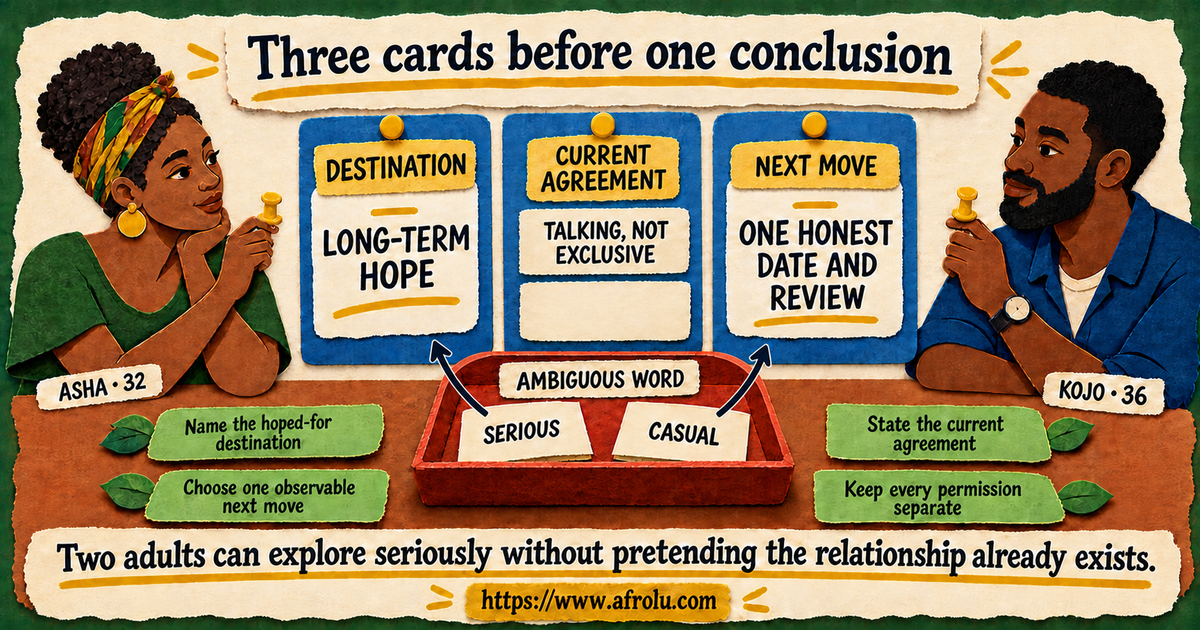
A hoped-for destination is not today's agreement; ask for both.
Written and edited by Jean-Claude Mukendi · Relationship Guides Editor
Put three cards on the table: DESTINATION, CURRENT AGREEMENT and NEXT MOVE. Ask what serious would eventually mean, translate casual as relaxed pace, current non-exclusivity or no commitment goal, and state what exists today. Then choose one observable action while exclusivity, sexual health, consent, privacy, money, meeting and exit remain separate decisions.
Early relationship discovery · New Relationship Starters
How can a new dater tell whether a talking stage has serious long-term direction, a casual present agreement or an unresolved mismatch without inferring commitment from tone, messages, sex or spending?
A talking stage is an exploratory period before adults have necessarily agreed a dating structure, exclusivity or relationship. Serious usually describes a hoped-for long-term direction. Casual may describe tone, current non-exclusivity or a commitment-free goal. Because those words answer different questions, only a direct present-tense agreement can define this connection.
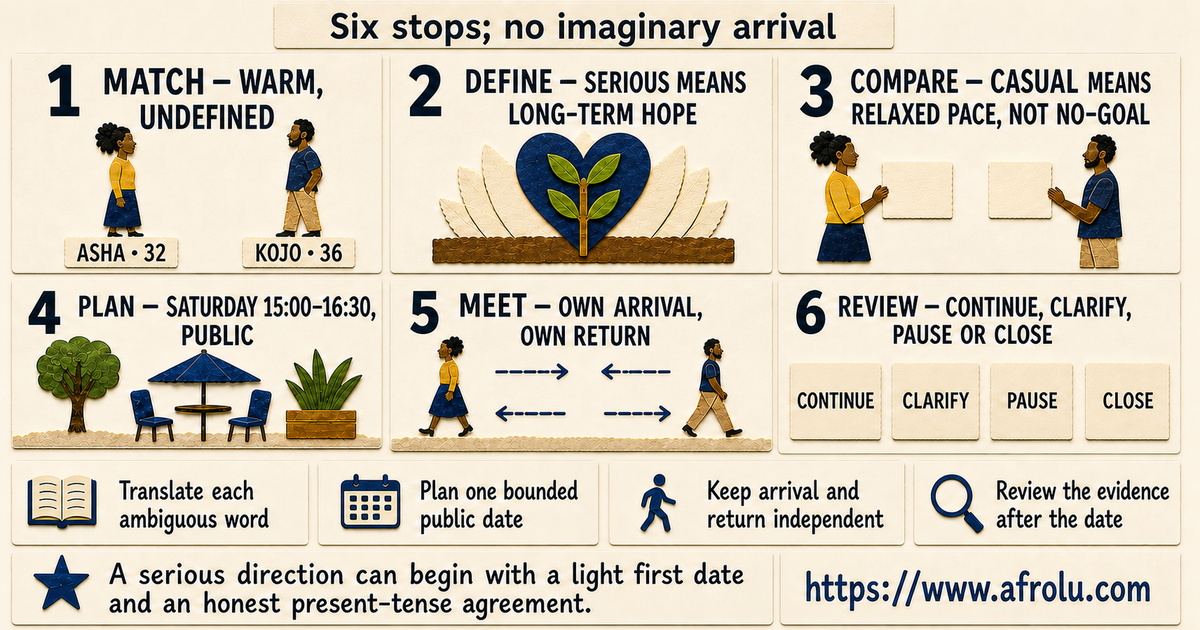
Asha, 32, and Kojo, 36, are fictional adults. Asha's profile says serious; Kojo calls early dating casual. They discover that both hope for partnership while preferring a relaxed, non-exclusive first stage. They plan one bounded public date and review afterward. When Kojo's available goal changes, he names it, and Asha freely declines the revised arrangement.
The new-journey three-card map room
Let hope point forward without letting it rewrite today
Jean-Claude separates serious direction from current status and treats casual as an ambiguous word that adults must translate rather than rank.
Name the destination, write the current agreement, choose one next move and keep every permission independently controlled.
Name destination
Describe what you hope to build without assigning it to this match.
Write today
State the relationship and exclusivity agreement that actually exists.
Choose a move
Ask, plan, pause or close through one observable voluntary action.
Protect choice
Keep body, money, images, access and exit outside every label.
Start with the words that are doing too much work
Serious and casual can describe different parts of the same journey
A talking stage is an exploratory period in which two adults are deciding whether they want another conversation, an in-person date or a clearer romantic agreement. It is not automatically exclusive, committed or sexual. For someone beginning or restarting dating, that uncertainty can feel like a test with a hidden answer. There is no hidden answer: the current agreement must be said, and either adult may decide it does not fit.
Serious usually describes a direction: the adult hopes eventually to build a committed long-term partnership, perhaps with shared life plans. It does not mean that a new match is already a partner, that every date must continue, or that the first conversation is an audition for marriage. Serious intention can coexist with humour, a short coffee, gradual disclosure and a decision to stop after one kind but incompatible meeting.
Casual is more ambiguous. One person may mean a relaxed tone, another may mean dating without exclusivity while learning, and another may mean a continuing relationship with no commitment goal. Those are materially different arrangements. Do not infer the meaning from clothing, reply speed, flirtation, sex, who paid or how affectionate the messages sound. Ask which meaning applies and what it changes today.
The taxonomy matters because relationship stages, structures and behaviours are not interchangeable. A talking stage describes unfinished exploration. Casual dating can be an agreed structure. Non-exclusive dating answers one permission question. Serious dating names long-term intention. A situationship usually points to sustained ambiguity without a mutually clear agreement. None is automatically healthy or harmful; informed agreement, respect, consent and the freedom to leave determine the next response.
Use three cards instead of one loaded label
Destination, current agreement and next move belong on separate lines
Card one is DESTINATION: what kind of connection would each adult be glad to build if fit develops? An answer might be a committed partnership, an intentionally casual relationship, ethical non-exclusivity or uncertainty that needs more time. This card is about direction, not a promise concerning the person in front of you. A destination may change, but the change should be named before another adult keeps investing on an outdated assumption.
Card two is CURRENT AGREEMENT: what, exactly, exists between these two adults today? They may be talking and free to date others; they may have agreed to focus on each other; they may have planned one date without any exclusivity; or they may have agreed to casual dating. Silence is not an agreement. A profile preference, frequent chat, a kiss or sex cannot answer the card on behalf of both people.
Card three is NEXT MOVE: what small action will produce useful evidence without borrowing commitment? It could be one public date, a definition conversation, a slower reply rhythm, an exclusivity question, a sexual-health discussion, a pause or a clear ending. Make the move observable and time-bounded enough to review. ‘See where it goes’ is not a plan unless both adults understand what contact and choices remain open during the seeing.
Keep permissions outside the three cards unless each one is deliberately discussed. Destination does not grant access to money, passwords, intimate images, home, workplace, body or transport. Current agreement does not pre-authorise sex or a later meeting. A next move does not obligate the move after it. Kenya's data regulator explains necessity and purpose limits for organisations processing personal data; this guide borrows only the practical discipline of asking whether a disclosure is needed, not a legal rule for every private conversation.
Watch a vague word become a usable answer
Asha and Kojo keep warmth while they correct an assumption
Asha, 32, and Kojo, 36, are fictional adults who meet through a dating service. Both are new to this particular journey; the guide does not specify whether either has dated before, where they live, what they earn or which gender usually asks the questions. Their exchange is warm and playful. Asha's profile says ‘serious relationship’; Kojo says during a call that he likes to ‘keep early dating casual.’ Neither phrase settles the current agreement.
Asha asks, ‘When you say casual, do you mean relaxed pace, non-exclusivity, or no commitment goal?’ Kojo says he hopes to build a committed relationship if fit develops, but prefers one date at a time and does not assume exclusivity before a conversation. Asha shares the same destination and says she also needs direct notice if either adult's goal changes. They have clarified direction without promising a relationship.
They write the current card in plain language: talking and not exclusive, with no sexual or financial expectations. The next move is a Saturday meeting from 15:00 to 16:30 in a public café area, followed by separate journeys home. Each tells a trusted person useful details. Neither treats the plan as a test of seriousness, and either may cancel, shorten or decline another date without owing a more dramatic reason.
Afterward, Asha wants another date; Kojo realises his available capacity supports occasional casual dates but not the committed direction he named. He says so rather than lowering contact and hoping Asha will infer it. The match ends respectfully. That is not a failed serious journey. The three cards did their job: a changed destination became visible before ambiguity consumed more time or warmth was mistaken for a promise.
Organise observations by the question they answer
Words, patterns, boundaries and safety must not cancel one another
LANGUAGE asks whether the hoped-for destination is named, casual is translated, present status is current and changes can be spoken. A polished answer can still be incomplete, while a hesitant answer can be honest. Listen for content: what do you want eventually, what are we now, may we date others, and what is the next decision? Do not count confidence, romantic vocabulary or message length as commitment.
PATTERN asks whether questions return, invitations become complete, missed expectations receive repair and effort remains sustainable. Equal care does not require identical reply times, spending or personality. One adult may write less and plan carefully; another may speak often and avoid every decision. Compare the stated intention with several relevant actions, while allowing ordinary mistakes to be acknowledged and corrected without inventing a permanent character verdict.
BOUNDARIES asks whether pace is respected, exclusivity is discussed rather than assumed, sexual choices remain separate and a no does not attract punishment. A difference can be workable when both adults can choose freely. Pressure hides inside apparently romantic claims: ‘If you were serious, you would prove it,’ ‘If this is casual, consent should be automatic,’ or ‘After everything I planned, you owe me.’ None creates permission.
SAFETY asks whether privacy remains controlled, money stays separate, meetings are leaveable and exit is respected. eSafety's Australian guidance says online daters can choose platforms around relationship needs while still minimising personal information, using in-app controls and meeting only when ready. It cannot verify an individual or guarantee a meeting. Threats, tracking, image abuse, coercion, money pressure or a blocked exit need protection and local support, not another intention conversation.

Read one lane at a time; never let chemistry average away a safety fact.
Ask one question at the point where its answer matters
Twelve scripts turn abstract compatibility into usable choices
Open with your own position so the question does not feel like a disguised exam. ‘I want commitment eventually; I am not naming us yet’ separates direction from current status. Follow with the missing card: ‘What are you hoping to build if dating goes well?’ If the word serious appears, ask what behaviours or agreements the speaker expects now rather than assuming shared timing.
Translate casual with options that expose its different meanings: relaxed pace, current non-exclusivity or no commitment goal. Then ask about exclusivity directly. ‘Are we both free to date other people right now?’ has a usable answer. If either adult wants that to change, discuss when the new agreement starts and what it covers. Deleting an app, spending a weekend together or having sex does not silently enact exclusivity.
Sexual health deserves an adult conversation before sex, not after a relationship label is awarded. CDC guidance recommends discussing sexual health with partners before sex and consulting a healthcare professional about testing appropriate to the person. That is U.S. public-health guidance, not a universal testing schedule. Ask about relevant partners, protection, testing and privacy; use current qualified local care for individual decisions and keep each sexual act separately consensual.
A pause or ending should be as plain as the opening. ‘I cannot give this attention this week; I will contact you by Friday if I want to continue’ includes a boundary and a review point. ‘Our goals differ, so I am ending this talking stage’ is enough for an ordinary safe mismatch. If contact has become threatening or an exit is being defeated, explanation is optional; protect accounts, preserve useful evidence where safe and seek appropriate help.

A useful intention question asks what the word means and what changes now.
Keep serious intention from making the first meeting enormous
A bounded date can test fit without auditioning a life partner
Choose a public, populated setting, a start time, a likely end, a confirmation point and independent transport. RAINN's U.S. survivor-support guidance recommends meeting only when ready, sharing useful plans with a trusted person, choosing public places and controlling transport. These steps may reduce exposure but cannot guarantee safety or make a harmed person responsible. Readers need local services and emergency routes appropriate to their location.
Do not make expense a measure of serious intent. One adult may pay, split or alternate by mutual choice, but a bill cannot buy exclusivity, affection, sex, another date or gratitude beyond ordinary courtesy. Keep control of money and return travel. The FTC's U.S. romance-scam guidance describes fabricated romantic stories leading to money requests; it does not mean every delayed meeting or casual dater is fraudulent. A request for money is still a reason to stop and check independently.
Serious and casual intentions do not alter consent. WHO's global sexual-health framework centres physical, emotional, mental and social well-being, respect and freedom from coercion, discrimination and violence. It is a framework rather than personal medical or legal advice. Consent remains specific, voluntary and revisable; a profile label, repeated date, exclusive agreement, payment, test result or earlier yes cannot authorise a different act.
Digital boundaries continue after a pleasant meeting. The U.S. Office on Women's Health identifies repeated unwanted messages, demands for passwords, pressure for private images and demands for immediate replies as possible digital abuse. Its services and legal context are American, and ordinary mismatched communication should not be mislabelled as abuse. Look at observable pressure, control and defeated boundaries; respond proportionately and prioritise safety when direct harm appears.
End with a move, not a personality verdict
Eight equal routes let clarity count even when romance ends
CONTINUE when destination, current agreement and a wanted next move are sufficiently clear. ASK AGAIN when one important word remains ambiguous and the response is safe to request. DEFINE THE AGREEMENT when both adults want exclusivity, casual dating or another structure and need to state when it begins. RESET PACE when the direction still fits but contact or meeting frequency does not. Each move should say what changes now.
MEET SAFER when both adults want a public, leaveable plan and the remaining uncertainty can reasonably be explored in person. PAUSE when capacity is unavailable and a real review point protects both people from indefinite waiting. CLOSE when goals, availability, boundaries or attraction do not fit. None of these routes requires proving that the other adult is bad, unserious or afraid of commitment; incompatibility is enough.
GET HELP is not a stronger version of close. It is a separate route for threat, stalking, image abuse, coercion, money or credential pressure, impersonation, defeated privacy or blocked exit. Preserve useful evidence where safe, secure affected systems, tell trusted support and use current platform, financial, specialist, legal or emergency services suited to the facts and location. Do not wait for a relationship definition before protecting yourself.
Review the three cards after meaningful new evidence, not after every message. Ask: has the destination changed, is the current agreement still mutual, and what next move is freely wanted? A new dating journey becomes steadier when adults can revise an answer without rewriting history. The most serious act may be a respectful ending; the most relaxed act may be naming a boundary early enough that nobody has to guess.

Choose the smallest honest move that preserves both adults' freedom.
Eight moments when serious and casual stop meaning the same thing
The serious badge
A profile says serious relationship, but the two adults have not discussed what serious means, whether either is seeing other people or what they want next.
Treat the badge as an invitation to ask, not a present agreement.The easygoing date
A first meeting is light, funny and inexpensive, so one adult worries that the other cannot have a long-term intention.
Judge the stated direction and follow-through; relaxed tone is not a relationship structure.The casual shortcut
A match uses casual to mean slow pacing, while the listener hears continuing sex and dates without a commitment goal.
Offer the three meanings and ask which one changes today's choices.The deleted profile
One person removes an app after a promising weekend and assumes the gesture quietly made both adults exclusive.
Ask whether exclusivity is wanted, when it starts and what it covers.The all-day proof
Fast replies and daily calls are treated as evidence of serious intent, even though every invitation remains vague and no status answer arrives.
Compare words with complete plans and sustainable effort instead of message volume.The status after intimacy
After consensual sex, one adult believes the connection must now be committed while the other believes the current non-exclusive agreement continues.
Discuss status and sexual-health choices separately before relying on either assumption.The quieter destination
A person who originally hoped for partnership now has capacity only for occasional casual dates and begins reducing contact instead of saying the goal changed.
Name the revised destination promptly and let the other adult freely decline it.The seriousness fee
A romantic contact says money, a code, an intimate image or a private-home meeting will prove the reader is not wasting time.
Refuse the demand and move from compatibility review to the appropriate protection route.Sixteen observations across language, pattern, boundaries and safety
LANGUAGE · Destination named — the hoped-for relationship can be described without assigning it to this match.
LANGUAGE · Casual translated — relaxed tone, non-exclusivity and no-commitment intent are kept distinct.
LANGUAGE · Status current — both adults can say what exists today without borrowing a future label.
LANGUAGE · Change spoken — a revised goal or capacity is named before the old answer keeps guiding investment.
PATTERN · Questions return — curiosity and disclosure move in both directions without becoming an interview.
PATTERN · Plans complete — invitations include enough detail to accept, decline, alter or leave.
PATTERN · Repair happens — a missed expectation can be acknowledged and answered with a proportionate change.
PATTERN · Effort sustainable — warmth does not depend on permanent access, spending or performance.
BOUNDARIES · Pace respected — slower or faster preferences can be discussed without punishment or proof demands.
BOUNDARIES · Exclusivity asked — app use, frequency, sex or affection is never substituted for agreement.
BOUNDARIES · Sex separate — every sexual-health and consent choice remains distinct from relationship intent.
BOUNDARIES · No penalty — a no, pause, counteroffer or ending does not trigger humiliation or bypass.
SAFETY · Privacy kept — personal details and digital access expand only by freely chosen purpose.
SAFETY · Money refused — no fee, emergency, investment, gift or fare becomes proof of affection.
SAFETY · Meeting leaveable — place, time, trusted check-in and independent return remain controlled.
SAFETY · Exit respected — closure is not defeated through new accounts, other people or physical pressure.
Ten questions for moving from a label to a proportionate choice
| Situation | What it may mean | What to do next |
|---|---|---|
| Can each adult describe the hoped-for destination? | Fits: Both directions are understandable without a promise. Needs review: One person is genuinely undecided and says what review is needed. Stop: A future fantasy replaces every present answer. | Name the direction once, then decide whether uncertainty fits. |
| Does casual have a shared meaning here? | Fits: Tone, exclusivity and commitment goal are separated. Needs review: One meaning still needs an example. Stop: The word changes whenever a boundary is raised. | Offer the three meanings and record the current choice. |
| Is the current agreement explicit? | Fits: Status and open choices can be said by both adults. Needs review: One permission remains unasked. Stop: Sex, messages or app deletion is used as silent consent. | Ask directly before acting as though the agreement changed. |
| Does the next move create useful evidence? | Fits: A complete, wanted action has a review point. Needs review: Timing or logistics need one counteroffer. Stop: Only indefinite waiting or instant commitment is allowed. | Choose one smaller action or close the mismatch. |
| Do words and repeated conduct broadly align? | Fits: Several relevant actions support the stated direction. Needs review: One ordinary inconsistency can be repaired. Stop: Warm language repeatedly hides incomplete plans and avoided answers. | Ask about the pattern and decide from the response. |
| Is exclusivity treated as a mutual agreement? | Fits: Both adults know whether and when it applies. Needs review: Scope or start date needs defining. Stop: Possession, monitoring or punishment substitutes for consent. | Define it together or remain non-exclusive and honest. |
| Are sexual choices separately informed and voluntary? | Fits: Health, protection, privacy and consent are discussable. Needs review: A qualified local health question remains. Stop: Status, spending or prior intimacy is used as permission. | Pause the act; use current local care or support as needed. |
| Is the proposed meeting bounded and leaveable? | Fits: The public plan and independent return work. Needs review: One practical safeguard is missing. Stop: Privacy, transport or a home visit is demanded as proof. | Change the plan or do not meet. |
| Can a changed destination be spoken without retaliation? | Fits: Revision leads to a fresh free choice. Needs review: Disappointment needs space without pressure. Stop: Contact is reduced strategically while the old promise is kept alive. | Request one current answer, then set your own limit. |
| Is there a direct safety or fraud fact? | Fits: Ordinary compatibility review remains appropriate. Needs review: A claim or request needs independent checking. Stop: Threat, tracking, image abuse, coercion, money pressure or blocked exit appears. | Protect the affected system and use appropriate local help. |
Twelve complete lines for intention, pace, exclusivity, health and exit
“I want commitment eventually; I am not naming us yet.”
“If dating goes well, what would serious mean in your everyday life?”
“Does casual mean relaxed, non-exclusive, or no commitment goal?”
“Are we both free to date other people right now, and do either of us want that to change?”
“I prefer one date at a time and a check-in after each; what pace works for you?”
“I can meet Saturday from 15:00 to 16:30 in a public place and will arrange my own return.”
“I do not message all day, but I can usually reply in the evening and name a busy day.”
“Before sex, let us discuss partners, protection, tests and privacy.”
“Wanting a serious relationship does not decide this physical choice; do you want to continue now?”
“I do not send money, codes, gifts or investment funds to someone I am getting to know.”
“I cannot give this attention this week; I will contact you by Friday if I want to continue.”
“Our goals differ, so I am ending this talking stage.”
Know the difference
Talking stage or casual dating? Ask what has actually been agreed
The adults are exploring fit and may not yet have agreed a dating structure, exclusivity or long-term direction together.
The adults have an understood dating arrangement without a current serious-commitment agreement; exclusivity still must be stated rather than assumed.
A relaxed conversation can occur in either. The distinction is the mutually understood current agreement, not message tone, sex or who initiated the date.

Name the current agreement before choosing the nearby route.
Do not confuse a relaxed pace with casual dating or a talking stage
| Type or dimension | What it describes | Best next question |
|---|---|---|
| Relaxed pace | This describes how pressure and timing feel, not whether the relationship goal is casual or serious. | Agree one sustainable contact and meeting rhythm. |
| Casual dating | The adults understand they are dating without a current serious-commitment agreement; exclusivity varies. | Define the goal, openness, sexual-health choices and review point. |
| Non-exclusive dating | This answers whether dating others remains allowed, not whether either person hopes for partnership. | State the permission plainly and revisit it only by mutual agreement. |
| Talking stage | Fit is still being explored and important status or structure questions may not yet be answered. | Name destination, current agreement and one next move. |
| Serious dating | The adults date with an expressed long-term commitment direction, without guaranteeing this match will continue. | Compare values and conduct while keeping each next choice voluntary. |
| Exclusive dating | Both adults have agreed not to date others; that agreement alone does not settle every commitment milestone. | Define scope, timing, app choices and how changes will be discussed. |
| Situationship | A continuing romantic or sexual connection lacks sufficient mutual definition for one or both adults' needs. | Ask for the missing agreement and set a limit on unresolved ambiguity. |
| Mixed signals | Observed words and actions appear inconsistent, but the label does not explain intention by itself. | Name one concrete mismatch and request a current answer. |
| Coercion or fraud | Pressure, deception, threats or money and access demands create a protection issue rather than a dating type. | Stop the compatibility debate and use suitable safety or fraud routes. |
Put destination, current agreement and next move on separate cards
Ambiguous-word translator
Write the speaker's practical meaning of serious and casual, then replace each label with an agreement or observable action.
Three-card map
Keep the hoped-for destination, today's agreement and the next move on different lines so future hope cannot silently create present access.
Pattern notebook
Record a few relevant words, complete plans and repairs without rating the whole person or monitoring private activity.
Permission inventory
List exclusivity, sexual choices, money, images, home, transport and digital access as separate decisions that no label bundles together.
Small-date plan
Choose a public setting, start and likely end, confirmation point, trusted check-in, controlled spending and independent return.
Route review
After meaningful evidence, continue, ask, define, reset, meet, pause, close or seek help according to the affected question.
Questions for the destination, current agreement, next move and safety route
Choose a few prompts that fit the moment. This is a reference library, not a list to complete.
Destination card
Describe hope without assigning a partner.
- What would I gladly build?
- What am I not promising yet?
- Could this direction change?
- How would I name a change?
Current-agreement card
Write only what both adults understand now.
- Are we merely talking?
- May either date others?
- What remains unanswered?
- Which permissions stay separate?
Next-move card
Choose one observable and leaveable action.
- What question matters next?
- Is the invitation complete?
- When will I review it?
- Can either person decline freely?
Protection route
Move direct harm outside compatibility review.
- Is money or access pressured?
- Has a boundary been bypassed?
- What evidence is safe to keep?
- Which current local help fits?
What seven current official and survivor-support sources can—and cannot—support
eSafety keeps relationship choice beside privacy and platform controls
Australia's eSafety Commissioner says platforms may serve long-term, casual, monogamous or multiple-partner interests and advises checking privacy, contact, location, report and block controls, minimising profile data and meeting only when ready.
Evidence limit: This is Australian guidance. It does not certify a platform or profile, define serious or casual for an individual, impose a meeting deadline or guarantee that precautions prevent harm.
ODPC explains purpose limits and necessary personal-data processing
Kenya's Office of the Data Protection Commissioner lists rights to information, access, objection, correction and deletion and says organisational processing should be lawful, transparent, purpose-specific and limited to what is necessary.
Evidence limit: These are Kenyan data-protection rights concerning controllers and processors. This guide does not claim every private dating disclosure has the same legal scope or that another country uses identical rules.
WHO centres respect, well-being and freedom from coercion
WHO's global sexual-health framework includes physical, emotional, mental and social well-being, respectful relationships and the possibility of safe experiences free from coercion, discrimination and violence.
Evidence limit: The framework does not decide an individual's consent, contraception, testing, diagnosis, treatment or local law. Personal care requires qualified current help appropriate to the adult and location.
CDC recommends an informed sexual-health conversation before sex
The U.S. Centers for Disease Control and Prevention advises adults to talk openly with sexual partners before sex, including relevant partner history, STI information and testing, and to discuss individual testing needs with a healthcare professional.
Evidence limit: This is U.S. public-health guidance and not a universal test list or timetable. It does not make a result proof of exclusivity, relationship intent, consent or future conduct.
RAINN pairs personal readiness with a public and leaveable plan
RAINN's current U.S. survivor-support guidance recommends meeting only when ready, telling a trusted person useful details, choosing a public populated location and retaining control of transportation.
Evidence limit: Risk-reduction cannot guarantee safety or make a harmed person responsible. RAINN's named hotline and emergency references are U.S.-specific, so readers elsewhere need current local support.
FTC routes romantic money requests to consumer protection
The U.S. Federal Trade Commission describes fake romantic profiles, movement away from platforms, stories that prevent meeting and later requests for travel, emergencies, gifts or investments, with prompt provider contact if money was sent.
Evidence limit: The guidance and reporting route are American. Distance, affection, a changed intention or a postponed date alone does not prove fraud, and payment recovery differs by country and method.
Office on Women's Health identifies pressure and control across devices
The U.S. Office on Women's Health includes repeated unwanted contact, demands for passwords or immediate replies, pressure for private images and digital monitoring among possible dating-abuse behaviours, while healthy partners respect boundaries.
Evidence limit: This is U.S. health and support information, not a diagnosis or a universal legal test. An ordinary reply mismatch needs proportionate communication; threats, control and defeated boundaries need suitable local safety help.
Six shortcuts that turn ambiguous labels into imaginary agreements
Treating serious as a current contract
A long-term hope does not make a new match exclusive, committed or entitled to access. Name today's agreement separately.
Using casual as a universal definition
Relaxed tone, non-exclusivity and a no-commitment goal are different. Ask which meaning the speaker intends.
Counting messages as commitment
Frequent contact may feel close while plans and status remain vague. Compare words with relevant repeated action.
Letting sex decide the status
Consensual intimacy does not silently create or cancel exclusivity, commitment or another sexual choice.
Making expense prove intention
A costly date, gift or journey cannot buy affection, consent or continuation and may create avoidable pressure.
Debating fit after danger appears
Threats, stalking, coercion, image abuse, money pressure and blocked exit require protection, not a better definition talk.
Translate one loaded word before planning the next date
Start with the card that is actually missing: long-term direction, the agreement that exists today or one freely wanted next move. These three released Afrolu guides keep the concepts distinct before access expands.
Explore the guide library
Show more related guides
Continue with Afrolu
Show more Afrolu guides
Reviewed sources with geography, scope and explicit limits
Afrolu reviewed these health, research, safety, or public guidance resources while editing this page. They support the behaviour and safety guidance; they do not diagnose any individual described by a reader.
New-journey questions about serious intent and casual dating
What is a talking stage when I want a serious relationship?
It is a period of exploring whether another conversation, date or agreement is wanted. Your serious intention describes the kind of partnership you hope eventually to build; it does not make this match committed or exclusive. State the destination, name today's agreement and choose one next move without borrowing permission from the future.
Can a serious dater keep the first few dates casual?
Yes, if casual means light, low-pressure or not yet exclusive and both adults understand the current arrangement. A relaxed coffee or gradual pace does not contradict long-term intent. If casual means an ongoing no-commitment structure, that may conflict with your destination. Translate the word rather than judging the atmosphere.
How do I ask what casual means without sounding demanding?
Offer the ambiguity calmly: ‘Does casual mean relaxed, non-exclusive, or no commitment goal?’ Share your own answer too. You are not demanding commitment; you are checking whether the available arrangement fits. A person may answer, remain unsure or decline, and you may decide from that information.
Does talking every day mean the relationship is becoming serious?
It means contact is frequent. It may show interest, habit, convenience or a preferred communication style, but it does not create exclusivity or commitment. Look for direct status answers, complete plans, sustainable effort, respected boundaries and repair. Then ask about the current agreement instead of asking message volume to decide it.
When should we discuss exclusivity in a talking stage?
Discuss it before either adult starts relying on it. There is no universal number of messages or dates. Ask whether both people remain free to date others, whether either wants that to change, when a new agreement would begin and what it covers. App deletion, sex, travel or meeting friends cannot silently answer for both adults.
Does sex turn a casual talking stage into a relationship?
No. Consensual sex does not by itself create exclusivity, commitment or a future date. Discuss the relationship agreement directly and keep sexual health, protection, testing, privacy and each act's consent separately voluntary. Use current qualified local healthcare for personal decisions; neither a status label nor a test result guarantees consent or conduct.
How long should a talking stage last before meeting?
No universal deadline makes a meeting right. Meet when both adults want to and can make a public, bounded, independently leaveable plan. A repeated refusal to create any feasible next step may show mismatch, but timing should reflect readiness, accessibility, transport and real capacity. Pressure to meet is not proof of serious intent.
What if someone changes from serious to casual?
Ask what changed and what casual now means. They are allowed to revise a goal; you are allowed to decline the new arrangement. Update the destination and current-agreement cards rather than letting the old answer preserve your investment. If contact becomes strategically vague, set a clear review point or end the talking stage.
Is asking for money a sign they only want something casual?
It is not evidence about casual intent; it is a separate money and possible fraud issue. Do not send money, codes, gifts or investment funds to prove interest. Check claims through routes you locate yourself, contact a payment provider promptly if funds moved and use current fraud-reporting support for your country.
How do I end a talking stage when our goals differ?
For an ordinary safe mismatch, say the goals do not match and that you are ending contact. You do not need to prove either person is wrong or afraid of commitment. If there are threats, tracking, image abuse, coercion, impersonation, workplace contact or blocked exit, prioritise security, evidence and appropriate local specialist or emergency help.
One thing to do now
Fold the map only after the current agreement is visible
Separate future direction from today's agreement, then compare both with repeated conduct and the response to a modest boundary. Continue, ask, define, reset pace, meet safer, pause or close for ordinary fit decisions. Send threats, tracking, image abuse, coercion, money pressure, impersonation and blocked exit directly to appropriate protection routes.