Diaspora dating · Nairobi safety and clarity
Nairobi Talking Stages for Diaspora Daters
A diaspora guide to Nairobi talking stages: turn attention into clear public plans, protect privacy, money and travel, and keep meetings independently safe.
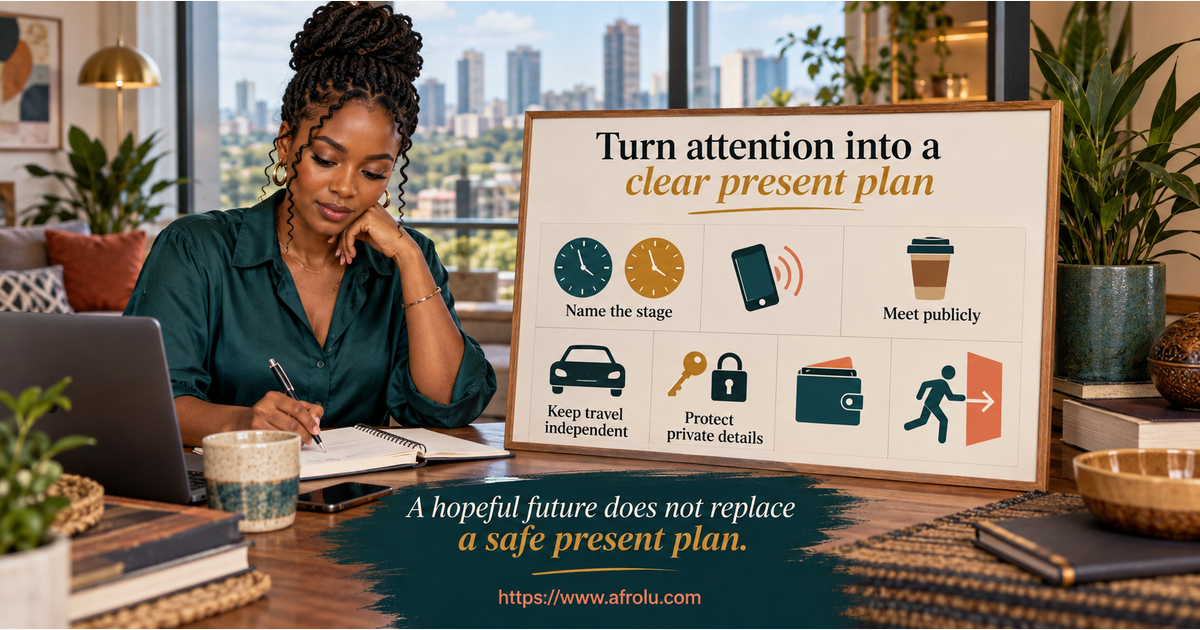
A clear present plan can protect a hopeful connection.
Written and edited by Nia Kato · Profile Advice Editor
Keep the talking stage present-tense. Name one realistic contact rhythm, choose a current publicly accessible meeting that you can independently reach and leave, keep travel, money, accommodation, records, and location separate, and watch whether the person respects a small boundary. No guide or venue can guarantee safety; choose the action that preserves your freedom to pause or leave.
Early relationship discovery · Diaspora Daters
How can a diaspora dater turn a Nairobi talking stage into a clear public plan without confusing attention, a future story, or travel logistics with a reason to surrender money, privacy, consent, or independent safety?
A talking stage is a period of getting to know someone before a relationship is defined. For diaspora daters planning a Nairobi meeting, it can include time zones, travel, culture, and local logistics. This guide treats those as practical choices, not proof of commitment, and centres current public planning, privacy, financial independence, consent, reporting, emergency awareness, and a free no.
Nadia is abroad and plans a Nairobi visit while a promising talking stage grows through voice notes and future talk. She asks for one public daytime coffee, keeps her hotel and transport private and independent, and declines a request to pay for a ticket. When the person accepts the smaller plan without pressure, she has a clearer next step; if they did not, she would still have a safe reason to pause.
diaspora dating · Nairobi safety and clarity
Nadia turns future talk into one public present plan
A long-distance talking stage can make a Nairobi visit feel like a relationship deadline. This guide helps diaspora daters keep contact, public planning, travel, money, privacy, consent, and emergency awareness visible without claiming any venue or person can be certified safe.
Name the current stage, choose an independently reachable public plan, separate travel from romance, protect difficult-to-reverse information, use clear stage language, keep consent current, and choose the right response route when a concern appears.
Name one current agreement
A talking stage can stay hopeful without becoming a promise before you meet.
Plan for independent choice
Use current local information, public access, separate transport, payment, and an exit.
Keep every dependency separate
Tickets, lodging, money, documents, and location do not prove commitment.
Use the facts
Pause, report, seek support, or close when a request narrows your agency.
Name the present before planning the future
A talking stage is a period of getting to know someone, not a promise that removes ordinary safety choices
Nadia lives abroad and is considering meeting someone in Nairobi during an upcoming visit. They have exchanged kind messages, voice notes, and long conversations about food, family, work, and the city. She enjoys the connection, but she notices that their imagined future is growing faster than their actual agreements. A talking stage can hold possibility; it should not require her to treat a hopeful story as a completed relationship.
She brings the conversation back to the present. What do they each want to explore now? Is a short public meeting during the visit realistic? How will they communicate if the travel date changes? What information do they need without handing over private travel routines, financial records, family contacts, or access to each other’s devices? These questions do not make the conversation cold. They give both adults a chance to choose something they can actually carry out.
Nadia avoids treating messaging frequency as the main evidence of care. Across different time zones, work schedules, travel days, and family obligations, a delayed reply may mean very little. A more useful sign is whether someone can name a practical next contact, respect a limit, and follow through on a small plan. Repeated vagueness, pressure for quick access, or anger at a simple boundary deserves more attention than a dramatic late-night declaration.
She keeps the first agreement proportionate: one planned video call, one public daytime meeting if the visit happens, and no promises about a second date before the first one has occurred. A relationship can grow from that. It does not need to be manufactured by treating flight dates, hotel bookings, or a warm conversation as proof that either adult must move faster than their own judgment allows.
Plan a Nairobi meeting around independent choice
Choose a publicly accessible setting that both adults can reach and leave without relying on the other person
Nadia does not ask a guide to certify a particular Nairobi café, mall, park, hotel, or neighbourhood as safe. Conditions change, and no place can guarantee another person’s behaviour. Instead, she chooses a current, publicly accessible setting she can independently research, reach, and leave. She looks for a daytime time window, a clear meeting point, working phone charge, her own payment method, and a route home or back to accommodation that does not depend on the date.
She tells one trusted person enough to support her: the broad location, time, who she is meeting, and when she expects to check in. This is not a request for someone to monitor every move or judge the date. It is a practical support option if the plan changes. Nadia keeps her exact accommodation, room number, private family address, and detailed travel schedule private from a new match until she freely decides otherwise.
Independent transport matters before and after the meeting. A ride offer can be generous, but it may also make leaving harder if the conversation changes or a public plan becomes a private one. Nadia can choose a route she understands, keep enough money or payment access for it, and decide in advance that she will not enter a vehicle, residence, or unfamiliar location merely because declining feels awkward. Her comfort is enough information.
If a venue becomes unavailable or the date asks to move somewhere private, late, or harder to leave, Nadia can reschedule or end the plan. She does not need to debate whether the alternative is objectively risky. A respectful person can accept a public replacement or a postponement. A person who argues, guilt-trips, threatens, or insists that trust requires a last-minute change is giving her a reason to protect distance.
Keep travel and money outside the romance claim
A visit creates practical decisions that should remain independent of attraction
Nadia keeps her own booking, payment, accommodation, documents, and return plan under her control. She does not send a new match money for a fare, receive money to hold, take an unfamiliar investment offer, or allow a romantic promise to turn into a request for a transfer. A person who has an emergency may have a real emergency, but Nadia is not required to solve it because they are dating or because she hopes to meet them.
She also does not hand over a passport image, booking reference, airport arrival time, hotel address, or live location as a condition of the conversation. A match can know the broad city and a proposed public meeting time without gaining access to everything that would make Nadia easier to find, track, impersonate, or pressure. Trust does not grow from information that is hard to take back.
The same rule applies to a local match who offers to arrange every detail. They may genuinely be trying to help, but independent transport, lodging, payment, and a way to leave protect both adults from hidden obligation. Nadia can accept useful public information while still making her own bookings. If the only workable plan requires the other person to pay, host, hold documents, or decide where she goes, she can wait until an independent plan is possible.
Distance can amplify future talk. Someone may mention a shared home, a wedding, or a trip before they have kept a single call or public meeting. Nadia can respond warmly without converting the hope into a contract. She brings the conversation back to what is verifiable now: a scheduled call, a public coffee, a clear statement of what each person is exploring, and respect for a no if the visit or relationship does not proceed.
Protect privacy without becoming an investigator
A talking stage does not require passwords, codes, documents, private images, family introductions, or constant location sharing
Nadia chooses what she shares in layers. A first video call may help her hear a person’s voice and see whether a conversation feels coherent, but it is not an identity guarantee. A profile photo, accent, local knowledge, or mutual contact can also be real or misleading. She avoids treating any one signal as complete verification and avoids making money, travel, or private disclosure depend on a promise that she has 'proved' someone.
She keeps the platform available until moving to another channel feels voluntary. If she eventually shares a number, she can still avoid connecting every social account, disclosing home or hotel details, sending identity images, or sharing live location. She does not need to accept a link, download an unfamiliar app, receive a code, open a trading account, or send a private image because a match says that privacy proves a lack of trust.
A reverse image search, a conversation with someone trusted, and a pause before a financial or travel request can sometimes help Nadia notice inconsistencies. These are choices for her own information, not a licence to demand passwords, monitor a person, contact their employer, or expose them publicly. If the information remains unclear, she can choose not to meet. She does not need to turn uncertainty into surveillance to keep a boundary.
If a person threatens to reveal images, claims access to an account, impersonates Nadia, asks for money or a code, or pressures her to move a conversation into secrecy, the focus changes. She should stop sending material, preserve relevant evidence where safe, use platform reporting, contact a financial institution promptly if money or account access is involved, and seek appropriate local support. The request itself is enough reason to protect access; she does not need a final explanation.

Name the request before choosing the response.
Turn attention into one clear agreement
A talking stage becomes less confusing when both adults can name the current purpose, pace, and next contact
Nadia asks, 'I enjoy talking with you. I am open to seeing whether there is a real connection, and I would like to keep the first meeting public and simple if my visit goes ahead. Does that work for you?' The question names interest, a practical next step, and a boundary without asking the person to declare permanence. It gives the other adult a useful choice: accept, offer a different public plan, say the timing does not fit, or step away.
She can also ask about contact rhythm: 'What kind of communication is realistic around your work and mine this week?' A practical answer may be one call, a set message window, or a later check-in. An answer that is only a demand for constant availability does not fit a talking stage that leaves room for work, sleep, family, and independent judgment. She does not mistake all-day access for proof of interest.
When serious goals matter, she names them without fast-tracking commitment: 'I am dating with a long-term relationship in mind, and I want to let our real-life choices show whether we are compatible.' This can coexist with a casual first coffee. A person who hears long-term intent as a requirement for immediate exclusivity, money, dependent travel, or intimacy is asking Nadia to collapse several decisions into one.
If messages remain vague, she makes one direct ask and then stops carrying the plan. 'If you want to meet, send a public time and place that work for you; otherwise I will leave the conversation here.' It is not a threat. It is a boundary around attention. A person may be busy or uninterested, but Nadia's time does not need to remain on hold while she waits for a future that is never scheduled.

A clear limit can make the next plan safer and simpler.
Keep the first meeting public, bounded, and voluntary
An independent arrival, clear time window, and ability to leave make room for a real yes
Nadia arrives independently, lets a trusted person know the broad plan, and keeps a time boundary that lets her check in with herself. She does not have to announce every safety choice to the date or make them responsible for it. The point is that if the conversation feels uncomfortable, she can end it. A good date does not become less good because she retains that option.
She keeps consent current. Agreeing to a public coffee does not decide whether she gets into a car, visits a private residence, drinks alcohol, shares a photo, gives a phone number, kisses, stays later, or meets again. She can say no, change her mind, or leave without producing a detailed reason. A person who respects her comfort may be disappointed, but they do not punish, trap, threaten, or keep asking until the answer changes.
Nadia also resists assumptions in the other direction. She does not use safety planning to demand that the date prove every detail of their life, share passwords, or surrender their privacy. A talking stage should leave two adults with agency. Her boundary is about what she will do, share, fund, or agree to; it is not a tool for controlling someone else. If that boundary means the connection cannot progress, she can accept the mismatch.
If she is threatened, followed, coerced, assaulted, or believes she is in immediate danger, she should prioritise getting to safety and contacting local emergency support. Kenya's National Police Service lists emergency hotlines including 999, 112, and 911; current local advice and access can change, so a reader should use the official source and relevant local support when needed. A planned first date cannot guarantee safety, and harm is never the fault of the person who experienced it.
Choose the next action from the facts, not the fantasy
Continue slowly, pause, report, seek support, or close according to what protects your agency
After a few conversations, Nadia reviews the evidence she can actually see. Has the person respected the pace she named? Can they make a realistic public plan? Do they keep money, documents, and travel separate? Do they repair a missed call with a usable alternative? Is she more settled after contact or more vigilant? She does not use one answer as a score; she looks for whether the connection leaves room for dignity, work, rest, family, and choice.
If the answers are unclear, she can slow down. A pause, one planned call, or a decision not to meet during this trip can be a thoughtful response rather than a lost opportunity. If the answers are clearly unsafe—money demands, account pressure, private-plan coercion, threats, blackmail, stalking, or repeated unwanted contact—she can stop engaging, preserve evidence, use platform reporting, and seek support. Her task is not to teach someone else why the boundary matters before enforcing it.
Nadia tells one trusted person when the connection becomes intense or the meeting plan changes. That person is not there to approve the relationship or investigate the date. They are a source of perspective and practical help. For a cyber incident in Kenya, the Communications Authority identifies National KE-CIRT/CC as the national coordination point for cyber security; for immediate danger, official emergency services are more appropriate. She can use the relevant route without assuming that one report solves every concern.
Her final standard is modest and strong: a talking stage should be able to remain a talking stage until both adults freely choose more. The person who fits her life will not need her to give up money, privacy, travel independence, safety planning, consent, or the ability to say no in order to prove that the connection is real. A clear present plan is more valuable than a future story that makes her less free today.

A clear present plan protects choice before travel grows.
Eight ordinary diaspora Nairobi talking-stage moments
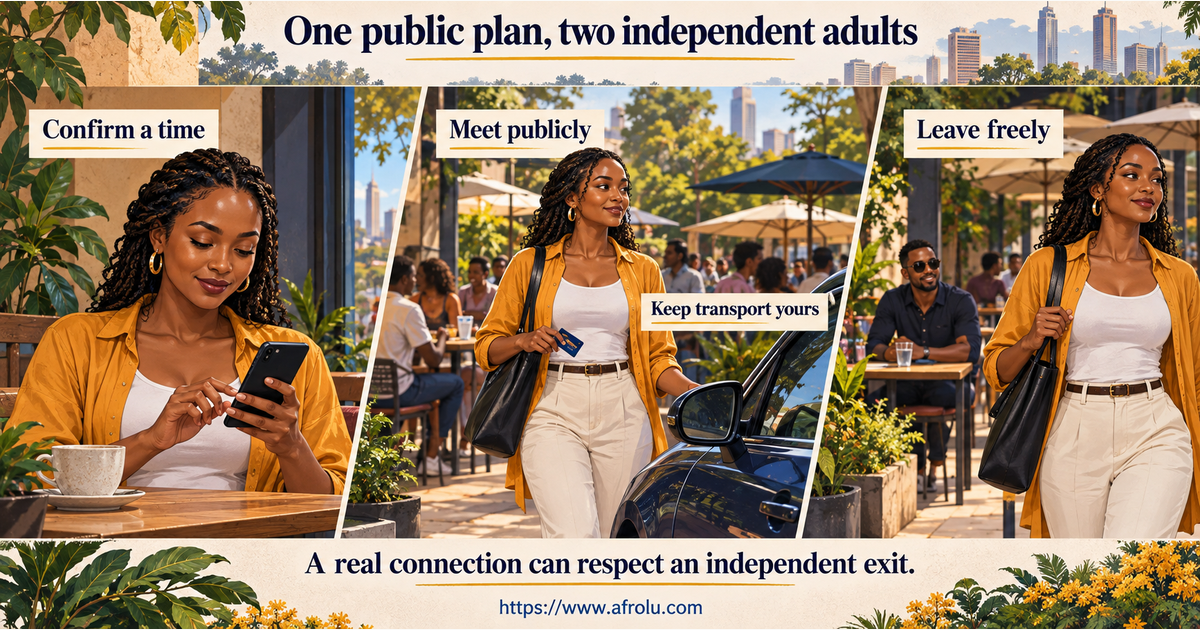
A diaspora dater wants to meet during a Nairobi trip
A hopeful conversation is not yet a travel or relationship contract.
Choose one public daytime plan with independent arrival and exit.A match replies late after a workday
A delay may be ordinary across two schedules.
Ask for a realistic next call before interpreting silence.A match says paying a fare proves commitment
Travel money turns attraction into a financial pressure point.
Do not send it; keep bookings and money independent.A person asks for exact accommodation details early
A public meeting does not require disclosure of private lodging or room information.
Share only the public place and time you choose.A café plan becomes a private ride or home visit
The change can remove the independent exit you planned.
Keep the public plan, reschedule, or leave.A match asks for a passport image or code
Private records and codes are not a dating-stage requirement.
Decline, preserve the request if concerning, and use platform tools.A match talks about marriage before a first meeting and wants exclusivity now
A serious goal can be real without collapsing several decisions into one.
Return to a small current agreement and observe the response.A person threatens to expose an image after you slow down
The conduct has moved beyond ordinary dating ambiguity.
Stop sending material, preserve evidence, report, and seek appropriate support.Signals that contact, travel, privacy or a safety boundary needs attention
A talking stage is treated as if it already obliges you to travel, pay, disclose, or commit.
A person reacts to a delayed reply with guilt, anger, or a demand for constant availability.
Future talk grows faster than any practical public plan or reliable contact rhythm.
A match asks for money, tickets, transfers, investments, gift cards, or help moving funds.
They seek a passport image, booking reference, codes, accounts, live location, private images, or exact accommodation.
A public meeting is repeatedly shifted to a private, late, or dependent plan.
You feel you must accept a ride, stay, or invitation because a flight or meal has already cost money.
A person asks you to leave the platform immediately and reacts badly if you prefer not to.
They use a shared city, culture, language, or mutual contact as proof that you should lower a boundary.
A match makes you responsible for their disappointment when you say no or need more time.
You are spending more energy investigating a story than assessing whether the current plan works for you.
Your work, rest, family calls, friends, or travel independence shrink around the intensity of the chat.
A person returns through new accounts after you have ended or blocked contact.
Threats, stalking, blackmail, impersonation, coercion, or fear appear when you protect a boundary.
Choose a next move from the current request
| Situation | What it may mean | What to do next |
|---|---|---|
| A visit is being discussed | Interest may be real, but travel creates money, lodging, transport, privacy, and exit decisions. | Keep each practical dependency independent before choosing a meeting. |
| A reply is delayed | Time zones, work, travel, sleep, and family can all affect messaging. | Ask for one realistic next contact rather than demanding all-day access. |
| A match wants to meet | A first plan can be useful when it is public, bounded, and independently reachable. | Choose a setting and time you can research, reach, and leave yourself. |
| They ask for accommodation details | A public meeting does not require private lodging information. | Share only the public meeting details you freely choose. |
| They offer to pay for everything | Generosity can be kind but may also create a sense of obligation. | Keep your own transport, money, and ability to change plans. |
| They ask to move off-platform | The request may be ordinary, but its timing and response to a no matter. | Stay on-platform until another channel is your free choice. |
| They want a serious relationship quickly | Long-term goals can be genuine, but they do not decide immediate travel or exclusivity. | Name the direction and keep the next plan small. |
| They ask for money, documents, or a code | This is an access or fraud concern, not a compatibility question. | Do not send it; preserve evidence, report, and block. |
| The public plan changes | An unexpected closure can happen, but an alternative should remain voluntary and easy to leave. | Choose another public option, postpone, or cancel. |
| They threaten or coerce you | The situation has moved beyond normal dating uncertainty. | Prioritise safety, preserve evidence, report, and seek appropriate local help. |
Twelve short lines for pace, public plans, privacy, money and travel
“I enjoy talking with you, and I am open to seeing whether there is a real connection without making promises before we meet.”
“I can offer this call time this week; I do not stay available all day around work and family.”
“If we meet in Nairobi, I am comfortable with a short public daytime plan.”
“I will arrange my own transport there and back.”
“I do not share my accommodation details early in dating.”
“I do not send, receive, invest, or move money for people I meet online.”
“I do not share passports, booking references, codes, account access, or private images.”
“I prefer to keep this conversation here for now.”
“I am dating with a long-term relationship in mind, and I want to let real-life choices show whether we fit.”
“I am not changing to a private location. We can choose another public option or reschedule.”
“I need time to think about whether this pace and plan work for me.”
“This is asking for more access than I am comfortable giving, so I am ending the conversation.”
Know the difference
A talking stage, a clear public plan, travel logistics and direct pressure are different facts
A time-zone delay, a present-tense agreement, a current public meeting plan, an independent trip, and a privacy choice can leave room for two adults to decide freely.
Money, tickets, private accommodation access, documents, codes, location, private-plan pressure, threats, blackmail, stalking, and ignored consent need a firm stop, evidence preservation, reporting, and appropriate support.
Do not let a future story choose the response. Name the current request, then choose the action that keeps your independence and safety visible.

A delayed reply, travel plan and access demand need different responses.
Separate talking-stage uncertainty, logistics, privacy and direct pressure
| Type or dimension | What it describes | Best next question |
|---|---|---|
| A talking stage | Two adults are learning about fit without a commitment that overrides ordinary boundaries. | Name one current purpose, pace, and next contact. |
| Future-pressure stage | Large promises are used to rush money, travel, exclusivity, intimacy, or private access. | Bring the conversation back to a small present agreement or step away. |
| A time-zone delay | A reply can be late because two lives have real schedules. | Use a planned contact rhythm before assigning meaning. |
| Repeated vagueness | No practical call or public meeting becomes clear after reasonable chances. | Make one direct ask, then reduce access if no plan follows. |
| An independent visit | Each adult controls transport, lodging, documents, money, venue, and an exit. | Discuss logistics before booking or meeting. |
| A dependent trip | A ticket, private lodging, reimbursement, or held document creates pressure to continue. | Postpone or choose a fully independent arrangement. |
| A public-plan change | A venue may close or timing may change without removing either person's freedom to decline. | Choose a public alternative or reschedule. |
| A privacy request | A person may ask for a different channel while respecting a no and your information boundaries. | Move only when it is voluntary and reversible enough for you. |
| An access demand | Money, codes, identity records, images, location, or secrecy are requested as proof of trust. | Decline, preserve evidence, report, and block. |
A clear present plan before a larger travel story
The present deserves clarity
A talking stage can hold hope without becoming a relationship contract before any shared real-life evidence exists.
Nairobi plans need current local judgment
Choose a public setting and route you can independently research, reach, and leave; no guide can certify a venue or person.
Travel is not commitment
Tickets, accommodation, documents, money, transport, and exit plans need independent decisions.
Privacy can be layered
You can share broad context while keeping lodging, schedules, records, accounts, images, and location protected.
A public first meeting is information
A clear, bounded plan can show how someone responds to time, a no, a changed venue, and ordinary logistics.
Reports and support have different roles
Platform tools, cyber-incident resources, trusted support, and emergency services each fit different kinds of concern.
Questions organised by purpose and depth
Choose a few prompts that fit the moment. This is a reference library, not a list to complete.
Present-stage check
Use these before making a future promise.
- What are we actually exploring today?
- What small next step would give us useful real-world evidence?
- What remains separate until trust has more time?
Nairobi-plan check
Use these before agreeing to a first meeting.
- Can I independently reach, pay for, and leave the public plan?
- Have I checked current local conditions close to the day?
- Who can I contact if the plan changes?
Travel-and-access check
Use these before sharing information or booking anything.
- Am I being asked for money, documents, codes, location, or a secret?
- Can each adult control travel and lodging independently?
- Would I still choose this if the connection ended tomorrow?
Pattern check
Use these after you name a boundary.
- Was the limit accepted without punishment?
- Can the person make a clear practical plan?
- Does this stage leave room for work, rest, family, safety, and a free no?
Look more closely at public planning, access, consent and response routes
Turn a talking stage into one present plan
Name interest, a realistic contact rhythm, and a small public next step without asking for a future promise.
Evidence limit: One clear conversation cannot guarantee compatibility or safety.
Use current local information and independent routes
Choose a publicly accessible setting, check conditions close to the day, keep payment and transport under your own control, and leave room to cancel.
Evidence limit: No guide can certify a venue, route, or another person as safe.
Separate every practical dependency
Keep flights, lodging, money, documents, transport, location, and exit plans independent before deciding to meet.
Evidence limit: Planning can reduce risk but cannot guarantee another person's conduct.
Treat difficult-to-reverse information carefully
Do not share codes, accounts, private images, accommodation details, identity records, live location, or financial information because a match asks.
Evidence limit: This guide cannot provide individual cyber, legal, immigration, or financial advice.
Keep every agreement current
A public coffee does not decide a ride, private venue, touch, image, overnight stay, payment, or another date; a person can leave or say no.
Evidence limit: This guide cannot replace emergency, advocacy, or clinical support.
Use the right channel for the concern
Use platform reporting for app conduct, relevant official cyber or financial channels for digital or money concerns, and local emergency support when safety is immediate.
Evidence limit: Reporting may not solve every issue, and urgent danger requires prompt local help.
Common shortcuts that make travel pressure harder to see
Treating future talk as current proof
A promised future cannot replace a clear call, public plan, or respectful boundary response today.
Using a guide to certify a location
Conditions and people change; a public venue and independent route can preserve options but cannot guarantee safety.
Letting a ticket decide consent
Travel cost can make a change of mind feel expensive even though a free no must remain available.
Sharing private travel records early
Accommodation details, documents, booking references, and live location can be difficult to take back.
Turning caution into surveillance
Demanding passwords, location, or proof from another adult can create harm without making a connection healthy.
Explaining a safety limit until it becomes a negotiation
Your boundary does not require the other person to agree before you keep it.
Choose one resource for the concern you can actually see
Start with the guide that matches the open fact: a talking-stage question, long-distance logistics, or conduct that needs a private safety review rather than more future planning.
Explore the guide library
Show more related guides
Continue with Afrolu
Show more Afrolu guides
Sources used for this guide
Afrolu reviewed these health, research, safety, or public guidance resources while editing this page. They support the behaviour and safety guidance; they do not diagnose any individual described by a reader.
Questions about diaspora Nairobi talking-stage safety
What is a talking stage?
It is a period of getting to know someone before a relationship is defined. It can hold interest without requiring money, travel, privacy, consent, or commitment decisions before both adults freely choose them.
How do I plan a first meeting in Nairobi safely?
Choose a current, publicly accessible setting that you can independently research, reach, and leave. Check local conditions near the day, keep your own transport and payment access, tell a trusted person enough to support you, and remain free to cancel.
Can a guide tell me which Nairobi venue is safe?
No. Conditions and people change, and no venue can guarantee safety. Use current local information and choose a plan with public access, independent transport, payment, and an easy exit.
Should I share my hotel or accommodation with a new match?
You can keep accommodation details, room number, full itinerary, and live location private. A public meeting does not require a new date to know where you are staying.
What if a match asks for travel money or a ticket?
Do not send money or travel funds to a new online match. Keep bookings and finances independent, preserve the request if concerning, report it, and block if pressure continues.
Can I ask for a video call before meeting?
You can choose a call if it helps you decide, but a video call is not complete identity verification. Keep money, documents, travel, and private disclosure separate regardless.
What if a match wants constant messaging across time zones?
State the contact rhythm you can actually sustain around work, rest, family, and travel. Constant availability is not a requirement for genuine interest.
What if a public plan changes at the last minute?
You can choose another public option, reschedule, or cancel. You do not need to accept a private ride, home visit, or late change because declining feels awkward.
What if a person pressures me for images, codes, or private information?
Do not send them. Stop sharing material, preserve relevant evidence where safe, use platform reporting, and seek appropriate cyber, financial, local professional, or emergency support depending on the concern.
What should I do in an immediate emergency in Kenya?
Prioritise getting to safety and contact appropriate local emergency support. Kenya's National Police Service lists 999, 112, and 911 in its published standards; check official current guidance and use the emergency route that is available to you.
One thing to do now
Let a clear present plan protect the future you are only beginning to explore
Choose the smallest next step that keeps contact, travel, accommodation, money, privacy, consent, transport, local planning, and your ability to say no under your own control.