Six protected margins around a lighter pace
Build Slow Casual Dating Around Two Real Professional Lives
A low-pressure casual dating guide for professionals covering calendars, work privacy, mutual effort, sexual health, consent, money and review.

Protect calendar, channel, energy, effort, access and review before calling the pace sustainable.
Written and edited by Thandiwe Mbeki · Southern Africa Dating Editor
Name the present casual structure, choose a planning window and a modest repeatable rhythm, and keep employer systems outside dating. Track who initiates, travels, pays and repairs changes. Discuss other dating, relevant sexual-health facts and consent before they affect choice. After four ordinary weeks, continue, redesign one feature, pause or close from the full pattern rather than job title or reply speed.
Intentional dating · Professionals
Can this lighter dating rhythm protect two careers while giving both adults enough plan, reciprocity and information to choose freely?
Professional low-pressure casual slow dating is a deliberately bounded relationship rhythm in which status, calendar, personal channels, effort, private access and review are explicitly shared while both adults retain work, rest, money and physical choice.
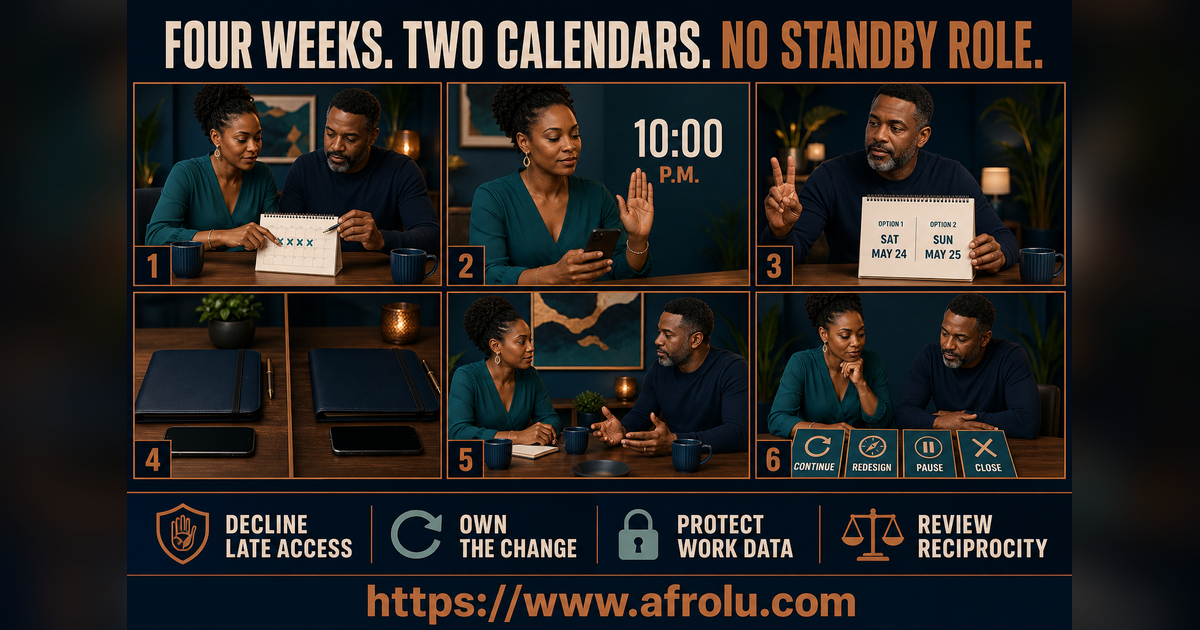
Nia and Kofi are fictional professionals, 38 and 41. Their four-week test follows one late invitation, two repaired schedule changes, protected work channels, a health conversation and a review that adjusts contact without silently changing status.
The six-margin professional pace desk
Protect the rhythm before expanding the access
Thandiwe follows two demanding calendars through planning, work privacy, reciprocity and one ordinary month.
Six separate margins keep professional capacity visible without letting career status decide relationship access.
Calendar
Set a planning window, ordinary frequency and repair rule.
Channel
Keep employer systems and colleagues outside dating.
Energy and effort
Protect recovery and rotate the practical burden.
Access and review
Choose every layer separately and preserve four outcomes.
Start with the operating truth
A full calendar can explain limits but cannot design the relationship alone
Professional life can create real limits: travel, shift changes, confidential work, caregiving, recovery and periods when attention is narrow. Those limits deserve accurate discussion. They do not answer whether dating is open, how often plans happen, what a cancellation requires or how long one adult should remain available. Treat workload as information for designing a rhythm, not as a complete relationship agreement.
Slow dating means learning at a deliberately bounded pace. Casual names a present structure that does not promise partnership by itself. Low pressure describes how contact and escalation are handled. Together they can support one planned date every week or two, lighter messaging and protected work time. They become misleading when one adult receives late-night access, emotional labour or sexual availability while avoiding plans and status language.
A professional title is not evidence of reliability, income, safety or emotional capacity. Do not infer character from an employer, education, clothing or travel. Verify only facts that matter proportionately, keep confidential systems closed and watch ordinary conduct. Someone can be genuinely busy and still own a change, offer an alternative, answer a material question and accept that the arrangement may not fit.
Begin by naming today's structure and the minimum useful rhythm. Say whether either adult dates others, how far ahead plans are normally made, which channels are personal and when the arrangement will be reviewed. If the minimum is already too much for one adult or too little for the other, that is fit information. A clean no is kinder than a prestigious explanation that keeps someone waiting.
Build six protected margins
Calendar, channel, energy, effort, access and review need separate limits
The calendar margin states planning windows, ordinary frequency and genuinely unavailable periods. It can accommodate a rotating roster or quarterly travel without pretending dates will happen spontaneously. Add a cancellation rule: useful notice where possible, ownership of the change and one realistic alternative from the person who changed it. Emergencies will happen; the repeated return tells you whether flexibility is shared.
The channel margin keeps employer email, internal chat, managed devices, client records and location systems outside dating. Use a personal channel chosen by both adults. A relationship does not justify passcodes, calendar scraping or photographs of restricted places. If a personal device carries work access, follow the responsible organisation's security rules and do not make a romantic partner a workaround.
The energy and effort margins ask who initiates, travels, researches venues, absorbs late changes and restores connection. Equal does not require identical tasks each week, but the total arrangement should not make one adult a permanent planner or recovery service. A lower-frequency relationship can show high care through accurate notice, useful attention and repair. Constant messages can still contain little responsiveness.
The access and review margins cover home, workplace, money, colleagues, intimate images, sexual health and physical consent. Casual status grants none automatically. Decide each layer separately and set a review after enough ordinary evidence—perhaps four weeks containing at least two completed plans. Review does not mean promotion. Continue, redesign, pause and close must all remain credible outcomes.
Follow one ordinary month
Nia and Kofi test whether flexibility stays mutual
Nia, 38, manages a regional operations team. Kofi, 41, works in consulting with periodic travel. They enjoyed a public lunch and chose an open casual arrangement for four weeks: one date most weeks when feasible, personal messages without a daily quota, no workplace visits and a review after three completed plans. Each paid personal costs and kept business details general.
During week two, Kofi offered a 10 p.m. same-day invitation after another commitment ended. Nia declined because she needed rest before an early meeting. He did not call her inflexible or ask her to prove interest. The next morning he acknowledged the short notice and offered Thursday dinner or Saturday coffee. Nia chose Saturday. The repair cost neither adult access to work or sleep.
In week three, Nia's own project changed a planned dinner. She notified Kofi once the conflict was known and offered two alternatives. They also discussed other dating and what sexual-health information would matter before any future intimacy. Casual did not make that conversation unnecessary. Kofi declined a private-home plan for now, and Nia accepted the boundary without reading it as rejection.
At the month review, they found planning and inconvenience broadly balanced, but both wanted fewer late weekday messages. They redesigned the channel rhythm and continued for another month without changing status. If one later needs more frequency or commitment, a different answer may be right. The useful outcome is not that busy adults always succeed; it is that evidence and choice remain visible.
Inspect the recurring operating pattern
Six drawers distinguish sustainable flexibility from convenient vagueness
Calendar signals include plans made within the agreed window, accurate notice and alternatives after a change. An amber pattern is repeated uncertainty during an exceptional season that both adults can bound. A red pattern is chronic same-day access for one adult, disappearing after plans or anger when the other person is unavailable. The question is not whether a career is demanding; it is who carries the demand.
Channel signals include respect for personal contact hours and complete separation from employer systems. Pressure for passcodes, restricted information, private workplace access or contact through colleagues is not closeness. Energy signals include enough recovery, sleep and attention for both. If every meeting relies on exhaustion, alcohol, rushed travel or next-day impairment, reduce the plan before adding emotional significance.
Effort signals appear in initiation, venue choice, travel, cost and repair. One temporary imbalance can be reasonable; a permanent one needs redesign. Access signals include an easy no to home visits, intimate images, money, health disclosure beyond relevance and touch. A boundary response provides better evidence than polished claims about being mature, relaxed or too busy for drama.
Review signals include direct answers and a real willingness to continue, redesign, pause or close. Amber means the record is too small or a time-limited project season needs another bounded test. Red means deceit, coercion, workplace intrusion, financial pressure or punishment after refusal. Do not bargain those signals into a more convenient schedule; reduce access and seek appropriate support.

Read the whole operating pattern instead of using reply speed as the only signal.
Use concise operational language
Ten lines protect warmth without turning dating into another job
For status, say: 'I enjoy this and I am dating casually, not exclusively.' For planning: 'A few days' notice usually works; same-day plans are optional.' For a change: 'I need to move Thursday, and I can offer Saturday morning or Tuesday evening.' These lines distinguish honest flexibility from an expectation that only one calendar matters.
For replies: 'I may be offline during work; I normally return by the next day.' For work: 'Please use my personal number and do not contact my colleagues or workplace.' For effort: 'I planned the last two dates; would you choose and confirm the next one?' None of these statements require revealing clients, travel documents, meetings or internal schedules.
For money: 'I keep dating costs affordable and I do not lend or invest through a new match.' For health: 'Before relevant intimacy, I want a direct conversation about current partners, testing, prevention and boundaries.' For consent: 'I am comfortable with this plan, not a private setting, and that answer may change.' Casual status and professional confidence do not replace a specific answer.
For review: 'Does this rhythm give each of us enough connection without making one person permanently flexible?' Listen for the actual answer. If a need differs, try one bounded redesign rather than indefinite persuasion. If workplace pressure, financial manipulation, stalking, threats or coercion appears, prioritise safety, organisational reporting where appropriate and independent local support.

Name the boundary and offer the next workable choice when one exists.
Audit four ordinary weeks
Separate capacity, conduct, burden, repair and choice
Record completed plans, not message volume alone. Note who proposed each plan, whether it occurred, who changed it and whether a useful alternative followed. The record should be simple and private; it is not surveillance. One emergency or deadline deserves context. Several changes with no ownership create a different pattern, especially when the other adult keeps clearing time.
Cost the burden across travel, spending, sleep, emotional preparation and work recovery. A casual relationship should not require one person to subsidise venues, remain ready every evening or accept private access they did not choose. Also notice benefits: warmth, curiosity, laughter, calm and enough room for other priorities. Fit includes what nourishes the adults, not only what goes wrong.
Read repair after disappointment. Did the person acknowledge impact, offer an alternative and change the next instance? Did a no stay safe? Responsiveness research can illuminate why feeling understood and cared for matters, but it cannot prescribe a response deadline or score a couple. Use it as a question about quality, not a demand for constant availability.
Choose continue when the arrangement is accurate and mutually sustainable. Redesign one named feature and set another date when evidence supports a workable adjustment. Pause when health, capacity or safety facts are missing. Close when needs differ or repeated convenience flows one way. No job title, sunk cost or enjoyable chemistry obliges another month.

Review pattern, burden and repair before increasing access or shrinking your needs.
Compare repeatable rhythms
Choose a structure by burden and evidence rather than professional prestige
Bounded discovery uses two or three public dates before deciding whether a rhythm should exist. Fortnightly casual dating creates space for demanding calendars but needs plans far enough ahead to be real. A weekly light rhythm gives more continuity without daily access. Each can remain open when other dating is explicitly understood and material health facts are discussed before intimacy.
A travel-season rhythm names time zones, blackout periods and who absorbs journeys. A project-season minimum protects a temporary intense month while setting an end date for review. Asynchronous connection uses voice notes or messages without live-response expectations, but it still needs responsiveness and planned meetings when location allows. These are operating choices, not measures of affection.
One-person focus describes an individual's attention, not mutual exclusivity. If both want exclusivity, make a separate agreement and specify what changes. Closure ends the rhythm when capacity or need does not fit. A respectful ending can happen by clear message when appropriate; no final meeting or continuing friendship is required where safety or free choice calls for distance.
Compare types through planning window, contact, burden, included access and review evidence. Shrink a plan that repeatedly fails, but do not shrink one adult's legitimate need forever. Expand only after conduct supports it and both want the added layer. If the pattern depends on secrecy, employer access, money pressure or a no that cannot be used, leave the ordinary pace comparison and protect safety.
Eight professional slow-dating moments where flexibility can become convenience
Rest competes with convenient access
A 10 p.m. message asks one adult to abandon recovery after every busy day.
Make same-day plans optional and request an advance alternative.A temporary squeeze has a stated end
Contact reduces for ten days and the next date is already protected.
Judge the bounded plan and whether the return happens.Dating enters an employer channel
A match uses internal messaging after a personal reply is delayed.
Move contact out, document concern and use workplace support if needed.Flexibility flows in one direction
The same adult chooses venues, travels and repairs every change.
Ask for one full planning turn and read the result.Casual is treated as home access
A public-date boundary is dismissed as too formal for busy adults.
Keep the boundary and choose a public alternative or decline.A busy season postpones material facts
Intimacy is proposed while the health conversation keeps moving.
Pause relevant intimacy until the information is discussed.Status is measured through spending
A costly venue or transfer is framed as proof of professional success.
Choose an affordable plan and keep funds separate.One adult needs more continuity
The rhythm is respectful but not enough connection for one person.
Close without blaming work or demanding a personality change.Signs that calendar, channel, energy, effort, access and review remain protected
Both adults can state the same casual, open or exclusive status.
Plans are usually made inside the agreed window rather than through standby access.
The adult who changes a plan owns the return and offers a realistic alternative.
Personal channels remain separate from employer accounts, colleagues and restricted data.
Reply expectations protect focused work and still include a dependable return.
Initiation, travel, cost and repair are balanced across the ordinary month.
Other dating and relevant sexual-health facts are discussed before they affect choice.
Money, passcodes, location and intimate images remain behind separate boundaries.
A no to timing, venue or touch does not trigger status pressure or retaliation.
Continue, redesign, pause and close remain genuine outcomes at review.
Decide the next rhythm through ten operating questions
| Situation | What it may mean | What to do next |
|---|---|---|
| Is today's casual structure shared? | Fits: Both describe the same open or exclusive status. Needs review: Warmth is carrying an assumption. Stop: Access is claimed without agreement. | Name the smallest accurate structure. |
| Is the planning window usable? | Fits: Most plans arrive with workable notice. Needs review: A bounded busy season needs adjustment. Stop: One adult is kept permanently on call. | Set a minimum window and test it. |
| Do changes return with ownership? | Fits: Impact is acknowledged and options follow. Needs review: Repair is inconsistent. Stop: Disappearance or blame follows every change. | Require one complete repair or close. |
| Are work systems protected? | Fits: Dating stays on chosen personal channels. Needs review: Device boundaries need restating. Stop: Colleagues or restricted systems are used after refusal. | Cut access and use appropriate support. |
| Is effort broadly reciprocal? | Fits: Planning and inconvenience rotate. Needs review: A short imbalance has context. Stop: One person services the whole arrangement. | Assign the next full planning turn. |
| Does the rhythm protect functioning? | Fits: Sleep, work and recovery remain intact. Needs review: One feature is becoming costly. Stop: Dating repeatedly requires overload or impairment. | Reduce the plan before escalating. |
| Are health facts timely? | Fits: Relevant information precedes intimacy. Needs review: A direct conversation is pending. Stop: Status or busyness conceals material facts. | Pause intimacy and seek suitable care. |
| Does money stay independent? | Fits: Plans are affordable without transfers. Needs review: Spending expectations need a limit. Stop: Urgency or prestige pressures payment. | Decline and verify outside the relationship. |
| Can every no remain usable? | Fits: A limit is accepted without punishment. Needs review: Repeated persuasion requires distance. Stop: Threats, stalking or coercion appear. | Prioritise safety and independent help. |
| What does four weeks support? | Fits: The rhythm is accurate and mutual. Needs review: One bounded redesign deserves testing. Stop: Need, burden or safety cannot fit. | Continue, redesign, pause or close. |
Scripts for planning, changes, work boundaries, health, consent and review
“I enjoy this and I am dating casually, not exclusively.”
“A few days' notice usually works; same-day plans are optional.”
“I need to move Thursday, and I can offer Saturday morning or Tuesday evening.”
“I may be offline during work; I normally return by the next day.”
“Please use my personal number and do not contact my colleagues or workplace.”
“I planned the last two dates; would you choose and confirm the next one?”
“I keep dating costs affordable and I do not lend or invest through a new match.”
“Before intimacy, I want to discuss current partners, testing, prevention and boundaries.”
“I am comfortable with this plan, not a private setting, and my answer may change.”
“Does this rhythm give each of us enough connection without making one person permanently flexible?”
Know the difference
A lighter pace still needs a complete operating agreement
Names status, protects work systems, distributes inconvenience and returns after change with enough evidence for a real review.
Keeps one adult ready, uses work as a permanent exemption and requests access without providing plans, repair or shared choice.
Choose the smallest repeatable rhythm that preserves both careers and gives both adults enough connection to decide freely.

Choose the smallest repeatable rhythm that gives both adults enough connection and evidence.
Compare eight slow casual rhythms without ranking careers or commitment
| Type or dimension | What it describes | Best next question |
|---|---|---|
| Bounded discovery | Two or three public dates before an ongoing rhythm exists. | Two completed plans and one direct review |
| Fortnightly casual | A planned date about every two weeks with open status stated. | Enough continuity for both adults |
| Weekly light rhythm | One usual date with modest personal messaging and no daily quota. | Four ordinary weeks of follow-through |
| Travel-season rhythm | Location changes and blackout periods are named before plans are made. | Balanced travel and a dependable return |
| Project-season minimum | A temporary lower-contact period has a date when normal choice returns. | Conduct at the stated endpoint |
| Asynchronous connection | Voice or text carries contact without live-response expectations. | Useful responsiveness rather than volume |
| One-person focus | One adult concentrates attention without claiming shared exclusivity. | A direct structure conversation |
| Closure | The rhythm ends because capacity, need or safety does not fit. | A clear boundary and proportionate support |
Build a lighter professional dating rhythm in six moves
Name the structure
Keep open, focused, exclusive and partnered status separate from chemistry or workload.
Price the calendar
Choose a planning window and frequency both adults can sustain without standby access.
Close work channels
Protect employer accounts, colleagues, restricted data and managed devices from dating access.
Rotate the burden
Track initiation, travel, cost and repair across the ordinary month.
Keep access granular
Discuss money, home, health information, images and touch as separate choices.
Review four outcomes
Continue, redesign, pause or close without making escalation the expected result.
Questions for calendars, channels, burden and choice
Choose a few prompts that fit the moment. This is a reference library, not a list to complete.
Calendar questions
Design a repeatable rhythm.
- What notice usually works?
- Which periods are genuinely closed?
- Who offers the return after a change?
- How often is enough?
- When will we review?
Channel questions
Protect personal and professional systems.
- Which personal channel do we use?
- When are replies likely?
- Which work details stay private?
- Who may contact us?
- What access is excluded?
Burden questions
Make flexibility reciprocal.
- Who initiated recent plans?
- Who travelled?
- Who absorbed cost?
- Was repair complete?
- Does either adult feel on call?
Choice questions
Keep access and endings free.
- What is today's status?
- Which health facts matter?
- Is money controlled?
- Can every no stand?
- Continue, redesign, pause or close?
What work-time, responsiveness, device, health and consent evidence supports
Work schedules vary and can affect life outside work
The International Labour Organization reviews global working-time patterns and work-life balance. It supports asking what a real professional calendar can sustain instead of imposing one universal dating frequency.
Evidence limit: The report addresses labour patterns broadly and does not prescribe a personal relationship schedule.
Sustainable functioning belongs in the dating design
World Health Organization guidance describes psychosocial risks and protective action in working life. Afrolu uses it narrowly to reject rhythms that repeatedly require overload, lost recovery or impaired functioning.
Evidence limit: The guidance is not an assessment of either adult and cannot decide relationship compatibility.
Feeling understood differs from receiving instant replies
Peer-reviewed intimacy research examines disclosure and perceived partner responsiveness. It supports noticing whether a response conveys understanding and care rather than treating speed or volume as the only signal.
Evidence limit: The research does not set a reply deadline or prove that one channel creates closeness.
Personal devices may carry organisational access
NIST guidance identifies security and privacy issues when personal devices access work resources. Keep credentials and restricted information private and follow the responsible organisation's controls.
Evidence limit: The U.S. technical guide is organisational guidance, not personal legal or device-configuration advice.
Casual status still requires informed health choices
World Health Organization sexual-health material frames wellbeing through respectful, informed and coercion-free conditions. A lighter relationship type does not remove direct health conversation or suitable care.
Evidence limit: The overview is not personalised medical advice; qualified local care should guide individual decisions.
Professional confidence and prior dates never answer for someone now
NSW Government guidance describes consent as free, voluntary, communicated, ongoing, specific and withdrawable. Those properties remain relevant at every relationship pace and status.
Evidence limit: Law and services vary by place; use appropriate local professional or emergency help when needed.
Six ways professional dating becomes one-sided convenience
Treating busy as a full answer
Capacity explains a limit but does not define status or reciprocity. Repair: specify the rhythm and review.
Rewarding same-day access
One adult becomes permanently available for gaps. Repair: set a planning window and make late offers optional.
Using employer channels
Romance crosses into managed systems or colleagues. Repair: move contact out and protect organisational boundaries.
Counting messages instead of repair
Volume hides poor planning or inattentive responses. Repair: examine useful contact, ownership and follow-through.
Letting prestige set the budget
Cost becomes proof of seriousness or success. Repair: choose affordable plans and keep money independent.
Making review mean promotion
Time together is treated as automatic escalation. Repair: preserve four equally credible outcomes.
Use a reviewed resource that matches the decision
This guide focuses on the relationship decision, so it does not rank dating apps. Check current prices, safety tools, and local availability before choosing a service.
Explore the guide library
Show more related guides
Continue with Afrolu
Show more Afrolu guides
Primary work, relationship-process, device, health and consent sources
Afrolu reviewed these health, research, safety, or public guidance resources while editing this page. They support the behaviour and safety guidance; they do not diagnose any individual described by a reader.
Slow casual dating questions for professionals
Can busy professionals date slowly and casually?
Yes. State whether dating is open or exclusive, choose a realistic planning window and frequency, keep work systems private, discuss other partners and relevant health facts, and review after enough ordinary plans. Slow describes pace and casual describes present structure; neither excuses disappearance, one-sided effort or pressure for access.
How much notice should a professional date require?
There is no universal number. Choose a window that reflects both calendars and makes a real plan possible. Same-day offers can remain optional. When someone changes a plan, useful repair usually includes notice where possible, ownership and a realistic alternative rather than leaving the other adult to restart everything.
Does slow dating require daily messages?
No. Agree on a personal channel, ordinary response range and how urgent practical changes are handled. Evaluate whether replies are accurate and responsive, not only fast. A lower-message rhythm can feel connected; constant contact can still be inattentive. The test is whether both receive enough information and connection without harming work or recovery.
Should a date contact me through work?
Usually keep dating outside employer email, internal chat, colleagues, workplace visits and restricted systems. Say which personal channel is acceptable. If contact continues after refusal or affects safety or employment, preserve relevant records and use appropriate platform, workplace, legal or local support according to the situation.
How do we keep effort balanced with different workloads?
Look across a month rather than requiring identical tasks each week. Count initiation, venue planning, travel, cost, notice and repair. A bounded project season may explain temporary imbalance. It should have an endpoint and a return. If one adult remains the permanent planner or standby option, redesign once or close the mismatch.
When should casual daters discuss sexual health?
Before relevant intimacy, not after assumptions have shaped consent. Discuss current partners, testing, prevention, boundaries and when qualified care is needed. Share information relevant to the decision without demanding unrelated records. A professional role, polished appearance, open status or exclusivity cannot substitute for a direct health conversation.
What money boundaries suit professional dating?
Choose affordable public plans, retain control of accounts and avoid loans, investments, transfers or shared financial commitments through a new relationship. Income and employer claims are not verification. If urgency or prestige is used to pressure payment, decline and verify independently. Contact a financial provider quickly if money has moved unexpectedly.
How long should we test the rhythm?
Use enough ordinary evidence rather than a magic duration. Four weeks containing two or three completed plans may reveal planning, changes, effort and boundary responses. Extend a review only for a named time-limited reason. Do not let a temporary test become indefinite access without a decision.
Can a low-pressure arrangement become exclusive?
Yes, when both adults directly choose it. One-person focus, frequent dates or stopping other dates personally does not create shared exclusivity. Discuss what outside dating or sexual contact will stop, when the change begins and which access remains separate. Work accounts, money, home and physical consent are never automatically included.
When is it better to close the arrangement?
Close when the rhythm remains too small or costly after one realistic redesign, needs differ, or conduct includes deceit, coercion, financial manipulation, workplace intrusion, stalking or punishment after a boundary. A demanding career does not make harm acceptable. Use a clear boundary and independent support proportionate to the safety facts.
One thing to do now
Choose the rhythm that two real calendars can freely sustain
Continue when the spoken structure remains accurate, plans usually occur, changes return with ownership, effort is broadly mutual, work systems stay closed and every no remains safe. Redesign one bounded feature when fit is possible. Pause for missing health or capacity facts. Close when need differs or convenience, money, work access, stalking or coercion flows one way.