Three fences for an adult connection that protects family privacy
Slow Dating for Parents Choosing Serious or Casual
Separate slow pace from serious or casual intention as a parent, with adult-only dates, child privacy, household gates, money, consent and clear scripts.

Choose dating direction in the adult lane; protect the household and child lanes separately.
Written and edited by Adwoa Boateng · Dating Safety Editor
Separate pace from direction. Slow means small, reviewable steps; serious means exploring lasting partnership; casual means that is not the present goal. Keep early dating adult-to-adult. Offer broad availability without names, photos, school, care or another caregiver's private details. Use staffed public dates with controlled time, cost, transport and return. Home access, exclusivity, introduction, caregiving, money and intimacy are separate permissions. Do not accept or send urgent family-related money through a new match. Ask direction early enough to hear the real answer. Continue when rhythm and fit are reciprocal, revise one observable element, or close before a household is recruited into adult uncertainty.
Intentional dating · Parents Returning To Dating
How can a parent date slowly, state serious or casual direction honestly and gather adult relationship evidence without opening household or child access too early?
Slow dating for parents is a deliberately modest adult rhythm whose reason, movement and review are visible while family systems stay protected. The three-fence garden separates adult dating, household access and child privacy, and treats serious or casual intention as a direction rather than a speed or moral grade.
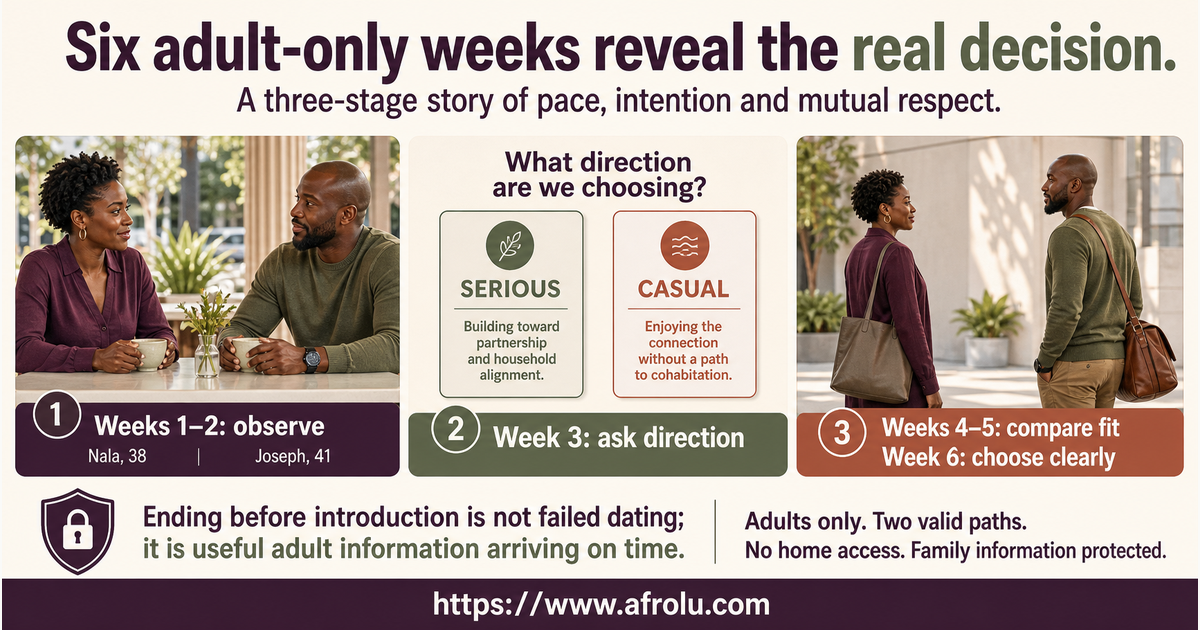
Nala, 38, a fictional parent, and Joseph, 41, date publicly for six weeks. Nala shares broad availability but no child details. At their third date she states serious intention; Joseph honestly states casual intention. They remain adult-only, decide the directions do not fit and close respectfully before any home or family introduction.
The three-fence decision garden
Let adult dating grow without opening the household by momentum
Adwoa separates pace, direction and present structure before protecting home and child information behind independent gates.
The garden uses three fences, one six-week adult evidence cycle and a six-pocket date plan without depicting or involving minors.
Adult dating
Test intention, rhythm, reciprocity, structure and consent between adults.
Household access
Keep address, routines, keys, devices and care systems separate.
Child privacy
Protect identity, images, location, records and emotional participation.
One gate at most
Continue, revise or close before considering another layer.
Separate how fast from where it is going
Slow dating can carry a serious, casual or uncertain intention
Slow describes how quickly communication, dates, intimacy and access expand. Serious describes a direction toward lasting partnership. Casual describes a lighter connection without that present goal. An adult parent may choose any of these honestly. A serious direction can move slowly; a casual direction still needs clear agreements, consent and respect. Confusion begins when a hopeful label is asked to perform the work of a conversation.
Parenthood adds protected systems: a child's identity and routine, the home, care arrangements, finances and the emotional stability of the household. Early romantic interest does not need those systems in order to grow. Broad availability is usually enough to plan an adult date. A match does not need names, photos, school, health details, exact handover times or an explanation of another caregiver's private life.
Slow dating is useful when it produces observable movement at a sustainable size. Both adults know roughly how contact and public dates repeat, can initiate, repair changes and reach a review point. Slow is not a promise to wait indefinitely. When one person avoids every direction question, contributes nothing or seeks private access while calling the arrangement careful, the label no longer describes the pattern.
This guide addresses adult dating decisions, not custody, child development assessment or a rule for when every parent should introduce a partner. Family structures, ages, culture, law and safeguarding needs vary. Qualified local advice may be needed. The practical baseline here is modest: keep early dating adult-to-adult, protect identifying information and let direction become clear before household access is considered.
Build the three-fence decision garden
Adult dating, the household and child privacy need separate gates
Inside the adult-dating fence are profiles, conversations, public meetings, intention and relationship structure. Keep the evidence here long enough to observe reliability, response to limits, money behaviour and repair. Both adults arrange their own practical participation. Parenting capacity can explain a smaller rhythm without turning a child's timetable into proof. A date can know that care responsibilities exist without knowing who, where or when.
The household fence protects address, access codes, keys, rooms, neighbours, devices and the routines that make home function. A private home date may feel convenient when care time is scarce, but convenience can enlarge access before trust is tested. Choose public or otherwise appropriately supported adult plans first. If a relationship later reaches home access, make that a separate decision with its own safety and family considerations.
The child-privacy fence protects identity, images, health, education, location, communication and emotional participation. Do not use a child to verify that you are a good parent or that a match is family-minded. Do not ask a child to keep a relationship secret, evaluate a date or carry messages. A new adult does not need direct contact to respect a parent's responsibilities. The parent controls what is disclosed, subject to applicable duties and agreements.
A gate opens only for a defined purpose after relevant evidence exists; it does not disappear. Serious intention may justify discussing what family integration could mean, but not immediate introduction. Casual intention may mean the gate stays closed permanently. Either is an adult choice when stated honestly. If a match says access is required to prove trust, return to the adult lane and examine why the relationship cannot proceed without protected information.
Nala and Joseph use a six-week adult cycle
A direction mismatch can arrive before a household becomes involved
Nala, 38, is a fictional parent. Joseph, 41, is a fictional adult she meets online. They arrange three daytime public dates across six weeks with light messages between them. Nala says she has parenting responsibilities and offers two broad windows. She does not disclose a child's name, image, school, schedule or home address. Joseph plans within the offered times and never contacts another caregiver or asks to prove the reason for a delayed reply.
On the third date, Nala says she is dating toward a lasting partnership and will move slowly before any family introduction. Joseph explains that he currently wants a casual adult connection and does not expect household access. Neither answer is a confession. They clarify that they are non-exclusive and discuss relevant sexual-health and consent expectations. Warmth between them does not erase the different directions.
They consider whether a bounded casual connection would genuinely suit both. Nala notices that she would keep hoping Joseph changed his mind; Joseph does not want her to invest on that assumption. They decide not to continue romantically. Joseph returns one borrowed book through a public reception and deletes a photo Nala had shared of herself. No child has met him, received a message or experienced the ending.
The six weeks were not wasted. Nala observed respect for time and privacy, asked the direction question before enlarging access and accepted the actual answer. Joseph stated a casual intention without pretending that slow meant future commitment. Their ending protects both adults from a conversion project and keeps the household outside ordinary dating uncertainty. Slow dating succeeded by delivering useful information at a manageable cost.
Sort movement, direction, mismatch and pressure
Not every disappointment is danger, and not every careful label is safe
Deliberate slow dating has a reason, a modest rhythm, reciprocal initiative and a review point. A parent may cancel because care changes unexpectedly, but gives notice when possible and offers a realistic alternative. The other adult can express disappointment without demanding evidence. Over time, both contribute. The arrangement may be small, yet it is not invisible.
A serious or casual direction is useful when stated plainly and matched by conduct. Serious does not mean immediate access to a home, child, money or exclusive structure. Casual does not mean secret dating, unreliable plans or reduced consent. Either direction can be kind. A mismatch becomes harmful when somebody hides their answer, promises conversion or keeps the other investing in a future they do not intend.
Low effort is different from limited capacity. It leaves planning, curiosity, confirmation and repair to one person. Vagueness makes every definition feel forbidden. Test the pattern with one proportionate request: ask the other adult to plan the next public date or name the current direction. Then observe the response. More explanations from the overfunctioning person will not create reciprocity.
Pressure targets the protected fences: requests for home access, child photographs, exact routines, money, passwords or private meetings are framed as proof of seriousness. A firm no should remain usable. Repeated challenges, threats, workplace or school contact, stalking or account intrusion require protection, not another compatibility conversation. Secure systems and use qualified local help suited to the risk.

Do not call a direction mismatch unsafe or call pressure romance.
Say enough without publishing the family system
Broad availability and a direct intention are clear adult communication
Name the pace with an actual cycle: two public dates this month, light contact and a conversation after the second. This is clearer than ‘I am very busy’ and safer than sending a care schedule. If capacity changes, say what happens to the agreed plan and offer alternatives you can sustain. Nobody needs documentation of a child, another caregiver or employer to accept a scheduling answer.
Ask direction before emotional and practical investment makes the answer harder to hear: ‘I am dating toward partnership; what are you open to now?’ Accept serious, casual or uncertain as information. If you would stay only because the other person might change, say so to yourself. A relationship cannot become compatible through silent waiting. Set a review point or end rather than treating hope as an agreement.
Protect the fences with concise language: ‘I do not share child details or invite dates home at this stage; we can meet at this public place.’ The alternative communicates interest while keeping access proportionate. A disappointed but respectful response can be repaired. Mockery, guilt or attempts to discover information elsewhere are stronger evidence than a charming statement about loving families.
When closing, do not use the child as a shield: ‘Our relationship directions do not fit, so I am ending the connection.’ That answer is complete. If safety has changed, avoid a private final meeting, adjust account and home access and tell relevant trusted adults without oversharing. Closure is an adult boundary, not a negotiation in which a new match is owed family information.

Explain capacity without publishing the private systems that create it.
Keep early dates practical and adult-only
A complete plan protects time, cost, transport, privacy and return
Choose a place both adults can identify independently, a duration that fits the real care window and transport that does not depend on the match. Keep a working phone and enough money to change plans. A trusted person may know the broad date plan when useful, but should not receive unnecessary details about another household. Check current venue and travel information rather than relying on assumptions about an area.
Do not combine a first or early date with childcare, pickup, a child's activity, a home visit or an introduction disguised as coincidence. These combinations reduce privacy and can make leaving complicated. If care arrangements change, reschedule. A respectful adult can be disappointed without demanding that the parent improvise access. Scarce free time is not a reason to make the date larger than the evidence.
Keep costs survivable and financial systems separate. A match may offer to pay for childcare, school items, transport, legal fees or a family emergency. In a new connection, decline transfers and do not share account or child records. Romance scams use believable urgent stories. If money or credentials were sent suspiciously, contact the relevant provider quickly and secure connected accounts.
Consent applies to each adult physical and digital choice. A parent's limited time, a paid meal, serious intention or a long wait does not authorise touch, sex, images or recording. Either adult can end the date. For immediate danger in Kenya, check current official emergency information; the DCI page reviewed here lists 999, 911 and 112. Local support may also be needed for stalking, violence or child-safeguarding concerns.

Keep the early connection small enough that ordinary dating evidence can arrive first.
Choose the next adult step
Continue, revise or close before opening another fence
Continue when direction is compatible, the slow rhythm contains movement, both adults contribute and protected information remains protected. Choose one adult next step: another month of public dates, an exclusivity conversation or a slightly longer activity. Do not combine that step with home access, family introduction, caregiving, financial support and intimacy. One permission is enough for the next evidence cycle.
Revise when interest is present but scheduling, direction or effort remains unclear. Change one observable element: a new cadence, one adult plans the next date, or a specific direction conversation happens by a named point. If casual is acceptable only under particular boundaries, state them. Revision should create different conduct; endlessly calling the same one-sided pattern slow keeps uncertainty rather than testing it.
Close when serious and casual directions do not fit, one adult cannot accept the offered capacity or the relationship repeatedly targets protected fences. A clean ending can protect a child and household without blaming either romantic direction. Remove access that is no longer needed. Do not ask a child to deliver, explain or conceal the decision. Adult relationships begin and end through adults.
Seek additional support when there are threats, violence, stalking, extortion, account compromise, inappropriate contact with a child or attempts to reach care, school or workplace systems. Preserve useful evidence and contact qualified local services. The WHO parenting guidance and UNICEF treaty material reviewed here support child wellbeing at a broad level; neither provides a universal dating timetable. Apply context-specific safeguarding and legal advice where needed.
Eight parent dating moments where the correct fence matters
A small adult cycle is clearly designed
A parent offers broad availability, the date plans within it and both know when direction will be discussed.
Proceed because the slow rhythm has movement and review.A cancellation receives a realistic alternative
The parent gives notice without sending private evidence and proposes two later windows.
Read the repair rather than demanding access to the reason.A match asks to see the child early
The request is framed as proof that the parent is honest and family-minded.
Decline; no image is required for an adult dating decision.Limited free time is used to push private access
A date says meeting at home is the only practical way to continue.
Reschedule publicly instead of opening the household fence.Serious and casual answers differ
Both adults speak plainly and neither promises to change later.
Choose whether the actual directions fit now.Help becomes an early financial tie
A new match offers an urgent transfer for care costs and requests account information.
Decline and keep financial and family systems separate.One adult plans and repairs everything
Limited capacity is real, but the other person never initiates or follows through.
Request one contribution, then stop compensating.The relationship closes before introduction
The adults exchange a concise message and remove unnecessary access.
Treat timely clarity as a successful protective decision.Evidence that slow adult dating still protects household choice
{'label': 'Reason', 'title': 'The pace protects named responsibilities', 'detail': 'Broad context explains capacity without exposing a child or household.', 'reading': 'Deliberate pace'}
{'label': 'Rhythm', 'title': 'Small plans still repeat', 'detail': 'Both know how dates, contact and cancellations roughly work.', 'reading': 'Visible movement'}
{'label': 'Direction', 'title': 'Serious or casual is said plainly', 'detail': 'Neither adult relies on slow language to hide their goal.', 'reading': 'Honest intention'}
{'label': 'Structure', 'title': 'Exclusivity has its own conversation', 'detail': 'Parenthood, warmth and frequency do not manufacture agreement.', 'reading': 'Present clarity'}
{'label': 'Privacy', 'title': 'Child details are not requested', 'detail': 'Names, photos, routines and records remain outside early dating.', 'reading': 'Protected information'}
{'label': 'Home', 'title': 'Public alternatives receive respect', 'detail': 'Limited time is not used to demand residence access.', 'reading': 'Proportionate place'}
{'label': 'Money', 'title': 'Care costs stay outside courtship', 'detail': 'No transfer, account or document becomes proof of support.', 'reading': 'Financial independence'}
{'label': 'Consent', 'title': 'Every adult permission remains current', 'detail': 'Time scarcity and serious direction create no entitlement.', 'reading': 'Free choice'}
{'label': 'Repair', 'title': 'Disruption produces changed conduct', 'detail': 'An apology includes notice, an alternative and later follow-through.', 'reading': 'Useful evidence'}
{'label': 'Impact', 'title': 'Dating does not destabilise the household', 'detail': 'The adult connection remains contained enough for ordinary life to function.', 'reading': 'Sustainable fit'}
Choose the next step from the three-fence garden
| Situation | What it may mean | What to do next |
|---|---|---|
Scripts for pace, direction, scheduling, privacy, home and endings
“I date slowly and can offer two public meetings this month with a review afterward.”
“I am dating toward partnership, and I still keep introduction as a later decision.”
“I want a casual adult connection and do not want you waiting for me to change.”
“I share broad availability, not a child's routine or another caregiver's details.”
“I do not share child photographs with people I am newly dating.”
“I am not opening my home; let us choose a staffed public place.”
“Care costs and family accounts stay outside a new connection.”
“Limited time and serious interest do not make physical contact automatic.”
“Your casual direction and my serious direction do not fit for me now.”
“I am ending the adult connection and will not discuss family information further.”
Know the difference
The five-card parent dating gate register

Keep speed, direction, agreement and family access on different cards.
Compare slow, serious, casual, exclusive and introduced
| Type or dimension | What it describes | Best next question |
|---|---|---|
| Slow pace | ||
| Serious intention | ||
| Casual intention | ||
| Exclusive structure | ||
| Public adult date | ||
| Home access | ||
| Introduction | ||
| Clean ending |
Build a parent-safe adult dating cycle in six moves
Separate pace and direction
Draw three fences
Design a small adult cycle
Protect data and money
Observe response to gates
Open at most one gate
Questions organised by adult dating, privacy, plans and review
Choose a few prompts that fit the moment. This is a reference library, not a list to complete.
Adult-lane questions
Define pace, direction and structure without borrowing from parent identity.
- What pace can I sustain?
- What am I dating toward?
- What is our present structure?
- Can both adults initiate?
- When will we review?
Privacy questions
Keep the household and child fences closed by default.
- Which detail is actually needed?
- Can broad availability suffice?
- Are images protected?
- Is home access separate?
- Who else may know?
Date-plan questions
Make adult meetings small, public and leaveable.
- Is the place identifiable?
- Does the time box fit?
- Who controls transport?
- Are costs independent?
- Can either adult leave?
Review questions
Choose from present evidence rather than hoped-for conversion.
- Did effort travel both ways?
- Were gates respected?
- Do directions fit now?
- What needs one revision?
- Should the connection close?
What child-rights and official guidance can support
A child's interests and privacy remain distinct from adult courtship
The UNICEF-hosted Convention on the Rights of the Child text addresses best interests and privacy at treaty level. Afrolu draws a narrow practical lesson: do not make a child's identity, records or participation the price of an adult dating decision.
Evidence limit: The treaty does not supply a universal dating or introduction timetable, and this page is not legal advice.
Parent-child relationships belong to a broader wellbeing system
World Health Organization parenting guidelines focus on preventing maltreatment and enhancing parent-child relationships. This guide does not convert those programme recommendations into a dating formula; it simply keeps new romantic uncertainty outside protected family systems.
Evidence limit: The WHO guideline targets parenting interventions, not individual partner introductions.
Purpose and necessity support a restrained information habit
Kenya's Data Protection Act includes purpose, necessity and private-affairs principles for covered processing. In personal dating, the cautious parallel is to share only information needed for the present adult decision.
Evidence limit: The Act has specific scope and exemptions; this guide does not decide whether a private interaction is legally covered.
Family and emergency stories can be used in romance scams
The U.S. Federal Trade Commission warns that remote trust may be followed by travel, medical or other urgent payment requests. Keep family costs and account credentials outside a new connection and contact providers promptly after suspected loss.
Evidence limit: FTC routes are U.S.-specific; use reporting and financial channels appropriate to your location.
Parenthood, time scarcity and relationship direction do not create consent
NHS public-health guidance describes active consent and the ability to withdraw it. The principle applies to each adult physical and digital choice without regard to serious or casual intention.
Evidence limit: The NHS source describes UK context; legal definitions and support services vary.
Immediate danger needs current official support
The Kenyan Directorate of Criminal Investigations page reviewed for this guide lists its reporting hotline and police emergency numbers 999, 911 and 112. Use current official information and locally appropriate safeguarding channels when risk involves a household or child.
Evidence limit: Channels and service availability can change; verify at the time of need.
Six shortcuts that open the household before evidence arrives
Use a reviewed resource that matches the decision
This guide focuses on the relationship decision, so it does not rank dating apps. Check current prices, safety tools, and local availability before choosing a service.
Explore the guide library
Show more related guides
Continue with Afrolu
Show more Afrolu guides
Treaty text and official guidance used for this parent garden
Afrolu reviewed these health, research, safety, or public guidance resources while editing this page. They support the behaviour and safety guidance; they do not diagnose any individual described by a reader.
Slow, serious and casual dating questions for adult parents
Can a parent date slowly but still want a serious relationship?
Yes. Slow describes pace; serious describes direction. State both: you are exploring lasting partnership and will use small public adult steps before any household or family introduction. Serious intention does not create exclusivity, home access, financial responsibility or a guaranteed outcome.
Can slow dating for a parent be casual?
Yes. A casual intention can move deliberately and still include reliable plans, explicit structure, consent and privacy. Say that lasting partnership is not the present goal so the other adult does not wait for conversion. Keep child and household access closed if that fits the arrangement.
How much should I tell a new match about my child?
Share only broad parenting context needed to understand availability. Early dating rarely requires a child's name, image, age, school, health, exact routine, location or another caregiver's details. Applicable legal or safeguarding duties vary, but romantic interest alone is not a reason to publish protected family information.
When should a parent introduce someone they are dating?
There is no universal week or date count in this guide. Treat introduction as a separate parenting and safeguarding decision after relevant adult evidence exists, not as a prize for serious language. Consider the child's context, family arrangements and qualified local guidance. A relationship may remain meaningful while introduction stays closed.
What if limited free time makes public dates difficult?
Use shorter public meetings, reschedule or choose another appropriately supported adult plan. Do not combine early dates with childcare, pickup, a child's activity or home access merely for efficiency. Scarce time is real, but it does not make a larger, less leaveable plan necessary.
Should a match pay childcare or family costs so we can meet?
Keep care costs and accounts outside a new connection. Early payments can create leverage and may expose records or financial systems. Romance scams also use urgent family stories. Seek support through channels you already trust, and contact the provider promptly if money or credentials were sent suspiciously.
What if serious and casual intentions do not match?
Treat the mismatch as important adult compatibility information. Ask whether either arrangement can be accepted freely now, without waiting for one person to change. If not, end clearly. Neither direction is automatically dishonest or unsafe; hiding the answer or recruiting false hope is the problem.
Does exclusivity mean a partner may meet my child or enter my home?
No. Exclusivity answers whether either adult dates others under the current agreement. Home access, introduction, caregiving, finances, sex and digital access are separate permissions. Expand one layer only when relevant evidence and your wider responsibilities support it.
How can I tell deliberate slow dating from low effort?
Deliberate slow dating has a reason, modest rhythm, reciprocal initiative, repair and a review point. Low effort leaves one adult to plan, restart and clarify everything. Ask for one concrete contribution, then observe. Do not expose more family information or offer more labour to compensate.
How do I end the relationship without involving my child?
Send a concise adult message stating that the direction or arrangement no longer fits. Remove unnecessary access and return belongings safely. Do not ask a child to deliver, explain or conceal the ending. If threats, stalking or inappropriate family contact occurs, protect systems and seek qualified local support.
One thing to do now
Let the adult relationship declare its direction before another fence opens
Keep evidence inside the adult fence until pace, direction, reciprocity, limits and repair are observable. Continue with one adult next step when directions fit. Revise a specific cadence or question when interest remains. Close when serious and casual aims conflict, effort stays one-sided or protected information and access are pressured. Introduction and home access are later, separate parenting decisions, never proof of romance.