Six permission gates across distance
Build a Safer Slow Casual Connection Across Diaspora Distance
A six-gate guide to slow casual diaspora dating: set contact, privacy, consent, visit, money and ending boundaries without pressure.
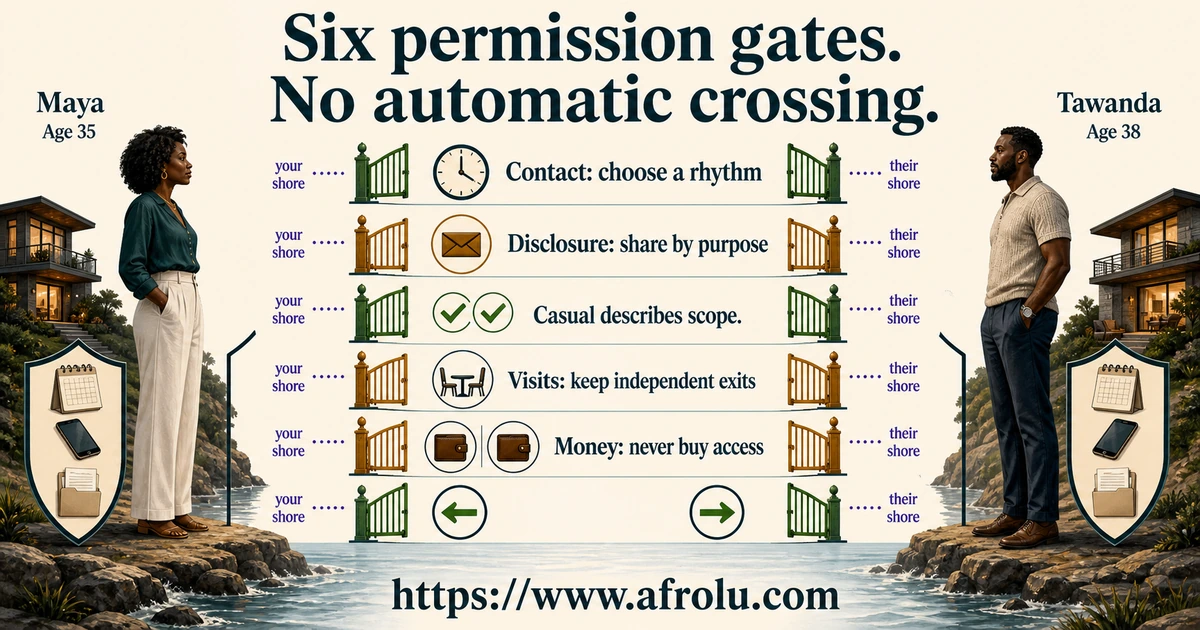
Open only the gate both adults freely choose now; distance and chemistry do not open the next one.
Written and edited by Tariro Ncube · Diaspora Dating Editor
Use six permission gates. Agree on a sustainable contact rhythm and a repair for missed plans. Share identity and personal context by purpose while devices, documents, home, live location and third-party information stay protected. Keep sexual conversation, images, recording, touch and sex behind separate voluntary consent. Build any first visit around verified facts, public meetings, independent lodging, controlled transport and a reliable return. Never send money, codes or account access to an online love interest or treat spending as a claim on attention. Finally, preserve the right to close one gate, change the casual scope or end. Slow describes pace and casual describes scope; neither grants the next form of access.
Intentional dating · Diaspora Daters
Which permission gate is open now, and can the connection remain casual and slow without turning distance into silence, surveillance, sexual pressure or financial dependence?
Slow casual diaspora dating is a limited adult connection that develops deliberately across geographic distance. Slow describes pace, casual describes present relationship scope and diaspora distance describes context. Exclusivity, contact, disclosure, sexual consent, visits, money and future direction remain separate agreements. The permission-bridge model keeps both adults on independent shores and opens only the gate both freely choose for the present decision.
Maya and Tawanda are fictional adults. Maya is 35 and lives in Manchester; Tawanda is 38 and lives in Harare. They agree on a casual, non-exclusive, slow connection but never define contact. After Tawanda misses a call and stays silent for six days, Maya asks for two voice notes and one Friday call rather than work or location proof. Tawanda accepts and repairs for three weeks. They discuss other partners and sexual-health disclosure while keeping digital intimacy limited. When a visit becomes an idea, they keep lodging, travel documents, money and return independent. The contact gate opens more clearly; none of the other five opens automatically.
The six-gate permission bridge
Keep both adults independent while selected forms of access cross the distance
Distance can make a limited connection feel larger than its agreement. Tariro gives each consequence its own gate.
The bridge opens contact, disclosure, intimacy, visits, money and endings separately, using current consent and reversible evidence rather than romantic momentum.
Contact and disclosure
Choose a workable rhythm and share only what the present decision needs.
Sexual choices
Keep conversation, images, recording, touch and sex behind specific ongoing consent.
Visits and money
Plan public, independent travel while documents, accounts and return stay controlled.
Change or ending
Allow either adult to close access, redefine scope or leave without retaliation or sunk-cost claims.
A permission bridge
Give six kinds of access six separate gates
Slow casual diaspora dating combines three dimensions. Slow describes pace. Casual describes a lighter present relationship scope. Diaspora distance describes a geographic and social context in which travel, time zones, identity, money and family expectations may shape contact. None of these terms answers exclusivity, sexual consent, disclosure, visit access or future direction. Treating them as a bundle creates assumptions precisely where distance makes correction harder.
The first gate is contact. Agree on the approximate rhythm, useful channels and what a disruption looks like. A casual connection need not provide daily availability, yet disappearing whenever convenient can leave one adult carrying all uncertainty. The second gate is disclosure. Share by purpose: enough identity and context for the current choice, while employer systems, documents, home, accounts, live location and third-party information stay protected. Emotional intensity cannot create a need for unrestricted access.
The third gate covers sexual choices and relevant disclosure. Casual never means sexually available; distance never turns images, video or intimate talk into low-risk substitutes. Every activity needs a free present answer. Discuss other partners, testing and prevention before choices where the information matters. Protect intimate media and do not use it as identity proof. The fourth gate is the visit: verified identity, public meetings, independent lodging, controlled documents and a reliable return.
The fifth gate is money. Keep accounts separate and decline urgent fare, visa, customs, health, family, business or device requests from an online love interest. Payment cannot purchase responsiveness, sex, lodging or seriousness. The sixth gate is change or ending. Either adult may close a gate, revise the casual scope or leave. Time invested across borders does not create a debt. A safe structure lets the connection remain enjoyable while every adult keeps an independent shore.
A repair without surveillance
Maya and Tawanda turn six quiet days into one usable contact agreement
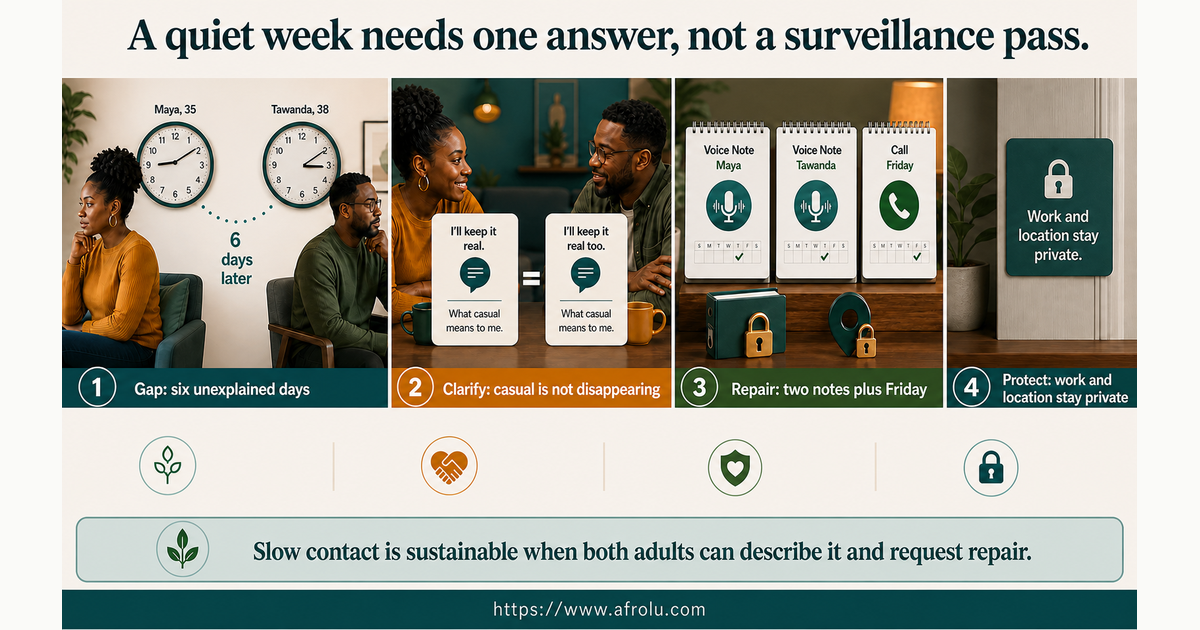
Maya is 35 and lives in Manchester; Tawanda is 38 and lives in Harare. They met through a music discussion group and agreed that the connection was casual, non-exclusive and intentionally slow. They enjoy voice notes and two video calls, then Tawanda goes silent for six days. Maya feels unsettled because slow had meant fewer reliable contacts to her, while Tawanda had understood it as contact whenever capacity appeared. Neither meaning had been spoken.
Maya sends one direct message: she is not asking for constant conversation, but unexplained week-long gaps do not fit the casual connection she wants. She asks whether two short voice notes and one planned Friday call are realistic. She does not request screenshots, work schedules, location or proof of why Tawanda was busy. If no usable answer arrives, she will stop allocating attention rather than chase, monitor or intensify disclosure.
Tawanda explains that a deadline consumed his personal capacity and acknowledges he relied on the casual label instead of communicating. He offers the proposed rhythm for three weeks, with a short update before a planned call if he cannot attend. Maya accepts. They also clarify that they are non-exclusive and will discuss relevant sexual-health information before any in-person intimacy. The repair changes contact; it does not expand every other gate.
During the third week Tawanda keeps the rhythm but mentions a possible future visit. They treat it as an idea, not a booking or a financial request. Maya will not host at home, fund travel or share identity documents. Tawanda retains his own lodging and return obligations. At their review they can continue, change the rhythm or end. A specific contact repair becomes one piece of evidence; it does not require either person to promote a casual connection into a serious one.
Identity with limits
Verify enough for the next choice without opening every private system
Distance creates genuine verification questions. Use proportionate layers: consistent live conversation, cross-checking information through sources you locate yourself, public online context where appropriate and an independently planned in-person meeting before major reliance. Notice inconsistencies without turning yourself into an investigator. A video call can reduce one uncertainty while leaving names, intentions, relationship status and future conduct unproven.
Protect identity documents, immigration records, tickets, financial statements, employer systems and exact residence. A person may offer a redacted or limited fact for a legitimate visit need, but a romantic partner should not become the custodian of an identity archive. Never share passwords or one-time codes. Do not accept the claim that distance requires live location, all-day camera access or an open device to prove casual honesty.
Disclosure also includes other people's data. Family names, children's information, former partners, colleagues and care responsibilities do not become common property because they explain availability. State the practical consequence instead: you are unavailable during a period, cannot host or need a confirmation deadline. If a future visit has a real emergency-planning purpose, exchange only what that plan needs and decide who else receives it.
If information conflicts, slow the next gate rather than paying, travelling or exposing more to settle the anxiety. Search official contact details independently when a claimed institution matters. Reverse-image and profile checks can be useful clues but are not verdicts. When there is financial deception, threats, intimate-image abuse or persistent unwanted contact, preserve useful evidence when safe and use relevant platform, financial, legal or specialist support.
Conduct over labels
Read reciprocity, consent and pressure without treating casual as unsafe
A casual connection can be honest, reciprocal and caring. Look for direct scope, sustainable contact, accurate notice, repaired plans and freedom around every form of intimacy. Each adult keeps friends, work and independent decision-making. Non-exclusivity, if agreed, is not itself deception. The safety-relevant question is whether adults receive the information needed for consent and whether agreements can be discussed and changed without coercion.
Pressure narrows a free answer. It may appear as guilt over message speed, demands for private images, threats to disclose the connection, repeated sexual requests, monitoring, isolation or claims that travel spending creates entitlement. Casual language does not make those behaviours normal, and serious language would not make them safe. Name the conduct, set the boundary and reduce access when the boundary is debated or bypassed.
Financial urgency deserves its own route. Romance-scam stories often involve travel, medical, customs, business or family needs. Do not send cash, gift cards, cryptocurrency, codes or account access to an online love interest. A sophisticated career, long contact history or convincing video does not make a transfer safe. Verify claimed organisations through independently found channels and contact the relevant financial provider promptly after suspected loss.
Immediate danger changes the task. A threat, coerced sexual activity, blocked exit, confiscated documents, stalking, non-consensual intimate-media use or physical aggression is not a contact-style disagreement. Create distance when possible and use suitable local emergency, venue, trusted, platform, legal or survivor support. This guide cannot assess an individual situation, provide legal advice or promise that a checklist will prevent harm.

Read behaviour across ordinary weeks while identity, lodging, money, documents and consent stay under personal control.
Language for limited scope
Use direct scripts that do not convert casual connection into access
For contact, name a sustainable rhythm and the repair expected before a planned interaction. You can enjoy spontaneity while identifying which gaps make the connection unusable. Avoid demanding minute-by-minute explanations or proof. A person who cannot offer the requested rhythm may be honest and incompatible. End or resize from that fact rather than opening workplace calendars, location or devices.
For casual scope and non-exclusivity, state the current agreement. Ask whether either adult sees or seeks other people, what relevant changes should be disclosed and what safer-sex conversation is needed before intimacy. Do not infer sexual availability from flirtation or non-exclusivity. Consent remains specific, voluntary and ongoing; it can be withdrawn before or during any activity, including digital sexual interaction.
For visits, make the plan independently survivable. Each adult should know the public meeting, lodging, transport, cost, communication and return. Hosting is optional and may be unsuitable for a first visit. A visitor does not receive home, documents or sexual access because they travelled. A host does not receive control because the city is familiar. Discuss cancellation and emergency contacts without turning either adult into the other's border or financial sponsor.
For endings, use one clear sentence and remove access that no longer has a purpose. Casual does not mean a person deserves silence, though safety may make direct contact unsuitable. Do not use a pause as leverage or demand reimbursement for freely chosen communication and travel. If contact continues after a clear no, use platform controls and suitable support. The right to leave is part of the original agreement, not a betrayal of the time invested.

Name the current offer and leave room for the other adult to accept, decline or propose something smaller.
A permission audit
Review one ordinary month without counting messages or escalation
Begin with contact fit. Did the agreed rhythm survive ordinary work, rest and time-zone constraints? Were disruptions named and repaired, or did one adult repeatedly wait without usable information? Do not total messages as a proxy for care. A few reliable exchanges may fit better than continuous access. The outcome can be the same rhythm, a revision or an ending; no volume proves the casual connection should grow.
Review permission next. Which disclosure, sexual, image or visit choices occurred, and did every no or change of mind remain intact? Notice whether one gate was quietly used to open another. A video call does not authorise screenshots. Flirting does not authorise intimate images. A travel discussion does not authorise bookings. Close or revise a gate whenever the current risk, comfort or desire changes.
Review reciprocity and independence. Did both adults sometimes initiate, listen and repair? Are money, devices, lodging, documents, work and social support still independently controlled? Help can be generous without creating authority; decline any arrangement that conditions support on attention, sex, secrecy or access. If a planned visit would require harmful debt, surrendered documents or dependence on a new match for return, the plan is not ready.
End with the smallest accurate choice: continue the open gates, revise contact, close a particular gate, redefine the casual scope or end the connection. Do not promote the relationship merely because the month was pleasant, and do not demote casual adults as incapable of care. The review exists to keep shared words aligned with current conduct while every adult remains able to return to an independent life.

Review whether each open gate still fits, repair what changed and close any gate without punishment.
Terms that answer different questions
Separate slow pace, casual scope, distance, structure and effort
Slow dating describes how quickly access, knowledge or commitment develops. Casual dating describes a lighter present scope. Long-distance describes the geographic condition under which meetings require greater planning. A connection can be all three. None determines whether adults are exclusive, whether sex is on offer, how frequently they communicate or whether a visit is safe. Those questions need their own answers.
Non-exclusive describes a present relationship agreement; it should not be inferred merely because the connection is casual. Some casual partners agree to exclusivity, and some people pursuing serious partnership date non-exclusively during early evaluation. The important work is accurate disclosure and informed choice. Name what applies now, what changes require conversation and which sexual-health information matters before relevant activity.
Low effort describes contribution, not pace. A slow connection can contain reliable modest plans, direct answers and reciprocal repair. A fast stream of messages can still be low effort if one person avoids every consequential decision. Judge the burden and evidence rather than intensity. If one adult carries contact, travel, money and emotional interpretation, request a specific contribution and decide from the response.
Diaspora context can include distance, time zones, family ties, migration systems and different daily realities, but it does not define the adults. Avoid scripts that assign wealth, obligation, morality or relationship goals based on location. Ask about the actual person's offer. Then protect the gates that involve documents, money, residence and travel because those consequences can remain long after the casual connection ends.
Eight permission-gate decisions across diaspora distance
Maya asks for a rhythm instead of a work screenshot
Maya is 35 and receives no contact for six days after a planned call. She asks whether two voice notes and one weekly check-in are realistic. She does not request an employer calendar or location history. The answer will show whether the current rhythm fits, not whether Tawanda can prove innocence.
Request one sustainable contact agreement and decide from the repair rather than surveillance.Neo keeps flirtation separate from image consent
Neo is 32 and enjoys sexual conversation but does not want to create or send intimate images. His match says casual adults should be relaxed about it. Neo repeats no and stops the exchange when the request returns. Flirting and an earlier yes to conversation do not authorise recording or sharing.
Make the image decision specific and reduce access when a no is challenged.Safiya asks what casual means today
Safiya is 40 and her distant match says casual means they are both seeing others. Safiya has not agreed to that structure. They discuss whether either dates or seeks others and what should be disclosed before intimacy. Casual scope cannot silently write a non-exclusive agreement.
State structure and relevant disclosure directly before either adult acts on an assumption.Kelechi retains lodging after a warm invitation
Kelechi is 37 and plans a first visit after months of contact. His match offers home lodging to save money. Kelechi keeps a refundable independent room and return route. The offer may be generous; declining it protects options and does not accuse the host.
Build a public first meeting, controlled lodging and independent return before travel.Asha refuses to fund a document emergency
Asha is 43 and hears that a visa fee must be paid that day for a promised visit. She sends nothing and checks the claimed process through an official site she finds herself. The visit may now fail; romantic disappointment does not make an urgent transfer safe.
Verify institutions independently and keep dating separate from payments and document access.Daniel rejects permanent midnight availability
Daniel is 34 and every call occurs after midnight in his time zone. He offers alternating windows. His match says the person abroad should accommodate. Daniel declines that rule. Geography explains the constraint; it does not assign one adult's sleep as the relationship resource.
Distribute inconvenience explicitly and treat an unworkable rhythm as compatibility information.Zola wants serious direction and says so
Zola is 39 and realises the casual connection no longer fits her. She asks whether serious exploration is available. Her match says no. Zola ends rather than waiting in the hope that continued access will change the answer. A changed desire deserves a conversation, not an automatic promotion.
Request the new scope once and choose from the actual answer.Omar removes access without demanding repayment
Omar is 36 and ends after the contact rhythm repeatedly fails. He sends one clear message, removes intimate chat history from shared spaces he controls and blocks after unwanted contact continues. He does not demand the value of past calls or gifts back as a condition of leaving.
Close clearly when suitable, remove unnecessary access and use platform support if no is ignored.Evidence that slow casual contact remains reciprocal and safe enough to assess
Casual scope, slow pace, distance and relationship structure are stated as separate dimensions.
The contact rhythm fits time zones and ordinary life without demanding continuous proof of availability.
Both adults can request repair, a different rhythm or an ending without retaliation.
Identity is checked proportionately while documents, passwords, devices and live location remain protected.
Flirting, intimate talk, images, touch and sex each receive their own free present answer.
Non-exclusivity or exclusivity is explicitly agreed rather than assigned from the word casual.
Relevant sexual-health conversations happen before choices where the information matters.
A first visit has public meetings, independent lodging, controlled documents and a reliable return.
Travel cost is affordable and no transfer, gift or financial access is required as romantic proof.
Contact, planning and repair are reciprocal enough for the current limited scope.
A closed permission gate remains closed without bargaining, guilt, threats or indirect access.
The connection can end without one adult losing control of home, money, documents or social support.
Route each distance moment to the right permission gate
| Situation | What it may mean | What to do next |
|---|---|---|
| A planned call passes without any update. | The contact agreement may be missing or the repair pattern may be weak. | Ask for one sustainable rhythm and notice whether a specific repair follows. |
| A match requests an intimate image. | A new consent, privacy and distribution decision is present. | Decline or agree freely; never use an image as identity, affection or casual-scope proof. |
| Casual is said to mean non-exclusive. | Relationship scope and structure are being merged. | Define whether either adult dates or seeks others and which disclosures matter. |
| One time zone always carries the late calls. | Geographic inconvenience has become one-sided effort. | Alternate windows or choose a rhythm both adults can sustain. |
| A first visit assumes home lodging. | Travel, residence access and exit control have been bundled. | Retain independent lodging and public meetings until each choice is separately supported. |
| A visa, fare or customs fee becomes urgent. | Financial pressure is active regardless of the romantic story. | Send nothing and verify the institution through contact details you find independently. |
| The casual connection becomes emotionally important. | One adult's desired scope may have changed. | Ask whether a new agreement is available and accept the actual answer. |
| A no to video or images is repeatedly revisited. | Consent pressure and digital privacy risk are present. | End the interaction, remove access and use platform controls or support as needed. |
| A visit is booked before identity questions are resolved. | Financial commitment is being used to outrun uncertainty. | Stop expansion, protect documents and make any next step independently reversible. |
| The contact is sparse but reliable and mutually chosen. | A slow casual rhythm may genuinely fit both adults. | Continue if wanted without treating low volume as weak interest. |
| One adult carries all calls, plans and reassurance. | Low effort may be hiding behind distance and slow pacing. | Request one concrete reciprocal contribution and decide from the pattern. |
| There is a threat, coerced act or document confiscation. | The situation has moved beyond a dating-pace disagreement. | Create distance where possible and use suitable local emergency, legal or specialist support. |
Scripts for contact, disclosure, consent, visits, money and endings
“Two voice notes and one Friday call are the rhythm I can sustain. Does that work for you?”
“If a planned call fails, I need a brief update and a specific new offer.”
“I am offering a casual connection, not an exclusive or serious agreement at this point.”
“Are either of us seeing or actively seeking other partners?”
“I will share the information this decision needs, not my documents, passwords or live location.”
“I do not create or send intimate images. Please do not ask again.”
“Casual describes the connection. It does not answer whether I want this activity.”
“Our first visit needs public meetings, separate lodging and an independent return.”
“I do not fund fare, visa, health or family requests from an online match.”
“Casual no longer fits me. Are you open to serious exploration, or should we end?”
“I am no longer comfortable with video calls. Text contact is the only gate open now.”
“This connection no longer fits, so I am ending romantic contact. Do not contact me again.”
Know the difference
Slow casual connection versus convenient access
The limited scope, contact rhythm and permission gates are clear enough for both adults to choose and revise.
Contact, sex, travel, disclosure or money appear when one person wants them while the other carries uncertainty and cost.
The pace can be sparse and still reciprocal; the deciding issue is whether shared words and burden match the stated scope.

Name pace, scope, geography, structure and contribution separately before choosing the next gate.
Compare the neighbouring terms before assuming access
| Type or dimension | What it describes | Best next question |
|---|---|---|
| Slow dating | A deliberate pace for contact, disclosure, intimacy, visits or commitment. | Which gate moves slowly, and what modest progress remains visible? |
| Casual dating | A lighter present relationship scope without automatic future commitment. | What is actually on offer, and what remains outside the connection? |
| Long-distance condition | Geography makes ordinary meetings require travel and planning. | Which contact and visit structure fits both locations? |
| Non-exclusive structure | An explicit agreement that permits dating or seeking others under understood terms. | What disclosure is needed before relevant choices? |
| Consent | A free present answer to a specific activity, including digital sexual interaction. | Does each adult want this now without pressure or assumption? |
| Low effort | One adult contributes too little planning, contact, repair or care for the available arrangement. | Which reciprocal action would make the pattern usable? |
| Privacy | Control over identity, home, devices, documents, images, location and third-party information. | What minimum information does this next choice genuinely need? |
| Visit readiness | Enough verified information and independent planning for a reversible in-person meeting. | Are public meetings, lodging, transport, cost and return controlled? |
| Financial pressure | Money, gifts or account access are tied to urgency, affection, travel or continued contact. | How can payment stop while claims are independently checked? |
| Scope change | One adult now wants a different relationship direction or structure. | Is a new shared agreement available, or should the connection end? |
Build a six-gate casual distance agreement
Name six gates
Separate contact, disclosure, sexual choices, visits, money and endings so no label opens them together.
Write the contact rhythm
Choose a sustainable pattern and a simple repair without requesting work or location surveillance.
Verify proportionately
Reduce uncertainty in stages while passwords, documents, residence and accounts stay protected.
Keep every visit reversible
Use public meetings, independent lodging, controlled transport and a reliable return.
Refuse financial proof
Do not fund online love interests or exchange money for responsiveness, access or seriousness.
Review open gates
Continue, revise, close a gate or end according to present fit rather than sunk time.
Questions for a limited, workable cross-border connection
Choose a few prompts that fit the moment. This is a reference library, not a list to complete.
Contact and time zones
Design a modest rhythm without opening work or location surveillance.
- Which contact frequency fits both ordinary weeks?
- Which time-zone burden should alternate?
- What update comes before a planned call fails?
- How long a gap becomes unusable?
- When will we review the rhythm?
Casual scope and structure
Separate limited scope from exclusivity and sexual assumptions.
- What does casual include for each of us?
- Are either of us dating or seeking others?
- Which change requires disclosure?
- What future direction is not promised?
- How can either adult request a scope change?
Digital privacy and consent
Keep every increase in digital intimacy behind its own gate.
- Which identity detail does this choice actually need?
- Are images or recordings outside the offer?
- How will a changed mind be respected?
- Which third-party details stay private?
- What access should end if contact ends?
Visits and money
Build a reversible visit that neither adult must finance through romantic trust.
- Which public meetings anchor the visit?
- Where does each adult stay and return?
- What can each person afford independently?
- Which documents remain controlled?
- What happens if the visit is cancelled?
What research and public guidance can actually support
Distance does not determine relationship quality
A U.S. study comparing long-distance and close-proximity relationships found a mixed picture rather than simple distance fatalism. Afrolu uses it only to reject the claim that geography alone proves strength or failure. Individual quality and stability still require current evidence, and the study does not prescribe contact or visit frequency.
Evidence limit: The study population, measures and period cannot predict one diaspora or casual connection.
Casual scope does not replace relationship agreements
Research on couples' sexual agreements illustrates the importance of communication around relationship and safety agreements. Its specific male-couple sample does not define all adults. The narrow practical use is to say exclusivity, other-partner disclosure and safer-sex choices deserve direct conversation rather than assumptions from a broad dating label.
Evidence limit: A particular study sample cannot establish the best structure or rules for every relationship.
Consent is activity-specific and ongoing
NHS public guidance explains that sexual activity requires active consent, that an earlier yes or a relationship is not consent, and that consent can be withdrawn at any time. Ask separately before sexual contact and before creating or sharing intimate material. Travel cost or a casual agreement cannot supply the next answer.
Evidence limit: Public education cannot provide jurisdiction-specific legal advice or assess an individual incident.
Sexual-health conversations belong before sex
CDC guidance encourages honest partner conversations before sex, including testing and relevant STI information. Afrolu does not infer health status from exclusivity, appearance, location or trust. Discuss testing and prevention with qualified healthcare support appropriate to the adults and location.
Evidence limit: General public-health guidance is not an individual diagnosis, testing schedule or treatment plan.
Children and third parties retain privacy
UNICEF Nigeria's child-online-safety guidance identifies details such as full names, home addresses, schools and phone numbers as personal information that should not be shared with strangers. The narrow lesson here is that another person's data should not be traded to explain availability or prove identity.
Evidence limit: The source addresses child online privacy, not every adult dating disclosure or legal duty.
Romance scams often turn distance into a money story
FTC consumer guidance describes online love interests who build trust and then request money for travel, health or other urgent needs. Do not send cash, gift cards, cryptocurrency, codes or account access. Verify institutions independently and contact a financial provider promptly after suspected loss.
Evidence limit: A warning pattern does not prove a crime; respond to observable risk and use suitable local support.
Six shortcuts that turn distance into pressure
Letting casual mean access
A lighter relationship scope does not create consent to sex, images, home, money or constant contact.
Letting slow mean silence
A deliberate pace can still include an understood rhythm and a specific repair after disruption.
Verifying through surveillance
Passwords, continuous video and live location expose private systems without guaranteeing identity or conduct.
Booking to force certainty
Travel spending can deepen pressure while unresolved identity, lodging and return questions remain.
Paying to save the visit
Romantic urgency does not verify fare, visa, customs, health or family money requests.
Treating ending as betrayal
The ability to withdraw, redefine or leave is part of a freely chosen casual connection from the start.
Use a reviewed resource that matches the decision
This guide focuses on the relationship decision, so it does not rank dating apps. Check current prices, safety tools, and local availability before choosing a service.
Explore the guide library
Show more related guides
Continue with Afrolu
Show more Afrolu guides
Research and public guidance reviewed for this permission bridge
Afrolu reviewed these health, research, safety, or public guidance resources while editing this page. They support the behaviour and safety guidance; they do not diagnose any individual described by a reader.
Slow casual diaspora dating questions
Can casual dating also be slow and long-distance?
Yes. Casual describes the present relationship scope, slow describes pace and long-distance describes geography. None automatically decides exclusivity, sexual activity, contact frequency, travel or future direction. Name each relevant answer separately so both adults can choose from the same current offer.
How often should a slow casual diaspora connection communicate?
There is no universal quota. Choose a rhythm that fits both time zones, work, rest and desired scope. Include what happens before a planned call fails and how to request change. A sparse pattern can be healthy when mutually understood; unexplained gaps and one-way repair may make it unusable.
Does casual mean we are both free to date other people?
Not automatically. Casual scope and non-exclusive structure are different answers. Ask whether either adult dates or seeks others, what changes require disclosure and which information matters before sexual choices. Never reconstruct the agreement from app activity, flirtation or private assumptions.
How can I verify a distant match without invading privacy?
Use staged live conversation, consistent information, independently found sources and a public in-person plan before major reliance. Protect documents, passwords, work systems, live location and third-party data. No check guarantees identity or conduct, so keep financial and travel decisions reversible.
Should I send an intimate image to prove I am real?
No. Intimate images are not identity verification and can create lasting privacy risk. Consent to flirting or video does not authorise an image, recording or distribution. You can decline without explanation. If pressure or non-consensual sharing occurs, reduce access and use relevant platform, legal or specialist support.
What makes a first cross-border visit safer?
Verify enough for the plan, meet publicly, keep independent lodging, transport, documents, money and a reliable return, and tell trusted support when useful. Agree on communication and cancellation. Travel never purchases sex, home access or a relationship result, and no checklist can guarantee safety.
Should the person abroad pay more because of the currency difference?
Location does not assign financial duty. Discuss affordability and fairness without demanding income proof or exposing accounts. Protect essentials and avoid harmful debt. A visit should not proceed if it relies on a new match's transfer, surrendered documents or financial authority over the other adult.
What if a match asks for visa or fare money?
Do not send money, gift cards, cryptocurrency, codes or account access to an online love interest. Check any claimed institution through details you find independently. If money was sent after suspected deception, contact the financial provider promptly and use relevant reporting support.
How do I ask to change a casual connection into something serious?
State that the current scope no longer fits and ask whether serious exploration is available. Define what that would mean now rather than demanding a promised future. The other adult may say no. Choose from the answer instead of continuing access as a strategy to change it.
Is ghosting acceptable because the relationship is casual?
Casual scope does not remove basic clarity, though direct contact may be unsuitable when safety is at risk. When safe and appropriate, use one concise ending and remove unnecessary access. If a clear no is ignored, use platform controls and suitable support rather than continuing explanations.
One thing to do now
Open only the gate both adults choose now
Name the six gates and the current state of each. Expand contact, disclosure, intimacy or travel only when shared words and behaviour support that specific choice. Keep money, identity, lodging and return independent, and respond to urgent payment requests as financial risk rather than romantic tests. Review the open gates after an ordinary month and continue, revise, close a gate or end without treating the time invested as debt.