Adult students · low-pressure weekend clarity
Adult Student Situationships: Low-Pressure Weekends
For adult students in a situationship, make low-pressure weekend plans clear, keep consent and privacy current, handle changes, and recognise pressure safely.
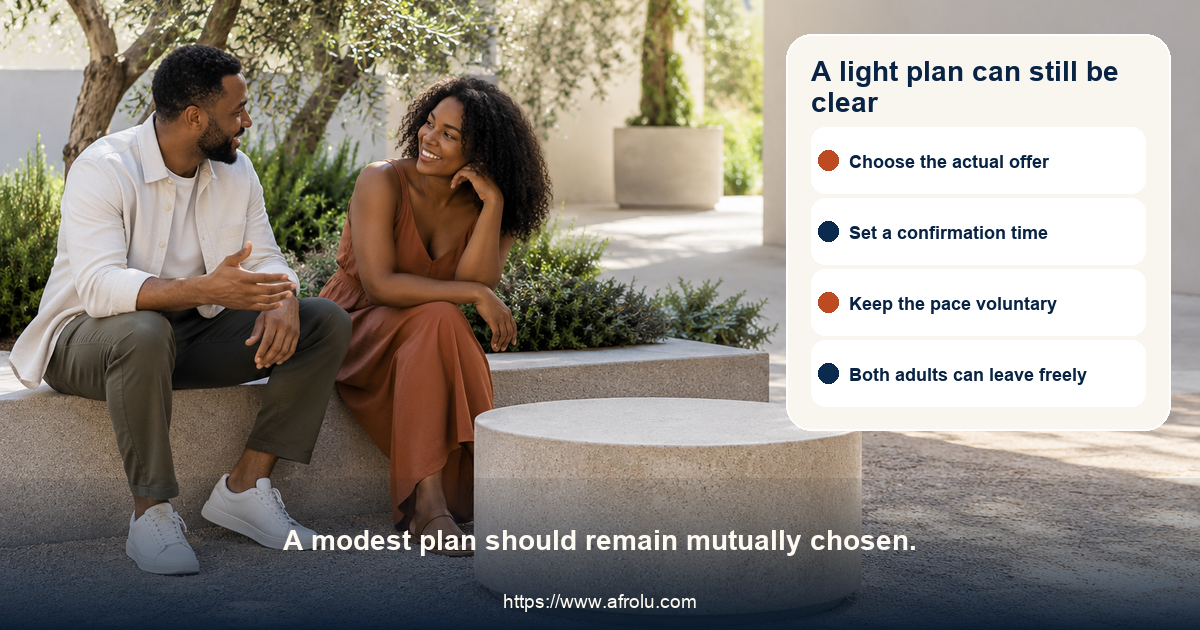
Low pressure still leaves room to choose.
Written and edited by Grace Mutiso · Kenya Guides Editor
Make the actual weekend offer clear: what happens, when it is confirmed, what pace and setting fit, and what either adult can decline. Low pressure does not erase consent, privacy, other-date conversations, independent transport, or a respectful cancellation. If money pressure, monitoring, coercion, threats, image abuse, repeated pursuit, or fear appear, reduce access and choose support over more negotiation.
Relationship clarity · Students
Is this a mutual light weekend arrangement, a plan that needs confirmation, a mismatch in availability or intimacy, a privacy question, a money request, unwanted pursuit, or conduct that makes me feel unsafe?
A low-pressure weekend situationship is a light or casual dating connection that fits a limited amount of time without requiring a large commitment. It remains mutual only when plans, privacy, intimacy, access, cancellation, and the option to stop are consciously chosen by both adults.
Amara wants a weekend coffee with someone she has been seeing casually, but she does not want to hold her whole Saturday open or turn the date into an overnight plan. She offers a short public meeting, sets a confirmation time, keeps her own transport, and later asks what casual means to them. The response shows whether the connection can stay light and still be respectful.
adult students · low-pressure weekends
Amara makes a small weekend invitation clear without turning casual dating into standby availability
This guide separates mutual casual plans, ordinary cancellations, capacity differences, current consent, gradual privacy, vague recurring contact, money pressure, unwanted pursuit, and fear—without treating adult students as a single dating type.
Make the offer usable, confirm it, choose the pace and setting, layer access, ask the question that changes your next move, and switch from clarity to protection when freedom narrows.
Make it usable
A small invitation needs a time, a setting, and a confirmation point.
Keep it current
Meeting does not decide intimacy, access, or how long you stay.
Share in layers
Routine, home, accounts, and social circles remain your choices.
Change the task
Pressure, money requests, monitoring, and fear need protection.
adult study · weekend pace
Low pressure can mean a smaller weekend plan, not a relationship where one adult must guess everything
An adult student may want a weekend connection that does not compete with study, shifts, rest, friends, family responsibilities, or a need for quiet. That can be a healthy preference. The difficulty begins when low pressure becomes a vague phrase that permits late changes, unspoken intimacy, or one person carrying all the emotional logistics.
Start by describing the actual offer. Is this one coffee, a walk, a meal, an evening together, or a casual arrangement that will be reviewed later? Are either of you seeing other people? Does a plan end at a stated time? A modest answer gives both adults something real to accept, revise, or decline.
Low pressure is not the same as low care. You can make a small plan and still confirm it, communicate a change, respect transport and privacy choices, and ask before touch or an overnight extension. Those ordinary practices make a relaxed weekend feel safer because nobody has to interpret silence as a commitment.
You do not need to make a weekend date carry the meaning of a whole relationship. You can say that you are interested but only available for a short meeting, or that you prefer to keep things casual for now. If a person needs more than you can honestly offer, that is fit information rather than proof that either of you has failed.
plans · changes · ordinary respect
A flexible plan still needs a time, a place, and a respectful way to change it
Weekend availability can move quickly. An assignment may take longer, a shift may change, a friend may need support, or you may simply decide you need rest. Flexibility is useful when it is shared openly rather than used to keep someone waiting through a whole day with no usable answer.
Offer a bounded plan: a public place, an approximate start and end, a way to get there independently, and a simple confirmation point. You can say, 'If we have not confirmed by four, I will make other plans.' That is not a threat. It prevents your time from becoming a reserve someone else can draw on indefinitely.
If you must cancel, do it when you know rather than disappearing until the original time passes. A concise explanation and, only if you genuinely want one, a realistic alternative are enough. You do not owe private evidence of why your day changed, and the other adult does not have to accept a replacement invitation.
Pay attention to patterns rather than making a theory from one disrupted weekend. A single reschedule can be ordinary. Repeated last-minute contact, pressure to become available after you have made other plans, or anger when you keep the original boundary tells you more about the arrangement than an apology without a different plan.
consent · pace · current choices
A relaxed weekend does not turn a yes to meeting into a yes to touch, sex, images, or staying longer
Situationships can become physically or emotionally intense because the time together feels scarce. That does not mean either adult needs to make the most of every hour. You can choose a daytime meeting, leave when you said you would, keep intimacy off the table, or change your mind after arriving without having to defend the decision.
Say what helps you stay comfortable before the moment becomes hard to navigate. You might share that you are only free for a walk, that you are not going home with someone, that you need to talk about other dates before sex, or that you do not send private images. The statement is not an accusation; it is information needed for a voluntary plan.
Watch how a boundary is received. An adult can be disappointed and still respond with respect. Pouting, bargaining, repeated requests, claims that you led them on, or attempts to isolate you from your own transport are not signs that you need a better explanation. They are signs to slow down or leave.
If an interaction feels unsafe, awkward, or simply wrong for you, the goal is not to deliver the perfect closing sentence. You can go, contact someone you trust, use a platform report or block tool, and seek local support if pressure continues. A low-pressure arrangement should always leave room for an immediate no.

Say what works before the plan grows.
privacy · independence · gradual access
A weekend connection does not need a map of your study routine, home, devices, accounts, or social circle
A casual connection can feel familiar quickly, especially if you message often. Familiarity may invite questions about where you live, when you are alone, how you travel, where you spend weekends, or who knows you. You can keep answers broad and choose public settings without treating the other person as a danger.
Keep the systems that support your independence separate. Use transport you control, hold your own phone and payment methods, avoid sharing account access or verification codes, and think carefully before linking social accounts or sending content that could be copied. A person who respects you will not make gradual disclosure into a referendum on trust.
Your social world needs consent too. You may want to keep a situationship separate from friends, relatives, classmates, coworkers, or online communities until you know whether it has a place in your life. No one has a claim to an introduction because a weekend has gone well or because they have shared something private with you.
When someone asks for more access than you want to give, decline the particular request rather than arguing about their character. 'I keep that private,' 'I am meeting in public,' or 'I do not share that information' is complete. If the request becomes pressure, reduce access before it becomes a pattern you have to manage.
mutuality · ambiguity · capacity
Casual can still be mutual; it becomes costly when one person supplies all the planning, reassurance, or availability
Some people want an occasional, non-exclusive connection and can say so plainly. Others want a serious relationship but have only a small amount of capacity right now. Those are different positions, yet both can be workable if the conduct matches the description and the other adult has a genuine opportunity to decide whether it suits them.
The pattern becomes less mutual when one person sends only last-minute invitations, expects instant replies, relies on you for late-night reassurance, or calls the connection low pressure only when you ask a question. You do not need to label that person selfish to recognise that the arrangement leaves you with too much uncertainty.
Ask the question that would change your next action. It might be whether they are dating others, whether plans can be made in advance, whether this is likely to remain occasional, or whether either person wants to pause intimacy. An unclear answer is still information when it tells you that no shared arrangement is available.
You can redesign without forcing a relationship upgrade. Try fewer but confirmed dates, a lower contact rhythm, a pause, or a clear ending. If you keep returning to the same question and nothing changes, treat the repeated absence of a usable answer as part of the answer rather than waiting for a different weekend to fix it.

A small plan needs boundaries, not guesswork.
safety · money · unwanted contact
A confusing weekend plan needs conversation; coercion, financial requests, monitoring, and fear need protective action
Not every cancellation, delayed reply, or uncertain answer signals danger. You can decide a mismatch is enough reason to leave without turning ordinary disappointment into a diagnosis. Keeping the categories proportionate helps you make a useful decision and avoids asking a guide to predict a person's motives.
The category changes if someone asks for money, a transfer, a code, account access, a document, a secret favour, or help moving funds. A weekend connection is not a safe verification system for an urgent story. Pause, decline, and verify any claim through independently found official contacts rather than links or numbers the person provides.
It also changes if a person follows you, uses new accounts after you have blocked them, threatens to disclose information or images, watches your activity, pressures you for sexual content, or refuses to accept a clear no. These actions reduce voluntary choice. Limit access, keep records only if it is safe, and reach out to trusted, specialist, platform, or urgent support.
You are allowed to end contact without a final debate. If you fear retaliation, make a safety plan before announcing a change and use safer devices or support services where appropriate. The right next step is the one that increases your control, not the one that best manages the other person's reaction.

Keep time, consent, privacy, and money separate.
future choices · self-trust
The goal is not to make dating more serious than you want; it is to make every invitation easier to choose freely
Choose one practical standard for the next invitation: confirm by a time, meet somewhere you can leave independently, decide your own end time, discuss exclusivity before intimacy, keep your address private, or do not transfer money in dating connections. The best standard is not dramatic. It is one you can remember when you are excited or tired.
Let another person's response teach you about fit. Someone may prefer spontaneous plans while you prefer notice; someone may want more contact than you can give. Neither preference needs to become a character judgment. The question is whether there is a shared arrangement that leaves both adults free to say yes, no, or not this weekend.
Keep the rest of your life visible. Study, work, sleep, friendships, family responsibilities, solitude, and interests are not obstacles a worthy connection must overcome. They are the context that tells you what a date can realistically be. A good casual arrangement makes room for that context instead of treating it as evidence of insufficient interest.
If you encounter coercion, unwanted pursuit, money pressure, threats, monitoring, image abuse, or fear, set the lightness aside and choose protection. Use reporting and block tools, tell someone you trust, preserve information only if safe, and seek local or specialist help. You do not owe access in exchange for a weekend's connection.
Eight adult-student weekends where confirmation, pace, access, money, or safety changes the next move
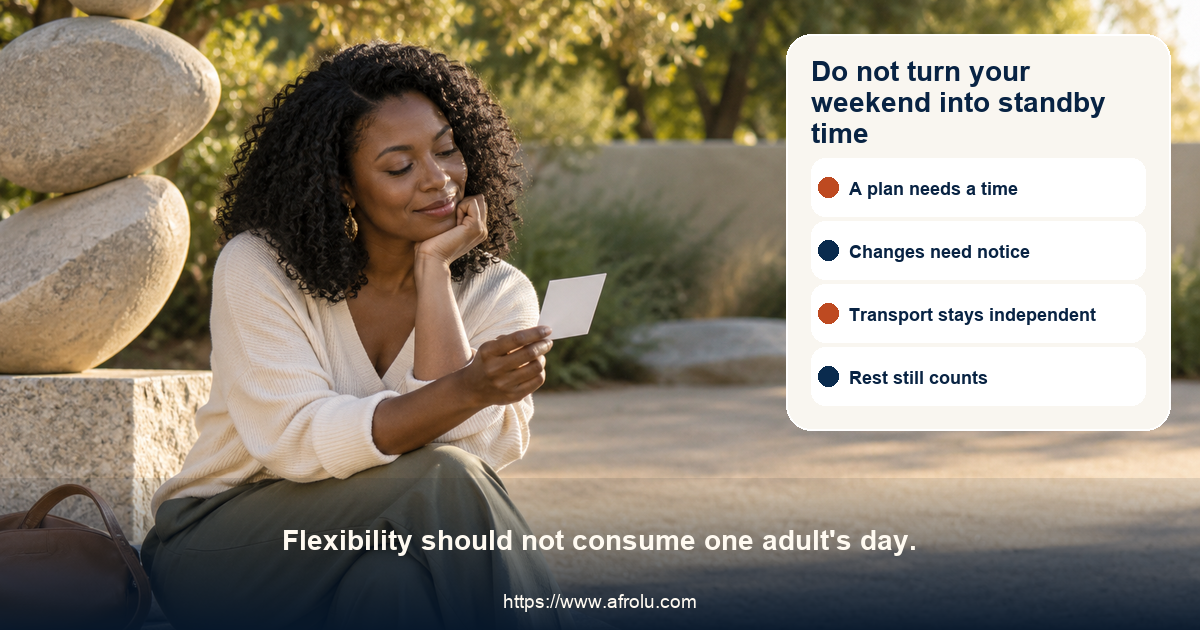
A plan never receives a confirmation
One adult holds their day open while the other keeps sending warm messages without naming a time or place.
Set a confirmation time and make other plans when it passes.A coffee is enough
A person proposes a long evening, but the other adult only wants a daytime public meeting.
State the smaller offer without apologising for its size.The setting changes after arrival
A public plan becomes a request to go somewhere private after one person has already travelled.
Keep the original boundary and leave using independent transport if needed.A real obligation interrupts
A date is cancelled early with an honest explanation and no pressure to accept a replacement.
Decide later whether the alternative works for you.Casual means different things
One person assumes other dates are fine while the other assumes regular weekends imply exclusivity.
Ask before a choice that needs the information.A casual date wants more detail
Someone asks for an address, daily routine, or live location before trust has grown.
Keep the answer broad and choose a public meeting point.A small emergency becomes a transfer
An urgent payment request arrives after a few affectionate conversations.
Decline and verify outside the connection.A clear no becomes repeated contact
After a short closing message, a person uses new accounts and mutual contacts to continue the conversation.
Reduce access and seek support rather than debating the decision.Fourteen observable signs that a low-pressure situationship remains mutual, vague, pressuring, controlling, or unsafe
A low-pressure plan still has a time, place, and way to confirm it.
Both adults can name whether the connection is casual, exploratory, exclusive, or undefined.
A changed plan is communicated before the other person's time has been consumed.
You can choose a short, public, daytime, or no-date option without punishment.
Touch, sex, images, staying longer, and travel are discussed as current choices.
Each adult can leave using their own transport, phone, money, and support contacts.
Your address, schedule, accounts, codes, and social profiles remain gradual.
A boundary is accepted without sulking, bargaining, guilt, or repeated requests.
One missed plan does not become a pattern of endless standby availability.
Other dates and sexual-health decisions are not inferred from weekend frequency.
Study, work, sleep, friends, and private time remain part of your weekend.
No urgent transfer, document, code, account access, or secret favour enters the connection.
A clear ending is allowed to remain an ending.
Monitoring, threats, image pressure, repeated pursuit, or fear shift the task to safety.
A proportionate decision map for plans, changes, consent, privacy, other dates, money, endings, and safety
| Situation | What it may mean | What to do next |
|---|---|---|
| The plan is vague | Interest may be present without an actual invitation. | Set one confirmation time and stop holding the day open. |
| You only want a short meeting | Your available pace is smaller than the proposed date. | Offer the plan you can freely sustain. |
| They ask to change location | The original boundary may no longer fit the invitation. | Keep the setting or leave without negotiating access. |
| They cancel early | A disruption can be ordinary. | Decide whether a specific replacement suits you. |
| They cancel repeatedly | The arrangement may rely on your standby availability. | Reduce investment or ask for a different pattern. |
| Intimacy becomes expected | A prior yes may be getting treated as continuing access. | State the current boundary and slow down. |
| You wonder about exclusivity | A present decision needs direct information. | Ask before assuming what regular contact means. |
| They request location or accounts | Access may be moving faster than trust. | Keep information layered and use independent logistics. |
| They request money or codes | The connection has entered a risk category. | Decline and verify independently. |
| They push after no | Your freedom may be being treated as negotiable. | Reduce access, document only if safe, and seek support. |
Twelve complete lines for an invitation, confirmation, privacy, intimacy, cancellation, money, and an ending
“I am free for a short coffee, not an open-ended evening.”
“If we have not confirmed by four, I will make other plans.”
“I like this, and I want to keep the weekend pace light for now.”
“Before we get more physical, are either of us seeing other people?”
“I am meeting in public and travelling independently.”
“I am not going somewhere private tonight.”
“I keep my home and routine private until I know someone better.”
“Thanks for telling me. I cannot keep tonight open, so we can revisit another time.”
“Are you looking for occasional plans, or something more regular?”
“I do not lend, transfer, or share financial access in dating connections.”
“This setup does not work for me, so I am stepping back.”
“I asked you not to contact me again. Do not contact me further.”
Know the difference
A low-pressure weekend arrangement can be mutual, vague, or pressuring
Both adults can make small plans, revise them respectfully, and keep intimacy, privacy, and access current.
One adult supplies availability and guessing while the other keeps the plan, terms, or boundary deliberately unclear.
Low pressure should leave both adults with more choice, not less information.

Mutual flexibility differs from being kept waiting.
Keep mutual low-pressure planning distinct from standby availability, privacy pressure, financial manipulation, and conduct that reduces freedom
| Type or dimension | What it describes | Best next question |
|---|---|---|
| Planned casual date | A smaller meeting has clear logistics and a voluntary end. | Confirm it and keep transport independent. |
| Spontaneous but mutual plan | Both adults can decline or change the invitation without fallout. | Check that the setting and pace still suit each person. |
| Early exploration | Interest exists without a settled relationship definition. | Ask the question that changes the next decision. |
| Mutual casual dating | Both adults understand limits, other dates, and current consent. | Review the agreement when the pattern changes. |
| Standby availability | One person waits through a vague day for a possible invitation. | Set a confirmation point or make another plan. |
| Privacy pressure | Routine, location, devices, or social contacts are treated as owed access. | Layer information and reduce access after a boundary is ignored. |
| Financial manipulation | Urgency and intimacy are used to seek money or account access. | Decline and independently verify any claim. |
| Unwanted pursuit | A no, silence, or block is followed by new contact routes. | Report, block, and seek support as needed. |
| Coercion or fear | Threats, isolation, image pressure, or monitoring reduce free choice. | Prioritise safety planning over relationship discussion. |
A simple plan you can use today
Small plans can be real
A coffee, walk, or short call becomes more respectful when both adults know its boundaries.
Flexibility needs notice
Changing a plan is ordinary; leaving someone on standby is a different pattern.
Consent is not a weekend package
Meeting, touching, sex, images, and an extension are separate current choices.
Privacy supports choice
Layered information lets you decide about another date without managing unwanted access.
Casual still needs mutuality
A light arrangement should not ask one adult to supply all the time or certainty.
Safety changes the task
Money pressure, coercion, monitoring, threats, and fear need protection rather than a better label.
Questions organised by purpose and depth
Choose a few prompts that fit the moment. This is a reference library, not a list to complete.
The actual invitation
Use before leaving a day open for a possible plan.
- What exactly am I agreeing to this weekend?
- When will I stop waiting for confirmation?
Pace and consent
Use before a plan becomes more intimate or private.
- What access do I want to give tonight?
- What would I need to say no to comfortably?
Capacity and mutuality
Use when a casual pattern starts consuming too much attention.
- Does this rhythm leave room for my actual life?
- Can both adults make and keep a usable plan?
Safety and exit
Use when a request or contact pattern starts to feel coercive.
- Would I share this information or money outside dating?
- What action increases my control now?
What deserves a closer look
Make a weekend invitation usable
State the setting, approximate duration, confirmation point, and independent travel choice.
Evidence limit: A clear plan does not promise a future relationship.
Handle cancellations with proportion
Communicate promptly, offer an alternative only when sincere, and let the other adult decide.
Evidence limit: No private evidence is required to justify a change.
Keep every step current
Check before touch, sex, images, a private location, or an extended plan.
Evidence limit: Earlier consent cannot decide the next moment.
Control the access you give
Keep location, home, accounts, devices, routine, and social circles layered.
Evidence limit: Privacy does not mean controlling another adult.
Measure the cost of casual dating
Notice whether both people can plan, ask, decline, and adjust without one person staying on standby.
Evidence limit: No guide can infer another person's motive.
Switch tactics when a boundary is ignored
Use platform tools, trusted support, and safety planning for pressure, pursuit, threats, or fear.
Evidence limit: Protecting yourself does not require proving a diagnosis.
Shortcuts that turn a relaxed weekend into waiting, unwanted access, pressure, or risk
Calling vagueness low pressure
A relaxed tone does not make an unconfirmed plan or missing agreement mutual.
Keeping every weekend open
Constant availability hides whether the other adult can make a usable invitation.
Treating a meeting as consent to more
A yes to one plan never settles touch, sex, images, or an overnight stay.
Sharing logistics too soon
Address, routines, and account access can be difficult to take back once shared.
Explaining a no until it is negotiated
A person who respects a boundary does not need a closing argument.
Making an urgent financial exception
Emotional closeness does not make a transfer or code request safe.
Set a boundary, calm a first-date worry, or choose a proportionate follow-up
Choose the guide that fits your immediate decision. An editorial resource can help you name a preference, but it cannot promise another adult's honesty, availability, or conduct.
Explore the guide library
Show more related guides
Continue with Afrolu
Show more Afrolu guides
Sources used for this guide
Afrolu reviewed these health, research, safety, or public guidance resources while editing this page. They support the behaviour and safety guidance; they do not diagnose any individual described by a reader.
Questions about adult-student situationships and low-pressure weekends
Can a situationship be low pressure and still respectful?
Yes. A small, casual arrangement can be respectful when both adults know the present terms, can decline plans, and keep consent and privacy current.
How long should I keep a weekend plan open?
Choose a confirmation time that works for your day. If it passes without a usable plan, make other plans instead of waiting indefinitely.
Is it rude to only want a short daytime date?
No. A shorter or public plan is a valid preference. The other adult can accept it, propose another option, or decline.
What if I do not know whether they are seeing other people?
Ask before a decision that needs the information, especially before intimacy or a regular pattern begins. Do not infer exclusivity from weekend frequency.
Can I change my mind after agreeing to meet?
Yes. You can cancel, leave, decline touch, change the setting, or decide not to continue. Current consent includes a changed mind.
Should I share my address for convenience?
Only if and when you want to. A casual date can meet publicly, and gradual disclosure protects your ability to decide about future contact.
What if they always text late and want immediate plans?
State the availability and notice you need. If the pattern remains last-minute, decide whether the arrangement genuinely works for you.
Should I lend money to someone I have been casually seeing?
Keep money, transfers, accounts, codes, and documents separate from dating. Verify any urgent claim independently.
What if they keep contacting me after I end it?
Reduce access, use platform block and report tools, preserve information only if safe, and seek trusted or specialist support if contact continues or you feel unsafe.
Do I need to explain why I do not want another date?
No. A short statement that you are stepping back is enough. You do not need to keep negotiating a decision that does not feel right.
One thing to do now
Choose the next invitation that leaves your weekend and freedom intact
Choose the smallest next action that protects your time, rest, study, work, private information, money, accounts, body, movement, support network, and ability to revise or end the plan without having to manage another adult's disappointment.