Adult capacity · clarity in a career season
Situationships for Adult Students: Clear Dating in a Career Season
A practical situationship guide for adult students in a career season: name mutual expectations, protect time and privacy, set consent, and act on clarity.

Name the arrangement you can both choose.
Written and edited by Grace Mutiso · Kenya Guides Editor
Describe the arrangement that exists and ask what each person is choosing now. Offer the time and contact you can genuinely sustain, then use plans, privacy boundaries, independent movement, and current consent to keep choice visible. A mutual casual setup can be caring when expectations are clear; a vague pattern can be released. Keep money, accounts, codes, documents, and location separate. If pressure, threats, monitoring, or fear appear, reduce access and use support.
Relationship clarity · Students
Is this a mutual casual arrangement, a vague recurring connection, a capacity mismatch, a return worth redesigning, access or money pressure, unwanted pursuit, or conduct that makes me feel unsafe?
A situationship is a connection with some intimacy, affection, or recurring contact but no fully shared definition of commitment, expectations, or future. The important distinction is not casual versus serious; it is mutual clarity versus a pattern that asks one person to infer the rules or surrender choice.
Mara is an adult student in a demanding career season. She likes the person she has been seeing, but their plans are mostly last-minute and their intimacy has never included a conversation about other dates or contact. She asks what they are open to, offers one planned evening a week, and keeps her routines private. The answer helps her decide that a smaller mutual arrangement is possible only if both people can name it.
adult capacity · clarity in a career season
Mara makes a situationship readable without turning it into a performance of unlimited availability
This guide separates a mutual casual arrangement, vague recurring closeness, a capacity mismatch, a direct conversation, a return after silence, privacy pressure, financial manipulation, unwanted pursuit, and fear—while keeping adult study and career life in proportion.
Name observable facts, offer the scale you can sustain, ask a present-tense question, keep consent and access current, distinguish ambiguity from risk, redesign only mutual terms, and carry forward one usable standard.
Describe it
Facts about plans and boundaries are more useful than a hoped-for label.
Offer a scale
A smaller truthful plan protects a full adult season.
Keep it chosen
Familiarity never makes privacy or consent automatic.
Change the strategy
Money pressure, coercion, monitoring, and fear need protection.
adult study · career season
Clarity begins with the arrangement that exists, not the label you hope will solve it
For an adult student balancing coursework, paid work, or a transition in career, a situationship can feel easier to leave unnamed. It may offer warmth without a large promise, or it may occupy a surprising amount of thought because nobody has said what the connection is for. Neither response makes you demanding. It tells you that the present arrangement deserves a sentence.
Start with observable facts. How often do you see each other? Do plans get made and kept? Is intimacy part of the connection, and are there assumptions about exclusivity, other dates, communication, or emotional availability? Naming those facts is not an audition for commitment. It is how two adults avoid building private stories from the same vague pattern.
A mutual casual arrangement can be completely legitimate when both people can describe it similarly and act with consideration. Vague closeness is different. It asks one person to absorb uncertainty while the other keeps every option open without saying so. The issue is not whether the connection is serious enough. The issue is whether both people still have room to choose.
You do not need an instant title after one good evening. You can decide that you are still learning, ask what someone is open to, or say that a particular setup does not work for you. Clear speech is not a demand for a grand future. It is a way to make the next week, message, plan, and boundary intelligible.
attention · sustainable pace
A limited season can hold connection without pretending that availability is unlimited
Career-heavy seasons often turn a situationship into a strange background task. You may reply between obligations, postpone a conversation you want to have, or agree to last-minute plans because it seems easier than explaining your limits. Over time, that can make the connection feel bigger than the actual time you have chosen to give it.
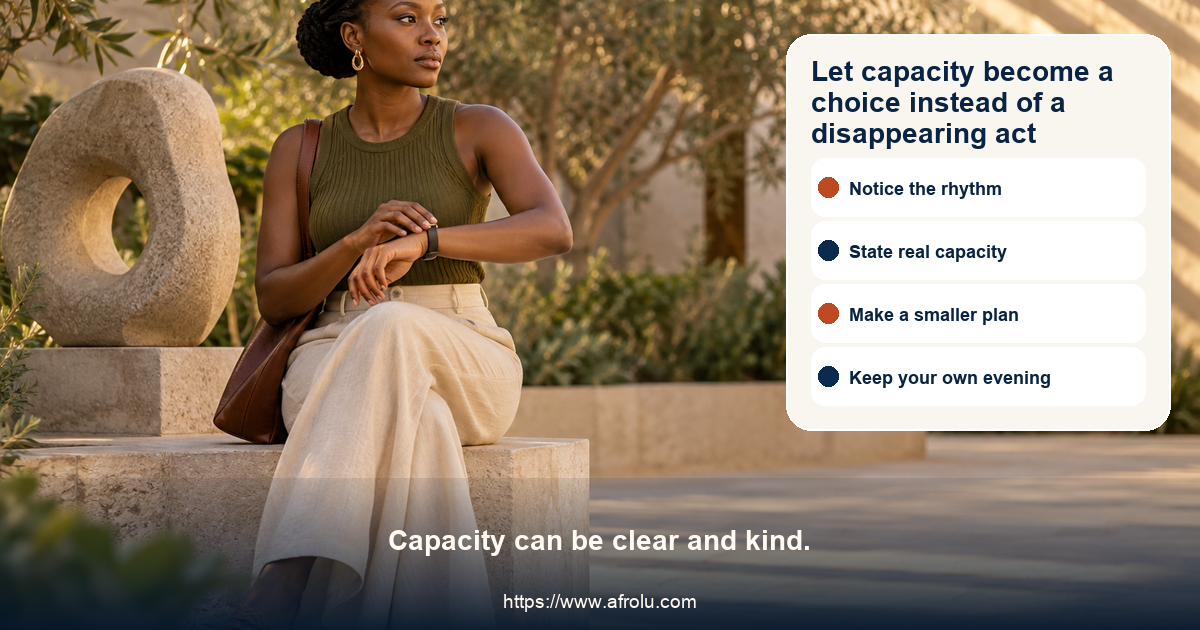
Try naming the scale instead of apologising for it. You might be available for one planned evening, a short call, or intermittent messages while a deadline passes. That statement is useful because it includes a choice. It lets the other person say whether that rhythm works for them, rather than asking either of you to guess or perform constant enthusiasm.
The other person's capacity matters too, but it needs to become actionable. A busy period can be real and still leave room for a clear alternative, a smaller plan, or an honest pause. Repeated explanations that never lead to a usable arrangement may mean the connection is not available at the level you want, regardless of the reason behind them.
Protect the parts of life that keep you steady: rest, study, work, friendships, privacy, and the routines that existed before this connection. A situationship should not require you to turn depletion into proof of interest. When the pace only works if one person abandons their own life, the arrangement is already giving useful information.
clarity conversation · directness
A short question can reveal more than weeks of reading between messages
Before starting a conversation, decide what information would genuinely alter your next move. Perhaps you need to know whether they are also seeing others, whether a regular plan is realistic, whether physical intimacy has shared boundaries, or whether they only want occasional contact. A question works best when it is tied to a choice you can make, not an attempt to control their answer.
Use ordinary language. 'I like spending time with you. What are you open to at the moment?' or 'I need to know whether we are keeping this casual and non-exclusive so I can decide what fits me' are complete starting points. You can be warm without padding the question until it no longer asks anything.
Listen for usable content. An honest uncertain answer can still be clear: someone may say they cannot offer a consistent connection, do not want exclusivity, or would rather pause. An answer that changes shape whenever you name a boundary is different. It may leave you with more words but no agreement about how the relationship operates.
You are allowed to take time after the answer. Clarity does not require an immediate yes, no, or escalation. You can say that you will think, choose a lower-contact arrangement, or decide that the connection no longer matches your capacity. The conversation succeeds when it restores your ability to choose, not only when it produces a preferred label.

A short true sentence can restore choice.
privacy · consent · independent choice
A situationship does not automatically earn a map of your routines, devices, or body
Early familiarity can make privacy boundaries seem unnecessarily formal. A person may know your course schedule, ask where you work, want live location, suggest moving every conversation to a private channel, or expect immediate replies because you have been close before. You can keep an answer broad. Access should grow through trust, not through a reluctance to appear distant.
Consent works the same way. A previous kiss, a regular sleepover, a flirtatious message, or an earlier agreement does not settle what happens next. You can change the setting, decline an image, stop touch, leave, or decide not to meet at all. A considerate connection treats a changed mind as ordinary information rather than an injury to someone else's expectations.
Build logistics that preserve your choice. Meet publicly when that suits you, use transport you control, keep your address, accounts, documents, and verification codes private, and choose communication channels you can leave. These are not accusations about the other person. They keep the structure of the arrangement from becoming more binding than your actual consent.
If someone pushes after a clear limit, treat the behaviour as data instead of searching for a more persuasive explanation. You can repeat the boundary once, reduce access, block or report through a platform, and bring in support if the pressure continues. A connection that depends on eroding your freedom is not made safer by calling it casual or undefined.
proportion · safety
Not every confusing situationship is dangerous, but money, monitoring, coercion, and fear require a different response
Someone may be inconsistent, undecided, unskilled at communicating, or simply not a fit for the kind of closeness you want. Those possibilities can hurt without meaning that you must treat every delayed reply as a safety emergency. You can ask once, choose less contact, or leave the arrangement based on the ordinary evidence available to you.
The category changes when a person asks for money, payment help, account access, codes, documents, or a secret financial favour. Emotional intimacy and a compelling story do not make a new or undefined connection a safe route for transactions. Keep systems separate and verify any urgent claim through a recognised institution, not through the person asking.
It also changes when someone keeps contacting you after you have said no, uses new accounts after a block, monitors your activity, threatens you, pressures you for sexual material, or leaves you afraid to change plans. Those patterns are not a clarity problem that a longer conversation can solve. Reduce access, document only when safe, and seek trusted, specialist, platform, or urgent support as appropriate.
You are not required to prove a pattern beyond doubt before taking a protective step. If the connection makes your movement, money, privacy, body, or attention feel less voluntary, you can act. A safe arrangements leaves room for a no, an exit, a slower pace, and a decision to involve other people when you need help.

Ask once; protect freedom when the category changes.
choice point · mutual fit
Clarity can lead to a smaller agreement, a fresh boundary, or a clean ending
Once you have the facts, look for a design rather than a verdict. You might agree on occasional planned dates, pause physical intimacy until expectations are clearer, keep the connection non-exclusive with explicit health and communication boundaries, or step back while a demanding season passes. The meaningful part is not the sophistication of the label. It is whether the agreement is specific enough to guide actual conduct.
Check the cost of continuing. Are you routinely rearranging work or study, waiting for confirmation, suppressing questions, or accepting access you do not want because a small amount of closeness feels hard to lose? Those costs do not prove that the other person is bad. They may show that the arrangement asks you to pay more than it returns.
If you choose to release it, keep the ending proportionate. 'This setup is not working for me, so I am stepping back' is sufficient. You do not need to produce a closing argument or remain available to process a decision that you have already made. If direct contact feels unsafe, you may use a shorter close, block, or avoid further engagement.
A good redesign can also include a review point. You might agree to revisit after a date or a defined period, not as a countdown to commitment but as a way to ask whether the stated arrangement still fits. Adults can revise agreements when reality changes. What matters is that revision remains mutual rather than imposed by silence.
next move · self-trust
Use this experience to make a clearer invitation, not a smaller life
Choose one practice for the next conversation. It could be confirming the purpose of a plan, saying what kind of contact you can sustain, discussing sexual-health and exclusivity expectations before intimacy, keeping your address private, or treating a repeated non-answer as information. A useful standard should be small enough to use when you actually like someone.
Do not turn every past ambiguity into a reason to demand certainty from the first message. Early dating contains uncertainty, and no one can promise a future on request. The difference is whether both people can be truthful about the present, respect a boundary, and allow each other to decline without punishment or pursuit.
Keep your academic, career, and personal life in the picture. A connection is healthier when it sits alongside your sleep, work, friendships, interests, and commitments rather than replacing them. The right amount of dating attention is not universal. It is the amount that leaves you able to recognise your own preferences and act on them.
Where a situation includes financial pressure, unwanted pursuit, coercion, threats, monitoring, image abuse, or fear, make protection the next standard. End contact where possible, use platform tools, preserve information only if it is safe, and reach out for local or specialist help. You never owe one more explanation in exchange for your right to feel secure.

Choose the move that leaves you more free.
Eight adult-student situationships where clarity, capacity, privacy, and safety change the next move
Warm contact, then no plan
Two adults message most evenings, but plans only appear after one person asks repeatedly.
Ask what rhythm they are actually open to; do not call daily messages an agreement.Interest without spare evenings
A student genuinely has a heavy month and wants contact that does not collapse their sleep or preparation.
Offer one smaller plan or an honest pause instead of indefinite standby.Closeness without shared assumptions
Physical intimacy has started, but neither person has discussed other dates, protection, testing, or communication boundaries.
Name the current expectations before treating familiarity as permission.Every clarity question becomes a joke
One person responds warmly but never says whether they want casual contact, a regular relationship, or anything in between.
Notice the absent answer and decide whether vagueness works for you.A match wants routine details
Someone asks for live location, a work pattern, private accounts, or access that exceeds the plan you have chosen.
Keep access layered and return the conversation to the specific plan.A heartfelt request arrives early
A situationship becomes a reason to receive money, pay a bill, share a code, or make a transfer.
Keep money and systems separate; verify independently and decline.Silence followed by sudden intensity
After several quiet weeks, a person reappears asking for immediate access and a large emotional conversation.
Choose a pace that fits today, or decline to restart.An ending is treated as negotiable
After a direct boundary, messages multiply, new accounts appear, or the tone becomes threatening.
Reduce access, use safety tools, and seek support rather than debating.Fourteen observable signs that a situationship is mutual, vague, pressuring, controlling, or unsafe
Both people can describe the current arrangement in ordinary language.
A limited schedule leads to a specific smaller plan or an honest pause.
A clarity answer includes a choice, not only reassurance.
You can decline a plan without being punished by silence or pressure.
Physical intimacy has current, mutual boundaries rather than borrowed assumptions.
Your work, study, home, account, and location details stay gradual.
A person accepts that contact may remain on a channel you control.
A planned meeting has a time, public option when wanted, and independent exit.
A return after a gap comes with present conduct, not only a dramatic explanation.
Money, payment access, documents, and codes remain outside the connection.
A no does not lead to repeat messages, new accounts, or monitoring.
You still have energy for rest, friendships, study, and work.
The arrangement feels chosen rather than managed through anxiety.
Fear, coercion, threats, or blackmail change the question from clarity to safety.
A proportionate decision map for expectations, capacity, consent, access, returns, money, and safety
| Situation | What it may mean | What to do next |
|---|---|---|
| You want a label immediately | You may need information about current expectations, not a prediction. | Ask what each person is open to now. |
| A plan stays vague | The connection may not have enough coordination to claim your evening. | Set a confirmation point and release the time if it passes. |
| They say they are busy | Capacity may be real or the fit may be too limited. | Ask whether a smaller plan or pause is realistic. |
| You feel attached after intimacy | Your feelings may need a boundary conversation, not self-criticism. | Name the expectation that would let you choose freely. |
| They want more digital access | Familiarity may be getting mistaken for entitlement. | Keep the channel, location, and details you choose. |
| They return after silence | A new invitation is not a debt to resume. | Consider only a scale that fits your present interest. |
| They ask for financial help | The situation is no longer ordinary relationship uncertainty. | Decline and verify any claim through independent routes. |
| They push after no | Choice and consent may be eroding. | Stop engagement, reduce access, and use support. |
| You want to end it | Mismatch can be enough reason without assigning blame. | Give a concise close or use distance if safety requires it. |
| You feel afraid | The relevant issue is safety, not better communication. | Seek appropriate urgent, specialist, trusted, or platform support. |
Twelve complete lines for expectations, capacity, privacy, consent, a return, and an ending
“I like seeing you, and I want to check what you are open to at the moment.”
“This month is full for me, so I can offer one planned evening rather than last-minute plans.”
“Before we continue physically, I need us to be clear about whether either of us is seeing other people.”
“If we have not confirmed by Thursday afternoon, I will make another plan for the evening.”
“I keep my routine and personal accounts private while I am getting to know someone.”
“I will meet you there; I am not sharing live location.”
“I am interested, but I want to keep this at a pace that leaves room for the rest of my life.”
“I am open to a brief catch-up, but I am not going back to an undefined rhythm.”
“I do not lend, send, receive, or move money in a dating connection.”
“I do not want to continue with that plan tonight.”
“This arrangement is not working for me, so I am stepping back.”
“Do not contact me again.”
Know the difference
Mutual casual clarity and vague recurring closeness are not the same arrangement
Both adults can say what contact, intimacy, other dates, privacy, and exits mean for them now.
Warmth exists, but one person has to infer the rules, chase plans, or accept access without agreement.
Casual can be caring and clear; ambiguity becomes costly when it removes either person's ability to choose.

Compare the pattern before changing your life around it.
Keep mutual casual clarity distinct from vague recurring closeness and conduct that reduces freedom
| Type or dimension | What it describes | Best next question |
|---|---|---|
| An invitation | It names a day, time, and scale. | Confirm it or make another plan. |
| A hint | It suggests seeing each other without an arrangement. | Ask whether a plan is actually being made. |
| A pause | It is openly named and has a reason or review point. | Decide whether waiting serves you. |
| A fade | Contact thins while access or expectation stays implied. | Release the assumption and choose your boundary. |
| A mutual casual setup | Both people can discuss other dates and consent. | Keep agreements current as circumstances change. |
| One-sided availability | One schedule determines everything without discussion. | Offer your capacity and notice the response. |
| Observable repair | A return includes changed conduct and a usable plan. | Start small if you remain interested. |
| Access pressure | Privacy, location, images, money, or contact channels are pushed. | Keep systems separate and reduce access. |
| Fear or coercion | A no produces pursuit, threats, monitoring, or intimidation. | Move from conversation to safety support. |
A simple plan you can use today
A label is not the whole agreement
The important information is how both adults treat plans, intimacy, access, and exits in the present.
Small plans reveal fit
A short, confirmed meeting can show more than days of vague, high-intensity messaging.
Capacity is relational information
Saying what you can sustain lets another adult make a real choice too.
Warmth does not erase boundaries
Familiar contact can still require fresh consent and gradual privacy.
An answer can disappoint and still help
A clear mismatch is easier to act on than a hopeful pattern with no terms.
Protection is not overreaction
Money pressure, coercion, monitoring, and fear deserve a different response from ordinary ambiguity.
Questions organised by purpose and depth
Choose a few prompts that fit the moment. This is a reference library, not a list to complete.
Name the present
Use these prompts before asking for clarity.
- What do I know from conduct rather than hope?
- What information would change my next choice?
- What arrangement can I honestly accept now?
Check capacity
Keep a demanding season visible.
- How much time and messaging can I sustain?
- What do I need to protect this month?
- What would a smaller plan look like?
Check consent and access
Make choice practical.
- What access have I freely chosen?
- What would I rather keep private?
- Can I change my mind without friction?
Choose a next move
Use facts, not momentum.
- Do I want a direct question, a redesign, or an ending?
- What would I do if the answer stays vague?
- Who could support me if contact feels unsafe?
What deserves a closer look
Ask what the connection is for
Use a question about present openness, frequency, intimacy, or exclusivity that informs a choice you control.
Evidence limit: Do not use a clarity talk to force a future promise.
Make a plan small enough to keep
Set a time, confirmation point, and end that work around real study and career commitments.
Evidence limit: Do not treat an unconfirmed idea as an obligation.
Make assumptions discussable
Discuss testing, protection, other partners, images, touch, and stopping before silence does the negotiating.
Evidence limit: Do not rely on familiarity as a substitute for consent.
Keep access in layers
Share only what the current plan needs and keep channels, transport, accounts, and routines within your control.
Evidence limit: Do not reveal a private system to prove trust.
Read repair through conduct
A returning person can offer a clear, modest plan and respect the pace you choose.
Evidence limit: Do not let an apology become an entitlement to access.
Change strategies when freedom narrows
Use blocking, reports, trusted people, specialist support, or urgent help when pressure, money, threats, monitoring, or fear arise.
Evidence limit: Do not continue direct contact merely to be polite.
Shortcuts that turn a situationship into standby time, unwanted access, pressure, or risk
Calling anxiety a label problem
A title cannot replace an agreement about behaviour and boundaries.
Offering more access to earn clarity
Extra availability, location, or intimacy rarely makes a vague arrangement safer.
Making every plan provisional
Standby time quietly teaches the connection that your life is always movable.
Ignoring a non-answer
Repeated deflection is information even when the messages remain affectionate.
Treating prior intimacy as permanent consent
A changed mind needs no special justification.
Negotiating with coercion
Threats, pressure, money requests, monitoring, or fear need protection, not better phrasing.
Set a boundary, ask a first-date question, or send one clear post-date message
Choose the guide that matches your immediate decision. An editorial resource can help you name a preference, but it cannot promise another adult's interest, honesty, or conduct.
Explore the guide library
Show more related guides
Continue with Afrolu
Show more Afrolu guides
Sources used for this guide
Afrolu reviewed these health, research, safety, or public guidance resources while editing this page. They support the behaviour and safety guidance; they do not diagnose any individual described by a reader.
Questions about situationships for adult students in a career season
What is a situationship?
It is a connection whose expectations, commitment, or future are not fully defined. It can be mutual and workable when both adults can describe the present arrangement and keep their boundaries voluntary.
Do I have to ask for a label?
No. You can ask about plans, exclusivity, intimacy, contact, or capacity instead. The useful aim is enough shared information to make a free choice.
Can a situationship be casual and respectful?
Yes. Casual does not mean careless. Mutual expectations, current consent, privacy, honest limits, and an easy exit can make casual dating clearer rather than colder.
How do I talk about this during a busy career season?
Offer the amount of time and contact you can sustain, then ask whether that works. A small specific plan is better evidence than indefinite busyness.
What if they say they do not know what they want?
Take that as current information. You can decide whether a lower-stakes arrangement works for you, set a review point, or step back rather than waiting for certainty.
Should I end it after a vague answer?
You may. You can also redesign the arrangement if both people can make it specific enough to uphold. The question is whether continuing preserves your dignity, time, and choice.
Do prior dates or intimacy mean I owe more access?
No. Consent, touch, images, calls, location, and meetings remain current decisions. Previous closeness does not make later access automatic.
What if a situationship asks for money or account help?
Keep money, accounts, documents, codes, and financial transfers separate from dating. Verify any urgent story independently and decline requests that reduce your security.
What if they keep contacting me after I end it?
You can block, report, preserve information only if safe, and seek support. Repeated unwanted contact, threats, monitoring, or fear are safety concerns, not an invitation to explain more.
How can I date without losing focus?
Choose a scale that fits your actual life, use confirmation points, protect rest and private routines, and let a mismatch be information instead of a project to solve.
One thing to do now
Choose the next arrangement that leaves room for your whole life
Choose the smallest next action that protects your time, rest, private routines, independent movement, current consent, money, support network, and ability to end or redesign the connection without negotiating your freedom.