Nairobi professionals · situationship safety
Nairobi Professional Situationship Safety Guide
For Nairobi professionals in a situationship, make plans independently, set clear terms, protect privacy and money, and respond safely to pressure or pursuit.
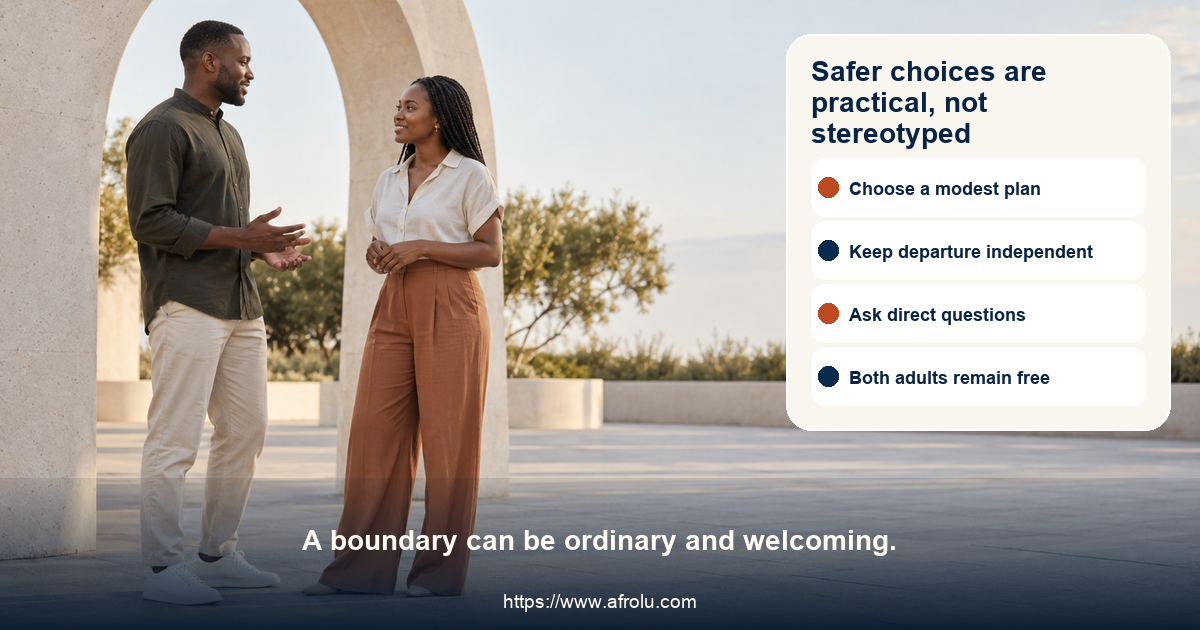
Safety begins with options you control.
Written and edited by Miriam Otieno · Senior Kenya Editor
Use practical autonomy rather than city, status, or mutual-contact assumptions: make a plan you can leave, keep arrival and departure independent, ask for current terms, share personal information gradually, and keep money, accounts, documents, devices, and professional information separate. If someone pressures access, ignores a boundary, monitors, threatens, seeks images or money, pursues you, or makes you afraid, reduce access and use support.
Relationship clarity · Professionals
Is this ordinary dating uncertainty, a mutual casual arrangement, a meeting-logistics decision, an access or privacy boundary, a consequential claim, a money request, unwanted pursuit, or conduct that makes me feel unsafe?
A Nairobi professional situationship is recurring dating, romantic, or intimate contact without a fully shared commitment. It can be mutual and safe when both adults can make clear plans, keep access gradual, state present terms, and leave freely; it becomes risky when access, pressure, money, or fear replaces voluntary choice.
Wanjiku meets someone through an ordinary social introduction and enjoys their early conversations, but she keeps the first plan public, uses her own transport, declines a last-minute venue change, and asks what each person is open to. When a later message requests a financial favour, she separates warmth from systems and pauses. Her choices keep the situationship readable without treating familiarity as proof.
Nairobi professionals · situationship safety
Wanjiku uses ordinary independent choices to make a situationship safer without turning Nairobi, status, or a mutual contact into a safety score
This guide separates ordinary uncertainty, mutually chosen casual dating, proportional checks, public meeting logistics, present terms, gradual access, financial manipulation, unwanted pursuit, and fear—without stereotyping a city or treating professional identity as proof of safety.
Choose a plan you control, match checks to risk, ask a present-tense question, layer access, keep systems separate, end proportionately, and switch to protection when freedom narrows.
Keep it independent
Arrival, departure, setting, and duration remain your choices.
Ask what is current
Regular contact does not settle exclusivity or access.
Keep systems separate
Home, routine, accounts, money, devices, and work details stay gradual.
Change the response
Pressure, pursuit, threats, monitoring, and fear need protection.
nairobi dating · adult autonomy
Safer situationship choices come from boundaries and independent options, not assumptions about Nairobi or another adult
Professionals in Nairobi may meet through apps, friends, social circles, events, or ordinary daily life. A familiar neighbourhood, a mutual contact, an impressive claim, or a polished online presence can feel reassuring, but none of it settles the questions that matter in a situationship: what is being offered, what access is welcome, and whether either adult can change their mind without cost.
Begin with a modest plan you can control. Choose a public setting when that suits you, make your own travel decisions, keep your phone and payment method accessible, tell a trusted person only what you choose to share, and decide your own departure time. These are not accusations. They are ordinary structures that prevent convenience from becoming dependence.
Safety also includes emotional and informational choice. You can keep an early connection private, decline to disclose your home or routine, ask a direct question about relationship terms, and leave an invitation unanswered or declined. A respectful adult does not require you to prove that your caution is reasonable before accepting a boundary.
Do not ask a location label to do the work of judgment. One adult may be inconsistent but not dangerous; another may make a compelling offer while pressuring access or money. The useful task is to notice what is observable, choose a proportionate next step, and switch from dating logistics to protection when your freedom starts to narrow.
proportionate checks · privacy
You can take a consequential claim seriously without demanding documents, passwords, location access, or a private investigation
A situationship can invite premature certainty. Someone may describe a relationship status, an identity, a personal history, a financial issue, or a reason for urgency in a way that feels important to verify. Instead of deciding whether every detail is true, ask what decision the claim is asking you to make and how much risk that decision carries.
For an early meeting, ordinary interaction, a public plan, and your own transport may be enough. For a request involving money, housing, a private address, documents, an account, travel, or a major change in access, pause. Use independently found public or official channels for consequential verification rather than links, screenshots, names, or urgent instructions supplied by the person.
Keep your own checks proportionate too. You do not need to ask for identity records, browse a person's private network, demand their location, or use a mutual contact as an investigator. Those actions can expose both adults and create a relationship structure based on surveillance instead of consent. You can simply decide that the available information is not enough for the request.
An adult who is sincere may still prefer privacy or decline to provide proof. That is their right. Your response can be to make a smaller plan, delay the decision, or decline the connection without turning uncertainty into an accusation. The boundary is not 'prove yourself'; it is 'I will not make a high-risk decision without independent confidence.'
meeting logistics · independent movement
A public meeting is more useful when each adult can arrive, change the plan, and leave without depending on the other person
Choose a first or early meeting in a setting where you are comfortable and can make your own decisions about arrival and departure. You do not need to turn this into a dramatic security exercise. A simple public location, independent transport, a charged phone, and a known check-in point can be enough to protect your freedom without treating a date as a threat.
Set the scale before you go. A daytime coffee, a defined dinner, or a short walk can be a complete meeting. You can say that you are leaving at a certain time, decline a change of venue, or decide not to continue to a private setting. The other adult may be disappointed, but disappointment does not give them a claim on your time or movement.
Keep your personal logistics yours. Do not let convenience require you to hand over a phone, share your live location, reveal your address, depend on one person for transport, or accept a ride that you do not want. If a plan changes unexpectedly, you can pause and choose the option that gives you the clearest route to leave.
If someone responds to an ordinary boundary with pressure, irritation, isolation from your support, or an attempt to make independent departure difficult, treat that response as meaningful. You do not need to decide whether they intended harm before changing the plan. Leave, contact someone you trust, and use a safer next step if you feel uneasy.
clarity · access · mutuality
A situationship becomes harder to navigate when regular contact, sex, or social visibility create expectations neither adult has named
A connection may be warm, physical, practical, private, or emotionally significant without being a defined relationship. The risk is not the label itself. The risk is one adult assuming that regular messages mean exclusivity, that intimacy means continued consent, that a mutual contact means disclosure is welcome, or that a future idea means plans are owed.
Ask the question that changes the next decision. You might need to know whether either adult is dating others, whether this arrangement is likely to remain casual, whether a particular kind of intimacy is welcome, or whether a regular meeting rhythm is realistic. Keep the question in the present. Nobody needs to guarantee a future before they can tell the truth about now.
Listen for conduct as well as words. A person can say they want something serious and still avoid every plan, repeatedly disappear, ignore your privacy boundary, or expect access they have not been given. Another can say they want a casual connection and still be clear, considerate, and reliable about the limited agreement. The useful distinction is whether both adults retain choice.
If you want a different arrangement, say so without trying to manage the answer. You can slow down, keep things non-exclusive with explicit limits, make fewer plans, or leave. A connection does not become safer or more respectful because one person accepts ambiguity they do not actually want in order to keep a small amount of closeness.

Say the boundary before access becomes assumed.
digital boundaries · financial independence
An early or undefined connection does not need access to your accounts, devices, private contacts, money, documents, or work-related information
Digital access can grow faster than a situationship itself. A person may ask to move every conversation to a channel you cannot easily leave, request a live location, want access to a device, send a link to open, ask for a code, or pressure you to share intimate material. Pause before adding access you would struggle to withdraw later.
Keep money separate even when a request appears modest. Do not lend, send, receive, move, or hold funds for a dating connection. Do not share account details, verification codes, documents, payment credentials, or anything connected to your professional life. A genuine adult can use their own institutions and independently found contacts for a real problem.
Your professional world deserves a boundary too. You may choose not to discuss a workplace, client, roster, building, income, contacts, or private professional material with someone you are still assessing. That is not secrecy. It avoids turning a new connection into a route for social engineering, unwanted contact, reputation pressure, or access to information that belongs to others.
If someone asks for secrecy, treats a financial no as betrayal, tries to access a device, threatens to expose messages or images, or uses personal information to pressure you, step out of ordinary dating analysis. Reduce access, use safer devices if needed, preserve information only when safe, report through relevant tools or institutions, and seek support.

Independent systems keep a connection voluntary.
risk shift · exit · support
A disappointing situationship may need an ending; unwanted pursuit, coercion, threats, monitoring, or fear need a safety response
It is useful to keep ordinary dating disappointment in proportion. A vague answer, a cancellation, a preference for casual dating, or a mismatch in availability can be enough reason to leave, but it does not automatically mean an emergency. You can end the arrangement simply because it no longer suits you and avoid turning every hard feeling into a theory about another adult.
The category changes when boundaries are ignored: someone keeps messaging after no, uses new accounts after a block, follows or tracks you, threatens you, pressures you for sexual content, blackmails you, shares or threatens to share private material, involves others to reach you, or leaves you afraid to make a normal decision. Those patterns reduce voluntary choice.
Respond proportionately and safely. You might stop replying, block or report through a platform, tell someone you trust, save records only when it does not create more risk, and contact local, specialist, platform, legal, or emergency support as the situation requires. Do not announce a plan that could escalate risk before you have considered your safety.
You are not responsible for soothing an adult who ignores your boundary. If a direct ending is safe, it can be brief. If it is not safe, you can reduce access without one more conversation. A guide cannot assess immediate danger from a distance; trust your situation and seek urgent local help when you believe someone may be at risk.

Keep plans, access, money, and exits independent.
next connection · autonomy · confidence
The purpose of safer dating is not to make every connection suspicious; it is to give you enough independent choice to enjoy a good one
Choose a small set of practices you can use every time: make a plan you can leave, arrange your own transport, keep personal details gradual, ask a present-tense question before assumptions grow, do not send money or codes, and let a boundary be complete. These are not rituals that promise safety. They are ways to reduce avoidable dependence.
Notice positive conduct without treating it as a guarantee. Someone who accepts a public plan, respects a no, offers a specific alternative after a change, keeps their own systems separate, and leaves room for your independent life is showing useful information. A green flag is not a reason to skip your boundaries; it is evidence that the boundaries can coexist with interest.
Keep your relationships, rest, private life, and support network active while you date. A situationship should sit alongside your existing life instead of becoming the channel through which every decision, social contact, or emotional need must pass. That balance makes it easier to recognise a mismatch early and easier to leave if you need to.
If pressure, financial manipulation, monitoring, coercion, threats, image abuse, repeated unwanted pursuit, or fear appear, return to protection. Use platform tools, safer-device practices, trusted support, and urgent local assistance where needed. You do not owe ongoing availability in order to prove that your safety choice was justified.
Eight Nairobi professional situationships where plan, access, terms, money, unwanted contact, or safety changes the next move
A mutual contact feels like verification
A person appears through an overlapping social circle, and familiarity begins to replace discussion of boundaries.
Use the same gradual plan you would choose otherwise.A consequential story asks for trust
Someone's status or personal story is used to support a larger request for access or a rushed decision.
Match any check to the risk and use independent sources.A public meeting becomes private
After an early date starts, one adult asks to move somewhere the other did not choose.
Keep the original setting or leave independently.Regular contact becomes entitlement
A situationship is treated as permission for live location, home details, or immediate replies.
State the boundary and keep access layered.The terms are not mutual
One adult wants a casual connection while the other has quietly assumed exclusivity.
Ask a direct present-tense question before more investment.A financial request arrives through intimacy
A problem story becomes a request to send, receive, or move money.
Decline and verify outside the relationship.A no leads to pressure
A person asks repeatedly for images or threatens social exposure after a boundary is set.
Reduce access and seek specialist support if needed.An ending does not end contact
After a clear close, messages continue through new accounts or other people.
Use reporting, blocking, and a safety plan rather than debate.Fourteen observable signs that a situationship remains mutual, vague, pressuring, controlling, or unsafe
A plan is based on your own choices rather than an assumption about a city, social circle, or status claim.
Both adults can arrive, leave, and change a meeting without depending on the other person.
A public setting and independent transport are available when you want them.
A changed venue, duration, intimacy level, or private plan remains optional.
A direct question about casual dating, exclusivity, privacy, or availability receives a usable answer.
Consequential claims are checked proportionately through independent sources, not private surveillance.
Address, routine, workplace details, accounts, contacts, devices, and social profiles remain gradual.
Money, transfers, codes, documents, payment credentials, and account access stay outside the connection.
A financial or urgent request can be declined without guilt, secrecy, or retaliation.
A mutual contact or professional claim does not substitute for your own boundary.
A clear no, cancellation, or ending is accepted without repeated access attempts.
Both adults retain friends, rest, private life, and support outside the situationship.
Ordinary disappointment is not used to pressure an exception to your boundary.
Monitoring, threats, image pressure, coercion, repeated pursuit, or fear trigger a safety response.
A proportionate decision map for plans, checks, terms, privacy, money, a clear close, unwanted pursuit, and safety
| Situation | What it may mean | What to do next |
|---|---|---|
| A mutual contact reassures you | Familiarity may be doing more work than evidence. | Keep your normal pace and boundaries. |
| A claim matters to a larger decision | The request may require independent confidence. | Verify proportionately through a source you find yourself. |
| A venue changes unexpectedly | The original logistics may no longer protect your choice. | Keep the plan public or leave independently. |
| They want your live location | Access may be moving faster than trust. | Decline and keep routine information layered. |
| You do not know the terms | Regular contact may be creating unspoken expectations. | Ask the question that changes your next choice. |
| They say casual but expect access | The label may be hiding an unequal arrangement. | State the boundary and reduce the scale if needed. |
| They request money or a code | The connection has moved into a risk category. | Decline, secure your systems, and verify independently. |
| They ask about private professional details | New access may create social or security exposure. | Keep workplace and other people's information private. |
| They ignore an ending | Your freedom may be getting treated as negotiable. | Reduce access, report, block, and seek support. |
| You feel afraid to change a plan | A relationship question may have become a safety concern. | Prioritise control and local or specialist help. |
Twelve complete lines for independent logistics, present terms, access, money, a final boundary, and asking for support
“I am meeting in public and arranging my own way there and back.”
“I can meet until this time, then I am leaving.”
“I am staying with the plan we agreed, or I will head home.”
“What are you open to in this connection right now?”
“Before we continue physically, are either of us dating other people?”
“I do not share live location, home details, or account access while dating.”
“I keep work details and other people's information private.”
“I do not send, receive, move, or share financial access in dating connections.”
“I do not make urgent decisions about money, documents, or accounts through a dating connection.”
“This setup is not working for me, so I am stepping back.”
“I asked you not to contact me again. Do not contact me further.”
“I need support with unwanted contact and I do not want to handle it alone.”
Know the difference
A Nairobi situationship can involve ordinary uncertainty, a mutual casual arrangement, or conduct that requires a safety response
Both adults can make a clear plan, keep access gradual, ask direct questions, and leave without a loss of control.
One adult seeks private systems, movement, money, information, or continued contact while treating a boundary as negotiable.
The decisive distinction is not a city, status, or label; it is whether both adults retain voluntary choice.

Mutual choice differs from managed access.
Keep independently chosen dating distinct from access pressure, financial manipulation, digital coercion, unwanted pursuit, and fear
| Type or dimension | What it describes | Best next question |
|---|---|---|
| Early public meeting | The plan is limited, independently accessible, and easy to change. | Keep your own arrival and departure options. |
| Mutual casual situationship | Both adults understand the current limits and can revise them freely. | Review consent, access, and other-date assumptions when needed. |
| Undefined but respectful connection | Terms are unsettled but direct questions are accepted. | Ask for the information that changes the next decision. |
| Availability mismatch | One adult cannot offer the rhythm the other wants. | Choose a smaller arrangement or an ending. |
| Privacy pressure | Location, devices, accounts, workplace detail, or contacts are treated as owed access. | Layer information and reduce access after pressure. |
| Financial manipulation | Urgency and connection are used to seek funds, codes, documents, or secrecy. | Decline and independently verify any claim. |
| Digital coercion | Images, passwords, accounts, or a device are sought through pressure or threat. | Secure access and seek specialised support. |
| Unwanted pursuit | A no, silence, or block is followed by new contacts, tracking, or threats. | Report, block, and make a safety plan. |
| Fear or coercion | A person feels unable to change plans or leave freely. | Prioritise immediate control and local support. |
A simple plan you can use today
Location is not a verdict
A city, status claim, or mutual contact cannot replace present conduct and your own boundaries.
A modest plan protects choice
Independent arrival, departure, setting, and duration make a date easier to revise freely.
Checks need proportion
High-risk requests need slower independent verification, not private surveillance.
Terms prevent accidental access
A direct conversation separates recurring contact from assumed exclusivity, intimacy, or disclosure.
Systems stay separate
Money, accounts, documents, devices, private contacts, and professional information do not prove care.
Safety changes the response
Pressure, monitoring, threats, image abuse, repeated pursuit, and fear call for protection.
Questions organised by purpose and depth
Choose a few prompts that fit the moment. This is a reference library, not a list to complete.
Plan and exit
Use before making an early or undefined-connection meeting.
- Can I arrive, leave, and shorten this plan independently?
- What boundary keeps the setting voluntary?
Terms and access
Use before regular contact becomes assumed permission.
- What do I need to know about the connection now?
- What information or access stays private for now?
Checks and systems
Use before a consequential claim or urgent request.
- What decision is this claim asking me to make?
- Can I verify it without private access or financial risk?
Safety response
Use when a boundary is ignored or you start to feel afraid.
- What action gives me more control today?
- Who can support me without escalating risk?
What deserves a closer look
Build a date around independent choice
Choose a setting, duration, transport, phone, and exit option that you control.
Evidence limit: No logistics plan can promise another adult's conduct.
Verify consequential claims proportionately
Use independently found official channels for requests involving money, documents, accounts, housing, or major access.
Evidence limit: Do not turn caution into private surveillance.
Ask what changes your next decision
Discuss casual dating, exclusivity, intimacy, privacy, and availability in the present tense.
Evidence limit: A clear answer cannot guarantee a future.
Keep access gradual
Protect home, routines, accounts, devices, contacts, social profiles, and professional information.
Evidence limit: Privacy is not a request to control another adult.
Keep money and work separate
Decline transfers, codes, documents, account access, client information, and secret favours.
Evidence limit: Independent verification is necessary for any consequential claim.
Move from clarity to protection
Use reporting, blocking, safer-device practices, trusted support, and urgent help for pressure, pursuit, threats, or fear.
Evidence limit: Do not wait for proof of intent before protecting yourself.
Shortcuts that turn familiarity or convenience into unwanted access, pressure, financial risk, or fear
Using a city or status as a safety score
Place, polish, and familiarity cannot substitute for a voluntary plan and observable conduct.
Turning verification into surveillance
Passwords, documents, tracking, and private investigations can create new harm without answering the real decision.
Letting convenience control logistics
A lift, venue change, or dependent plan can make it harder to leave when you want.
Treating regular contact as automatic access
Messages or intimacy do not grant location, home, device, or social-circle access.
Making a financial exception
Urgency and affection do not make transfers, accounts, codes, or documents safe.
Explaining an ignored boundary indefinitely
Reduced access and support may be safer than a longer conversation.
Look for green flags, date multiple people responsibly, or recognise benching
Choose the guide that fits your immediate decision. An editorial resource can help you name a preference, but it cannot promise another adult's honesty, availability, or conduct.
Explore the guide library
Show more related guides
Continue with Afrolu
Show more Afrolu guides
Sources used for this guide
Afrolu reviewed these health, research, safety, or public guidance resources while editing this page. They support the behaviour and safety guidance; they do not diagnose any individual described by a reader.
Questions about Nairobi professional situationships and safety
Does dating in Nairobi require a different safety rule?
No single city rule can assess a person or relationship. Use practical boundaries that preserve independent choice wherever you meet.
How much should I verify before an early date?
Match the check to the decision. A public plan may need only ordinary interaction; high-risk requests need slower independent verification.
Is it rude to insist on my own transport?
No. Independent arrival and departure are ordinary preferences that make a meeting easier to choose and change.
What if they want to move a public date somewhere private?
You can keep the original plan, decline the change, or leave. A yes to meeting does not include a yes to a new setting.
How do I ask whether a situationship is casual or exclusive?
Ask a direct present-tense question before a decision that needs the information. Do not infer terms from regular contact or intimacy.
Should I share my workplace or professional contacts?
Only if and when you choose. Early dating does not require workplace details, other people's information, or access to your professional world.
What if a date asks for money or a code?
Decline. Keep transfers, account access, documents, codes, and urgent requests outside a dating connection and verify any claim independently.
Can a mutual contact verify someone for me?
A mutual contact may provide context, but it cannot replace your own boundaries, gradual disclosure, and proportionate decisions.
What if someone keeps contacting me after I end it?
Reduce access, use reporting and block tools, save records only if safe, and seek trusted, specialist, platform, or local help if contact continues or you feel unsafe.
Do I need to prove someone is dangerous before acting?
No. You can choose a smaller plan, end contact, or seek support when a pattern makes your choices feel less free.
One thing to do now
Choose the next connection that keeps your options, privacy, and freedom intact
Choose the smallest next action that protects your time, private life, money, accounts, documents, professional information, current consent, independent movement, support network, and ability to redesign or end contact without being financially pressured, monitored, threatened, or made afraid.