Adult dating · casual clarity
Professionals’ Casual Situationship Clarity
For adults with professional lives, clarify casual situationship terms, protect privacy and consent, plan independently, and respond safely to pressure.
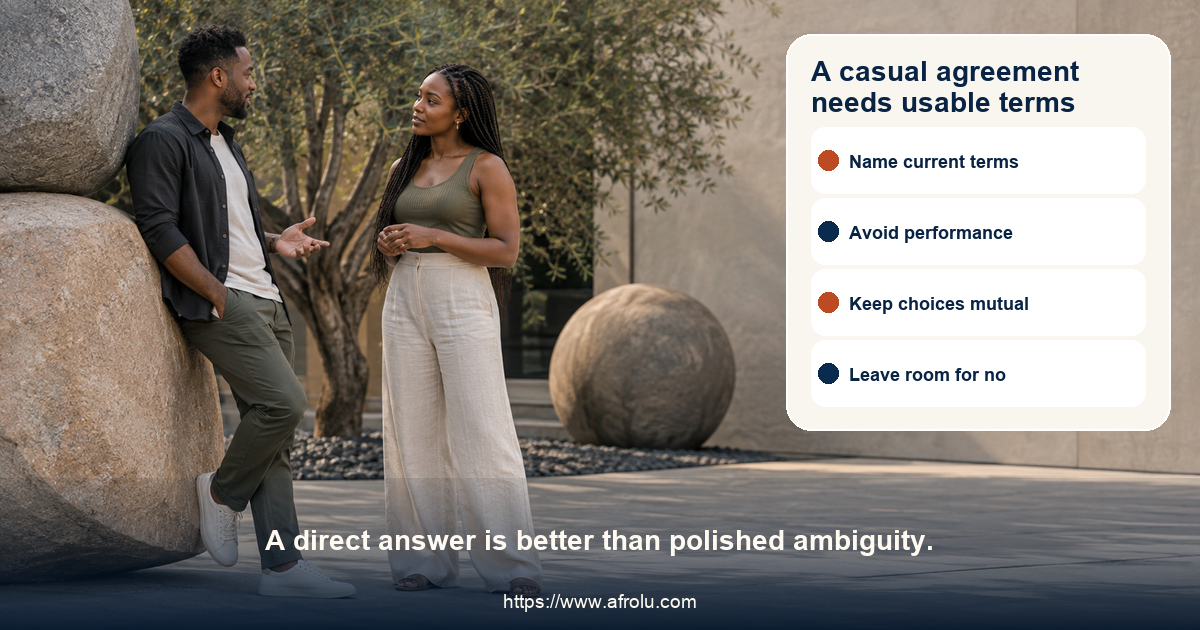
Casual clarity is a present practice.
Written and edited by Samira Benali · Faith and North Africa Editor
Keep casual dating clear by naming the current contact, plan, privacy, intimacy, and other-date terms rather than performing certainty or permanent availability. Make disclosure gradual, keep transport, devices, money, accounts, and exits independent, and ask before consent or exclusivity assumptions matter. A mismatch can call for a short ending. If access is pressured, money enters, a no is ignored, or fear appears, reduce access and use support.
Relationship clarity · Professionals
Is this a mutual casual agreement, an availability mismatch, a privacy or access question, an intimacy decision, a money request, an unclear return, unwanted pursuit, or conduct that makes me feel unsafe?
A casual situationship is recurring contact with some affection, intimacy, or expectation but no assumed commitment definition. For adults in professional life, the useful test is not how polished or busy anyone appears; it is whether the present arrangement gives both adults clear terms, sustainable capacity, privacy, current consent, independent systems, and a freely chosen exit.
Rami enjoys a light connection but notices that its casual label is used whenever he asks for a plan, while immediate replies are still expected. He states the rhythm he can offer, keeps personal accounts separate, asks about other dates before intimacy, and declines a request to cover an urgent expense. The response shows him whether casual can remain mutual.
adult dating · casual clarity
Rami makes a casual situationship readable without trading time, privacy, systems, or consent for the appearance of ease
This guide separates a mutual casual agreement from an availability mismatch, privacy pressure, assumed intimacy, independent-plan problem, money request, return after silence, unwanted pursuit, and fear—without treating professional identity or status as a dating script.
Name current terms, choose a sustainable rhythm, make privacy deliberate, keep consent current, preserve independent logistics, separate mismatch from access pressure, and switch to protection when freedom narrows.
Make casual usable
A current direct answer is more useful than polished ambiguity.
Protect a rhythm
Care does not require permanent access or a reserve position.
Control access
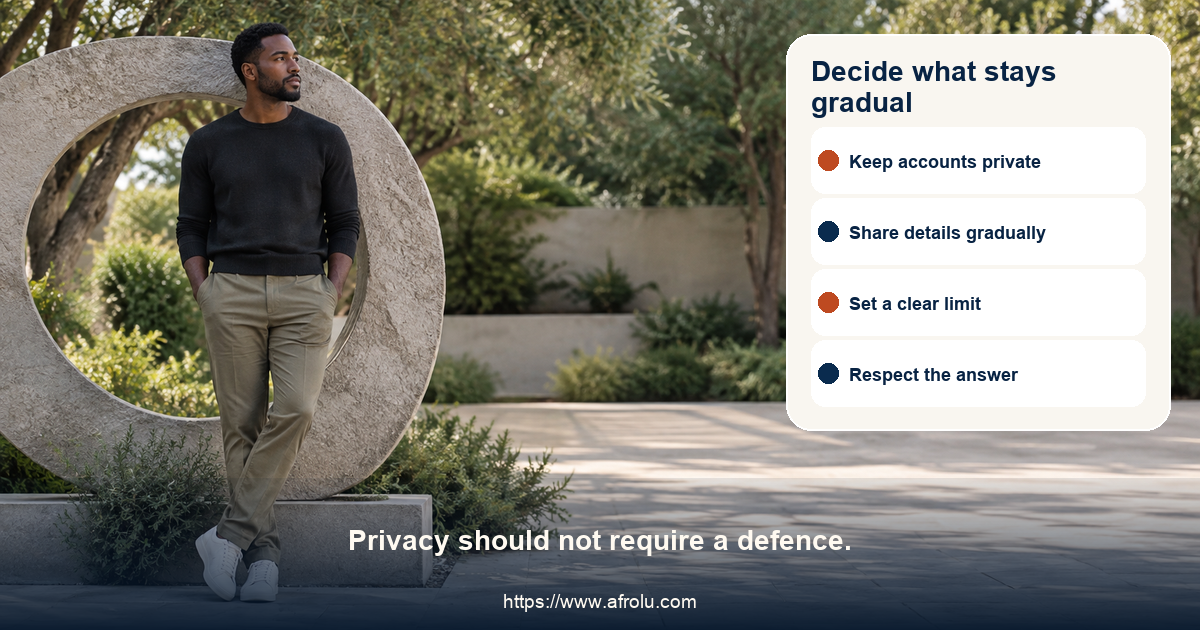
Accounts, routines, images, and exact details can remain gradual and chosen.
Keep systems independent
Money pressure, monitoring, and ignored boundaries require control, not negotiation.
casual dating · direct terms
A casual situationship becomes clearer through ordinary directness, not through perfect availability, status signals, or a polished relationship presentation
Adults in professional life are often assumed to be organised, decisive, or endlessly capable in every part of life. Dating does not work that way. You may be thoughtful and still unsure, able to plan and still want something casual, or interested and still unwilling to offer constant access. A situationship should not turn a public identity into a private obligation.
Begin by naming the actual connection. Are you seeing each other occasionally? Is the arrangement non-exclusive? Do you want to make plans with notice, keep communication light, or revisit the question after a few dates? A small, accurate description gives another adult real information instead of inviting them to infer commitment, disinterest, or availability from a polished surface.
Casual does not excuse evasiveness. If you want a lighter relationship, say so before your conduct creates a different expectation. If you want more direction, say that too. Neither answer needs a lengthy justification. What matters is that the other person can make their own choice without being held in a relationship that changes shape only when they ask a direct question.
The goal is not to eliminate uncertainty from early dating. It is to make uncertainty proportionate. You can say, 'I like this and I am keeping it casual for now,' or, 'I do not know yet, but I can tell you what I am available for this month.' That is more respectful than using a label to postpone every practical conversation.
availability · capacity · no standby
A connection can be casual and still need a rhythm that does not turn one adult into an inbox, a backup plan, or a source of on-demand reassurance
The pressures of adult life can make a situationship look inconsistent even when interest is genuine. The answer is not to promise 24-hour availability or to make another person guess whether silence means a change. A brief, realistic rhythm is better: a planned call, a day when you do not message, a confirmation point for plans, or an honest pause when capacity is low.
Set expectations around the part that affects the other person. You do not need to disclose every reason you are unavailable. You can say, 'I am not able to chat during the day, but I can make time on Thursday,' or, 'If we have not confirmed by tomorrow afternoon, please make other plans.' Those lines protect both adults from holding an invisible reserve position.
Look at the pattern rather than a single late reply or changed plan. Repeated warmth followed by unexplained disappearance, requests for immediate access after long gaps, or anger when you protect your time can make a casual connection feel disproportionately demanding. You do not need to name a motive before deciding that the shape no longer works for you.
If the rhythm is mismatched, redesign it. Choose fewer but confirmed dates, a lower contact level, a pause from intimacy, or an ending. A person who wants spontaneous contact may not be wrong, and a person who needs notice may not be rigid. The question is whether the arrangement leaves both adults free to say yes, no, or not this week.

Sustainable contact is clearer than on-call care.
privacy · digital boundaries · adult choice
Privacy in casual dating is a way to control disclosure and access; it does not require hiding a relationship or treating another adult as a threat
A casual connection can become overly familiar through frequent messages, shared frustrations, or the ease of a digital conversation. Familiarity can make it tempting to link personal accounts, reveal a full daily pattern, share a private location, or offer more professional and social detail than the relationship has earned. You can slow that process without accusing anyone of bad intent.
Build privacy into the plan. Keep early communication in a channel with report and block tools, avoid linking public accounts before you want to, meet in places that do not reveal your private routine, and hold onto your own phone, payment method, and transport. These choices are easier to make before a connection becomes emotionally intense or physically convenient.
Separate privacy from secrecy. You may choose to be clear that you are dating casually while declining to share information about other contacts, personal history, home, work, or online life. Another adult may prefer more openness, but they do not get to turn that preference into a demand for credentials, passwords, location, evidence, or a social map.
When a request feels too personal, answer the request rather than defending your character. 'I keep that private,' 'I do not share live location,' or, 'I am not linking accounts right now,' is complete. If a person repeatedly asks, searches for information, or treats a boundary as betrayal, reduce access. Respect is shown in how someone hears a limit.
consent · health · other dates
A casual agreement does not make intimacy automatic or make either adult responsible for guessing what the other means by regular contact
Casual dating can be emotionally uncomplicated only when practical questions are not left to guesswork. One person may assume regular dates imply exclusivity; another may assume neither person has promised that. One may be comfortable with physical intimacy but not private images or an overnight. The goal is not to make everyone want the same thing; it is to put the necessary information where both adults can use it.
Ask at the level of the next decision. 'Before we become physical, are either of us seeing other people?' or, 'I am comfortable with this date, but not with an overnight,' gives a clear boundary without demanding a relationship forecast. You can discuss testing, protection, images, pace, and plans as ordinary adult choices rather than a test of how casual the connection is.
Consent remains live. Prior attraction, a ride, a meal, a previous date, prior sex, or a casual label does not create permission for the next thing. An adult can feel disappointed and still stop, slow down, or accept a different answer. Repeated requests, pouting, guilt, isolation from transport, or pressure for images are reasons to pause or leave.
If another adult does not want to discuss a topic that matters to you, that is useful information even if they are otherwise charming. You can keep the arrangement non-intimate, choose less contact, or end it. Clarity is not a demand that another person match your preference; it is a way to protect your ability to choose.

Ask before assumptions carry weight.
meeting logistics · systems · money
A pleasant casual plan should not require one adult to control the transport, location, payment, account, device, or exit of the other
A casual connection can produce small moments of convenience: one person offers a ride, suggests a private setting, wants to book everything, or asks for help with an urgent issue. Any of those may be benign. The question is whether the plan leaves both adults able to leave, pay, communicate, and decide independently if the situation changes.
Use options that preserve control. Meet where you can arrive and leave yourself, keep your phone and payment method with you, and do not share an address, code, account, document, or device access just because it would make a plan easier. If a person insists that a casual date only works through their logistics, choose a different plan or none at all.
Keep money outside the relationship. Do not send or receive funds, use your account for someone else, share verification codes, buy a ticket, lend a device, or respond to pressure framed as an emergency. Verify organisational claims through contacts you find independently. A genuine person may be disappointed by a boundary but does not need your financial systems to show interest.
If access, money, secrecy, or urgency enters the conversation, do not let a casual tone make the request seem smaller. Decline the particular action and observe the response. Guilt, threats, a promise of repayment, or an attempt to make you feel uniquely responsible are reasons to reduce access rather than negotiate your way into a safer version of the request.

Keep transport, money, devices, and exits yours.
fit · returns · endings
Not every unclear situationship is unsafe, but a casual label should never be used to keep another adult in a cycle of hope, access, and uncertainty
One adult may want more regular contact while another prefers occasional plans. One may be open to an intentional relationship while another wants casual dating. These are ordinary fit questions. You can name the difference, try a smaller agreement, or decide that the current shape costs too much. A lack of compatibility does not require either person to be cast as a villain.
A pattern becomes more concerning when a person uses vague labels to regain access after disappearing, expects immediate emotional labour whenever they reappear, or treats your clear terms as an obstacle to overcome. A return after a gap is not a claim on your time. Ask what is available now and decide whether the present conduct is enough for you.
Use a short ending when it feels safe: 'This no longer works for me, so I am stepping back.' You do not need to provide a performance review or stay in contact while another person processes the answer. If someone can accept it, the situation may simply be a mismatch. If they cannot, the response tells you to change tactics.
When pressure begins, make control the standard. Do not meet to explain an ending, do not share more information to calm someone down, and do not let mutual contacts become a channel around your boundary. Use reduced access, reporting tools, records where safe, and trusted or specialist support if the pattern persists or creates fear.
practical reset · sustainable boundaries
The strongest casual-dating boundary is often a small rule you can use while you are busy, hopeful, disappointed, or tempted to make an exception
Choose one rule that solves the recurring decision. It might be confirming plans by a set time, keeping early dates independently reachable, not linking personal accounts, discussing other dates before intimacy, not sharing images, or never moving money through a dating connection. The best standard is not impressive. It is one you can apply when the connection feels especially appealing or confusing.
Use the response as information about fit. Another adult may prefer more spontaneity, more contact, or a different level of privacy. That does not make either of you unreasonable. The question is whether the relationship can be designed in a way that leaves both adults with a meaningful yes, no, or not now.
Let your private life remain private enough to support good judgment. Rest, friendships, interests, responsibilities, solitude, and unstructured time are not evidence that you lack care. They are the context that tells you what you can sustainably offer. A casual connection should fit within that context rather than asking you to abandon it to prove interest.
If a pattern moves into money pressure, tracking, threats, image abuse, repeated contact, or fear, set ordinary clarity aside and choose protection. Use block and report tools, tell a trusted person, preserve evidence only if safe, and seek local or specialist assistance when needed. The next action should give you more control, not a more satisfying explanation.
Eight casual situationships where terms, capacity, privacy, a plan, intimacy, money, a return, or unwanted contact changes the next move
A casual label has no usable terms
A person says they want casual but avoids answering about contact, other dates, intimacy, or how plans are made.
Ask which present boundaries the label is meant to describe.Availability becomes proof
Warm conversation turns into irritation whenever one adult is not immediately reachable.
State a realistic rhythm and decline permanent on-call access.Privacy becomes a test
Someone asks to link accounts, share live location, provide evidence, or reveal a detailed routine early on.
Keep systems gradual and answer the specific request with a firm no.A public plan becomes private
A short neutral date shifts into a request to travel together or continue somewhere one adult cannot leave independently.
Keep the original plan or leave using transport you control.Regular contact means different things
One adult assumes frequent dates mean exclusivity while the other has never agreed to that term.
Ask before intimacy or a decision that depends on the answer.A casual connection becomes a financial channel
An apparent emergency includes a transfer, code, account, document, ticket, or secret task.
Decline and independently verify any claim outside dating.A gap is followed by immediate demands
Someone who disappeared returns warmly and expects rapid replies, emotional labour, and a new date on their terms.
Treat it as a new invitation and choose a small present plan or decline.A no becomes a campaign
After an ending, new accounts, mutual contacts, threats, or private information are used to restart access.
Reduce access, use platform tools, and seek support when needed.Fourteen observable signs that a casual agreement remains mutual, sustainable, vague, access-driven, financially risky, or unsafe
Casual is translated into a present agreement about contact, plans, privacy, intimacy, and other dates.
Neither adult has to perform endless availability to demonstrate care.
A realistic reply or planning rhythm is named without disclosure of every private reason behind it.
Personal accounts, addresses, routines, images, documents, and location remain gradual and chosen.
A plan has a confirmation point and an independently reachable setting or exit.
A person can say no to a private extension, ride, overnight, or changed plan without pressure.
Touch, sex, images, protection, other dates, and exclusivity are discussed before assumptions carry weight.
A boundary is heard without guilt, pouting, bargaining, status language, or retaliation.
No money, code, document, account, ticket, purchase, or secret financial task enters the connection.
A return after silence offers present conduct rather than demands for old access.
A mismatch can be named without turning one adult's preference into a flaw.
A short ending is allowed to remain an ending.
Privacy is treated as a system of voluntary access rather than a sign of secrecy.
Monitoring, threats, image pressure, repeated pursuit, or fear shift the task from clarity to safety.
A proportionate decision map for terms, availability, privacy, plans, consent, money, mismatch, returns, and safety
| Situation | What it may mean | What to do next |
|---|---|---|
| You want casual dating | A lighter relationship may fit if the actual terms are visible to both adults. | State what you can offer around plans, contact, intimacy, and other dates. |
| A person wants a faster answer | They may seek reassurance, or they may be trying to avoid the work of a present agreement. | Offer the current answer you have rather than a future promise. |
| Contact feels demanding | Different rhythms can be a mismatch; repeated demands for access can make the arrangement unworkable. | Name your sustainable contact boundary and observe whether it is respected. |
| A private detail is requested | Curiosity can be ordinary; pressure for accounts, location, evidence, or routine is an access question. | Keep the information gradual and decline the specific request. |
| A plan changes shape | A convenient switch may remove independent choice or create unplanned access. | Keep the original public or independently reachable plan. |
| Intimacy is possible | Casual does not settle consent, health, images, or exclusivity. | Discuss the exact topic needed for the next decision. |
| A money request arrives | Dating is not a safe verification system for an urgent story. | Do not transfer, receive, share, or lend money, codes, documents, accounts, or devices. |
| A past contact returns | A return can be welcome, but familiarity does not restore old access automatically. | Ask for a modest current plan and decide from follow-through. |
| The connection does not fit | A direct mismatch can be enough reason to leave without proving harm. | Use a short ending and do not keep negotiating a relationship shape you do not want. |
| A no is ignored | The situation has moved into unwanted contact or safety risk. | Reduce access, use report and block tools, and seek support if it continues or creates fear. |
Twelve complete lines for casual clarity, capacity, privacy, plans, other dates, money, a return, a mismatch, and an ending
“I am enjoying this, and I am keeping it casual for now. I want us to be clear about plans, contact, and other dates.”
“I am not available for constant messaging, but I can make time for a planned call or date this week.”
“If we have not confirmed by tomorrow afternoon, I will make other plans.”
“I keep my address, routine, accounts, and social connections private while I am getting to know someone.”
“I am happy with the plan we made, but I am not changing it to a private setting today.”
“Before this becomes physical, are we seeing other people, and what information do we each need?”
“I do not send private images. That is a standing boundary, not a negotiation about trust.”
“I do not send, receive, or move money, accounts, codes, documents, or tickets in dating connections.”
“I can consider a new conversation, but I am not returning to the old pattern by default.”
“This casual arrangement is not working for me, so I am choosing less contact rather than more ambiguity.”
“This no longer fits what I want, and I am stepping back from contact.”
“I have asked for no further contact. Do not reach me through other accounts or people.”
Know the difference
Compare casual clarity that leaves both adults free with a pattern that turns access, availability, or uncertainty into leverage
Contact, privacy, plans, consent, and other-date terms can be discussed directly. Each adult keeps systems, movement, and an ending under their own control.
A label avoids every practical question, access becomes a test, or uncertainty is used to secure emotional labour, money, or repeated entry after a no.
A casual label is clear only when it protects both adults' ability to make a current choice.

Casual terms differ from permanent uncertainty.
Keep usable casual clarity distinct from managed ambiguity, access pressure, and conduct that reduces freedom
| Type or dimension | What it describes | Best next question |
|---|---|---|
| Terms | Clarity describes what casual changes; ambiguity uses the word to defer every answer. | Name the current offer in ordinary language. |
| Contact | A rhythm is sustainable; on-demand access turns care into a performance. | State the contact boundary you can keep. |
| Privacy | Voluntary access grows gradually; pressure asks for a social map or private system. | Keep exact details, accounts, and routines controlled. |
| Plans | Independent logistics preserve choice; a convenience shortcut can remove an exit. | Use public or independently reachable plans. |
| Intimacy | Current consent invites discussion; assumed access treats casual as permission. | Ask before a choice needs an answer. |
| Money | A healthy connection leaves systems alone; a risky one introduces urgency or secrecy. | Refuse money, codes, documents, accounts, and purchases. |
| Return | Changed conduct can be evaluated; entitlement claims old access. | Treat contact after a gap as a new invitation. |
| Mismatch | Different needs can be named; a pressure pattern makes one adult responsible for managing the other. | Choose a smaller arrangement or a clean ending. |
| Safety | An ending is accepted; unwanted pursuit routes around it. | Reduce access and use support when necessary. |
A simple plan you can use today
Clarity is not a performance
A direct, limited answer about casual dating is more useful than a polished future promise.
Capacity needs a boundary
You can protect your reply rhythm and planning time without narrating every private obligation.
Privacy is an access system
Gradual disclosure allows connection without surrendering accounts, routine, address, images, or control.
Casual consent is specific
A label cannot answer questions about touch, sex, health, images, exclusivity, or an overnight.
Independent plans reveal fit
Transport, payment, and an exit that you control make a date easier to choose freely.
A mismatch can be enough
You can leave a casual arrangement that costs too much without proving someone had a hidden motive.
Questions organised by purpose and depth
Choose a few prompts that fit the moment. This is a reference library, not a list to complete.
Current agreement
Use before a casual label begins to carry unspoken expectations.
- What can I genuinely offer now?
- What does casual change in plans, contact, intimacy, and other dates?
Capacity and privacy
Use before availability or access becomes a measure of care.
- What rhythm can I sustain without becoming on call?
- Which systems and details stay gradual for now?
Plan and consent
Use before a date becomes more private or intimate than agreed.
- Can I arrive and leave independently?
- What do I need to discuss before the next decision?
Fit and safety
Use when a return, money request, ignored boundary, or fear appears.
- Does the actual arrangement work for me?
- What move increases my control if access is pressured?
What deserves a closer look
Say what casual changes
Describe present contact, planning, privacy, intimacy, and other-date terms in ordinary language.
Evidence limit: Do not use a label to postpone every practical answer.
Make capacity visible
Set a realistic reply and planning cadence without sharing every private reason behind it.
Evidence limit: Availability is not a test of care.
Control access deliberately
Keep profiles, accounts, address, routines, images, and social connections gradual.
Evidence limit: A boundary does not need a defence.
Ask at the moment it matters
Discuss consent, health, images, exclusivity, and pace before an assumption has consequences.
Evidence limit: Prior warmth does not decide the next step.
Keep logistics independent
Retain your own transport, payment, phone, accounts, documents, and exit; refuse money requests.
Evidence limit: Convenience does not outrank control.
Change category when freedom narrows
Use reduced access, reporting, and support when a no is ignored or pressure persists.
Evidence limit: Do not wait for a perfect explanation to protect yourself.
Shortcuts that turn casual dating into permanent availability, vague access, or pressure
Treating casual as an answer to every question
A casual label cannot replace discussions about plans, privacy, intimacy, and other dates.
Performing availability
Constant access can conceal a mismatch and make one adult's time the cost of connection.
Calling privacy secrecy
Gradual disclosure protects choice and does not require another adult's permission.
Using convenience to give away control
Private transport, location, payments, accounts, and devices can make leaving or changing your mind harder.
Confusing a return with repair
Familiarity does not demonstrate changed conduct or restore access after a gap.
Using more conversation after a no is ignored
Pressure, monitoring, threats, or repeated pursuit need access reduction and support.
Read mixed signals, spot benching, or check emotional availability before carrying a casual pattern forward
Choose the guide that fits the immediate decision. An editorial resource can help you name a pattern or boundary, but it cannot promise another adult's honesty, availability, or conduct.
Explore the guide library
Show more related guides
Continue with Afrolu
Show more Afrolu guides
Sources used for this guide
Afrolu reviewed these health, research, safety, or public guidance resources while editing this page. They support the behaviour and safety guidance; they do not diagnose any individual described by a reader.
Questions about casual situationship clarity for adults with professional lives
Can a casual situationship be clear?
Yes. It can be clear when both adults can describe current contact, plans, privacy, intimacy, other-date, and ending boundaries.
How do I say I am not available for constant messaging?
State a realistic rhythm and an alternative you can keep, such as a planned call or a date with notice. You do not need to disclose every reason.
Should I link personal social accounts early?
No. Keep accounts, routines, address details, images, and other private information gradual until you actively want to share them.
What if a casual date wants a private setting or ride?
You can prefer a public or independently reachable plan. A convenient option is not required if it removes your control of arrival or exit.
Do I need to ask about other dates?
Ask before a decision that needs the information, especially before intimacy or a change in exclusivity expectations.
Can I change my mind about intimacy in a casual connection?
Yes. Consent is current. A prior date, attraction, sex, or casual label does not settle the next moment.
What if someone wants money or account help?
Do not send, receive, or move money, codes, documents, accounts, tickets, purchases, or devices through dating. Verify claims independently.
What if someone reappears after a long gap?
Treat it as a new invitation. Ask what is available now and decide from present follow-through rather than old familiarity.
Can I end it because the rhythm feels one-sided?
Yes. A recurring standby or access pattern may be enough reason to choose less contact or an ending without proving a hidden motive.
What if they will not accept my ending?
Reduce access, use block and report tools, preserve information only if safe, and seek trusted or specialist support if repeated contact or fear continues.
One thing to do now
Choose the next casual connection that leaves your time, systems, and freedom intact
Choose the smallest next action that protects your time, private systems, current consent, independent movement, money, support network, and ability to redesign or end a casual connection without bargaining away freedom.