Parents dating · career-aware safety
Parents' Situationship Safety and Career
For parents, assess a career-shaped situationship with adult-to-adult clarity, child privacy, independent dates, current consent, and safety boundaries.
Adult-to-adult terms protect privacy.
Written and edited by Miriam Otieno · Senior Kenya Editor
Keep early dating adult to adult. Parenthood and career shape capacity but do not write your relationship terms or grant access to child information, a home, money, accounts, or your body. Ask for a current offer, protect family privacy, choose independent public plans, keep consent specific, and reduce access if a clear boundary is ignored.
Relationship clarity · Parents Returning To Dating
Is this an adult-to-adult connection with a workable rhythm, a request that crosses child privacy, a plan that reduces independence, an assumption about consent, a financial or status pressure, or contact that needs a safety response?
A career-shaped situationship for parents is recurring dating contact with interest or intimacy but without a fully shared relationship definition, while work and parenting may affect time. The useful question is whether the connection protects adult choice, child privacy, independent plans, current consent, money and digital systems, and a safe exit.
Samira enjoys a connection with someone who has a polished career story and asks to see her more often. She says what dates and contact windows work, declines questions about her family life, chooses a public plan with her own transport, and refuses an offer that would connect finances to dating. The response gives her better evidence than the early charm.
parents dating · career-aware safety
Samira keeps a career-shaped situationship adult to adult, private, independently planned, and safe
This guide distinguishes parenthood as context from access, an honest capacity offer from standby dating, gradual family privacy from secrecy, independent plans from logistical leverage, and ordinary mismatch from conduct that reduces freedom.
State adult-to-adult terms, ask for present capacity, protect family information, plan independently, keep systems and consent separate, and close access if a boundary is ignored.
Keep dating adult to adult
Parenthood does not decide the relationship shape you choose.
Protect family information
A new connection does not need a child's details to respect you.
Keep options independent
Public timing, payment, transport, and exit preserve choice.
Protect a clear no
Money, status, systems, and persistence cannot override a boundary.
parents · adult-to-adult clarity
Being a parent can shape time and privacy, but it does not make a person more available, less available, automatically nurturing, automatically cautious, or responsible for explaining their family life to a new date
Dating advice can turn parents into a stock character: always busy, always ready for commitment, always seeking help, or always required to put everyone else's comfort first. Real people do not fit that script. You may want casual dating, serious dating, no dating, a slow pace, a limited connection, or a clear ending. Your role as a parent does not decide the relationship offer you owe another adult.
Start with a narrow, current conversation. You might tell someone that you have limited windows for dates or that you keep personal information gradual. You do not need to disclose a child's name, age, school, routine, location, photos, or household schedule to make a plan. A considerate person can respect a boundary without asking you to make your private life legible to them.
Keep the situationship from becoming a test of how accommodating you are. A person may have a different availability preference, and you may have a different relationship goal. That is a fit question, not evidence that either adult is selfish or unreliable. Clarity lets you choose the actual connection rather than performing a role someone else expects from a parent.
The best early standard is simple: adult dating stays separate from children and from the parts of your life that need privacy. That separation creates room to assess character, communication, consent, and plans without bringing another adult into a personal system they have not earned access to and do not need in order to date respectfully.
career · present rhythm
Career pressure and parenting responsibilities can both affect availability, yet neither income, job title, busyness, ambition, or apparent sacrifice proves that a person is safe, serious, generous, or entitled to flexible access
Some weeks genuinely change. A school event, a work deadline, illness, travel, rest, or another responsibility can alter a plan. The key question is not whether life is complicated; almost every adult has a complicated week. The question is whether the person can communicate a limit directly, suggest a realistic alternative, and respect your time when the available relationship shape is smaller than either of you hoped.
Do not turn clarity into surveillance. You do not need their work calendar, employer information, salary, custody details, private household arrangements, or proof of stress. You need only enough information to decide whether the present rhythm supports the kind of connection you want. That could be one confirmed date, a weekly call, a pause, or an honest acknowledgment that there is not enough room right now.
Notice whether flexibility flows both ways. If they can cancel without notice but expect you to be available whenever a gap appears, the arrangement may be based on convenience. If you are repeatedly asked to rearrange your rest, work, friendships, or personal commitments, a career or parenting story does not make that demand fair. A respectful adult treats your time as a real life to coordinate with.
You can decide that a limited offer is acceptable, that you prefer a different rhythm, or that it is best to step back. You do not have to assess whether someone is trying hard enough. Your decision can be based on fit: does this current connection leave you enough room for your responsibilities, your private life, and your own chosen way of dating?
privacy · gradual disclosure
A new or undefined dating connection does not need access to a child's identity, image, school, routine, address, other caregiver, household, or any detail that makes a family easier to locate or contact
It may feel awkward to decline casual questions about children, especially when someone says they are simply interested in getting to know you. A simple boundary can help: 'I keep family details private while I am dating.' That is enough. You are not asking them to earn access by becoming serious, and you are not accusing them of risk. You are setting a responsible line that does not need further negotiation.
Be careful with indirect disclosure too. Social profiles, tagged photographs, routines, location sharing, work pages, school events, household backgrounds, and mutual contacts can reveal more than a conversation does. Consider what remains visible when you share a name, photo, story, link, or schedule. Privacy can be gradual and still leave room for honest adult dating; it simply avoids widening another person's access before you decide it is appropriate.
A respectful date may say they understand and move on. A person who presses for pictures, asks where children spend time, wants to meet them early, requests your home address, or frames your boundary as evidence that you do not trust them is showing you something important. You do not need to teach them why the boundary exists. You can reduce disclosure, slow the connection, or decide that it is not a safe fit.
Keep child privacy separate from relationship pressure. Early commitment, a costly gesture, a career story, strong chemistry, or a promise about the future should not move the disclosure timetable. Each step should be chosen because it is right for you and protective of the child, not because another adult has made the connection emotionally difficult to pause.

Share less before sharing more.
meeting · movement · choice
A date should be easy to enter, leave, shorten, or cancel without revealing a home, arranging childcare through a new connection, depending on another adult's payment or transport, or treating logistical effort as a debt
You can make a date simple on purpose. A public venue, a defined time, your own funds, and a friend who knows the general plan can be enough. You do not need to host, disclose your address, accept collection from a private location, combine a date with family time, or reveal the shape of your household in order to show interest. An adult can be curious about you without being brought into your home life.
Keep any child-related arrangements completely separate from an early date. Do not ask a new date to provide transport, supervision, financial help, or access to a household plan. These boundaries are not about treating every person as dangerous; they are about keeping responsibilities and romantic exploration from becoming entangled before you know whether basic adult-to-adult trust and respect are present.
Expense deserves a boundary as well. You can choose what you are comfortable spending, retain your own payment method, and decline a plan that feels too elaborate or hard to leave. A person can pay for something freely, but that does not turn your time, touch, location, or private information into a return. Any suggestion that it does is a reason to pause.
A cancellation may be unavoidable, but notice whether it is handled with consideration. Does the person let you know early, acknowledge the impact, and offer an alternative that fits your availability? Or do they expect you to preserve an open slot and become apologetic for having a full life? Use the answer to decide whether this connection supports the safety and dignity you need.

Keep the exit clear.
independence · current consent
Career credentials, income, a polished lifestyle, gifts, bills, an offer of help, or apparent generosity do not establish trust and do not buy access to your body, home, children, money, accounts, images, or personal decisions
Safety can be obscured by apparent success. Someone with a convincing career story, a generous date plan, or an offer to solve a practical problem may seem easier to trust. But character is visible in their response to boundaries, not in the price or polish of an invitation. A person who respects your no does not need you to demonstrate appreciation by becoming more available, disclosing more, or combining your systems.
Keep financial decisions boring and independent. Do not lend, transfer, receive, route, hold, or invest money through a situationship. Do not share an account, code, document, payment credential, or device. If a person claims a problem needs an immediate response, use contact information you find independently before you do anything. Urgency is a reason to slow down, especially when it asks you to act in secret.
Consent follows the same rule of independence. A previous date, a gift, an adult's career status, a kind message, or an earlier yes does not settle a new touch, an image, an overnight, a private setting, or an exclusive agreement. Ask at the level of the decision. You are free to answer differently today, and a respectful person makes room for the change without treating it as a personal insult.
If someone tries to link help, expense, intimacy, disclosure, or a child's privacy into one bargain, step away from the bargain. You do not need to decide whether the person's motive was generous or manipulative before protecting yourself. The impact is enough: an arrangement that makes your no expensive, embarrassing, or difficult is not yet one you can choose freely.

Keep money, access, and consent separate.
unwanted contact · technology safety
A relationship mismatch can end with a clear conversation; repeated messages after a no, new accounts, monitoring, threats, requests for child information, image pressure, or access to private systems require a safety response that increases control
It helps to distinguish an ordinary disappointment from conduct that changes the task. Someone can be sad about an ending, ask one respectful question, or decide they need something different. You can still leave without declaring them unsafe. Keeping that category separate lets you make a proportionate choice and avoids treating every difficult dating interaction as a crisis.
The pattern is different when a person continues after you have clearly said stop, creates new profiles after blocks, follows your activity, contacts others to bypass you, threatens to reveal private material, asks where children are, or uses a detail you shared to unsettle you. These actions are not misunderstandings that you owe more explanation. They narrow freedom and require you to prioritise protection.
Start with practical control. Review account privacy, stop sharing location, avoid disclosing new personal information, use platform reporting tools, and let someone you trust know what is happening. Keep screenshots or messages only when it is safe and useful to do so. If you feel in immediate danger, seek emergency help where you are rather than arranging a meeting or a final call.
A boundary may be one sentence, or no message at all may be safer. The goal is not to get agreement about the ending. It is to protect your body, home, routine, accounts, privacy, children, support, and ability to move through daily life. Your parenting role and a person's career story never make you responsible for helping them accept your no.
practical reset · self-trust
A good safety standard must work when a connection feels exciting, when a person appears impressive, when time is scarce, or when you feel tempted to excuse a concern because you want the arrangement to succeed
Write a sentence that is usable before a real invitation. It might be, 'I do not bring a dating connection into my family life early,' or 'I do not make plans I cannot leave independently.' The clarity lies in its concreteness. You know when the rule applies, and you do not have to debate whether someone is sufficiently charming, successful, apologetic, or interested to make an exception.
Test the rule against one current decision. Before you share a photo, disclose a routine, accept a home pickup, let someone pay for something costly, make an intimacy decision, or respond to an urgent request, ask whether you would still feel free if the relationship stayed exactly the same. If the answer is no, pause. A slower decision can keep a temporary feeling from creating lasting access.
Let ordinary evidence matter: a person accepts privacy without complaint, follows a confirmed plan, handles disappointment without punishment, keeps money separate, leaves accounts alone, and accepts a no. These behaviours cannot predict every future outcome, but they show whether the current connection offers a foundation you can assess without putting children or private systems into the relationship too soon.
You can be open to love, companionship, intimacy, or casual dating while being exact about safety. You can decide that a person is not a fit without proving they are bad. The right conclusion is the one that lets you carry forward the responsibilities, privacy, and independence that make your life workable after the date is over.
Eight parent situationships where terms, child privacy, capacity, plans, cost, money, or unwanted access changes the next move
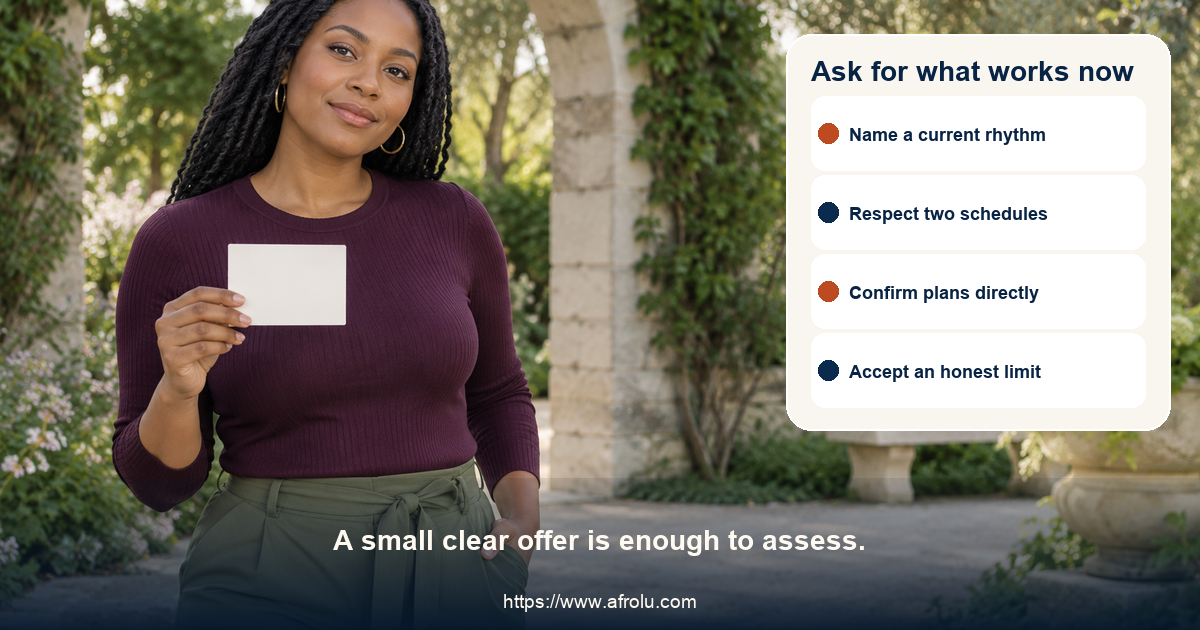
The parent script
A date assumes that being a parent means you must want a particular kind of relationship.
State your present preference without defending it.The busy biography
Career and personal obligations are described at length, but no workable contact rhythm is offered.
Ask for one small current offer and decide from it.The family question
Someone asks for names, photos, routines, or household details early on.
Keep family information private and do not negotiate the boundary.The home pickup
A date treats your address or household plan as the easiest way to meet.
Choose a public independently reachable plan instead.The expensive rescue
A polished offer or career story becomes pressure to accept help, access, or intimacy.
Keep cost, consent, and private systems separate.The code request
An apparent emergency becomes a request for funds, verification, or account action.
Do not transfer, receive, or move money or codes through dating.The schedule pressure
A person expects late notice availability and calls your limits a lack of interest.
Keep a confirmation and reply rule that protects your time.The access workaround
After an ending, new profiles or other people are used to contact you or find family details.
Reduce access and use reporting or support if it persists.Fourteen observable signs that adult dating remains private, mutual, independently planned, financially safer, or unsafe
They treat parenthood as context, not a relationship script.
They accept that adult dating and child information remain separate early on.
A present contact rhythm is named without a demand for calendar or household access.
Plans are confirmed with enough notice to respect your whole life.
They accept public dates and independent arrival and departure.
A home address, family routine, and photos remain private by your choice.
A costly date or career status does not alter your consent or privacy.
They can handle a cancelled plan without making you feel indebted.
Money, codes, accounts, documents, and devices stay independent.
They ask before assumptions about exclusivity, intimacy, or disclosure matter.
Your no is accepted without a request to explain it repeatedly.
They do not use a child or family detail to increase closeness or pressure.
You can get support without being isolated from it.
A clear ending is respected without monitoring, threats, or new contact routes.
A proportionate decision map for parenthood context, capacity, family privacy, dates, consent, systems, a return, and safety
| Situation | What it may mean | What to do next |
|---|---|---|
| They ask about parenthood | Ordinary curiosity or a request for access you have not chosen. | Share only the adult-to-adult context you want to share. |
| They cite a busy week | A real limit or a vague access pattern. | Ask what contact and planning are feasible now. |
| They want family details | Interest or a crossed privacy boundary. | Keep names, routines, images, and household information private. |
| They suggest a home plan | An invitation or a plan that reduces your independence. | Choose a public setting you can leave easily. |
| They make a costly offer | A gesture or possible leverage. | Keep consent, cost, and disclosure separate. |
| They ask for help | A safety boundary regardless of apparent status or story. | Do not move money, codes, documents, or accounts. |
| They ask about intimacy | A current decision that needs direct consent. | State the boundary you choose today. |
| They expect availability | A preference or on-call access pressure. | Set a reply and confirmation rhythm. |
| They return after silence | A new invitation rather than an access entitlement. | Assess the present offer, not the old intensity. |
| They ignore a clear no | Conduct that may need protection. | Close access, report, and seek support if pressure persists. |
Twelve complete lines for adult terms, child privacy, capacity, plans, consent, money, a different fit, and no contact
“I keep family details private while I am getting to know someone.”
“What contact can you realistically offer over the next two weeks?”
“I do not share names, photos, routines, or household details early on.”
“I will meet somewhere public and arrive and leave independently.”
“I am not meeting at my home or sharing my address.”
“I need plans confirmed in advance; I do not hold open last-minute slots.”
“I am not choosing that kind of intimacy tonight.”
“Before we change this, are either of us dating other people?”
“I do not send, receive, or move money through dating.”
“Thank you, but a gift does not change my boundary.”
“This relationship shape does not work for my life, so I am stepping back.”
“I am ending contact. Do not contact me again.”
Know the difference
Adult-to-adult dating versus a connection that reaches into private family life
Capacity, plans, consent, privacy, money, and an exit remain between two adults while child details and household access stay protected.
Career status, cost, charm, urgency, family curiosity, or persistence are used to widen access before it is freely chosen.
The relationship can be evaluated without bringing children, a home, money, or private systems into it early.

Privacy and freedom need room.
Keep protected adult dating distinct from access-driven pressure into private family life
| Type or dimension | What it describes | Best next question |
|---|---|---|
| Parenthood as context | Availability may be shaped without deciding relationship goals. | State the adult-to-adult offer you want. |
| Parenthood as a script | Someone assumes your needs or obligations from a role. | Return to present preference. |
| A capacity conversation | A modest current rhythm is named clearly. | Choose whether it fits your life. |
| Standby access | Your time is treated as flexible while theirs is protected. | Set a planning boundary. |
| Gradual disclosure | Family information remains private until you choose otherwise. | Keep names, routines, images, and home details protected. |
| Access seeking | Questions or pressure aim to map a family life early. | Reduce disclosure and assess safety. |
| A free gesture | Expense does not change your ability to refuse. | Keep terms and consent unchanged. |
| A leverage gesture | Status, help, or cost is tied to wider access. | Pause and return to independent systems. |
| A respected exit | A no is accepted without a workaround. | Use blocks and support if it is not. |
A simple plan you can use today
Roles do not decide terms
Parenthood does not determine whether you want a casual, serious, slow, or no relationship.
Capacity should be visible
A small current offer tells you more than an elaborate explanation.
Child privacy has its own boundary
A date does not need family information to respect you.
Plans can protect safety
Independent timing, transport, payment, and exit preserve choice.
Status cannot buy access
Career, gifts, or a bill do not prove safety or create consent.
Protection can be brief
You can reduce contact without negotiating an ignored boundary.
Questions organised by purpose and depth
Choose a few prompts that fit the moment. This is a reference library, not a list to complete.
Adult-to-adult terms
Use before another person writes a parenthood script for you.
- What relationship shape do I choose now?
- What availability can I honestly offer?
Family privacy
Use before a date asks about children, a home, routine, photos, or location.
- Which details remain private?
- What sentence will I use to hold that boundary?
Plans and consent
Use before a date, cost, private setting, intimacy, or another change.
- Can I arrive and leave independently?
- What remains a current no?
Safety
Use if money, systems, private information, or unwanted contact becomes part of the connection.
- Which access must remain closed?
- Who can support me if a boundary is ignored?
What deserves a closer look
Keep dating adult to adult
Discuss availability and relationship goals without turning parenthood into a fixed script.
Evidence limit: Do not infer a family role from a date.
Ask for a small present offer
Use a practical contact and planning rhythm instead of private biographies.
Evidence limit: Do not inspect work or household details.
Protect child information
Keep names, images, routines, household context, and location gradual and voluntary.
Evidence limit: Do not negotiate a non-negotiable boundary.
Design independent dates
Use public settings, timing, transport, payment, and exit options you control.
Evidence limit: Do not blend a new date with family systems.
Separate money and access
Keep career, gifts, accounts, codes, documents, and a child's details outside a bargain.
Evidence limit: Do not act under urgency or debt.
Move toward protection
Use privacy tools, blocks, reports, trusted people, and specialist support if access becomes unwanted.
Evidence limit: Do not meet for closure if it feels unsafe.
Shortcuts that turn parenthood or career into assumption, access, debt, or unwanted contact
Accepting a parent script
It can replace your own relationship preferences with another person's assumptions.
Explaining family privacy until it is debated
A child-protection boundary does not need another adult's approval.
Letting a home plan feel convenient
It can widen location and household access too early.
Calling career status trust
Professional polish cannot replace respect for a no.
Treating expensive help as care
Cost can create pressure without creating safety.
Trying to reason with persistence
Repeated unwanted contact often needs a protection response.
Set a boundary, slow the pace, or check a pressure pattern before your next plan
Choose the resource that fits the current decision. An editorial guide can help name an option or safety pattern, but it cannot guarantee another adult's honesty, future capacity, or conduct.
Explore the guide library
Show more related guides
Continue with Afrolu
Show more Afrolu guides
Sources used for this guide
Afrolu reviewed these health, research, safety, or public guidance resources while editing this page. They support the behaviour and safety guidance; they do not diagnose any individual described by a reader.
Questions about parents' situationships, child privacy, career capacity, and safety
Can a parent have a casual situationship?
Yes. Parenthood does not decide your relationship goals; direct adult-to-adult terms do.
Do I need to disclose child details early?
No. A date does not need a child's name, images, routine, school, address, or household details to know you respectfully.
How do I explain limited availability?
State the contact or date windows you can offer without sharing private family or work records.
Should a new date meet my children?
Not early in an undefined connection. Keep adult dating separate while you decide what is safe and appropriate.
Can I insist on public dates?
Yes. Public plans, independent transport, and a clear exit are valid boundaries.
Does a costly date create an obligation?
No. Cost never creates consent, intimacy, privacy, disclosure, or access to family life.
What if someone offers financial help?
Keep funds, accounts, codes, documents, and child information separate from dating requests.
How do I ask about exclusivity?
Ask before a decision it affects: are we seeing other people, and what would each of us need to change that?
What if they demand family information?
State the boundary once, reduce disclosure, and step back if the pressure continues.
When should I seek safety support?
Seek it when a clear no is ignored or contact includes monitoring, threats, image pressure, family-information requests, account pressure, or fear.
One thing to do now
Choose the next connection that leaves family privacy, independent systems, and freedom intact
Choose the smallest next action that protects child privacy, your private information, time, body, money, accounts, documents, independent movement, support network, and ability to revise or end contact without bargaining away freedom.