Adult dating · low-pressure casual clarity
Parents’ Low-Pressure Casual Situationships
For parents dating as adults, make casual situationship terms clear, keep child privacy separate, plan independently, protect consent, and respond to pressure.
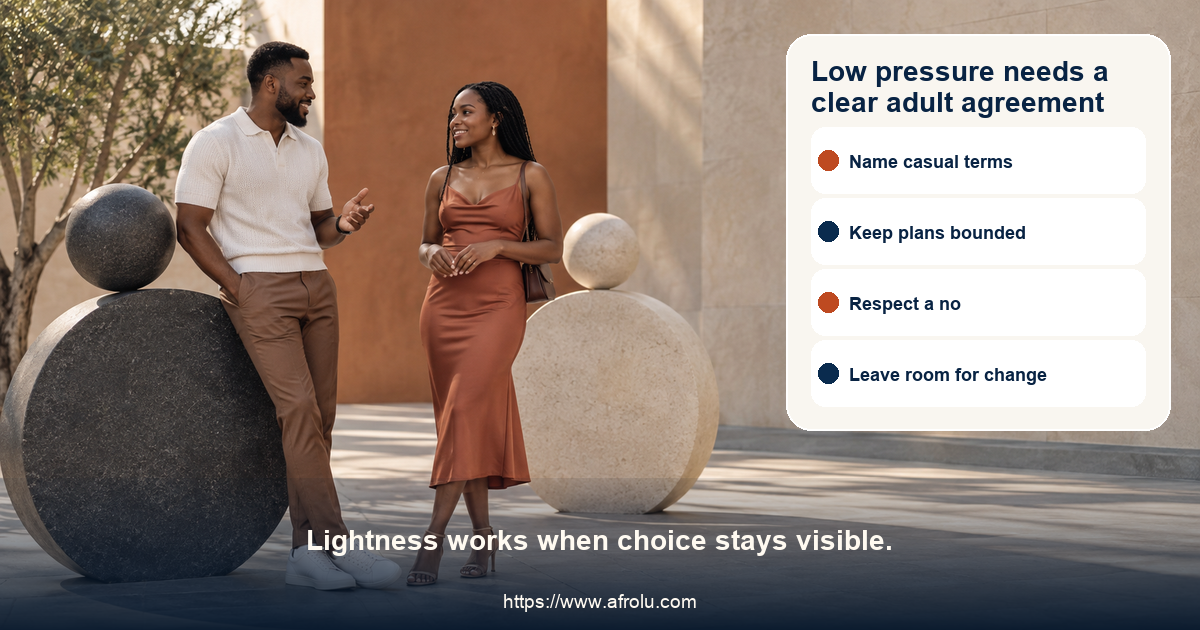
Light dating still needs chosen terms.
Written and edited by Miriam Otieno · Senior Kenya Editor
Keep casual dating adult-only and clear. Define the contact and planning you can offer, keep child information entirely separate, choose independently reachable adult plans, make intimacy and other-date terms current, and protect addresses, devices, accounts, money, and exits. A casual connection should not require standby availability or access to people outside it. If a boundary is ignored or fear appears, reduce access and use support.
Relationship clarity · Parents Returning To Dating
Is this a mutual casual adult arrangement, an information or access request that crosses a privacy boundary, a planning mismatch, an intimacy decision, a financial request, unwanted pursuit, or conduct that makes me feel unsafe?
A low-pressure casual situationship is recurring adult contact with some affection, intimacy, or expectation but no assumed commitment, designed around a lighter current agreement. For parents who are dating, the key distinction is whether adult terms, child privacy, plans, consent, systems, and endings remain independently chosen instead of letting convenience or curiosity create unwanted access.
Asha wants occasional adult dates that do not take over her life. She states that her casual connection needs confirmation and public adult-only plans, keeps child information off her profile and out of conversation, declines an overnight shortcut, and asks directly about other dates before intimacy. The other person's response tells her whether the arrangement can stay genuinely low pressure.
adult dating · low-pressure casual clarity
Asha keeps adult dating light without letting a casual situationship reach into child privacy, her schedule, or her independent systems
This guide separates chosen casual adult dating from vague availability, child-information pressure, convenient but access-heavy plans, assumed intimacy, money requests, unwanted pursuit, and fear—without treating parenthood as a dating restriction or family story.
Make casual terms usable, keep adult dating and child privacy separate, build bounded plans, make consent current, protect systems, test the actual mutuality, and shift to protection when freedom narrows.
Keep casual clear
Low pressure needs a present adult agreement, not vague access.
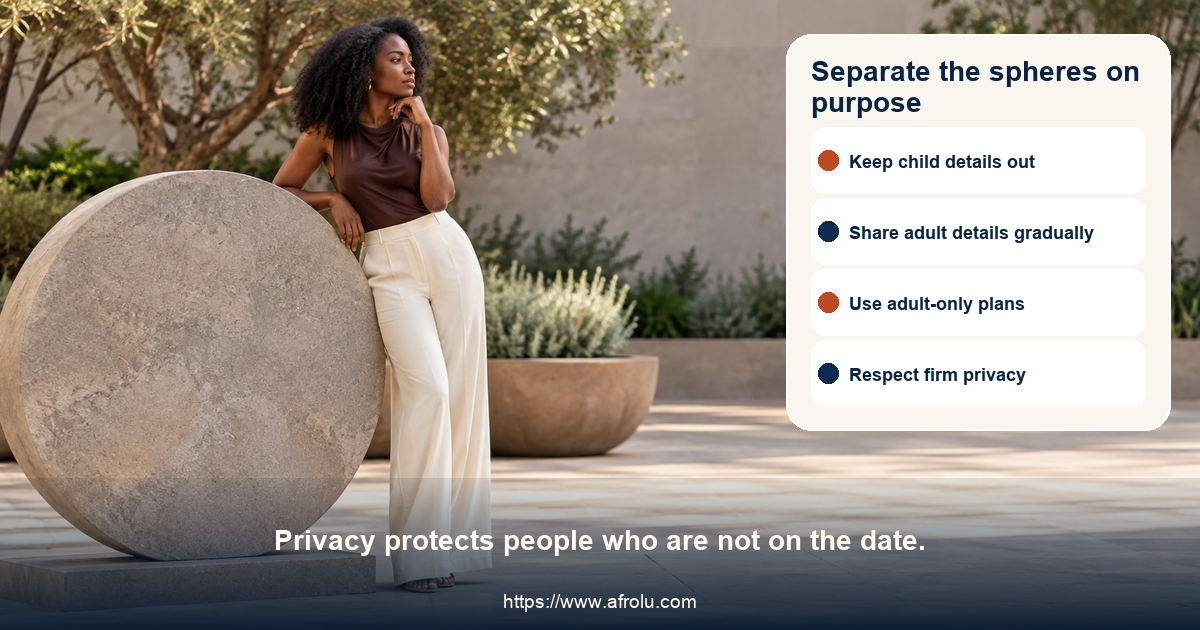
Separate the spheres
Child information and access stay completely outside adult dating.
Choose independence
Confirmation, public options, and a personal exit protect time and choice.
Protect systems
Money pressure, monitoring, and ignored boundaries need control, not negotiation.
casual dating · adult autonomy
Low pressure can mean a lighter casual connection without making one adult guess the terms, carry all the planning, or lose the right to say no
A parent can want adult dating that feels calm, occasional, private, or non-exclusive. That preference does not need to be explained as a deficit, a family story, or a promise about the future. The useful question is whether the connection offers the amount of contact and definition that you can genuinely choose rather than making you manage someone else's assumptions.
Start with the actual offer. Is this one public coffee, an occasional daytime date, a casual arrangement that will be checked in on, or a connection that needs more definition before intimacy? Are either of you seeing other people? Can plans be made with notice? Small answers matter because they let both adults consent to the relationship shape instead of inferring it from warmth.
Low pressure should reduce performance, not remove ordinary consideration. You can make a short plan and still confirm it, communicate a change, respect independent transport, ask before touch, and accept a no. Those practices keep an adult date voluntary because no one is asked to turn a relaxed mood into blanket access.
If another person needs more frequency, visibility, or commitment than you can honestly offer, that is fit information. You can lower the contact rhythm, make plans only when both want them, or end the connection without converting it into a referendum on parenthood. A casual relationship is only low pressure when both adults remain free to choose it.
privacy · child information · adult boundaries
A person you are dating does not need access to children, child images, names, routines, locations, schools, or family arrangements to know you as an adult
Dating profiles and early messages can reveal more than intended. A photo, a casual story, a public account, a pickup pattern, a location tag, or a question about your day can expose details about people who have not consented to participate in your dating life. Keep child images, names, schedules, schools, locations, and identifying stories out of the connection.
This boundary is not about hiding that you are a parent. You may say as much or as little about your adult life as you prefer. The line is that a new or casual date has no need for identifying information, access, introductions, or meetings involving children. An adult connection should be able to develop, pause, or end without bringing anyone else into its logistics.
Choose adult-only meeting plans that you can reach and leave independently. Do not turn a casual date into a visit to a private home, a family setting, or a shared routine because it seems convenient. A public, bounded plan protects more than safety; it protects your freedom to decide whether another date makes sense without rearranging anyone else's life.
If someone acts offended by this separation, asks repeatedly for details, searches for information, or treats the boundary as evidence that you do not trust them, take the response seriously. Respectful adults understand that privacy can be firm without being personal. Repeated pressure is a reason to reduce access, not a cue to offer more information.
time · plans · changes
A flexible adult schedule can still have a confirmation point, a public location, and a respectful way to change plans
Adult availability can change for reasons that do not require disclosure. A day may become full, quiet time may be needed, or a plan may no longer feel right. You do not owe private evidence of why you need to cancel. At the same time, another adult should not have to hold an entire evening open while receiving only hopeful messages and no usable answer.
Use a bounded invitation: a public place, an approximate start and finish, a confirmation time, and your own way there and back. You could say, 'If we have not confirmed by six, I will make other plans.' That creates a respectful default rather than turning a changed plan into a test of affection or a reason for an argument.
If you cancel, communicate when you know. A concise explanation and, only if you genuinely want one, a realistic alternative is enough. Do not offer a replacement date merely to soften disappointment. Likewise, you are not required to accept a new invitation after a last-minute cancellation just because someone says they are sorry.
Look for the repeated pattern. One reschedule can be ordinary. A recurring cycle of last-minute contact, disappearing until plans lapse, or anger when you keep your own schedule shows that the relationship is not low pressure for you. You can choose fewer plans, more notice, a pause, or an ending without needing to prove bad intent.

A flexible plan still needs an exit.
consent · health · casual terms
A casual situationship can be affectionate and still require clear conversations about touch, sex, images, other dates, protection, and a changed mind
Casual dating sometimes invites an idea that direct conversation would make things too serious. In practice, a short question can keep a light connection more comfortable because neither person has to guess. You may want to know whether other people are being dated, what information matters for sexual health, whether images are off the table, or how each person wants to handle an overnight invitation.
Say what you need before the situation becomes difficult to steer. 'I am available for a short public date, not an overnight,' or, 'Before we become physical, I need to talk about other dates and protection,' can make an adult plan more relaxed because it sets the expectations early. A boundary does not accuse someone; it gives them the information necessary to respect your choice.
Pay attention to the response. An adult can feel disappointed and still accept a slower pace or a no. Pouting, bargaining, repeated requests, isolating you from your transport, claims that you led them on, or pressure for private images are not problems that require a better explanation. They are signs to pause or leave.
If the answer is that your boundaries do not fit the other person's casual style, treat that as useful information. You can keep the connection non-intimate, change the terms, or step away. Your aim is not to make every date work; it is to keep intimacy and access genuinely voluntary.

Ask before the plan becomes more private.
independent systems · practical safety
Convenience is not a good reason to give a new or casual date your home address, device access, account details, codes, money, or a role in your private logistics
A casual date may suggest a private location, offer a ride, ask to connect social accounts, or seek help with a payment or urgent problem. Any one request may sound ordinary. The relevant question is whether accepting it gives another person access you would not otherwise grant, makes you dependent on their transport or money, or ties your safety to their reaction.
Keep your phone, payment method, keys, account recovery information, passwords, verification codes, and documents under your sole control. Avoid sending private images or details that could be copied or used to locate you. Use transport you control and locations that do not reveal more about your adult life than you want to share. You can decline a convenience without diagnosing another adult.
Money deserves a firm line. Do not send or receive a transfer, buy a ticket, provide a code, receive funds, lend an account, or make an urgent purchase because a person you are dating has a compelling story. Verify any claim through independently found official channels. Emotional closeness is not a safe system for checking financial urgency.
If a person reacts to a practical boundary with guilt, anger, secrecy, or promises that you will be rewarded later, reduce access. A respectful adult can make a casual plan within the safeguards you choose. You do not need to prove a request is fraudulent or dangerous before refusing one that compromises your control.

Keep systems, money, and exits independent.
mutuality · ambiguity · redesign
Casual can be a chosen relationship shape; it becomes costly when one adult supplies all the emotional labour, availability, or hope for a future definition
Some people prefer occasional, non-exclusive dating and can say so plainly. Others would like a serious relationship but only have a small amount of capacity right now. Both positions can be honest. The difficulty starts when one person calls the connection casual only to avoid questions while expecting immediate replies, emotional reassurance, repeated last-minute availability, or intimate access whenever they return.
Ask the question that changes your next move. Is this likely to stay occasional? Are either of you seeing others? Can plans be made in advance? Do you want to pause intimacy? Does one person need more contact than the other can offer? A vague answer is still information when it tells you that no shared arrangement is available.
You can redesign without demanding a relationship upgrade. Try a lower contact rhythm, fewer but confirmed adult-only dates, a pause, or a clean ending. If you keep asking the same reasonable question and the pattern does not change, consider whether the connection is asking you to wait in a role you never agreed to occupy.
A relationship label should not be used to make parenthood the explanation for every mismatch. Your preference for privacy, planning, low contact, more definition, or no further access belongs to you as an adult. The practical issue is whether the arrangement respects it, not whether another person finds it convenient.
unwanted contact · safety · support
An unclear casual connection needs a conversation; repeated pursuit, monitoring, threats, image pressure, or fear need protective action
Not every disappointment is a safety problem. A cancellation, a different casual preference, or a person who does not want a second date can be enough reason to move on without assigning a diagnosis. Keeping that distinction clear helps you act proportionately and avoids asking a guide to predict why someone is unavailable or unkind.
Treat repeated unwanted contact as an access pattern, not a debate about someone’s intentions. The situation is more serious when a boundary is bypassed through fresh profiles, mutual contacts, location seeking, threats, unwanted image requests, monitoring, or conduct that leaves you anxious. That is no longer an ordinary dating mismatch and may call for support beyond another conversation.
Make a practical safety record only when it is safe: note relevant account names and dates, retain useful material somewhere private, remove shared visibility, and use the platform’s report and block tools. Bring one trusted adult into the picture. For urgent danger, contact local emergency or specialist support instead of confronting the person or trying to resolve the pattern alone.
Adult-only dating does not create a claim on your address, attention, time, or a closing conversation. You can use a concise ending when that feels safe, or cut off contact without further explanation when it does not. Choose the step that keeps your privacy, movement, finances, digital life, and future decisions in your own hands.
Eight casual adult situationships where terms, child privacy, a plan, intimacy, money, or unwanted contact changes the next move
A low-pressure date needs a real shape
Two adults want something casual, but neither has said whether it means an occasional public plan or open-ended availability.
Name the actual offer before warmth fills in the gaps.A date asks about people who are not part of the date
Someone asks for child photos, names, routines, locations, or identifying stories early in conversation.
Keep child information and adult dating completely separate.A private setting is presented as easiest
A public plan changes into an invitation that would reveal an address or make one adult dependent on the other's transport.
Keep the original adult-only public plan and independent exit.A casual plan consumes an evening
Warm messages continue but no time or place is confirmed until after another adult has kept the day open.
Set a confirmation point and make other plans when it passes.Casual is treated as blanket access
A date assumes that a ride, a meal, or previous interest means an overnight or intimacy is expected.
State the immediate boundary and leave if it is challenged.Casual means different things
One adult assumes other dates are fine while the other assumes regular contact means exclusivity.
Ask before a decision that needs the information.A casual contact asks for money or codes
An urgent story arrives with a request for a transfer, purchase, document, account, or verification code.
Decline and verify through independent official channels.Private information is used to regain access
After a clear ending, someone uses new accounts or information from social media to continue contact.
Reduce access, use platform tools, and seek support if it creates fear.Fourteen observable signs that a low-pressure casual arrangement remains adult-only, mutual, clear, pressuring, or unsafe
Low pressure is defined by present terms rather than a promise of unlimited availability.
Child images, names, schedules, locations, schools, and identifying stories remain outside adult dating.
A new or casual date is not introduced to children or folded into family logistics.
Plans are adult-only, public when appropriate, independently reachable, and easy to leave.
A confirmation point protects both adults from keeping time indefinitely in reserve.
A cancellation is communicated with enough notice and without demands for private proof.
Touch, sex, images, overnight plans, protection, other dates, and exclusivity are current conversations.
A no is accepted without pouting, guilt, bargaining, or attempts to isolate someone from transport.
Addresses, devices, accounts, codes, routines, payment methods, and documents remain gradual and private.
No transfer, ticket, account, secret task, code, or financial rescue enters the situationship.
Casual does not become a disguise for last-minute access or one-sided emotional labour.
A relationship mismatch can be named without blaming parenthood or trying to change another adult.
A clear ending remains an ending rather than an invitation to use new accounts or contacts.
Monitoring, threats, image pressure, repeated pursuit, or fear shift the task to safety.
A proportionate decision map for casual terms, privacy, adult plans, intimacy, money, access, and safety
| Situation | What it may mean | What to do next |
|---|---|---|
| You want casual dating | A lighter adult connection may fit, provided its terms are usable for both people. | State the kind of contact, planning, and privacy you can offer now. |
| Someone asks about children | They may be curious, but identifying details and access do not belong in early or casual dating. | Keep the answer broad and refuse child information, images, routines, or introductions. |
| A plan becomes private | Convenience may be genuine, but it can also remove independent choice or reveal too much. | Keep a public adult-only plan and transport you control. |
| Confirmation never arrives | One missed detail can be ordinary; a recurring pattern can make you a reserve option. | Set a time to confirm and make other plans when it passes. |
| Intimacy is expected | A casual label does not settle touch, sex, images, or an overnight. | Name the immediate boundary and leave if pressure begins. |
| Other dates are unclear | Regular contact can create different assumptions about exclusivity. | Ask before intimacy or a decision that requires the information. |
| You want more or less contact | A mismatch may be solvable with new terms or may mean the casual arrangement does not fit. | Ask for a smaller workable rhythm or step away. |
| A money request arrives | Emotional closeness is not financial verification. | Do not send, receive, move, or lend money, accounts, codes, or documents. |
| A boundary is mocked or challenged | Disappointment is ordinary; repeated pressure is information about safety and fit. | Repeat the limit once if safe, then reduce access. |
| Contact continues after no | The question has moved from clarity to unwanted pursuit. | Use block and report tools, save evidence only if safe, and involve support. |
Twelve complete lines for casual terms, adult-only privacy, plans, consent, systems, money, a mismatch, and an ending
“I am open to a casual connection, and I want us to be clear about what that means for plans, other dates, and contact.”
“I keep children and their information entirely separate from my dating life.”
“I do not share child images, names, routines, locations, or family logistics with someone I am dating.”
“I am comfortable meeting in a public place and arranging my own arrival and end time.”
“If we have not confirmed by five, I will make other plans for the evening.”
“I am available for a short date, not an overnight or a private setting today.”
“Before this becomes physical, I need to talk about pace, protection, other dates, and what each of us wants.”
“I keep my address, devices, social accounts, and daily routine private while I am getting to know someone.”
“I do not send, receive, or move money, codes, accounts, or documents in dating connections.”
“This connection feels too undefined for me. I need either clearer terms or less contact.”
“This arrangement no longer works for me, and I am stepping back from contact.”
“I have asked for no further contact. Do not use other accounts or people to reach me.”
Know the difference
Compare low-pressure casual dating that protects adult autonomy with a pattern that turns privacy, time, or access into leverage
Adult terms are clear, child information stays separate, plans are independently reachable, and each person can adjust or end contact without losing control.
Casual becomes a reason for last-minute access, private information, assumed intimacy, financial help, or refusal to accept an ending.
Low pressure is only low pressure when it leaves both adults more—not less—free to choose.

Low pressure differs from access pressure.
Keep chosen casual adult dating distinct from convenience-driven pressure, vague access, and conduct that reduces freedom
| Type or dimension | What it describes | Best next question |
|---|---|---|
| Casual terms | A mutual casual agreement describes contact and limits; vagueness lets one adult fill in the rules. | Name the actual offer before the next plan. |
| Child privacy | Respect keeps children entirely outside dating; pressure asks for details or access it does not need. | Decline identifying information and keep adult dating adult-only. |
| Plans | A flexible plan still has confirmation and independent movement; a pressured plan consumes time or removes an exit. | Use a public setting and a clear confirmation point. |
| Intimacy | Consent is current; assumed access treats casual as blanket permission. | Name what you are and are not agreeing to today. |
| Privacy | Gradual disclosure is respected; convenience demands address, routines, devices, or accounts. | Keep specific systems and details private. |
| Money | A healthy connection leaves financial systems alone; a risky one introduces urgency or secrecy. | Refuse transfers, codes, documents, and account access. |
| Availability | Both adults can keep their schedules; one-sided standby turns casual into a waiting room. | Set a confirmation boundary or reduce contact. |
| Mismatch | Different needs are allowed; pressure blames a life context for a boundary. | Choose whether the actual arrangement fits you. |
| Ending | A respectful adult accepts no; unwanted pursuit routes around it. | Reduce access and seek support when needed. |
A simple plan you can use today
Low pressure needs a shape
A short, casual adult plan can be clear about time, setting, contact, and what it does not promise.
Child privacy is not a dating test
No new or casual connection needs images, names, routines, locations, access, or meetings involving children.
Convenience can cost control
A private setting, ride, address, or shared device may be easy in the moment but can make leaving or changing your mind harder.
Consent remains particular
Casual dating does not merge a yes to one plan into permission for intimacy, images, or another kind of access.
Time reveals mutuality
A confirmation point shows whether plans respect both adults' ability to make their own choices.
Safety can be adult-only too
You can protect privacy, money, devices, and access without turning family life into a dating storyline.
Questions organised by purpose and depth
Choose a few prompts that fit the moment. This is a reference library, not a list to complete.
Casual terms
Use before a light connection starts relying on assumptions.
- What does casual mean for contact, planning, intimacy, and other dates?
- What am I not available to offer right now?
Adult-only privacy
Use before a conversation, profile, or plan includes information about people who are not dating.
- What information stays entirely out of adult dating?
- What access am I not willing to create?
Plan and consent
Use before a date becomes more private, longer, or more intimate than agreed.
- Can I arrive and leave independently?
- What do I need to say before the plan changes?
Exit and safety
Use when a money request, access demand, or ignored boundary appears.
- Would I do this outside dating?
- What action increases my control if a no is ignored?
What deserves a closer look
Keep casual specific
Describe the available contact, planning, other-date, and intimacy boundaries without forcing a future promise.
Evidence limit: Casual is not an exemption from clear conduct.
Keep adult dating adult-only
Protect children from images, names, routines, locations, access, introductions, and identifying stories.
Evidence limit: Do not make child information a relationship milestone.
Design for an independent exit
Choose a bounded adult-only plan with transport, timing, and confirmation you control.
Evidence limit: A convenient private shortcut can cost freedom.
Name the specific next step
Discuss touch, sex, images, protection, other dates, and overnight plans before assumptions matter.
Evidence limit: A past date does not decide a later moment.
Keep money and access separate
Do not move funds, codes, accounts, documents, address, or device control through a casual connection.
Evidence limit: Emotional warmth is not verification.
Treat pursuit differently from mismatch
Use reduced access, reporting, and support when pressure, monitoring, threats, or fear appear.
Evidence limit: You do not need to prove a motive before protecting yourself.
Shortcuts that turn low-pressure adult dating into disclosure, standby, access, or risk
Calling vagueness low pressure
A casual connection still needs enough terms for both adults to choose it.
Sharing child information to reassure a date
Children and their details are not evidence of trust and do not belong in early dating.
Using convenience as a safety plan
Private logistics can remove independent movement or reveal more than you want to share.
Assuming casual cancels consent
Every new intimate, digital, or private step remains a current choice.
Keeping your time permanently on standby
Repeated last-minute plans can turn a light connection into one-sided availability.
Trying to reason someone into accepting a no
Repeated pursuit, threats, or monitoring need reduced access and support, not a better argument.
Try a slower rhythm, set a boundary, or clarify ethical multi-dating before the next casual plan
Choose the guide that fits the immediate decision. An editorial resource can help you name a preference or boundary, but it cannot promise another adult's honesty, availability, or conduct.
Explore the guide library
Show more related guides
Continue with Afrolu
Show more Afrolu guides
Sources used for this guide
Afrolu reviewed these health, research, safety, or public guidance resources while editing this page. They support the behaviour and safety guidance; they do not diagnose any individual described by a reader.
Questions about low-pressure casual situationships for parents who are dating
Can a parent have a casual situationship?
Yes. A casual adult connection can be respectful when its terms, privacy, planning, intimacy, and limits are mutually clear and freely chosen.
Should I share child photos or details with someone I am dating?
No. Keep child images, names, routines, locations, schools, identifying stories, access, and introductions outside early or casual adult dating.
Do I need to explain my availability in detail?
No. You can state a date or contact boundary without disclosing private family logistics or asking another adult to approve them.
Can I insist on public adult-only plans?
Yes. A public, independently reachable adult-only meeting is a reasonable way to preserve privacy and freedom to leave.
What if a casual date expects an overnight?
A date does not create consent for an overnight or intimacy. State the immediate boundary and leave if it is challenged.
How do I ask about other dates?
Ask before a decision that needs the information: are we seeing other people, and what terms would each of us need if that changes?
What if someone only confirms plans at the last minute?
Set a confirmation time and make your own plans when it passes. Repeated standby expectations may mean the arrangement does not fit.
Should I help with a date's urgent financial problem?
No. Do not send or receive money, codes, accounts, documents, or purchases through a dating connection; independently verify any claim.
Can I end a casual connection without a long explanation?
Yes. A short statement that the arrangement no longer works is enough. You do not owe continued negotiation of access.
What if they keep contacting me after I end it?
Use block and report tools, preserve information only if safe, tell a trusted person, and seek local or specialist support if repeated contact or fear continues.
One thing to do now
Choose the next adult connection that protects privacy, independence, and a freely chosen no
Choose the smallest next action that protects child privacy, your adult privacy, time, personal systems, current consent, independent transport, money, support network, and ability to redesign or end the connection without bargaining away control.