Returning to dating · clear Nairobi plans
Situationships for Parents Returning to Dating: Clear Nairobi Plans
A practical situationship guide for parents returning to dating in Nairobi: clarify plans, protect privacy and consent, make time choices, and respond safely.
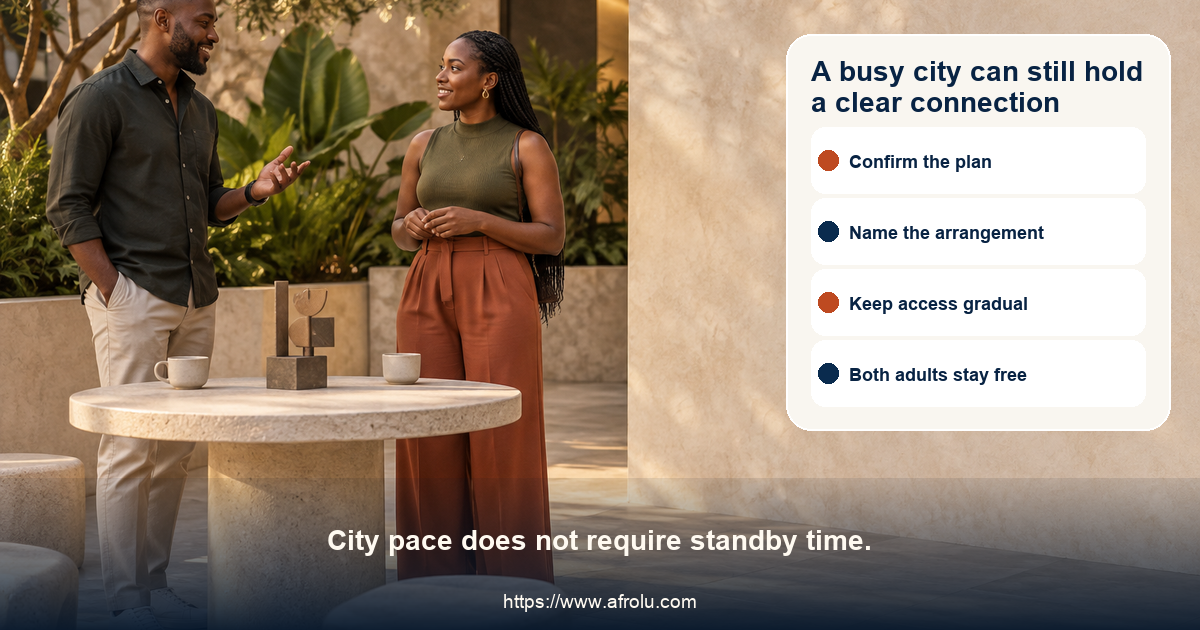
A clear plan protects adult time.
Written and edited by Miriam Otieno · Senior Kenya Editor
Treat time as a real part of the arrangement: confirm plans or release the slot, then ask for enough present information to decide what casual contact means. Keep routines, location, accounts, and private details gradual; choose public settings and independent movement, and keep consent current throughout a date. A mismatch can be ended without blame. If money pressure, repeated unwanted contact, monitoring, threats, coercion, or fear appear, reduce access and use support.
Relationship clarity · Parents Returning To Dating
Is this a clear mutual situationship, an unconfirmed city plan, a normal flexibility mismatch, a question about expectations or consent, a return worth a smaller plan, access or money pressure, unwanted pursuit, or conduct that makes me feel unsafe?
A situationship for a parent returning to dating is an undefined or partly defined adult connection that may include affection, intimacy, or recurring plans. Nairobi changes practical timing and privacy logistics, not the core standard: both people need enough clarity, consent, and freedom to choose the arrangement rather than live on standby.
Sanaa is returning to dating in Nairobi and enjoys a warm but undefined connection. Invitations often arrive without a time, and the other person asks for more personal detail whenever she asks for confirmation. Sanaa sets a simple check-in point, keeps the setting public and her routines private, then asks what the situationship is meant to be. The answer lets her choose a smaller mutual arrangement only if the plans and boundaries become real.
returning to dating · clear Nairobi plans
Sanaa makes a situationship fit her adult life by treating time, privacy, and consent as real parts of the plan
This guide separates a confirmed invitation, an open hint, mutual flexibility, standby time, a clarity conversation, gradual privacy, independent movement, a return after silence, financial pressure, unwanted pursuit, and fear—without family imagery, local stereotypes, or landmark shorthand.
Make time visible, turn interest into a plan, ask one present question, keep private access gradual, make consent and exits practical, distinguish mismatch from risk, and carry a clear standard into the next invitation.
Confirm or release
A plan needs enough detail to become a free adult choice.
Ask the present
A small question can replace weeks of decoding.
Keep it gradual
Connection does not require a map of your private life.
Protect freedom
Money pressure, coercion, monitoring, and fear change the task.
returning to dating · Nairobi context
A busy city can make a situationship feel effortless until unclear plans start taking your time
For a parent returning to dating, a situationship may feel appealing because it promises companionship without a large declaration. In a city where plans can shift and adult time is finite, that can be genuinely welcome. The difficulty begins when a connection relies on last-minute invitations, broad hints, or access that you have not chosen, while you are expected to keep space available indefinitely.
Begin with the facts instead of the label. How often are you actually meeting? Are plans confirmed? Is the connection casual, non-exclusive, exploratory, or moving toward something more intentional? What privacy do you need? These are not heavy questions because you are a parent or because you live in Nairobi. They are ordinary questions that help an adult make an informed choice.
City life does not give anyone an entitlement to your responsiveness. A delayed message, changed route, or busy week can happen; so can a direct update, a smaller alternative, or an honest pause. Clarity is shown less by perfect availability than by whether both people can make their time usable and release a plan without resentment.
Treat your time as a real part of consent. You can want a connection and still prefer a short public meeting, a confirmed evening, a slower rhythm, or a pause. An arrangement becomes more sustainable when it fits alongside the rest of your adult life rather than asking you to make that life invisible in order to appear easygoing.
time · confirmation · proportion
A clear situationship does not need constant access, but it does need plans that exist before they take over your day
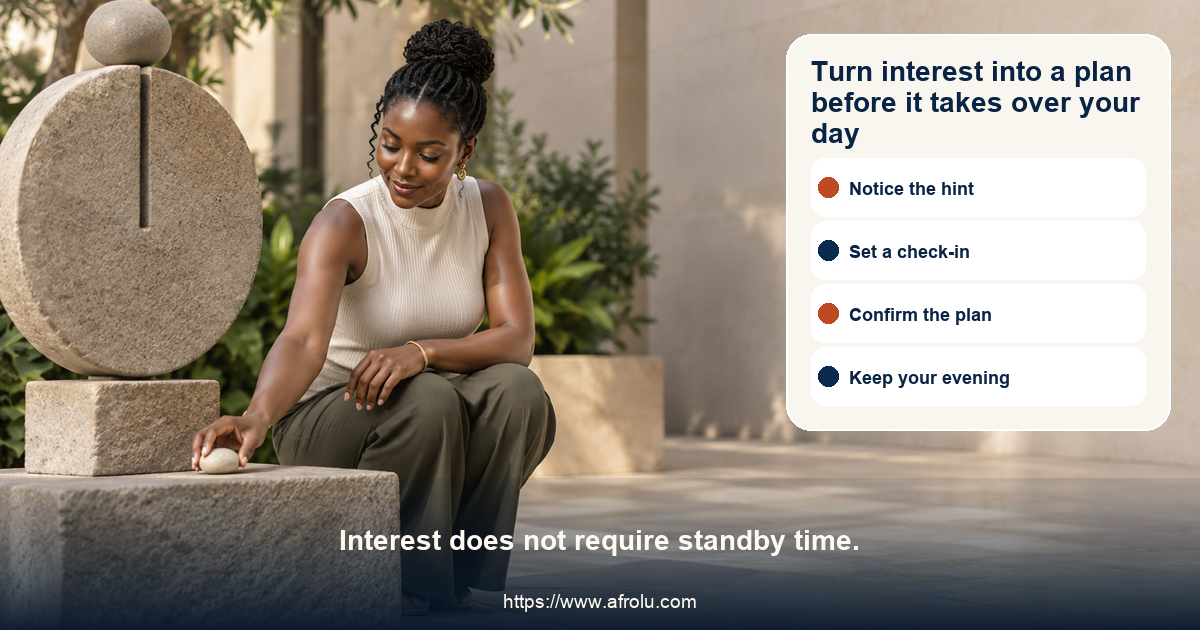
Returning to dating can make it tempting to say yes before you know what the plan is, especially when you enjoy the person or do not want to appear difficult. That habit turns ambiguity into an invisible cost. You may reorganise a full day, wait for an update, or abandon rest only to learn that the invitation was never more than a vague idea.
Set a simple confirmation point. Ask for a time and a location you are comfortable with, or state that you will make another plan if you have not heard by a certain point. This is not a test of devotion. It is a way to make adult time visible. A person who wants to meet can confirm, offer an alternative, or be honest that the plan is not possible.
Notice what happens when a plan changes. An unavoidable shift can still be handled with a prompt update and a practical alternative. A repeating pattern of late changes, disappearing invitations, or pressure to rearrange yourself at short notice may show that the situationship does not fit the time you are willing to give it.
You can keep a connection warm without placing your life on hold. Suggest a smaller plan, choose a different day, or release the evening. If someone treats your need for confirmation as a lack of interest, remember that interest and self-respect are not opposites. A clear plan is often the easiest way for both adults to feel that the invitation is real.
expectations · current information
A direct question can replace weeks of decoding whether the situationship has terms
Before raising the subject, identify the question underneath the feeling. You might need to know whether they are seeing other people, whether they want regular contact, whether intimacy has shared boundaries, whether a public plan is the only setting you want right now, or whether they can offer confirmation. A specific question is kinder than a wide conversation in which neither person knows what answer matters.
Try plain language: 'I enjoy spending time with you. What are you open to at the moment?' or 'I am comfortable keeping this casual, but I need clearer plans and honesty about other dates.' The point is not to sound perfectly relaxed. The point is to make your own decision possible without asking the other person to read your mind.
Listen for a response you can use. Someone may say they cannot offer regularity, do not want exclusivity, prefer more casual contact, or would rather step back. That can hurt and still be clear. A reply that circles around every practical question, while asking you to remain available, is also information about the arrangement they are actually offering.
You do not need to decide on the spot. You can take a day, propose a smaller arrangement, or end the situationship. Clarity is not successful only when the answer matches what you wanted. It is successful when it restores your ability to spend time, share access, and make future plans according to your own informed choice.

A short true sentence makes time usable.
privacy · gradual access
An adult date needs enough information for the plan, not a detailed route into your private life
Parents returning to dating may feel pressure to explain more than they want to explain: why a time does not work, where they are, who is in their life, or how they organise their days. You can keep those details broad. A person does not need an inventory of your responsibilities in order to respect a boundary or confirm a date.
Choose channels and settings that remain under your control. You can stay on an app, use a communication method you can leave, meet in a public place, and arrange your own transport. These choices do not signal that you expect the worst. They make it easier to change your mind without turning a new connection into an access problem.
Take special care when someone asks for live location, repeated proof, private images, an address, a more hidden channel, access to accounts, or a shortcut into people you know. You can decline without proving that the request is dangerous. The fact that it makes you less free to choose what you reveal is already a sufficient reason to keep the answer simple.
If a privacy boundary is ignored, revise the setup rather than producing a longer defence. Reduce contact, keep records only if it is safe, block or report through a platform when useful, and involve a trusted person if the behaviour continues. A connection worth keeping will not depend on you making your private life more available than you want.
consent · public plans · exit
A confirmed date still leaves you free to change the setting, pace, touch, time, or decision to stay
A situationship can include affection and regular contact, yet each meeting remains a separate moment. You may want to shorten a date, remain in a public setting, decline a second venue, stop physical contact, or leave without explaining every feeling. Those are ordinary choices. A previous plan, a gift, a compliment, or the time someone spent travelling does not turn into permission.
Use logistics that leave you in charge of your own movement. Choose a public setting if you prefer it, decide your own arrival and departure, and do not rely on a new date for transport or a place to go afterward. This is not a claim about anyone's character. It is a way to keep a changed mind practical rather than complicated.
Consent also applies to messages, calls, images, video, personal disclosures, and a request to move the conversation elsewhere. You can say yes to one kind of contact and no to another. You can accept an invitation and later cancel. The more ordinary these choices feel, the less likely either person is to confuse warmth with a standing claim.
If someone pushes after a clear no, makes leaving feel rude, invokes money or effort to make you stay, or tries to bargain against your comfort, treat the response as information. You can repeat the boundary once, leave, block, or seek help if you cannot disengage safely. A respectful situationship should never make your freedom to stop feel like a betrayal.
safety · category change
Unclear terms can be addressed directly; money pressure, coercion, unwanted pursuit, and fear require a different response
A person may be inconsistent, busy, non-exclusive, or less invested than you hoped. Those outcomes can be disappointing without being dangerous. You can ask one question, decide that the fit is too vague, or end the connection. Proportion matters because it lets you respond to ordinary uncertainty without losing sight of the situations that call for more care.
The category changes when someone asks you to send money, receive money, provide banking help, share a code, reveal documents, or solve a financial emergency. A dating connection, casual or otherwise, is not a safe reason to merge systems. Keep financial routes separate and independently verify any claim that asks you to act quickly or privately.
It changes again when someone refuses a no, contacts you through new accounts, threatens you, monitors you, pressures you for sexual material, uses private information to gain leverage, or makes you afraid to alter a plan. Those actions are not a failure of communication. They can require blocking, reporting, trusted support, specialist advice, or urgent help depending on the circumstances.
You are allowed to act on the effect of the behaviour. If your time, body, money, privacy, movement, or attention feels less voluntary, the safety question is already present. You do not owe a final explanation or a chance to make a boundary more acceptable to someone who is using access to make you smaller.

City flexibility is not one-sided access.
next move · return to dating
A clearer situationship can be redesigned, ended, or replaced by a better starting standard
If the conversation leads to mutual clarity, create a modest arrangement. You might agree to confirmed dates, lower contact, a non-exclusive setup with explicit health boundaries, a pause from intimacy, or a review after a defined period. The detail matters because it gives both adults something observable to choose rather than an atmosphere of implied obligation.
If you decide the fit is not right, use a proportionate ending. 'This setup is no longer working for me, so I am stepping back' is enough. You do not have to provide a case file, wait for approval, or leave yourself available to keep another person comfortable. If direct closure does not feel safe, you can use a shorter boundary, block, or stop engaging.
When someone returns after a gap, check the current facts instead of being pulled into the old story. Do you want contact? Can they make a specific plan? Do they respect the level of privacy and pace you choose? A returning message may deserve a small fresh invitation, but it never requires you to restore the access that was not earned before.
Carry one standard into your next date: confirm before holding time, name the arrangement early, keep private details gradual, choose independent movement, or treat repeated vagueness as a mismatch. A return to dating can be full of curiosity and pleasure while still being shaped by standards that protect the adult life you have built.

Choose the move that preserves your adult life.
Eight returning-to-dating situationships where clear plans, privacy, consent, and safety change the next move
A date is suggested but never confirmed
A situationship leaves an evening vague until late, while the other person waits to see whether it becomes real.
Set a confirmation point and release the time if it passes.A plan changes without an alternative
A busy day creates a genuine change, but the person repeatedly expects an immediate rearrangement.
Ask for a new specific plan or choose another day.Warmth without shared expectations
A recurring connection includes intimacy or close contact but no agreement about other dates or what casual means.
Ask one present-tense question that changes your choice.Private details are requested early
A person asks for your routine, address, location, personal accounts, or information about people in your life.
Keep details broad and share only what supports the plan.A public date becomes a private expectation
A familiar date treats a planned meeting as a reason to move somewhere you did not choose.
Keep the setting or leave; consent is current.Connection becomes a money request
A warm message asks for a transfer, account help, code, document, or secret payment favour.
Keep systems separate and verify any claim independently.Silence is followed by a large apology
Someone returns after a gap and wants immediate access, a spontaneous plan, or a long emotional conversation.
Choose a smaller current step or decline to restart.A clear ending becomes pursuit
A no produces new accounts, repeated calls, threats, monitoring, or pressure.
Reduce access and use appropriate safety support.Fourteen observable signs that a city-context situationship is mutual, vague, pressuring, controlling, or unsafe
An invitation has enough detail to become a real, freely chosen plan.
A change in plans includes an update and a usable alternative.
Both adults can describe the current situationship in ordinary terms.
A clarity question receives an answer, even if it reveals a mismatch.
You can decline last-minute changes without being punished or persuaded.
Private routines, location, accounts, contacts, and personal details remain gradual.
A public plan and independent movement are accepted without debate.
A changed mind about setting, touch, time, or contact is respected.
A return after quiet time offers current conduct rather than immediate entitlement.
Money, transfers, documents, codes, and account access stay outside the connection.
A no does not lead to repeat contact, new accounts, monitoring, or threats.
The situationship fits beside the rest of your adult life rather than consuming it.
Both people can release an unconfirmed plan without resentment.
Fear or coercion changes the response from dating clarity to safety.
A proportionate decision map for plans, expectations, privacy, consent, returns, money, and safety
| Situation | What it may mean | What to do next |
|---|---|---|
| A plan is only a hint | Interest has not become a usable arrangement. | Ask for confirmation or make another plan. |
| A change arrives late | Life may be busy, or the connection may expect standby time. | Accept a specific alternative or release the time. |
| You want clarity | You need present information, not a future guarantee. | Ask what they are open to now. |
| They say casual | The word may conceal different assumptions. | Ask about contact, other dates, intimacy, privacy, and plans. |
| They want more personal detail | Familiarity may be getting confused with access. | Keep information gradual and return to the plan. |
| The date changes setting | A previous yes may be getting treated as standing permission. | State the current setting or leave. |
| They return after a gap | A new invitation is not a debt to resume. | Choose only the scale and access you want now. |
| They ask for financial help | The situation has moved beyond ordinary dating ambiguity. | Decline and verify independently. |
| You want to end it | A mismatch can be enough reason to step back. | Use a concise close when safe. |
| You feel unsafe | The relevant question is protection, not better wording. | Seek trusted, specialist, platform, or urgent support. |
Twelve complete lines for confirmation, clarity, privacy, consent, a return, and an ending
“If we have not confirmed by late afternoon, I will make another plan for the evening.”
“I enjoy this, and I want to know what you are open to at the moment.”
“If we are keeping this casual, I need clarity about other dates and the kind of contact we are choosing.”
“I cannot do a last-minute change today; another confirmed time could work.”
“I keep my personal routines and private accounts gradual while I get to know someone.”
“I will meet you there; I am not sharing live location.”
“I am staying with the public plan tonight.”
“I do not want to continue with that part of the plan.”
“I can consider a short planned catch-up, but I am not returning to an undefined rhythm.”
“I do not send, receive, lend, or move money in a dating connection.”
“This setup is not working for me, so I am stepping back.”
“Do not contact me again.”
Know the difference
City flexibility and one-sided standby time are different situationship patterns
Plans can change, but both adults update, offer alternatives, respect privacy, and remain free to say no or release the time.
One adult waits for vague invitations, provides increasing access, and absorbs late changes because the connection has no clear terms.
A flexible city pace can still be clear; convenience for one person is not mutuality.

Compare the plan before reorganising your life.
Keep mutual city flexibility distinct from one-sided standby time and conduct that reduces freedom
| Type or dimension | What it describes | Best next question |
|---|---|---|
| A confirmed plan | It has time, place, and a mutual yes. | Keep it or update it clearly. |
| An open invitation | It suggests interest without creating a commitment of time. | Ask whether a real plan is being made. |
| Mutual flexibility | Both people can change plans without pressure. | Offer or accept an alternative freely. |
| Standby time | One person keeps an evening open for a non-answer. | Set a confirmation point and release the slot. |
| Casual clarity | Both adults can name contact, other dates, intimacy, and privacy terms. | Review the agreement when facts change. |
| Vague closeness | Warmth exists but rules are inferred rather than shared. | Ask once or choose less contact. |
| Observable repair | A return includes a specific plan and respect for limits. | Start small if you remain interested. |
| Access pressure | Location, routine, accounts, money, or private details are pushed. | Keep systems separate and reduce access. |
| Fear or coercion | A boundary leads to pursuit, threats, monitoring, or intimidation. | Use safety support rather than more dating talk. |
A simple plan you can use today
Time is part of a boundary
A confirmed plan is a form of respect for an adult life that cannot stay on standby.
A city context is not a rulebook
Busy logistics can explain change, but they do not excuse one-sided vagueness or pressure.
A question can be small
Present information about plans, contact, or other dates may be enough to guide your next choice.
Privacy is not secrecy
Gradual access protects choice while trust has time to form.
An independent exit supports consent
A date remains more honest when either adult can change or end it.
Risk has its own category
Money pressure, coercion, monitoring, threats, and fear call for protection, not a clearer label.
Questions organised by purpose and depth
Choose a few prompts that fit the moment. This is a reference library, not a list to complete.
Make time visible
Choose a plan standard before the next invitation.
- When does a hint become a plan for me?
- What confirmation point protects my time?
- What alternative could I offer?
Ask for facts
Use a question that affects a present choice.
- What do I need to know about contact or other dates?
- What answer would change my next move?
- Can I hear a mismatch without bargaining?
Protect privacy and consent
Keep access separate from interest.
- What detail does this plan actually need?
- Can I leave or change my mind easily?
- What access would I rather keep gradual?
Choose proportion
Match the response to the pattern.
- Is this a scheduling mismatch or pressure?
- What is the smallest true next step?
- Who can support me if I feel unsafe?
What deserves a closer look
Make a plan real before it takes your time
Use a time, setting, confirmation point, and alternative that each adult can choose freely.
Evidence limit: Do not treat a vague invitation as an obligation.
Ask for present facts
Choose one question about contact, plans, other dates, intimacy, or privacy that informs your next move.
Evidence limit: Do not seek a future promise to avoid a present decision.
Keep personal access gradual
Share only the information the current plan needs and retain control of channels, location, accounts, and routines.
Evidence limit: Do not offer private details to prove interest.
Keep exit and change practical
Choose settings, transport, and contact that leave you able to stop, shorten, or leave.
Evidence limit: Do not let a planned date become a debt.
Test repair at a small scale
A returning person can offer a clear current plan and respect the pace you now choose.
Evidence limit: Do not restore access automatically.
Change strategies when freedom narrows
Use blocking, reports, trusted people, specialist support, or urgent help for money pressure, coercion, threats, monitoring, or fear.
Evidence limit: Do not keep engaging merely to be polite.
Shortcuts that turn an invitation into standby time, unwanted access, pressure, or risk
Treating a hint as a plan
It turns adult time into a waiting room for someone else's decision.
Overexplaining an unavailable time
A simple no or alternative is enough; private details are not the price of a boundary.
Calling vagueness flexibility
Mutual flexibility still gives both people usable information.
Giving access to make a plan feel real
Location, routines, accounts, and private details do not create trust.
Treating a previous yes as permanent
Consent and the setting remain current decisions.
Negotiating with fear
Money pressure, coercion, monitoring, threats, or repeated contact need protection.
Set a boundary, ask a clearer question, or send one proportional post-date message
Choose the resource that fits your immediate decision. A guide can help you name a preference, but it cannot promise another adult's availability, interest, or conduct.
Explore the guide library
Show more related guides
Continue with Afrolu
Show more Afrolu guides
Sources used for this guide
Afrolu reviewed these health, research, safety, or public guidance resources while editing this page. They support the behaviour and safety guidance; they do not diagnose any individual described by a reader.
Questions about situationships for parents returning to dating in Nairobi
What is a situationship for someone returning to dating?
It is an undefined or partly defined connection that may include affection, intimacy, or recurring contact. The important question is whether plans, privacy, consent, and expectations remain mutual and freely chosen.
Do I need a label before I keep seeing someone?
No. You may need a few present facts instead: whether plans are regular, whether the connection is casual, what other dates mean, and what boundaries you want.
How do I keep a busy city schedule from creating confusion?
Use confirmation points and practical alternatives. A change can be ordinary; a repeated expectation that you remain on standby can show a mismatch.
Is it okay to ask for confirmed plans?
Yes. Confirmed plans protect both adults' time. Asking for a clear invitation is not the same as demanding constant access.
How much private information should I share?
Share only what you freely want and what the current plan requires. Your routine, location, address, accounts, contacts, and personal background can remain gradual.
Can I change my mind during a date?
Yes. You can change the setting, end the date, decline touch, stop an activity, or leave. A previous message or plan does not settle your current consent.
What if they say I am too difficult for wanting clarity?
A compatible person can accept a simple question or say the fit is not for them. You do not have to trade clear plans for approval.
Should I restart after someone goes quiet?
Only if you want to. Treat a return as a fresh invitation, choose a smaller plan, and look for present conduct rather than relying on an explanation alone.
What if they ask for money or account help?
Keep money, transfers, documents, codes, banking, and accounts separate from dating. Verify any urgent claim independently and decline financial involvement.
What if I feel unsafe?
Reduce access, use platform blocking or reporting tools, preserve information only when safe, and seek trusted, specialist, platform, or urgent support appropriate to your situation.
One thing to do now
Choose the next arrangement that protects the adult life you have built
Choose the smallest next action that protects your time, private life, independent movement, current consent, money, support network, and ability to confirm, redesign, pause, or end the connection without negotiating your freedom.