Six care links before one adult meeting
Plan a Safer Nairobi First Date When You Are a Parent
A Nairobi guide for parents managing first-date anxiety, child privacy, care, public venues, transport, check-ins, digital safety, consent and review.
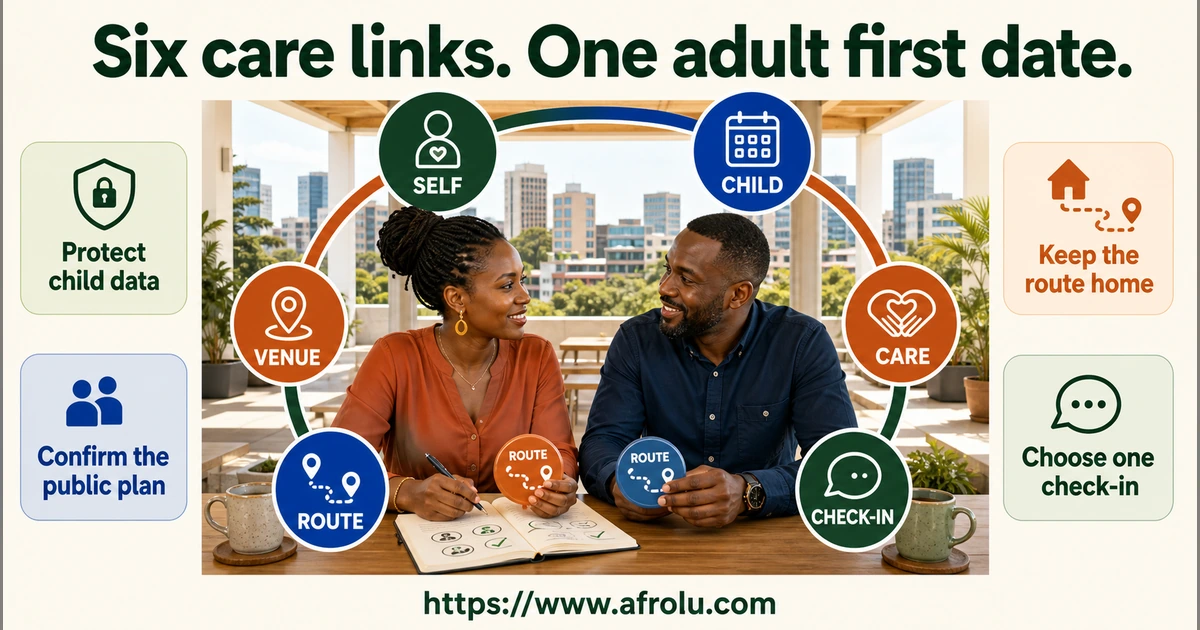
Plan the adult meeting while keeping children's identities and care systems outside the date.
Written and edited by Adwoa Boateng · Dating Safety Editor
Use two tracks: support anxiety and assess safety through current facts and conduct. Build six links—self, child privacy, care, venue, route and check-in. Share parent availability without child names, images, schools, routines, addresses or caregiver contacts. Confirm a public bounded plan, retain phone, payment and departure, and use one proportionate trusted-person update if useful. Pause or shorten freely. After regulation, review body state, facts, boundary response, care impact and privacy, then repeat, revise, pause or close.
First dates · Parents Returning To Dating
Can this adult first meeting remain public, bounded and leaveable while child privacy, care continuity, digital security, consent and an anxious body's needs all stay protected?
A parent-safe Nairobi first date is a bounded adult meeting whose identity checks, public logistics, movement, digital access and consent are planned without exposing or destabilising a child's information and care system.
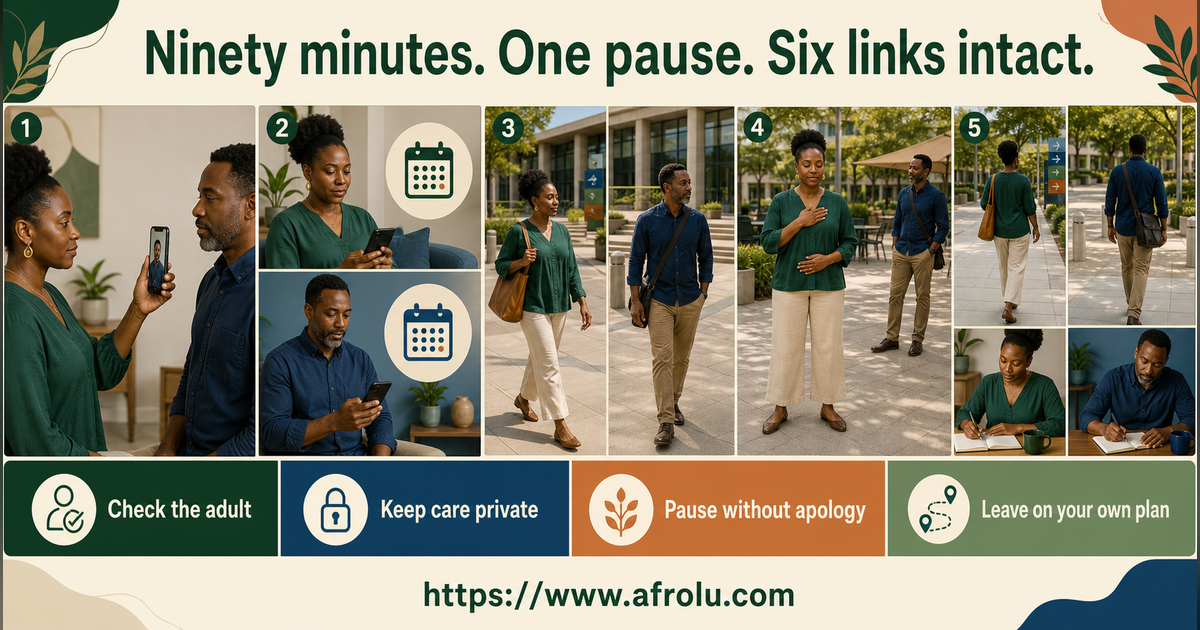
Njeri and Musa are fictional parents, 38 and 42. A ninety-minute public Nairobi date, one anxiety pause, protected child-care information and separate travel show how an adult meeting can change while all six care links remain intact.
The six-link Nairobi parent care circle
Plan the adult date without putting the child on its map
Adwoa separates anxiety support from safety evidence, then protects self, child privacy, care, venue, route and check-in through one short first date.
The circle minimises family data, keeps movement independent and uses a twenty-four-hour review with four equal outcomes.
Self and child
Support the adult body while keeping the child's identity and routines private.
Care
Let disruption shorten or postpone the date without opening home access.
Venue and route
Confirm a current public plan and retain an independent departure.
Check-in
Share the least adult information that still supports the chosen safety plan.
Use two tracks before the date
Anxiety needs care while safety decisions need current facts and controlled logistics
A first date can activate uncertainty, self-consciousness and practical concern even when nothing harmful is happening. Parenting adds more moving parts: care cover, return timing, phone access and the knowledge that a delayed plan may affect another person. Treat the emotional response with kindness rather than using it as evidence that you are unready or that the match is unsafe. Then assess safety separately through adult identity checks, a current public plan, controlled movement, privacy boundaries and observed conduct when a limit is heard.
Keep the first date small enough to understand. A ninety-minute public meeting with a clear end can reduce logistical load and make leaving ordinary. Confirm current venue details through authoritative sources where relevant; public does not mean risk-free or universally accessible. Arrange arrival and departure you control, keep payment and phone usable and give one trusted adult the broad plan if that supports you. Do not require the match to know where you or your children live in order to coordinate.
Parent status is relevant, but a child's identity is not first-date content by default. You can say, 'I am a parent and my dating availability has these limits' without naming children, showing photographs, sharing a school, describing routes or exposing a caregiver or co-parent. A new match may have reasonable questions about availability and future compatibility. Answer the adult relationship question while postponing child-specific information until there is a clear purpose, enough evidence and a decision that protects the child.
Anxiety support can be practical. Rehearse one opening line, choose clothing and transport early, eat if appropriate, limit stimulating substances if they worsen your symptoms and practise a brief grounding exercise. The World Health Organization's stress guide offers techniques such as grounding and making room for difficult feelings, while individual needs vary. If anxiety is persistent, severe or disrupting daily life, consider qualified mental-health support rather than making the date the treatment test.
Build the six-link care circle
Self, child privacy, care, venue, route and check-in should each remain intact
Self includes physical needs, anxiety supports, money, phone, time limit and the right to leave. Decide what would help you feel present without demanding zero anxiety. Child privacy covers names, images, schools, health details, routines, addresses, device access and care contacts. In Kenya, the Data Protection Act treats family details including names of children as sensitive personal data and includes safeguards for processing children's data. The precise legal application depends on context; the practical privacy lesson is to minimise disclosure and protect the child's interests.
Care means arranging a trusted caregiver or co-parent through your normal channel, sharing only the information they need and confirming how you will return. Do not send a new match the caregiver's contact, live updates about a child or evidence of where the child is staying. If care changes, decide whether the date can shorten, move or be postponed. A respectful adult understands that reliable care takes priority and does not use disruption to seek home access or an introduction.
Venue and route are adult logistics. Choose a current public setting, bounded timing and accessible departure. Nairobi conditions, hours and transport can change, so confirm close to the date rather than relying on memory or a match's confidence. Each adult should know how to leave without the other's vehicle, phone, fare or permission. If weather, traffic or closure changes the plan, choose another public option or reschedule; convenience does not require a private home.
Check-in is one proportionate signal to a trusted person, not continuous broadcasting. Share the broad adult plan and an expected completion window if useful. Avoid transmitting child routines or asking the date for permanent location access. If you need help, use the appropriate trusted, venue, transport, platform, financial, cyber, specialist or emergency channel for the actual situation. A first-date plan reduces avoidable exposure; it cannot remove all risk.
Njeri and Musa keep six links intact
A shorter date lets anxiety settle without giving the match access to the care plan
Njeri, 38, and Musa, 42, were both parents and had spoken on a dating platform before a short live call. They agreed on a ninety-minute daytime meeting at a public Nairobi venue each confirmed independently. They said only that care was arranged and that the date needed to end at a particular time. Neither shared a child's name, photograph, school, address, health detail, schedule or caregiver contact. Each travelled separately and one trusted adult knew Njeri's broad meeting plan.
Twenty minutes before leaving, Njeri noticed a racing heart and an urge to cancel without explanation. She used a short grounding routine, reviewed the plan and decided she still wanted to meet but would keep the first thirty minutes as the only commitment. She messaged Musa: 'I am looking forward to meeting. I may keep it shorter today, and I will decide after the first drink.' Musa accepted without asking for a medical explanation or making the effort he had spent travelling into a debt.
At the venue, Njeri's anxiety rose when the room became noisy. She said she needed five minutes outside in the public courtyard. Musa stayed at the table and did not follow, touch her or call repeatedly. When she returned, they chose a quieter public area and completed seventy minutes. They discussed parenting values at a broad level, not individual children. Musa asked before taking a photograph; Njeri declined and the subject ended.
They left separately at the agreed time. Njeri did not decide on the journey home. After rest, she reviewed body state, confirmed facts, Musa's boundary responses, the effect on care and what remained private. Anxiety had reduced, but that alone did not prove Musa safe. His ordinary conduct supported another short public date. Musa reached the same conclusion independently. The next step opened one adult meeting, not family contact, home access or introductions.
Read six parent-safety signals
The best evidence is adult conduct that leaves the child's world unopened
Adult identity begins with proportionate checks: live interaction, consistent ordinary details and independent verification of a consequential claim when needed. Reverse-image checking and remaining on the dating platform until confidence improves may be useful in some cases. Do not ask either adult to send full identity records as proof. A document copy can expose more than the date requires and may still fail to establish intent. Match evidence to the next bounded action.
Child and care privacy are visible when the match accepts broad answers. 'I have care covered and need to leave at eight' is enough for a first date. Repeated questions about a child's exact age, school, appearance, address, schedule, devices, caregiver or co-parent after a boundary are meaningful. Do not supply fictional details to keep the interaction smooth; simply decline and reduce the relationship if the pressure continues. Parents also deserve privacy about family history that is not yet relevant.
Venue and movement signals appear when plans change. A respectful person can accept separate transport, a current public setting, a shorter meeting and a reschedule. They do not use local familiarity, spending or concern to remove the route home. Confirm links and venue information independently, because fake pages and phishing can target any online interaction. Keep accounts secured with unique passwords, multifactor authentication where available and swift action after suspected compromise.
Consent includes conversation, images, touch and the length of the date. Anxiety, freezing or social pressure can complicate communication, so ask clear questions and respond to the actual answer. A parent owes no physical reassurance for arranging care or accepting a meal. If there is no free specific yes, stop. When severe coercion, stalking, threats, digital compromise or fraud appears, use appropriate local emergency, legal, specialist, cyber, platform or financial support rather than treating it as first-date nerves.

Verify the next adult action and disclose no more than it needs.
Use ten short boundary switches
Parent status can be honest while child details, care systems and home access stay off
For parent status: 'I am a parent, and my dates need a fixed end time.' For child privacy: 'I do not share names, photos, schools or routines while I am getting to know someone.' For care: 'My care plan is covered and private; if it changes, I will shorten or reschedule.' These scripts answer availability without creating a pathway into the child's life. A compatible adult may eventually need broader family conversations, but not before trust, purpose and the child's interests support them.
For venue and time: 'I can meet at the public place we both confirm and stay until eight.' For transport: 'I will arrive and leave on my own plan.' For check-in: 'A trusted person knows my broad plan; I do not share continuous location.' These choices do not accuse the date. They establish a normal first-meeting structure. If the venue closes or transport changes, keep the same principles and choose again rather than drifting into a private setting.
For anxiety: 'I am interested and may take a short pause or finish early; I will tell you directly.' This communicates agency without disclosing a diagnosis or asking the date to become a therapist. For images: 'Please ask before taking, sending or posting a photo.' For consent: 'I am comfortable with this, not that, and I may change my answer.' A respectful adult can tolerate these switches without pressing for proof, rescuing or making affection conditional.
For review: 'I will decide tomorrow whether another public date fits.' A twenty-four-hour rule is optional, not universal, but it may help a parent separate adrenaline, excitement and care logistics from the next decision. If a severe safety event occurred, do not wait merely to follow a review routine. Conversely, do not interpret residual anxiety as evidence against a considerate match. Use body information and concrete conduct together, giving safety facts appropriate weight.

State the boundary and the workable adult plan in the same sentence.
Settle, then review six segments
Body state, facts, conduct, care impact, privacy and next choice need separate notes
Body asks what you noticed before, during and after: tension, racing thoughts, numbness, relief, excitement or fatigue. Use plain description rather than self-diagnosis. If social fear is persistent and interferes across situations, information from the National Institute of Mental Health can help identify when professional assessment may be useful. A first date cannot diagnose or cure social anxiety. Choose qualified support based on your broader functioning and needs.
Facts and conduct ask what actually occurred. Was the adult identity consistent enough for this step? Did the venue and route remain as planned? What happened when you shortened, paused or declined a photo or touch? Separate observation from interpretation: 'They asked again after I said no' is more useful than either 'they are definitely dangerous' or 'I am overreacting.' Repetition, severity and context guide the response, and some events justify immediate closure and support.
Care impact and privacy ask whether the date disrupted the child's wellbeing, caregiver agreement or your essential availability, and whether any family information moved farther than chosen. A late return may need a repair with the caregiver regardless of how the date went. Do not solve that repair by giving the new match more access. If a child image or detail was shared, reduce further disclosure, remove material where possible and consider appropriate advice based on the actual context.
Next offers repeat, revise, pause and close. Repeat the bounded format when conduct and capacity fit. Revise one adult variable, such as venue noise or duration, while keeping child privacy and movement intact. Pause for care, wellbeing, facts or support. Close when interest is absent or when pressure, deception, digital intrusion, unsafe movement or privacy disregard makes another test unwise. A thoughtful ending is a successful safety outcome, not a failed date.

Review the date after regulation without overriding concrete safety evidence.
Compare eight parent-first-date formats
Choose the smallest plan that gives useful adult evidence and leaves care stable
A short coffee or tea meeting offers a clear end and simple conversation. A daylight walk can reduce face-to-face intensity but needs a well-understood public route and weather alternative. A bounded activity provides shared focus while making conversation less continuous. A simple meal offers more time but can increase cost and perceived obligation. None is inherently safest; confirm current conditions and choose what is accessible, affordable and leaveable for both adults.
A video-first meeting can add live context before travel while preserving home-location privacy; use a neutral background and do not show children or identifying household details. A group-adjacent date places the meeting near a public community activity without requiring friends to supervise or share private information. Keep the couple's consent and exit individual. Other adults cannot verify every claim or decide whether the match receives family access.
A rescheduled date is appropriate when care fails, illness, anxiety, weather, transport or venue conditions make the original plan poor. Offer a new option only if you want one. Repeated last-minute changes still create fit information, even when every reason may be genuine. No meeting is appropriate when identity remains materially unclear, logistics cannot be made leaveable, pressure has appeared or interest has changed. You do not owe an in-person test to justify closure.
Compare adult disclosure, care privacy, meeting load, exit and review. The first date should answer a modest question: do I want another bounded adult meeting based on this person's conduct and our fit? It should not test how quickly a match can enter family life. Let child information, home access and introductions remain closed until a later, separately reasoned decision protects everyone involved.
Eight Nairobi parent-first-date moments where anxiety, care and privacy can blur
Parent status becomes a child biography
A dating conversation is collecting names, images and routines it does not need.
Share the adult availability fact and withhold child details.A caregiver change threatens the meeting
Pressure builds to reveal an address or bring the date closer to home.
Shorten, reschedule or cancel without opening the care system.The confirmed place is too noisy
Anxiety rises and the public plan no longer supports conversation.
Pause, choose a quieter public option or end early.Convenience asks for the home location
A ride offer would expose a family address and control departure.
Meet there and retain independent transport.Safety sharing becomes live tracking
A bounded trusted-person update expands into continuous location access.
Share only the adult plan and agreed completion window.A date image could identify family context
Posting may reveal routines, audience links or location.
Decline capture or sharing and review visible background details.A racing heart is treated as a verdict
Body activation is deciding either danger or incompatibility alone.
Regulate, review concrete facts and choose the next adult step.Care effort becomes physical obligation
Arranging time away from parenting is used to pressure intimacy.
Stop the act and keep departure under personal control.Signs that adult verification, child privacy, care, movement and consent remain intact
{'label': 'Adult', 'title': 'Verification stays adult and proportionate', 'detail': 'The next meeting does not require a family dossier.', 'reading': 'Measured'}
{'label': 'Child', 'title': 'Names, images and routines remain private', 'detail': 'Parent honesty does not expose the child.', 'reading': 'Protected'}
{'label': 'Care', 'title': 'Disruption can shorten or postpone the date', 'detail': 'A match does not seek access through a care change.', 'reading': 'Stable'}
{'label': 'Venue', 'title': 'The public plan is current and revisable', 'detail': 'Noise, access or closure can produce another safe choice.', 'reading': 'Adaptable'}
{'label': 'Route', 'title': 'Arrival and departure remain independent', 'detail': 'Home privacy and the route back stay controlled.', 'reading': 'Leaveable'}
{'label': 'Check-in', 'title': 'One trusted update is enough', 'detail': 'Safety planning does not become broad location sharing.', 'reading': 'Proportionate'}
{'label': 'Anxiety', 'title': 'A pause receives room rather than rescue', 'detail': 'The adult keeps agency over regulation and timing.', 'reading': 'Respectful'}
{'label': 'Images', 'title': 'Capture and audience require permission', 'detail': 'A first date does not become public family context.', 'reading': 'Private'}
{'label': 'Consent', 'title': 'Every no remains effective', 'detail': 'Care effort, spending and attraction create no debt.', 'reading': 'Voluntary'}
{'label': 'Review', 'title': 'The next choice waits for facts and capacity', 'detail': 'Repeat, revise, pause and close all remain real.', 'reading': 'Grounded'}
Choose the next adult step through ten care-and-safety questions
| Situation | What it may mean | What to do next |
|---|---|---|
| Is adult identity enough for this step? | Fits: Relevant claims have proportionate support. Needs review: One material fact remains unclear. Stop: Documents or family data are demanded as proof. | Verify only the adult claim needed for the meeting. |
| Is child information minimised? | Fits: Names, images, schools, routines and locations stay private. Needs review: A broad answer revealed more than intended. Stop: Child details are pursued or shared after refusal. | Stop disclosure and reduce relationship access. |
| Is the care plan stable? | Fits: Trusted care and return timing remain workable. Needs review: One change requires a shorter plan. Stop: The date pressures home entry or child contact. | Shorten, reschedule or cancel without opening care. |
| Is the venue current and suitable? | Fits: Both confirm a public accessible option. Needs review: Noise, hours or transport need rechecking. Stop: Only an unfamiliar private location is accepted. | Choose another public plan or do not meet. |
| Can each adult leave independently? | Fits: Phone, payment and route stay controlled. Needs review: Convenience creates avoidable dependence. Stop: Departure is obstructed, threatened or exposed. | Restore movement and prioritise safety. |
| Is the check-in proportionate? | Fits: A trusted adult has the broad meeting window. Needs review: More detail is shared than needed. Stop: Live tracking or child routines are demanded. | Narrow sharing and remove access when possible. |
| Can anxiety receive a pause? | Fits: The adult may regulate, shorten or leave without shame. Needs review: The setting needs one manageable change. Stop: Distress is mocked, exploited or used to take control. | End the meeting and seek appropriate support. |
| Are digital systems secure? | Fits: Accounts, codes and images remain controlled. Needs review: A link or channel needs verification. Stop: Phishing, credential demands or exposure threats appear. | Stop access, secure accounts and preserve evidence. |
| Is consent current and specific? | Fits: Every act receives a free communicated answer. Needs review: An assumption needs an immediate reset. Stop: Parenting effort, gifts or previous yes override refusal. | Stop the act and prioritise safety. |
| What does the review support? | Fits: Conduct and capacity justify another bounded adult date. Needs review: One variable needs revision or more time. Stop: Deception, coercion or privacy harm makes another test unwise. | Repeat, revise, pause or close from the evidence. |
Scripts for parent status, child privacy, care, venue, anxiety, consent and review
“I am a parent, and my dates need a fixed end time.”
“I do not share names, photos, schools or routines while getting to know someone.”
“My care plan is covered and private; if it changes, I will reschedule.”
“I can meet at the place we both check and stay until eight.”
“I may keep today shorter and will tell you directly.”
“I will make my own way there and home.”
“A trusted person knows my broad plan; I do not share continuous location.”
“I am interested and may take a short pause or finish early.”
“I am comfortable with this, not that, and I may change my answer.”
“I will decide tomorrow whether another public date fits.”
Know the difference
Meeting format, child privacy and anxiety support are separate planning dimensions
Uses minimal adult disclosure, protects the child's world, preserves care and movement, and allows anxiety, consent and timing to change.
Uses convenience, reassurance or parent identity to open home, child, caregiver, location, account or physical access before evidence supports it.
Choose the smallest format that answers whether another adult meeting fits while keeping every child-related system outside the date.

Choose the smallest meeting format that gives useful adult evidence and a simple exit.
Compare eight Nairobi first-date formats for parents
| Type or dimension | What it describes | Best next question |
|---|---|---|
| Short coffee or tea | Hold a bounded conversation. Rhythm: Forty-five to ninety minutes. Boundary: Fixed end and separate route. | Conduct during one clear boundary |
| Daylight public walk | Reduce face-to-face intensity. Rhythm: Known route and weather plan. Boundary: No address or pickup. | Comfort with pace and movement |
| Bounded activity | Share focus while learning. Rhythm: One short public task. Boundary: Easy exit before extension. | Cooperation without control |
| Simple public meal | Allow deeper conversation. Rhythm: Longer but timed. Boundary: Spending creates no obligation. | Respect across a fuller interaction |
| Video-first meeting | Add live context before travel. Rhythm: Short planned call. Boundary: Neutral background, no children. | Consistent adult identity and interest |
| Group-adjacent date | Meet near a public activity. Rhythm: Independent couple conversation. Boundary: Friends do not supervise or disclose. | Adult conduct outside the network |
| Rescheduled date | Protect care or current capacity. Rhythm: New plan only if desired. Boundary: No home access through disruption. | Response to the changed plan |
| No meeting | Close before in-person access. Rhythm: No further test required. Boundary: Privacy and movement stay closed. | Support or reporting if harm occurred |
Build a calmer, privacy-preserving first date in six moves
Split emotion and safety
Support anxiety while judging the meeting through current facts and conduct.
Build six care links
Protect self, child privacy, care, venue, route and check-in separately.
Minimise family data
Share adult availability without names, images, schools, routines or addresses.
Bound the public plan
Confirm current conditions, timing and an independent route home.
Pause and read conduct
Let a shorter date or clear no reveal how the adult responds.
Review after regulation
Repeat, revise, pause or close without opening the child's world.
Questions for privacy, care, the meeting and twenty-four-hour review
Choose a few prompts that fit the moment. This is a reference library, not a list to complete.
Privacy prompts
Share the parent fact while minimising child data.
- What adult fact is needed?
- Which child detail stays private?
- Who may receive the broad plan?
- What image could reveal context?
- When would more detail have purpose?
Care prompts
Keep the child-care system stable and separate.
- Is care confirmed?
- What is the return window?
- What happens if care changes?
- Does the date know too much?
- Can I cancel freely?
Meeting prompts
Bound venue, route, anxiety support and consent.
- Is the venue current?
- How do I leave?
- Where can I pause?
- Is the check-in proportionate?
- Can every no work?
Review prompts
Let the body settle while facts remain visible.
- What did my body do?
- What was confirmed?
- How was a boundary answered?
- Did care or privacy change?
- Repeat, revise, pause or close?
What Kenya privacy, cyber, anxiety, stress, fraud and consent guidance supports
Family and child details deserve careful minimisation
Kenya's Data Protection Act includes family details, including names of a person's children, within sensitive personal data and sets conditions around processing a child's personal data. For dating practice, this supports minimising names, images, schools, locations and routines even though exact legal duties depend on context.
Evidence limit: This is a privacy principle, not legal advice or a claim that every private conversation falls under the Act in the same way.
Account compromise has a national incident channel
National KE-CIRT/CC, established through the Communications Authority of Kenya, provides cyber-security information and an incident-reporting route. It can be relevant when dating conduct includes phishing, account compromise or cyber fraud.
Evidence limit: The service does not verify a date or replace emergency, financial, platform, legal or specialist support.
Persistent fear and avoidance may warrant qualified support
The U.S. National Institute of Mental Health describes social anxiety disorder as more than ordinary shyness and provides information about signs and treatment. A reader whose anxiety is persistent or substantially interferes with life can use this as a reason to seek appropriate assessment.
Evidence limit: A webpage and a first date cannot diagnose an individual; services, emergencies and treatment options vary by location.
Grounding can support the moment without proving safety
The World Health Organization's Doing What Matters in Times of Stress guide presents practical skills including grounding and making room for difficult feelings. These can support regulation before or during a date while concrete safety evidence remains separately assessed.
Evidence limit: The guide is general self-help, not personalised mental-health care or a substitute for urgent support.
Limit profile information and slow urgent requests
UK Government Stop! Think Fraud guidance recommends limiting social-media information, checking whether profile images appear elsewhere and considering staying on the dating platform until identity confidence improves. It warns about urgent pressure for money or information.
Evidence limit: The reporting route is UK-specific; Kenyan, platform, financial-provider and other local channels differ.
Parenting effort and anxiety never replace a current answer
NSW Government guidance presents consent as free, voluntary, communicated, ongoing, specific and withdrawable. Care arrangements, spending, previous affection, freezing or a wish not to disappoint cannot supply an adult's present yes.
Evidence limit: Legal definitions and support pathways vary; use appropriate local professional or emergency help when needed.
Six ways anxiety or convenience can overexpose a parent-first-date plan
Over-sharing to prove honesty
Parent status expands into child images, names, schools and routines. Repair: Return to the adult availability fact the date actually needs.
Letting care disruption open the home
A changed caregiver plan creates pressure for private access. Repair: Shorten, reschedule or cancel while keeping care closed.
Using public as a guarantee
A venue label replaces current checks, awareness and an exit. Repair: Confirm conditions and retain phone, money and transport.
Treating anxiety as intuition or failure
Body activation decides the person or the dater's readiness alone. Repair: Regulate, record concrete conduct and review broader patterns.
Giving a match the safety feed
Location and check-in access goes to the person being assessed. Repair: Use one trusted independent adult and narrow the information.
Making care effort a debt
Time away from parenting is used to demand extension or intimacy. Repair: Keep the end time and consent independent of sunk effort.
Use a reviewed resource that matches the decision
This guide focuses on the relationship decision, so it does not rank dating apps. Check current prices, safety tools, and local availability before choosing a service.
Explore the guide library
Show more related guides
Continue with Afrolu
Show more Afrolu guides
Primary Kenya privacy, cyber, mental-health, stress, fraud and consent sources
Afrolu reviewed these health, research, safety, or public guidance resources while editing this page. They support the behaviour and safety guidance; they do not diagnose any individual described by a reader.
Parent first-date anxiety and Nairobi safety questions
How much should a parent share before a first date?
Share the adult facts needed for compatibility and coordination: that you are a parent, broad availability and a fixed end time. Avoid child names, photographs, schools, routines, health details, addresses, device access, caregiver contacts and co-parent information. More detail can wait until there is a clear purpose, enough evidence and a decision that protects the child.
Is first-date anxiety a warning that the person is unsafe?
Not by itself. Anxiety can arise from uncertainty, social fear, past experience or practical load, while calmness also cannot guarantee safety. Support the body with a bounded plan and grounding if useful, then assess adult identity, current logistics, privacy and conduct after a boundary. Persistent or impairing anxiety may deserve qualified mental-health assessment.
What is a safe Nairobi first-date plan for parents?
Choose a currently confirmed public setting, clear start and end, independent arrival and departure, controlled phone and payment, and one proportionate trusted-person check-in if helpful. Keep home and child-care locations private. Public is not a guarantee, so stay aware and revise or leave if venue, transport, conduct or capacity changes.
Should a date know who is caring for my child?
Usually not on a first date. The match needs to know only that care is arranged and your timing is bounded. Do not share the caregiver's name, contact, address or live child updates. If care fails, shorten, reschedule or cancel. A respectful adult will not use disruption to seek a home visit, pickup or child introduction.
Can I accept a pickup if transport is difficult?
Consider whether it would expose a home or care location and make departure dependent on the date. The safer first-date default is to meet there and retain a route you control. If conditions change, choose another public plan or postpone. Convenience should not require an address, surrendered phone, fare or permission to leave.
How can I manage anxiety during the date?
Use a brief plan you have practised: feel your feet, notice the room, slow the next breath, name what you are experiencing and choose a small action. You may step outside in a public area, move to a quieter place, shorten the date or leave. Tell the date only what you choose. Seek professional support when symptoms are persistent, severe or broadly disruptive.
Should I share live location with my date or trusted person?
Do not give the person being assessed continuous tracking as a safety requirement. If useful, one trusted independent adult can receive the broad venue and expected completion window, or limited trip information for a defined purpose. Exclude child routines and remove access when the purpose ends. Choose the least data that still supports the plan.
What if a match keeps asking about my children?
State the boundary once: you discuss parenting values broadly but do not share identifying details while learning. A reasonable person can accept that. Repeated pursuit, attempts to find profiles, requests for images or pressure for a home introduction are important evidence. Reduce access, preserve relevant evidence and use appropriate support if conduct becomes threatening or intrusive.
How long should a first date last when I am anxious?
Choose a bounded period that fits care, transport and your capacity; forty-five to ninety minutes may be easier to leave than an open evening, but there is no universal duration. You can extend only through a fresh choice, or shorten without apology. The goal is enough adult interaction for one next decision, not endurance.
How do I review the date without letting anxiety decide?
After enough regulation and rest, describe body state, confirmed facts, the person's response to boundaries, care impact and any privacy change. Give concrete severe conduct its proper weight even if anxiety later falls. Repeat the bounded format, revise one adult variable, pause for support or facts, or close. None of these outcomes requires opening the child's life.
One thing to do now
Let one adult date answer one adult question
Advance when adult identity is proportionately checked, child and care data remain private, the public plan is current, movement stays controlled and every pause or no receives respect. Revise one adult variable when manageable. Pause for care, wellbeing or facts. Close when intrusion, deception, coercion, cyber harm or unsafe movement makes another test unwise.