New dating · low-pressure distance clarity
Situationships in New Dating: Low-Pressure Distance Clarity
A practical situationship guide for adults new to dating: choose a low-pressure rhythm, protect privacy and consent, ask for clarity, and respond safely.
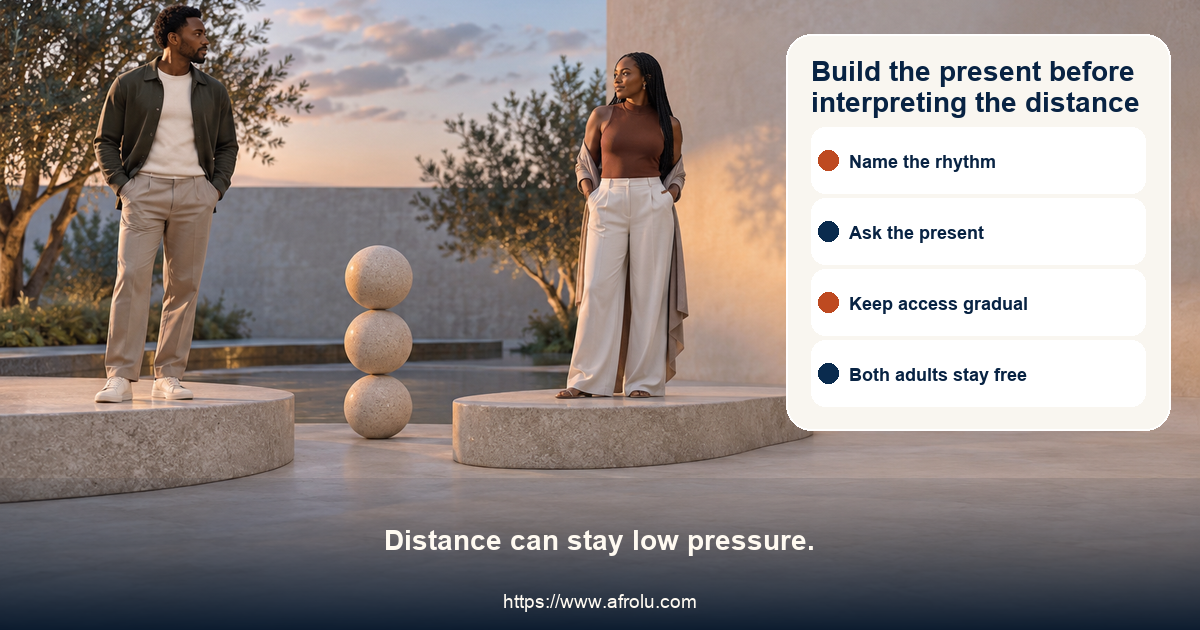
Choose a rhythm both adults can recognise.
Written and edited by Jean-Claude Mukendi · Relationship Guides Editor
Choose a contact rhythm that leaves both adults their own life, then ask one present-tense question when the answer changes a real decision. Keep communication, location, images, routines, and meetings under your control; make every in-person or intimate step current and voluntary. A quiet gap can be ordinary, while money requests, repeated unwanted contact, monitoring, coercion, threats, and fear require a safety response. You can redesign or end a rhythm that no longer works.
Relationship clarity · New Relationship Starters
Is this a mutual low-pressure rhythm, an unclear communication pattern, a question about expectations or intimacy, a return worth a smaller plan, digital or money pressure, unwanted pursuit, or conduct that makes me feel unsafe?
A distance-aware situationship is an undefined or partly defined connection in which physical distance between routines shapes messaging, calls, and plans. The useful distinction is between a low-pressure mutual rhythm and a low-information pattern that makes one adult carry all the uncertainty or surrender access to keep closeness.
Tari is beginning a new connection with someone whose day rarely overlaps with hers. Their long calls feel promising, but neither has said what casual contact or quiet time means. Tari asks for a lighter rhythm, keeps her communication channel and routines private, and chooses a short independent plan if they meet. The response gives her a clearer view of whether the connection can stay warm without becoming constant.
new dating · low-pressure distance clarity
Tari makes a new distance-aware situationship readable without turning communication into surveillance
This guide separates a chosen communication rhythm, a reply clock, a small clarity question, gradual digital access, current consent, an independent meeting, a return after quiet, financial pressure, unwanted pursuit, and fear—without travel clichés or promises about the future.
Build a rhythm before a story, ask one current question, make quiet readable, keep access and consent separate, distinguish ambiguity from risk, redesign only mutual terms, and carry one durable standard forward.
Choose a cadence
A shared pace can hold care without constant access.
Ask one fact
Present information is enough to guide the next decision.
Keep it gradual
Digital closeness never makes privacy or consent automatic.
Change the strategy
Money pressure, coercion, monitoring, and fear need protection.
new dating · distance-aware pace
A low-pressure situationship begins with a rhythm you can both recognise, not a future you have not agreed to
When adults are new to dating again or starting with distance between their routines, a situationship can quickly become emotionally loud. A few long conversations may create a sense of closeness, while practical questions about contact, plans, intimacy, or expectations remain untouched. That does not mean the connection is unreal. It means the story may be moving faster than the shared structure.
Begin with the smallest truthful rhythm. How often do you actually want to message or speak? What happens if either person needs quiet? Are you both open to a casual connection, learning slowly, or trying to make regular plans? A low-pressure pace is not a lack of interest. It is an agreement not to treat constant access as the price of being taken seriously.
Distance does not require a perfect communication schedule. It does ask you to make absence readable. A person can be unavailable without being abandoning, and you can want consistency without requiring immediate replies. The useful question is whether the two of you can name the pattern and adjust it when the reality of your days changes.
A rhythm becomes safer when it leaves both people their own life. You should still have room for rest, friends, interests, work, study, and private thought. If the connection depends on monitoring reply times or repairing every gap, it is not low pressure. It is using distance to make uncertainty somebody else's full-time task.
expectations · ordinary questions
You can ask for enough information to choose without turning a new connection into an interrogation
A situationship often remains confusing because questions get bundled together: what are we, where is this going, how often should we talk, are we exclusive, and do we owe each other a large emotional explanation? Untangling those questions makes the conversation kinder. You can start with the one fact that would change the next decision you make.
For example, you might ask whether someone is open to regular calls, whether they are seeing other people, whether they want to keep things casual, or whether they prefer lower contact between planned conversations. Each answer can be useful. An honest 'I do not know' is also information if it tells you that they cannot offer the clarity you need right now.
Avoid filling the silence with a narrative about why distance is difficult or why your question deserves a particular answer. The distance itself does not create a rule that one person must accept inconsistent access. It only changes the logistics. You can say what helps you stay open, hear the response, and choose whether the proposed pattern fits your nervous system and life.
If a person repeatedly offers warmth but no usable answer, notice the pattern rather than increasing the volume of the question. You can choose a smaller connection, a pause, or an ending. Clarity is not successful only when someone gives you certainty. It is successful when it gives you enough truth to stop making decisions in the dark.

Ask for the fact that changes your next move.
cadence · independent attention
A chosen contact pattern can hold care without turning delayed replies into evidence
Distance-aware situationships can become confusing when communication is treated as proof of feeling. A rapid series of messages may feel reassuring one day and exhausting the next. A missed call may feel significant when there is no other practical contact. Before you interpret any one gap, ask whether you and the other person have said what ordinary availability looks like.
You might agree to check in when a plan changes, reserve certain times for a call, or simply say that neither of you expects immediate replies. These are not rules for managing another adult. They are shared information that helps you decide whether the rhythm is compatible. A person who wants more contact can say so; a person who wants less can say so too.
Keep the communication channel under your control. You do not have to provide a private number, share live location, stay on a platform that feels difficult to leave, or answer every request for visual proof of where you are. A distance-aware connection becomes healthier when curiosity does not become a demand for access or a test of loyalty.
If a request for reassurance begins to involve screenshots, location, repeated calling, account access, or pressure to respond, pause. You can offer one clear boundary and watch whether it is respected. A connection that needs surveillance in order to continue is not solving the uncertainty of distance; it is relocating the cost of uncertainty onto your freedom.
consent · private access
A low-pressure situationship still needs explicit consent when communication, images, intimacy, or plans change
When two people communicate across distance, there can be pressure to make up for absence with more personal access. Someone may request a private image, a late call, a video conversation, a detailed routine, or an emotional disclosure before you are ready. You can decline without proving that the request is unsafe. Your comfort and choice are enough.
If intimacy is part of the connection, discuss what matters before assumption does the work. That might include other dates, sexual-health information, protection, image sharing, how you want to be contacted, or whether a planned meeting is still desired. These are not signs that the connection has become too serious. They are the ordinary care that makes casual or new intimacy voluntary.
Plan any in-person meeting at a scale that leaves you independent. Choose a setting you prefer, retain your own transport and ability to leave, and do not let a prior call or a warm message become a reason to move faster than you want. Distance does not make an in-person moment less current. You can alter, shorten, or cancel a plan without owing access as compensation.
If someone frames a boundary as proof that you are cold, suspicious, or wasting their effort, notice the shift. A considerate person can feel disappointed and still accept a no. Pressure after a clear limit is not a communication-style difference. It is information about whether the connection has room for your freely chosen yes.
proportion · safety
A delayed reply can be disappointing; money pressure, coercion, monitoring, and fear call for protection
People can be busy, change their mind, prefer less contact, or discover that a new connection is not a fit. Those things can sting, especially when messages have felt emotionally vivid. They can still be handled through a small question, a pause, or an ending. You do not have to label every quiet period as deception in order to decide that the rhythm no longer works for you.
The category changes when a person asks for money, transfers, banking details, gift cards, documents, account access, or verification codes. A long-distance story, a claim of urgency, or a seemingly deep connection does not make a new dating situation a safe financial route. Keep all money and systems separate, and check claims through independent sources.
It also changes when someone repeatedly calls or messages after you say no, demands live evidence of your location, appears in new accounts after a block, threatens to share material, uses sexual content as leverage, or makes you afraid to set a boundary. These patterns are not solved by a better contact schedule. Reduce access and seek trusted, specialist, platform, or urgent support appropriate to your circumstances.
You are allowed to act without proving someone had the worst possible intention. If your attention, body, money, location, or digital access no longer feels voluntary, protect it. The point of a low-pressure pace is not to tolerate every discomfort. It is to keep enough space that you can recognise when a connection is no longer safe or free.

Keep rhythm distinct from pressure.
fit · redesign · release
Distance can support a real connection, but it cannot replace mutual reliability, clarity, or respect
After you have discussed the facts, consider whether there is a smaller design that feels good to both of you. You might choose occasional calls, less frequent messages, a non-exclusive arrangement with clear sexual-health boundaries, one planned meet-up at a time, or a pause while you see whether interest holds. The useful agreement is the one you can carry without turning it into surveillance.
Look at the cost as well as the promise. Are you losing sleep to keep a call going, checking your phone instead of being present, rearranging obligations for plans that do not confirm, or sharing access you do not want because distance makes the connection feel fragile? Those costs are information. They may show that the arrangement is asking you to keep it alive alone.
A returning message after a gap can be considered fresh, not as a debt owed to the earlier connection. If you are interested, choose a modest next step and see whether their conduct makes the distance more readable. You do not need to provide greater availability, more intimate access, or a larger promise to compensate for the uncertainty that came before.
You can release the connection without deciding that it was meaningless. A short statement that the rhythm is not working for you can be accurate and generous. If direct communication is not safe, you may create distance through blocking, reporting, or no further engagement. A low-pressure ending is one that does not require you to manage another adult's reaction.
next move · durable openness
A better beginning does not need more intensity; it needs a standard you can practise while you care
Choose one lesson to take forward. You may decide to discuss expected reply pace before a long call becomes routine, set a confirmation point before holding a time open, keep a chosen communication channel, name an intimacy boundary earlier, or treat a repeated non-answer as a sign to step back. These are practical adjustments, not a demand that the next person reassure you perfectly.
Let interest remain voluntary. A new connection should sit beside your friendships, sleep, work, study, interests, and quiet rather than crowd them out. The right rhythm is not the one with the most messages. It is the one that lets both adults recognise their own preferences and make choices without fear of punishment or disappearance.
Distance can make projection tempting. You may find yourself imagining commitment from the warmth of a call or rejection from the length of a gap. Return to observable facts: what has been agreed, what has been done, what boundary was respected, and what plan is actually available. Facts do not remove feeling, but they give feeling a safer place to stand.
If a new or returning connection brings money requests, repeated unwanted contact, coercion, threats, tracking, image abuse, or fear, take the distance out of the analysis and put safety first. Close routes of access where possible, seek help, and use appropriate reporting or urgent support. You never owe more contact because someone calls pressure a test of trust.

Choose the move that keeps connection voluntary.
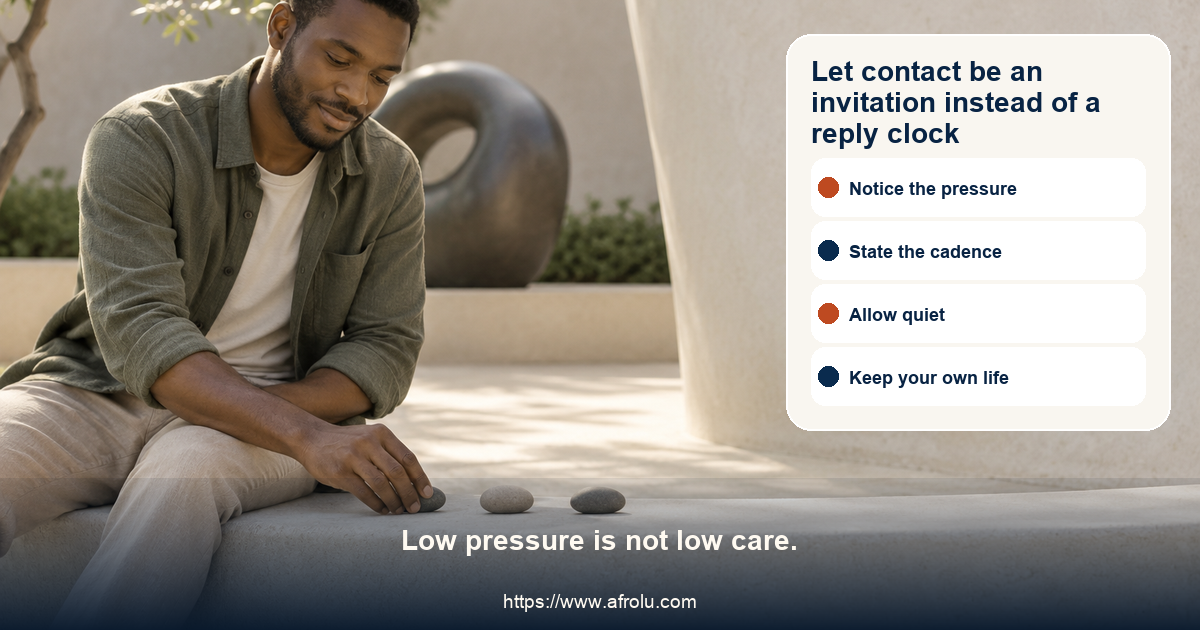
Eight distance-aware new-dating situationships where rhythm, clarity, privacy, and safety change the next move
Closeness before terms
Two adults have hours of conversation but have not discussed what contact or casual dating means to either of them.
Ask one present-tense question about the rhythm or scope.Silence becomes evidence
A late reply is read as a verdict because neither person has named ordinary availability.
Agree on a communication expectation or decide the mismatch is real.One person wants less intensity
A new starter enjoys the connection but needs more quiet between calls and messages.
Offer the pace clearly instead of fading to create it.Distance becomes a reason for access
A person asks for location, private images, an account, or immediate video proof.
Keep access gradual and decline what you do not choose.Warm messages create momentum
A planned meeting begins to feel like a debt after days of conversation.
Use independent logistics and keep consent current on the day.Connection becomes a payment route
A distance-aware situationship is used to request money, a transfer, code, or document.
Keep money and systems separate; verify outside the connection.A gap is followed by intensity
A person returns after quiet time and wants immediate access to the old level of closeness.
Choose a smaller current step or decline to reopen it.A contact limit becomes pursuit
Blocking leads to new accounts, repeated calls, threats, or monitoring.
Reduce access and use appropriate safety support.Fourteen observable signs that a distance-aware situationship is mutual, unclear, pressuring, controlling, or unsafe
Both people can name the communication rhythm they are trying.
A quiet period can be explained or accepted without monitoring.
A clarity question receives a usable answer or an honest uncertainty.
A low-pressure pace still includes plans that are confirmed and respected.
You can keep one communication channel under your control.
Location, private images, routines, and accounts remain gradual.
A planned meeting has independent arrival, exit, and current consent.
Neither adult has to stay awake, abandon obligations, or perform availability to keep interest.
A return after a gap includes a present plan rather than instant entitlement.
Money, documents, codes, and transfers remain outside the connection.
A no does not produce escalating calls, accounts, tracking, or threats.
Your life away from the phone remains visible and nourishing.
Both adults can revise a rhythm without punishment.
Fear or coercion changes the response from coordination to safety.
A proportionate decision map for communication, expectations, consent, access, meetings, returns, money, and safety
| Situation | What it may mean | What to do next |
|---|---|---|
| A long call feels like a relationship | Emotional intensity may be outrunning shared terms. | Ask what contact or casual dating means now. |
| Replies slow down | Capacity, preference, or fit may have changed. | Ask once if an answer would change your plan. |
| You want fewer messages | The current cadence may exceed your capacity. | Name a lower-pressure rhythm you can sustain. |
| They want constant contact | Their need may not match your availability. | Offer your limit and let them choose their response. |
| They request video or location proof | Distance may be getting used to seek unearned access. | Keep channels and details under your control. |
| You plan to meet | Warm contact can create a false sense of obligation. | Choose independent logistics and current consent. |
| They ask for money | The situation has moved beyond ordinary ambiguity. | Decline and verify any urgent story independently. |
| They reappear intensely | A return may be sincere but is not a command to resume. | Choose a smaller fresh step if interested. |
| You need to end it | The rhythm may be a mismatch even without wrongdoing. | Use a concise close or step back. |
| You feel afraid | The issue is safety, not distance management. | Seek trusted, specialist, platform, or urgent support. |
Twelve complete lines for rhythm, clarity, privacy, consent, a meeting, a return, and an ending
“I enjoy talking with you, and I want to find a rhythm that does not require either of us to be always available.”
“What are you open to at the moment: occasional contact, regular plans, or something else?”
“I do not expect instant replies, but I would like us to say when a plan changes.”
“I need more space between calls, and that is how I can keep this enjoyable.”
“I am staying on this channel while I get to know someone.”
“I do not share live location or proof of where I am.”
“Before we take that step, I want to talk about what each of us is comfortable with now.”
“I will make my own way there and leave when I am ready.”
“I can consider a short catch-up, but I am not going back to an undefined contact pattern.”
“I do not mix dating with transfers, account help, codes, or documents.”
“This rhythm is not working for me, so I am stepping back.”
“Do not contact me again.”
Know the difference
A low-pressure rhythm and a low-information pattern create very different situationships
Both adults choose a realistic cadence, accept quiet, name changes, keep access gradual, and make room for a free no.
Messages feel urgent, terms remain unclear, one person manages reassurance, and digital access becomes a substitute for trust.
Distance is not the problem; a pattern that makes one adult carry all uncertainty is.

Compare the pattern before you give more access.
Keep a low-pressure mutual rhythm distinct from a low-information pattern and conduct that reduces freedom
| Type or dimension | What it describes | Best next question |
|---|---|---|
| A chosen cadence | It makes availability and quiet legible. | Use it until both people want to revise it. |
| A reply clock | It turns message timing into proof of interest. | Name the pressure and choose a sustainable pace. |
| A direct question | It asks one fact that changes a decision. | Hear the answer and act on it. |
| A story-filled silence | It invites one person to infer what was never said. | Ask once or release the assumption. |
| A planned meeting | Both adults retain an independent route and current consent. | Keep the scale easy to alter or end. |
| Digital pressure | Location, images, proof, or accounts become a loyalty test. | Keep access gradual and reduce it if pressure continues. |
| Observable repair | A return includes a present plan and respect for your pace. | Start smaller if you choose to restart. |
| Financial manipulation | Urgency or affection is used to seek systems or money. | Decline and verify through independent channels. |
| Fear or pursuit | A boundary creates repeated contact, monitoring, threats, or blackmail. | Use safety support and stop direct negotiation. |
A simple plan you can use today
Distance needs a rhythm, not a fantasy
A small shared pattern gives a connection more useful shape than imagined certainty.
Quiet can be ordinary
A delayed reply is not a verdict when both people can name what availability looks like.
Low pressure still contains information
You can ask about one practical expectation without making a new connection heavy.
Digital intimacy remains chosen
Calls, images, location, and private access need present consent rather than accumulated momentum.
A meeting is a new moment
Warm communication does not create an obligation to meet, stay, or be intimate.
Safety is not a pacing preference
Money requests, coercion, monitoring, threats, and fear demand protection.
Questions organised by purpose and depth
Choose a few prompts that fit the moment. This is a reference library, not a list to complete.
Find your rhythm
Describe a pace that remains enjoyable.
- What amount of contact leaves me rested?
- How do I want plans to be confirmed?
- What kind of quiet can I accept?
Ask one question
Choose information that changes a decision.
- What do I need to know now?
- What answer would make me step back?
- What can I offer without overextending?
Protect access
Keep digital and in-person choice visible.
- Which channel feels under my control?
- What details remain private?
- Can I leave a plan easily?
Read the category
Respond to the actual pattern.
- Is this an ordinary mismatch or pressure?
- What evidence do I have?
- Who could support me if I feel unsafe?
What deserves a closer look
Make ordinary availability visible
Discuss the kind of messaging, calls, quiet, and plan changes each adult can genuinely sustain.
Evidence limit: Do not turn a cadence into surveillance.
Ask one present-tense question
Choose the fact that affects your next decision and let the answer guide you.
Evidence limit: Do not demand a future promise to avoid a current choice.
Keep digital intimacy gradual
Retain control over channels, location, images, routine details, and accounts.
Evidence limit: Do not give access merely to prove care.
Treat in-person choice as fresh
Use independent logistics, chosen settings, and current consent on the day.
Evidence limit: Do not let messages create a debt to meet or stay.
Read a new invitation through conduct
Choose a modest current plan and see whether the person respects your rhythm.
Evidence limit: Do not restore old access automatically.
Protect freedom when the pattern changes
Use blocking, reports, trusted people, specialist support, or urgent help for money pressure, coercion, monitoring, threats, or fear.
Evidence limit: Do not negotiate with a pattern that narrows choice.
Shortcuts that turn a new distance-aware connection into monitoring, unwanted access, pressure, or risk
Using message volume as proof
Intensity can feel like information while leaving the real terms unspoken.
Fading to create a lower pace
Silence may recreate the uncertainty you are trying to escape.
Giving access to quiet anxiety
Location, images, accounts, and constant video proof do not create earned trust.
Treating a call as a commitment
A warm conversation does not settle exclusivity, contact, or consent.
Planning around an unconfirmed idea
Standby time can make distance feel more costly than it is.
Calling coercion a distance problem
Pressure, money, monitoring, threats, and fear require safety action.
Set a boundary, ask a low-pressure question, or work through a distance-aware worry
Choose the resource that fits the decision in front of you. A guide can help you name a preference, but it cannot promise another adult's interest, availability, or conduct.
Explore the guide library
Show more related guides
Continue with Afrolu
Show more Afrolu guides
Sources used for this guide
Afrolu reviewed these health, research, safety, or public guidance resources while editing this page. They support the behaviour and safety guidance; they do not diagnose any individual described by a reader.
Questions about low-pressure distance-aware situationships in new dating
What is a distance-aware situationship?
It is an undefined or partly defined connection where distance between routines affects communication and planning. The key issue is whether the rhythm and boundaries remain mutual and freely chosen.
How often should we talk?
There is no universal amount. Choose a cadence that both adults can sustain and revise it openly when it no longer fits.
Is it okay to ask what they want early?
Yes. Ask about a present fact, such as contact, casual dating, other dates, or a plan. You do not need a future promise to ask for usable information.
What if they reply slowly?
A slow reply can reflect many things. Notice whether the overall pattern and any agreements work for you, then ask once or step back if the rhythm does not fit.
How can I keep it low pressure?
Avoid treating constant access as proof, agree on how plans change, protect time away from the phone, and let each adult choose their level of contact.
Do calls or messages create consent for an in-person meeting?
No. A planned meeting, touch, intimacy, images, and the decision to stay are current choices that can change at any time.
Should I share location or private images to build trust?
No. Trust can grow through consistent respect. Keep access gradual and decline requests you do not freely want to meet.
What if they return after a long gap?
Treat the return as a new invitation. You can choose a small clear step, set a different rhythm, or decline without owing a reopening.
What if they ask for money or account help?
Keep money, transfers, documents, codes, and accounts separate from dating. Verify claims independently and decline financial involvement.
What if I feel pressured or afraid?
Reduce access, use blocking or reporting tools, preserve information only when safe, and seek trusted, specialist, platform, or urgent support appropriate to the situation.
One thing to do now
Choose the next rhythm that keeps connection and freedom in the same frame
Choose the smallest next action that protects your time, attention, private access, independent movement, current consent, money, support network, and ability to slow down, redesign, or end the connection without negotiating your freedom.