Six signals for one bounded first meeting
Meet a New Long-Distance Match With Clarity
A non-medical guide to first-date anxiety in a new long-distance journey: verification, public plans, lodging, transport, money, consent and aftercare.

Regulate what is ordinary, clarify what is uncertain and act on concrete danger.
Written and edited by Grace Mutiso · Kenya Guides Editor
Use six signals: body sensations, verified facts, the complete plan, response to a small boundary, independent exit and aftercare. Optional grounding may help ordinary nerves, but do not calm away identity inconsistencies, money pressure, a private venue change or a blocked return. Keep the first meeting public and time-boxed, with separate lodging, personal ticket, documents, phone, payment and transport. Travel creates no debt. Rest before deciding whether one more bounded step is worthwhile.
First dates · New Relationship Starters
Is the unease ordinary anticipation, a fixable information gap, a genuine mismatch or a response to concrete deception and visit pressure?
First-date clarity on a new long-distance journey is a non-medical decision process that distinguishes ordinary body activation from missing information, incompatibility and pressure while keeping verification, logistics, access, consent and exit explicit and independent.
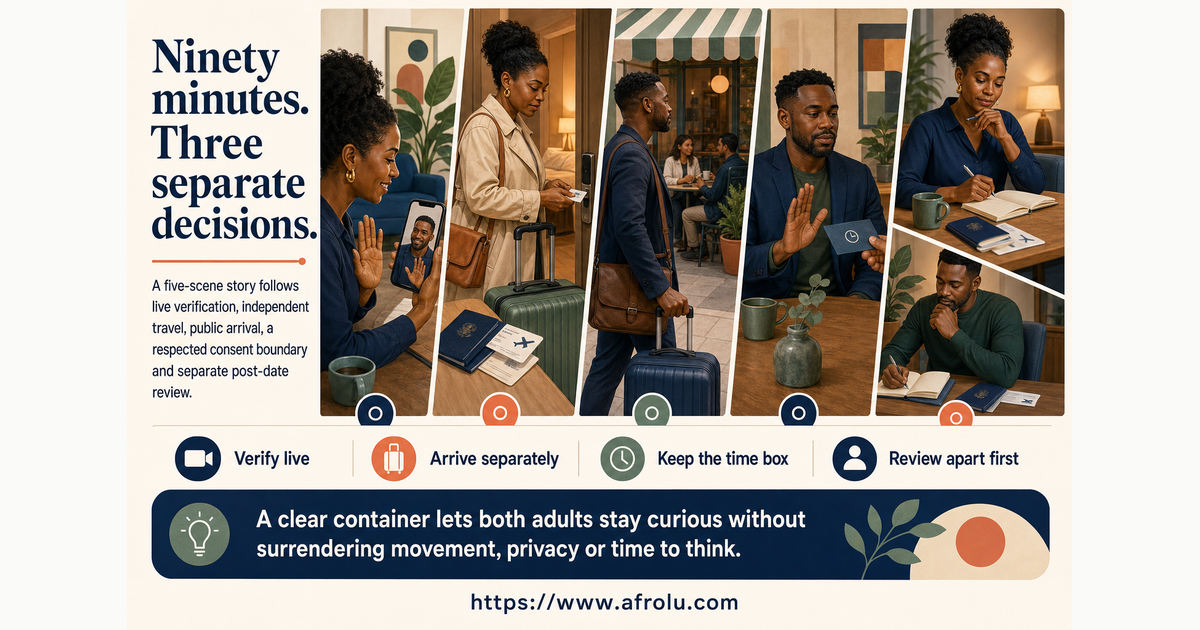
Kesi and Malik are fictional adults, 32 and 36. They verify live, arrive separately for a ninety-minute public date and keep lodging and return independent. Malik accepts Kesi's decision not to extend the venue, and both reflect before choosing another bounded meeting.
The six-signal first-meet deck
Make the first meeting small enough to read both comfort and concern
Grace separates body activation from facts, logistics and boundary response, then builds a seven-anchor arrival pack with independent aftercare.
The deck follows a fictional ninety-minute date and uses four non-diagnostic reading zones: regulate, clarify, choose and stop.
Body and facts
Notice sensation while checking what is verified and unknown.
Plan and response
Complete the logistics and test one small boundary.
Exit
Keep lodging, documents, money, phone and return controlled.
Aftercare
Restore ordinary needs before choosing another step.
Begin without diagnosing yourself
First-date nerves can ride beside a clear long-distance plan
A first in-person meeting after weeks or months of remote contact can feel larger than an ordinary date. Travel has been arranged, expectations have accumulated and both adults may wonder whether online closeness will survive the room. A faster heartbeat, rehearsed conversation or wish to cancel may be ordinary anticipation. Those sensations are information about arousal, not proof that the date will fail or that the person is safe.
Separate body sensations from concrete facts. A complete plan, consistent identity details, public venue and respectful response to boundaries may support going while nervous. Missing lodging, a sudden venue change, money pressure, document demands, identity inconsistency or anger after a no is different. Do not use breathing, positive thinking or sunk travel cost to silence a practical warning. Clarify a fixable gap, resize a mismatched plan and stop when pressure or danger makes further testing inappropriate.
The goal is not to eliminate every feeling before you leave. It is to make the first meeting small enough that you can observe. Choose a public format with a clear duration, independent arrival and return, personal phone and payment, separate lodging where appropriate and a trusted contact of your choosing. No venue or checklist guarantees safety, and current details must be checked for the actual trip.
If anxiety is persistent, intense or interfering with daily life, qualified professional support may be useful. General grounding can help some people manage ordinary stress, but it is not a diagnosis or cure. You may also decide not to meet for reasons you cannot fully explain. Consent to a date is optional, can change and answers only that plan.
Use the six-signal first-meet deck
Read body, facts, plan, boundary response, exit and aftercare separately
The body signal includes breath, muscle tension, stomach sensation, thoughts and energy. Notice without turning the experience into a verdict. The facts signal covers live contact, consistency, what is independently confirmed and what remains unknown. A video call reduces some uncertainty but cannot prove every identity, employment, relationship or financial claim. Keep verification proportional to one modest meeting.
The plan signal includes current public venue, time box, payment expectation, lodging, transport, phone, trusted contact and return. Complexity increases load. A cross-border weekend may contain several dates and consent transitions, so break it into separate choices. The boundary-response signal asks what happens when you say no to home lodging, money, an intimate image, a ride, a longer date or physical contact. Respectful disappointment differs from bargaining, shame, threats or retaliation.
The exit signal is practical: can you leave the venue, accommodation and city without the other adult's money, vehicle, document or permission? Keep tickets, identity papers and authentication codes controlled. The aftercare signal protects recovery and interpretation. Give yourself time to eat, rest and speak with a chosen supporter before deciding whether the meeting proved an entire future.
Use all six signals together. You can go while nervous when facts and logistics are sufficiently clear and the boundary response is respectful. You can postpone a promising match because the plan is incomplete. You can leave a pleasant date because capacity is finished. You can stop a pressured visit without collecting more proof. The deck protects choice, not a predetermined outcome.
Kesi and Malik plan ninety minutes
A small first meeting lets remote hope meet present reality
Kesi, 32, and Malik, 36, had spoken remotely for six weeks. Both were beginning a new dating chapter and were open to a serious future, but had not chosen exclusivity. Before travel they used a live call and checked consistent public information without exchanging documents. Kesi chose her own hotel and ticket. Malik selected two current public cafe options near transport, and Kesi chose one.
On arrival, Kesi noticed tension and a strong urge to perform confidence. She used a brief grounding exercise she already found helpful, then checked the facts: phone charged, contact informed, route known, return controlled. The nerves remained but stopped being the only signal. Malik arrived separately and did not ask for her room or detailed itinerary.
The ninety-minute conversation was warm. Near the end, Malik suggested moving to a quieter private venue. Kesi declined and said she wanted to finish at the agreed time. Malik accepted without bargaining and helped confirm the public transport entrance without insisting on a ride. His response was useful evidence. It did not oblige Kesi to extend the date or promise another meeting.
Each adult reflected separately. Kesi distinguished ordinary awkwardness from the concrete respect she observed. Malik noticed that he had expected travel to produce a longer date and corrected that assumption. The next day they chose another public meeting. Relationship direction, exclusivity, lodging and physical pace remained separate future conversations. The first date had done enough.
Distinguish four possible readings
Nerves, uncertainty, mismatch and pressure call for different actions
Ordinary nerves may include anticipation, self-consciousness and temporary body activation while the plan remains coherent. Optional grounding, slower breathing, familiar clothing, food, rest and a smaller format may help. The action is regulate enough to observe, not force yourself to feel fearless. You may still cancel; coping skill does not create an obligation to attend.
Uncertainty is a missing fact that can be answered: which venue, how long, who pays, where each person stays, whether the profile is consistent or what happens after a delay. Ask directly and verify current logistics independently. If the information becomes clear and the response is respectful, the plan may continue. Repeated evasiveness can move the reading from uncertainty toward pressure or deception.
Mismatch means the facts are clear but do not fit: one adult wants a private weekend, the other wants a short public date; one seeks immediate commitment, the other seeks exploration; travel cost or accessibility is unworkable. Neither adult must be unsafe or wrong. Resize the plan if both want a smaller overlap, or decline. Compatibility includes format and timing.
Pressure includes identity inconsistency, urgent money, document requests, intimate-image demands, secrecy, isolated venue changes, blocked exit, surveillance or punishment after a no. The action is not to calm yourself into compliance. Stop the transaction or meeting, protect accounts and movement, preserve relevant evidence where safe and seek appropriate platform, financial, professional or emergency support.

Calm the body only after concrete facts and boundaries receive their own response.
Use eight practical sentences
Clear logistics reduce assumption load without reducing warmth
For identity, say: 'I would like a short live call before either of us travels.' For venue: 'I will meet at this public place; I am not changing to a home or room.' These requests are proportionate to one meeting and do not require passport copies, financial records or intrusive investigation. If a claim matters to safety, verify it through an appropriate independent route rather than asking romance to certify it.
For time and lodging, say: 'I can meet for ninety minutes, and I keep my own accommodation.' For transport: 'I will arrive and return independently.' A complete plan helps both adults prepare and makes changes visible. If the other person wants a longer or different format, they can ask. Your no does not require a detailed anxiety explanation.
For money, say: 'I do not send fare, carry packages or invest through a match.' For consent: 'I am not agreeing to that now.' Payment, travel, serious direction and remote intimacy create no debt. A photograph, post, ride, venue change or physical act receives its own answer. If refusal produces pressure, end the step rather than trying to deliver the perfect calming explanation.
For ending, say: 'I am finishing the date now; I will reflect and contact you later if I choose.' You may decide there is no next date. You may also say: 'I was nervous and still observed enough respect to meet again.' Clarity does not demand immediate certainty. It creates a bounded container in which either answer can be acted on.

A calm plan can be warm, direct and easy to leave.
Pack seven independent anchors
A complete arrival system leaves room for curiosity and exit
Verification should be proportionate. Use live contact and check consistency, while accepting residual uncertainty. Do not exchange documents, authentication codes or intimate images to prove seriousness. Confirm current travel, venue and accommodation details through relevant independent sources. Tell a trusted person the broad plan and choose a check-in that supports you without becoming continuous tracking.
Use a current staffed public venue and a clear duration. Separate lodging can protect rest and choice, especially on a first visit. Control ticket, identity papers, phone, payment and return. Avoid carrying packages or accepting last-minute isolated destinations. If the venue closes or transport changes, verify a public alternative or cancel. Money already spent is not a reason to accept a less safe plan.
Prepare for body activation without treating self-regulation as safety verification. Eat, hydrate, choose clothing and accessibility supports that help you stay present. A brief grounding or breathing exercise may be optional. Avoid relying on alcohol or another substance as the only route through discomfort. If symptoms are persistent or impair daily life, consider qualified care rather than building the entire date around concealment.
After the meeting, restore ordinary needs before evaluating the future. Review what was observed: consistency, public conduct, response to limits, payment expectations and whether your exit remained usable. Separate attraction, relief and gratitude from relationship status. A good first date supports another choice; it grants no access and predicts no guaranteed outcome.

The plan should remain usable if either adult changes the venue, duration or answer.
Compare eight first-date containers
Format changes the load, not the meaning of the relationship
A short live video can reduce travel and test conversational ease, but it cannot verify every claim. Public coffee or tea provides a simple in-person container. A daytime public walk can reduce table intensity while adding route, weather and accessibility load. A timed lunch permits a deeper conversation but increases duration and payment expectations. None decides whether the relationship is casual, serious or exclusive.
A structured public activity gives shared focus and natural pauses. A permission-based group event can reduce one-to-one intensity while increasing community visibility; ask before introductions, photographs or posts. A same-city day visit may contain several activities but still needs separate consent and an independent return. A cross-border weekend adds lodging, documents, money, recovery and many plan transitions.
Do not use the largest format to prove commitment. If travel is already booked, the meeting can still remain short. If video answers enough to reveal a mismatch, no in-person trip is owed. Break any longer plan into choices: venue, duration, transport, payment, audience, private space and physical contact. A yes to one cannot migrate to another.
Match the format to the evidence gap. Conversational ease may need a live call. Public conduct may need a short meeting. More complex compatibility requires repeated ordinary contexts, not necessarily a longer first date. The first date is complete when both adults can leave with enough accurate information to decide whether another bounded step is worthwhile.
Eight long-distance first-meet moments where nerves need the right reading
The heart races before departure
The plan is complete, facts are consistent and boundaries have been respected.
Use optional grounding and keep the small plan.A live call keeps being avoided
Travel is approaching while a proportionate uncertainty remains unresolved.
Postpone the meeting and verify independently.The public place changes to a room
The new plan adds privacy and exit load at the last minute.
Offer a public alternative or cancel.A booked ticket creates guilt
Money spent is being used to demand a longer date.
Keep the agreed time box; sunk cost creates no access.Separate accommodation is called insulting
A privacy boundary is being made into a trust test.
Retain lodging or postpone.An urgent fare gap appears
Romantic emotion is replacing independent provider verification.
Do not transfer and contact the relevant service directly.A good date moves toward a private venue
One adult wants to finish at the agreed public endpoint.
Accept the no; leave if pressure follows.Relief feels like certainty
The meeting ended safely and warmly, but ordinary fit remains unknown.
Rest, reflect separately and decide the next bounded step later.Signs of ordinary nerves, uncertainty, mismatch and unsafe pressure
{'label': 'Body', 'title': 'Sensations are noticed without becoming verdicts', 'detail': 'Nerves can coexist with observation and choice.', 'reading': 'Regulated'}
{'label': 'Facts', 'title': 'Identity information stays consistent enough', 'detail': 'No intrusive document exchange is required.', 'reading': 'Proportionate'}
{'label': 'Plan', 'title': 'Venue, time, payment and return are complete', 'detail': 'Changes are visible and optional.', 'reading': 'Clear'}
{'label': 'Lodging', 'title': 'Private accommodation remains independent', 'detail': 'Hospitality is not a relationship test.', 'reading': 'Bounded'}
{'label': 'Money', 'title': 'No transfer is needed to make the date happen', 'detail': 'Essential funds and accounts stay controlled.', 'reading': 'Independent'}
{'label': 'Response', 'title': 'A small no is accepted calmly', 'detail': 'Disappointment does not become bargaining.', 'reading': 'Respectful'}
{'label': 'Consent', 'title': 'Every new act receives a current answer', 'detail': 'Travel and chemistry grant nothing automatically.', 'reading': 'Voluntary'}
{'label': 'Exit', 'title': 'Either adult can end the plan', 'detail': 'Movement does not depend on the match.', 'reading': 'Leaveable'}
{'label': 'Aftercare', 'title': 'Reflection happens outside the date', 'detail': 'Relief and attraction are not forced into status.', 'reading': 'Thoughtful'}
{'label': 'Next', 'title': 'Only one bounded step is chosen', 'detail': 'The first meeting does not decide the future.', 'reading': 'Proportionate'}
Choose the next action from six signals and four reading zones
| Situation | What it may mean | What to do next |
|---|---|---|
| What kind of discomfort is present? | Fits: Ordinary anticipation sits beside a coherent plan. Needs review: One uncertainty or mismatch needs action. Stop: Pressure or danger is being minimised as nerves. | Classify facts before choosing a coping tool. |
| Is identity uncertainty proportionate? | Fits: Live contact and consistency support one meeting. Needs review: A claim needs independent checking. Stop: Identity changes, live contact is avoided or documents are demanded. | Postpone and verify outside romance. |
| Is the plan complete? | Fits: Venue, time, payment, lodging and return are clear. Needs review: One practical field is missing. Stop: The plan depends on secrecy or a private last-minute change. | Complete the field or cancel. |
| Does the format fit capacity? | Fits: The smallest useful meeting is manageable. Needs review: Duration or travel needs resizing. Stop: Sunk cost is forcing an intolerable plan. | Shorten, defer or decline. |
| Is lodging independent? | Fits: Each adult controls rest and private space. Needs review: A convenience assumption needs a boundary. Stop: Hosting is demanded or departure is obstructed. | Retain separate lodging and return. |
| Does money remain separate? | Fits: No transfer or credential is required. Needs review: Payment expectations need words. Stop: Urgent fare, investment or account access is requested. | Stop the transaction and verify independently. |
| How is a small boundary received? | Fits: The no is accepted and the plan adapts. Needs review: Disappointment needs a pause. Stop: No triggers shame, threats or repeated bargaining. | End the pressured interaction. |
| Can consent change at every stage? | Fits: Each activity and act receives a present answer. Needs review: A transition needs a new question. Stop: Travel, status or spending is treated as debt. | Stop and retain the independent exit. |
| Is the exit fully controlled? | Fits: Phone, payment, documents and return stay personal. Needs review: One dependency can be removed. Stop: Movement depends on the match's permission or vehicle. | Leave or seek immediate appropriate help. |
| What does aftercare support? | Fits: Another bounded step fits observed conduct. Needs review: More reflection is needed without escalation. Stop: The pattern requires closure and protection. | Continue, pause or close after restoring ordinary needs. |
Scripts for identity, venue, time, lodging, transport, money and consent
“I would like a short live call before either of us travels.”
“I will meet at the public venue; I am not changing to a home or room.”
“I can meet for ninety minutes and will finish at the agreed time.”
“I keep my own accommodation and will not share the address.”
“I will arrive and return independently, so please do not wait for my route.”
“I do not send fare, carry packages or invest through a match.”
“I am not agreeing to that, even though the earlier part felt good.”
“I am finishing the date now and will reflect before choosing another.”
“Your preferred first-meet format does not fit me, so I am declining it.”
“I was nervous and still observed enough respect to choose one more public date.”
Know the difference
The new-journey long-distance first-date format deck
Video, coffee, walks, activities and travel plans distribute logistics and visibility differently. The format should remain manageable and leaveable.
Serious direction, exclusivity, trust and consent cannot be inferred from distance travelled, money spent, duration or chemistry.
Choose a complete public container for today's evidence; decide status, access and any future step through separate conversations.

Choose the smallest format that answers the next question without turning travel into a test.
Compare eight long-distance first-date formats by practical load
| Type or dimension | What it describes | Best next question |
|---|---|---|
| Short live video | ||
| Public short coffee | ||
| Daytime public walk | ||
| Timed public lunch | ||
| Structured public activity | ||
| Permission-based group event | ||
| Same-city day visit | ||
| Cross-border weekend |
Build a calm and independent first meeting in six moves
Name the signal
Verify proportionately
Choose the container
Own every system
Test a small boundary
Review after rest
Questions for signals, plans, boundaries and aftercare
Choose a few prompts that fit the moment. This is a reference library, not a list to complete.
Signal questions
Separate the body from facts and pressure.
- What am I feeling?
- Which fact is missing?
- Is this a mismatch?
- Was a no respected?
- Do I need to stop?
Plan questions
Make the meeting complete and bounded.
- Is the venue public?
- What is the time box?
- Where is lodging?
- Who controls payment?
- How do I return?
Boundary questions
Keep every transition separately chosen.
- What venue change is unacceptable?
- Which data stays private?
- What money stays closed?
- What is my consent sentence?
- Can I end without debate?
Aftercare questions
Let ordinary needs return before a future verdict.
- Have I eaten and rested?
- What did conduct show?
- What remains unknown?
- Which feeling is relief?
- Is one more bounded step useful?
What official mental-health, scam, account and consent guidance can support
Persistent social anxiety is more than ordinary occasional nerves
NIMH describes social anxiety disorder as an intense, persistent fear involving social or performance situations and explains professional treatment options. Afrolu uses the source to preserve a boundary between general first-date guidance and clinical care.
Evidence limit: A webpage or dating guide cannot diagnose a reader; individual assessment belongs with qualified professionals.
Brief breathing practice may support ordinary stress
NHS guidance offers a simple breathing exercise for stress that can be practised regularly. It may be one optional preparation tool before a date while factual safety and consent decisions remain separate.
Evidence limit: The exercise is not a cure, safety test, emergency response or substitute for personal medical advice.
Practical skills can help make room for difficult feelings
WHO's illustrated guide offers general skills such as grounding, unhooking from difficult thoughts and acting on values. The relevant lesson is that discomfort can be noticed without forcing attendance or ignoring danger.
Evidence limit: General self-help guidance is not diagnosis, treatment or emergency support.
Pre-meeting money requests are a separate risk signal
FTC guidance warns about dating-app matches asking for money after remote trust-building. A complete travel plan should not depend on transfers, account access, packages or investment through the match.
Evidence limit: The guidance cannot determine whether one person is genuine and its reporting routes are U.S.-specific.
Strong account security preserves a new journey
CISA recommends strong unique passwords, multifactor authentication, software updates and phishing awareness. Remote intimacy and planned travel are not reasons to share credentials or verification codes.
Evidence limit: Security practices reduce risk but cannot verify identity or guarantee personal safety.
Consent remains informed, voluntary and reversible
The Australian Department of Health explains that sexual consent is a free, voluntary and informed agreement and that a person can decide to stop at any time. Travel, lodging, gifts, chemistry and relationship direction cannot decide a new physical or digital act.
Evidence limit: Health and legal routes vary by country; use appropriate local professional and emergency support.
Six ways anxiety or travel cost can distort the first meeting
Use a reviewed resource that matches the decision
This guide focuses on the relationship decision, so it does not rank dating apps. Check current prices, safety tools, and local availability before choosing a service.
Explore the guide library
Show more related guides
Continue with Afrolu
Show more Afrolu guides
Official mental-health, stress, scam, account-safety and consent sources
Afrolu reviewed these health, research, safety, or public guidance resources while editing this page. They support the behaviour and safety guidance; they do not diagnose any individual described by a reader.
First-date anxiety questions for a new long-distance journey
Is first-date anxiety normal before meeting a long-distance match?
Some anticipation, self-consciousness and body activation can be ordinary, especially when travel and remote expectations make the meeting feel significant. This guide cannot diagnose you. Separate sensations from facts: check identity consistency, plan completeness, boundary response and exit. If anxiety is persistent, intense or impairs daily life, qualified professional support may help.
How can I distinguish nerves from a warning sign?
Nerves can coexist with a coherent public plan and respectful conduct. A warning is a concrete fact such as identity inconsistency, avoided live contact, urgent money, a private last-minute venue, document demand, blocked exit or punishment after a no. Clarify a fixable uncertainty, resize a mismatch and stop pressure without waiting for perfect certainty.
Is a video call enough to verify a long-distance match?
No. Live contact can reduce uncertainty and test consistency but cannot prove every identity, employment, relationship or financial claim. Use proportionate independent checks for one modest meeting, then keep venue public and lodging, documents, money, transport and return controlled. Do not exchange sensitive documents as romantic proof.
Should a first long-distance date last the whole weekend?
No. Travel length does not determine date length. A ninety-minute public meeting may be complete, with additional activities chosen separately later. Use a time box that fits capacity and keep accommodation independent. Sunk cost creates no entitlement to a longer date, private venue, physical contact or future commitment.
Should I stay with the match to reduce travel cost?
Separate lodging is a strong first-meet option because it preserves rest, address privacy and exit. If it makes the trip unaffordable, postpone or choose a lower-load format rather than creating dependence. A genuine match can respect independent accommodation. Confirm current travel and lodging details through appropriate sources.
What should I do if the venue changes at the last minute?
Verify a current staffed public alternative independently or cancel. You do not have to accept a home, room, vehicle or isolated place because travel is booked. Keep your ticket, documents, phone, payment and return. Tell your chosen contact about a legitimate change and leave if pressure or obstruction appears.
Should I send fare if the match cannot reach the date?
Do not let urgency or travel emotion replace independent verification. Choose a plan each adult can fund or postpone. Contact a provider through an official channel if a booking claim matters. Never share authentication codes, carry unexplained packages or invest through a match. Use appropriate financial and reporting support after loss.
Can I use alcohol to calm first-date anxiety?
Do not rely on alcohol or another substance as the only route through discomfort. It may affect judgement, coordination and consent. Choose a shorter daytime plan, use familiar non-medical coping tools if helpful and seek qualified support for persistent anxiety. You can cancel; no coping strategy makes attendance obligatory.
Do I owe physical affection after someone travelled far?
No. Travel, lodging, meals, gifts, remote intimacy and serious direction create no physical debt. Consent is specific, voluntary and reversible. Ask at the relevant moment and accept no. Keep an independent exit and leave if spending or sacrifice is used to pressure, shame or obstruct your choice.
How soon should I decide whether the relationship is serious after meeting?
There is no required deadline. Restore ordinary needs and review what you observed: consistency, public conduct, response to limits, payment expectations and how the exit worked. A good first date may support another bounded meeting. Relationship direction, exclusivity, lodging, money and future geography each need separate conversations and more ordinary evidence.
One thing to do now
Make the first meeting small enough for truth and choice
Read six signals and four zones. Regulate ordinary nerves when facts and logistics are coherent. Clarify one missing fact, resize a mismatch and stop pressure or danger. Close or leave when identity deception, urgent money, document demands, isolated venue changes, blocked movement or retaliation after a no reduces agency.