Three rooms for one small return to dating
Try One Low-Pressure First Date Without Exposing Your Career
A three-room plan for first-date anxiety during a career change, with a public hour, independent exit, work privacy and calm review.
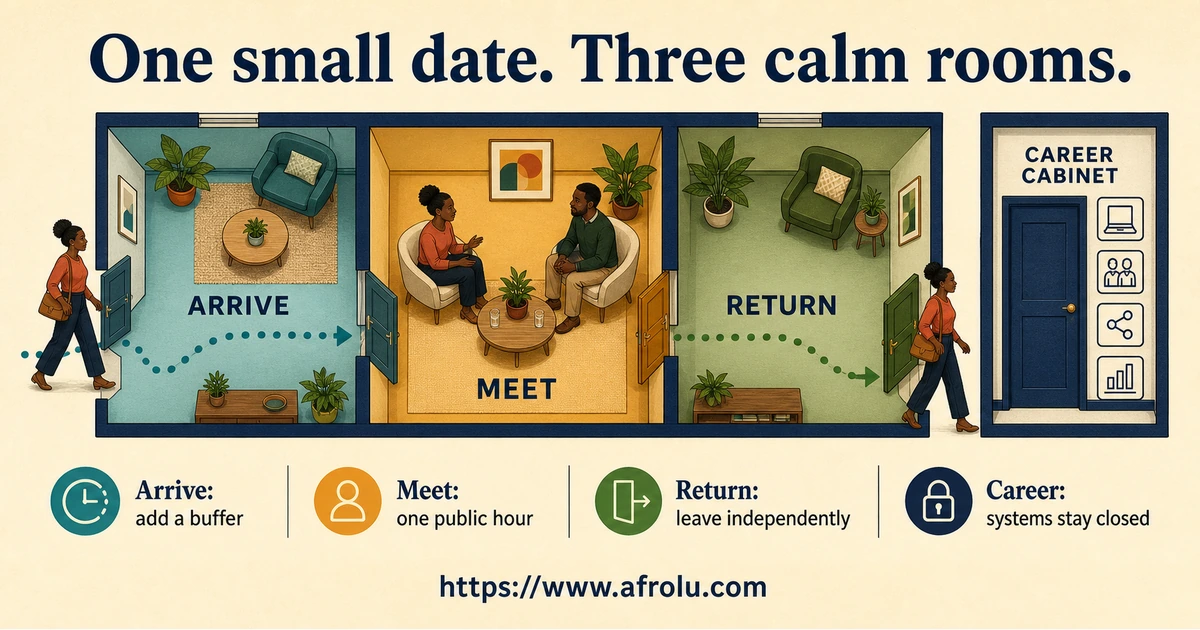
Arrive, meet and return through three rooms; keep the career cabinet closed.
Written and edited by Tariro Ncube · Diaspora Dating Editor
Use a three-room re-entry studio. Arrive through a short buffer that separates work from the date without demanding perfect calm. Meet for a bounded period at a staffed public venue with a modest cost, a stated end and independent transport. Return on your own route and delay the future verdict until the body settles, unless conduct requires immediate action. Keep a separate career cabinet closed: employer systems, clients, applications, colleagues, devices, credentials, referrals, investments, accounts and essential money never become proof of interest. Sort internal nerves, respectful incompatibility and observable boundary violations into different categories. After rest, review recovery, fit, conduct and career separation, then choose no, maybe later or one more small date.
First dates · New Relationship Starters
How can I try one small first date while a career transition already uses my attention, and keep nerves separate from fit, safety and professional access?
First-date anxiety during a career transition is anticipatory worry around an unfamiliar social meeting while another major life change already uses attention and capacity. The three-room re-entry studio makes the date a small reversible experiment—arrive, meet and return—while a separate career cabinet protects professional systems, people, money and reputation.
Zuri and Ben are fictional adults, 32 and 35. During Zuri's first month in a new role, they plan Saturday coffee from eleven to noon. Zuri buffers away from work, shares only broad career context and declines Ben's referral question. He accepts it and returns to personal conversation. Zuri leaves on time using her own route. The next day she reviews recovery, fit, conduct and career separation and chooses one more small public date.
The new-career three-room re-entry studio
Let one social hour sit beside the career transition rather than inside it
Tariro treats nervousness with care while keeping diagnosis, professional access and the pressure to perform outside the first-date plan.
The studio prepares an arrival buffer, bounded public meeting and independent return, then reviews feeling, fit, conduct and career separation.
Arrive
Leave a familiar transition between the career day and the social experiment.
Meet
Use a staffed public place, modest duration, clear cost and stated end.
Return
Leave independently and postpone the future verdict until recovery.
Career cabinet
Keep systems, people, referrals, accounts and essential money purpose-specific.
Two transitions do not need one giant leap
Make the first date smaller than the career change already in progress
A new job, business, training period, career return or professional pivot already asks an adult to tolerate uncertainty, meet people and learn unfamiliar systems. Returning to dating at the same time may make a first meeting feel unusually loaded. The useful response is not to expose more of the new career to create intimacy. It is to make the social experiment small enough that curiosity can coexist with protection.
First-date anxiety means anticipatory worry about an unfamiliar meeting. It may include butterflies, rehearsing, self-consciousness, an urge to cancel or difficulty concentrating. Those experiences can be ordinary. This guide cannot diagnose an anxiety disorder. Persistent fear that lasts, causes marked distress or interferes with work, relationships or daily life deserves discussion with a qualified health professional. A date should not become treatment imposed by a match.
Separate feeling, fit and conduct. Feeling is the internal experience before or during uncertainty. Fit includes different schedules, ambitions, spending preferences or desired relationship direction that can be discussed respectfully. Conduct includes observable actions such as deception, refusal to accept an end time, pressure for home or workplace access, financial grooming, tracking, threats or retaliation. A strong feeling alone proves none of those categories.
Choose a low-pressure plan that is still complete: a staffed public venue, one hour or another manageable duration, a cost that protects essentials, independent transport and a clear end. Share the plan with a trusted person if useful. Use a personal channel. The date can learn about the broad career transition without receiving employer, client, application, device, account, financial or referral access.
The three-room re-entry studio
Arrive, meet and return while the career cabinet stays outside the floor plan
The arrive room begins before the venue. Put a transition between work and the date: close the laptop, change location, eat, take prescribed medication as usual, breathe, walk or sit quietly. Choose something familiar rather than constructing a perfect version of yourself. A buffer cannot guarantee calm, but it prevents the meeting from beginning inside the last work emergency.
The meet room has a confirmed public place, manageable duration, independent spending and a visible end. Prepare two or three genuine questions, not an interview. The aim is to notice conversation, fit and conduct. You can say that you are beginning a new career chapter while keeping employer, clients, applications, colleague identities and live schedule broad. Privacy is not dishonesty when the withheld detail is unrelated to the date.
The return room belongs to the dater again. Leave at the stated time even if the date is pleasant. Use your own route. Do not decide the entire future while adrenaline, disappointment or relief is high. Record a few facts if useful: what happened, what fit, how limits were handled and which feeling remains after rest. You owe no immediate second-date promise because the other person travelled, paid or enjoyed the meeting.
The career cabinet stays closed across all three rooms. It contains work and personal-device access, passwords, confidential material, internal calendars, colleagues, references, clients, opportunities, applications, account details and essential money. A first date can hear values, interests and broad career context without touching any of it. Later access remains a separate purpose-specific decision, not a reward for chemistry.
Zuri and Ben complete one hour
A respectful end time makes room for a real next choice
Zuri and Ben are fictional adults, 32 and 35. Zuri has returned to dating during her first month in a new role. She feels excited and exposed. They choose Saturday coffee rather than meeting after a demanding workday. Zuri confirms she can stay from eleven to noon, sets a modest spending limit and arranges her own return. She gives a trusted friend the public plan.
Before leaving, Zuri spends twenty minutes away from work alerts. She does not try to eliminate every nervous feeling. At the café, she tells Ben that she is enjoying a new professional chapter and wants a gentle dating pace. She does not name the employer or open her calendar. Ben asks what she likes about the work rather than what connections the role could provide.
Halfway through, Ben mentions that he is looking for a referral in Zuri's field. Zuri says she does not mix first dates with referrals. Ben says he understands and returns to the conversation without presenting a résumé, pressing for a name or suggesting that help would prove interest. The awkward moment becomes useful because his behaviour changes immediately.
At noon, Zuri leaves as planned even though the conversation improved. Ben does not bargain for another venue or follow her transport. The next morning, Zuri reviews the facts: her body settled after the opening minutes, their relationship directions may fit, the referral boundary held and work remained separate. She chooses another short public date. The first date succeeded by becoming complete, not by becoming long.
The three-tray sorter
Give nervousness, incompatibility and unsafe conduct different responses
The feeling tray might contain a racing mind, rehearsed answers, butterflies or fear of being judged while the plan remains public and the other adult respects limits. Use the arrival buffer, slow the conversation, take a bathroom break, shorten the date or leave if you want. You do not need to prove that the feeling is rational before responding kindly to your body.
The fit tray holds honest differences: Ben wants frequent weekday dates while Zuri protects a career transition; one adult wants marriage and the other is exploring; their budgets or social preferences differ. Ask one or two direct questions. Offer a workable alternative. If the lives do not fit, decline without turning the mismatch into a safety accusation or a verdict on worth.
The conduct tray holds observable pressure: a date changes the public venue to a private place, refuses the end time, demands a referral, investment, confidential detail or device access, follows the return route, contacts the workplace, monitors online activity, threatens reputation or ignores a physical no. Use the exit. Preserve relevant evidence and seek venue, workplace, platform, legal, advocacy or emergency support appropriate to the risk.
Do not let charm empty the conduct tray. A prestigious job, shared contacts, perfect manners or a calming first half cannot cancel a later violation. Do not let anxiety fill it without evidence either. The sorter is not a demand to override intuition; it is a way to pair facts with response while keeping the right to leave for any reason. No one owes a date merely because danger cannot be proved.

Name the tray before choosing the response: regulate, discuss or leave.
One sentence per room
Use language that makes the date small without making your boundaries negotiable
For the plan, say: ‘I am returning to dating slowly and can meet at this public café from eleven to noon.’ The sentence is interested and bounded. If the other adult wants a longer date, they can accept this one and discuss another later. Repeated bargaining before the meeting is information; reducing the plan further or cancelling remains available.
For work, say: ‘I am excited about a new role, and I keep my employer, applications, clients and live schedule private.’ Share values or broad field context if you choose. Do not open a device to prove the story. If the career transition involves public information, decide what depth is comfortable before the date rather than under live pressure.
For access, say: ‘I do not give referrals, invest, lend, share accounts or open professional systems through a new dating connection.’ A legitimate opportunity can use an independent ordinary process. Romance should not accelerate due diligence or make a person responsible for another adult's career. If a money transfer is requested, stop and verify outside the relationship.
For an exit, say: ‘I said this plan ends at noon, and I am leaving now.’ A full explanation is optional. If workplace or transport contact continues later, preserve relevant messages, secure exposed accounts and alert appropriate support. Anxiety can make leaving feel impolite; the plan already supplied the polite ending. Safety does not require one more private conversation.

Offer the date, name the limit and keep every career permission separate.
Protect the new chapter
Keep work, money, digital access and consent separate from first-date reassurance
A career transition may involve probation, applications, new clients, confidential onboarding, shared devices or uncertain income. Give those systems stronger boundaries, not more disclosure. Use personal contact rather than employer email or collaboration tools. Keep devices locked and follow workplace requirements. A date does not need colleague names, references, internal documents, codes or a tour of the workplace.
Money uncertainty can make a persuasive opportunity feel especially attractive. Do not invest, transfer, borrow, co-sign, receive funds or buy an alleged opportunity because a first connection offers a shortcut. Do not reveal balances, application details or financial credentials. Verify any genuine product or role through sources you locate independently and obtain qualified advice where the consequences justify it.
Care for the body without turning the date into a test of recovery. Eat, hydrate, limit substances according to your own health needs, preserve sleep and use familiar coping or prescribed care. The other adult may be kind but is not automatically a clinician. If anxiety is persistent or interferes with work and relationships, qualified support can help. Choosing not to date right now is also a valid adult decision.
Consent stays activity-specific. Career admiration, a paid bill, a successful date, vulnerability about anxiety, a ride or a second invitation does not supply touch or sex. Ask and accept changes. For individual sexual-health decisions, use qualified healthcare. If coercion or assault occurs, prioritise immediate safety and appropriate local medical, advocacy, legal or emergency support rather than self-blame.
The twenty-four-hour re-entry review
Review after rest—unless conduct requires immediate action
First, check recovery. Did the body settle after the initial uncertainty, during the return or after sleep? Which support helped? A difficult recovery does not prove that Ben was dangerous; it may show that the plan was too demanding or that dating is not the right choice now. If symptoms persist or interfere broadly, speak with a qualified health professional rather than using another date as a diagnostic experiment.
Second, check fit. Did conversation reveal compatible intentions, pace, availability, spending and respect for a career transition? A pleasant hour can coexist with a schedule mismatch. Decide whether one more small date would answer a real question. Do not schedule it merely to reward the other adult, prove courage or avoid seeming inconsistent.
Third, check conduct. Was identity broadly consistent? Did the venue and end time hold? Were questions accepted when you declined detail? Did touch require a present yes? Any repeated boundary violation, stalking, financial pressure, threats or workplace intrusion can justify immediate ending and support; the twenty-four-hour pause is not a waiting requirement for safety.
Finally, check the career cabinet. Did employer, client, application, device, account, referral and money access remain closed? Choose no when there is no interest, fit or safety. Choose maybe later when the transition needs capacity but conduct was respectful. Choose one more small date when curiosity remains and the plan worked. The purpose is not to eliminate every nerve. It is to preserve authorship of both new beginnings.

After rest, review recovery, fit, conduct and career separation; then choose no, maybe or another small date.
Eight first-date moments where a small plan protects a new chapter

A safe plan can still feel significant
Zuri has verified the venue and arranged her return, yet her mind keeps rehearsing every possible mistake.
Use the arrival buffer, reduce performance goals and retain the right to leave without calling the feeling a prediction.Different availability may simply not fit
Ben wants spontaneous weekday evenings while Zuri needs predictable weekends during onboarding.
Offer one sustainable rhythm and decline if neither adult wants the other's workable plan.Broad context can be honest enough
A date asks where Zuri works and assumes reluctance to name the employer means she is hiding something.
Share the field at the depth chosen, keep employer and live location private and notice whether the boundary is accepted.A first date is not an access interview
Conversation shifts to who Zuri can introduce and whether she will forward a résumé.
Decline the referral and return to personal conversation; leave if access remains the focus.A new chapter can attract a false shortcut
A polished date offers a private investment or business opportunity tied to Zuri's fresh start.
Transfer nothing, disclose no account details and evaluate any real opportunity independently.Enjoyment does not cancel the planned exit
The hour goes well, and the date repeatedly asks Zuri to continue at a second venue after she says no.
Leave on the independent route; repeated bargaining is conduct evidence.A surprise office visit changes the category
After Zuri declines another date, the match finds her new workplace and appears to demand an explanation.
Do not meet privately; preserve evidence and alert workplace and local support appropriate to risk.A hard day after does not force another exposure
The date was respectful, but Zuri remains exhausted and cannot focus on the new role.
Choose maybe later or pause dating, protect rest and seek qualified support if distress persists or interferes broadly.Evidence to sort feeling, fit and conduct without guessing
The date has a confirmed staffed public venue, manageable duration, cost limit and independent return.
A transition buffer separates work or study from the meeting without requiring perfect calm.
The dater can share broad career context without naming employer, clients, applications or live schedule.
Personal contact stays outside employer email, team chat and managed work systems.
Different schedules or relationship directions can be discussed without pressure or character attacks.
The stated end time remains complete even when the date is pleasant or the other person paid.
A referral, opportunity or money request can be declined without attention or affection being withdrawn.
Devices, passwords, documents, accounts and professional contacts stay individually controlled.
Touch and intimacy are requested in the present rather than inferred from vulnerability or effort.
A mistaken question is followed by acknowledgment, topic change and no repeated access attempt.
Post-date reflection uses facts, fit and recovery rather than a demand to reward courage.
Repeated contact, tracking, workplace intrusion, threats or coercion triggers an exit and appropriate support.
Match nerves, mismatch, access pressure and recovery with the right response
| Situation | What it may mean | What to do next |
|---|---|---|
| Nerves rise before a complete public plan | Anticipation around uncertainty | Use the buffer, shorten or cancel if desired and avoid treating the feeling as proof. |
| Two calendars do not match | A possible lifestyle incompatibility | Offer one sustainable rhythm and accept a respectful no. |
| A date asks your broad field | Ordinary getting-to-know-you curiosity | Share only the depth you want and keep identifying systems private. |
| The employer name is demanded | Curiosity is crossing a stated privacy boundary | Repeat the limit once and observe whether the topic changes. |
| A referral is requested | Professional access is entering the date | Decline and direct any legitimate application to the ordinary process. |
| An investment is tied to the fresh start | Financial urgency is being wrapped in hope | Transfer nothing and verify outside the relationship. |
| The hour ends pleasantly | The experiment was complete | Leave on time and decide later without extending from guilt. |
| The private extension is pressed | The end or venue boundary is not being accepted | Use the independent exit and seek venue support if needed. |
| A date asks before touch | Present consent is being treated as answerable | Give the answer you want and notice whether it remains complete. |
| Work contact appears after a no | Personal rejection is becoming workplace intrusion | Preserve evidence and alert appropriate workplace or local support. |
| Recovery takes longer than expected | The plan or current timing may exceed capacity | Pause, resize and seek qualified help if distress persists or impairs life. |
| Curiosity remains and boundaries held | One more small date may answer a real fit question | Repeat the bounded plan rather than escalating every permission. |
Scripts for date size, career privacy, referrals, money and exits
“I am returning to dating slowly and can meet at this public café from eleven to noon.”
“I am excited about a new career chapter, and I am protecting a gentle pace while it settles.”
“I can share my field, but my employer, applications, clients and live schedule stay private.”
“Please use my personal number. My work email and team channels stay for work.”
“I do not make referrals or professional introductions through a new dating connection.”
“I do not invest, lend, transfer or share accounts through a first-date relationship.”
“This plan ends at noon, and I am leaving on the route I arranged.”
“I am not moving this first date to a home, hotel or unconfirmed place.”
“Please ask before touch. My answer can be different at any point.”
“Your spontaneous weekday rhythm and my protected transition do not fit, so I am declining another date.”
“The date was respectful, but I need more capacity before dating again. I am not making another plan now.”
“I asked you not to contact my workplace. I am ending contact and taking steps to protect access.”
Know the difference
First-date nerves, incompatibility and danger require different evidence
Anticipatory worry about an unfamiliar meeting. It may be ordinary or part of a broader concern, but the feeling alone does not diagnose danger or incompatibility.
Conduct such as deception, ignored boundaries, tracking, financial grooming, workplace intrusion, threats or coercion that removes safe choice.
Incompatibility sits between them as a respectful mismatch in pace, schedule, intent or lifestyle. Ground a feeling, discuss or decline a mismatch and leave or seek support for harmful conduct.

Use different evidence and a different response for feeling, fit and harmful conduct.
Compare ordinary nerves, persistent anxiety, incompatibility and danger
| Type or dimension | What it describes | Best next question |
|---|---|---|
| Ordinary first-date nerves | A temporary feeling around uncertainty or evaluation | Would a smaller public plan feel manageable? |
| Persistent anxiety | Fear or worry that may last and interfere across daily life | Would qualified health support be useful? |
| Incompatibility | A respectful mismatch in schedule, intent, pace or lifestyle | Is there one workable alternative, or should we decline? |
| Safety concern | Observable conduct that restricts choice or creates harm | Which exit and support fit the present risk? |
| Low-pressure date | A bounded, reversible plan with modest consequence | Are time, place, cost and return complete? |
| Slow dating | A deliberate ongoing pace with rhythm, effort and review | Does the pace remain mutual after date one? |
| Career privacy | Purpose-specific limits around professional people and systems | What broad context is enough for this date? |
| Career secrecy | Material facts are hidden to deceive a relevant decision | Which fact actually affects informed relationship choice? |
| Referral request | A request to spend professional trust or influence | Can the ordinary public process be used instead? |
| Financial grooming | Connection is used to move toward transfers, investment or account access | Can contact and money be separated immediately? |
Build a three-room first-date re-entry studio
Build the arrive room
Add a familiar buffer between the career day and the date without requiring every nerve to disappear.
Bound the meet room
Confirm a public place, manageable duration, cost and independent return before movement begins.
Lock the career cabinet
Keep employer, clients, applications, devices, referrals, accounts and essential money outside proof.
Sort the evidence
Separate internal feeling, respectful mismatch and observable harmful conduct before choosing a response.
Complete the return room
Leave at the stated time, use the independent route and avoid an immediate future promise.
Review after rest
Check recovery, fit, conduct and career separation, then choose no, maybe or another small date.
Questions organised by arrive, meet, return and review
Choose a few prompts that fit the moment. This is a reference library, not a list to complete.
Arrive
Separate the career day from the date without demanding perfect calm.
- What buffer is realistic?
- Have I eaten and planned transport?
- Which feeling is present?
- Who can hold the public plan?
- Do I still choose to attend?
Meet
Make the one social experiment complete and bounded.
- What time does it end?
- Which broad career context is enough?
- What fit question matters?
- Which access stays closed?
- Can either adult say no comfortably?
Return
Protect the independent exit and postpone the future verdict.
- How do I leave independently?
- Did the end time hold?
- What facts should I remember?
- What can wait until tomorrow?
- Is any immediate support needed?
Review
Choose the next step from recovery, fit, conduct and separation.
- Did my body settle?
- Did our lives seem compatible?
- Were boundaries respected?
- Did career systems remain closed?
- Do I choose no, maybe or another small date?
What mental-health, work, device, safety and consent guidance can support
Dating can be a setting in which social anxiety appears
NIMH explains that social anxiety disorder can involve fear of scrutiny in situations including meeting new people, dating and job interviews, and that symptoms must persist and interfere with life for diagnosis. Afrolu uses this to distinguish ordinary nerves from a condition requiring qualified assessment.
Evidence limit: A public information page and this guide cannot diagnose a reader; symptom duration, severity and impairment need professional evaluation.
Work conditions and change can affect mental health
WHO identifies workloads, inflexible hours, low control, job insecurity and conflicting home-work demands among psychosocial risks at work and describes supportive workplace action. A career transition can therefore deserve capacity without becoming a dating diagnosis.
Evidence limit: Population guidance cannot explain one person's symptoms, employer duties or treatment needs.
Personal devices carrying work access create security and privacy risks
NIST's BYOD practice guide describes challenges when personal devices access organizational resources. The narrow dating lesson is to keep passcodes and work access private and follow the responsible organization's policies.
Evidence limit: The NIST publication is U.S. organizational technical guidance, not an individual legal rule or complete personal security plan.
Public plans and limited personal information remain useful
Police Scotland's online-dating guidance recommends protecting personal information and taking care when meeting, including public daytime settings. A known job title or shared professional contact does not replace those choices.
Evidence limit: UK police guidance cannot guarantee safety or define all relevant Kenyan and other local support routes.
Romance can be used to steer a person toward transfers or investments
The U.S. FTC describes online interests who build trust and then request money or promote cryptocurrency investment. During a vulnerable career transition, keep romantic interest separate from financial opportunity and verify independently.
Evidence limit: The examples and reporting options are U.S.-specific; remedies depend on the payment method and jurisdiction.
A date, payment or past yes does not create present consent
NHS guidance explains that active consent is required, that a relationship or earlier agreement is not enough and that consent may be withdrawn. Vulnerability about anxiety or career change likewise creates no entitlement.
Evidence limit: The source provides UK public-health and legal context; local laws and individual incidents require qualified local support.
Six shortcuts that make one first date too large
Trying to remove every nerve
Perfect calm becomes another performance test and can make one small meeting feel larger.
Dating inside the workday
No transition buffer leaves the date carrying unfinished professional stress and access cues.
Using career detail as intimacy
Confidential information, colleagues and devices create consequences without proving connection.
Rewarding charm with access
A polished first hour cannot justify referrals, money, accounts or a private venue.
Extending from guilt
Ignoring the stated end removes the small-plan benefit and weakens the evidence of boundary respect.
Treating a second date as recovery proof
Another meeting is a relationship choice, not a diagnosis, exposure target or courage certificate.
Use a reviewed resource that matches the decision
This guide focuses on the relationship decision, so it does not rank dating apps. Check current prices, safety tools, and local availability before choosing a service.
Explore the guide library
Show more related guides
Continue with Afrolu
Show more Afrolu guides
Public and technical guidance reviewed for this re-entry studio
Afrolu reviewed these health, research, safety, or public guidance resources while editing this page. They support the behaviour and safety guidance; they do not diagnose any individual described by a reader.
First-date anxiety during a new career chapter
Is it normal to feel anxious before a first date during a career change?
Anticipatory nerves can be ordinary when two uncertain experiences overlap. A feeling alone does not prove danger, incompatibility or a disorder. Make the plan smaller and protect recovery. If anxiety persists, causes marked distress or interferes with work, relationships or daily life, speak with a qualified health professional for individual assessment.
Should I wait until my new job feels settled before dating?
There is no universal timetable. Ask whether you genuinely want a small date and have enough capacity for a complete public plan and recovery. Maybe later is valid. Dating now does not require a large commitment, and pausing does not mean failure. Protect essential work, sleep, healthcare and financial stability either way.
How long should a low-pressure first date be?
Choose a duration that feels manageable and fits the venue and travel; one hour is an example, not a rule. State the end before meeting. A short date can still answer whether conversation, fit and boundary respect support another meeting. You may leave earlier for any reason, and enjoyment does not require an extension.
How much should I share about my new career?
Share broad context and values at the depth you choose. A first date rarely needs employer, client, application, colleague, live-calendar, document or account detail. Privacy is not deception when the withheld information does not affect an informed relationship choice. Relevant conflicts or material facts can be discussed at the appropriate time.
What if a date asks me for a job referral?
You may decline without questioning your interest. Referrals spend professional trust and affect third parties. Direct the person to an ordinary public process if one exists. If the request returns as a test of affection or the person contacts colleagues without permission, protect the relevant access and reconsider the connection.
Can I discuss anxiety with a first date?
Yes if you want to, but you owe no diagnosis or medical history to justify a small plan. You can simply say that you are returning slowly and prefer one public hour. A respectful date can work with the boundary without becoming a clinician. Personal health advice belongs with a qualified professional.
How can I tell nerves from incompatibility?
Nerves are an internal feeling around uncertainty. Incompatibility is a difference in schedules, intent, pace, spending or lifestyle that remains respectful. Ask a direct question and see whether a workable option exists. Both can coexist. Neither should distract from observable conduct such as ignored limits, tracking, money pressure or threats.
Should I accept an investment or business opportunity from a date?
Do not act through romantic urgency or a desire to transform your career. Separate the decision, share no account credentials and verify identity and claims using routes you locate independently. Obtain qualified financial or legal advice where appropriate. A polished profile or first-date chemistry is not due diligence.
Do I owe a second date because the first one went well?
No. A good hour is evidence, not a debt. Review recovery, fit, conduct and career separation after rest if useful. You can choose no, maybe later or another small date. Do not schedule again to reward payment, effort, travel, charm or your own courage. Any physical activity also needs its own present consent.
What if someone contacts my new workplace after I say no?
Preserve relevant messages, dates and witness information, restrict exposed channels and alert appropriate workplace security, management or human-resources contacts. Use platform, advocacy, legal or emergency support according to the behaviour and local risk. You do not owe an in-person explanation or private meeting to stop workplace intrusion.
One thing to do now
Let one complete hour remain one complete hour
Build arrive, meet and return rooms before the date, then lock employer, client, device, referral and money access outside them. Sort feeling, fit and conduct without diagnosing yourself or excusing observable pressure. After rest—unless safety needs immediate action—review recovery, compatibility, boundary respect and career separation, then choose no, maybe later or one more bounded date.