Entering dating · serious or casual clarity
Late-Comers Situationships: Serious or Casual
For adults entering or returning to dating, define serious or casual terms, protect privacy and consent, plan clearly, and respond safely to pressure.
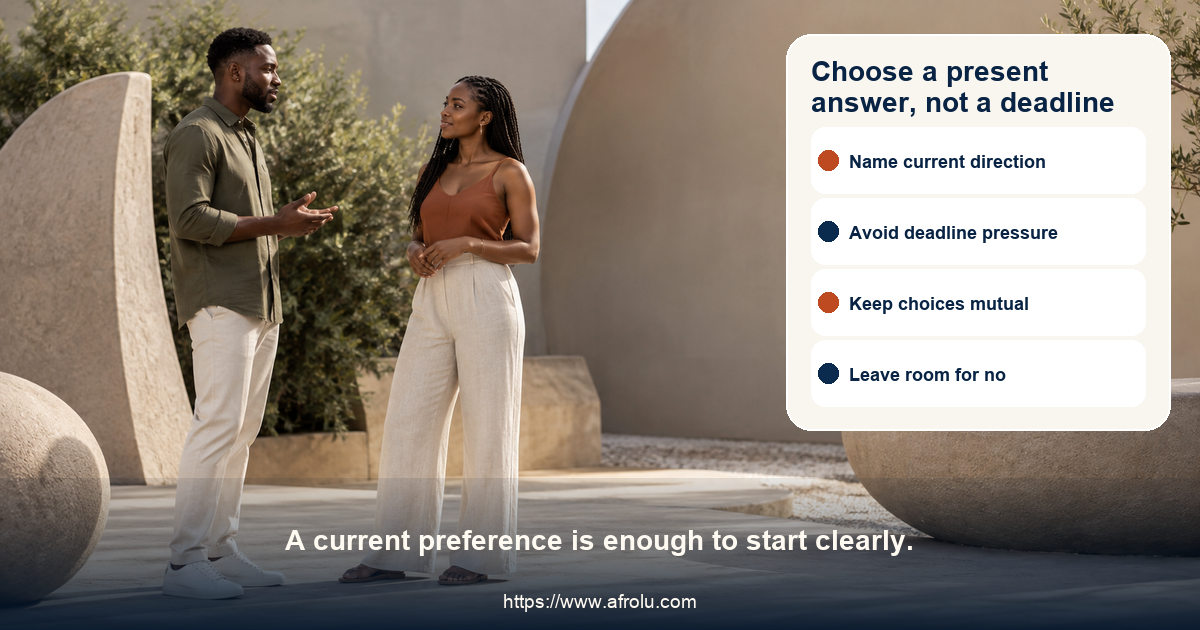
Current direction matters more than a timeline.
Written and edited by Jean-Claude Mukendi · Relationship Guides Editor
Start with the relationship shape you can offer now, not a timeline you feel pressured to meet. Translate serious or casual into practical terms about contact, exclusivity, intimacy, privacy, and plans. Keep disclosure gradual, consent current, money and identity systems separate, and an ending usable. If a boundary is ignored, access narrows, or fear appears, protect yourself rather than trying to make the relationship clearer.
Relationship clarity · Late Entrants
Is this a mutual serious or casual agreement, a timeline pressure problem, a disclosure question, an intimacy decision, a planning mismatch, a return worth considering, financial manipulation, or conduct that makes me feel unsafe?
A situationship is recurring contact with some affection, intimacy, or expectation but without a fully shared commitment definition. For adults entering or returning to dating, the useful distinction is not a life-stage script; it is whether the present terms leave both adults free to choose pace, privacy, consent, availability, and direction without a deadline or pressure.
Noah enjoys an easy connection but notices that every warm evening is followed by pressure to decide whether it is serious. He names what he can offer now, asks what casual and serious would practically change, keeps his personal details gradual, and declines an urgent money request. The response gives him a clearer basis for choosing the next plan.
entering dating · serious or casual clarity
Noah makes a new situationship readable without letting a timeline, vague label, or demand for access choose for him
This guide separates mutual serious direction, mutual casual dating, an honest unknown, a planning mismatch, gradual disclosure, current consent, a return after silence, financial pressure, unwanted pursuit, and fear—without treating age or previous relationship history as a script.
Start with present capacity, translate labels into conduct, make disclosure gradual, discuss intimacy in time, choose a usable rhythm, treat mismatch as information, and shift to protection when freedom narrows.
Choose the present
A current honest preference is more useful than a rushed future promise.
Make labels practical
Serious and casual only help when both adults can describe what they change.
Share in layers
Truthful disclosure can remain gradual, relevant, and under your control.
Keep choice intact
Money pressure, access demands, and ignored boundaries need protection, not optimism.
entering dating · current direction
Starting or returning to dating does not require a deadline, a confession, or a performance of certainty
People enter or re-enter dating for many reasons, and none of those reasons predicts what they should want next. Some adults are curious, some want companionship, some are open to a committed partnership, and some are not ready to promise direction. The useful starting point is not why you arrived here but what kind of connection you can honestly participate in now.
A situationship becomes harder when a person treats a broad life narrative as a reason to rush. You may hear that someone should know immediately, should not be casual, or should accept whatever attention appears. Those ideas turn dating into a deadline. A better question is whether the present arrangement lets you choose intimacy, contact, privacy, and future conversations without giving up your own judgment.
Serious is not automatically more mature, and casual is not automatically less caring. Serious can mean an intention to explore partnership with dependable action; casual can mean enjoying an affectionate, non-exclusive connection with clear limits. Either can be respectful if neither adult uses a label to conceal unavailable conduct or extract more access than the agreement provides.
You do not have to offer a complete biography in order to state a current preference. Try a simple sentence: 'I am open to getting to know someone, and I want to be honest about whether we are keeping this casual or exploring something more intentional.' That leaves room for another adult to answer honestly, including with a preference that does not match yours.
labels · conduct · agreement
A label helps only when both adults can explain what it changes in practice
When someone says serious, ask whether they mean exclusivity, regular plans, emotional availability, eventual partnership, public acknowledgment, or simply a wish to date with intention. When someone says casual, ask whether they mean non-exclusive dating, occasional time together, no future planning, or a temporary arrangement. The words are broad; the practical details are what allow informed choice.
Choose one topic at a time. You might need to know whether either person is seeing others before intimacy, whether plans can be made in advance, or whether a connection has room to grow. You do not need to demand certainty about a distant future in order to ask for the information that affects your next week, your health, or your emotional investment.
Watch for a mismatch between description and conduct. A person may call something serious while repeatedly disappearing, or call it casual only whenever you ask for basic respect. That does not prove a hidden motive. It does tell you that the current arrangement may not provide enough usable information for you to keep choosing it comfortably.
A clear answer can be limited. Someone can say they do not know yet, are not available for exclusivity, or only want an occasional connection. You can respond by adjusting the pace, keeping it non-intimate, lowering contact, or leaving. Clarity is not successful only when it delivers the relationship you hoped for; it is successful when it makes your decision yours again.

Terms need conduct, privacy, consent, and choice.
privacy · disclosure · self-direction
Openness is not measured by how quickly you hand a new connection a detailed account of your past, routines, or personal systems
Entering dating again can make ordinary questions feel loaded. You may worry that you need to explain every gap, previous relationship, family detail, health matter, or practical choice before someone will take you seriously. You do not. Honesty means not inventing a story; it does not mean turning early dating into a full disclosure process before trust and relevance exist.
Share in layers. You can discuss a value, a current preference, or a boundary without providing names, addresses, exact routines, private documents, social accounts, or intimate images. Keep your own phone, payment methods, and account recovery details under your control. Privacy helps you assess fit without creating access that becomes difficult to withdraw later.
Be alert to questions that become pressure. It is one thing for someone to ask about your hopes or history; it is another to insist on specifics, demand evidence, use your disclosures later in an argument, or imply that a private boundary proves distrust. No one earns a detailed personal map because a conversation was warm or because they offered their own disclosure.
You can say, 'I am happy to talk about that when we know each other better,' or, 'I keep that part of my life private for now.' A person who can hear that may still decide they need a different level of openness; that is fit information. A person who tries to wear down the boundary is showing you why gradual access matters.
consent · health · changing your mind
An affectionate situationship does not make sex, touch, images, exclusivity, or an overnight plan automatic
Adults can bring different levels of experience, confidence, hope, caution, and desire to a new connection. None of that tells you what someone consents to today. A person may want a serious relationship and still want to move slowly physically; another may prefer a casual arrangement and still want clear discussion about health, protection, other dates, or private images.
Use plain language before assumptions become consequential. You might say, 'I like where this is going, and I want to talk about what we each need before we become physical,' or, 'I am not ready for an overnight, but I would like to keep seeing you.' These statements make room for interest and boundaries at the same time.
Consent needs room for uncertainty and reversal. Silence, hesitation, prior intimacy, a shared meal, a ride, or a relationship label does not settle the next moment. An adult who feels disappointed can still respect a stop, a slower pace, or a decision not to send images. Pressure, bargaining, guilt, or a claim that you led them on are reasons to pause rather than explain more perfectly.
If an exclusivity or health conversation feels awkward, that is not a sign you should avoid it. It may be exactly the conversation the next decision needs. If another adult will not discuss a necessary boundary, gives a vague answer that leaves you unsafe, or treats a question as an accusation, choose a pace that does not require you to guess.

Ask about the next decision without overpromising.
availability · planning · mutuality
A new connection can be light and spontaneous without making one adult a reserve option for the other
Dating can fit alongside a full life without making that life a stereotype or obstacle. You may have responsibilities, interests, private time, work, study, friends, or a need for rest. Another adult does too. The question is whether the connection has a rhythm that acknowledges those realities rather than rewarding the person who can drop everything fastest.
Try concrete planning. A confirmed coffee, a call with a time boundary, a check-in before a weekend, or a straightforward cancellation can be enough. You can decide that you will not keep an entire day open without confirmation, or that you prefer someone who can make plans with notice. This is not demanding a grand gesture; it is refusing to make uncertainty your permanent task.
Pay attention to patterns, not a single disrupted plan. A genuine emergency, a busy week, or a changed feeling can happen. What matters is whether contact becomes a recurring cycle of last-minute invitations, warm reassurance after silence, and pressure for immediate availability whenever the other person returns. That pattern may be incompatible with the calm you want, even if affection is present.
You can redesign an arrangement without forcing it to become serious. Ask for fewer but confirmed plans, a lower message rhythm, a pause from intimacy, or an ending. If the same direct question keeps producing no usable answer, treat that absence as information. You do not need to wait until resentment makes the choice for you.
fit · endings · returns
Different hopes do not require either adult to become wrong, but they may make the current situationship unworkable
One adult may want an intentional relationship while another wants an occasional casual connection. One may need more private time, another may prefer frequent contact. Those differences can sometimes be redesigned, but not if one person has to abandon their stated need in order to keep access. Mutuality depends on both people having a real option to say no.
Name the smallest truth. 'I enjoy you, but this does not work for me as an undefined arrangement,' or, 'I am not available for a serious relationship, so I do not want to imply otherwise.' A short statement is often kinder than repeated hopeful ambiguity. You do not need to prove that your preference is objectively correct before changing the arrangement.
If someone returns after a gap, separate an apology from an entitlement. They may have changed, and you may be open to hearing them. Yet you do not owe a restart because the connection was once meaningful or because they now want a different pace. Ask what is actually available now and decide whether that is enough for your current life.
An ending does not require a final debate. If a person respects your decision, a concise message may be enough. If they pressure, monitor, threaten, repeatedly reappear, or use private information to regain access, stop treating the issue as a mismatch. Reduce access and use support that increases your control.
safety · money · unwanted contact
Hope is not a reason to relax the boundaries that protect your body, privacy, money, and ability to leave
It is healthy to keep risks proportionate. A cancelled plan or different relationship preference is not automatically dangerous. You can leave an unworkable situationship without diagnosing the person. At the same time, you do not need to minimise a request or pattern that makes you less free simply because you hope the relationship will become serious.
Keep financial and identity systems separate. Do not send or receive money, share verification codes, open accounts, provide documents, or make an urgent purchase because someone you are dating has a compelling story. Verify any organisational claim using independently found contact details. A respectful adult can hear that your financial boundary is not a personal judgment.
Use independent movement and digital privacy as ordinary practices. Meet in places you can leave, keep control of your phone and payment method, limit early disclosure of routines and address, and be deliberate about social accounts and images. These choices allow you to change your mind without having to manage access you never wanted to create.
When a clear no is ignored, a person uses new accounts after block, threatens exposure, pressures you for images, tracks you, or makes you afraid, seek support. Use platform tools, preserve information only if safe, tell someone you trust, and contact local or specialist help where needed. You do not need to make the ending feel fair to someone who is refusing your freedom.

Keep your time, systems, consent, and exit yours.
Eight situationships where a timeline, label, disclosure, intimacy, planning pattern, money request, or ignored boundary changes the next move

A new match wants a full answer now
Someone says that entering dating later means you should decide immediately whether this is forever.
Return to the present choice and state the level of connection you can honestly offer.Serious words lack a working plan
A person calls the connection intentional but avoids discussing exclusivity, reliable plans, or what changes next.
Ask which concrete agreement the label is meant to describe.Curiosity becomes entitlement
Early questions about past relationships turn into pressure for names, details, evidence, and private accounts.
Keep disclosure gradual and decline the specific access request.Affection is treated as permission
A pleasant date becomes an expectation that you will stay longer or become intimate without a prior conversation.
State the current boundary and leave with independent transport if needed.Plans appear only when another adult is free
Contact is warm but invitations routinely arrive at the last minute after you have kept time open.
Set a confirmation boundary and stop holding your schedule in reserve.Casual and serious desires differ
One person wants a relationship direction while the other wants an occasional non-exclusive connection.
Decide whether a smaller arrangement truly works or end it without trying to convert them.A past connection asks for instant restoration
After silence, someone returns with affection and expects the previous access to resume immediately.
Treat the return as a new choice based on present behaviour.A personal emergency targets your systems
A person asks for money, a code, a document, or help receiving funds because they say no one else can help.
Decline, verify independently, and reduce access if pressure follows.Fourteen observable signs that a serious or casual situationship remains mutual, vague, pressured, financially risky, or unsafe
You can state a current dating preference without defending your history or age.
Serious and casual are translated into practical expectations rather than status labels.
A limited answer is accepted as useful information rather than treated as a challenge to overcome.
Past relationships, health, routines, accounts, and private contacts remain gradual disclosures.
Plans include enough notice that neither adult must remain permanently available.
A change in pace is communicated instead of hidden behind warm but unusable language.
Exclusivity, other dates, health, images, touch, and overnight plans are discussed before they matter.
A changed mind is accepted without guilt, bargaining, sulking, or a demand for proof.
A mismatch can be named without one adult trying to make the other accept a different relationship shape.
A return after silence is evaluated by new conduct rather than familiarity alone.
No financial transfer, account, code, document, or secret task enters the connection.
Transport, phone, payment, and personal information remain under each adult's control.
A clear ending is not treated as an invitation to keep negotiating access.
Monitoring, threats, image pressure, repeated pursuit, or fear change the task to safety.
A proportionate decision map for direction, labels, disclosure, intimacy, plans, mismatch, returns, money, and safety
| Situation | What it may mean | What to do next |
|---|---|---|
| You feel pushed to decide quickly | Interest may be genuine, but a deadline can also hide the absence of present information. | State what you know now and refuse to make a future promise to relieve pressure. |
| Someone calls it serious | They may mean direction, exclusivity, regular plans, or simply warmth. | Ask what the label changes in practice for both adults. |
| Someone calls it casual | They may be offering an honest limited connection or avoiding basic accountability. | Ask about availability, other dates, intimacy, and whether the arrangement is actually workable for you. |
| A personal question feels too early | Curiosity can be ordinary; persistence can turn information into a test. | Keep the answer broad and choose what, if anything, you want to disclose later. |
| Intimacy may happen | Prior attraction does not settle consent, health, images, or exclusivity. | Name the topic needed for the next decision before proceeding. |
| Plans keep changing | One disruption can be ordinary; repeated standby expectations may be a poor fit. | Set a confirmation point and make your own plans when it passes. |
| A relationship mismatch appears | Neither preference is wrong, but both may not fit in the same arrangement. | Redesign only if the new terms meet your actual need; otherwise end it. |
| A person returns after silence | An apology may matter, but access is not stored for later use. | Ask for a current, modest plan and decide from its follow-through. |
| Money or identity help is requested | An undefined relationship is not a safe place for urgent financial or identity tasks. | Do not transfer, receive, share, or open anything; independently verify claims. |
| A no is ignored | The question has moved beyond relationship fit into unwanted contact. | Reduce access, use report and block tools, and involve support if it continues. |
Twelve complete lines for a present preference, serious or casual terms, privacy, planning, intimacy, a return, money, and an ending
“I am open to getting to know someone, but I want to be honest about what I can offer now rather than make a quick promise.”
“When you say serious, what would that change about how we date, make plans, or see other people?”
“I can consider casual dating, but I need to know what casual means for contact, intimacy, and other dates.”
“I share personal history gradually. I am not ready to discuss that detail or share those accounts.”
“I am happy to make a plan if we can confirm it by tomorrow; otherwise I will keep my evening open for something else.”
“I am interested, and I need to talk about pace, protection, and what we each mean before becoming physical.”
“I am not planning an overnight or private setting today. I can still enjoy a shorter public date.”
“I respect that you want something casual, but I am looking for a different relationship shape, so I am stepping back.”
“I can hear what has changed, but I am not resuming the old pattern by default. What is workable now?”
“I do not send, receive, or move money, codes, or documents in dating connections.”
“This arrangement does not work for me, and I am not available to keep negotiating it.”
“I have asked for no further contact. Do not contact me through new accounts or other people.”
Know the difference
Compare a deliberate serious-or-casual situationship with a pattern built on timelines, vagueness, or pressure
Each adult can name present availability, privacy, intimacy, and relationship direction, then change course without surrendering dignity or access.
A broad life story is used to rush decisions, labels avoid practical terms, or a boundary becomes something to wear down.
The arrangement is only clear when its present conduct gives each adult a meaningful choice.

Mutual terms differ from a borrowed timeline.
Keep current mutual agreement distinct from deadline pressure, vague access, and conduct that reduces freedom
| Type or dimension | What it describes | Best next question |
|---|---|---|
| Starting point | A mutual connection starts with current preference; pressure starts with a deadline or social script. | Name what you can honestly offer now. |
| Serious | Serious direction has practical terms; a serious label alone can conceal vagueness. | Ask what changes in plans, exclusivity, and conduct. |
| Casual | Casual can be bounded and caring; vague access asks one person to guess constantly. | Describe availability, other dates, and intimacy limits. |
| Disclosure | Gradual sharing supports choice; demanded history converts curiosity into control. | Keep personal systems and details private until you choose otherwise. |
| Pace | Mutual planning protects time; standby dating makes one person a reserve option. | Set a confirmation point and retain your schedule. |
| Intimacy | Current consent welcomes pauses; assumed access treats warmth as permission. | Name the exact decision before it matters. |
| Mismatch | Respect allows different desires; pressure tries to turn one adult into a project. | Choose whether the actual arrangement fits. |
| Return | Repair offers changed conduct; entitlement expects old access. | Evaluate a new, modest plan. |
| Safety | An ordinary ending is accepted; unwanted pursuit routes around it. | Reduce access and use support if freedom narrows. |
A simple plan you can use today
There is no correct entry timeline
Your dating history does not make a particular speed, label, or amount of access obligatory.
Labels need conduct
Serious and casual become meaningful only when they change a present agreement in a way both adults understand.
Privacy is not dishonesty
Gradual disclosure lets you be truthful without handing a new connection your whole personal system.
Consent does not borrow from hope
Wanting partnership or enjoying a date does not determine touch, images, sex, or an overnight.
Planning reveals fit
A modest confirmed plan can tell you more than repeated reassurance after last-minute changes.
An ending can be complete
You do not need a mutual verdict before choosing distance from a relationship shape that does not work.
Questions organised by purpose and depth
Choose a few prompts that fit the moment. This is a reference library, not a list to complete.
Present preference
Use before a conversation becomes a deadline.
- What kind of connection can I honestly offer now?
- What promise would I be making only to relieve pressure?
Terms and pace
Use before interpreting a label as a shared agreement.
- What does serious or casual change in practice?
- What rhythm lets me keep my own life visible?
Privacy and intimacy
Use before disclosure or physical closeness happens by default.
- What stays private for now?
- What do I need to discuss before the next intimate decision?
Fit and protection
Use when a mismatch, return, money request, or pressure pattern appears.
- Does the actual arrangement work for me?
- What action gives me more control if a boundary is ignored?
What deserves a closer look
Choose a present, not permanent, answer
State whether you are exploring, casual, intentional, or unsure today.
Evidence limit: Do not promise a future you cannot yet evaluate.
Translate words into conduct
Ask what serious or casual changes about plans, other dates, intimacy, and availability.
Evidence limit: A label cannot repair contradictory behaviour.
Disclose in layers
Share relevant history at your pace while keeping personal systems and detailed routines controlled.
Evidence limit: Curiosity never creates a right to access.
Make the immediate choice explicit
Discuss health, consent, images, exclusivity, and pace before a decision needs an assumption.
Evidence limit: Previous closeness does not settle a new moment.
Design or end the arrangement
Try a smaller rhythm or a clear ending when the relationship shape does not meet your needs.
Evidence limit: Do not convert another adult into a project.
Keep hope from overruling safeguards
Use independent transport, private systems, no-money rules, and support if access is pressured.
Evidence limit: Safety is not a referendum on your optimism.
Shortcuts that turn new dating into deadlines, vague access, overdisclosure, or pressure
Letting a timeline choose for you
Urgency may hide the fact that the present arrangement has not earned your agreement.
Treating serious as a moral rank
A serious label does not guarantee care, and casual dating can still be clear and respectful.
Overdisclosing to prove sincerity
New intimacy does not require surrendering personal history, routines, accounts, or private images.
Confusing warmth with consent
Affection and future hopes do not settle physical access or exclusivity.
Waiting through a permanent maybe
Repeated standby availability can be a relationship shape you are allowed to decline.
Making safety a test of optimism
Money pressure, monitoring, threats, or repeated contact require control and support, not more hopeful analysis.
Define the relationship, explore serious direction, or keep casual dating clear before the next plan
Choose the guide that fits the immediate decision. An editorial resource can help you name a preference, but it cannot promise another adult's honesty, availability, or conduct.
Explore the guide library
Show more related guides
Continue with Afrolu
Show more Afrolu guides
Sources used for this guide
Afrolu reviewed these health, research, safety, or public guidance resources while editing this page. They support the behaviour and safety guidance; they do not diagnose any individual described by a reader.
Questions about serious or casual situationships when entering dating
Is it wrong to want casual dating when entering dating later?
No. Casual dating can be respectful when both adults understand the limits, privacy, availability, intimacy boundaries, and non-exclusivity if applicable.
Do I need to know immediately whether I want a serious relationship?
No. You can name what you know now and ask for an arrangement that does not require a false future promise.
How can I ask what serious means?
Ask what it changes in practice: plans, exclusivity, contact, intimacy, public acknowledgment, or future direction.
Should I explain my entire relationship history early?
No. Be truthful, but disclose personal history gradually according to relevance, trust, and your own preference.
Can I want serious direction but move slowly physically?
Yes. Relationship intention and physical pace are separate current choices, and consent stays active throughout.
What if someone calls it casual but expects constant access?
Point out the practical mismatch and set a contact or planning boundary. If it remains unworkable, you can step away.
What if our preferences do not match?
Neither person needs to be wrong. Decide whether a redesigned arrangement truly fits, or end it clearly rather than hoping one person will change.
Can I say no to a person who comes back after a gap?
Yes. A return is a new invitation, not stored access. Decide based on what is available and comfortable now.
Should I help with an urgent financial request?
No. Do not send or receive money, share codes, documents, or accounts in dating. Independently verify any claim.
What if someone will not accept an ending?
Reduce access, use block and report tools, preserve information only if safe, and seek trusted or specialist support if repeated contact or fear continues.
One thing to do now
Choose the next connection that leaves your direction, private life, and freedom intact
Choose the smallest next action that protects your time, privacy, personal systems, current consent, independent transport, money, support network, and ability to redesign or end a connection without bargaining away freedom.