Dating later · long-distance safety
Late-Comer Long-Distance Situationship Safety
For adults dating later, assess a long-distance situationship with clear terms, proportionate checks, independent meetings, consent, and safety boundaries.
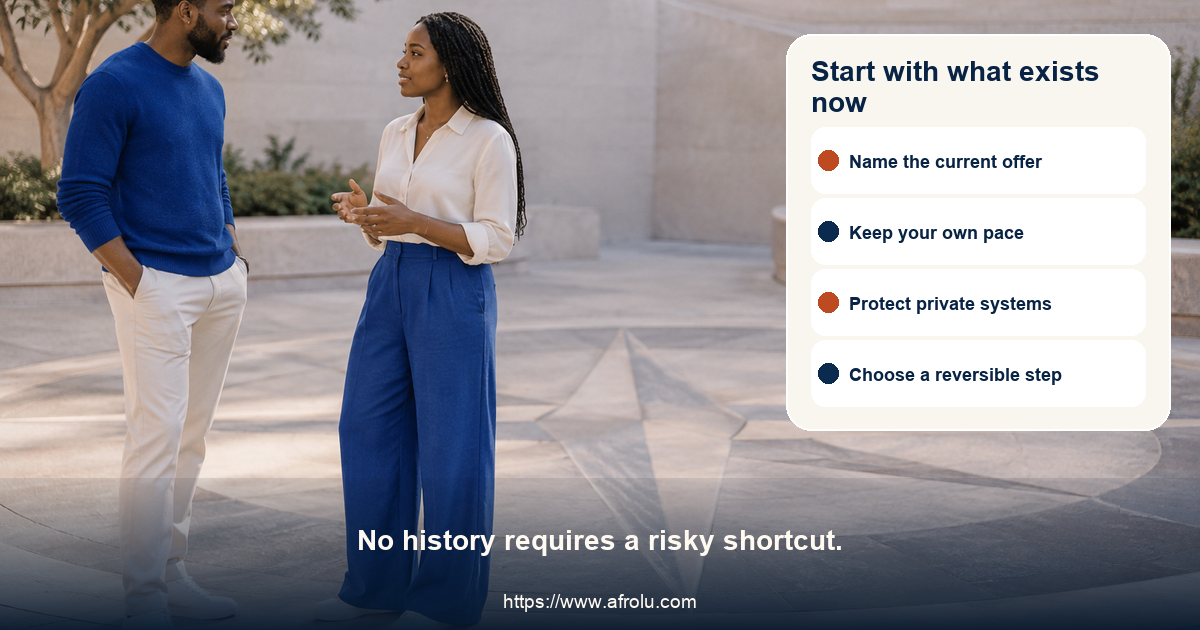
Choose the present arrangement freely.
Written and edited by Adwoa Boateng · Dating Safety Editor
There is no deadline that makes unclear or risky access worth accepting. Name the present relationship offer, use proportionate voluntary checks, plan public meetings with independent exits, make consent and exclusivity current, keep money and private systems separate, and reduce access if a clear boundary is ignored or fear appears.
Relationship clarity · Late Entrants
Is this a connection I can explore at my own pace, a verification question, a meeting that needs independent logistics, an assumption about intimacy, a financial request, or a contact pattern that feels unsafe?
A late-comer long-distance situationship is recurring contact with affection, interest, or expectation but without a fully shared definition, where distance requires more deliberate planning. Arriving later to dating does not change your right to a chosen pace, private systems, current consent, independent movement, and an uncomplicated exit.
Moses enjoys talking with someone who lives far away, but future-heavy messages are beginning to replace a usable plan. He asks for a realistic call rhythm, suggests a short public meeting with separate arrangements, declines an emergency payment request, and asks about other dates before intimacy. The answers help him choose from the present rather than a deadline story.
dating later · long-distance safety
Moses makes a distance connection readable without letting chronology, travel effort, money, or pressure decide for him
This guide separates present interest from a deadline story, proportionate checks from surveillance, independent meetings from dependent logistics, and ordinary disappointment from conduct that reduces freedom.
Name what exists now, verify only for the next decision, make meetings reversible, ask before assumptions matter, keep systems separate, and shift to protection if access becomes unwanted.
No deadline story
You can explore interest without rushing your standards.
Protect privacy
Verification should never require control of private systems.
Keep choices open
Independent arrival and exit support a freely chosen plan.
Close risky routes
Urgency, money, monitoring, and threats need protection, not debate.
long distance · present choice
Coming to dating later does not require a faster decision, a lower standard, a particular level of confidence, or a willingness to accept an arrangement that is hard to read
People sometimes talk about late-comer dating as if it comes with a deadline. That story can make a new connection feel unusually precious, so a few warm calls or a future-looking message begin to carry more weight than they should. You do not need to turn caution into cynicism. You only need to keep a difference between enjoying possibility and agreeing to a relationship that exists now.
Ask yourself what the present offer actually is. Is it occasional conversation, a regular call, a tentative meeting idea, a sexual connection, or an exclusive relationship? Each can be legitimate if both adults say so. The confusion comes when one person treats an undefined bond as a promise and the other relies on uncertainty to keep access without making a clear choice.
Long distance can heighten this effect because messages can feel intimate while everyday conduct remains unseen. Do not use that gap to invent a biography for the other person or to judge yourself for needing ordinary information. Ask what contact is sustainable, whether plans can be confirmed, what privacy each person needs, and how either of you can say that a different shape would suit you better.
A slower answer is not a failed answer. You may decide a distance connection fits, that you prefer something local, that you want clearer terms, or that the timing is not right. Those decisions are not judgments about age, history, or confidence. They are ways of protecting your ability to choose a relationship rather than being carried by the fear of missing one.
online safety · proportionate checks
Verification should support a decision such as another call or a first public meeting; it should never become a demand for documents, passwords, full social access, or continuous location
A long-distance situationship naturally raises questions about whether someone is who they say they are. Notice a story that changes, a repeated refusal to interact live, pressure to move off safer platforms, or a rush to become private. Those observations can justify slowing down. They do not justify asking for a passport, a home address, financial records, account access, or a full map of another person's life.
Choose a modest check that fits the next action. Before a further call, a video conversation may be enough. Before meeting, you may want consistent communication, a public plan, and your own travel arrangements. If an important question remains unanswered, you can decline to proceed. You do not need to expose someone or prove fraud before choosing a smaller step.
Keep the early connection on a service with block and report tools where possible. Share information gradually: private photos, social accounts, daily routines, work locations, legal names, and family details are not admission tickets to dating. The less access you grant early, the easier it is to change direction later without managing a complicated digital footprint.
Notice whether your boundary is accepted. A person may want more reassurance and still understand that you will not hand over documents, passwords, location, or proof on demand. Anger, urgency, flattery used as pressure, or repeated demands for evidence are useful information. A connection cannot remain voluntary when verification becomes a condition of control.
meeting · independent movement
A possible in-person meeting should increase options for both adults, not make one person dependent on the other for transport, lodging, payment, privacy, or a way to leave
A distance connection can make preparation feel emotionally significant. Time off, bookings, or effort may create an unspoken story that the meeting has to become intimate, lengthy, or decisive. It does not. You can meet briefly, keep it public, choose separate accommodation, or leave earlier than expected. A plan becomes safer when each step can be altered without financial or practical punishment.
Keep logistics separate enough that one adult cannot trap the other. Bring your own means of payment, choose transport you can use independently, avoid sharing a private address, and do not place documents or devices under someone else's control. A public meeting point and a person who knows your plan can be useful safeguards without turning ordinary dating into a dramatic event.
If someone reacts badly to a short public meeting, a separate room, a refusal to drink, or your wish to leave at a stated time, listen to the reaction. The issue is not whether their feelings are understandable; it is whether their response preserves your freedom. Disappointment can be respectful. Negotiating, sulking, anger, or using expense as leverage cannot make consent more genuine.
You are allowed to change your mind before arrival, at the door, or halfway through a meeting. You do not have to reward travel, investment, or conversation with privacy, intimacy, a longer visit, or a second date. A safe plan gives both adults a dignified exit and leaves no one responsible for making the other person accept a boundary.

A good plan keeps exit choices open.
consent · health · terms
A regular call, affectionate messages, shared hopes, a visit, or previous physical closeness do not create continuing consent or a shared agreement about other dates, health, images, or exclusivity
Distance can blur the line between emotional intimacy and a relationship agreement. One person may think frequent messages mean exclusivity; another may see them as companionship. One may expect a visit to include physical intimacy; the other may want to stay in public. Neither adult is wrong for having a preference. The crucial part is making the decision visible before either person is placed in a situation they did not choose.
Use language sized to the moment. 'Are we seeing other people?' may be the only question you need before making a sexual-health choice. 'I am not planning an overnight' can be enough before a meeting. You can discuss protection, testing, images, privacy, alcohol, and a changed pace without declaring a future that you are not ready to promise.
A yes from a previous conversation does not settle a new call, a photo, a hotel room, a touch, or a new relationship definition. A person who is uncertain, silent, pressured, tired, or intoxicated is not giving a freely usable answer. Warm consent still leaves space for questions, pauses, refusal, and an immediate stop without the need to manage the other person's disappointment.
If the response to a necessary question is vague, evasive, or incompatible with what you need, let that inform your choice. You can keep the connection non-intimate, choose different terms, or end it. Clarity is valuable even when it produces a difference. Its purpose is to restore choice, not to produce matching feelings or a romantic resolution.

Ask before silence decides.
scam resistance · private systems
A persuasive story about distance, an emergency, a future meeting, or personal vulnerability does not make it safe to send funds, receive funds, share codes, provide documents, or give access to accounts and devices
Requests often arrive wrapped in a detail-rich problem: a delayed reimbursement, a restricted account, a temporary travel issue, a medical cost, a lost item, or an opportunity to finally meet. The story may sound plausible and the emotional connection may feel genuine. You still do not need to transfer money, receive money, open an account, relay a code, buy something, or offer documents in order to be caring.
If an organisation is mentioned, find its contact details yourself rather than using an address supplied in the message. If the request feels urgent, that is a reason to slow the situation down. A legitimate problem can tolerate independent verification. A pressure pattern often depends on secrecy, speed, and the belief that saying no proves you do not care.
Keep meeting expenses separate too. You can decide what you will spend, decline to pay for another adult, and avoid arrangements where their booking controls your transport or accommodation. Do not let a proposed visit turn into a demand for a private address, a payment promise, a shared account, or an obligation to host. A relationship cannot make an unsafe financial arrangement safer by calling it trust.
If a person becomes angry, threatening, excessively affectionate, or guilt-inducing when you protect your systems, reduce the access they have to you. You do not need a courtroom-level conclusion that the story is false. The request itself can be enough to decide that you will not continue. Financial independence protects your ability to leave without more loss.

Keep funds, codes, and documents separate.
unwanted pursuit · protection
A mismatch can be ended with ordinary clarity; repeated contact after a no, tracking, threats, digital harassment, image pressure, or fear require a response focused on safety rather than relationship repair
A cancelled call, a disappointing answer, or even a sudden ending can hurt without meaning someone is dangerous. Keeping that category separate helps you decide proportionately. You are allowed to leave a connection because it is not for you, and you do not need to turn every mismatch into a diagnosis or gather proof before declining another conversation.
The response changes when someone continues after a direct request to stop, creates new profiles after being blocked, follows your online activity, threatens to share private material, makes threats, or recruits other people to reach you. These behaviours make it harder to exercise choice. They are not evidence that you should offer more explanation or meet privately for closure.
Start with the action that gives you room. Change privacy settings, limit information visible on platforms, tell a trusted person what is happening, and use reporting tools. Save messages or screenshots only if that does not put you at greater risk. If you believe you are in danger, seek emergency or specialist help where you are instead of trying to handle the pattern alone.
There is no universal script for ending contact. Sometimes a short written boundary is appropriate; sometimes silence and blocking are safer. The right choice is the one that protects your body, movement, accounts, privacy, and support. Your age, relationship history, or the fact that a person travelled a long distance does not make you responsible for their response to your no.
decision rule · self-trust
A strong long-distance standard should be simple enough to use while you are excited, flattered, unsure, disappointed, or tempted to accept a risky shortcut because you want the connection to work
Put the rule into your own words. It might be, 'I do not make a travel plan until I can leave it independently,' or 'I do not share financial or identity information with someone I am dating.' The best rule is concrete. It helps at the moment of decision, when a compelling story or a future promise could otherwise make you overlook what you already know.
Try it against a realistic invitation. Before you move a conversation off-platform, accept a meeting, book a room, share an image, disclose an address, or respond to an emergency request, ask whether you would still feel free if the relationship did not progress. If the answer is no, pause. Slowing down is a legitimate answer and often brings more information than another emotional conversation.
Look for plain evidence: answers that match conduct, a boundary accepted without punishment, a plan with an exit, systems left alone, and a return that includes a present offer. These signs do not guarantee a future, and they do not ask you to become suspicious. They show whether the connection gives you enough room to make decisions from self-trust rather than fear of loss.
You can want companionship and still protect yourself. You can acknowledge a real connection and decide the current arrangement is not good enough. The point of this guide is not to make anyone more guarded than they wish to be; it is to preserve the freedom that lets care, attraction, and curiosity remain genuinely chosen.
Eight long-distance situationships where pace, checks, a meeting, intimacy, money, or unwanted contact changes the next move
The future-heavy call
A person speaks vividly about a later life together but cannot name this week's contact.
Ask for the present rhythm before treating the future story as an offer.The proof request
They want documents or constant location to reassure them before a meeting.
Offer only proportionate voluntary checks and keep systems private.The controlled visit
Their plan requires you to depend on them for a ride, room, or payment.
Choose independent transport, public time, and an exit.The assumed overnight
Travel effort is used to imply intimacy should happen.
State the plan and your physical boundary beforehand.The health assumption
Frequent messages are treated as proof nobody else is dating.
Ask directly before a decision it affects.The emergency transfer
A detailed crisis becomes a request for funds, codes, or account help.
Keep money and identity systems separate.The pressure return
A person reappears and wants immediate access after silence.
Assess the new offer rather than familiarity.The new-account contact
A boundary is followed by messages from fresh accounts or through others.
Reduce access, report, and get support if needed.Fourteen observable signs that a distance connection remains voluntary, vague, access-driven, financially risky, or unsafe
They can state a present rhythm rather than sell a distant future.
A live interaction is voluntary, not a demand for private records.
They accept gradual disclosure and platform safety tools.
A meeting plan gives each adult independent arrival and departure.
Travel effort is not used as a claim on intimacy.
They can discuss other dates and sexual health before assumptions matter.
A no is accepted without sulking, bargaining, or coercion.
Money, devices, accounts, codes, and documents remain separate.
Urgency is not used to make a financial request harder to refuse.
Your address and daily routine stay private until you choose otherwise.
A cancelled plan is handled with directness and a realistic repair.
You can prefer a local connection without being argued out of it.
A return after absence contains a new present offer.
An ending is not met with monitoring, threats, or repeated workarounds.
A proportionate decision map for contact, verification, meetings, consent, money, privacy, a return, and safety
| Situation | What it may mean | What to do next |
|---|---|---|
| The connection feels intense | Warm possibility or a future story without current terms. | Ask what exists this week. |
| They seek verification | A reasonable question or a bid for surveillance. | Match a voluntary check to the next decision. |
| A visit is suggested | An invitation or a plan that narrows your exit. | Keep transport, money, and lodging independent. |
| They mention cost | Practical planning or a claim on your attention. | Treat expense as separate from consent. |
| Intimacy is implied | An invitation that requires current agreement. | Name your boundary before the setting changes. |
| They ask about other dates | A useful terms conversation. | Answer honestly and ask the same question. |
| They need help urgently | A safety boundary regardless of the detail. | Do not transfer funds or share codes or documents. |
| They want your address | A request for closeness or unwanted access. | Keep private location gradual and choose public plans. |
| They reappear | A new invitation, not an automatic continuation. | Assess the actual new rhythm offered. |
| They keep contacting you | A pattern that may require protection. | Reduce access and use support rather than debate. |
Twelve complete lines for a present offer, checks, a meeting, intimacy, privacy, money, a return, and an ending
“What kind of contact can we each genuinely sustain this month?”
“I am comfortable with a short live call, not with sharing documents or passwords.”
“I will arrive and leave independently, and I am keeping the first meeting public.”
“I am ending the date at this time even if plans change.”
“I am not agreeing to an overnight or physical intimacy.”
“Before we make that choice, are either of us seeing other people?”
“I do not send private images.”
“I cannot send, receive, or move money through a dating connection.”
“I am not sharing my home address; a public place works for me.”
“What is the plan you can offer now, rather than later?”
“I am choosing a connection that works closer to my daily life.”
“I do not want further contact. Please respect that.”
Know the difference
Exploring distance carefully versus losing practical choice
Both adults use proportionate checks, voluntary contact, public plans, current consent, and separate systems.
Urgency, travel cost, access requests, or fear are used to make one adult surrender privacy, money, movement, or a no.
Distance should create more planning, not fewer choices.

Pressure changes the task.
Keep independent long-distance exploration distinct from a pattern that reduces practical choice
| Type or dimension | What it describes | Best next question |
|---|---|---|
| A present rhythm | Contact is described in ordinary current terms. | Choose whether that rhythm works. |
| A future story | Hope replaces a usable offer. | Return to the next real plan. |
| A live check | A voluntary conversation fits the immediate decision. | Keep personal records private. |
| Surveillance | Documents, accounts, or location are demanded as proof. | Decline and reduce access if pressure continues. |
| An independent meeting | Transport and exit remain under each adult's control. | Keep the setting public initially. |
| A dependent meeting | One adult controls lodging, payment, or departure. | Redesign or decline the plan. |
| Current consent | The next choice is asked, heard, and changeable. | Pause if there is uncertainty. |
| Assumed consent | Travel or closeness is used as entitlement. | State a clear no and leave if needed. |
| A clean exit | A boundary is respected after disappointment. | Use blocks and support if it is not. |
A simple plan you can use today
There is no deadline
A desire for connection need not turn a risky shortcut into a good choice.
Checks can stay proportional
Verification should never cost control of private systems.
Logistics are consent tools
Independent movement and a clear end time keep a meeting chosen.
Terms require words
Messages and hope do not define exclusivity or intimacy.
Systems protect options
Money, documents, codes, and accounts should remain yours.
Protection is not unkind
You can reduce contact without winning agreement about the ending.
Questions organised by purpose and depth
Choose a few prompts that fit the moment. This is a reference library, not a list to complete.
Present arrangement
Use before future hope replaces a current offer.
- What is available now?
- Does this rhythm leave me with choice?
Verification
Use before more disclosure or an in-person plan.
- What check fits the next step?
- Which systems stay private?
Meeting and consent
Use before travel, a room, alcohol, images, or intimacy.
- Can I arrive and leave independently?
- What needs a direct yes today?
Safety
Use when urgency, money, monitoring, or repeated contact appear.
- What gives me more control immediately?
- Who can support me if contact continues?
What deserves a closer look
Refuse the deadline story
Choose from the relationship available now, not from fear of missing a future.
Evidence limit: Do not use history as a reason to accept less.
Check for the next decision
Use live interaction and gradual disclosure to assess a practical step.
Evidence limit: Do not demand records or digital access.
Keep routes independent
Design public plans, separate money, and a stated exit.
Evidence limit: Do not let travel effort create debt.
Ask before the change
Discuss intimacy, images, health, and exclusivity at the decision point.
Evidence limit: Do not infer agreement from closeness.
Protect accounts
Keep payments, codes, documents, and devices under your own control.
Evidence limit: Do not act under urgency.
Prioritise control
Use blocks, reports, trusted support, and specialist help if boundaries are ignored.
Evidence limit: Do not meet for closure when it feels unsafe.
Shortcuts that turn distance into surveillance, debt, assumed intimacy, or unwanted access
Dating against a deadline
It makes vague or unsafe access feel like a rare chance.
Turning verification into surveillance
It trades safety for private control.
Letting travel decide intimacy
Effort and cost do not create consent.
Assuming exclusivity from closeness
Health and relationship terms can remain different.
Solving an emergency
Funds and identity systems can become a route for loss.
Debating an ignored no
Repeated contact often needs access reduction, not better wording.
Build a distance rhythm, set a boundary, or check a pressure pattern before the next plan
Choose the guide that fits the immediate decision. An editorial resource can help name a preference or safety pattern, but it cannot guarantee another adult's honesty, availability, or conduct.
Explore the guide library
Show more related guides
Continue with Afrolu
Show more Afrolu guides
Sources used for this guide
Afrolu reviewed these health, research, safety, or public guidance resources while editing this page. They support the behaviour and safety guidance; they do not diagnose any individual described by a reader.
Questions about coming to dating later and long-distance situationship safety
Can I take a long-distance situationship slowly?
Yes. Slowing down can make present capacity, privacy, and consent easier to evaluate.
Should I request proof someone is real?
Use proportionate voluntary checks such as a live conversation; do not request documents, passwords, or account access.
Does a meeting mean we are committed?
No. A meeting is a plan, not a relationship definition or consent to intimacy.
How can I plan a safer first meeting?
Choose a public setting, independent transport and payment, a stated end time, and an easy exit.
Do I owe intimacy after travel?
No. Travel, cost, and preparation never create consent.
How do I ask about exclusivity?
Ask before the decision it affects: are we seeing other people, and what would change that?
What if someone asks for money?
Do not transfer, receive, or move money or share codes, documents, or account access through dating.
Can I prefer a local connection?
Yes. A practical relationship preference is valid without judging the other adult.
What if they contact me after I end it?
Reduce access, use block and report tools, preserve information only if safe, and seek support if fear or pressure continues.
Does coming to dating later change safety advice?
No. You retain the same right to a clear pace, privacy, current consent, and an easy exit.
One thing to do now
Choose the next distance connection that leaves your pace, systems, and freedom intact
Choose the smallest next action that protects your pace, private details, money, accounts, documents, body, independent transport, support network, and ability to revise or end contact without bargaining away freedom.