Entering dating later · safer career clarity
Situationships for Adults Entering Dating Later: Safer Career Clarity
A situationship guide for adults entering dating later: name expectations, protect privacy and consent, fit connection around a career season, and stay safe.

Your pace is allowed to be your own.
Written and edited by Adwoa Boateng · Dating Safety Editor
You do not have to catch up by accepting an undefined pace. Ask for present information about the situationship, offer the time and contact you can truly sustain, and keep consent, privacy, movement, and access current. Do not let confidence or dating experience become leverage over your boundaries. Keep money, accounts, codes, documents, and location separate. If contact becomes coercive, persistent, financially manipulative, threatening, or frightening, reduce access and use support.
Relationship clarity · Late Entrants
Is this a supportive learning experience, a mutual situationship, a capacity mismatch, a question about access or consent, a return worth a smaller plan, financial or digital pressure, unwanted pursuit, or conduct that makes me feel unsafe?
A situationship for an adult entering dating later is an undefined or partly defined connection with affection, intimacy, or recurring contact but incomplete expectations. The useful distinction is between a learning curve that keeps choice open and a pattern that uses uncertainty, pressure, or an artificial timeline to reduce freedom.
Kato is entering dating later while protecting a full career season. A new connection is warm but undefined, and the other person calls every boundary a sign that Kato is overthinking. Kato names a smaller pace, asks what the situationship includes, keeps private details gradual, and declines a financial favour. The response helps Kato see that curiosity does not require accepting pressure or proving confidence.
entering dating later · safer career clarity
Kato makes a situationship fit real capacity without treating a later start as a deadline
This guide separates a supportive learning curve, a mutual situationship, a capacity boundary, a confidence test, gradual privacy, current consent, a return after silence, financial pressure, unwanted pursuit, and fear—without age, career-status, workplace, or travel stereotypes.
Choose your own pace, describe the current arrangement, offer realistic capacity, keep consent and access current, distinguish ordinary learning from risk, read returns through conduct, and carry one practical standard forward.
Leave timelines behind
A later start does not create a debt to move faster.
Ask the present
A small specific question can restore choice.
Offer a scale
Time and energy are practical boundaries, not status.
Protect freedom
Money pressure, coercion, monitoring, and fear change the task.
entering dating later · career season
A later start in dating does not require you to accept an undefined situationship faster than it fits
Adults who begin or return to dating later sometimes feel an extra pressure to catch up. A situationship can seem like a way to learn quickly, prove openness, or avoid appearing inexperienced. That pressure can make it harder to notice when an arrangement is asking for more time, intimacy, or access than you genuinely want to give.
Begin with the fact that your pace is allowed to be your own. You can be interested and still ask what the connection is, prefer a smaller plan, keep intimacy gradual, or decide that a vague pattern is not enjoyable. A later entry point does not create a debt to become casual, serious, constantly available, or unusually accommodating.
Avoid using experience as a ranking system. The relevant question is not whether you are more or less practised than someone else. It is whether you can recognise your preferences, state them, and keep them in the presence of attraction or uncertainty. A respectful person does not need you to perform expertise in order to respect a boundary.
Career-heavy seasons add another kind of pressure. You may have limited attention, a changing schedule, or a strong need to protect rest and personal time. That is not a flaw to hide. It is practical information about the scale of connection you can sustain. The most useful situationship is one that can fit real capacity without turning it into a status contest.
expectations · present facts
A label does not tell you enough unless both adults can say how the connection actually works
A situationship may include regular messages, occasional dates, intimacy, affection, or a sense of possibility without a shared definition. That can be perfectly workable if both adults understand the terms. It becomes costly when one person is doing the guessing: wondering whether plans count, whether other dates are relevant, or whether warmth means more access than has ever been agreed.
Start with what would change your next choice. Do you need to know whether they are seeing other people, whether a regular plan is realistic, whether the connection is casual, whether physical intimacy has boundaries, or whether they can offer a clearer rhythm? A short, specific question is more useful than a wide conversation built from accumulated anxiety.
Listen for an answer that gives you something to act on. Someone may say they prefer low contact, cannot offer regularity, want a non-exclusive arrangement, or are still unsure. That answer may disappoint while still protecting your ability to choose. A polished answer that avoids every practical point can leave you with more reassurance but less clarity.
You are allowed to decide that the arrangement does not work for you. That choice does not prove that you were too serious, insufficiently relaxed, or bad at dating. It simply recognises that a connection has to fit your actual preferences and capacity. A useful label is one that helps both people consent to the present, not one that asks you to ignore yourself.

A short true sentence can restore your pace.
career season · time and energy
A full career season can support dating when the connection fits your energy instead of consuming it
You may be tempted to hide how much dating effort a new situationship takes. Perhaps you stay up too late to keep a conversation going, rearrange restorative time for unconfirmed plans, or answer every message while trying to manage a demanding week. Those habits can make the connection feel urgent while making the rest of your life smaller.
Say what is realistic. You might want one planned date, a short call, a slower message rhythm, or a pause during a demanding stretch. This is not an apology for having a career or for entering dating later. It is an invitation to build a connection at a scale that does not depend on either person pretending to have more attention than they do.
Notice whether capacity becomes reciprocal information. Someone else's busy season can be genuine, but it should eventually lead to a usable option: a smaller plan, a later date, a defined pause, or an honest ending. Repeatedly citing busyness while expecting you to remain ready can create a one-sided situationship even when the explanations sound reasonable.
Protect rest, friendships, interests, and the private parts of your adult life. A relationship possibility does not need to become the loudest item in your schedule in order to matter. If you have to make yourself tired, anxious, or constantly available to keep the connection alive, the arrangement may be revealing a mismatch in pace rather than a lack of effort on your part.
consent · privacy · independent choice
Being less practised at dating does not make you responsible for accepting access you have not freely chosen
A situationship can become familiar before it becomes well understood. Someone may speak as though a previous date settles the next plan, a flirtation settles an image request, or a warm call settles a private meeting. None of those shortcuts replaces current consent. Your interest can be real and your no can be equally real, even if the other person was expecting something different.
Keep personal access gradual. You do not have to give a detailed work pattern, home location, private account, live location, private images, documents, codes, or a channel you cannot easily leave. A person does not need access to your systems or routines in order to get to know you. You can decline without implying that every request is dangerous.
Choose arrangements that preserve independent movement. Meet in a setting you prefer, use a route you control, and make a plan small enough to alter or end. These decisions are not a test of another adult's character. They help your present choice remain practical if your comfort changes after you arrive.
If someone responds to a limit by patronising you, questioning your dating experience, pushing you to prove trust, or treating your no as a negotiation, pause. A respectful connection makes boundaries easier to practise, not harder. You do not need to demonstrate confidence or sophistication before you are entitled to a freely chosen pace.
proportion · support
You can learn dating as you go without treating pressure, money requests, monitoring, or fear as normal uncertainty
A person may be inconsistent, decline to define a connection, be unavailable, or turn out not to be a fit. Those outcomes can be frustrating and sad without being a danger signal. You can ask once, decide that you need a different rhythm, or end the situationship. Learning through ordinary mismatch is part of dating, not evidence that you made a mistake by trying.
The category changes when someone asks for money, a transfer, a code, bank access, documents, a payment favour, or secrecy around a financial problem. Flattery, urgency, apparent career status, or a persuasive story do not make a dating connection an appropriate place to merge systems. Keep financial choices outside the relationship and verify claims independently.
It changes when someone keeps contacting you after you have said no, uses a new account after a block, demands proof of where you are, threatens you, pressures you for sexual content, tries to shame you into access, or makes you afraid to change a plan. Those patterns are not explained away by dating inexperience. They require reduced access and appropriate support.
Trust the effect on your freedom. You do not need to know why a person is applying pressure before you protect your body, money, privacy, movement, and attention. You can block, report, seek trusted support, or contact specialist or urgent help when appropriate. A safe connection never requires you to become an expert before you are allowed to be safe.

Learning is not a reason to accept pressure.
repair · current choice
A returning situationship can be considered without restoring the access or urgency that did not work before
Someone may reappear with a thoughtful apology, a compelling account of a difficult season, or a renewed expression of interest. Before responding, check your own present answer. Do you want this contact? Does it fit your energy? What would a proportionate next step look like? Your answer does not need to be generous simply because their explanation sounds moving.
If you remain interested, choose a small, observable arrangement: a brief planned call, a public meeting with a defined end, or a message exchange that does not require immediate replies. This is not a trap for the other person. It is a way to see whether they can participate in the kind of connection you can actually enjoy.
Do not compensate for the earlier absence by offering more access. A return does not entitle someone to a private routine, location, intimate image, financial detail, late-night availability, or a plan that is hard to leave. Repair becomes meaningful when a person respects your current limits without making you justify them.
You can also decide not to reopen the connection. A short close, or no reply when that is safer or quieter, is allowed. Ending a situationship does not mean that you failed to be open-minded. It means you have enough information to choose the kind of adult dating experience you want to make room for next.
next move · self-trust
A safer career-season standard makes space for interest without making you smaller
Choose one adjustment you can use while you actually like someone. You may set a confirmation point before giving an evening, state the amount of contact you can sustain, ask about other dates before intimacy, keep one communication channel, or treat a repeated non-answer as information. The point is not to build a long list of rules. It is to practise a boundary before frustration has to force it out.
Let your career season remain a context, not an identity. Your value is not increased by appearing busy or decreased by wanting more connection. Capacity is simply one of the facts that helps you choose a pace. A compatible adult does not need you to convert exhaustion into access in order to believe that you are interested.
Keep dating connected to the rest of your life. Rest, friends, interests, private time, and ordinary pleasure should still be visible. A situationship may add warmth, but it should not require you to use all of your attention interpreting someone else's behaviour. The clearest standard is often the one that leaves you more able to recognise your own voice.
Where pressure becomes financial, sexual, digital, persistent, threatening, or frightening, make protection your standard. End contact where you can, use platform tools, preserve material only when safe, and seek appropriate support. You never owe a final lesson, a more polished explanation, or another chance to someone who is narrowing your freedom.

Choose the move that keeps your freedom intact.
Eight later-entry situationships where pace, capacity, clarity, privacy, consent, and safety change the next move
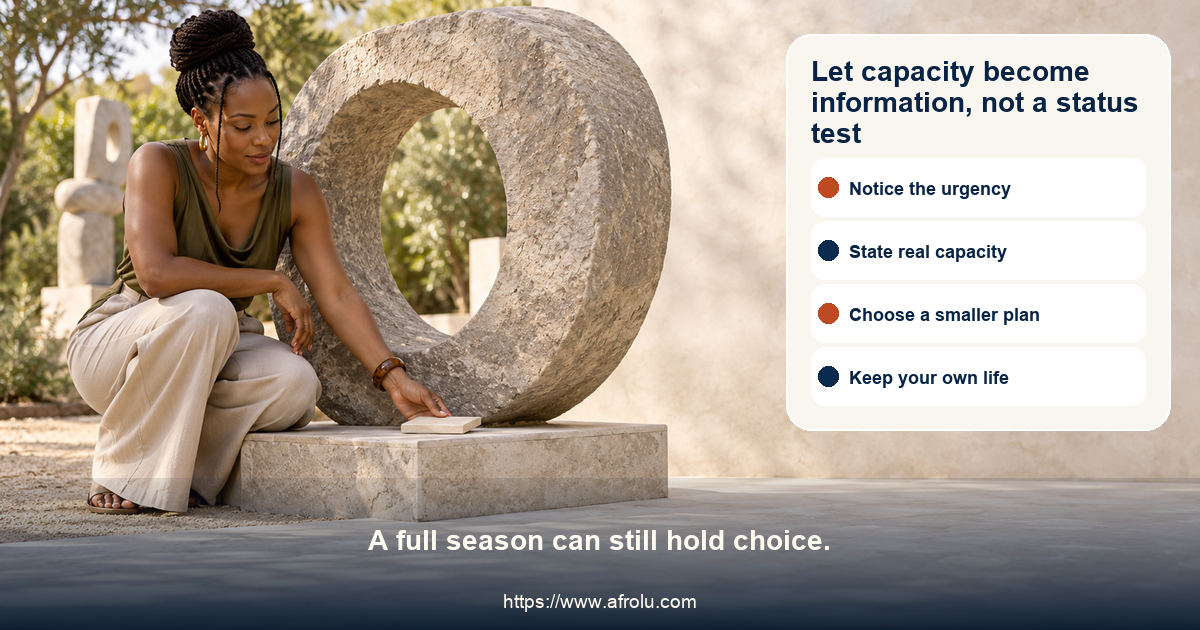
A new connection feels like a deadline
An adult entering dating later feels compelled to accept an undefined arrangement so they do not seem inexperienced or slow.
Return to the pace and terms you actually choose.Contact is affectionate but unreadable
A situationship includes regular messages and occasional plans, yet nobody has discussed other dates, intimacy, or expectations.
Ask one specific question about the current arrangement.Interest exceeds available energy
A demanding career period makes messages, late plans, and emotional processing take more than you can give.
Offer a smaller sustainable rhythm or an honest pause.A limit is treated as inexperience
Someone calls a privacy or consent boundary unnecessary because they think you should trust them by now.
Keep the boundary and observe the response.Familiarity becomes a request for access
A person asks for a detailed routine, location, private account, image, code, or document.
Keep access gradual and separate from interest.Connection becomes a financial route
A compelling story asks for money, a transfer, account help, or secrecy.
Decline and verify any claim outside the situationship.Silence becomes a request for urgency
Someone reappears after a gap and expects immediate availability or a large emotional reset.
Choose a small current step or decline to restart.A no creates pursuit
After a clear close, messages multiply, new accounts appear, or the tone becomes threatening.
Reduce access and use appropriate safety support.Fourteen observable signs that a situationship is supportive, mutual, vague, pressuring, controlling, or unsafe
Your pace is treated as a preference, not a deficiency to correct.
Both adults can describe what the situationship currently includes and excludes.
A clarity question receives a usable answer or an honest uncertainty.
Career capacity leads to a specific plan, lower rhythm, or genuine pause.
You can decline a last-minute invitation without being shamed or persuaded.
Private routines, location, accounts, images, documents, and codes remain gradual.
A public plan and independent movement are accepted without a confidence test.
A changed mind about touch, time, setting, or contact is respected.
A return after a gap includes current conduct rather than automatic access.
Money, transfers, documents, codes, and account help stay outside the connection.
A no does not create repeated contact, tracking, threats, blackmail, or new accounts.
You retain rest, friendships, interests, and attention outside the situationship.
No one uses dating experience as leverage over your boundaries.
Fear or coercion changes the response from learning to safety.
A proportionate decision map for pace, expectations, capacity, access, consent, returns, money, and safety
| Situation | What it may mean | What to do next |
|---|---|---|
| You feel behind | A social timeline may be pushing you to accept a pace you do not want. | Return to the terms you freely choose. |
| The label is vague | Warmth may be outrunning shared expectations. | Ask the fact that changes your next decision. |
| Your energy is low | The current rhythm may exceed your capacity. | Offer a smaller plan or a defined pause. |
| They say they are busy | Capacity may be real or the fit may be too limited. | Ask whether a usable alternative exists. |
| They question your boundary | Your experience may be getting used as leverage. | Keep the limit and notice whether it is respected. |
| They request more access | Familiarity may be getting confused with entitlement. | Keep channels, routines, location, and systems gradual. |
| They return after silence | An old pattern may be seeking a new opening. | Choose a small present step only if you want it. |
| They ask for money | The issue is no longer ordinary dating ambiguity. | Decline and verify independently. |
| You want to leave | A mismatch can be enough reason without a verdict. | Use a short clear close when safe. |
| You feel afraid | The issue is protection, not a learning curve. | Seek trusted, specialist, platform, or urgent support. |
Twelve complete lines for pace, clarity, capacity, privacy, consent, a return, and an ending
“I am interested, and I want to move at a pace that lets me stay present in the rest of my life.”
“What are you open to at the moment, and what does that mean for how we see each other?”
“This is a full season for me, so I can offer one planned evening rather than last-minute availability.”
“Before we continue physically, I need us to be clear about whether either of us is seeing other people.”
“I keep my routines, accounts, and personal details gradual while I get to know someone.”
“I will meet you there; I am not sharing live location.”
“I do not want to continue with that plan tonight.”
“I do not need to explain my dating history in order for this boundary to be respected.”
“I can consider a short planned catch-up, but I am not going back to an undefined rhythm.”
“I do not mix dating with money, transfers, codes, documents, or account access.”
“This arrangement is not working for me, so I am stepping back.”
“Do not contact me again.”
Know the difference
A learning curve and pressure dressed as confidence are not the same dating experience
Both adults can ask questions, name preferences, slow down, and make mistakes without one person using experience or certainty as leverage.
One person treats unfamiliarity as a reason to hurry intimacy, expand access, dismiss a boundary, or make the other adult responsible for proving trust.
You can learn dating without surrendering your right to an informed, freely chosen pace.

Let present conduct—not a later start—determine your access.
Keep supportive adult learning distinct from pressure that uses confidence, timelines, or access as leverage
| Type or dimension | What it describes | Best next question |
|---|---|---|
| Curiosity | It welcomes a question and leaves room for a no. | Ask what you need to know. |
| A confidence test | It makes a boundary proof of inexperience or distrust. | Keep the boundary and reduce access if pressure persists. |
| A realistic offer | It names the time and energy an adult can sustain. | Choose it or say the fit is too limited. |
| Standby availability | One person must constantly adapt to preserve interest. | Set a plan or release the time. |
| Mutual clarity | Terms about contact, intimacy, privacy, and exits are discussable. | Review them when facts change. |
| Vague reassurance | Warm words replace usable information. | Ask once or decide the pattern does not fit. |
| Observable repair | A return includes a small current plan and respect for limits. | Restart only at the scale you choose. |
| Financial manipulation | Urgency or affection is used to seek money, systems, or secrecy. | Keep all systems separate. |
| Fear or pursuit | A no creates tracking, threats, repeated contact, or coercion. | Use safety support instead of more explanation. |
A simple plan you can use today
There is no deadline for a freely chosen pace
Entering dating later does not make another adult's terms automatically reasonable.
A question is a dating skill
You do not need advanced experience to ask for present information that changes your choice.
Capacity is practical data
A smaller rhythm can protect interest, rest, and dignity more effectively than performed availability.
Confidence should widen choice
A considerate person makes it easier to ask, slow down, or decline.
Privacy and consent remain current
Familiarity, a date, or another person's certainty does not create automatic access.
Safety does not require expertise
Money pressure, coercion, monitoring, threats, and fear can be acted on immediately.
Questions organised by purpose and depth
Choose a few prompts that fit the moment. This is a reference library, not a list to complete.
Choose your pace
Make a later start a source of curiosity rather than urgency.
- What pace feels freely chosen?
- What do I not need to rush?
- What would make this arrangement enjoyable?
Name the facts
Use a question that changes a real decision.
- What do I need to know now?
- What answer would change my next move?
- What can I offer in this season?
Protect access
Keep comfort and confidence separate.
- What access have I freely chosen?
- What do I want to keep gradual?
- Can I change my mind easily?
Read the pattern
Match the response to the conduct.
- Is this a mismatch or pressure?
- What boundary is true in one sentence?
- Who can support me if I feel unsafe?
What deserves a closer look
Leave dating timelines outside the decision
Choose the time, contact, intimacy, and questions that fit your own present preference.
Evidence limit: Do not use a later start as a reason to override yourself.
Describe the connection in practice
Ask about contact, plans, other dates, intimacy, privacy, and exits only where the answer affects your choice.
Evidence limit: Do not seek a future guarantee to avoid a present answer.
Offer a sustainable scale
Name the amount of dating time and attention you can actually enjoy during a full career season.
Evidence limit: Do not turn exhaustion into proof of interest.
Keep privacy and consent separate from confidence
Retain control over channels, routines, location, images, accounts, and meetings.
Evidence limit: Do not give more access to prove trust.
Test repair through a small plan
A returning person can respect a modest current arrangement and your existing boundaries.
Evidence limit: Do not restore old access automatically.
Respond to patterns that reduce freedom
Use blocking, reports, trusted people, specialist support, or urgent help for money pressure, coercion, monitoring, threats, or fear.
Evidence limit: Do not keep teaching someone how to respect a no.
Shortcuts that turn a later start into pressure, unwanted access, burnout, or risk
Dating against a deadline
A sense of catching up can make an undefined arrangement seem more acceptable than it feels.
Treating confidence as consent
Someone else's certainty cannot decide your pace, access, or boundaries.
Hiding capacity
Performed availability turns a full season into exhaustion and standby time.
Giving access to look trusting
Location, accounts, images, and private routines are not proof of adult interest.
Explaining every boundary through experience
A no can stand without a history lesson.
Calling coercion a learning curve
Pressure, money requests, monitoring, threats, and fear need protection.
Set a boundary, ask a safety-aware question, or send one clear casual follow-up
Choose the resource that fits the decision in front of you. A guide can help you name a preference, but it cannot promise another adult's honesty, interest, or conduct.
Explore the guide library
Show more related guides
Continue with Afrolu
Show more Afrolu guides
Sources used for this guide
Afrolu reviewed these health, research, safety, or public guidance resources while editing this page. They support the behaviour and safety guidance; they do not diagnose any individual described by a reader.
Questions about situationships for adults entering dating later in a career season
What does entering dating later have to do with a situationship?
It may bring a sense of urgency or unfamiliarity, but it does not change your right to a clear, freely chosen pace. The useful question is whether the arrangement fits your preferences and capacity.
Do I need to know exactly what I want before I date?
No. You can be curious and still ask for present information about contact, plans, other dates, intimacy, and boundaries.
How do I ask what a situationship means?
Ask one specific question that changes a decision, such as whether someone wants regular plans, casual contact, or non-exclusivity. Listen for usable information.
Can a career-heavy season make dating impossible?
No. It may mean a smaller rhythm works better. Offer the amount of time and attention you can honestly sustain, then see whether the fit is mutual.
What if someone says I am overthinking because I am new to dating?
You can keep your question or boundary. A respectful person can answer directly or say the fit is not for them without using experience as leverage.
How can I keep a situationship safe?
Keep privacy gradual, use settings and movement you control, keep consent current, separate money and systems, and take repeated pressure seriously.
Can I change my mind after agreeing to a date or intimacy?
Yes. Consent is current. You can alter, shorten, cancel, leave, or decline any new step without owing a more persuasive explanation.
Should I restart if someone returns after silence?
Only if you want to. Treat the return as a new invitation, choose a small current plan, and watch whether your boundaries are respected.
What if they ask for money, a transfer, or account help?
Keep money, accounts, documents, codes, and financial requests separate from dating. Verify any claim independently and decline involvement.
What if I feel afraid or pressured?
Reduce access, block or report when useful, preserve information only if safe, and seek trusted, specialist, platform, or urgent support appropriate to the situation.
One thing to do now
Choose the next connection that makes room for curiosity and freedom together
Choose the smallest next action that protects your pace, time, rest, private access, independent movement, current consent, financial security, support network, and ability to slow down, redesign, or end contact without negotiating your freedom.