Five rooms for an adult dating re-entry
Return to First Dates Without Putting Your Career or Life on Trial
A first-date anxiety guide for adults entering or returning to dating later, covering grounding, career privacy, public plans, health, consent and review.

Prepare body, biography, career, boundary and review as separate rooms.
Written and edited by Grace Mutiso · Kenya Guides Editor
Treat later entry as context, not a deficit. Define success as following one public plan and gathering evidence rather than producing chemistry. Support the body with familiar care, prepare one short re-entry sentence and keep employer systems private. Choose venue, duration, transport, cost and exit before the date. Discuss sexual health before intimacy, keep consent current and review body state, conduct, fit and pressure after recovery.
First dates · Late Entrants
Can I prepare one bounded adult first date that preserves body support, selective history, career privacy, clear boundaries and a next-day choice?
Later-career first-date re-entry is the process of beginning or returning to dating with adult history and professional responsibilities while using a bounded meeting, selective disclosure, protected systems, present consent and a separate after-date decision.
Wanjiku and Mensah are fictional later-career adults, 48 and 51. Their ninety-minute public date includes ordinary body activation, a brief return-to-dating story, protected client information, a declined second venue and a next-day yes freely chosen.
The five-room later-career re-entry foyer
Prepare the transition without auditioning your whole life
Grace follows one mature first date through body activation, chosen history, professional privacy, a planned ending and a next-day decision.
Five separate rooms keep a feeling from becoming the whole verdict and a career from becoming the whole person.
Body
Support ordinary activation without diagnosing or demanding perfect calm.
Biography
Choose one truthful re-entry sentence and protect the rest.
Career
Keep employers, clients and managed systems outside dating access.
Boundary and review
Bound the meeting, recover and make a fresh response.
Correct the starting story
Entering or returning to dating later is an adult transition, not remedial work
Some adults begin dating later; others return after a long relationship, bereavement, caregiving, recovery, migration, faith commitments or years centred on work. Those paths are different and need not be justified on a first date. Experience may be extensive in life and limited in current dating customs, or the reverse. Neither profile makes an adult immature, behind or automatically vulnerable.
A serious career can add competence and status while making first-date uncertainty feel unusually exposed. Work may reward preparation, expertise and clear outcomes; a date contains mutual choice, incomplete information and no guaranteed result. Do not turn the evening into an interview or pitch. The task is smaller: arrive safely, notice the other adult, share selectively and leave able to decide.
Ordinary activation can include a faster heartbeat, dry mouth, self-consciousness, temporary blankness or an urge to overprepare. Those sensations do not diagnose a disorder or prove danger. NIMH distinguishes persistent social anxiety that interferes with life from occasional anxiety experiences. Seek qualified assessment when distress is persistent, severe, broad or concerning rather than self-diagnosing from one date.
Set a compassionate success definition before leaving home: I will follow my logistics, ask two genuine questions, answer within my chosen boundaries and end when planned. Attraction and a second date remain optional outcomes. A date can reveal mismatch and still succeed as a decision process. Your age, relationship history and career achievements purchase neither rejection nor access for anyone.
Prepare five rooms, not a performance
Body, biography, career, boundary and review each solve a different first-date problem
The body room holds sleep, food, medication as normally prescribed, clothing comfort, breath and one optional grounding practice. WHO's stress guide offers general grounding and making-room skills; it does not certify that a situation is safe or replace care. Plan minimal alcohol or none if it affects clear choice, and do not add unfamiliar substances as a confidence strategy.
The biography room selects a truthful short version of why you are dating now. You may say, 'I have had a full work season and I am making space for partnership now,' without disclosing grief, medical history, divorce details or sexual experience. Share more when purpose, trust and your own desire support it. A respectful date can accept an adult story that is still private.
The career room prepares one general description, unavailable times and firm system boundaries. Employer names, clients, building access, travel itineraries, income, professional contacts and managed devices do not belong to a first date by default. Avoid offering career help to create rapport or accepting an opportunity that blends money and romance before independent review.
The boundary room holds venue, duration, transport, cost, home access, images, sexual-health discussion and physical consent. The review room protects the hours after. Arrange a short transition, do not promise an instant verdict and decide when your body has settled. A later reply is not game-playing when the timing was stated and both adults remain informed.
Follow one ninety-minute date
Wanjiku and Mensah meet as adults rather than résumé and audience
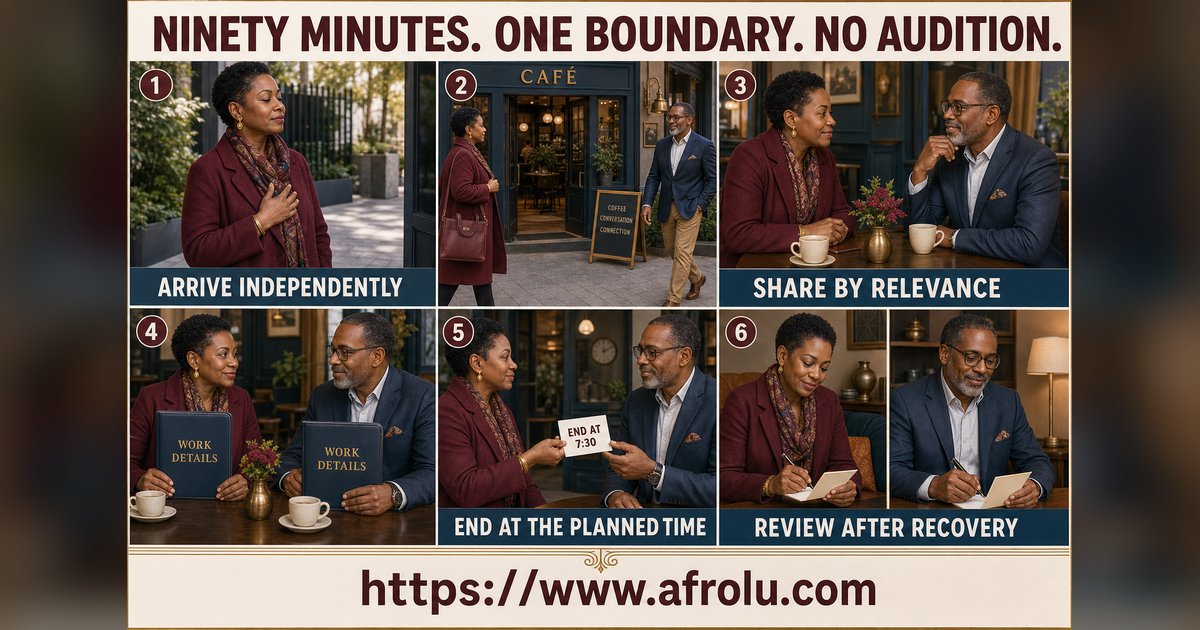
Wanjiku, 48, is a senior architect returning to dating after a long period focused on work and family responsibilities. Mensah, 51, works in operations and began dating again after divorce. They chose a quiet public café, 6 p.m. to 7:30 p.m., with separate transport and an affordable order. Each told one trusted person the plan without circulating private profile details.
Outside the café, Wanjiku noticed a racing heartbeat and the urge to cancel. She named five things she could see, felt her feet on the ground and checked the facts: public venue, controlled transport, planned end. The sensation remained but became less central. She did not treat grounding as proof that Mensah was safe; she continued to observe logistics and conduct.
When Mensah asked about her largest clients, Wanjiku answered generally and said she kept current projects private. He accepted the limit and shifted to what she enjoyed about design. Wanjiku said she was dating toward partnership but wanted a measured pace. Mensah described the same broad intention without asking how many relationships she had missed or whether work had made her difficult.
At 7:25, Mensah suggested a second venue. Wanjiku declined and kept the planned end. He said goodnight without pressure. The next morning, she reviewed conduct, fit and her own activation separately. She wanted another short date and said so. Her answer was not owed by the respectful ending; it was a new choice supported by interest and usable evidence.
Sort three kinds of information
Continue, notice and stop cards prevent body sensation from becoming a safety verdict
In the body room, continue means activation is present but manageable enough for chosen action. Notice means you need a pause, water, grounding, a shorter plan or to leave. Stop means a health concern, impairment or severe distress requires immediate care or support. Only a qualified professional can assess a condition; a date should never pressure you to ignore symptoms.
In the biography room, continue means curiosity without entitlement. Notice means a question reaches material you do not want to discuss. Stop means humiliation, age stereotypes, demands for sexual or relationship history, or using loss and loneliness to pressure access. In the career room, continue means general interest and respected confidentiality; stop includes workplace intrusion, credential demands or employment threats.
In the boundary room, continue means venue, money, transport, images, touch and timing remain separately chosen. Notice means ambiguity needs a direct question. Stop means blocked departure, financial urgency, intoxication undermining choice, stalking, coercion or retaliation after no. Ordinary nervousness may coexist with green conduct; unusual calm may coexist with red logistics. Check both.
In the review room, continue means you can recall facts, preferences and impact without forcing certainty. Notice means exhaustion or immediate relief is dominating the answer; allow recovery. Stop means fear, repeated unwanted contact or a safety concern requires distance and support. Do not schedule a second date merely to reward politeness or prove that returning to dating is going well.

A feeling is information about your state; conduct and logistics answer different questions.
Use ten adult sentences
Prepared language protects attention without turning the meeting into an interview
For re-entry: 'I am making room for dating again after a full work and family season.' For intention: 'I am open to a serious partnership and I prefer to learn slowly.' Both tell the truth without supplying a life audit. If asked why now, you may answer briefly, redirect or say that the fuller story is private until more trust exists.
For career: 'I work in design leadership; I keep current clients and office details private.' For schedule: 'Weekends and one planned evening usually work; my workday is not a dating channel.' For privacy: 'Please ask before sharing my name, image or story.' A compatible adult does not need restricted details to sustain interesting conversation.
For money: 'I keep first dates affordable and do not lend, invest or exchange account access through dating.' For pace: 'Ninety minutes and one venue works for me tonight.' For health: 'Before relevant intimacy, I want a direct conversation about testing, prevention, comfort and boundaries.' Adults later in life still deserve accurate, non-stigmatising sexual-health information and qualified care.
For consent: 'I am comfortable with this, not that, and I may change my answer.' For ending: 'Thank you for meeting; I am leaving as planned and will reply tomorrow.' If the date reacts with shame, age insults, professional pressure, financial urgency or coercion, end contact as safely as possible and use trusted, platform, financial, health, legal or emergency support appropriate to the facts.

Use one honest sentence, then return attention to the person in front of you.
Recover before deciding
Separate body state, conduct, fit, pressure and the next response
In the now tray, write only a few observable facts: plans kept, boundary responses, material contradictions, how departure worked and whether follow-up matched the agreement. Add body state without interpretation. Eat, rest, take usual care and reconnect with ordinary life. Avoid replaying every sentence as if one awkward pause can reveal the future.
The next day, review conduct: was curiosity reciprocal, privacy respected, money separate and every no usable? Review fit: did conversation, values, attraction, pace and life capacity support another meeting? Review pressure: did age, loneliness, career prestige, gifts or time get used to accelerate access? A person may behave respectfully and still not be your fit.
Choose yes when you want another bounded meeting. Choose maybe later when genuine capacity or information is missing and state what that means rather than keeping someone indefinitely waiting. Choose no when interest or fit is absent. Choose no contact when further engagement feels unsafe or boundaries have already been ignored. You need not litigate a decision into agreement.
If first-date anxiety repeatedly prevents chosen activities, causes substantial distress or interferes broadly with work and life, consider qualified mental-health care. General grounding can accompany care but does not replace assessment or treatment. The goal is not to eliminate every sensation before dating; it is to preserve health, agency and realistic support while making personally meaningful choices.

Let the body settle, then decide from conduct, fit and free choice.
Choose a format by cognitive load
Duration, sensory load, conversation support and exit matter more than a bravery ranking
Coffee offers a short natural boundary and easy exit but can feel interview-like; choose comfortable seating and one shared topic. A public walk reduces face-to-face intensity but needs weather, accessibility and a route with people and exits. A gallery supplies conversation objects and pauses. Breakfast can protect evening recovery and alcohol-free clarity.
Lunch fits many professional calendars and has a natural endpoint, though work spillover should remain outside the conversation. A quiet dinner allows depth but can carry cost, duration and alcohol expectations; set them in advance. A structured public activity gives hands and attention a shared task while still allowing conversation. Avoid formats that make leaving socially or physically difficult.
A video-first meeting can reduce travel and add basic context before an in-person plan, but it does not verify every claim or grant recording permission. Keep private backgrounds and employer details out of view. It may be the first format or a preliminary step; no adult needs to apologise for using it after later entry or a long gap.
Compare load, time, talk support and exit. Choose one venue, a modest duration and an affordable cost. Retain transport and belongings. If a format works poorly, distinguish venue mismatch from person mismatch before deciding, while still honouring any no. The goal is not to graduate toward a more romantic setting; it is to gather enough usable evidence with dignity.
Eight later-career first-date moments where nerves, history and privacy can blur
A long gap is treated as a confession
A date asks for a full defence of why an adult has not dated recently.
Offer one chosen sentence and keep private history private.Conversation becomes an interview
Preparation produces rapid questions, polished answers and little mutual presence.
Pause, notice one genuine detail and share rather than evaluate.A racing heart is treated as a verdict
Ordinary activation appears before a well-planned public date.
Ground optionally, check facts and choose the next small action.Interest reaches confidential work
A date asks for names, contacts or current project detail.
Answer generally and close professional systems.Later entry is framed as a defect
A teasing comment suggests the adult must be desperate, difficult or inexperienced.
Name the impact or end; no stereotype needs to be tolerated.Politeness is mistaken for another location
A planned ninety-minute meeting becomes pressure for a private second venue.
Keep the original end and leave independently.Maturity is used to skip sexual-health talk
A date says experienced adults need no direct conversation.
Discuss relevant facts before intimacy and seek suitable care.Respectful conduct is mistaken for an owed yes
The date went well, but one adult does not want another meeting.
Send a clear no without inventing a fault.Signs across body, biography, career, boundary and review rooms
Later entry or return is discussed without shame, interrogation or a deficit story.
Body activation can be named without being treated as diagnosis or proof of danger.
The venue, duration, cost, transport and exit are chosen before cognitive load rises.
Conversation includes mutual curiosity rather than a résumé exchange or audition.
Employer, client, income, schedule and professional contacts remain appropriately private.
Money, accounts, home, images and sexual-health information stay separately controlled.
A pause, declined topic, planned ending or physical no remains safe and complete.
Age, loneliness, career status or time invested is never used to accelerate access.
The review separates observable conduct, personal fit, body state and pressure.
Yes, maybe later, no and no contact remain equally legitimate next-day choices.
Choose the next first-date move through ten re-entry questions
| Situation | What it may mean | What to do next |
|---|---|---|
| Is later entry treated with dignity? | Fits: History is received without ranking. Needs review: Curiosity reaches a private area. Stop: Age, grief or inexperience is weaponised. | Limit disclosure or end the interaction. |
| Can the body state be tolerated? | Fits: Activation remains manageable. Needs review: A pause or shorter plan is needed. Stop: Severe distress or a health concern needs care. | Use proportionate support, not self-diagnosis. |
| Is the plan low-load enough? | Fits: Venue, time and exit preserve attention. Needs review: Noise, cost or duration needs adjustment. Stop: Leaving or clear choice is obstructed. | Change the setting or leave. |
| Is conversation reciprocal? | Fits: Both ask, answer and listen. Needs review: Interview habits are taking over. Stop: Humiliation or interrogation persists. | Reset once or close. |
| Are career systems protected? | Fits: General work context is enough. Needs review: A detail request needs a boundary. Stop: Clients, access or employment are pressured. | Close the channel and seek support if needed. |
| Does money stay ordinary and controlled? | Fits: The date is affordable without obligation. Needs review: Cost expectations need clarity. Stop: A loan, investment or transfer is requested. | Decline and verify outside romance. |
| Are health facts discussable? | Fits: Relevant information can precede intimacy. Needs review: The conversation is premature or incomplete. Stop: Maturity or status is used to conceal facts. | Pause intimacy and seek suitable care. |
| Can consent and the end remain current? | Fits: A no or planned departure is accepted. Needs review: Repeated persuasion requires distance. Stop: Blocking, threats or coercion appears. | Leave and prioritise safety. |
| Has the body had time to recover? | Fits: The review includes facts and preference. Needs review: Immediate activation dominates. Stop: Urgent safety facts require action now. | Rest when appropriate; never delay protection. |
| What response is freely wanted? | Fits: A bounded yes is genuinely desired. Needs review: Capacity or information needs clear time. Stop: Fit or safety supports no contact. | Choose yes, maybe later, no or no contact. |
Scripts for re-entry, career privacy, pace, health, consent and ending
“I am making room for dating again after a full work and family season.”
“I am open to a serious partnership and I prefer to learn slowly.”
“I work in design leadership; I keep current clients and office details private.”
“Weekends and one planned evening usually work; my workday is not a dating channel.”
“Please ask before sharing my name, image or story.”
“I keep first dates affordable and do not lend, invest or exchange account access through dating.”
“Ninety minutes and one venue works for me tonight.”
“Before intimacy, I want to discuss testing, prevention, comfort and boundaries.”
“I am comfortable with this, not that, and I may change my answer.”
“Thank you for meeting; I am leaving as planned and will reply tomorrow.”
Know the difference
First-date formats differ by load, not by adult courage
Uses a bounded public plan, leaves professional and personal history selective, accepts the planned end and allows a next-day decision.
Requires impressive disclosure, expensive symbolism, private extension or instant chemistry while treating later entry as something to prove.
Choose the format that lets two complete adults notice conduct and fit without sacrificing privacy, health or an easy exit.

Choose the format that leaves enough attention for curiosity and a usable exit.
Compare eight first-date formats by load rather than courage
| Type or dimension | What it describes | Best next question |
|---|---|---|
| Coffee | Short and easy to bound, though it may feel interview-like without a shared topic. | A comfortable seat and stated end |
| Public walk | Side-by-side attention with movement, weather and accessibility to plan. | A populated route with exit points |
| Gallery | Objects supply natural conversation, pauses and a visible route. | Mutual interest and an independent departure |
| Breakfast | Daylight and a natural endpoint can protect evening recovery. | A simple affordable order |
| Lunch | Fits professional calendars but needs work talk and timing boundaries. | No client access and a fixed return |
| Quiet dinner | Supports depth while increasing duration, cost and alcohol expectations. | Budget, one venue and controlled transport |
| Structured activity | A shared task reduces direct gaze but must allow actual conversation. | Low stakes and an easy opt-out |
| Video-first meeting | Reduces travel and adds basic context without verifying every claim. | Private background and no recording |
Prepare one later-career first date in six moves
Correct the timeline story
Treat later entry or return as adult context rather than a deficit to defend.
Prepare the body room
Support sleep, food, comfort and optional grounding without seeking perfect calm.
Select biography and career detail
Share truthfully by relevance while keeping private history and systems closed.
Bound the date
Choose public venue, duration, cost, transport and one clear exit.
Keep health and consent adult
Discuss relevant facts and ask for every present physical choice.
Review after recovery
Separate body state, conduct, fit and pressure before responding.
Questions for body, story, date and review
Choose a few prompts that fit the moment. This is a reference library, not a list to complete.
Body questions
Support attention without demanding perfect calm.
- Have I eaten and rested?
- Which familiar skill helps?
- What facts are true now?
- Can I shorten the plan?
- Is professional care needed?
Story questions
Choose biography and career detail.
- What one sentence feels truthful?
- Which history stays private?
- How general is work talk?
- Which contact stays closed?
- Can I redirect comfortably?
Date questions
Bound logistics and access.
- Which public venue fits?
- What is the end time?
- How will I leave?
- What is my cost limit?
- Which physical choices are yes?
Review questions
Separate sensation, conduct and fit.
- What actually happened?
- How was no received?
- What did I enjoy?
- Was pressure present?
- Yes, maybe later, no or no contact?
What anxiety, stress, work, later-life health, fraud and consent sources support
Persistent social anxiety differs from ordinary occasional nerves
NIMH explains that social anxiety disorder can involve intense persistent fear in social situations, including dating, and describes professional treatment. Afrolu uses the source to avoid diagnosing activation from one date.
Evidence limit: A public information page and this guide cannot diagnose or choose treatment for an individual.
Grounding can support attention without certifying safety
The World Health Organization's illustrated stress guide offers skills such as grounding and making room for difficult feelings. An adult may use them while separately checking conduct, logistics and risk.
Evidence limit: General self-help is not therapy, diagnosis, crisis care or proof that a date is safe.
Career demands affect capacity without deciding relationship worth
The International Labour Organization reviews global working-time patterns and work-life balance. It supports building first-date timing around actual energy and recovery rather than a prestige narrative.
Evidence limit: The report does not prescribe a date duration or assess an individual's wellbeing.
Dating and sexual wellbeing remain relevant later in life
Newcastle Sexual Health explains that adults over 50 may date again and that intimacy, desire and comfort can continue or change, alongside safer-sex choices and partner or clinician conversations.
Evidence limit: The UK service page is general information, not individual medical advice or an age threshold for this guide.
Later entry and professional identity should not be exploited financially
UK Government guidance describes false profiles, information limits, reverse-image checking, platform use and payment pressure. A reader can refuse money and verify independently without proving fraud first.
Evidence limit: Reporting routes are UK-specific; use relevant local platforms, providers and authorities.
Age, experience and a successful date never supply consent
NSW Government guidance describes consent as free, voluntary, communicated, ongoing, specific and withdrawable. Those properties apply to every adult and every act.
Evidence limit: Legal definitions and services vary; use appropriate local health, legal or emergency support.
Six ways later-career first dates become auditions
Defending the timeline
A first date becomes a trial of why dating started now. Repair: offer one chosen sentence and redirect.
Preparing an interview
Questions and achievements replace mutual presence. Repair: alternate curiosity, sharing and silence.
Treating sensation as verdict
Activation is made proof of danger or incompatibility. Repair: check body, facts and conduct separately.
Using work as personality
Career detail carries the whole conversation and opens systems. Repair: describe generally and protect access.
Rewarding politeness with extension
A second venue or meeting is accepted from obligation. Repair: keep the planned end and decide later.
Demanding instant certainty
Relief, chemistry or anxiety must produce an immediate answer. Repair: allow recovery and four valid responses.
Use a reviewed resource that matches the decision
This guide focuses on the relationship decision, so it does not rank dating apps. Check current prices, safety tools, and local availability before choosing a service.
Explore the guide library
Show more related guides
Continue with Afrolu
Show more Afrolu guides
Primary mental-health, stress, work, sexual-health, fraud and consent sources
Afrolu reviewed these health, research, safety, or public guidance resources while editing this page. They support the behaviour and safety guidance; they do not diagnose any individual described by a reader.
First-date anxiety questions for later-career adults
Is it unusual to start or return to dating later?
No single adult timeline is required. People begin or return after work, caregiving, bereavement, relationships, recovery, migration, faith commitments or simply different priorities. Share only the history you choose. Later entry changes context, not your right to privacy, health information, a measured pace, an easy exit and a complete no.
How can I calm first-date nerves after a long gap?
Aim for manageable attention rather than perfect calm. Support sleep, food and comfortable logistics, use a familiar grounding skill if helpful and define a small success standard. Check body sensation, observable conduct and venue facts separately. If anxiety is persistent, severe or broadly interfering with life, seek qualified assessment rather than diagnosing yourself from one date.
What should I say about why I am dating now?
Use one truthful sentence that fits your privacy, such as making room after a full work or family season. You do not owe divorce, bereavement, medical, sexual or relationship history on a first date. A respectful adult can accept a brief answer. Share more later only when purpose, trust and your own desire support it.
How do I stop the date feeling like a job interview?
Prepare fewer questions, notice one genuine detail and alternate asking with sharing. Use a setting with natural conversation material, such as a gallery or walk. Keep work description general and do not evaluate achievements as relationship evidence. Silence or one awkward answer does not require you to fill the evening with another assessment.
How much career information should I share?
Describe your field or role as generally as you prefer. Keep employer, clients, building access, itinerary, income, professional contacts, credentials and managed systems private unless a later purpose genuinely requires them. Do not offer work opportunities to create closeness. If a date contacts colleagues or workplace after refusal, use suitable workplace and local support.
What is a good first-date length after a long gap?
There is no universal duration. Sixty to ninety minutes with one public venue often provides a useful boundary, but choose for your energy, accessibility and context. State the end in advance, retain transport and leave when planned even if the date is pleasant. A second venue is a new decision, not the polite default.
Do adults later in life still need sexual-health conversations?
Yes. Discuss current partners, testing, prevention, comfort, relevant health factors and boundaries before intimacy, and use qualified care for individual decisions. Do not infer health from age, experience, relationship intention or appearance. Share what affects the choice without demanding unrelated medical history. Every physical act still needs a current free answer.
What if I feel no instant chemistry?
You do not need immediate chemistry to accept another date, and you do not need to override a clear lack of interest. Let your body recover, then review curiosity, attraction, conduct, fit and pressure separately. Choose another bounded meeting only if you want it. A respectful first date does not create a debt to keep exploring.
When should I reply after the date?
Set an honest window, such as the next day, rather than using silence as a tactic. Reply sooner if logistics or safety require it. After recovery, choose yes, maybe later with a clear meaning, no, or no contact. A concise no is enough. You do not need to manufacture criticism or persuade the other adult to agree.
When should first-date anxiety receive professional help?
Consider qualified support when fear or avoidance is persistent, intense, distressing or interfering with dating, work, relationships or daily life. A clinician can assess symptoms and options. General date preparation and grounding may support the moment but cannot diagnose or treat a disorder. Use emergency or crisis services when there is immediate risk.
One thing to do now
Enter one date without putting your adulthood on trial
Proceed when the public plan preserves attention and exit, later entry is treated with dignity, career systems stay closed, money and health remain discussable and every no is accepted. Adjust load or duration when manageable. Pause for recovery or qualified care. End or use no contact when fit is absent or age shame, intrusion, financial pressure, stalking or coercion appears.