Faith-led dating · low-pressure clarity
Faith-Led Low-Pressure Situationships and Career
For faith-led adults, keep a career-shaped situationship low pressure with clear terms, voluntary consent and privacy, independent plans, and safety boundaries.
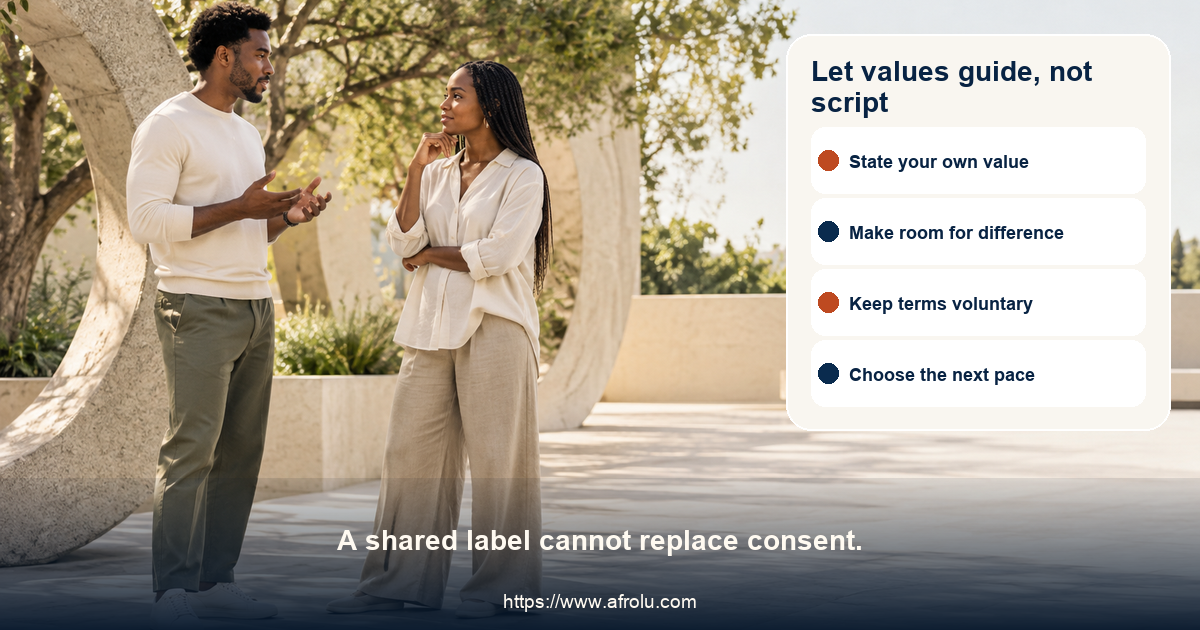
Values guide a choice; they do not write it.
Written and edited by Samira Benali · Faith and North Africa Editor
Do not let faith, career pressure, attraction, or a gentle label write terms neither adult has chosen. State your own values and limits, define what low pressure means in practice, ask for a current capacity offer, keep consent and disclosure specific, and protect money, privacy, and access. If a no is ignored, shift from explanation to safety.
Relationship clarity · Faith-Led Daters
Is this a values-led lighter connection, an unclear label, a career capacity mismatch, an assumption about intimacy or disclosure, a financial request, or conduct that reduces my freedom?
A faith-led low-pressure situationship is an undefined or deliberately limited dating connection where faith may inform personal choices and career may shape availability. It is not a preset path. A healthy version leaves both adults able to name their own values, boundaries, plans, privacy, consent, and exit without guilt or pressure.
Nia enjoys someone who talks about values and has a demanding job, but she notices that 'easy' has begun to mean she must remain flexible. She asks what low pressure means in messages and plans, keeps dates public, declines a request for greater disclosure, and names her physical boundary. Their response shows her whether the connection can remain freely chosen.
faith-led dating · low-pressure clarity
Nia keeps values personal, low pressure explicit, and career context separate from access or obligation
This guide separates individual values from presumed rules, chosen lightness from vague access, honest capacity limits from standby dating, and ordinary difference from pressure or unsafe conduct.
State your values, define low pressure, ask for a present offer, make consent and privacy specific, protect disclosure and systems, and reduce access when a boundary is ignored.
Keep them personal
Faith can guide a choice without deciding it for another adult.
Give lightness edges
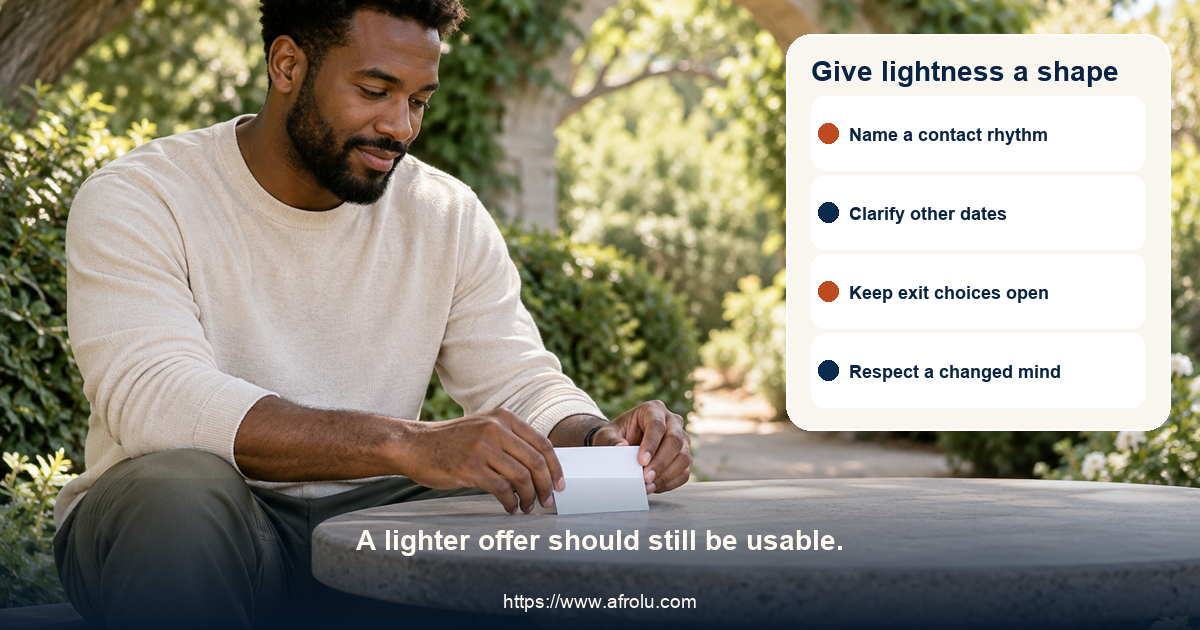
A lighter arrangement needs terms you can use.
Name the exact decision
Attraction and shared values never replace a current yes.
Protect choice
Money, privacy, and access should stay under your control.
values · low-pressure clarity
Faith can inform a person's choices without prescribing the same pace, sexual boundary, family role, community involvement, or relationship destination for everyone
Faith-led dating is often discussed as though it creates one obvious relationship path. It does not. Two adults can both value faith and still hold different views about pace, exclusivity, intimacy, privacy, ceremony, commitment, or whether they want to date at all right now. A situationship becomes less confusing when neither person has to perform a presumed script.
Start with personal language rather than category language. You might say, 'I want to keep this low-pressure while I learn whether we fit,' or 'My boundary around physical intimacy is this.' Those statements tell another adult what you choose without requiring them to defend their belief, declare a future, or take on a role they did not offer.
Shared values can be a useful starting point, but they are not evidence of safety or compatibility. Notice whether the person treats disagreement with patience, whether a limit survives attraction, and whether your consent remains current. A person can speak warmly about principle while still pressuring you; another can make a different choice while respecting yours completely.
The goal is not to make a relationship less meaningful. It is to keep meaning attached to conduct that both people freely choose. A lighter arrangement, a deliberate pause, a committed path, or an ending can all be values-consistent when the terms are honest, consent is active, privacy is protected, and neither adult uses faith as leverage.
pace · voluntary contact
Low pressure is not an empty space where one person waits, chases, accepts secrecy, or becomes permanently available while the other avoids a conversation
Some people use 'let us keep it easy' to mean fewer demands; others hear it as a promise that time will naturally create seriousness. Neither interpretation is safe when it stays unspoken. A clear low-pressure arrangement has ordinary edges: perhaps occasional dates, no overnight plans, no assumption of exclusivity, or a check-in after a few weeks to see whether the shape still works.
There is no moral ranking between a casual connection and a serious one. What matters is whether the stated shape matches conduct. If one adult repeatedly asks for more access, reassurance, or intimacy than the arrangement contains, the label is no longer doing its job. If the other cannot state a limit without disappearing, the connection may be too vague to choose freely.
Use plain questions. 'When you say low pressure, what would that look like in practice?' is more useful than debating whether someone is sincere. Follow with your own answer: how often you want to meet, whether you are seeing other people, what privacy you need, and what would tell you that it is time to pause or end. This creates consent around the actual connection.
A low-pressure relationship does not require low standards. You can expect politeness, honesty about material changes, respect for a no, and enough notice to make plans safely. You can also decide that a connection that is too casual for your needs is not wrong, just not yours. Choosing that distinction protects both adults from resentment disguised as patience.
capacity · ordinary life
Work demands may shape availability, yet income, ambition, credentials, and busyness do not prove maturity, reliability, generosity, or entitlement to flexibility
Career language can obscure a simple compatibility question. Perhaps someone can only meet during certain hours; perhaps they cannot make plans far ahead; perhaps they have plenty of time but prefer a light arrangement. None of those facts need shame. They become difficult only when you are asked to interpret every cancellation as evidence of importance and never allowed to know what is genuinely available.
Request a small, practical offer. It could be one call each week, plans confirmed by a specific time, or a short pause while another obligation is intense. Do not ask for a calendar, employer details, salary, or proof of stress. The point is to decide whether their available relationship shape works for you, not to inspect or rank their work.
Be wary of a double standard where their busyness is treated as untouchable but your time is assumed flexible. A respectful adult can ask for a change, acknowledge disappointment, and make another plan. They do not need you to cancel your rest, friends, responsibilities, or privacy just to demonstrate that you take their career seriously.
If the present offer is smaller than you want, believe it without trying to persuade someone into more. You may enjoy the lighter shape, revisit it later, or step away. That choice is not a judgment of their ambition or faith. It is a decision about the space a relationship has in two real lives right now.

A small clear plan protects two lives.
consent · personal boundaries
Affection, values talk, dates, prior intimacy, or an expensive plan never create automatic permission for touch, images, personal information, exclusivity, or an overnight stay
A low-pressure situationship can still bring high-stakes decisions. One adult may be happy with public dates while another expects private time; one may want to share intimate images while another does not; one may understand physical intimacy differently. The safe response is not to guess from faith language, previous attraction, or the cost of a date. It is to ask and listen before each change.
Use wording that keeps the choice present. 'I want to keep this date public,' 'I do not share photos like that,' or 'I am not agreeing to exclusivity' can all be complete. You do not owe a theological argument, a work explanation, or a promise to reconsider. A respectful response may include a different preference, but it does not include bargaining, sulking, intoxication, or pressure.
Protect digital privacy at the same pace. Keep accounts, location, work contacts, passwords, live routines, and private photos under your own control. A person can be curious about you without needing access to every part of your life. Early disclosure should leave you able to change your mind without having to manage unwanted contact or a merged social world.
If the conversation reveals incompatible boundaries, the result can be sad and still useful. Do not turn disagreement into a contest over values. You can adjust the relationship, keep it non-intimate, or end it. Consent works when it makes an honest no survivable, not when it forces either adult to find the perfect explanation for a limit.

Ask at the point of choice.
privacy · independent choice
No adult should have to disclose a situationship to friends, relatives, a faith community, colleagues, or anyone else before they choose; secrecy should not be demanded either
Some adults want dating kept separate from their wider life until there is enough trust and direction; others are comfortable with more openness. Neither preference is automatically healthier. Trouble appears when one person uses a group, family, social standing, or imagined reputation to hurry the other into disclosure, or when secrecy becomes a way to avoid basic honesty about other relationships and intentions.
You can set a simple boundary: 'I am not introducing dating connections to people in my life yet,' or 'I do not want our messages shared.' That leaves room for the other adult to say what they need without granting them a vote over your relationships. It also avoids assuming that anyone's faith community has a particular view, role, or authority over their dating choices.
Look for whether privacy is reciprocal and practical. Are you asked to erase yourself, avoid public places, lie, or accept contact only at hidden hours? Are you being pressured to reveal more than you want in order to prove sincerity? Either extreme can make the connection hard to choose. A healthy privacy rule preserves autonomy, safety, and an ability to get support.
If the only way the relationship can continue is through secrecy that leaves you anxious, isolated, or unable to name ordinary boundaries, pause. You do not need public approval to date, and you do not need to sacrifice your own judgement to keep a connection discrete. The standard is whether both adults retain honest choice and access to trusted support.
safety · independent systems
A heartfelt story, shared values, career difficulty, or proposed future does not make a request for money, documents, codes, account access, private images, or constant location safe
Pressure can arrive in a form that seems difficult to question: a sudden employment crisis, a medical problem, a promise that a payment is temporary, or a claim that helping is a sign of trust. The person may sound frightened or affectionate. None of that changes the safest rule: your bank, account, documents, and identity tools remain under your sole control.
The same independence matters for a date. Keep your own transport, funds, location decisions, and way to leave. Avoid an arrangement that requires you to disclose your address, stay somewhere you did not choose, or become responsible for another adult's itinerary. A respectful person can accept a public plan, a shorter meeting, or a cancellation without turning practical effort into a debt.
When contact continues after you say no, gets routed through new accounts, involves threats to expose private material, or makes you fear for your safety, the task is no longer relational clarity. Restrict access, use platform tools, preserve evidence only when safe, tell someone you trust, and seek local or specialist support if needed. You are not required to make the person understand.
Do not let politeness keep you in a risky conversation. A concise refusal can be enough; silence and blocking may be safer in some circumstances. Personal values are compatible with strong safeguards. Compassion does not require funding, rescuing, exposing yourself, or remaining available to somebody who ignores your autonomy.

Keep money and access separate.
practical reset · self-trust
The clearest low-pressure rule is one you can follow when you feel hopeful, guilty, flattered, lonely, rushed, or tempted to call uncertainty a sign of depth
Write a sentence you can actually use: 'I do not make private plans until I know I can leave independently,' or 'I do not keep dating in a shape that cannot be described.' A concrete standard is easier to apply than a broad wish for respect. It tells you when to pause without requiring a dramatic event or an argument that someone else agrees with your interpretation.
Test it against the next real decision. If a date is proposed with little notice, if someone asks for a photo, if career stress is used to avoid a basic conversation, or if the relationship is kept secret in a way that isolates you, ask whether the choice will still feel voluntary tomorrow. If not, you can wait, decline, or leave the question unanswered.
Let your evidence stay simple: direct answers, consent respected, plans revised honestly, private systems left alone, and no punishment for a boundary. These signals do not guarantee a future. They do make it possible to choose an emerging relationship without surrendering judgement to chemistry, community stories, or imagined obligation.
You can value connection while declining pressure. You can care about someone while saying that the available arrangement does not suit you. The best outcome is not a label imposed by values talk; it is a relationship shape that both adults can name, consent to, and change without losing safety or dignity.
Eight low-pressure situationships where values, time, plans, privacy, money, or pressure changes the next move
The assumed path
A person says shared faith means you should want the same pace and destination.
State your own values and ask what they actually want now.The undefined easy connection
Low pressure means you receive affection but cannot ask about plans or other dates.
Ask for the practical meaning of the label before continuing.The career exception
Work is cited whenever you request notice, yet your time is expected to remain open.
Request a small mutual rhythm and assess whether it is respected.The private-plan assumption
A warm date is treated as an expectation of intimacy or an overnight stay.
Name the setting and boundary before you meet.The disclosure demand
You are asked to introduce the connection or explain it to others before you want to.
Keep disclosure at your chosen pace.The rescue request
A compelling personal or career problem becomes a request for funds or account help.
Keep money and systems separate; verify independently.The return with guilt
Someone reappears and says your boundary shows you lack compassion.
Decide from present conduct, not guilt.The repeated message
A clear ending is followed by new accounts, pressure, or threats.
Reduce access and seek support if it feels unsafe.Fourteen observable signs that a faith-led connection remains chosen, vague, access-driven, financially risky, or unsafe
They describe their own values without assuming yours.
Low pressure has practical terms rather than permanent ambiguity.
Your reply pace is accepted without tests of care.
Career limits are named with a realistic current offer.
A public or independent plan is treated as normal.
A no to touch, images, or an overnight is accepted immediately.
Privacy is reciprocal and does not isolate either adult.
You are not required to disclose the connection to prove sincerity.
They can discuss other dates before exclusivity is assumed.
Gifts, expenses, or values talk do not create debt.
Money, codes, documents, and accounts stay separate.
A changed preference is met with honesty rather than shame.
You can get support without fear of retaliation.
A clear ending is respected without monitoring or new contact routes.
A proportionate decision map for values, pace, career capacity, consent, disclosure, money, a return, and an ending
| Situation | What it may mean | What to do next |
|---|---|---|
| They mention faith | A personal value or an attempt to write terms for you. | Ask what they want rather than infer. |
| They say low pressure | A deliberate lighter shape or a way to avoid all edges. | Name messages, plans, other dates, and exit terms. |
| Work disrupts a plan | A normal constraint or one-sided standby access. | Look for notice and a usable alternative. |
| Intimacy is raised | A current invitation, never an implied duty. | State your boundary and wait for clear respect. |
| They ask for disclosure | A preference or pressure for public proof. | Keep your social world under your control. |
| They offer a costly date | A gift or a possible attempt to accelerate access. | Keep your no unchanged and your transport independent. |
| They want account help | A safety boundary regardless of closeness. | Do not send, receive, or move money or codes. |
| They want constant contact | Reassurance or an attempt to narrow your freedom. | Set a response rhythm you can maintain. |
| They return after silence | A new invitation, not a moral debt. | Ask what they can offer now. |
| They ignore an ending | A situation requiring access reduction and support. | Block, report, and seek help if fear or pressure persists. |
Twelve complete lines for values, low pressure, plans, consent, privacy, money, a different fit, and no contact
“My values guide my choices, but I do not assume they decide yours.”
“What would low pressure look like in messages, plans, and other dates?”
“What can you realistically offer during this busy period?”
“I need a public plan and my own way home.”
“I am not choosing that tonight.”
“I do not share private photos.”
“I am keeping this part of my life private for now.”
“Before that changes, are either of us dating other people?”
“I do not lend, receive, or move money through dating.”
“Thank you, but this does not change my boundary.”
“I respect your preference, and this shape is not right for me.”
“I am ending contact. Do not message me again.”
Know the difference
Intentional low pressure versus pressure hidden behind a gentle label
Both adults name limits, respect consent, keep systems separate, and can change or end the arrangement without shame.
One adult is asked to wait, disclose, give access, or accept guilt while the relationship remains conveniently undefined.
A value-led connection is measured by voluntary conduct, not by a shared label or an assumed script.

A gentle label cannot excuse pressure.
Keep chosen low pressure distinct from ambiguity, leverage, and conduct that narrows freedom
| Type or dimension | What it describes | Best next question |
|---|---|---|
| Personal value | A choice described as yours. | Say what it means for the current decision. |
| Presumed rule | A label used to decide for another adult. | Return to explicit consent and preference. |
| Low pressure | Limits are named and mutually usable. | Check whether the actual rhythm fits. |
| Low accountability | Questions are treated as demands while access stays open. | Ask for concrete terms or step back. |
| Busy season | A smaller present offer is made honestly. | Choose whether that offer works. |
| Standby expectation | Your time is held open for irregular access. | Set a confirmation and reply boundary. |
| Private dating | Disclosure stays voluntary and support remains available. | Keep your social choices independent. |
| Isolating secrecy | You are asked to hide, lie, or lose support. | Pause and reassess safety. |
| A boundary | A no is accepted without debate. | Continue only at the pace you choose. |
A simple plan you can use today
Faith is not a shortcut
A shared label cannot replace a current conversation.
Low pressure needs edges
The lighter the arrangement, the more useful direct terms become.
Career is context
A busy schedule can be real without making your time disposable.
Consent needs no defence
A boundary can be complete without an explanation.
Privacy is chosen
Visibility and discretion should each remain voluntary.
Safety can be compassionate
Strong financial and digital limits protect both adults.
Questions organised by purpose and depth
Choose a few prompts that fit the moment. This is a reference library, not a list to complete.
Values and pace
Use before a shared label turns into an assumption.
- What does my value mean for the next choice?
- What does low pressure mean in practice to me?
Capacity
Use before career pressure makes your time permanently flexible.
- What can each adult offer now?
- What plan would protect my ordinary life?
Consent and privacy
Use before a private plan, image, disclosure, or intimacy decision.
- What do I freely choose today?
- Which details stay private for now?
Safety
Use if urgency, money, digital access, or unwanted pursuit appears.
- What system needs stronger separation?
- Who can help if a boundary is ignored?
What deserves a closer look
Keep difference possible
State what matters without assuming a shared faith label has settled every term.
Evidence limit: Do not use belief to pressure agreement.
Give lightness edges
Describe messages, plans, other dates, and how either person can slow down.
Evidence limit: Do not call indefinite waiting low pressure.
Ask for the present offer
Use a small realistic rhythm rather than a professional biography.
Evidence limit: Do not inspect private work details.
Name the exact choice
Keep touch, images, intimacy, and exclusivity current and voluntary.
Evidence limit: Do not infer permission from warmth or values.
Protect chosen disclosure
Keep social world, routine, and support network under your own control.
Evidence limit: Do not accept secrecy that isolates you.
Close risky routes
Keep money and technology systems separate and reduce access if pressure persists.
Evidence limit: Do not negotiate an ignored no.
Shortcuts that turn values talk into assumption, waiting, secrecy, debt, or unwanted access
Assuming shared belief means shared terms
It replaces curiosity with a script neither adult agreed to.
Calling ambiguity easy
It can leave one person waiting without a chosen plan.
Using career as a blank cheque
It treats your availability as less valuable.
Explaining every boundary
It invites bargaining over a decision that is already yours.
Confusing privacy with isolation
Secrecy can cut you off from support and choice.
Funding a compelling story
Financial entanglement can turn sympathy into risk.
Keep low pressure clear, set a boundary, or make consent current before your next plan
Choose the resource that fits the current decision. An editorial guide can help name an option or pattern, but it cannot guarantee another adult's honesty, future capacity, or conduct.
Explore the guide library
Show more related guides
Continue with Afrolu
Show more Afrolu guides
Sources used for this guide
Afrolu reviewed these health, research, safety, or public guidance resources while editing this page. They support the behaviour and safety guidance; they do not diagnose any individual described by a reader.
Questions about faith-led low-pressure situationships and career capacity
Can faith-led adults have a low-pressure situationship?
Yes. The useful question is whether the arrangement reflects each person's stated values and remains freely chosen.
Does shared faith mean we want the same relationship?
No. Pace, intimacy, exclusivity, visibility, and future goals still need direct conversation.
What does low pressure mean in practice?
It can mean limited contact or casual dating, but messages, plans, other dates, and exit terms should be clear enough to choose.
Can career stress explain inconsistent contact?
It can limit availability, but a person can still name the small offer they can make now.
Do I owe an explanation for a physical boundary?
No. A current no is complete, whether or not you share the reason.
Should I disclose a situationship to my community?
Only if and when you choose. Privacy should be voluntary and should not isolate you from support.
How should I respond to an expensive gift?
Receive or decline it by choice, but do not let it change your consent, privacy, or ability to leave.
What if someone asks for financial help?
Keep funds, accounts, codes, and documents outside dating, and verify any urgent claim independently.
Can I end it if our values differ?
Yes. Different preferences can be enough reason to step back without proving anyone wrong.
When is it a safety issue?
It is a safety issue when a clear boundary is ignored or contact includes monitoring, threats, image pressure, or account demands.
One thing to do now
Choose the connection that leaves your values, time, privacy, and freedom intact
Choose the smallest next action that protects your values, time, body, privacy, money, accounts, independent movement, support network, and ability to revise or end contact without shame or bargaining.