Diaspora dating · low-pressure weekends
Diaspora Low-Pressure Weekend Situationships
For diaspora adults, make a low-pressure weekend situationship clear with chosen privacy, mutual plans, current consent, separate systems, and safe exits.

A weekend offer needs present terms.
Written and edited by Tariro Ncube · Diaspora Dating Editor
Read the weekend offer as it is, not as a promise. Keep diaspora context individual and voluntary, make low pressure practical, plan dates with independent choices, keep money and private systems separate, assess a return by its present offer, and reduce access if a clear boundary is ignored.
Relationship clarity · Diaspora Daters
Is this a weekend arrangement I can describe and choose, a context I want to share gradually, a casual pace with usable terms, a plan that needs a boundary, a request for access, or a pressure pattern that needs an exit?
A diaspora low-pressure weekend situationship is recurring romantic or affectionate contact that is mostly shaped around weekend availability without a fully shared relationship definition. Diaspora experience and weekend rhythms vary widely, so the useful question is what both adults explicitly choose about contact, privacy, plans, intimacy, other dates, and the ability to change course.
Nia enjoys a few easy Saturdays with someone she met recently, but Friday invitations and warm messages have begun to feel like a relationship neither person has described. She asks for earlier notice, keeps a personal detail private, says no when a coffee plan turns into an overnight expectation, and decides a return after silence needs a present offer rather than a romantic explanation.
diaspora dating · low-pressure weekends
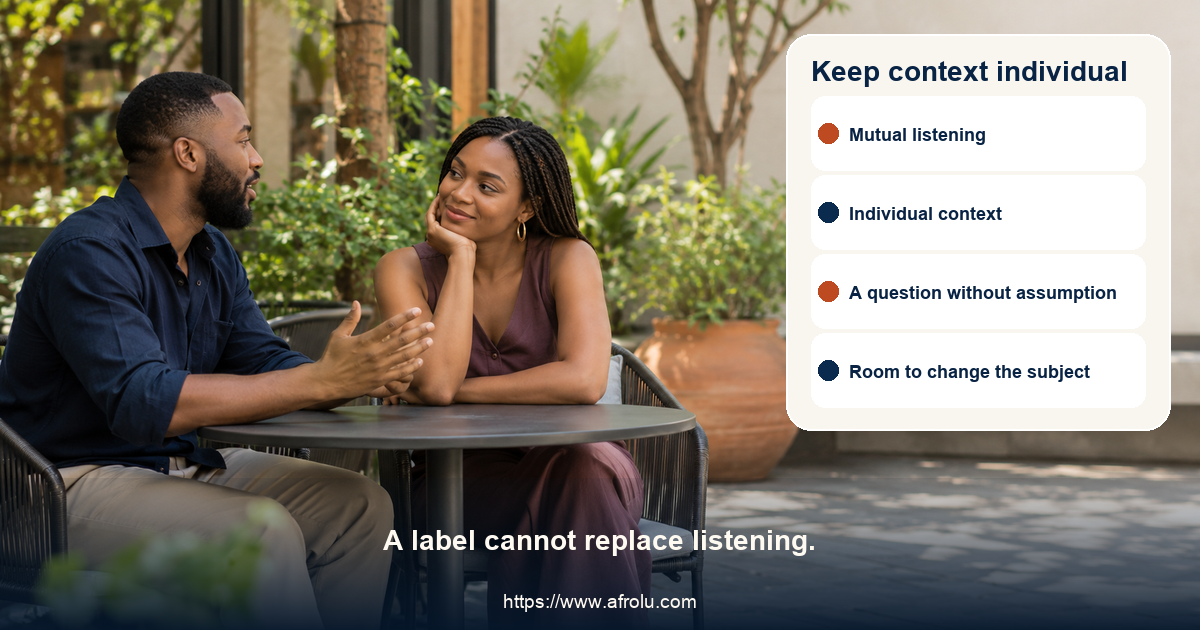
Nia makes a weekend connection readable without turning diaspora context, availability, or chemistry into a script
This guide separates a stated weekend offer from convenient access, invited context from identity assumptions, low pressure from vagueness, relaxed plans from assumed intimacy, and ordinary fading from conduct that reduces choice.
Name the current rhythm, keep disclosure chosen, ask what lightness means in practice, make plans reversible, protect private systems, and respond to pressure with more control rather than more explanation.
Read the present
Weekend attention is not a relationship definition.
Keep it individual
Identity details remain voluntary and nuanced.
Leave room to leave
Independent logistics keep a date freely chosen.
Protect access
Money, accounts, pressure, and ignored noes require limits.
weekend contact · present terms
A weekend pattern can be a pleasant, deliberately light connection, but it does not explain itself: it may reflect real capacity, a temporary preference, a casual arrangement, an undefined habit, or a mismatch that needs words
A Friday message can feel especially bright when the rest of the week has been busy, lonely, or full of obligations. That feeling is real, yet it cannot tell you whether the other person wants a regular date, an occasional plan, a sexual connection, a friendship that sometimes looks romantic, or simply a convenient way to pass time. Begin with the smaller, more useful question: what is being offered this weekend?
Weekend availability is not a moral score. Some people genuinely protect weekdays, some enjoy a slower rhythm, and some want more contact than they can currently provide. You do not need to diagnose the reason or create a biography from a gap between messages. You do need to notice whether the pattern is stated honestly, whether plans are made with care, and whether the arrangement leaves room for your own ordinary life.
A low-pressure situationship can be clear. It might mean one planned outing when both people are free, no expectation of daily messages, no exclusivity unless it is discussed, and no assumption that a weekend meeting expands into access to a home, body, social circle, money, or private accounts. The label matters less than whether both people could describe those practical boundaries in similar words.
If you want a different rhythm, say so without turning preference into a charge. You may prefer a weekday call, more notice before plans, less intimacy, more clarity about other dates, or a connection that does not begin and end around someone else's spare time. The goal is not to make a weekend pattern more serious. It is to choose whether its present shape is one you genuinely want.
identity · privacy · chosen disclosure
Diaspora experience can shape a person's relationships, schedules, language, privacy, family connections, and sense of belonging, but none of those things can be assumed from a label or used as a shortcut to intimacy
Diaspora is not one dating script. It does not tell you where someone was born, which languages they use, how close they are to relatives, what traditions matter, whether they travel, how visible they want a date to be, or what kind of relationship they seek. Treating a broad identity as a set of facts can make a light connection feel invasive before trust has had time to develop.
Ask practical questions at the level you actually need. If a weekend plan needs a time, ask which time works. If you are considering an event, ask whether a public setting feels comfortable. If a name, family detail, location, or personal history is not needed for the next choice, leave it open. A respectful conversation can have warmth without treating disclosure as the price of being taken seriously.
Notice the difference between someone choosing to share and someone being pressed to prove connection, background, or sincerity. Repeated questions about origins, family expectations, travel, residence, legal status, religion, or community can become a demand for a story the other adult has not offered. A clear boundary is not coldness; it is information about how that person wants to be known.
Your own context deserves the same care. You do not have to present a complete identity, introduce anyone, explain a private family arrangement, disclose an address, or become a guide to a culture in order to enjoy a date. A weekend situationship remains lighter and safer when each adult controls what becomes shared, public, remembered, or connected to people outside the two of you.
casual intention · mutuality
Low pressure should describe a mutually chosen pace and a real ability to say no, not a vague rule that lets one adult avoid every useful question while retaining attention, physical access, or emotional reassurance
People often use low pressure to mean different things. One person may mean no daily messaging; another may mean no exclusivity; another may want affection but not an overnight plan; another may be open to exploring without making promises. None of those positions is automatically unfair. Confusion begins when a broad word is asked to carry several agreements that have never been spoken aloud.
Try one question small enough to answer now: 'What would keep this comfortable for you over the next few weekends?' The response can reveal more than a demand for a future label. It can show whether the person can name a realistic rhythm, respect a boundary, accept another answer, and make plans without treating flexibility as a one-way benefit for them.
Low pressure still requires reciprocity. If you repeatedly accommodate last-minute plans, wait through unexplained silence, absorb jealous questions while being denied the right to ask about other dates, or feel unable to decline intimacy because the arrangement is supposedly casual, the word is not protecting choice. It may be hiding an uneven arrangement that deserves a clearer look.
You can revise a casual connection without making either adult wrong. Perhaps you want more reliability, perhaps the current pace is enough, perhaps a weekend-only pattern makes you feel peripheral, or perhaps you no longer want contact. State the change in present language and let the answer guide you. You are not required to preserve an easy label at the expense of a workable life.

Clarity can remain light.
meetings · boundaries · consent
A relaxed weekend plan should remain easy to alter: public enough for a first or uncertain meeting, clear about time and transport, and free from assumptions that food, effort, alcohol, a ride, or a previous date creates access to anything else
Weekend plans can accumulate momentum quickly. A coffee becomes dinner, dinner becomes an invitation, an invitation becomes an assumption about staying late, and a person who said yes to one part may feel expected to accept the rest. You can slow that chain down. Name a time you want to leave, keep your own route home, choose a public place when you prefer one, and make a new decision before the plan changes.
A last-minute invitation is not automatically unsafe or disrespectful. The useful question is whether you can freely decline it. If you have to rearrange care, work, money, rest, or another commitment every time the other person becomes available, the plan is asking more from you than it appears to ask. A low-pressure connection should make space for both adults' existing responsibilities.
Talk about intimacy at the point it becomes relevant, not as a reward for a date. You can say that you are meeting for a walk, that you are not going home with anyone, that you want to leave after one drink, or that you want to check in before touching or sharing an image. A prior yes, a flirtatious message, or a weekend reservation does not answer the question for the present moment.
If a boundary is met with teasing, sulking, repeated negotiation, a bill used as leverage, or pressure to explain why you want to leave, take that seriously. You do not have to convert the situation into a conflict to act on it. A respectful adult may feel disappointed and still protect your freedom. That is the minimum standard for a plan that claims to be relaxed.

Make each weekend choice current.
privacy · money · digital safety
A weekend situationship does not need shared money, financial help, identity records, device access, passwords, location history, private images, home details, or a secret channel that gives another adult leverage over your ordinary life
The safest early arrangement is uncomplicated. Pay for what you choose, keep your own tickets and transport, do not receive or move funds for someone you are dating, and do not share codes, account logins, documents, or devices as a test of trust. If a story requires urgency, secrecy, or a private link, it is a reason to slow down and verify independently rather than a reason to prove you care.
Privacy also includes the small details that let another person map your life: where you sleep, who lives with you, when you are alone, which route you take, where you work, which relatives know about you, and which accounts connect to your identity. You can share a detail because you want to. You do not owe it because the connection has become regular, playful, physical, or emotionally warm.
Be careful with an invitation to move communication into a place where reporting, blocking, and privacy controls are weaker. A new platform is not automatically a problem, but you can keep the channel that offers you more control. You can also decline a request for disappearing messages, live location, private photos, or contact with someone outside the two of you without turning your boundary into a debate.
If protecting your systems makes the connection feel less easy, that is useful information. Ease that depends on your money, private records, constant availability, or fear of disappointing another adult is not the kind of lightness this guide recommends. Choose arrangements that leave you able to end a date, close an account conversation, or stop replying without having to recover control first.

Keep access separate from attraction.
mixed signals · endings · safety
A quiet week, a cancelled plan, or a person returning after absence can be ordinary dating information; pressure, monitoring, repeated contact after a no, threats, image coercion, or financial requests require a response focused on control rather than on preserving a relaxed tone
A weekend connection can fade for many reasons: competing obligations, a change of interest, a mismatch, or simple inconsistency. You may ask once for clarity or decide that the pattern no longer works. You do not need to investigate every absence or declare that someone is dangerous because they did not become available. A present offer is enough information to choose your own next move.
The category changes when a boundary is ignored. Repeated messages after a clear no, contact through new profiles, threats to reveal information, pressure around images, attempts to track you, or demands that you restore access are not signs that you should schedule a private closure conversation. They are signs to reduce contact, use report and block tools, tell someone you trust, and seek local help when you feel afraid or your freedom is being limited.
A return after silence can be evaluated without punishment or hopefulness. Ask what has changed, what kind of contact is actually available, and whether the person can make a plan that fits your life. If the answer is another vague invitation, another late-night message, or another future story with no present action, you can leave it there. Familiarity is not a contract to reopen your time or body.
Your exit can be brief. 'This pattern does not work for me, so I am stepping back' is enough when a message feels safe and useful. Silence and blocking can be wiser when contact has become pressured. The aim is not to deliver a lesson or prove the other person wrong. It is to keep your schedule, privacy, movement, and support available to you after the connection ends.
decision rule · self-trust
A useful weekend standard is small enough to remember when a message is flattering, a plan sounds fun, an invitation is last-minute, or you feel tempted to accept an unclear arrangement because you do not want to lose the connection
Write your version in a sentence: 'I do not accept a weekend plan I cannot decline without fallout,' or 'I ask what casual means before I treat repeated contact as exclusive.' The best standard has a visible action attached to it. It helps you make a choice at the point where a warm message might otherwise replace the information you need about pace, privacy, or respect.
Try the standard against the next invitation. Can you arrive and leave independently? Can you keep a private detail private? Can you say you are unavailable? Can you ask about another date, intimacy, payment, or a changed plan without being mocked or punished? If the answer is unclear, choose the smaller step. A pause is a real decision, not a failure to be easygoing.
Look for evidence that low pressure is mutual: clear notice, a plan that can change, a boundary accepted on the first answer, no demand for proof, no debt around money or effort, and a return that includes a realistic present offer. These signs cannot promise a future relationship. They can show whether this weekend connection leaves you with enough freedom to keep deciding.
You can enjoy a light arrangement and take your own wellbeing seriously. You can want affection without accepting ambiguity that makes you smaller. You can be curious about a person without making their availability the centre of your week. A good weekend situationship lets both adults bring choice, context, and a no that does not require an apology.
Eight weekend situationships where availability, context, lightness, a plan, access, a return, or pressure changes the next move
The Friday-only invitation
Every plan arrives late on Friday, even when your weekend is already full.
Ask for more notice or decline without defending your schedule.The warm but undefined rhythm
Messages are affectionate, but no one has said whether the connection is occasional, casual, or exclusive.
Ask what the present arrangement includes.The identity shortcut
A date assumes family, travel, background, or cultural expectations from the word diaspora.
State what you want to share and leave the rest private.The plan that keeps expanding
A coffee invitation becomes pressure to spend the night after you arrive.
Make a new decision before the plan changes.The easygoing rule
Your request for clarity is called pressure while their access remains undefined.
Name the practical question and accept a different answer.The payment story
A familiar weekend contact asks for money, a transfer, or help with an account problem.
Keep funds, records, and codes outside dating.The return text
Someone reappears after weeks away with a late-night invitation but no explanation or plan.
Assess the new offer rather than the old chemistry.The boundary workaround
A clear no is followed by new accounts, messages through friends, or pressure to explain again.
Reduce access, report, and use support if needed.Fourteen signs that a low-pressure weekend connection remains mutual, readable, private, independently planned, or no longer safe
The weekend offer can be described in present, ordinary terms.
You can decline an invitation without managing anger or guilt.
Plans include enough notice for your existing responsibilities.
A casual label does not prevent practical questions.
Your identity and personal history remain yours to disclose.
Curiosity about context is met with permission, not assumption.
A meeting can remain public, short, or non-intimate by choice.
Transport, payment, address, and departure stay independent.
Consent is checked again when a plan changes.
Other dates are discussed before an answer matters.
Money, codes, documents, accounts, and devices stay separate.
Private images, routines, and locations are not treated as proof.
A return after silence includes a usable current offer.
A clear ending is not met with monitoring, threats, or workarounds.
A practical decision map for a late invitation, terms, disclosure, plans, consent, money, privacy, a return, and an ending
| Situation | What it may mean | What to do next |
|---|---|---|
| A late invitation arrives | Spontaneity or a pattern that relies on your availability. | Accept only if it genuinely works; ask for notice if you want it. |
| Contact feels intimate | Warmth without a shared agreement. | Ask what the rhythm and other-date terms mean now. |
| Context becomes personal | Voluntary sharing or pressure for a story. | Share only what helps the next choice. |
| A plan changes | An ordinary adjustment or an assumption about access. | Make a fresh decision before continuing. |
| You want less intensity | A preference, not a failure of low pressure. | State the pace that keeps the arrangement usable. |
| You want more clarity | A practical need around intimacy, time, or exclusivity. | Ask one direct present-tense question. |
| Money enters the conversation | A request that creates exposure or leverage. | Keep finances and accounts separate. |
| They request proof | Curiosity or a bid for private control. | Use a proportionate voluntary check, never records or passwords. |
| They return after silence | A new offer or familiar ambiguity. | Assess what is available now. |
| A no is ignored | A safety issue rather than a compatibility discussion. | Reduce access and use reporting or support. |
Twelve complete lines for a present offer, notice, casual terms, context, a date, consent, privacy, a return, and an exit
“I enjoy our time. What does a low-pressure weekend connection look like to you in practice?”
“Last-minute plans often do not work for me. Could we make plans earlier when we want to meet?”
“I do not need daily messages, but I do want a rhythm that is clear enough to choose.”
“Before this affects my choices, are you seeing other people, and what do you expect from me?”
“I would rather share that part of my life gradually.”
“I am comfortable meeting there for an hour and heading home afterward.”
“I agreed to coffee; I am not agreeing to extend the evening.”
“I like spending time with you, and I am not planning intimacy tonight.”
“I do not lend, transfer, or manage money in a dating connection.”
“I do not share passwords, live location, or private images as reassurance.”
“What kind of contact are you actually available for now?”
“This pattern does not work for me, so I am stepping back.”
Know the difference
Low-pressure weekend exploration versus convenient access
Both adults can name the current rhythm, protect privacy, change a plan, ask a practical question, and decline without punishment.
One adult keeps attention, time, intimacy, or disclosure available to them while calling every question pressure and every boundary inconvenient.
Lightness works only when both adults retain practical choice.

Convenience is not the same as choice.
Keep a mutually chosen weekend rhythm distinct from a convenient-access pattern that limits choice
| Type or dimension | What it describes | Best next question |
|---|---|---|
| A weekend offer | It is stated with enough notice and mutual choice. | Decide whether it fits your life. |
| A convenience pattern | Your availability is assumed whenever theirs opens up. | Ask for a different rhythm or decline. |
| Individual context | Identity details are shared voluntarily. | Let the person set the depth. |
| Identity shortcut | A label is treated as a biography or obligation. | Set a disclosure boundary. |
| A casual agreement | Terms can be named and revised. | Ask the question that affects your next choice. |
| Vagueness | A label is used to avoid every useful answer. | Use the lack of clarity as information. |
| A flexible plan | Each adult can change or leave it. | Keep transport and payment independent. |
| Assumed access | Effort or a date is used to claim more time or intimacy. | Restate the present limit. |
| A clean return | New contact includes a realistic current offer. | Assess it without relying on history. |
| Pressure | A no is met with guilt, monitoring, or repeated workarounds. | Reduce access and seek support. |
A simple plan you can use today
A weekend is not a definition
Availability alone cannot tell you what a connection means.
Diaspora is individual
Context should be invited, not inferred from a category.
Lightness needs terms
A casual pace can still be direct and reciprocal.
Plans are consent tools
Independent logistics and a stated end preserve choice.
Privacy protects ease
Separate systems make it simpler to change course.
A return is new information
Present behaviour matters more than familiar chemistry.
Questions organised by purpose and depth
Choose a few prompts that fit the moment. This is a reference library, not a list to complete.
Current offer
Use before you let a weekend pattern become a private story.
- What is actually available now?
- Does that fit my week?
Context and privacy
Use before sharing personal history or asking for theirs.
- What detail is needed for this plan?
- What can remain private?
Plan and consent
Use before an invitation expands into a longer or more intimate plan.
- Can I leave independently?
- What needs a fresh yes?
Pressure and exit
Use when money, monitoring, repeated contact, or guilt enters the pattern.
- What restores my control now?
- Who can support me if access continues?
What deserves a closer look
Read weekend contact plainly
Describe the current rhythm before treating it as a promise.
Evidence limit: Do not let attention substitute for terms.
Keep identity voluntary
Invite only the detail needed for a respectful next choice.
Evidence limit: Do not infer a biography from diaspora.
Make casual practical
Name contact, planning, scope, privacy, and a review point when needed.
Evidence limit: Do not call every question pressure.
Keep each step reversible
Use independent movement, payment, time, and current consent.
Evidence limit: Do not let effort create a claim.
Protect ordinary life
Keep money, documents, accounts, images, and location in your control.
Evidence limit: Do not act under urgency or secrecy.
Use the response that restores choice
End, block, report, and seek support when access becomes unwanted.
Evidence limit: Do not meet for closure when it feels unsafe.
Shortcuts that turn weekend chemistry into assumptions, debt, access, vagueness, or unwanted contact
Treating Friday attention as a promise
Warm contact can exist without a shared arrangement.
Reading diaspora as a script
It turns a person into assumptions before trust exists.
Calling all questions pressure
It prevents informed choice while preserving ambiguity.
Letting a plan drift
A date can become access without a fresh decision.
Using money to prove care
Financial or account exposure is not a relationship test.
Debating an ignored no
Repeated pressure often needs access reduction, not better wording.
Clarify long-distance expectations, compare your situationship's present terms, or set safer weekend boundaries
Choose the guide that fits the immediate decision. An editorial resource can help name a preference or safety pattern, but it cannot guarantee another adult's honesty, availability, or conduct.
Explore the guide library
Show more related guides
Continue with Afrolu
Show more Afrolu guides
Sources used for this guide
Afrolu reviewed these health, research, safety, or public guidance resources while editing this page. They support the behaviour and safety guidance; they do not diagnose any individual described by a reader.
Questions about diaspora dating and low-pressure weekend situationships
Can a weekend situationship be healthy?
It can be, when both adults can describe the current arrangement, change it freely, and protect ordinary boundaries.
Does low pressure mean I cannot ask questions?
No. You can ask the practical questions needed to choose contact, plans, intimacy, privacy, or other dating.
What should I ask about a weekend-only pattern?
Ask what contact, notice, plans, other dates, and privacy each person actually wants now.
Do diaspora adults have the same dating expectations?
No. Diaspora describes varied experiences, not a shared script, history, family arrangement, or relationship goal.
Should I explain my private background early?
Only if you want to. Share details gradually and do not treat disclosure as proof of interest.
How do I keep a casual date safer?
Choose a public setting when useful, independent transport and payment, a clear end, and current consent for any change.
Can I decline a last-minute invitation?
Yes. Your existing time, rest, care, work, and plans remain valid reasons to say no without an apology.
Should I lend money to someone I see on weekends?
No. Keep transfers, codes, documents, accounts, and financial help outside a new or undefined dating connection.
What if someone returns after disappearing?
Ask what is genuinely available now and decide from that answer rather than from earlier chemistry.
What if they do not respect an ending?
Reduce access, use block and report tools, involve trusted support, and seek local or specialist help if fear or pressure continues.
One thing to do now
Choose the next weekend plan that still leaves your own life, boundaries, and options intact
Choose the smallest weekend step that leaves your own plans, privacy, money, accounts, body, transport, support, and ability to say no intact. If the present offer cannot be named or a boundary cannot be accepted, pause or step back.