Diaspora dating · career-capacity clarity
Diaspora Situationship Clarity and Career
For diaspora adults, clarify a career-capacity situationship with usable terms, protected time and privacy, independent plans, consent, and safety boundaries.

Ask for a current offer, not a career biography.
Written and edited by Tariro Ncube · Diaspora Dating Editor
Treat career as context, not proof of character or a permanent exemption from clarity. Ask for a current contact and planning offer, protect your time and private systems, keep money and status outside dating decisions, discuss intimacy or exclusivity before they matter, and reduce access if a clear boundary is ignored.
Relationship clarity · Diaspora Daters
Is this a workable capacity limit, an on-call access pattern, a plan that lacks follow-through, an assumption about exclusivity, financial or status pressure, or conduct that makes contact unsafe?
A career-capacity situationship is an undefined connection where work or professional demands shape contact and plans. The useful question is not whether a busy adult deserves understanding, but whether the actual arrangement leaves both adults with voluntary time, privacy, consent, independent systems, and a clear enough choice.
Leila enjoys a lively connection with someone whose messages arrive in bursts around a demanding schedule. Rather than interpreting the biography, she asks what rhythm is possible, confirms plans by a stated time, keeps payment and private information separate, and names what she needs before intimacy. The answers make the arrangement easier to choose or decline.
diaspora dating · career-capacity clarity
Leila reads present conduct without turning work, identity, money, or status into a relationship test
This guide distinguishes an honest capacity limit from on-call access, vague planning, assumed exclusivity, financial leverage, unwanted pursuit, or fear, without treating diaspora identity or career as a relationship script.
Ask for a current offer, set a response rhythm, use plans as evidence, protect independent systems, discuss terms directly, and change tactics when a boundary is ignored.
Ask for what exists now
A small agreement kept is more useful than a grand future story.
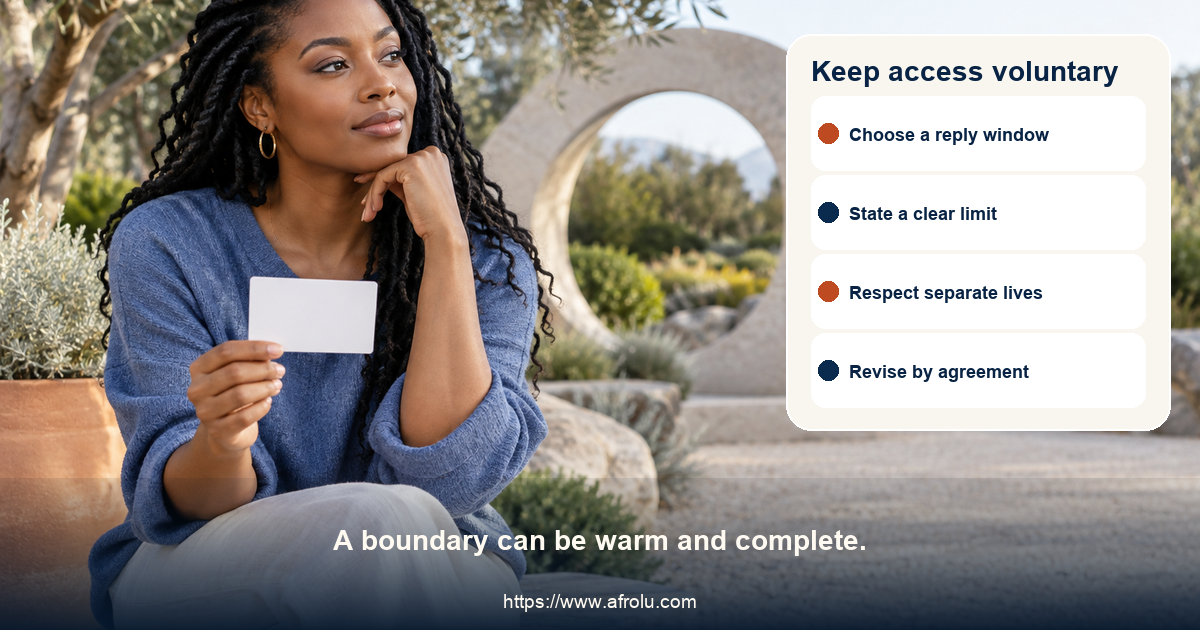
Keep access voluntary
Interest does not require either adult to remain on call.
Stay independent
Money, accounts, transport, and privacy should remain freely controlled.
Protect a clear no
Ignored boundaries, monitoring, and threats require more control, not more explanation.
clarity · present capacity
Career pressure can explain a limit; it cannot be used to make an undefined connection permanently unanswerable
A diaspora adult may move through several social worlds, calendars, obligations, and ways of working. Those details can matter to logistics, but they do not tell you what kind of partner somebody is. Treat career as one part of a present capacity conversation rather than a badge of virtue, an explanation for silence, or a reason you must lower every question.
Begin with the smallest question that changes your next decision. Ask what kind of contact they can reliably offer during the next few weeks, whether they are dating other people, and what happens when plans need to move. A modest answer that is kept is more informative than an impressive description of future availability that never becomes usable.
Clarity is not a request for access to their calendar, colleagues, income, job title, or private stress. It is an invitation to name the relationship shape both people can actually choose. You can respect a person's workload while still deciding that sporadic messages, last-minute invitations, or a refusal to discuss expectations do not work for you.
The aim is not to grade a busy adult. It is to make an agreement readable enough for both adults to consent to it. You might choose a light connection, a more regular rhythm, a pause, or an ending. Each option can be fair when it is based on present conduct rather than a story about diaspora identity, ambition, or future potential.
communication · boundaries
Warm messages do not require either adult to become permanently reachable, emotionally available on demand, or responsible for managing another person's pressure
Undefined connections often drift into a private rule: one person expects rapid reassurance while the other hopes flexibility will avoid an uncomfortable conversation. That pattern turns ordinary delay into a test. Instead, name a communication rhythm that leaves room for sleep, friends, work, solitude, and a change of mind without treating silence as proof of rejection or deception.
A practical boundary can sound ordinary: 'I do not take calls after ten, but I can reply tomorrow,' or 'I am happy to plan a day ahead rather than decide at the last minute.' These sentences do not accuse anyone of being needy or careless. They make your availability legible and allow the other person to say whether that arrangement fits them.
Watch how the limit is received. Disappointment is compatible with respect; repeated calling, guilt, monitoring activity, or insisting you justify your routine is different. Someone's career pressure does not entitle them to your private time, and your interest does not entitle you to their constant access. Mutuality means each person can make a no without needing to repair the other person's mood.
If your preferred rhythm repeatedly leaves one of you anxious or resentful, do not turn endurance into evidence of devotion. Discuss a smaller commitment, a different pace, or a clean end. A situationship becomes clearer when its communication rules preserve two separate lives instead of asking one person to remain on standby for the other.
plans · follow-through
A plan is not a promise of a relationship, but a repeated inability to make or revise one is useful information about fit
Career demands can change unexpectedly. A person can be sincere and still need to cancel a dinner, a call, or a weekend plan. The key question is not whether a single change happened, but whether the person names it directly, acknowledges the effect, and offers a realistic alternative instead of leaving you to keep a vague opening in your own life.
Try a clear planning standard: confirm by a stated time, choose a public and independently reachable setting, and treat a no as complete. Do not spend money, rearrange essential commitments, reveal a private address, or make physical intimacy the default outcome of a plan. Those safeguards protect both adults when a connection is still being defined.
Patterns matter more than isolated explanations. A person who repeatedly appears only when they have a gap, asks you to remain flexible, then withdraws when you request notice may be offering convenience rather than mutual dating. You do not need to prove bad intent before deciding that a connection which cannot support a basic plan is not meeting your needs.
A workable arrangement may be intentionally light: one planned meeting a week, a short check-in, or a pause during a demanding period. What makes it ethical is that the lighter offer is named and freely accepted, not concealed behind career language while one person waits for a seriousness that has never been offered.

Plans show what words cannot settle.
independence · financial boundaries
Income, credentials, gifts, expenses, and professional polish are not evidence that a person is safe, generous, serious, or entitled to more access
Career can invite an unhelpful shortcut: assuming that someone with apparent resources is less likely to pressure you, or feeling that a high-cost date creates a debt. Neither is reliable. Safety and consent are demonstrated in how a person receives limits, handles inconvenience, and keeps financial choices separate from the possibility of attention or intimacy.
Make ordinary arrangements that preserve choice. Pay only for what you have freely chosen, retain your own way home, and avoid lending, receiving, moving, or holding money through a new dating connection. Do not share bank details, verification codes, account access, documents, or a purchase decision because a story sounds urgent, professional, or personally persuasive.
If someone uses status, a gift, a bill, or a claim of career sacrifice to accelerate intimacy, disclosure, or commitment, pause. The issue is not whether the gesture was expensive; it is whether it changed your ability to say no. A respectful adult can offer something without making it a hidden contract or asking you to demonstrate gratitude through access.
Keep your conclusion proportionate. You may prefer simpler dates, separate payments, or no financial overlap at all. You may also leave when a person cannot accept those terms. Independence is not coldness. It makes it easier to evaluate affection without the pressure of debt, rescue, prestige, or a shared system that is difficult to exit.

Keep money, accounts, and consent separate.
terms · consent
Frequent contact, chemistry, or a demanding season do not establish exclusivity, sexual consent, image sharing, or a shared destination without a direct conversation
People sometimes avoid clarity because they fear sounding demanding during a busy time. The result is often more pressure, not less: one adult assumes their investment has a meaning while the other assumes no question has been raised. A brief conversation protects both people from carrying a private relationship definition that the other person has never accepted.
Try present-tense language. 'I enjoy seeing you and I want to know whether we are dating other people,' is clearer than asking someone to predict their entire future. 'I am not ready to share images or stay overnight' is complete without a career-related explanation. Consent is current; it is not granted by previous flirting, dates, gifts, or a period of intense contact.
A difference in preference can be disappointing and still be manageable. One person may want casual dating, another may want exclusivity, and a third option may be to step back. The measure of respect is not agreement but whether the answer is honest enough for each adult to choose without manipulation, silent punishment, or an attempt to bargain away a boundary.
If someone says they cannot discuss necessary terms, accept that as information about the available relationship. You do not have to wait until their work is calmer to know what you need today. A request for clarity is not an ultimatum when it simply asks whether the current arrangement is one you can freely continue.

Name the next decision clearly.
safety · unwanted contact
An ordinary mismatch may need a conversation; repeated contact after a boundary, monitoring, threats, image pressure, or account requests need a response that increases your control
Not every unclear situationship is dangerous. A late reply, an unwanted outcome, or a person declining exclusivity can be enough reason to leave without applying a label. Separating a mismatch from coercive conduct helps you respond proportionately and avoids treating difficult emotion as a diagnosis of another person.
The line changes when a person continues after a clear request to stop, makes fresh accounts after blocks, tracks activity, contacts friends to bypass you, threatens private material, demands access to a device or account, or uses money and career status as leverage. These actions reduce your freedom and are not solved by writing a more convincing explanation.
Choose the action that restores control first. Adjust privacy settings, tell someone you trust, use platform reporting tools, and keep evidence only if doing so is safe. Avoid meeting alone to provide closure or sharing additional personal details to calm the person. If you feel in immediate danger, contact local emergency support rather than handling it as a dating disagreement.
A clean ending can be brief, or no final message may be safer. You are allowed to protect your time, accounts, images, body, and routine. Career context does not soften a boundary violation, and being diaspora does not make you responsible for teaching another adult how to accept an end.
decision rule · self-trust
The best clarity standard is simple enough to use before you become exhausted by uncertainty or persuaded to ignore a limit that matters to you
Write your rule in plain language. It might be: 'I do not keep rearranging my week for plans that are never confirmed,' or 'I do not continue intimacy without an honest conversation about other dates.' A useful rule describes your conduct. It does not require you to diagnose a person, read a career situation perfectly, or win an argument about whose needs are more reasonable.
Test the rule against one real decision. Before answering a late invitation, lending money, accepting a vague future plan, or sharing something private, ask whether you would still choose it if nothing changed afterward. If the answer is no, delay the decision. Slowing down can reveal whether the connection has mutual substance or only momentum.
Let evidence be ordinary: direct answers, accepted boundaries, realistic plans, privacy respected, and repair after a disruption. These are not glamorous signs, but they create a relationship environment where either adult can speak clearly. A career story may be compelling; consistent conduct is what makes an arrangement safe enough to choose.
You can want affection and still want a reliable agreement. You can enjoy a connection and decide it is too uncertain. The conclusion does not need to condemn the other person. It only needs to protect the life, attention, and independence you are responsible for carrying forward.
Eight career-capacity situationships where time, planning, money, terms, or pressure changes the next move
The elaborate explanation
A person describes an intense work period but cannot say when they can speak or meet again.
Ask for one realistic rhythm for the next two weeks; decide from that answer.The after-hours expectation
They say a late call proves interest and react badly when you keep your evening private.
State your call window once and assess whether it is respected.The movable plan
Two dates are cancelled with no alternative while you are asked to remain available at short notice.
Stop holding the slot open until a specific, confirmed plan is offered.The costly gesture
A gift or expensive invitation is followed by pressure for intimacy or a private address.
Decline the trade-off and choose a public, independently reachable plan.The exclusivity assumption
Daily messages have led you to assume you are not seeing others, but nobody has said so.
Ask directly before making a health or intimacy decision.The account request
A career-related emergency is used to ask for a transfer, code, or payment action.
Keep accounts separate and verify any claim independently.The return after quiet
They reappear warmly after weeks away and want the old level of access immediately.
Treat it as a new invitation and ask what present plan is available.The ignored ending
After a clear no, messages continue through new accounts and mutual contacts.
Reduce access, document only if safe, and use platform or specialist support.Fourteen observable signs that a career explanation remains mutual, vague, access-driven, financially risky, or unsafe
They can describe a contact rhythm without offering a private calendar as proof.
A cancellation comes with direct notice and a realistic alternative, not a demand that you wait.
Your message pace is accepted without guilt, surveillance, or repeated calls.
Plans remain public and independently reachable while the connection is new.
Career details are shared voluntarily rather than used to avoid every relationship question.
A gift, bill, or invitation does not become a claim on your intimacy or privacy.
They can answer whether they are dating others before that answer affects your choice.
A different preference is met with honesty rather than persuasion or sulking.
Money, documents, accounts, and verification codes stay outside the connection.
Your private routine is treated as private, including location and social accounts.
They acknowledge a boundary without asking you to prove why it exists.
A return after absence includes a present offer rather than automatic entitlement to access.
You feel able to decline a plan without worrying about retaliation or debt.
A clear ending is accepted without monitoring, threats, or new routes of contact.
A proportionate decision map for time, plans, gifts, exclusivity, privacy, money, a return, and an ending
| Situation | What it may mean | What to do next |
|---|---|---|
| They say work is intense | A real limit or a way to avoid any usable answer. | Ask what contact is feasible this month. |
| A call is missed | A one-off disruption or a pattern of undefined access. | Wait for a direct repair and a concrete alternative. |
| They invite you late | Spontaneity that suits you or convenience that expects you on standby. | Accept only if the timing and setting are genuinely your choice. |
| They pay for something | A freely given gesture or a possible leverage point. | Keep your ability to say no unchanged. |
| Intimacy is implied | Shared interest or an assumption that needs words. | Name your current boundary before the plan proceeds. |
| They ask about exclusivity | A useful terms conversation, not necessarily a future promise. | State your own preference and ask theirs. |
| They request financial help | A safety boundary, regardless of the story's detail. | Do not transfer, receive, or move money through dating. |
| They want personal access | A request for trust or an attempt to widen control. | Keep accounts, documents, and routines private. |
| They return after silence | A new offer, not a debt owed to familiarity. | Assess the present plan rather than the old intensity. |
| They resist an ending | Disappointment or conduct that may require protection. | Reduce access and seek support if a boundary is ignored. |
Twelve complete lines for capacity, reply windows, plans, terms, gifts, money, privacy, a return, and a boundary
“What kind of contact can you honestly offer over the next two weeks?”
“I am not available for late calls, but I can talk on Wednesday evening.”
“If we have not confirmed by noon, I will make other plans.”
“I understand the change; I need a specific alternative before I hold another evening.”
“Before we become more intimate, are you currently seeing other people?”
“I do not share my address, accounts, or work details early on.”
“I do not lend, receive, or move money through a dating connection.”
“Thank you, but a gift does not change what I am comfortable with tonight.”
“I enjoy this, and I need it to stay at a pace I can choose.”
“It sounds as if we want different relationship shapes, and I am going to step back.”
“Before we restart, what is different in the plan you can offer now?”
“I am ending contact. Please do not message me again.”
Know the difference
A capacity conversation versus an access arrangement
Both adults name a realistic rhythm, revise plans directly, and keep privacy, money, and consent voluntary.
One adult must stay available, infer meaning from career stories, or accept pressure in exchange for intermittent attention.
A demanding life can be real without making your time, systems, and boundaries negotiable.

A clear limit differs from endless access.
Keep a genuine capacity limit distinct from standby dating, leverage, and conduct that reduces choice
| Type or dimension | What it describes | Best next question |
|---|---|---|
| A limited season | A short-term constraint is named with a realistic rhythm. | Decide whether that rhythm works for you. |
| An unavailable offer | No one can state what contact or planning is actually possible. | Stop filling the gap with hope. |
| A respectful cancellation | Notice and repair are offered without expecting you to wait. | Choose the revised plan freely. |
| Standby dating | Your time stays open for last-minute access. | Set a confirmation deadline. |
| A gift | A gesture is freely offered with no claimed return. | Keep your boundary unchanged. |
| A leverage gesture | Cost or status is used to accelerate access. | Pause and return to independent terms. |
| A terms conversation | Both adults can say what they want now. | Make the next choice from the answer. |
| Assumed exclusivity | Intimacy or frequency is used instead of a direct agreement. | Ask before making a health decision. |
| A clean end | A no is accepted, even if it disappoints. | Reduce contact at the pace that feels safe. |
A simple plan you can use today
Capacity is observable
A small agreement kept over time tells you more than a complicated promise.
Availability is not devotion
Fast replies and late access should remain freely chosen, not demanded.
Plans carry information
How a plan is confirmed or changed reveals whether both lives are respected.
Status is not safety
Career presentation cannot replace consent, integrity, or financial boundaries.
Terms need words
Exclusivity and intimacy are decisions, not outcomes of chemistry.
An ending can be enough
You can leave an unclear arrangement without proving someone is a bad person.
Questions organised by purpose and depth
Choose a few prompts that fit the moment. This is a reference library, not a list to complete.
Present offer
Use before you turn a career explanation into a relationship promise.
- What can each of us reliably offer this month?
- Would that arrangement still work if nothing changed soon?
Time boundary
Use before late calls or last-minute invitations become a private rule.
- What time and notice protect my ordinary life?
- How will I respond if that limit is not accepted?
Terms
Use before intimacy, exclusivity, images, or a costly plan.
- What exact decision needs a clear answer?
- What answer would let me choose freely?
Exit
Use when pressure, financial requests, or unwanted contact appear.
- What action gives me more control now?
- Who can support me if a no is ignored?
What deserves a closer look
Ask for an offer
Translate a vague career explanation into contact, planning, and terms that exist now.
Evidence limit: Do not demand private employment details.
Protect the reply window
Keep calls and messages within a rhythm you freely choose.
Evidence limit: Do not use availability as a loyalty test.
Make cancellation legible
Look for notice, repair, and an alternative that respects your schedule.
Evidence limit: Do not keep a slot open indefinitely.
Keep systems separate
Preserve money, accounts, transport, and home information as your own.
Evidence limit: Do not fund or manage another adult's problem.
Ask at decision level
Discuss exactly what would change the next intimate or exclusive choice.
Evidence limit: Do not treat familiarity as automatic permission.
Reduce access when needed
Use blocks, reports, trusted people, and specialist support if pressure persists.
Evidence limit: Do not negotiate with ignored boundaries.
Shortcuts that turn a career story into waiting, debt, assumption, or unwanted access
Treating a career story as a relationship offer
It asks you to infer a future instead of evaluating present conduct.
Remaining on call
It rewards undefined access and drains your own time.
Calling a costly gesture proof
Expense can create pressure without creating consent or trust.
Making exclusivity silent
Different assumptions can affect health and emotional choices.
Solving a money emergency
Financial entanglement can reduce your safety and exit options.
Explaining a no indefinitely
Repeated negotiation can become an access problem rather than a clarity problem.
Define the relationship, protect a boundary, or check mixed signals before you make the next plan
Choose the resource that fits the current decision. An editorial guide can help name an option or pattern, but it cannot guarantee another adult's honesty, future capacity, or conduct.
Explore the guide library
Show more related guides
Continue with Afrolu
Show more Afrolu guides
Sources used for this guide
Afrolu reviewed these health, research, safety, or public guidance resources while editing this page. They support the behaviour and safety guidance; they do not diagnose any individual described by a reader.
Questions about diaspora situationships, clarity, and career capacity
Can career pressure make a situationship unclear?
It can limit time, but it does not prevent a person from naming the limited offer they can make now.
Is it unfair to ask for a communication rhythm?
No. You are asking whether the actual connection fits your needs, not demanding access to another adult's calendar.
Should I interpret missed plans as rejection?
Not automatically. Look for direct notice, repair, and whether the pattern makes a usable plan possible.
Do expensive dates mean someone is serious?
No. Cost, status, and generosity do not create consent, safety, or a shared relationship definition.
How can I ask about exclusivity?
Ask before a decision it affects: are we dating other people, and what terms would each of us need to change that?
Should I share work information to build trust?
Share only what you freely choose. A new connection does not need your workplace, routine, or private records.
What if someone asks for money because of a career problem?
Keep funds, accounts, codes, and documents separate; verify any claim through independent official channels.
Can I prefer a simpler arrangement?
Yes. Separate payments, public plans, and limited contact can protect choice while you decide what fits.
What if they return after a busy period?
Ask what current plan they can offer rather than treating past intensity as an obligation.
When should I shift from clarity to safety?
Shift when a clear boundary is ignored or contact includes monitoring, threats, image pressure, account demands, or fear.
One thing to do now
Choose the next connection that leaves your time, terms, and independent systems intact
Choose the smallest next action that preserves your time, privacy, money, accounts, body, independent transport, clear terms, support network, and ability to revise or end contact without bargaining away freedom.