Two time horizons, one honest choice
When Serious Hope Begins With a Casual Structure
A guide for adults dating casually while seeking serious love, covering present agreements, future talk, exclusivity, consent, money, evidence, and review.
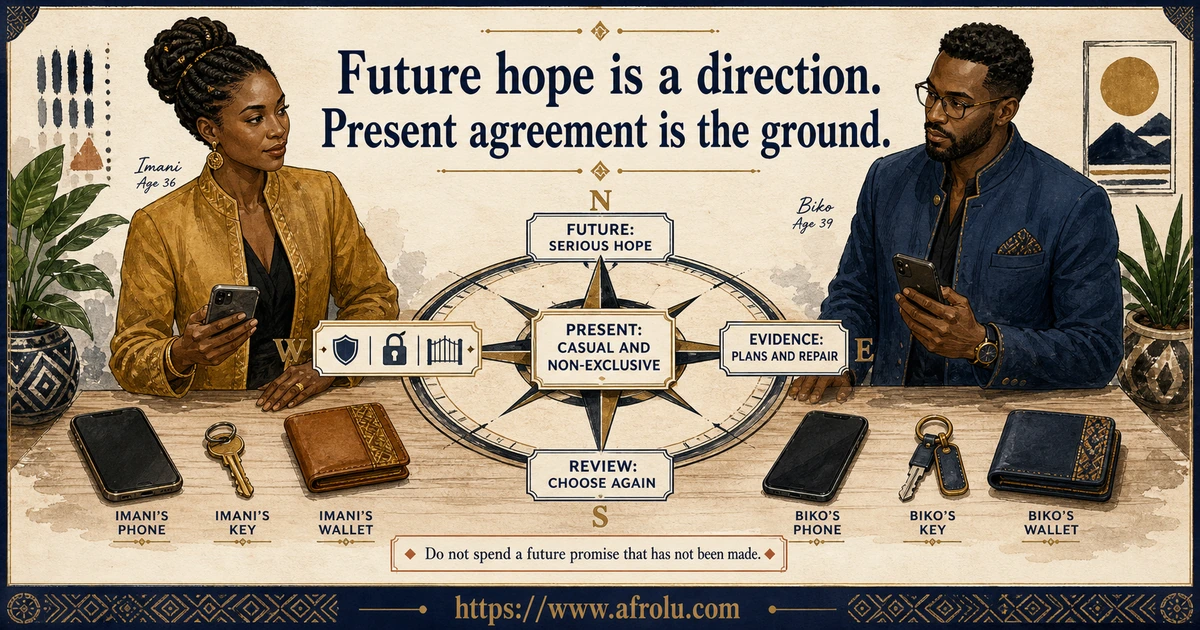
Hold two truths at once: name the future direction and read the agreement that exists today.
Written and edited by Grace Mutiso · Kenya Guides Editor
Keep four cards separate. Your future direction says what you eventually seek. The present agreement says what both adults have chosen today. Observable conduct shows what the connection can currently hold. A review creates the next free choice. Serious hope does not silently create exclusivity, priority, sex, money, home access, or a promised future. Casual dating does not forbid respect or honest intention. Name both time horizons, then continue only while the real agreement fits.
Relationship intent · New Relationship Starters
Is future hope being mistaken for commitment now?
A serious intention is one adult's direction toward a lasting partnership. A casual agreement is a shared present structure without an agreed serious commitment. It may also be non-exclusive. These truths can coexist for a limited period. They answer different questions. Conflict begins when future language is treated as a current contract, or when casual language hides expectations that were never offered. Clarity requires direct words, specific conduct, consent, and repeated freedom to choose again.
Imani and Biko are made-up adults. Imani is 36 and is dating again after a long relationship. Biko is 39 and has also said that partnership matters eventually. After their third date, Biko imagines a future trip together. Imani enjoys the hope but asks whether their agreement changed. It did not. They remain casual and non-exclusive. Neither adult owes exclusivity because the conversation felt intimate. They book nothing, keep money separate, choose one public museum date, and set a two-week status review.
The present-agreement future compass
Let hope point forward without allowing it to rewrite today
A new dating journey can hold serious personal hope and a casual shared structure. The two time horizons become safer when every adult can see which answer belongs where.
Grace separates direction, agreement, evidence, and review. She treats casual and serious choices with equal dignity while keeping consent, privacy, and money outside silent assumptions.
Future direction
State whether you eventually seek partnership, marriage, companionship, or another structure. Direction belongs to you until another adult freely shares it.
Present agreement
Name whether dating is casual, exclusive, open, or still undefined. Include other dates, communication, physical boundaries, and the right to change course.
Observable evidence
Judge kept plans, direct answers, repair, consent, privacy, and mutual effort. Future speech matters, but it does not outweigh repeated present conduct.
Next free choice
Choose whether to continue the casual structure, negotiate a different one, or close. Time and hope do not make any outcome compulsory.
Orientation
Put serious hope on the compass and the casual agreement at the centre
Wanting a lasting partnership can shape which dates you accept. It can guide your questions, boundaries, and willingness to continue. It does not mean every promising person has agreed to build that partnership. The compass points toward your desired future. The centre card records what exists with this adult today. Keeping those locations separate protects hope from becoming an invisible demand.
A casual agreement can still contain honesty, care, consent, and reliable plans. Casual does not mean careless. It usually means the adults have not agreed to a serious commitment. Ask whether dating is exclusive or non-exclusive. Ask what communication and disclosure are expected. Ask how either adult can leave. The answers matter more than a label chosen to sound relaxed.
Future talk deserves attention without automatic conversion. Someone may describe marriage, travel, a shared home, or the kind of partner they hope to become. That information reveals imagination and values. It may be sincere. It still does not reserve your future or create present obligations. Ask whether the speaker is describing a personal dream, a possibility, or an offer they want to discuss now.
The fourth card is review. A casual structure can remain suitable, change, or end. Pick a modest checkpoint before hidden expectations gather. A review is not an ultimatum to become serious. It is a moment to compare hope, agreement, and conduct. If the present offer remains casual and no longer fits you, leaving protects the serious direction better than arguing with reality.
A third-date reset
Imani hears Biko's future story and checks what changed today
Imani and Biko agreed that early dating would be casual and non-exclusive. They would disclose other partners before relevant sexual choices, keep money separate, and use public dates. After their third meeting, Biko describes a coastal trip he would enjoy with a future partner. He includes Imani in the picture. The moment feels tender. Imani notices that her hope is starting to treat the image as a plan.
She responds without mocking him. She says the trip sounds lovely and asks whether he is proposing a change to their present agreement. Biko says no. He is describing a possibility, not requesting exclusivity or travel. That answer may disappoint Imani. It also gives her something useful. She can decide whether another casual date serves her without claiming that Biko withdrew a promise.
They do not browse accommodation, exchange identification, pay deposits, or open a shared travel fund. They select a local museum for the following Saturday. Each adult travels independently and pays within their own budget. They also choose a date two weeks later to discuss whether casual dating still fits. The smaller plan lets their ordinary conduct become visible before a high-consequence fantasy takes over.
At the review, either adult may want exclusivity, continued casual dating, or an ending. Imani's serious direction does not make Biko wrong if he prefers casual. Biko's warm future story does not make Imani unreasonable for wanting more. Clarity reveals a possible mismatch while both adults can still choose cleanly. The goal is not agreement at any cost. It is a shared view of the actual offer.
Present terms
Write a casual agreement that is clear enough to decline
Start with exclusivity. Ask whether either adult dates, messages, or seeks other people. Define which answer matters to you. Two adults can agree to casual exclusivity, or to non-exclusive dating. A private decision to stop seeing others is not a shared agreement. Deleted profiles, frequent dates, sex, gifts, or future talk also cannot answer the question for both people.
Name communication without promising constant access. Decide whether plans need confirmation and how changes will be handled. Casual contact may be occasional, but basic truth still matters. Nobody should need to monitor a device or demand a live location. If one adult needs daily closeness and the other offers weekly plans, that difference may be a fit issue rather than evidence of wrongdoing.
Physical choices need specific consent every time. A casual label never means automatic touch or sex. A serious personal direction never turns sex into a relationship test. Before sexual activity, discuss partners, testing, prevention, and necessary health information. Consent can change during an encounter. Use qualified local healthcare for personal testing, symptoms, prevention, or treatment decisions.
Keep money, homes, devices, intimate images, documents, and work systems separate. A casual agreement does not excuse deception or financial pressure. Do not send money, transfer funds, share one-time codes, or accept account control to prove trust. Endings should also be named. Either adult can stop without repaying dates, gifts, disclosure, attention, or imagined future potential.
Observable evidence
Read serious language beside ordinary present behaviour
A person can sincerely want partnership and still be undecided about you. Initial attraction or compatibility impressions may predict later interest in some research settings. They do not guarantee a relationship. Let early excitement invite another observation. Notice whether the person keeps a date, answers a direct question, and respects your present terms. Those actions provide narrower and more useful evidence.
Listen for time words. Eventually, someday, and with the right person describe an open future. We are exclusive now describes a present agreement only when both adults choose it. I can meet Friday is a specific offer. Confusion grows when these sentences are stacked together and heard as one promise. Repeat the present answer in plain language before making a high-consequence choice.
Notice response to boundaries. A serious direction should not require early access to a home, money, device, account, workplace, family, or body. A casual agreement should not be used to dismiss consent, truth, or basic respect. Disappointment can be expressed without bargaining. Repeated guilt, ridicule, threats, tracking, or surprise arrival moves the issue beyond clarity and toward safety.
Review patterns rather than one polished moment. Compare plans, effort, repair, privacy, and direct answers across several ordinary dates. Do not collect secret evidence or inspect private systems. If future speeches grow while current agreements remain vague, ask a narrow question. An unavailable answer is still information. You may leave without proving whether the speaker meant well.

Listen to hope, then check today's agreement, ordinary plans, and response to boundaries.
Words to use
Use future and present language in the same conversation
Lead with ownership. Say that you eventually want a serious partnership. Do not announce that this person is already your future. Then name the present. Say whether you understand the connection as casual and non-exclusive. Ask the other adult to correct you. This structure reduces blame because it does not present your hope as a debt they must repay.
When you want change, request it directly. Ask whether exclusivity fits now. Explain the practical meaning you propose. The other adult may need time or may decline. Decide how much uncertainty you can genuinely accept. Do not offer sex, money, travel, home access, or emotional rescue to make agreement more likely. Consent obtained through leverage is not the clarity you wanted.
If casual dating still fits, say so without pretending your serious hope vanished. You can continue while observing fit. Set a review point that protects both adults from silent escalation. Avoid daily relationship auditions. The review should examine the real pattern and allow continued casual dating. It should also allow closure when one adult's needs have changed.
Use a concise ending when the time horizons no longer fit. Say that you want a structure the current relationship does not offer. You do not need to prove that casual dating is wrong. Nor must you wait until someone behaves badly. A respectful mismatch is enough. When an ending is ignored, stop explaining and use stronger privacy, platform, trusted-person, or local safety support.

Say what you hope for, say what is true today, and leave every new agreement freely chosen.
The checkpoint
Review hope, agreement, evidence, and fit after four ordinary weeks
First review future direction. Does each adult still want a similar eventual relationship, or did one person's answer change? A shared serious direction can support continued exploration. It does not prove compatibility or create exclusivity. Different directions may make closure sensible. Neither answer needs to be morally superior before it can guide a decision.
Second read the agreement aloud. Are you casual, non-exclusive, exclusive, or undefined? Which physical and sexual-health conversations are needed? What contact, privacy, money, and ending boundaries apply? If each adult gives a different summary, the agreement is not clear enough for larger choices. Return to the specific terms before adding access or responsibility.
Third compare conduct. Count direct answers, kept plans, shared effort, repair, and respected boundaries. Do not count chemistry, longing, expensive dates, profile changes, sex, or future stories as commitments. Research may identify average predictors in studied samples. It cannot calculate your compatibility. The review organises evidence; it does not score a person.
Finally choose. Continue the casual agreement when it still fits. Renegotiate only when both adults want new terms. Close when the available structure conflicts with your needs. You may schedule another review, but avoid using review after review to postpone a known mismatch. Hope remains valuable when it helps you choose honestly, not when it requires you to deny the present.

Review four cards: hope, agreement, evidence, and choice. Continue, renegotiate, or close.
Nearby definitions
Serious intention and casual agreement belong on different cards
Serious intention answers a personal question. What kind of relationship do I ultimately seek? It can guide screening and boundaries before a particular connection exists. It may include partnership, marriage, shared life, or another lasting form. It remains a direction rather than a guarantee. A preference match also cannot promise satisfaction. Real relationships involve many changing variables.
Casual agreement answers a shared present question. What responsibilities and freedoms have we chosen with each other now? It may allow other dates, limited contact, or no future planning. Casual adults still owe consent, truth within the agreement, and respect for boundaries. They do not owe escalation merely because one person entered dating with serious goals.
Commitment research often separates several related ideas, including satisfaction, alternatives, investment, and moral or structural constraints. Those constructs do not create a home test for commitment. Afrolu uses a simpler rule: ask what was chosen, then read conduct. Do not infer a binding agreement from investment, time, affection, or statements that remain about an unspecified future.
The two cards can align later. Adults may choose exclusivity or a serious partnership after enough evidence. They may also keep casual dating or stop. No sequence is guaranteed. A new journey becomes clearer when each transition has words, present consequences, and a free no. That allows serious hope to remain hopeful without turning another adult into a predetermined destination.
Eight moments when future hope and casual reality need separate cards
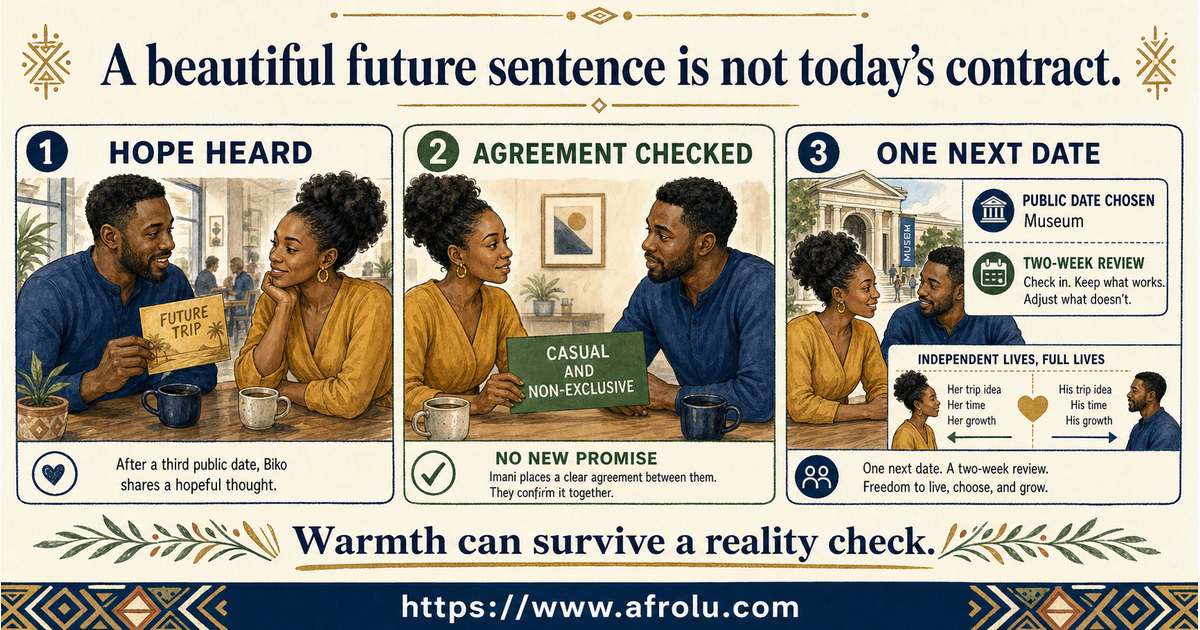
Imani asks whether Biko's coastal story changes their agreement
Imani is 36 and Biko is 39. Biko imagines a future trip after their third date. Imani asks whether he is proposing exclusivity or travel now. He is not. They keep the casual agreement, book nothing, and choose a local museum date. Warmth survives because the assumption is removed.
Receive the hope, ask what changed today, and avoid high-consequence plans without agreement.Nala stops dating others but does not turn her choice into Joseph's promise
Nala is 32 and Joseph is 35. Nala decides to focus on him after five dates. Joseph still understands their relationship as non-exclusive. She tells him what she wants and asks whether exclusivity fits. He says not yet. Nala can continue under that answer or leave.
Convert a private decision into a question and leave room for a free answer.Amara and Tinashe discuss health and consent without promising commitment
Amara is 30 and Tinashe is 34. Physical intimacy becomes relevant during casual dating. They discuss consent, other partners, testing, and prevention before deciding. Neither treats sex as proof that the relationship became serious. They retain the right to pause or decline each activity.
Have the relevant health and consent talk while keeping relationship status a separate question.Kendi deletes an app for rest, and Malik does not infer exclusivity
Kendi is 41 and Malik is 43. Kendi removes her dating profile because app use feels tiring. Malik asks whether their agreement changed. It did not. She may still meet people through other routes. They decide whether non-exclusive casual dating continues to fit rather than reading an interface as a contract.
Ask the relationship question directly instead of treating a platform action as shared agreement.Asha declines a weekend package from Emmanuel after four dates
Asha is 38 and Emmanuel is 42. He offers an expensive weekend while their relationship remains casual. Asha worries the gift will create expectations. She declines and suggests an affordable dinner. Emmanuel can accept or withdraw the offer. Money should not purchase exclusivity, sex, gratitude, or continuation.
Keep spending proportionate and decline gifts that make your next choice less free.Neo wants partnership soon while Sade wants indefinite casual dating
Neo is 37 and Sade is 40. Both have been honest, but their future directions differ. Neo notices that continued casual dating is strengthening hope without changing the offer. She closes after six dates. Sade is not punished for honesty, and Neo does not abandon her own direction.
End a clear direction mismatch before hope becomes a silent negotiation.David asks Miriam for one real date after repeated future stories
David is 44 and Miriam is 40. Miriam speaks warmly about future partnership, but four proposed dates remain unconfirmed. David offers two final options. Neither works and no alternative appears. He stops romantic contact without deciding whether Miriam's hope was sincere. The present offer is unavailable.
Test future language with one proportionate present action and decide from the response.Omar and Chipo negotiate exclusivity without adding every other commitment
Omar is 33 and Chipo is 31. After eight weeks, both want to stop dating others. They define exclusivity and discuss relevant sexual-health choices. Homes, money, work, travel, and family introductions remain separate. One changed agreement does not move every relationship boundary at once.
Name the new agreement and list the decisions it does not automatically change.Ten signs that both time horizons remain honest
Each adult can state a personal future direction without assigning it to the other person.
The current casual or non-exclusive agreement is described in similar plain language.
Future stories are identified as hopes, possibilities, or actual proposals.
Exclusivity is discussed directly instead of inferred from dates, sex, gifts, or profile changes.
Ordinary plans and repairs provide evidence alongside emotional or future-focused words.
Consent remains specific and can change regardless of relationship direction.
Money, homes, work systems, devices, documents, and intimate images remain protected.
Both adults can ask to continue, change, or end the structure without punishment.
Review dates reveal whether the present offer still fits rather than forcing escalation.
A clear mismatch is allowed to end without declaring casual or serious dating morally wrong.
Choose from the present event without borrowing a future promise
| Situation | What it may mean | What to do next |
|---|---|---|
| A date describes marriage or travel in a general future. | The speaker may be sharing a value, fantasy, possibility, or present proposal. | Ask which meaning applies and whether any current agreement is being offered. |
| One adult stops dating others without a conversation. | A private focus decision exists, but a mutual exclusivity agreement does not. | State the choice and ask whether exclusivity fits both adults now. |
| Sex occurs and one adult assumes the relationship became serious. | Physical intimacy and relationship status have been combined without shared words. | Discuss consent and sexual health, then ask the separate status question. |
| A profile disappears while the casual agreement remains unchanged. | The platform action may reflect rest, privacy, focus, or another reason. | Ask directly about other dating and do not infer a contract from the interface. |
| Future talk grows, but specific dates remain difficult to secure. | Hopeful language may exceed the relationship's present practical capacity. | Offer one concrete plan and choose from the usable response. |
| An expensive gift appears before any serious agreement. | The gift may be generous, uncomfortable, deceptive, or capable of creating pressure. | Decline or reduce the gift and keep money separate from consent and status. |
| Both adults want partnership eventually but want different timing now. | Future direction aligns while present structure or pace does not. | Name the time-bound offer each person can accept and close if no fit exists. |
| One adult requests exclusivity at the review. | A clear proposal is available, but no answer is owed in advance. | Define the proposed agreement and allow yes, no, not yet, or a different offer. |
| The casual structure is honest but keeps hurting one adult. | A valid agreement may no longer fit that adult's emotional needs. | Request change or leave without blaming the other adult for the stated offer. |
| A boundary receives threats, tracking, or repeated unwanted contact. | The issue has moved from relationship clarity toward coercive or unsafe conduct. | Stop negotiating, protect access, preserve relevant evidence, and seek suitable local support. |
Ten scripts for serious hope inside a casual structure
“I eventually want a serious partnership. I am still learning whether we fit that direction.”
“I understand us as casual and non-exclusive today. Is that also your understanding?”
“That future sounds appealing. Are you sharing a hope or proposing a change now?”
“I want to stop dating other people. Would you like to discuss exclusivity?”
“I will not infer from our frequency. Are either of us seeing or seeking other people?”
“Physical intimacy will not decide our status. I want consent and health questions answered first.”
“I keep money and bookings separate during casual dating. Let us choose a smaller plan.”
“I am not ready for home visits. I can meet in public on Saturday.”
“Can we review our direction and present agreement in two weeks?”
“I want a serious structure, and casual remains your offer. I am ending our dating here.”
Know the difference
Serious intention and casual agreement answer different questions
One adult names a hoped-for long-term relationship. This direction can shape dating choices, but it does not create a promise with a particular person.
Both adults define present responsibilities and freedoms without an agreed serious commitment. The structure still needs honesty, consent, privacy, and an available ending.
Direction says where one person hopes to go. Agreement says what two adults have chosen now. Observable conduct helps each person decide whether those truths can still coexist.

Keep direction and agreement on separate cards. Neither can silently rewrite the other.
Personal intention and shared agreement answer different questions
| Type or dimension | What it describes | Best next question |
|---|---|---|
| Serious intention | A personal long-term direction that exists before any specific partner commits. | State the direction without presenting this connection as its guaranteed destination. |
| Casual non-exclusive dating | Adults date without serious commitment and may continue meeting other people. | Define disclosure, consent, health, communication, money, and ending boundaries. |
| Casual exclusive dating | Adults agree not to date others without yet choosing a serious long-term structure. | Define exclusivity and keep future, home, money, and family decisions separate. |
| Serious dating | Adults share a long-term partnership direction while continuing to evaluate fit. | Name present actions and avoid treating direction as a guaranteed outcome. |
| Future possibility | An imagined trip, home, family, or partnership has been discussed without a present plan. | Ask whether it is a hope, possibility, or actual proposal before acting. |
| Present proposal | One adult clearly requests a new agreement, date, boundary, or shared action now. | Define consequences, cost, consent, and the right to decline before agreeing. |
| Undefined connection | The adults have not reached a shared description of current dating responsibilities. | Use plain questions before increasing physical, financial, home, or emotional access. |
| Clear mismatch | The present or future structures each adult needs cannot both exist in this connection. | Close respectfully rather than keeping one adult inside silent hope. |
The two-time-horizon answer
Time horizons need separate language
Eventually and someday describe an open future. Today and now describe a present agreement. Repeat the current answer before making decisions with financial, physical, home, or emotional consequence.
Casual does not mean careless
Casual dating can include reliable plans, honest disclosure, consent, sexual-health conversations, privacy, affordable choices, and respectful endings without becoming a serious commitment.
Serious does not mean certain
A long-term direction expresses intention. It cannot guarantee compatibility, duration, marriage, or a specific future. Present conduct and changing needs still matter.
Chemistry is evidence of experience
Strong attraction tells you something important about the moment. It cannot answer exclusivity, consent, money, safety, or long-term fit without other information.
Investment does not create ownership
Time, money, dates, sex, gifts, disclosure, and emotional attention cannot purchase another adult's commitment. Each agreement remains voluntary and reviewable.
A mismatch can be respectful
One adult may want serious dating while another wants casual contact. Honest offers can still be incompatible. Closure protects clarity without assigning moral failure.
Twenty questions for direction, agreement, evidence, and review
Choose a few prompts that fit the moment. This is a reference library, not a list to complete.
Questions about future direction
Keep the answer personal until both adults choose it together.
- What kind of relationship do I eventually want?
- Are you describing a general hope or an offer with me?
- Which future topics are still only possibilities?
- Would different long-term directions make continued dating unhelpful?
- Can we hold hope without promising an outcome?
Questions about the present agreement
Use current time words and define consequences.
- Are we casual, exclusive, non-exclusive, or undefined today?
- Are either of us seeing or seeking other people?
- What contact and plan-repair rhythm can we offer?
- Which consent and sexual-health conversations are relevant?
- How may either adult change or end the agreement?
Questions about evidence and access
Observe conduct while keeping private systems closed.
- Do direct questions receive usable answers?
- Do ordinary plans and repairs match the future language?
- Are money, homes, devices, documents, and work protected?
- Can each adult say no without bargaining or punishment?
- Which decision is being inferred from chemistry or gifts?
Questions for the four-week review
Continue, renegotiate, or close without forcing escalation.
- Does the future direction still fit each adult?
- Can both adults repeat the present agreement accurately?
- What did ordinary conduct show?
- Which need changed during these weeks?
- What is the next freely chosen structure?
Six research notes with their limits kept visible
First impressions can relate to later interest without guaranteeing fit
Speed-dating research found that initial impressions of compatibility and mate value predicted later interest and dating in its samples. Prediction is not certainty. Afrolu uses a restrained lesson: early chemistry deserves attention, then more observation. It cannot establish exclusivity, long-term compatibility, or a current serious agreement.
Evidence limit: The study designs and samples do not calculate one reader's future relationship outcome.
Ideal preference matching has limited predictive power
A large worldwide investigation tested whether matching a person's stated ideal preferences predicted romantic evaluations. Such work refines average associations; it does not identify a destined partner. Profiles and future stories may resemble an ideal. Adults still need present agreements, ordinary conduct, consent, and the freedom to revise their judgment.
Evidence limit: Population findings cannot certify an individual match or replace direct relationship evidence.
Relationship-quality prediction draws from many changing reports
A machine-learning project combined 43 longitudinal couples studies and compared self-report predictors of relationship quality. It identified robust associations in the available data. It did not create a clinical compatibility calculator for new dates. Afrolu uses observable questions because a personal future cannot be computed from a short checklist.
Evidence limit: Existing couples, measured variables, and study designs limit application to a new casual connection.
Commitment is broader than one feeling or investment
Commitment research distinguishes related factors and has studied how they connect with relationship stability. Those concepts should not become a home diagnosis. Time, satisfaction, alternatives, and investment may influence choices without creating a shared agreement. Ask what each adult has chosen and whether conduct supports it.
Evidence limit: Research constructs do not establish another adult's motives, morality, or current promise.
Consent and sexual health remain present-tense decisions
World Health Organization materials describe sexual health within a framework that includes respect, safety, and freedom from coercion. A relationship label cannot replace consent. Before sexual activity, discuss the partners, testing, prevention, and disclosures relevant to an informed choice. Qualified local healthcare should guide individual testing or treatment.
Evidence limit: General sexual-health information cannot replace personal medical care or local legal guidance.
The four-card compass is an editorial method
Afrolu created the compass to separate future direction, present agreement, observable conduct, and review. It has not been clinically validated and cannot score attachment, honesty, compatibility, or safety. Its value is organisational. It helps adults locate a statement in time before attaching consequences it does not carry.
Evidence limit: Do not use this framework for diagnosis, surveillance, legal proof, or coercive decision-making.
Six shortcuts that turn hope into an assumed contract
Hearing future talk as a present promise
Ask whether the words describe a value, possibility, or actual proposal before acting.
Pretending serious hope disappeared
You can acknowledge your direction while deciding whether casual dating still fits temporarily.
Using sex to discover the status
Physical consent and relationship agreement are separate questions that both need direct words.
Reading an app change as exclusivity
A deleted or paused profile has many possible meanings and cannot create a shared contract.
Buying momentum
Expensive gifts, trips, loans, and joined costs can create pressure without creating compatibility.
Reviewing without ever choosing
Repeated checkpoints can preserve the same mismatch. Decide when the real offer no longer fits.
Use a reviewed resource that matches the decision
This guide focuses on the relationship decision, so it does not rank dating apps. Check current prices, safety tools, and local availability before choosing a service.
Explore the guide library
Show more related guides
Continue with Afrolu
Show more Afrolu guides
Sources used for interest, preferences, quality, commitment, and sexual health
Afrolu reviewed these health, research, safety, or public guidance resources while editing this page. They support the behaviour and safety guidance; they do not diagnose any individual described by a reader.
Serious hope in casual dating: clear answers
Can I date casually if I ultimately want a serious relationship?
Yes, when the present structure genuinely fits and both adults understand it. State your serious direction without treating this person as the promised partner. Define whether casual dating is exclusive, how other dates are handled, and when you will review. Leave when the structure repeatedly conflicts with your needs.
Does talking about marriage mean someone is serious about me?
Not necessarily. The person may be sharing a value, dream, general preference, possibility, or actual proposal. Ask which meaning applies. Then check the present agreement and ordinary conduct. Do not make travel, housing, financial, sexual, or family decisions from a future sentence whose consequences were never discussed.
Can casual dating be exclusive?
Yes, if both adults explicitly agree not to date other people while stopping short of a serious long-term commitment. Define what counts as other dating, which disclosures matter, and how the agreement can change. Exclusivity still does not merge homes, money, devices, work, families, or every physical choice.
Does sex turn casual dating into a serious relationship?
No. Sexual activity requires specific consent and relevant health communication. It does not automatically change relationship status. Ask the status question separately. Before sex, discuss other partners, testing, prevention, and necessary disclosure. Seek qualified local healthcare for personal testing, symptoms, prevention, or treatment.
If I stop dating other people, are we exclusive?
Your private choice makes you focused, not mutually exclusive. Tell the other adult what you chose and ask whether exclusivity fits. They may say yes, no, or not yet. Decide whether the answer works for you. Do not claim repayment because you made a personal decision before receiving shared agreement.
How often should we review a casual arrangement?
There is no universal schedule. Review when expectations, exclusivity, physical choices, contact, or emotional needs change. This guide uses four weeks as an example, not a rule. A review should reveal what is true and allow continuation, renegotiation, or closure. It should not force a serious promotion.
What if our future goals match but our present needs do not?
Shared future direction does not guarantee present fit. One adult may need exclusivity, more contact, or faster clarity. The other may genuinely prefer casual dating. Ask whether a realistic structure serves both. If not, end respectfully instead of asking future compatibility to excuse current pain.
Should I accept an expensive trip from a casual date?
Consider whether cost, travel, documents, shared accommodation, or gratitude could reduce your freedom. Keep bookings, identification, money, and return options under your control. A smaller local date may fit the current stage better. Never treat a paid trip as creating consent, exclusivity, sex, or continued dating.
How do I ask for something serious without giving an ultimatum?
State your direction, describe the current agreement, and make a specific proposal. Explain what exclusivity or serious dating would mean. Allow a free yes, no, not yet, or different offer. Then decide what you can accept. A boundary about what you will do is different from a threat designed to control the answer.
When should I leave a casual connection that gives me hope?
Leave when the present offer does not fit and a realistic change is unavailable. You do not need deception or cruelty to justify the decision. Repeated future talk without present plans or answers is relevant evidence. Use a clear ending. If contact becomes threatening or persistent, prioritise privacy and suitable local support.
One thing to do now
Keep the future open and the present agreement readable
Name the future direction once, then return to the present card. Ask about exclusivity, other dates, communication, physical choices, sexual health, money, privacy, and ending rights. Compare the answers with ordinary conduct. Do not treat chemistry, sex, gifts, profile changes, or future stories as silent agreements. Continue, renegotiate, or close from the offer that exists now.