Three keys for serious direction, real evidence and earned access
Start Serious Dating Later Without Risking Career or Safety
Start serious dating later with clear intention, career privacy, account and money boundaries, public-date safety, consent scripts and review points.

Serious names a direction; evidence earns access one lock at a time.
Written and edited by Adwoa Boateng · Dating Safety Editor
Remove the catch-up deadline. Serious dating means exploring a lasting partnership; it does not automatically create exclusivity, speed, home access, financial disclosure or marriage planning. Use three separate keys: state future direction, observe ordinary evidence and grant each form of access only by a present decision. Share relationship history voluntarily, keep employer and client information narrow, protect accounts with unique credentials and multifactor authentication, and keep essential money outside new romance. Meet publicly and return independently. Watch what happens after a no: compatible seriousness preserves choice, while fast access, shame, workplace intrusion, surveillance or financial urgency requires smaller access or an ending.
Relationship intent · Late Entrants
How can a later starter state serious intent while letting evidence—not age, status or urgency—control access to work, money, home and body?
Serious dating for a later starter is adult exploration of a lasting partnership without an age-based timetable. The three-key vault keeps direction, observed evidence and access separate so career success, limited history or future hope cannot silently open private systems.
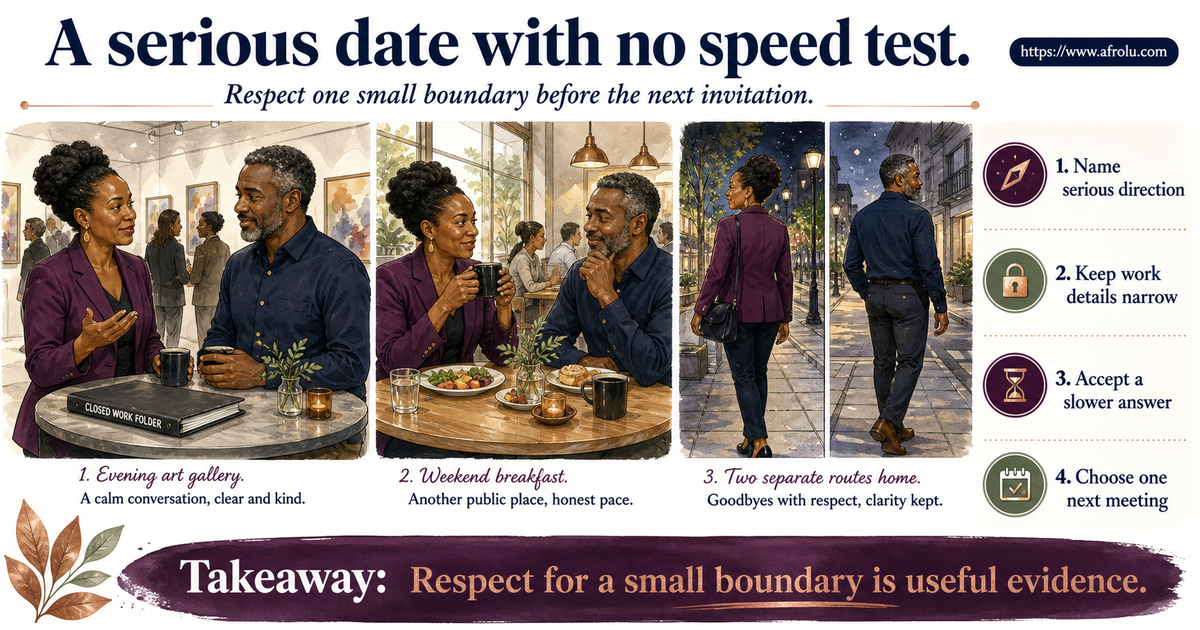
Lerato and Elias are fictional adults, 44 and 47, dating seriously after different long gaps. At a public gallery they discuss direction without turning experience into a score. Elias accepts Lerato's client and workplace boundary. They choose one public breakfast and a monthly review while home, accounts, money and exclusivity remain separate decisions.
The three-key safety vault
Let serious intention point forward while evidence controls every lock
Adwoa removes the social clock and protects the work, account, money, home and body systems that a new relationship does not own.
The vault uses three keys, four behavioural drawers and a six-lock career firewall to separate mature directness from accelerated access.
Future direction
State lasting intention without claiming certainty or a deadline.
Ordinary evidence
Observe planning, curiosity, repair and the response to no.
Specific access
Open work, home, money, accounts and body separately.
Career continuity
Keep professional systems able to survive a changed romance.
Remove the imaginary deadline
Starting serious dating later creates context, not a debt to catch up
A later starter may be entering a first committed relationship, returning after a long gap or simply beginning serious dating after years focused elsewhere. The label does not reveal age, sexual experience, confidence, attachment style or future skill. People arrive through many pathways: friendship, family introductions, apps, community, work-adjacent networks or chance meetings. Treat the actual adult in front of you as the source of present information rather than using a social timetable as a diagnostic tool.
Serious dating names a direction toward a lasting partnership. It does not promise that this particular match will become one, and it does not automatically create exclusivity, daily access, sex, cohabitation, financial merging or marriage planning. A later starter can state serious intention on date one and still choose public meetings, slow disclosure and a review after several weeks. Caution and commitment are not opposites when each decision is explicit.
An established career adds practical privacy questions. A public role, employer page or professional profile may expose a full name, colleagues, calendar hints and location patterns. A new match does not need client details, internal systems, travel itineraries, salary records or workplace access to understand that work matters. Offer a broad description and ordinary availability. Keep confidential or security-sensitive information inside the systems responsible for it.
This guide is for adults and cannot decide whether somebody is emotionally ready, compatible or safe. It does not replace mental-health, legal, financial, workplace-security or violence-support services. Its purpose is practical: separate direction, evidence and access; let experience be voluntary context; protect career and account systems; and ensure that serious hope never turns a boundary into proof that the later starter is immature, secretive or behind.
Use the three-key safety vault
Direction, evidence and access need separate keys
The direction key answers what each adult is exploring. Say whether you want a lasting partnership, are open but uncertain or prefer something lighter. Serious direction should make important questions discussable: values, children, location, money attitudes, caregiving, faith or community where relevant. It should not require instant answers. A useful conversation names which topics matter and chooses when each can be explored without turning the date into a formal assessment.
The evidence key observes behaviour across ordinary time. Does the person make realistic plans, accept a changed answer, repair an overstep and remain consistent when tired or disappointed? Can they hear limited experience without teaching, teasing or demanding a confession? Do their claims remain coherent under proportionate checking? Chemistry and eloquence matter as experiences, but neither can perform the work of reciprocity, repair and respect.
The access key controls each separate system: phone, home, work, schedule, colleagues, money, documents, health information, family, body and public identity. Grant only what the current decision needs. An invitation to a second date does not include home access. Exclusivity does not include passwords. Serious intention does not include salary disclosure. Consent to touch does not include images. The key can be withdrawn when conditions change.
Career privacy is not deception. Some adults must protect client, patient, student, commercial or security information; everyone is entitled to proportionate boundaries. If a match needs enough information to feel comfortable, discuss what can be checked safely. A respectful person may decide the available evidence is insufficient and decline. They may not retaliate by contacting an employer, publishing private data or demanding privileged access as the price of trust.
Lerato and Elias reject the speed test
One respected work boundary becomes useful relationship evidence
Lerato, 44, and Elias, 47, are fictional adults who meet on an app. Lerato has had relationships but never a long committed partnership. Elias is returning after a long period focused on family and work. They choose a staffed Thursday gallery event and arrange separate transport. Neither shares a home address, employee schedule or salary. A trusted person knows Lerato's broad plan; Elias keeps his own check-in routine.
They name serious direction early. Lerato hopes for a lasting partnership, while Elias wants the same but needs time before discussing cohabitation. Lerato asks about his present capacity rather than treating age as certainty. Elias does not ask how many partners she has had or whether she regrets starting late. They agree that relationship history can be shared voluntarily when it helps a current decision, not extracted to assign experience points.
When Elias asks which clients Lerato works with, she says the information is confidential and offers a broad description of her field. He accepts the boundary and changes the question to how work affects her availability. Later, Lerato declines his offer to collect her from the office. He does not search for the building or interpret independence as rejection. Those responses become more meaningful than his polished claim that he values ambitious partners.
They schedule a weekend breakfast and plan to discuss contact rhythm and what serious dating would look like for the next month. They do not become exclusive, exchange credentials, visit either home or merge calendars. Both leave the gallery with uncertainty, but it is accurate and bounded. Their late start has not made the process slower or faster than it should be; it has made clarity about access especially valuable.
Read the response after the answer
Serious intent, compatible pace, fast access and control are different patterns
Serious intent connects future direction to present conduct. The adult makes realistic plans, asks substantive questions without interrogation, keeps promises proportionate and tolerates the fact that compatibility is unknown. They do not promise marriage to end uncertainty. When they learn a difference, they decide whether it fits rather than pressuring the other person to transform. Seriousness is visible in how the process handles reality.
Compatible pace means both adults can understand and influence timing. One may have more relationship experience, but expertise does not create authority. The pair can choose a public sequence, review exclusivity, discuss physical boundaries and expand disclosure gradually. A faster pace can be healthy when both are free and essential systems remain protected. A slower pace can be unhealthy when one adult uses delay to collect devotion without reciprocal decisions.
Fast access bundles multiple locks: intense declarations, daily contact, home visits, workplace introductions, travel, exclusivity, sex and financial stories arrive before ordinary evidence. Acceleration is not proof of manipulation, but it increases the cost of a mistaken assumption. Unbundle the requests. Choose one small step, keep the rest closed and watch whether disappointment receives respect or a campaign to change your answer.
Control makes refusal expensive through shame, threats, surveillance, unwanted workplace contact, financial leverage, sexual pressure or public exposure. Secure the affected system first. Change credentials, use multifactor protection, notify an employer security contact when appropriate, preserve useful records and involve trusted or qualified support. Immediate danger calls for local emergency help. The goal is practical safety, not a debate about whether the person truly intended harm.

Watch what happens after a boundary, delay or ordinary disagreement.
Speak in present-tense permissions
Direct language can be serious without opening every archive
For experience, say: ‘I came to serious dating later than some people, and I will share history when it helps a decision we are making.’ This provides context without accepting an interrogation. You may also say that a topic is private. A match can decide whether limited information fits their needs. They cannot make shame, teasing or an intimacy test the price of continuing.
For direction and pace, try: ‘I am dating toward partnership. For the next month I want public dates and one planned call a week, then we can review.’ The sentence makes seriousness visible while keeping the experiment small. If you are uncertain, say so. Do not borrow certainty from age, career stability or the other person's enthusiasm. An honest smaller answer supports better consent than a grand answer offered to avoid appearing inexperienced.
For career privacy, say: ‘I can describe my field, but I do not share employer systems, client details or live schedules.’ If the person sends a link or attachment connected to a romantic story, verify through a separate route before opening or signing in. Keep unique passwords, multifactor authentication and software updates. Never share an authentication code, even with someone who says they are helping secure an account.
For money and consent, say: ‘I keep essential finances separate while trust grows’ and ‘Please ask before each physical or digital step.’ Paying for dinner, sharing a serious intention, becoming exclusive or having more experience does not purchase access. If a boundary is crossed, name the stop if safe, leave and protect systems. You do not owe a private repair meeting when risk has changed.

Experience may be disclosed; it never has to be defended.
Protect the systems that support your life
Work identity, accounts, money, home and meetings need independent locks
Limit searchable work detail on dating profiles. Consider whether a distinctive job title, office photograph, badge, conference schedule or client name reveals more than intended. Review platform privacy settings and remove metadata where appropriate. Do not invent an occupation or impersonate someone else. Use truthful but broad language until a present decision needs more detail. Professional visibility can never be made risk-free, so plan for boundaries rather than secrecy perfection.
Protect accounts with long unique passwords, a password manager where suitable, multifactor authentication and current software. CISA advises recognising phishing, using strong passwords, enabling multifactor authentication and updating software. Apply those basics before romance creates urgency. Do not sign in through links supplied in a match's message, share one-time codes or allow remote access to fix an invented problem. Use the provider's known route.
Keep salary documents, tax records, investments, property details and essential funds private. A later starter with an established career may be assumed to have resources or influence. Do not fund a new partner's emergency, business, travel or investment. If a suspicious transfer or credential disclosure occurred, contact providers promptly and preserve relevant evidence. Shame wastes time; system protection is the first task.
Meet in a staffed public place, keep a time box, control payment and return, and tell a trusted person the broad plan if helpful. Never visit a workplace uninvited or use professional contacts to learn more about a date. If unwanted contact reaches colleagues or an employer, use the organisation's safety or security route as appropriate. A relationship does not deserve protection at the expense of someone's livelihood or physical safety.

Protect the system first when romance reaches work, money or identity.
Choose the accurate label
Serious direction is not exclusivity, acceleration or a marriage plan
Serious dating means exploring a lasting partnership. Exclusive dating means both adults agree not to date others. The two can occur together or separately. Neither grants passwords, home keys, sex, account access or workplace involvement. Ask what the label changes today: contact expectations, disclosure about other dating, sexual-health choices or the timing of a review. If the answer is only a feeling, the agreement needs more work.
Fast escalation describes speed, not moral character. Several access layers may open quickly because both adults freely choose them, yet the higher exposure deserves explicit checks. If urgency, shame or sunk cost makes a no harder, close the affected layer. Marriage planning is different again: it involves specific mutual decisions and may involve legal, financial, faith, family or immigration systems. Serious intention cannot provide those answers in advance.
Continue when direction aligns, ordinary evidence grows, career and private systems remain respected and one modest next step fits. Revise when the setting, contact rhythm or disclosure level was too much but the response to a boundary was good. Become exclusive only with a clear agreement. Close when serious direction conflicts or when access pressure, money stories, workplace intrusion, coercion or retaliation makes practical freedom smaller.
The aim is not to date like someone who started earlier. It is to choose from today's knowledge, needs and capacity. Experience may make some skills familiar, but no history guarantees kindness or repair. A later starter can learn through reflection, trusted support and small live decisions. The strongest serious signal is not speed or certainty. It is a pattern in which both adults can tell the truth, keep essential systems and change their minds without punishment.
Eight serious-dating moments where timing and access diverge
A match asks for a complete relationship count
Curiosity becomes a test of whether the later starter is normal enough.
Share only context that helps a present decision.A profile detail reveals the workplace
The match arrives at the office without invitation after one date.
Use workplace safety routes and end access.Marriage language appears before ordinary evidence
The declaration bundles exclusivity, travel and home access.
Separate every request and choose at most one small step.Client names are requested as proof
Professional confidentiality is framed as romantic secrecy.
Offer a broad field description and keep protected data closed.A helpful account message asks for a sign-in
Romantic trust is used to reduce caution around credentials.
Use the provider's known route and share no code.Payment is treated as access
The adult who paid argues that a private visit is now expected.
Decline, leave independently and seek support if pressure rises.A serious dater cannot answer about cohabitation
The unknown is named instead of covered with a promise.
Set a review point or decide that the gap does not fit.A small boundary is accepted without complaint
Both adults retain work privacy and agree on one public breakfast.
Continue one layer while the rest stays closed.Evidence that direction remains serious and choice remains free
{'label': 'Direction', 'title': 'Serious is defined in behaviour', 'detail': 'The adult can describe a lasting direction without promising an outcome.', 'reading': 'Clear intent'}
{'label': 'Curiosity', 'title': 'Questions remain proportionate', 'detail': 'Experience is not turned into an examination.', 'reading': 'Respect'}
{'label': 'Pace', 'title': 'Both adults influence timing', 'detail': 'More experience creates no authority.', 'reading': 'Mutual'}
{'label': 'Work', 'title': 'Professional limits are accepted', 'detail': 'Client, colleague and system details stay closed.', 'reading': 'Career-safe'}
{'label': 'Accounts', 'title': 'Credentials remain individual', 'detail': 'No code, link or password becomes a trust test.', 'reading': 'Digitally bounded'}
{'label': 'Money', 'title': 'Resources do not define desirability', 'detail': 'No emergency or investment targets the relationship.', 'reading': 'Independent'}
{'label': 'Home', 'title': 'Private space opens separately', 'detail': 'Serious direction does not imply a key or visit.', 'reading': 'Proportionate'}
{'label': 'Consent', 'title': 'A current no ends the step', 'detail': 'Experience and expense create no entitlement.', 'reading': 'Voluntary'}
{'label': 'Repair', 'title': 'An overstep changes conduct', 'detail': 'The apology restores rather than requests more access.', 'reading': 'Observable'}
{'label': 'Future', 'title': 'Big questions tolerate real uncertainty', 'detail': 'Unknowns receive review dates, not manufactured certainty.', 'reading': 'Mature process'}
Choose the next lock from the three-key vault
| Situation | What it may mean | What to do next |
|---|---|---|
| Is serious direction explicit? | Fits: Both can describe what they are exploring. Needs review: One adult is honestly uncertain. Stop: Future talk changes under pressure. | Name direction without promising outcome. |
| Can experience stay voluntary? | Fits: Relevant context is invited, not extracted. Needs review: One question needs a boundary. Stop: Shame or ridicule follows refusal. | Stop the examination. |
| Is pace mutual? | Fits: Both adults can slow or advance. Needs review: One layer needs review. Stop: Age is used as a deadline. | Unbundle every request. |
| Is work privacy respected? | Fits: Broad context is enough. Needs review: One detail needs clarification. Stop: Clients, colleagues or systems are pursued. | Close access and protect work. |
| Are accounts protected? | Fits: Unique credentials and MFA remain private. Needs review: A suspicious message needs checking. Stop: Codes or remote access are requested. | Use the provider's known route. |
| Can money remain separate? | Fits: Each adult controls essential funds. Needs review: A shared cost needs terms. Stop: An emergency or investment creates urgency. | Send nothing and secure providers. |
| Is meeting logistics complete? | Fits: Public place, time and return work. Needs review: One item is unfinished. Stop: Home or work becomes the only option. | Keep it public or cancel. |
| Does consent remain current? | Fits: Every changed answer is respected. Needs review: A misunderstanding receives repair. Stop: Experience or cost creates entitlement. | Stop, leave and seek support. |
| Does repair restore choice? | Fits: The next action is different. Needs review: Follow-through is pending. Stop: Apology demands immediate access. | Judge the changed conduct. |
| What does the pattern support? | Fits: One serious but modest next step. Needs review: A smaller test and review. Stop: Less safety, privacy or agency. | Continue, revise or close. |
Scripts for experience, direction, work, money, consent and review
“I started serious dating later and will share history when it helps a choice we are making.”
“I am dating toward partnership, not promising that this match is the outcome.”
“For the next month I want public dates and one planned call, then a review.”
“I can describe my field, but I do not share client details, systems or live schedules.”
“I do not open sign-in links or share authentication codes through a relationship.”
“I keep essential finances and investments separate while trust grows.”
“Serious direction does not mean I am ready for a home visit.”
“I am changing my answer, so this physical step stops now.”
“Let us compare our contact rhythm and direction on the last Sunday of the month.”
“The pace and access you want do not fit me, so I am ending the romantic connection.”
Know the difference
The serious-dating access register

Serious intention points forward; present access still needs present evidence.
Compare serious direction, exclusivity, speed and formal planning
| Type or dimension | What it describes | Best next question |
|---|---|---|
| Serious dating | ||
| Exclusive dating | ||
| Fast escalation | ||
| Marriage planning | ||
| Public dating stage | ||
| Home access | ||
| Financial disclosure | ||
| Physical consent |
Build serious dating safely in six moves
Remove the social clock
Name serious direction
Gather ordinary evidence
Separate access keys
Secure career systems
Choose one next layer
Questions for direction, evidence, private systems and review
Choose a few prompts that fit the moment. This is a reference library, not a list to complete.
Direction questions
Define seriousness without inventing certainty.
- What future am I exploring?
- What remains unknown?
- What would exclusivity mean?
- Which issue needs time?
- When will we review?
Evidence questions
Observe conduct after ordinary friction.
- How are plans made?
- Can a no stand?
- Does repair change action?
- Are claims coherent?
- Is curiosity proportionate?
Access questions
Give every private system its own key.
- Which work detail is needed?
- Does home stay closed?
- Are accounts separate?
- Is money protected?
- Is consent current?
Review questions
Choose one layer rather than a catch-up sprint.
- What evidence grew?
- Which risk changed?
- What stays closed?
- Is one next step enough?
- Would ending protect more?
What relationship research and official safety guidance can support
Romance can begin through more than one route
Stinson and colleagues found that relationship-initiation research often overlooks friends-first pathways and reported that friends-first beginnings were common in their samples. A later starter need not imitate a stranger-first script to date legitimately.
Evidence limit: The samples and methods do not establish one preferred pathway for every adult or culture.
Relationship timing varies across development
A longitudinal study identified late starters, moderate daters, frequent changers and continuously single participants. Afrolu uses only the cautious point that relationship experience varies; no group predicts an individual adult's skill or future.
Evidence limit: The research followed adolescents into young adulthood and should not be generalised to all later-life daters.
Work and family details can be personal or sensitive data
Kenya's ODPC explains that personal data includes identifiers, address, location, images and recordings, while sensitive data includes property, marital status and family details. A serious date needs only proportionate information.
Evidence limit: This guide does not determine legal coverage or provide data-protection advice.
A relationship story can lead to money or investment requests
The U.S. FTC describes romance scammers who build contact, avoid meeting and later ask for travel, medical or investment money. Career stability does not protect anyone from manipulation; keep new romance outside essential financial systems.
Evidence limit: FTC reporting and remedies are U.S.-specific; use channels suited to your jurisdiction.
Basic account protection reduces avoidable exposure
CISA's Secure Our World guidance recommends recognising phishing, using strong passwords, enabling multifactor authentication and updating software. Apply those steps before sharing more digital life with a match.
Evidence limit: No security measure guarantees safety; use employer or provider support when an incident affects their systems.
Experience, status and expense do not replace consent
Healthdirect explains consent as knowingly and freely agreeing and says an answer can change at any time. Apply that principle to touch, sex, images and recording regardless of age, serious direction or who paid.
Evidence limit: Healthdirect services are Australia-specific; legal definitions and support routes vary by jurisdiction.
Six shortcuts that turn seriousness into access pressure
Use a reviewed resource that matches the decision
This guide focuses on the relationship decision, so it does not rank dating apps. Check current prices, safety tools, and local availability before choosing a service.
Explore the guide library
Show more related guides
Continue with Afrolu
Show more Afrolu guides
Primary research and official privacy, scam, account and consent sources
Afrolu reviewed these health, research, safety, or public guidance resources while editing this page. They support the behaviour and safety guidance; they do not diagnose any individual described by a reader.
Serious dating for later starters and career-focused adults
Am I behind if I start serious dating later?
No social timetable can decide your worth or readiness. Adults begin and return to relationships through many routes. Define what you want now, which skills or support would help and what pace protects consent. A later start creates context, not an obligation to catch up or accept faster access.
Should I disclose that I have limited relationship experience?
You may share it when the context helps a present decision, but you do not owe a complete history or defence. A useful sentence is: ‘I came to serious dating later and will share more as it becomes relevant.’ Watch whether the response is respectful rather than teasing, teaching or invasive.
What does serious dating mean at this stage?
It means you are exploring a lasting partnership. It does not guarantee that this match is the outcome, and it does not automatically create exclusivity, daily access, sex, home entry, financial disclosure or marriage planning. Make a separate mutual agreement for each layer.
How quickly should later starters become exclusive?
There is no age-based deadline. Discuss what exclusivity means, what each adult has observed, relevant sexual-health expectations and when the agreement will be reviewed. More experience does not give one person authority over timing. Choose only when both can say yes or no without pressure.
How much career information should I share with a date?
A broad field and general availability may be enough early on. Protect employer systems, client or patient details, live schedules, travel patterns, salary records and colleague information. If a material claim needs checking, use a proportionate independent route without sharing credentials or confidential records.
What digital-security steps matter in serious dating?
Use long unique passwords, a password manager where suitable, multifactor authentication and current software. Treat unsolicited links and attachments cautiously, and use the provider's known route to sign in. Never share a password, authentication code or remote-device access as proof of trust.
How do I discuss money without exposing accounts?
Discuss values, debt attitudes, spending habits and future goals at the level the current stage needs. Do not exchange bank statements, tax records, account access or investment credentials. Keep essential funds separate and do not finance a new partner's emergency, business, travel or investment story.
Is fast serious dating always a red flag?
No. Speed is a condition to examine, not a diagnosis. Unbundle the layers: direction, exclusivity, contact, home, work, money and physical intimacy. Choose each separately and watch the response to a slower answer. Urgency becomes unsafe when refusal triggers shame, threats, surveillance, leverage or retaliation.
Can a date contact my workplace if I stop responding?
A match should not use professional channels to bypass a personal boundary. If unwanted contact reaches work, preserve useful records and use the organisation's safety, security or human-resources route as appropriate. For threats or immediate danger, seek local emergency or specialist support. You do not owe a workplace explanation to keep the romance private.
How do I end a serious-dating mismatch safely?
Use a concise present-tense statement: the direction, pace or access expectations do not fit, so you are ending the romantic connection. Avoid a private closure meeting when safety has changed. Secure accounts, work information, money and home access, then seek trusted or qualified support if contact becomes persistent or threatening.
One thing to do now
Let serious direction earn one lock at a time
Use three keys in order. State direction; gather ordinary evidence through planning, repair and responses to limits; then open only the access the next decision needs. Continue when seriousness preserves work, money, privacy and a usable no. Revise one pace or setting when fit remains. Close when direction conflicts or age shame, rapid bundling, scams, workplace intrusion, coercion, surveillance or retaliation reduces practical choice.