Parents · Nairobi · digital boundaries
When an old date keeps viewing your stories
A former date still watches or reacts to your posts? Distinguish online presence from a plan, protect family privacy and choose a calm digital boundary.
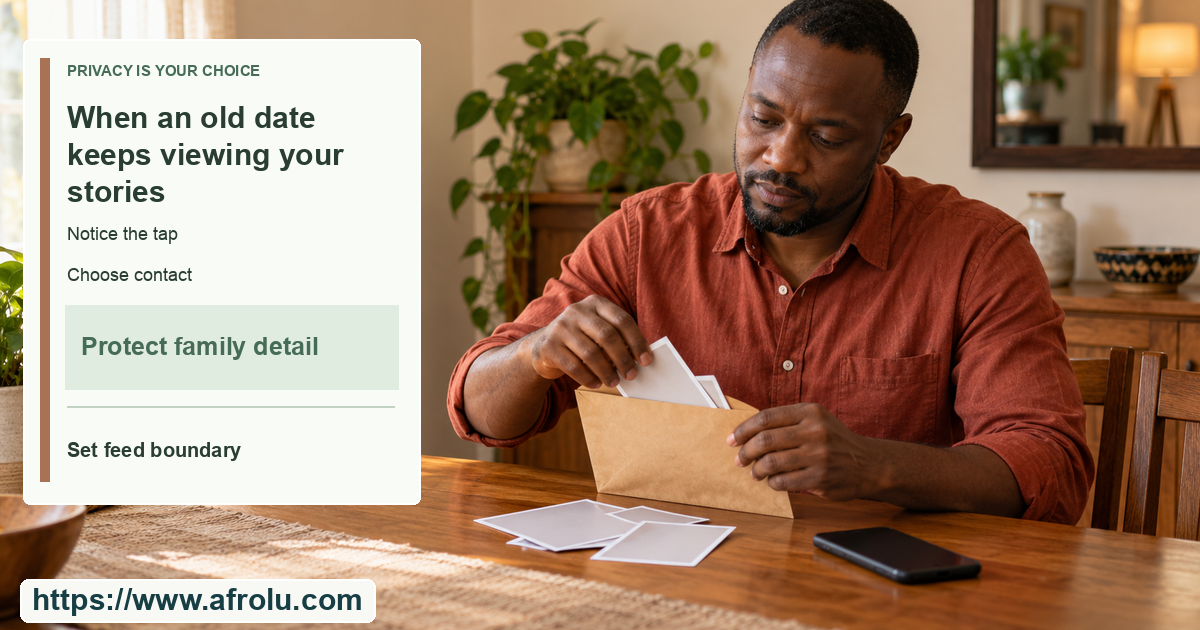
A story view is an online trace, not a renewed dating plan; family details remain your choice.
Written and edited by Ruth Akinyi · Local Dating Editor
A view or reaction is an observable online action, not a renewed relationship plan or a reliable window into motive. Decide first whether you want contact at all. If you do, one direct invitation is clearer than decoding repeated story views. If you do not, use the platform's mute, restrict, unfollow or block controls to protect your attention, and review what your profile reveals about your child, home and routine. You do not owe a response to a reaction. If the activity becomes harassment or makes you unsafe, document what is appropriate, use reporting tools and seek a safety plan before visible changes when retaliation is a concern.
What should I do when a former date keeps watching my posts but no longer makes contact?
Orbiting is an informal dating term for a person staying visible in someone's social-media activity after the direct dating connection fades. It describes a pattern seen on screen; it does not establish intention, affection or danger by itself.
A small signal on the screen
A story view does not answer a dating question
Someone may watch a story automatically, out of curiosity, from habit, or with a wish they have not spoken. A reaction can be warm and still leave no plan for contact. If the direct dating exchange has ended, do not reserve your weekend on the strength of a viewer list. The only thing the screen reliably shows is that an account interacted with a post.
The useful question is yours: do you want a new conversation with this adult? If yes, a brief direct invitation can test whether a mutually chosen meeting exists. If no, no response is required. You need not send a boundary speech every time someone taps an icon, and you need not solve their motive before changing what appears on your screen.

Trace versus plan
View full-size imageFeed trace
An account viewed or reacted to a family weekend post.
Adult plan
Two people directly agree on a public time and place.
- Contact wanted?
- Child clues visible?
- Setting effect known?
- Safety considered?
Only a direct agreement can reserve time; you can protect family privacy either way.

Does this tap need an answer?
View full-size imageA former date keeps watching your stories without making a plan.
Do you want to reopen a direct conversation with this person?
- YESask once about a real meeting.
- NOchoose a privacy boundary.
A tap is not a plan; a family boundary needs no explanation from the viewer.
The family line
Protect a child's life from the dating feed
Before changing the former date's access, look at what your posts already reveal: a school badge, a recurring route, a home gate, a child's name or a time pattern. Australia's eSafety Commissioner recommends care with dating profiles, linked social accounts and identifying information. Its advice is useful as a privacy prompt, while no setting can guarantee that an image already shared has not been saved.
You may share that you are a parent without making your child part of early dating or a public negotiation about a former date. Adjust the audience for family updates, remove identifying details where you can, and keep future plans off a broad story feed. These changes can serve your household even if the online viewer disappears tomorrow.
A boundary sheet
The screen shows activity; what do you choose?
A viewer list can pull a parent back into a connection that no longer has a real meeting in it. Separate the digital trace from your own contact and family-privacy decisions.
Notice the action, decide on contact, protect identifying family details, then choose the platform setting that fits your safety and comfort.
What actually appeared?
A view or reaction is a tap, not a stated intention.
Do you want a conversation?
One direct ask is available; silence is also a choice.
What is visible about a child?
Remove or limit school, route, home and identifying images.
Which setting suits you?
Mute, restrict, unfollow or block based on your needs and safety.

The child-aware privacy sheet
View full-size image- Viewer trace
- An interaction is visible but its motive is not.
- Contact choice
- The parent chooses whether any conversation is welcome.
- Family clues
- School, route, home and child-identifying clues are limited.
- Platform control
- The chosen control's visibility and safety implications are checked.
The family-privacy review stands even if the former date stops watching tomorrow.
Choose the quietest useful control
Mute, restrict, unfollow or block for your own reason
Muting may keep the person's posts out of your view. Restricting, unfollowing or removing a follower may change what each account can see. Blocking can stop contact on a service but may be noticeable. Read the current platform instructions before assuming a setting does exactly what you intend; check your own profile from the audience view when that feature is available.
love is respect's digital-boundary guidance supports limits on online contact and posting. If the behavior is merely distracting, a quiet mute may be enough. If reactions become persistent unwanted contact, use report and block tools as appropriate. For stalking or coercive contact, the U.S. National Domestic Violence Hotline warns that blocking can prompt retaliation and recommends preserving evidence; a safety plan and trusted local support may need to come before visible account changes. An ordinary story view alone does not imply that kind of danger.
A setting can also solve only part of the problem. Muting stops you from seeing some posts but may leave that person's view of your family updates unchanged; narrowing your audience addresses a different direction of access. Check the actual effect of each control on the service you use, and do not rely on a label that sounds protective without examining who can still see what.
Before changing a setting
Decide what you want the setting to do for contact, family visibility and safety.
Before a setting change
Know which issue you are solving.
- Do I want contact?
- What can the audience see?
- Would a visible change affect safety?
If you want an answer
Ask once about a real meeting, then let the answer stand
If you would welcome renewed contact, send a plain message that names a possible public meeting and gives room for no. For example: 'If you would like to catch up, I could meet for coffee Sunday afternoon. If not, no problem.' Do not cite every view as evidence that they owe you a meeting; they may not understand the pattern as you do.
If there is no answer or only more reactions, you can stop waiting. A person who wants to make a plan has the chance to say so. You may still enjoy the memory of the two dates and decide that a feed-only connection is not enough for your life. Keep any future first meeting public and your journey home independent; risk-reduction guidance cannot promise safety.

A direct ask, if wanted
View full-size imageIf you would like to catch up, I could meet for coffee Sunday afternoon. If not, no problem.
- Ask once
- Offer public time
- Allow no
Invite a real public meeting only if you want one; do not cite the viewer list as a debt.
Reclaim an ordinary week
Stop checking the audience list for a relationship
Notice how much time the viewer list has been taking. If you have begun posting in hopes of a particular reaction, a short break from stories may be more restful than one more privacy setting. Spend the next weekend on plans you chose with friends, family or yourself. The goal is not to make the former date notice your absence; it is to return attention to the people and choices present in your life.
Revisit the setting if your needs change. A child-aware privacy boundary is worth keeping whether you later welcome a conversation, start seeing someone else or remain single. If unwanted contact escalates, preserve safe evidence and seek relevant platform or local support. A digital trace can be ambiguous; your right to choose contact and protect family details is clear.

A quieter feed and weekend
View full-size image- Stop decodingDo not turn views into a promise.
- Review postsRemove identifying family clues and narrow the audience.
- Choose controlPick the setting that fits comfort and safety.
- Reclaim weekendReturn attention to your own weekend.
Read the view as a tap, decide whether contact is wanted, remove child-identifying clues and choose a safe platform boundary. If contact feels unsafe, plan with trusted support before a visible setting change.
Next choice
Choose your feed boundary
Decide whether contact is welcome, remove identifying family details and use the platform control that fits your safety.
About these links These information links are not affiliate buttons and are clearly labelled. They do not promise a match or relationship outcome.
eSafety, social-boundary and safer-meeting sources
Ordinary views are ambiguous. Safety-planning guidance addresses unwanted or coercive contact, where visible setting changes may carry risk.
Questions about an orbiting former date
Does every story view mean someone wants me back?
No. A view is observable activity, not a reliable statement of intent.
Should I message them?
Only if you want a direct conversation. One optional invitation is clearer than decoding reactions.
Is muting enough?
It may be if the issue is distraction. Check the platform's setting and choose a stronger limit if needed.
Should I remove child photos?
Review identifying details and audience settings; family privacy is worthwhile independent of this viewer.
What if the contact feels like harassment?
Save evidence safely, use relevant reporting tools and seek a safety plan or trusted support, especially if changing settings could provoke retaliation.