Adult-student dating · intent and capacity
Online Dating Burnout for Adult Students
An adult-student guide to dating-app fatigue: protect study time, state serious intentions clearly, keep casual plans safe, and return at a pace you choose.
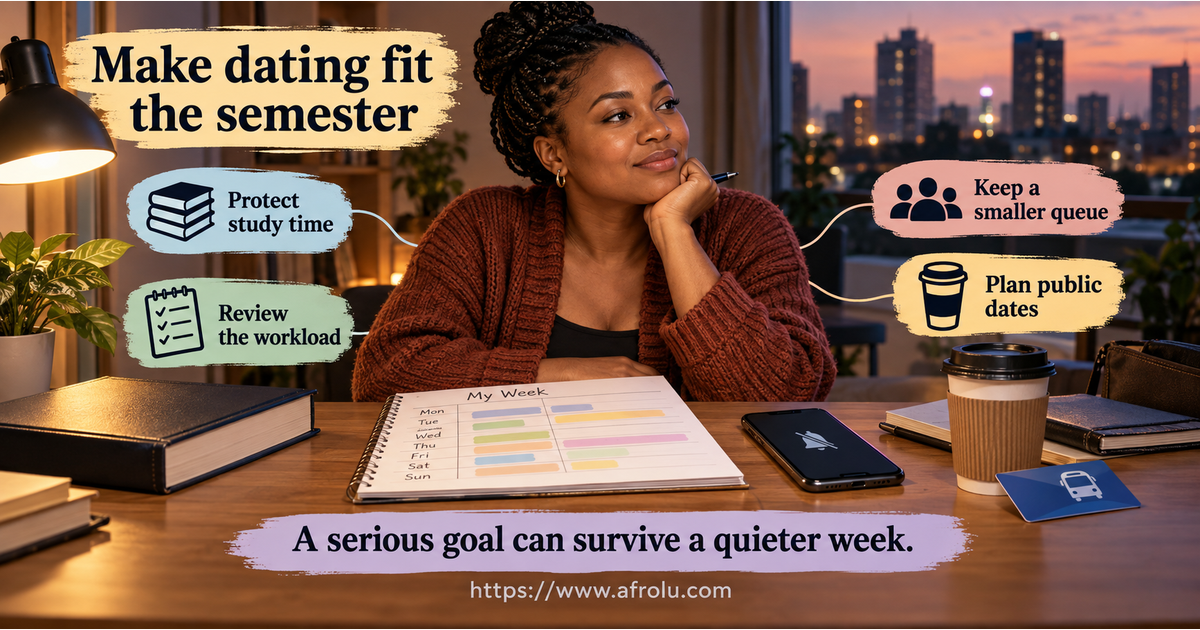
A smaller dating system can protect study and choice.
Written and edited by Nia Kato · Profile Advice Editor
Reduce the number of open dating decisions before lowering your standards. Use a small conversation cap, one app window, a clear intent line, public first plans, independent transport, and a review date. Keep money, academic access, private locations, consent, and leaving separate from any new match.
Dating wellbeing · Students
How can an adult student reduce dating-app overload while keeping a long-term goal, a low-pressure first pace, and independent safety choices?
Online dating burnout is everyday language for feeling depleted, numb, irritable, or overburdened by dating-app work. It is not a medical diagnosis. For adult students, a useful response protects study, work, rest, budget, privacy, consent, and the freedom to date intentionally at a pace that remains voluntary.
Mariam is completing postgraduate coursework when five dating chats begin to feel like a second assignment. She pauses new matches, keeps one Sunday coffee plan, and tells a new date that she will travel independently. When another person asks for student-account access, she treats that as a safety boundary rather than a test of trust. Her return becomes smaller, calmer, and more honest.
adult-student dating · intent and capacity
Mariam makes room for a goal without turning every message into coursework
A demanding semester can turn ordinary app work into a second inbox. This guide helps adult students make dating smaller, state a long-term direction clearly, and keep first plans public, affordable, and voluntary.
Count the invisible work, separate intent from urgency, reduce open loops, protect privacy and consent, use short scripts, and review a small return against real life rather than match volume.
Count the open loops
Messages, safety checks, plans, and closure consume attention beside study and work.
Name direction, not destiny
A serious hope can fit inside a modest, public first plan.
Keep access independent
Money, transport, academic records, consent, and private spaces remain separate from attraction.
Start smaller on purpose
One app window and a chat cap make it easier to see conduct clearly.
Begin with the workload
A crowded semester can make dating feel like unpaid admin
Mariam is completing a postgraduate course while working two evenings a week. By the time she has read class notes, answered a family message, and organised tomorrow's travel, a dating-app notification feels less like an invitation and more like another item that can go wrong. That reaction does not show that she is incapable of closeness. It may show that her current dating volume asks for attention she has already spent elsewhere.
She separates the wish from the work. Wanting a long-term partner is one thing; managing profiles, opening messages, interpreting silences, arranging calls, checking safety, and declining unsuitable plans is another. When every part is left open at once, even a promising conversation can feel like a deadline. Naming the tasks makes it possible to remove one without making a dramatic claim about love or the future.
Adult students do not have one timetable or one budget. Some are returning to education after work, caring for relatives, parenting, changing careers, or commuting across a city. Mariam does not need to compress that life into an apologetic profile explanation. A person worth meeting can work with a clear statement such as, 'I am open to getting to know someone, and I am not available for constant messaging during my study week.'
For the next seven days, she turns off match notifications, keeps one short app window after dinner, and does not start new chats. She notes whether the quieter phone makes her feel relieved, lonely, curious, or all three. Those observations are more useful than forcing a cheerful response when her attention is gone. A pause can be a way to gather evidence about capacity rather than a test she must pass.
Separate intent from tempo
Serious hopes can live inside a casual first plan
Mariam wants a relationship with room for commitment, but she does not want each first meeting to carry the weight of a future household. She notices that the word serious can become confusing when it is used to mean immediate access, daily reassurance, or a demand to skip ordinary getting-to-know-you stages. Her intent is about compatibility and direction; it is not permission for someone else to set the pace.
A casual plan describes the container, not a person's worth. A short public coffee, a daytime museum visit, or a walk in a well-used place can be casual in cost and duration while still allowing direct conversation. Mariam can say that she prefers to date intentionally and wants to see whether values, communication, and practical lives line up. That leaves room for either adult to decide that a second meeting is not the right next step.
The useful question after a first date is not, 'Did this prove that we are serious?' It is, 'Was the plan respectful, mutual, and easy to leave, and do I want another small step?' If a person asks for exclusivity before there is enough shared experience, treats a study deadline as rejection, or insists that a casual plan is evidence of low interest, Mariam can slow the conversation rather than defend her priorities.
She also avoids the opposite shortcut: presenting herself as casually available when that would hide what she actually wants. A concise line is enough: 'I am dating with a long-term relationship in mind, and I prefer to let trust build through ordinary plans.' It gives compatible people useful information without turning a profile into a contract. Clarity works best when it describes the present and preserves a free no.
Reduce the number of open loops
A smaller queue protects both judgment and kindness
Mariam sets a limit of two active conversations. That number is not a rule for every student; it is simply enough for her to answer willingly, notice whether someone respects a boundary, and keep the rest of her life visible. A long list of partial chats had made every unanswered message feel like unfinished coursework. A smaller list returns the choice to her rather than to the app's reminder system.
She chooses a response window that does not invade revision, lectures, sleep, or paid work. If a message arrives outside that window, it can wait. A compatible person may prefer a different rhythm, but they do not get to turn her attention into proof of affection. When their schedules genuinely clash, both adults can decide whether one planned call or a quieter connection is enough to explore further.
The same limit helps with safety. Mariam is less likely to confuse names, lose track of a person's stated city, or accept a rushed invitation because too many chats blur together. Before moving off-platform or agreeing to meet, she can reread the exchange, ask one direct question, and check whether the proposed plan still fits her own money, travel, and comfort limits. Volume is not the same as opportunity.
When a chat has gone silent or no longer fits, she does not need to leave it open as a backup plan. A short close such as, 'I am reducing my active conversations, so I will not continue this one,' is enough. If a person responds with abuse, guilt, threats, or repeated contact, the next task is not politeness; it is using platform controls, preserving relevant records, and seeking support if the behaviour creates a safety concern.
Keep study, money and consent independent
A limited budget should never become a reason to accept pressure
A busy campus or city can make it tempting to combine a first date with a ride home, a private study space, or a last-minute change of venue. Mariam treats those as separate decisions. She chooses a public place, tells a trusted person enough to support her, keeps her own way there and home, and brings what she needs to leave. These steps cannot control another person's behaviour, but they keep practical options available to her.
Budget is part of consent and pace. Mariam does not need an expensive plan to demonstrate interest, and she does not owe a second date because someone paid for a first one. If the cost, location, or travel plan has changed in a way that makes her uncomfortable, she can propose a different public option, split or cover her own costs where that feels right, or leave the plan entirely. Her financial choices remain hers.
The same independence matters online. New matches do not need access to student portals, academic schedules, identity documents, passwords, live location, private images, or a request to receive or move money. A person who rushes her off the platform, asks for a ticket, claims an emergency, or sends a link for an investment or verification should not be reassured by more disclosure. She can stop contact, save the material, report it, and speak to someone she trusts.
Consent is active and ongoing, not a reward for attention or a result of previous agreement. Mariam can change her mind about a venue, a kiss, a visit, sharing a photo, or continuing the date. Pressure, guilt, intimidation, threats, or ignoring a stated no are not communication problems she must solve alone. If she is in immediate danger, she should seek local emergency help; a dating guide is not a substitute for urgent support.

Slow down for workload; stop for access pressure.
Use short language before you are exhausted
A boundary can be clear without becoming a biography
Mariam writes a study-week line before her next busy period: 'I do not message much during coursework, but I can check in on Sunday.' It says what is available without inviting negotiation over every hour. If the other person says that rhythm does not work for them, that can be useful compatibility information. Neither person has to pretend that a mismatch will disappear with more pressure.
For intent, she keeps the language present and proportionate: 'I am open to a long-term relationship, and I prefer a relaxed first meeting to see whether we communicate well.' This is different from asking someone to promise permanence after a few messages. It also makes it easier to notice if a match hears serious intent as a demand for quick access, exclusivity, money, or future planning before trust has formed.
For a changed plan, she uses a practical sentence: 'I am only comfortable meeting in the public place we agreed, and I will make my own way home.' There is no need to prove that an alternative venue is dangerous. Her comfort is sufficient. If a date pushes, mocks, bargains, or turns cold, she has already learned something important without needing to continue the meeting.
For closure, she avoids diagnosing the other person. 'This does not fit my capacity or what I am looking for, so I am not continuing it' is enough. She can block after a clear message when contact becomes unwelcome, or block without a final message when responding would increase risk. Clear language is a tool for her own choice, not a mechanism for changing someone else's conduct.

A boundary can be brief and still complete.
Return with a system small enough to keep
A return plan should survive the next deadline
After her pause, Mariam does not reinstall every app or try to compensate for missed matches. She picks one platform, one weekly window, and two active chats at most. She also writes down a rule that protects her study time: no replies after a chosen hour, no first dates during assessment week unless she genuinely wants one, and no explaining herself repeatedly to people who treat those limits as negotiable.
Her profile offers a small truthful signal: she values a steady pace, adult communication, and intentional dating. It does not list her class timetable, home location, institution login, exact commute, or family responsibilities. A new match can learn enough to decide whether the rhythm appeals to them without receiving information that belongs to trust built over time.
She uses a simple first-call check: Can this person accept a small limit? Can they make a specific public plan? Do they speak about a serious goal without turning it into urgency? The answers do not certify character, and one smooth call does not eliminate risk. They do help Mariam decide whether the next hour deserves space in a life that already has real commitments.
At the end of the week, she reviews the effect rather than her match count. Did she feel clearer after using the limits? Were conversations respectful? Did dating crowd out sleep, coursework, friends, or safety decisions? She can extend the pause, continue the small system, or leave the app again. Each outcome can be a thoughtful choice, not evidence that she has failed at dating.

Choose the smallest honest next move.
Let support exist outside the app
Connection is larger than a match queue
Mariam notices that her urge to swipe rises after a disappointing seminar, an argument at home, or a long night of study. That does not make the wish for connection fake. It does mean that an app may be carrying more emotional weight than one stranger can reasonably hold. She schedules time with friends, a call with family, a walk, or a campus service that feels appropriate before treating a new match as the only available relief.
Support can also make a first meeting safer. A trusted person does not need every detail of her dating life to know where she plans to be, when she expects to check in, and what kind of help would be useful if plans change. The goal is not surveillance. It is making sure Mariam has someone she can contact without shame if she needs a ride, an exit, a listening ear, or help saving evidence of harassment.
If low mood, anxiety, sleep disruption, concentration problems, or distress begins to interfere with daily life, a qualified health professional or an appropriate student support service can offer care. The language of dating burnout should not turn a reader into a diagnosis. It is simply a prompt to notice whether a smaller system is enough or whether broader support belongs in the plan.
Mariam's final question is not whether she can make dating efficient. It is whether the way she dates leaves room for dignity, study, friendship, safety, and a future she still recognises as her own. A connection that can only exist by taking over those foundations is not made healthier by calling it serious. A compatible relationship should make ordinary life more workable, not smaller.
Eight ordinary adult-student dating moments

A match wants a nightly call during assessments
The request may be enthusiastic, but Mariam has already said when she is free.
Offer one realistic time; do not trade sleep for reassurance.A coffee date asks what serious dating means
A future goal can be stated without treating the first meeting as a commitment test.
Name the goal and keep the next step small.A public plan becomes a private ride to save money
Lower cost does not require giving up an independent exit.
Keep the public venue or decline the date.A message waits until after a class deadline
A delayed reply is a fact, not a verdict on attraction.
Reply in the planned window or let the chat rest.Five chats blur together after a late shift
Volume has made careful judgment harder.
Pause new matches and choose only the conversations you can hold well.A new date asks to use a student account or document
Academic credentials and identity records are not early-dating information.
Say no, preserve the request if concerning, and use platform controls.A match wants exclusivity after a few intense days
Strong words do not remove the need for time and mutual evidence.
Slow the pace and ask what present behaviour would make the plan workable.A closed chat keeps returning from new accounts
Repeated contact after a clear boundary can be harassment.
Save records, block, report, and seek local support if safety changes.Signals that workload, intent, or a safety boundary needs attention
Opening an app feels like starting another assignment rather than choosing connection.
You keep replying after your own sleep or study boundary because silence feels risky.
You cannot remember enough about active chats to assess what each person has actually said.
A new match treats coursework, work, or care duties as proof that you are not serious.
You hide a long-term goal because you fear it will be read as an immediate promise.
A casual first plan is repeatedly turned into pressure for a private or costly one.
You feel obligated after someone pays, sends a gift, or offers a ride.
A person asks for money, student access, documents, passwords, codes, or a secret.
A match insists on moving off-platform before a basic conversation has settled.
A date ignores a stated no, argues with a venue boundary, or makes leaving difficult.
Your friends, rest, coursework, or paid work disappear whenever a new chat becomes intense.
You reinstall or delete apps impulsively without deciding what would be different next time.
A stalled chat remains open for weeks because closure feels like another task.
You feel afraid to reduce access because the other person may become angry or retaliate.
Choose a next move from the present fact
| Situation | What it may mean | What to do next |
|---|---|---|
| A reply is late during a deadline | A study or work obligation may be taking priority for a few hours. | Use the agreed window before assigning meaning. |
| A match asks for daily contact | They may want a different rhythm, or they may be testing whether your limit moves. | State the available rhythm once and observe the response. |
| You want a serious relationship | Your goal is real, but a stranger cannot deliver certainty on demand. | Describe the direction and keep the next plan proportionate. |
| A first date becomes expensive | Cost can introduce pressure or simply reveal a budget mismatch. | Choose a public option you can leave and afford independently. |
| Someone offers a ride home | The offer can be kind, but it may remove an easy exit. | Keep your own route until trust has grown through time. |
| A match wants a private study session | A shared interest is not a reason to surrender privacy. | Meet publicly or keep the interaction online. |
| The app feels unbearable | Your current volume or notification system may be too large. | Pause new matches and choose one review date. |
| A person asks for money or account access | This is an access or fraud concern, not a compatibility puzzle. | Do not send, save the evidence, report, and block. |
| You want to stop a chat | The connection may no longer fit your capacity or intention. | Send a concise close when safe, or block if contact is unwelcome. |
| A boundary triggers threats | The issue has moved beyond ordinary dating disappointment. | Prioritise safety, preserve records, tell someone trusted, and seek appropriate local help. |
Twelve short lines for time, intent, money and safety
“I am in a busy study week, so I check messages in the evening rather than throughout the day.”
“I am open to a long-term relationship, and I prefer to see how we communicate through a few normal plans.”
“A short public coffee works for me as a first meeting.”
“I am only comfortable meeting in the public place we agreed.”
“I will make my own way there and home.”
“I do not need an expensive plan to enjoy getting to know someone.”
“I do not share school accounts, documents, codes, or private schedules early in dating.”
“I do not send money or receive transfers for someone I have met online.”
“This week is not workable for me. I can offer this time next week, or we can leave it there.”
“I am keeping my dating conversations smaller, so I will not continue this one.”
“I want to slow down and keep this to what we agreed.”
“This does not fit what I am looking for, so I am ending the conversation. I wish you well.”
Know the difference
Workload, serious intent, casual plans and direct pressure are different facts
A study pause, delayed reply, serious goal, or modest public first date can be discussed with specific limits and room for either adult to choose.
Money, logins, documents, private-plan demands, ignored noes, threats, and coercion need a firm stop, preserved evidence, and appropriate reporting or support.
Do not use one response for every uncomfortable moment. Name the current fact, then choose the smallest safe action.

A workload pause and direct pressure call for different decisions.
Separate workload, pace, purpose and direct pressure
| Type or dimension | What it describes | Best next question |
|---|---|---|
| A study-week pause | Removes dating tasks for a defined period while preserving future choice. | Choose a review date and one notification limit. |
| Avoiding every feeling | Uses nonstop swiping or total silence to escape discomfort without noticing what is needed. | Name one support or rest action outside the app. |
| Serious intent | Describes a hoped-for relationship direction without demanding early certainty. | Say what you are exploring and watch present conduct. |
| Urgency dressed as seriousness | Uses commitment language to rush access, exclusivity, travel, money, or intimacy. | Slow down and keep every decision independent. |
| A casual first plan | Keeps cost, time, and pressure proportionate while two adults learn about fit. | Choose a public, easy-to-leave setting. |
| A costly obligation | Turns payment, transport, or a gift into a reason you should continue. | Keep your own budget and leave if the pressure grows. |
| A delayed reply | May reflect class, work, sleep, or a stated boundary. | Use the next agreed contact point before judging it. |
| Repeated boundary testing | Returns to a limit after you have clearly answered it. | Reduce access, document concerning conduct, and use platform controls. |
| A smaller return | Uses a conversation cap and defined app window to protect judgment. | Review whether the system still fits after one week. |
A smaller system before another dating decision
Workload has parts
Notifications, selection, calls, safety checks, travel planning, and closure can be reduced separately.
Intent is not urgency
A long-term hope does not require all-day messaging or early promises from a new person.
Casual can be honest
A short first plan can be a respectful way to learn about compatibility without pretending it decides the future.
Budget supports choice
Keeping costs visible and transport independent makes it easier to say no when plans change.
Boundaries reveal information
A person's response to a simple limit often tells you more than an intense declaration does.
Support is not a dating failure
Friends, rest, student services, and qualified care can matter more than another match when distress is growing.
Questions organised by purpose and depth
Choose a few prompts that fit the moment. This is a reference library, not a list to complete.
Capacity check
Use these before opening an app during a demanding week.
- What dating task feels heaviest today?
- What can wait until I am rested?
- What would make one conversation manageable?
Intent check
Use these before agreeing to a first plan.
- What direction do I honestly want to explore?
- What pace still feels voluntary?
- What would I need to learn before a bigger promise?
Safety check
Use these before sharing access or changing a plan.
- Do I have an independent way there and home?
- Am I being asked for money, records, codes, or a secret?
- Can I leave without needing this person to agree?
Return check
Use these after one week of a smaller system.
- Did the app crowd out sleep or study?
- Did anyone respect the limits I named?
- What will I keep, reduce, or pause next week?
Look more closely at access, consent, cost and support
Count the dating tasks beside the semester
List messages, calls, safety checks, travel, emotional labour, and closure, then remove one task for a week.
Evidence limit: A list cannot diagnose exhaustion or decide whether a relationship will work.
State direction without predicting a future
Use one sentence about being open to a long-term relationship and another about learning through ordinary plans.
Evidence limit: Clear words cannot make another person compatible or safe.
Keep academic access out of early dating
Protect logins, documents, schedules, private study spaces, and the people connected to them.
Evidence limit: Shared classes or interests are not identity verification.
Preserve an easy exit
Choose a public venue, independent transport, a time boundary, and a person you can contact if plans change.
Evidence limit: Planning can reduce risk but cannot guarantee another person's behaviour.
Keep each agreement current
Pause or change a plan when comfort changes; a previous yes, a gift, or a date does not create future permission.
Evidence limit: This guide cannot provide emergency, legal, or clinical support.
Let stress have more than one outlet
Use friendship, rest, campus resources, or qualified support when distress affects daily life.
Evidence limit: Seek urgent local help if a person threatens, stalks, coerces, or endangers you.
Common shortcuts that add pressure
Treating overload as a flaw
Shame adds pressure while leaving the actual number of dating tasks untouched.
Calling urgency serious
Quick commitment language can conceal a demand for access that has not been earned.
Using cost as proof
Paying or being paid for can create a false sense of debt or obligation.
Combining first dates with private access
A ride, a home, a study space, or a login can make an exit harder than a public plan.
Keeping every chat alive
Unfinished conversations consume attention and make individual conduct harder to assess.
Explaining a no until it becomes a debate
A limit is not more valid after someone else agrees with its reasons.
Choose one resource that helps with the open fact
Start with the guide that matches what is actually happening: app workload, a long-term direction, or a safety concern that should not remain inside relationship interpretation.
Explore the guide library
Show more related guides
Continue with Afrolu
Show more Afrolu guides
Sources used for this guide
Afrolu reviewed these health, research, safety, or public guidance resources while editing this page. They support the behaviour and safety guidance; they do not diagnose any individual described by a reader.
Questions about adult-student dating burnout
Is dating burnout a medical diagnosis?
No. This guide uses it as everyday language for dating-app fatigue or overload. Persistent distress or difficulty functioning deserves appropriate qualified support.
Can I want a serious relationship and keep first dates casual?
Yes. A serious goal describes direction; a short public first plan can keep cost, pressure, and expectation proportionate while you learn about fit.
How many conversations should I keep active?
There is no universal number. Keep only as many as you can remember, answer willingly, and assess without displacing study, work, rest, safety, or people you care about.
Does slow texting mean someone is not serious?
Not by itself. Look for a stated rhythm, a usable repair after a missed plan, and a pattern of respectful conduct before drawing a conclusion.
Do I owe a date if someone paid for something?
No. A payment, gift, or ride does not create a debt for time, attention, intimacy, or another meeting.
Should I meet a new date at my campus or home?
Early meetings are usually easier to leave when they are in a public place that does not reveal your private routine. Keep your own route where possible.
What if a match asks for course access or a document?
Do not share logins, codes, student records, identity documents, or private schedules. If the request is concerning, preserve the record, report it on the platform, and block.
How can I end a chat without a long explanation?
Say that the connection does not fit your capacity or what you are looking for and that you are not continuing it. Block without a final message if responding would increase risk.
What if pressure happens during a date?
You can leave, contact someone trusted, or seek local emergency or support help if needed. Pressure, fear, and ignored boundaries are not problems you have to debate away.
Should I delete every app during exams?
Not necessarily. A time-limited pause, muted alerts, or one smaller account may remove enough work. Choose the option that protects your current capacity.
One thing to do now
Let dating fit the life you are building
Choose the smallest dating action that still leaves room for study, rest, independent money, clear consent, an easy exit, and a freely chosen no.