Three budgets · fourteen-day review
Reset Online-Dating Fatigue as a Nairobi Parent
A non-diagnostic Nairobi parent guide to dating-app fatigue, attention limits, child privacy, scam safety, a fourteen-day pause and a measured return.
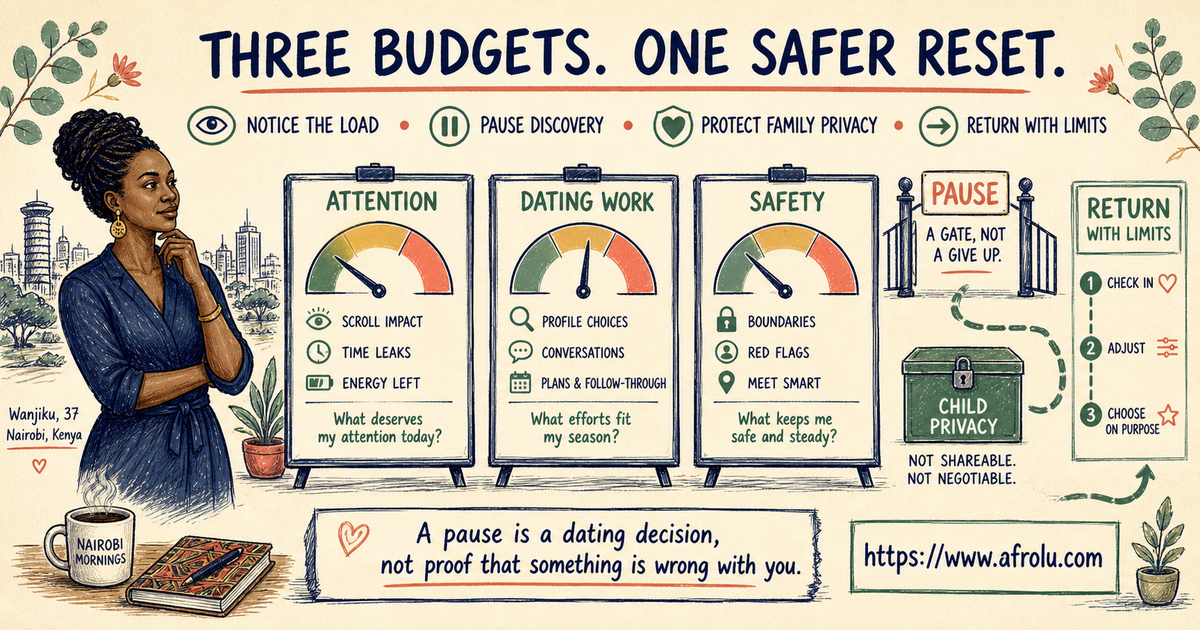
Protect attention, dating effort and safety capacity separately.
Written and edited by Nia Kato · Profile Advice Editor
Treat dating-app burnout as colloquial fatigue, not a diagnosis: WHO reserves burn-out for the occupational context. Separate ATTENTION, DATING WORK and SAFETY capacity. Close conversations you cannot carry, silence discovery prompts and use a reviewable pause. Keep child information, money, links, private venues and transport control outside romantic urgency. Return only through one small window with a conversation cap, or choose not to return. Persistent impairment needs qualified health support; threats, stalking, fraud or coercion need appropriate safety action.
Dating wellbeing · Parents Returning To Dating
How can a parent reduce dating-app fatigue without self-diagnosing, disappearing on active matches or weakening child privacy, money and first-meeting boundaries?
Online-dating fatigue is this guide's non-clinical name for repeated app-related depletion, cynicism, crowding or reluctance that affects how an adult uses dating services. It is assessed through observable use, daily impact and safety capacity rather than a screen-time diagnosis or a claim about personal worth.
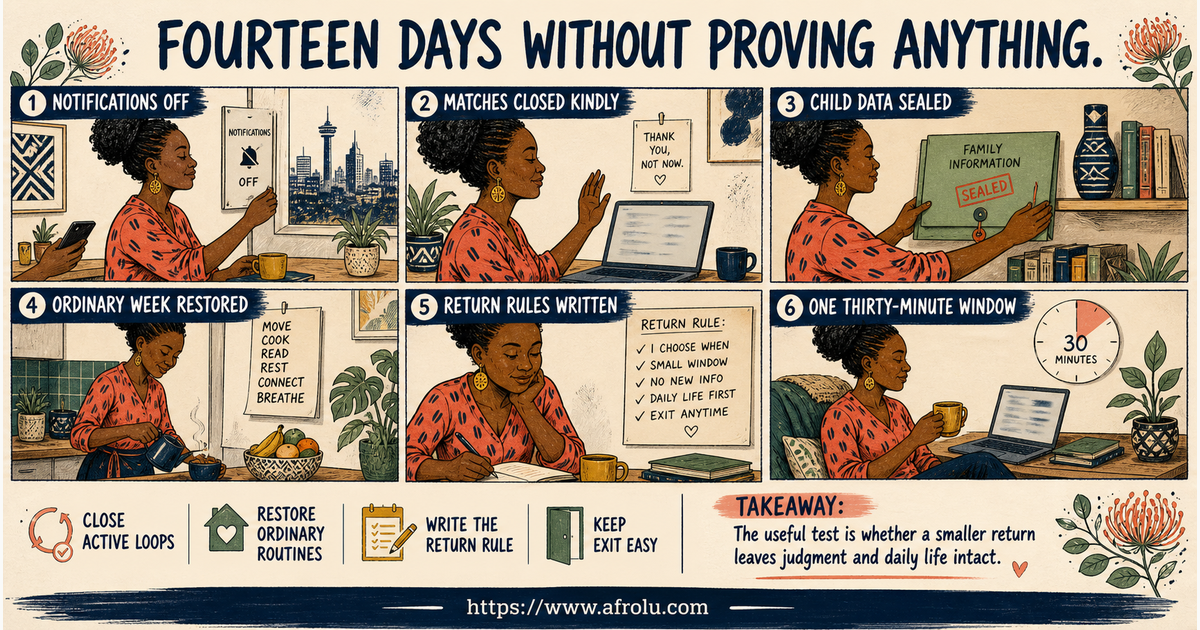
Wanjiku, a fictional 37-year-old Nairobi parent, notices that late-night checking has made replies vague and safety planning negotiable. She closes active loops, seals family information, pauses for fourteen days and restores ordinary routines. Her measured return uses one thirty-minute Sunday window and two conversations at most. The outcome is restored choice, not an immediate match.
The three-budget reset desk
Protect attention, dating effort and safety without grading your worth
Nia separates app-related strain into three practical budgets and gives a Nairobi parent an optional pause-and-return design.
Record repeated behaviour and daily effect, close current loops, restore ordinary life, then review desire and safety before any smaller return.
Attention
Choose when dating receives focus and when the phone returns to ordinary life.
Dating work
Keep only the conversations that can receive specific and honest effort.
Safety
Never reduce family privacy, money, verification, venue or exit rules to save energy.
Return is optional
Extend, return smaller, date elsewhere or seek support without treating one door as success.
Start with language that does not diagnose
Dating-app fatigue can be real without turning 'burnout' into a medical verdict
A parent can feel depleted, cynical, distracted or reluctant to open a dating app. Those experiences matter even though they do not establish a health condition. The most useful first record is concrete: how often the app is opened, which ordinary duties are displaced, what emotion follows a session and whether safety rules become harder to maintain.
One discouraging evening is not the same as a repeated pattern. A poor conversation, an empty match queue or a rude reply may deserve rest and a boundary without explaining the whole relationship with apps. Look across several sessions and contexts. Ask what changed in sleep, concentration, parenting presence, work, spending, self-talk and willingness to meet safely.
The same amount of app time can affect two adults differently. Recent research includes small samples, cross-sectional designs and mixed findings, while a 2026 meta-analysis reports associations rather than proof that swiping caused an individual outcome. This page therefore does not prescribe a universal daily limit or claim that deleting an app treats anxiety, depression or compulsive behaviour.
Use the guide as a decision tool. Reduce prompts when attention is fragmented, close active conversations respectfully when you cannot carry them, pause discovery when dating work has become resentful and seek qualified care when distress is persistent, overwhelming or interfering with daily life. Immediate safety concerns require a safety response, not a wellness experiment.
Separate three kinds of capacity
Attention, dating work and safety need independent budgets
ATTENTION is the ability to choose when to open, read and reply rather than reacting to every prompt. A Nairobi parent may already move between work messages, school administration, care arrangements, transport and household decisions. Put dating inside a chosen window. Notifications can be silenced without hiding the app or punishing a match.
DATING WORK is the effort of screening profiles, remembering conversations, proposing plans, declining poor fits and recovering from rejection. Limit the number of active conversations to what can receive truthful attention. Do not match because an empty queue feels like failure. Closing a conversation kindly is cleaner than keeping a person as background reassurance.
SAFETY CAPACITY is the ability to verify ordinary identity context, refuse third-party links, protect a child's details, keep money separate, choose a staffed public meeting and control the return. Tiredness is a reason to simplify or postpone. It is never a reason to share a home address, school, caregiver, live location, password, identity record or payment.
The budgets can move independently. You may have energy for one respectful conversation but no capacity for new discovery. You may enjoy messaging and still lack a safe meeting plan. You may pause apps while staying open to an introduction through friends. The right plan is the smallest one that keeps ordinary life and every safety rule intact.
Follow one parent through a real pause
Wanjiku closes five loops before deciding whether to return
Wanjiku, 37, lives and works in Nairobi and parents a school-age child whose details remain private. After several weeks of late-night swiping she notices that she opens the app between work messages, answers vaguely, resents polite questions and nearly agrees to a private pickup because arranging transport feels tiring. She does not call herself broken. She recognises that the system has outgrown her present capacity.
She chooses fourteen days because it is long enough to observe two weekends and short enough to feel reviewable; it is not a clinical prescription. She tells two active matches: 'I am pausing new dating for two weeks and cannot carry this conversation well.' One accepts the closure. David, 40, asks whether she wants him to wait. She says no promise is required and closes the chat kindly.
Wanjiku turns off discovery prompts, removes the app from the first phone screen and does not replace checking with surveillance of old profiles. She restores bedtime, sees friends, completes ordinary family tasks and writes four non-negotiables: no child details, no money, public first meetings and independent transport. She also records that she still wants companionship; she simply does not want the current volume.
On day fourteen she feels curious rather than compelled. She returns for one thirty-minute Sunday window, keeps no more than two active conversations and ends the session on time whether or not a match appears. The smaller plan works for a week. If it stops working, she will pause again. The success is restored choice, not permanent app attendance.
Read twelve signals without a total score
Some signals suggest a smaller session; others require a stop
ATTENTION signals include opening without deciding, checking during valued time, rereading matches after the useful information is gone and feeling unable to stop at the planned end. Try a smaller window, remove prompts or pause discovery. If the pattern remains distressing or impairs daily functioning, qualified support can help assess the wider context.
DATING-WORK signals include vague replies sent from obligation, resentment toward ordinary questions, matching without genuine interest and keeping several people waiting because closing feels uncomfortable. Reduce active conversations and write clear endings. A disappointing response does not mean the pause failed; it shows that another adult is free to choose too.
SAFETY signals are different. Stop when a match requests money, sends a payment or verification link, pursues child details, demands a home pickup, pressures a private venue, asks for passwords or identity documents, retaliates against a no or uses multiple accounts to regain access. Fatigue may explain why the signal was almost missed; it does not make the conduct less important.
Positive signals matter as well: sessions end when planned, ordinary life remains available, replies are specific, a no is respected and meeting logistics remain public and independent. Continue only while those conditions hold. Do not turn a good week into a permanent rule; capacity changes with work, care, health and the quality of actual matches.

Do not let tiredness make privacy, money or meeting rules negotiable.
Use language that works on a tired day
Ten short sentences can close loops without a long defence
For a pause: 'I am pausing new dating and closing this chat.' 'I cannot give this conversation proper attention.' 'I will not ask you to wait.' Those lines state capacity and release the other adult from an implied promise. A pause is not a tactic for making someone chase or a test of whether they care.
For family privacy: 'I share my availability, not my child's details.' 'I arrange care privately.' 'I do not use home pickup for a first meeting.' A parent may discuss parenthood and time constraints without naming a child, school, caregiver, routine, precise neighbourhood or live location. Repeated pursuit after one no is evidence.
For online safety: 'I do not send money or use match-sent payment links.' 'I keep early contact on the platform.' 'I will verify the venue independently.' FTC and FBI guidance support refusing money requests and suspicious verification schemes. Ordinary identity context can be checked without sharing passwords, financial information or sensitive documents.
For return: 'I check this app once on Sunday.' 'I keep two conversations at most.' 'I am ending here because the plan changed.' State only rules you control. Another adult may decline the pace. That mismatch can close the contact cleanly. If a boundary produces threats, stalking or retaliation, preserve useful evidence and seek appropriate support instead of continuing the debate.

Use one complete sentence; another adult's response becomes evidence.
Review the experiment without rewarding return
Pause, extend, return smaller, date elsewhere or seek support are equal options
Start with ATTENTION. Can you decide when dating receives focus and stop when the window ends? Then check SLEEP and ORDINARY LIFE: are work, friendships, caregiving, food, movement and rest less crowded by checking or post-session rumination? Improvement may support a small return, but it does not create an obligation to return.
Check SAFETY RULES next. Can you still refuse money, off-platform links, child questions, private first meetings and controlled transport even when a match is appealing? If any rule feels negotiable because you fear losing the connection, extend the pause and speak with a trusted person. Safety capacity must not be the price of dating momentum.
Finally ask about DESIRE. Curiosity sounds like choosing to meet people while accepting uncertain outcomes. Fear of missing out sounds like opening because silence feels intolerable or because leaving the app seems like romantic defeat. Neither feeling is a diagnosis, but they suggest different designs. Curiosity may fit one small window; compulsion or distress deserves more distance and possibly qualified support.
Choose one outcome for the next week: extend the pause, return with written limits, prefer offline introductions or seek support for persistent distress. Record what would make you change course. Do not buy a subscription as proof of seriousness or reactivate because a discount expires. A commercial prompt is not a clinical assessment or a relationship deadline.

Return only if the smaller plan protects the life you already have.
Know when self-management is not enough
Persistent impairment and external danger need different kinds of help
Seek qualified health support when distress is persistent, overwhelming or interfering with sleep, work, parenting, eating, movement or ordinary functioning. Mention the full context rather than asking an app label to explain everything. A clinician can assess symptoms and suitable care; a dating guide, screen-time number or fourteen-day experiment cannot.
Use platform reporting, trusted support and appropriate local legal or emergency services when another adult threatens, stalks, impersonates, extorts, tracks, coerces or keeps contacting after access is withdrawn. Preserve relevant messages and transaction details only when safe. Do not meet to obtain proof, recover money or force a confession.
If money was sent, contact the payment provider promptly and use official reporting routes. If a match sends a verification or payment link, do not enter financial or identity details. Navigate to the platform's own help resources independently. A polished profile, daily affection or video call does not turn a money request into a safe exception.
A parent can also ask a trusted adult for practical support without sharing the whole dating history. The request might be to hold the end time, accompany a public arrival or listen while options are sorted. Support should expand choice, not take control. The reader remains free to pause indefinitely, date differently or stop dating apps altogether.
Eight Nairobi parent moments where app load changes the next choice
A work reply becomes an automatic swipe
Wanjiku opens a dating app each time she clears a work notification, then loses the purpose of both sessions.
Move dating to one chosen window and silence prompts elsewhere.Four good people receive vague replies
The problem is not that every match is wrong; the active queue exceeds the attention available for honest conversation.
Close or pause conversations until the number fits real capacity.A warm match asks for the child's school
Fatigue makes a detailed answer feel easier than holding the boundary, but the information is unnecessary for an early match.
Share adult availability only and record whether the no is respected.Transport planning feels like too much
A match offers to collect Wanjiku at home, converting tiredness into loss of address and exit control.
Postpone or arrange independent transport; do not trade safety for convenience.Day three feels unusually quiet
Silence after prompts are removed can feel like evidence that the pause was a mistake even while ordinary attention is returning.
Let the review date arrive without reopening to relieve one feeling.A discount claims the chance will expire
Commercial urgency arrives while Wanjiku is deciding whether the service fits her life.
Ignore the timer and spend only after the non-commercial decision is clear.David does not want a fortnight gap
His decision is disappointing but does not make the pause wrong or his preference abusive.
Release the contact without persuading either adult to abandon capacity.One Sunday window ends without a match
The return still succeeds because Wanjiku stops on time and keeps her attention and safety rules intact.
Judge the system by choice and function, not by immediate romantic reward.Ten signs across attention, dating work and safety capacity
Opening the app without a conscious decision or clear task
Checking during work, caregiving, rest or valued conversation
Keeping more active chats than can receive truthful attention
Sending generic replies while resenting ordinary questions
Treating every low-match session as a judgment of personal worth
Staying because a subscription, streak or discount feels sunk
Considering child disclosure because holding privacy feels tiring
Considering private transport because planning an exit feels tiring
Ignoring money or verification-link pressure to avoid another reset
Feeling persistent distress or daily-life impairment that merits qualified support
Review the next app decision through ten separate questions
| Situation | What it may mean | What to do next |
|---|---|---|
| Can the session begin and end by choice? | Fits: A written window is easy to keep. Needs review: The end slips once and can be redesigned. Stop: Checking repeatedly overrides work, care or sleep. | Reduce prompts and pause discovery if the window will not hold. |
| Can each active conversation receive specific attention? | Fits: Replies reflect the actual person and question. Needs review: The queue needs reducing. Stop: People are kept as reassurance without genuine engagement. | Close excess conversations honestly before matching again. |
| Does a pause feel like a free option? | Fits: The account can be hidden or left without panic. Needs review: FOMO is present but choices remain. Stop: Commercial or emotional pressure makes stopping feel impossible. | Remove the prompt and seek support if distress persists. |
| Are child details still protected? | Fits: Only adult availability is shared. Needs review: A question is redirected once. Stop: The match pursues school, caregiver, routine or address. | Stop disclosure and reduce access; escalate if contact persists. |
| Do money rules survive attraction? | Fits: No money or match-sent payment links are used. Needs review: A request is refused and reviewed. Stop: Urgency, investment or verification charges continue. | Stop payment, verify independently and use official reporting routes. |
| Is a first meeting independently leaveable? | Fits: The venue is staffed and each adult controls transport. Needs review: A public detail needs reconfirming. Stop: Home pickup, hidden venue or blocked return is required. | Decline or leave; do not use tiredness as a reason to surrender exit control. |
| What follows one boundary? | Fits: The answer is accepted without punishment. Needs review: A misunderstanding is repaired once. Stop: Threats, ridicule, new accounts or surveillance follow. | End access and seek appropriate safety support. |
| Does the smaller system protect ordinary life? | Fits: Sleep, work, friends and caregiving remain available. Needs review: One area needs another adjustment. Stop: Daily functioning remains persistently impaired. | Extend the pause and consider qualified health support. |
| Is return driven by curiosity or urgency? | Fits: Uncertain outcomes feel acceptable. Needs review: FOMO can be named without obeying it. Stop: Opening is used to stop intolerable distress. | Stay paused and assess the wider distress with suitable support. |
| Can not returning be a complete answer? | Fits: Offline dating or no dating remains valid. Needs review: Identity is still tied to app participation. Stop: Return is framed as the only route to worth or partnership. | Choose the life-protecting option without making app use a duty. |
Ten lines for pausing, privacy, money, meetings and return
“I am pausing new dating and closing this chat.”
“I cannot give this conversation proper attention.”
“Please make your own dating choices while I pause.”
“I share availability, not my child's details.”
“I arrange my own first-meeting return.”
“I do not send money to an online match.”
“I will use the platform's official help page myself.”
“I check this app once on Sunday.”
“I keep no more than two active conversations.”
“You repeated this after my no, so contact ends.”
Know the difference
Dating-app fatigue, disappointment, unsafe pressure and occupational burnout need different responses
Repeated app-related load is affecting attention, willingness or daily life, so discovery may be reduced or paused without making a diagnosis.
One disappointing session, an external safety threat or work-related burnout requires a different record and response.
Name the experience precisely enough that rest, safety action and professional support do not replace one another.

Name the experience carefully so the next action fits the evidence.
Separate four nearby experiences before acting
| Type or dimension | What it describes | Best next question |
|---|---|---|
| Dating-app fatigue | Repeated dating-platform use feels depleting or crowding, but the phrase is descriptive rather than a diagnosis. | Reduce volume, pause and review function. |
| One disappointing session | A hard interaction or quiet queue has occurred without a repeated load pattern. | Rest, close the loop and avoid forecasting the whole future. |
| Ordinary rejection | Another adult declines or does not reciprocate without pressure, threat or deception. | Allow the no and protect self-respect. |
| Poor product fit | The platform's audience, features, cost or pace does not suit the reader. | Change tool or dating channel after needs are clear. |
| Unsafe pressure | Money, tracking, child pursuit, threats, coercion or blocked exit comes from another adult. | Protect access, preserve evidence and seek appropriate help. |
| Persistent distress | Symptoms or impairment continue beyond a dating-session design problem. | Seek qualified health assessment rather than self-diagnosing. |
| Occupational burnout | WHO limits the ICD-11 concept to chronic workplace stress, not dating. | Address the work context with appropriate support. |
| Chosen app-free dating | The adult prefers introductions, events, community or a period without dating apps. | Treat the choice as complete, not as failed recovery. |
Use the three-budget reset in six practical moves
Describe before diagnosing
Record checking, emotion, displacement and safety capacity without applying a clinical label.
Separate three budgets
Attention, dating work and safety can each require a different limit.
Close active loops
Tell current matches what is happening instead of leaving an indefinite waiting room.
Protect the family wall
Share adult availability while keeping child, home and care information sealed.
Test one smaller return
Use a chosen window and small conversation cap without promising permanent app use.
Escalate the right problem
Qualified care addresses persistent distress; safety support addresses threatening conduct.
Questions for attention, dating work, safety and return
Choose a few prompts that fit the moment. This is a reference library, not a list to complete.
Attention questions
Observe the actual loop.
- When did I choose to open?
- What task was displaced?
- How did the session end?
- What feeling followed?
- Could I stop at the written time?
Dating-work questions
Fit volume to honest effort.
- How many chats can I remember?
- Which reply is obligation?
- Who needs a clean closure?
- Do I want new discovery?
- What would a smaller queue be?
Safety questions
Keep the floor unchanged.
- Is family data sealed?
- Are money and links refused?
- Is identity context checked independently?
- Is the venue staffed?
- Can I leave without permission?
Return questions
Do not reward reopening by default.
- Has ordinary life returned?
- Is curiosity present?
- What is the one window?
- What is the stop condition?
- Would staying off be better?
What current terminology, research and scam guidance can support
WHO reserves burnout for the occupational context
The ICD-11 clarification describes burn-out as an occupational phenomenon and says it should not be applied to other areas of life. This guide therefore uses dating-app fatigue as colloquial descriptive language.
Evidence limit: The source does not assess a reader's health or determine which support is suitable.
A 2026 meta-analysis reports association and heterogeneity
The review of twenty-seven studies found several small-to-moderate mental-health correlations while noting considerable heterogeneity and gaps in longitudinal and mechanistic evidence. That supports caution about universal claims.
Evidence limit: Group-level associations do not prove that app use caused one person's distress.
A one-week pilot found a mixed pattern
The small ecological-momentary study used objective app measures and found that greater time predicted craving while notifications related to improved mood and self-esteem in that sample, illustrating that app experiences are not uniformly negative.
Evidence limit: The convenience sample had twenty-two participants and cannot set a population rule.
A systematic review finds inconsistent problematic-use concepts
The 2025 review examined how problematic online dating has been defined and measured, supporting a focus on actual behaviour, conflict and impact rather than calling every frequent user addicted.
Evidence limit: A review of research definitions is not a clinical test for a reader.
FTC guidance keeps funds outside online romance
FTC consumer guidance describes romance scammers building trust through dating or social platforms before asking for money and advises against sending cash, gift cards, wires or cryptocurrency to an online love interest.
Evidence limit: The U.S. source is general scam guidance and cannot determine whether every profile is genuine.
FBI guidance warns about fake dating verification services
The FBI alert describes fraudsters moving users off-platform and directing them to supposed free verification pages that collect payment and identity information or trigger recurring charges.
Evidence limit: The alert supports independently navigating official help; it does not make every ordinary safety question fraudulent.
Six ways a useful pause becomes another pressure system
Diagnosing from screen time
Minutes alone cannot explain an individual outcome. Repair: record context, effect and repeated pattern.
Using a pause to provoke pursuit
Rest becomes a hidden test. Repair: close conversations and release the other adult.
Replacing swiping with surveillance
Old profiles keep the loop active. Repair: remove the access cue and return to ordinary life.
Trading privacy for convenience
Tiredness opens child or home information. Repair: postpone rather than lower the safety floor.
Buying before deciding
A timer turns fatigue into sunk cost. Repair: settle the non-commercial choice before any subscription.
Making return the prize
App use becomes proof of recovery. Repair: allow pause, offline dating or no dating as complete outcomes.
Use a reviewed resource that matches the decision
This guide focuses on the relationship decision, so it does not rank dating apps. Check current prices, safety tools, and local availability before choosing a service.
Explore the guide library
Show more related guides
Continue with Afrolu
Show more Afrolu guides
Official terminology, dating-app research and fraud guidance
Afrolu reviewed these health, research, safety, or public guidance resources while editing this page. They support the behaviour and safety guidance; they do not diagnose any individual described by a reader.
Online-dating fatigue questions for a Nairobi parent
Is dating-app burnout a medical diagnosis?
No. WHO describes burn-out as an occupational phenomenon and says the term should not be applied to other areas of life. This guide uses dating-app fatigue as ordinary language for repeated depletion, cynicism, crowding or reluctance linked to app use. Persistent, overwhelming or impairing symptoms deserve assessment from a qualified professional rather than self-diagnosis.
How long should a parent take a break from dating apps?
There is no universal clinically proven pause length. Choose a reviewable interval that removes at least one normal cycle of prompts and gives you enough ordinary life to observe attention, sleep, desire and safety capacity. Wanjiku uses fourteen days as an illustration, not a prescription. Extend, shorten or stop permanently according to real function and choice.
Should I tell matches before I pause?
Close active conversations when it is safe and practical: say that you are pausing and cannot carry the chat well, then release them from waiting. You do not owe a health disclosure or return date. If a person has threatened, harassed or ignored boundaries, prioritise access controls, evidence and suitable support instead of a courtesy message.
Can I pause without deleting my account?
Usually a platform pause or hide control differs from uninstalling, cancelling renewal and deleting an account. Current controls vary, so use the platform's official help and confirmation screens. Choose the action matching your goal: fewer prompts, no discovery, no device access, no billing or full closure. None of those actions creates a relationship agreement.
How many conversations should I keep?
Use the smallest number that can receive specific, truthful replies without crowding sleep, work, caregiving or safety checks. Two is Wanjiku's experiment, not a universal cap. Reduce again when replies become vague or resentful. More matches are not automatically better, and a quiet queue is not evidence that your dating future is failing.
What family information should stay private?
Keep a child's name, image, school, caregiver, routine, location, health details and home address outside early dating. Share only adult logistics, such as the time you are available. Do not provide proof of care arrangements. Persistent child questions after one clear boundary are an external signal, not a test of whether you are being too cautious.
What if a match asks me to pay for verification?
Do not use the link or enter financial and identity information. The FBI has warned about fake dating-verification services that can create recurring charges and collect personal data. Navigate independently to the platform's official safety or help page. Refuse money transfers, gift cards, cryptocurrency and investment requests from online love interests.
How do I return without falling into the same pattern?
Write one opening window, one stop time, an active-conversation cap and the unchanged safety floor. Turn off prompts outside the window. End the session on time even if no match appears. Review after a week. A small return is optional; extending the pause, dating through other channels or remaining off apps are equally complete choices.
When should I seek professional help?
Seek qualified local health support when distress is persistent, overwhelming or interfering with daily functioning, including sleep, work, parenting, eating or ordinary relationships. Share the wider context rather than asking a screen-time number to diagnose you. If there is immediate danger, stalking, coercion or fraud, use appropriate safety, platform, payment, legal or emergency support.
Does taking a break mean I am giving up on partnership?
No. It means the current method or volume does not fit present capacity. Partnership goals can remain while one app, all apps or dating itself pauses. Return only if you choose it and the smaller plan protects ordinary life. A subscription, age worry, match queue or another person's impatience does not turn app participation into a duty.
One thing to do now
Return choice before returning to discovery
Continue smaller while app use begins and ends by choice, replies remain specific and every safety rule holds. Pause when volume, checking or resentment crowds ordinary life. Seek qualified care for persistent overwhelming impairment. End access and use suitable reporting or emergency support for money pressure, fraudulent links, child pursuit, tracking, threats, coercion or blocked exit.