Three-clock signal room · parent distance dating
Make Long-Distance Dating Lighter Without Exposing Family Life
A sourced parent guide to online-dating fatigue: agree low-pressure distant contact, protect child privacy, plan calls, avoid money pressure and pause safely.
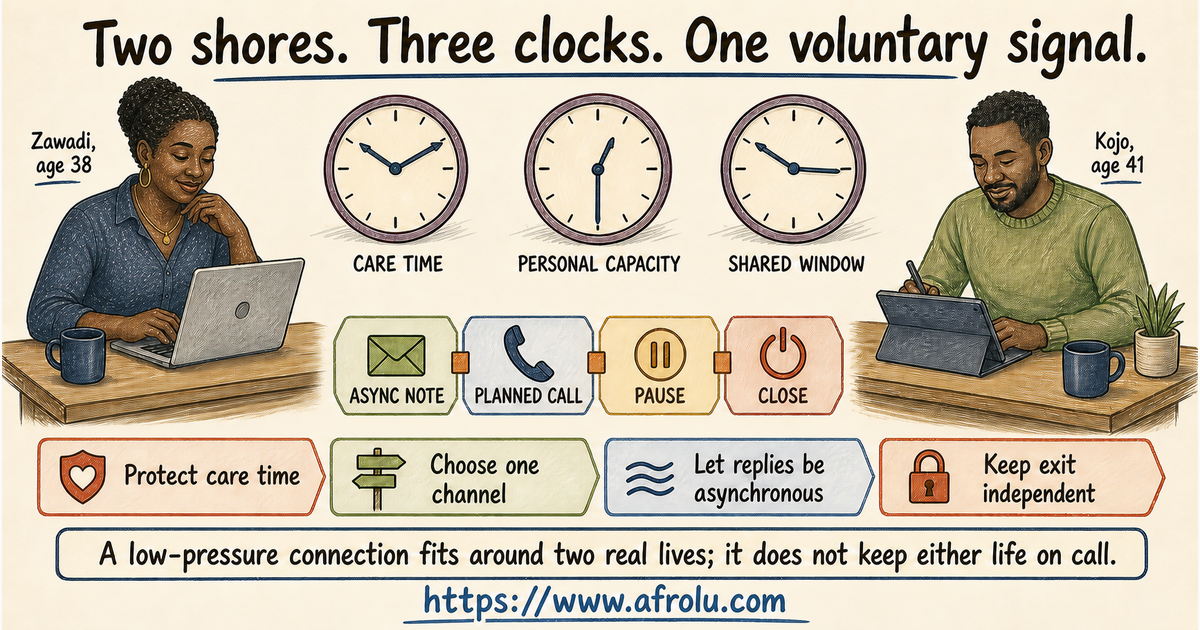
Distance needs a shared signal, not permanent access.
Written and edited by Nia Kato · Profile Advice Editor
Read three clocks separately: CARE TIME, PERSONAL CAPACITY and SHARED WINDOW. Remove the unwanted app task, offer one asynchronous note or translated bounded call, keep child and household details private, and leave visits, costs, relocation, exclusivity and intimacy as separate adult decisions. Then KEEP ONE SIGNAL, CHANGE RHYTHM, PAUSE APPS, CLOSE THREAD, SEEK CARE, SECURE SYSTEMS or SEEK PROTECTION according to current evidence.
Dating wellbeing · Parents Returning To Dating
How can a parent reduce app and communication load across distance without hiding interest, exposing a child or household, paying for proof, or promising constant access?
Online-dating burnout is used here only as non-diagnostic shorthand for unwanted discovery, matching, messaging, verification, call-planning and imagined-travel work. Parent is life context, low pressure is an explicit answerable rhythm, and long-distance is a geographic constraint—not a duty of continuous digital access or a promise to move.
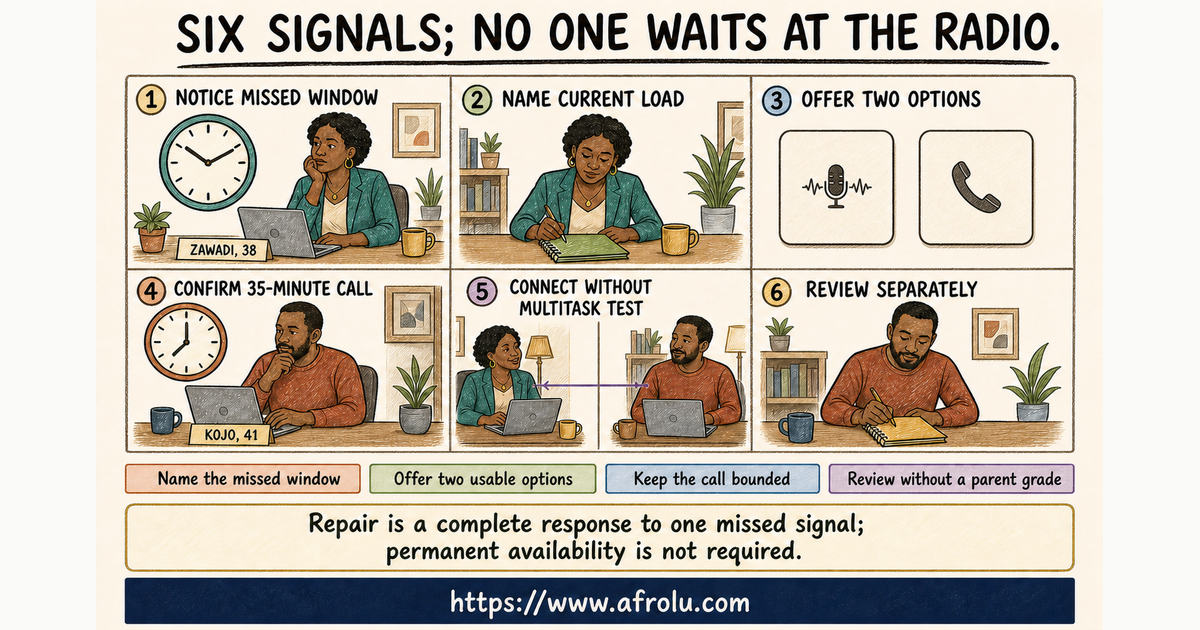
Zawadi, 38 in Dar es Salaam, and Kojo, 41 in Accra, are fictional adult parents. A missed call becomes a smaller two-option offer, one bounded conversation and two private reviews. No child, household proof, travel promise or real person appears; either adult may still decide the distance does not fit.
The parent-distance quiet-signal room
Read care time, present capacity and shared contact on separate clocks
Nia treats app fatigue as a task problem, parenthood as private life context and long distance as geography rather than a demand for permanent access.
Locate the unwanted task, translate one usable offer, protect both households and match the next route to present evidence.
Protect care
Offer adult availability without disclosing child, caregiver or household proof.
Check capacity
Choose discovery, one signal, a pause or no dating task today.
Translate contact
Write both local times, one channel, a duration and an ending.
Choose the route
Keep, revise, close, seek care, secure systems or seek protection.
Start with the quiet phone
Treat an unwanted dating task as a task, not evidence that a parent has failed at connection
When the phone goes quiet, a parent can still be carrying several kinds of noise: discovery prompts, unfinished introductions, reply expectations, call scheduling, identity questions and imagined travel. This page calls that online-dating burnout in everyday language only. The World Health Organization limits its formal burn-out description to the occupational context, so the phrase here neither diagnoses an adult nor explains every change in mood, sleep or concentration.
Parent means an adult has care relationships and privacy duties that shape availability. It does not mean overworked, less romantic, automatically serious, unable to travel or obliged to disclose a household. This guide never asks for a child's name, photograph, voice, school, routine, other caregiver, care agreement or location. Those details are not credentials for a new match, and no child is part of the fictional dating scenes.
Low-pressure contact is an explicit arrangement in which messages, calls and decisions have enough space for either adult to answer honestly, counter the offer or decline. It is not a code for low interest, vague effort or indefinite waiting. Long-distance means geography makes frequent in-person contact impractical. It does not create daily-message duties, exclusivity, travel spending, relocation plans or a right to enter either household.
Begin with the narrowest unwanted task. Is searching the burden, are too many threads open, does a call window collide with care, or is uncertainty about distance turning every message into a decision about the future? Remove or resize that task before judging dating as a whole. Severe or persistent impairment across ordinary life deserves qualified local care; threats, tracking, fraud or defeated exit deserve direct protection rather than a better schedule.
Read three clocks before sending
Keep care time, personal capacity and the shared distance window independently answerable
CARE TIME contains the periods already committed to responsibilities and the buffer around them. It can be described as unavailable without being proved through private family information. PERSONAL CAPACITY asks whether the adult currently wants discovery, a message, a voice note, a call or no dating task. A free hour on a calendar is not automatically available energy, and another person's disappointment does not convert it into a romantic debt.
The SHARED WINDOW is made from two offers, including time zones. ‘Sunday evening’ is incomplete when the adults live on different clocks; a useful invitation names both local times, the channel, the likely duration and when confirmation ends. The window can hold an asynchronous note instead of a live call. If neither option fits, the honest result may be a rhythm mismatch rather than neglect or lack of care.
Choose one signal for one purpose. A text can carry a brief update; a planned call can hold a deeper question; a private note can help each adult review fit. More channels do not automatically create more closeness. Research about remote communication is mixed and population-limited, so the couple's stated preferences and observed responsiveness matter more than a universal rule about daily texts or video dates.
Put PAUSE and CLOSE on the same board before connection begins. A pause can stop discovery while one conversation remains, suspend all app activity or end without a return date. Closure can name the romantic route and the channels that must stay closed. If a person responds through new accounts, relatives, work contacts or household approaches, the problem has moved beyond ordinary timing and requires access protection.
Let one missed call become usable evidence
Zawadi and Kojo repair a fictional distance signal without placing either household on display
Zawadi is 38, a parent in Dar es Salaam, and has stopped enjoying the late discovery sessions that once felt hopeful. Kojo, 41 and also a parent, lives in Accra. Their app exchange has lasted long enough for one planned call but not for exclusivity, travel or family access. On Wednesday, Zawadi misses their window because ordinary care runs late; she gives no child detail and sends no apology performance.
The next morning she says that her current app load is too large and asks whether Kojo wants either an asynchronous voice note or a Sunday call. She gives the proposed call as 18:00 to 18:35 in her time and translates it into his. Kojo accepts the voice note now and the call later. He does not demand a live explanation, household proof or continuous messaging until then.
During the call, both adults give attention instead of testing whether the other can multitask through care or work. They discuss what low pressure means: one planned call when practical, asynchronous notes that carry no same-day reply duty, and direct notice when interest changes. They leave visits, money and exclusivity unanswered because a communication agreement cannot decide those separate questions.
Afterward, Zawadi notes that removing discovery returned more capacity than shortening the conversation. Kojo notes that he can use an asynchronous rhythm without reading silence as rejection. Either may still decide the geography is unsuitable. The successful part of the story is the repair: a missed window became a smaller offer, and the offer produced evidence without exposing a child or borrowing a future.
Sort sixteen markers before deciding what distance means
Separate optional app load, shared rhythm, geographic reality and direct safety facts
LOAD markers ask whether discovery ends, stale threads close, rest returns and care details remain private. App activity is optional work, not a second household duty. If reducing discovery helps while one wanted conversation stays comfortable, the specific load has been located. If dating itself is unwanted, closing all routes is a complete answer rather than a failure to optimise the profile.
RHYTHM markers ask whether asynchronous contact is actually agreed, calls have beginnings and endings, missed windows can be repaired, and silence is not punished. Reciprocity does not mean identical message counts. It means both adults can make usable offers, receive counters and carry some of the planning. A rhythm that suits one adult but repeatedly harms the other may be incompatible even when neither behaves badly.
DISTANCE markers cover consistent location claims, optional travel, independent costs and the absence of implied relocation. A video call can reduce one uncertainty but cannot verify every biography, document or intention. Do not send money for a ticket, visa, emergency, investment or verification process because contact has been warm. Any genuine future travel should use independently checked bookings, separate accommodation and an exit the traveller controls.
SAFETY markers sit outside a relationship total. Requests for child access, passwords, live location, sexual images, money or account codes change the problem. So do threats, stalking, impersonation, image abuse and contact after closure. When safe, preserve useful records and secure accounts; use current platform, financial, survivor, legal or emergency resources for the relevant country. Do not keep negotiating merely to prove the correct label.

A warm signal cannot cancel money pressure, tracking or family intrusion.
Send a complete signal instead of an availability performance
Use twelve scripts for intent, asynchronous contact, privacy, visits, consent and closure
INTENT can stay modest: ‘I am open to learning whether a relationship fits, without rushing contact.’ ASYNC can say, ‘I may reply tomorrow; delay is not a hidden test.’ WINDOW should translate both clocks and include an ending. MISSED CALL can acknowledge the event and offer one repair without supplying evidence about a child, another caregiver or a private household disruption.
CARE PRIVACY deserves a complete sentence: ‘I share availability, not children's or care details.’ LOCATION can remain at city level until more is genuinely needed. VIDEO can be requested but not demanded as a loyalty test, and no recorded or sexual content is implied. Refusing a channel may leave uncertainty; it does not make invasive verification acceptable.
VISIT language keeps a trip hypothetical until both adults freely choose a verified plan. COST language says each adult controls bookings and ordinary spending, with no romantic transfer. CONSENT language covers every adult physical and digital act separately, including sexual conversation and images. Distance, anticipation, travel cost and prior affection do not supply a current yes or make a changed answer unfair.
PAUSE can be open-ended: ‘I am stepping away from app contact and will not set a return date.’ CLOSE should be channel-aware: ‘I am closing this contact; keep family and other routes closed.’ A boundary describes the speaker's action; it does not need agreement. For coercion, stalking or threats, use a risk-aware plan rather than delivering a polished final line alone.

A useful signal states what is available without explaining the whole household.
Do not confuse message heat with geographic fit
Compare app-task fatigue, low-pressure rhythm, idealisation, fraud and coercive control accurately
APP-TASK FATIGUE is the unwanted administration of finding and maintaining possibilities. PARENTING CONSTRAINT is a real limit on time or privacy. LOW-PRESSURE RHYTHM is a mutually understood contact agreement. LOW INTEREST means the person does not want the connection. None is a mental-health diagnosis, and none proves that a parent is unavailable for every future relationship.
DISTANCE MISMATCH appears when usable contact, likely visits, cost or location possibilities do not fit both adults. It can end a warm connection without fault. IDEALISATION is an editorial description here for a person or future imagined beyond current evidence; it is not a diagnosis or proof of deception. Test identity, communication, visit feasibility, cost and future-location assumptions separately rather than treating message volume as geographic fit.
ROMANCE FRAUD is not simply a distant person being affectionate or unable to travel. It involves deception used to obtain money, credentials, identity material or other value. Stop transfers, secure exposed accounts and report through current relevant channels. COERCIVE CONTROL involves a pattern that narrows autonomy through monitoring, isolation, threats, economic control or defeated exit; it needs specialist safety framing, not a communication-efficiency fix.
WIDER IMPAIRMENT belongs on another route when sleep, concentration, mood or daily functioning remains seriously or persistently changed across settings after dating tasks shrink. A guide cannot diagnose the cause or set a care timetable. The narrow wording matters: redesign app work for fatigue, negotiate rhythm for a fit question, end unwanted contact for low interest, verify for uncertainty, and bypass ordinary review for direct danger.
Close the signal log with one proportionate action
Choose connection, redesign, rest, care or protection without ranking the outcomes
KEEP ONE SIGNAL when the conversation remains wanted, the low-pressure rhythm fits and ordinary safety boundaries hold. CHANGE RHYTHM when both adults still want contact but the channel, time or frequency does not work. Make the revision specific, observe one real cycle and reassess. Do not add daily tasks merely to demonstrate that a long-distance connection is progressing.
PAUSE APPS when discovery or communication needs to stop. The pause may last a day, a season or indefinitely, and it need not promise a comeback. CLOSE THREAD when interest, geography or rhythm no longer fits. A parent can end kindly without supplying household evidence, a burnout diagnosis or a proposal for friendship. Closure is complete even when the other adult wanted another outcome.
SEEK CARE when serious or persistent changes extend beyond the app and ordinary relationship choices. Use qualified support appropriate to the person's location and needs. SECURE SYSTEMS when passwords, accounts, devices, funds or identifying information may be exposed. Change access through channels you control, contact relevant providers promptly and avoid relying on instructions supplied by the romantic contact.
SEEK PROTECTION for threats, stalking, image abuse, child approaches, coercion or an exit that is being defeated. Consider whether blocking or confrontation could change risk, preserve useful evidence when safe, and use current local specialist or urgent help. Then close the log. The board works when Zawadi, Kojo or any reader leaves with more voluntary choice—not when an app receives more hours.

The right next signal may be quieter, later or none at all.
Eight moments when a distant signal borrows time, privacy, money or exit
The second-shift search
After care and work, optional profile browsing fills the only unscheduled adult hour while no new conversation is wanted.
Close discovery and keep rest or one chosen thread.The silent-evening verdict
A delayed reply is treated as proof that the parent is uninterested, hiding something or incapable of distance.
Name the asynchronous agreement once and reject the test.The unconverted invitation
A caller says Sunday evening without translating time zones, duration or a confirmation point.
Offer both local times and an ending, or release the call.The care-schedule proof
A match asks for a child's routine, caregiver information or household photo to verify limited availability.
Share only abstract availability and close the family route.The imagined relocation
Warm conversation is read as agreement that one adult will eventually move and merge households.
Return to the present contact agreement and leave relocation undecided.The visit fund
A first meeting is repeatedly tied to a ticket, visa, emergency, verification or accommodation transfer.
Send nothing; verify and report through independent official channels.The intimate proof
Distance is used to request sexual images, recordings or live access as proof that the relationship is real.
Decline; secure content and accounts, and escalate threats or sharing.The family-channel return
After romantic closure, messages arrive through a new account, relative, caregiver, workplace or household route.
Preserve useful evidence, protect access and seek fitting local support.Sixteen markers across app load, shared rhythm, distance reality and safety
Discovery ends — the chosen search window closes; remove prompts that restart optional work.
Threads can finish — an unwanted possibility is closed; courtesy does not require permanent access.
Rest returns — empty adult time remains empty; do not fill every quiet hour with dating administration.
Care stays private — availability is abstract; never offer child, caregiver, school or household proof.
Async is agreed — neither adult assumes a same-day reply; name what delay usually means.
Calls have edges — both local times, channel, duration and confirmation make the plan usable.
Misses can repair — one missed window receives a proportionate new offer; avoid loyalty trials.
Silence is not punished — no guilt, accusation or alternate-channel pursuit follows an agreed gap.
Location stays consistent — broad geography and ordinary facts align; verify important claims independently.
Visits remain optional — interest does not become a booking; preserve separate travel and lodging choices.
Costs stay separate — no fare, fee, visa, emergency or investment becomes romantic proof.
No move is implied — distant connection creates no relocation, household or family-access agreement.
Children stay outside access — no image, voice, contact or routine is requested from a dating profile.
Devices stay personal — passwords, codes, recordings and live location remain under one adult's control.
Wider impairment persists — serious daily change remains after app tasks shrink; seek qualified local care.
Exit is defeated — threats, tracking, image abuse, fraud or renewed routes appear; use direct protection.
Ten questions for one proportionate signal-room decision
| Situation | What it may mean | What to do next |
|---|---|---|
| Can discovery stop without guilt? | Fits: The chosen session ends. Needs review: One useful task needs finishing. Stop: Searching consumes protected time. | Remove or reduce discovery first. |
| Can an unwanted thread close? | Fits: A clear ending is respected. Needs review: One closure needs sending. Stop: Possibility is maintained from obligation. | Close the route that is not chosen. |
| Is asynchronous contact explicit? | Fits: Delay has an agreed meaning. Needs review: One expectation needs naming. Stop: Every silence becomes accusation. | Agree a rhythm or accept mismatch. |
| Is the call usable on both clocks? | Fits: Times, channel and ending are clear. Needs review: One conversion is missing. Stop: An entire day remains on hold. | Complete the window or release it. |
| Does family privacy remain closed? | Fits: Only adult availability is shared. Needs review: One intrusive question is redirected. Stop: Child or caregiver proof is demanded. | Share nothing and protect the route. |
| Is geographic reality discussable? | Fits: Visits and costs remain hypothetical. Needs review: One future assumption needs correction. Stop: Relocation is treated as owed. | Return to present agreements. |
| Are identity checks proportionate? | Fits: Claims are checked independently. Needs review: One uncertainty remains open. Stop: Identity material or access codes are framed as trust evidence. | Refuse access and verify elsewhere. |
| Do money and intimacy remain separate? | Fits: Funds, images and consent stay voluntary. Needs review: One adult conversation remains. Stop: Payment or sexual content proves affection. | Stop the request and protect access. |
| Did reducing app work restore capacity? | Fits: Wanted attention and rest return. Needs review: Another safe observation may help. Stop: Severe impairment continues across life. | Consider qualified local care. |
| Is there a direct safety fact? | Fits: Ordinary fit review remains voluntary. Needs review: Account or platform action is needed. Stop: Threat, tracking, fraud or defeated exit appears. | Secure systems and seek current help. |
Twelve lines that protect care time without hiding the adult offer
“I am open to learning whether a relationship fits, without rushing contact.”
“I may reply tomorrow; delay is not a hidden test.”
“Sunday 18:00–18:35 here is 15:00–15:35 there.”
“I missed our window; I can offer a voice note or one new call, with no household explanation.”
“I share availability, not children's or care details.”
“I share my city, not my home, school route or live movements.”
“I can offer a short live call; I do not record or send identity documents.”
“A visit is not agreed until each of us chooses a separate, verified plan.”
“I arrange my own ordinary costs and do not send fares, fees, investments or emergency funds.”
“Distance, anticipation and a prior yes do not decide this image, call or physical step.”
“I am pausing app contact and will not set a return date.”
“I am closing this contact; keep family and other routes closed.”
Know the difference
Online-dating fatigue is not a synonym for every quiet long-distance connection
Discovery, threads, reply expectations, call planning or imagined travel consumes capacity even after the adult no longer chooses the task.
Both adults understand asynchronous contact, offer bounded calls, protect family privacy and can pause, counter or close without punishment.
Parenting constraint, low interest, distance mismatch, idealisation, wider impairment, romance fraud and coercive control each require their own evidence and route.

Name the smallest supported problem before changing two households.
Do not confuse fatigue, constraint, low interest, distance mismatch, fraud and control
| Type or dimension | What it describes | Best next question |
|---|---|---|
| App-task fatigue | Optional discovery, messaging or planning work feels unwanted and drains capacity. | Remove the narrow task and observe what changes. |
| Parenting constraint | Real care time or privacy limits the adult offer without deciding romantic interest. | Offer abstract availability and keep family evidence closed. |
| Low-pressure rhythm | Asynchronous replies and bounded calls are explicitly wanted by both adults. | Keep the agreement while it remains workable. |
| Low interest | The person does not want this conversation or dating route, even if time exists. | Decline or close without using a fatigue diagnosis. |
| Distance mismatch | Usable contact, likely visits, costs or location choices do not fit both adults. | Accept incompatibility without demanding sacrifice. |
| Idealisation | The inferred person or shared future exceeds current verified evidence. | Slow access and compare story with observable conduct. |
| Wider impairment | Serious changes persist across sleep, focus, mood or daily life beyond app use. | Ask a qualified local professional about persistent wider changes; do not assign yourself a diagnosis. |
| Romance fraud | A deceptive distant story is used to obtain money, codes, documents or investment access. | Stop transfers, secure accounts and report appropriately. |
| Coercive control | Monitoring, threats, isolation, economic pressure or defeated exit narrows autonomy over time. | Move to locally informed safety planning; use urgent services for immediate danger. |
Read three clocks before opening another channel
Task inventory
List discovery, replies, calls, verification and travel thinking separately; remove only what is no longer chosen.
Three-clock translation
Write care time, current personal capacity and a shared window in both local times before making an invitation.
Async agreement
Decide what a delayed reply does and does not mean instead of asking message speed to prove interest.
Family privacy wall
Share adult availability while withholding child, caregiver, school, routine, household and co-parenting details.
Distance reality check
Keep identity, costs, visits, lodging, relocation and exclusivity as independent questions supported by current evidence.
Proportionate route
Use fit conversation, closure, care, system security, fraud reporting or specialist protection according to the present fact.
Questions for the load, the offer, the households and the next route
Choose a few prompts that fit the moment. This is a reference library, not a list to complete.
Locate the load
Name the optional task before changing the relationship.
- Is discovery still wanted?
- Which thread can close?
- Does planning drain more than talking?
- What returns when the app closes?
Translate the offer
Turn capacity into one answerable signal.
- Which channel fits?
- What are both local times?
- When does the call end?
- What does a delayed reply mean?
Protect the households
Keep distance context separate from access.
- Which family facts stay private?
- Is the location too precise?
- Who controls travel and cost?
- Which future choice is still open?
Choose the route
Match action to today's strongest fact.
- Keep, revise or pause?
- Is this a fit mismatch?
- Are systems exposed?
- Does danger need direct help?
What current official guidance and limited communication research can support
WHO keeps formal burn-out inside occupational context
The ICD-11 explainer says burn-out is an occupational phenomenon rather than a medical condition and should not describe other areas of life, supporting this guide's non-diagnostic use of dating fatigue.
Evidence limit: It supplies no dating-app, parent, relationship or treatment model and cannot assess an individual experience.
The 2025 American Time Use Survey describes care and leisure, not dating capacity
The June 2026 release reports U.S. time-diary estimates by household-child status, making real care and household time visible without converting averages into a personal obligation.
Evidence limit: It covers U.S. civilian time use, not African parents or romantic readiness, and 2025 collection lost several weeks during a federal shutdown.
Pew records both excitement and overwhelm among U.S. online daters
Its probability-based survey of 6,034 U.S. adults in July 2022 found varied app experiences, message volume and unwanted conduct, supporting a task-specific rather than universal account of app strain.
Evidence limit: The data are self-reported, U.S.-specific and not a parent or long-distance subsample; they cannot estimate this reader's risk or capacity.
A Canadian study links texting patterns with satisfaction without proving a rule
The 2021 correlational study compared remote communication among 647 Canadian emerging-adult students, 36.5% in self-defined long-distance relationships, and examined frequency, responsiveness and relationship satisfaction.
Evidence limit: The mostly young student sample was not African or parent-focused, causation cannot be inferred, and the findings do not prescribe frequent texting.
Australia's eSafety guidance keeps child details and precise access out of profiles
The current official page covers privacy settings, location, platform reporting, online-dating abuse and specific cautions against sharing information or images involving children in one's care.
Evidence limit: Its evidence and reporting routes are Australian; platform features and legal options vary, and risk-reduction guidance cannot guarantee safety.
The FTC separates long-distance romance stories from money requests
The U.S. consumer page describes off-platform contact, claims of living far away and requests involving travel, emergencies or investments, with independent checks and prompt provider reporting.
Evidence limit: It is U.S. consumer guidance, not proof that a distant match is fraudulent, and payment recovery or reporting routes differ by country.
Six ways a flexible distance rhythm can become another unpaid shift
Turning rest into a dating shift
A fixed schedule becomes another obligation. Repair: choose the task each time and allow no app work.
Making children explain availability
Private family facts become romantic proof. Repair: offer only the adult window that is available.
Counting replies as reciprocity
Message totals replace usable offers and repair. Repair: compare choices, not identical output.
Calling every mismatch burnout
Low interest or distance incompatibility is hidden by a broad label. Repair: name the narrow supported issue.
Funding a future visit
Warmth and distance are used to justify transfers. Repair: keep bookings independent and send no romantic funds.
Negotiating after danger
Threats or bypass are treated as rhythm problems. Repair: secure access and use fitting protection.
Reduce the next task without assigning a verdict to the whole connection
Use the route that matches today's need: define what distance actually requires, protect the boundary around two real lives, or agree what a delayed message means. None requires a new subscription or a promised return date.
Explore the guide library
Show more related guides
Continue with Afrolu
Show more Afrolu guides
Six live sources with methods, jurisdictions and limits stated
Afrolu reviewed these health, research, safety, or public guidance resources while editing this page. They support the behaviour and safety guidance; they do not diagnose any individual described by a reader.
Parent questions about app fatigue, delayed replies, privacy and distant visits
Is online-dating burnout a diagnosis?
No. This guide uses the phrase for unwanted discovery, messaging, call-planning and distance administration. WHO confines formal burn-out to occupational context. A page cannot diagnose tiredness, low mood or concentration changes. Reduce the specific dating task; if serious or persistent impairment continues across daily life, seek qualified local assessment.
Does low-pressure dating mean low effort?
No. It means the effort is explicit, bounded and freely chosen: an asynchronous reply, one translated call or a clear no. Low effort is a judgment; low pressure is an agreement. Either adult may decide that the offered rhythm is insufficient and end the match without declaring the other uncaring.
How often should long-distance parents text?
There is no universal number. Research samples are limited and do not prescribe a schedule for African parents. Agree what a delay usually means, which channel fits which conversation and when a call starts and ends. Review whether the rhythm supports both adults rather than copying a daily-message rule.
How much should I share about my children?
Share no identifying or access information with a new match: no names, images, voices, school, routine, caregiver, care agreement, live location or home details. Offer only adult availability. The other person can decide whether that window fits without inspecting the family system that produced it.
Is missing a planned call a red flag?
Not by itself. Look at the explanation, proportionate repair and repeated pattern. One missed call can become a new offer. Repeated accusations, demands for household proof, alternate-channel pursuit or punishment after an agreed delay change the evidence. Direct threats or tracking should go to safety action rather than another scheduling test.
When should we plan a first visit?
No universal timeline applies. Consider a visit only when both adults freely want it and identity, cost, location and safety questions are sufficiently answered for that specific plan. Use independently checked bookings, public meetings, separate lodging and controlled return travel. A visit creates no entitlement to home access, sex, family introduction or relocation.
Should I help pay for a distant match's ticket or visa?
Do not send money under romantic urgency. Warm messages, video calls and plausible documents do not verify a travel, visa, medical or investment request. Check any genuine process through official channels you find independently. If money or credentials moved, contact the relevant provider quickly and use current local fraud-reporting options.
Can video calls verify a long-distance match?
A live call may reduce one uncertainty, but it cannot prove every identity claim, location, intention or future conduct. Do not share passports, account codes, recordings or sexual content as reciprocal proof. Keep checking proportionate and independent, and accept that unresolved uncertainty may justify waiting or closing.
What if I want to pause but do not know for how long?
Say exactly that. A pause can be open-ended and does not owe a countdown, return promise or continued emotional labour. Decide whether one thread remains or all app routes close. If contact continues through new, work or family channels after your boundary, secure access and seek support suited to the conduct.
When is this a safety issue rather than ordinary fatigue?
Use a safety route for threats, stalking, non-consensual tracking, image abuse, child approaches, coercion, fraud or contact that defeats a clear ending. Preserve useful evidence when safe, protect accounts and funds, and use current specialist, legal or urgent help for your location. Do not wait for a diagnosis or motive confession.
One thing to do now
Switch off the signal that no longer deserves today's capacity
Continue only while the chosen app task stays finite, asynchronous meaning is shared, calls respect both clocks, family details remain private, costs and devices stay independent, visits remain optional, consent is specific and closure works. Accept mismatch without diagnosis; use care for wider impairment and direct protection for fraud, tracking, threats, child approaches or defeated exit.