Weekend field journal · serious new chapter
Reset Dating-App Burnout for a Serious New Chapter
A sourced weekend reset for dating-app burnout: reduce app tasks, state serious intent, plan one safer date, protect privacy and choose an honest next route.
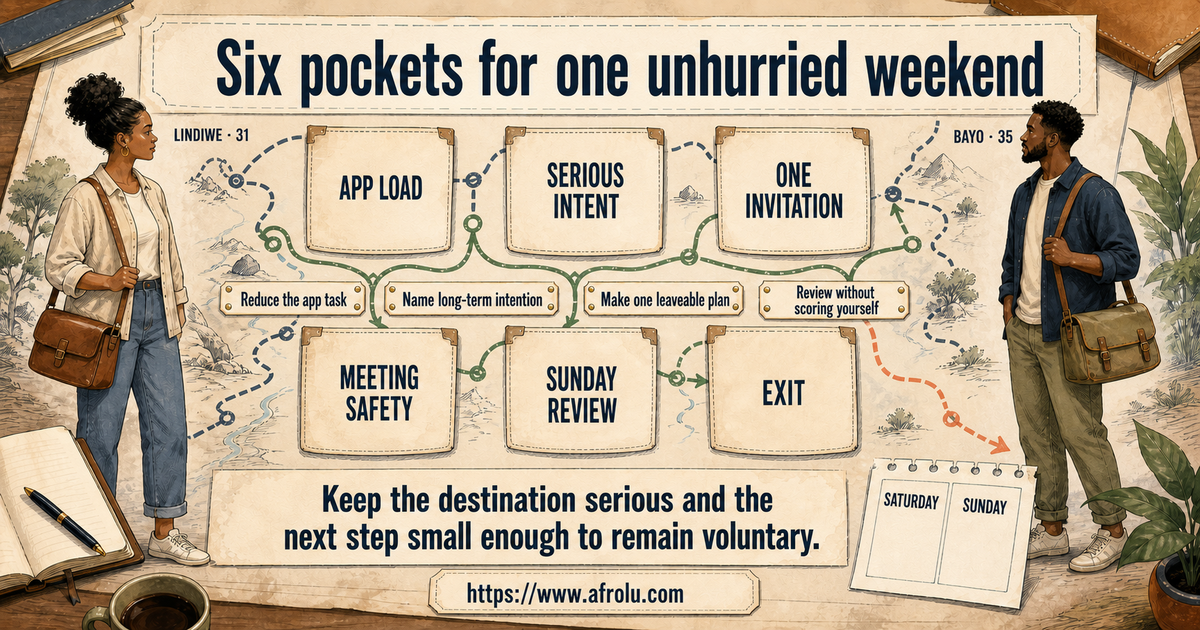
A serious destination does not require a rushed weekend.
Written and edited by Nia Kato · Profile Advice Editor
Use six independent pockets: APP LOAD, SERIOUS INTENT, ONE INVITATION, MEETING SAFETY, SUNDAY REVIEW and EXIT. Close discovery before it consumes the weekend, state long-term direction without assigning this match a future and make one public, timed, independently leaveable plan. Then KEEP ONE PLAN, REWRITE OFFER, LIMIT DISCOVERY, PAUSE APPS, MEET OFFLINE, CLOSE, SEEK CARE or SEEK PROTECTION.
Dating wellbeing · New Relationship Starters
How can a new-journey dater reduce unwanted app work without abandoning serious intention or compressing trust, safety and consent into one weekend?
Dating-app burnout here is everyday shorthand for unwanted discovery, matching, replying, verification and planning work; it is not WHO's occupational burn-out category or a diagnosis. A new journey is personal context, serious dating is a present long-term intention, and weekend-only availability is a capacity boundary. None creates exclusivity, trust, money access or consent.
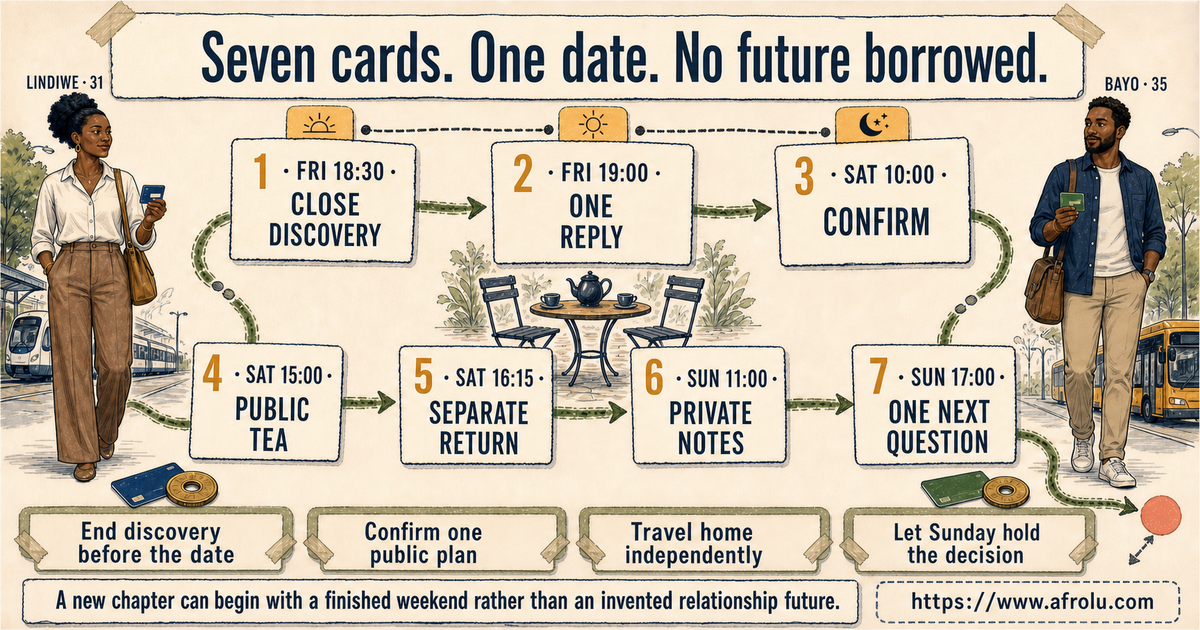
Lindiwe, 31, closes discovery on Friday before offering Bayo, 35, one public Saturday tea from 15:00 to 16:15. They confirm by 10:00, travel separately, keep work and home private and leave another date undecided until Sunday. The adults, events and setting are fictional.
The serious-new-journey weekend field journal
Keep the destination; carry less app work
Nia treats a new chapter as private context, serious dating as direction and weekend capacity as a real boundary rather than a motivation test.
Audit the app verbs, write one accurate intention, finish one leaveable invitation and let the Sunday evidence choose the next route.
Empty the queue
Remove the discovery or messaging task that no longer feels chosen.
Name the direction
State long-term intention without assigning a future to this match.
Finish one plan
Use a public, timed meeting with confirmation and separate return.
Choose one path
Continue, redesign, rest, close, use care or protect access.
Begin with the empty Saturday
Treat lost appetite for app tasks as information, not a verdict on love
A quiet Saturday can reveal something more precise than ‘dating is broken.’ Perhaps searching feels stale, four conversations are competing for the same attention, or every notification seems to demand a performance. This guide calls that dating-app burnout in ordinary language only. WHO confines its formal burn-out description to work, so the phrase cannot diagnose a dater or explain every difficult mood.
New journey means an adult is starting or restarting a dating chapter after a meaningful change. It does not mean naive, healed, inexperienced, recently separated or ready for advice from strangers. Lindiwe and Bayo are given ages only to make their fictional adulthood clear. The page offers no timetable for grief, recovery, disclosure, sex, exclusivity or a return to apps.
Serious dating describes a present intention to explore a committed long-term relationship. It is not a pledge to this particular match. The intention can guide profile wording, questions and which invitations deserve time, while trust still grows through observed conduct. A serious goal must never be used to rush a home address, exclusivity, money, sexual access or family involvement.
Write the weekend in verbs: search, read, match, reply, verify, invite, confirm, meet, review and close. Mark which verbs still feel chosen, which merely repeat and which create risk. Reduce the unwanted task before judging your whole romantic future. Persistent severe impairment across daily life belongs with qualified local care; threats, tracking, fraud or defeated exit belong with immediate protection.
Pack the six-pocket weekend map
Give app load, serious direction, one plan, safety, review and exit their own space
Pocket one holds APP LOAD: the discovery and communication tasks the adult actually chooses this weekend. Pocket two holds SERIOUS INTENT: the kind of relationship they hope to build over time. These are independent. Lindiwe can want partnership and decline a night of browsing. Bayo can like her profile and still decide weekend-only contact does not fit him.
Pocket three allows ONE INVITATION with a place category, start, ending and confirmation point. This is a capacity choice, not a rule that everyone must date one person. Pocket four keeps MEETING SAFETY: public setting, proportionate verification, independent transport, controlled spending and a trusted check-in where useful. A neat plan reduces some practical risks but certifies no character or future behaviour.
Pocket five is SUNDAY REVIEW. Record only observable details: whether confirmation arrived, the meeting stayed leaveable, conversation had room for both adults and stated serious intention matched current actions. Chemistry and hope may be included as feelings, not proof. No total score is needed, and one unsafe event cannot be cancelled by several pleasant observations.
Pocket six is EXIT, visible before the app opens. It may mean closing an unwanted thread, releasing an unconfirmed plan, ending romantic contact, protecting accounts or seeking help. Exit is not the opposite of serious dating; it is what keeps participation voluntary. If contact reappears through new, workplace or family channels after a clear ending, leave ordinary fit review and protect access.
Lindiwe lends one weekend to evidence
A fictional new chapter moves from an app queue to one finished serious-date experiment
Lindiwe is 31 and starting a new dating chapter after a private life change she does not owe a match. By Friday, discovery has occupied three evenings without producing a plan she wants. She closes the search at 18:30, ends two conversations kindly and replies to Bayo because his stated interest in a long-term partnership is compatible enough for one question.
Bayo, 35, says that a serious relationship is his direction, then asks what serious means to Lindiwe now. She answers that she wants to learn compatibility steadily and has dating time on weekends. She offers public tea on Saturday from 15:00 to 16:15. He confirms by 10:00 without asking for her home, workplace, live location or documents.
They arrive separately, buy their own ordinary refreshments and talk about time, communication and future hopes without negotiating exclusivity on the first meeting. No discussion creates consent to touch, sex, images or a second date. When the planned ending arrives, each makes an independent trip home. A pleasant hour remains only a pleasant hour until both choose something else.
On Sunday, Lindiwe notices that one completed plan felt different from maintaining many possible conversations. Bayo notices that weekend contact may fit if confirmation remains clear. They exchange one next question rather than naming a relationship. Either can still decline. The useful outcome is not that the story continues; it is that the weekend produced bounded evidence without consuming the new journey.
Read sixteen markers without building a leaderboard
Separate capacity, intention, conduct and safety before choosing a route
CAPACITY markers ask whether app windows end, discovery has a limit, unwanted threads can close and rest remains protected. None measures romantic worth. A quiet response can reflect workload, low interest, another communication style or the weekend agreement. Ask what availability is honestly offered rather than rewarding rapid contact as if it proves readiness for commitment.
INTENTION markers ask whether both adults can describe serious dating, whether exclusivity remains unclaimed until agreed, whether pace is discussable and whether a changed answer is allowed. Two people may both want partnership but disagree about children, geography, faith, money or timing. That is important fit information, not a reason to accelerate access before the mismatch becomes visible.
CONDUCT markers cover confirmation, reciprocity, public planning and repair. A kept small promise is useful evidence for another small decision, never a global green light. Polished profiles and professional-sounding histories do not verify identity. If details matter to money or physical safety, check them independently and share no badge, identity document, password, code or screen as romantic proof.
SAFETY markers sit outside any total. Money requests, threats, tracking, image abuse, workplace bypass and efforts to block an exit require their own response. Preserve useful records when safe, secure accounts and funds, tell trusted support and use current platform, bank, legal, health, survivor or emergency resources for the location. A new journey does not require one more explanatory conversation.

Do not average a safety fact into a promising serious-date score.
Borrow twelve lines, then make them sound like you
State direction, rhythm, privacy, consent and endings without a strategy performance
A new-chapter line can be simple: ‘I am starting dating again and learning what pace fits now.’ It supplies context without inviting an investigation. A serious-intention line can add, ‘I am exploring a committed long-term relationship, not promising one before we know each other.’ Together they resist two pressures: pretending certainty and apologising for reasonable uncertainty.
App rhythm needs a clock that can close. Try, ‘I use the app on Friday evening and Sunday afternoon,’ or ‘I keep one active plan instead of many unfinished chats.’ A compatible adult can accept, suggest another realistic pattern or decline. Silence and delay still need interpretation; the script merely removes the expectation of continuous weekend access.
Complete an invitation with boundaries: ‘I can meet in public on Saturday from 15:00 to 16:15.’ Add a confirmation point and independent travel. For privacy, state that home, workplace and live route stay private. For money, say no to fares, fees, gifts and investment funds. These sentences keep logistics from becoming improvised tests of seriousness or generosity.
Before sex, use direct adult language about protection, testing, agreements and the specific acts wanted. Serious interest is not consent, and a prior yes does not authorise another step. Pause may last two weekends without a promised return. Closure can be brief and channel-wide. When pressure, threats or monitoring is present, prioritise a safe exit over delivering perfect words.

Clear intention names a direction; it does not pre-book the journey.
Keep serious direction out of the sprint lane
Let commitment intention guide questions while trust, access and intimacy remain gradual
Serious daters can ask early about the broad shape of life: relationship intention, children, location, time, faith, finances and how conflict is handled. Answers are starting points rather than warranties. Someone may sincerely want partnership and still be incompatible, unavailable or unsafe. Build conclusions from conduct across time instead of treating profile language as a signed declaration.
Weekend availability may slow the number of meetings while improving their edges. It can also create a real mismatch for someone who needs weekday contact or spontaneous plans. Neither person should test affection by breaking the stated rhythm. A fair counteroffer names what would work; repeated pressure for instant access supplies conduct information and may justify closure.
Protect the infrastructure of ordinary life. Keep workplace systems, home access, money, passwords, identity documents and live travel data outside early romance. A video conversation may reduce one uncertainty, but it cannot prove every claim or future intention. Urgent fares, investments, medical costs or verification fees are not made trustworthy by a serious profile or a convincing story.
Sexual health and consent deserve explicit conversation whether a relationship is casual, serious, exclusive or undefined. Current public-health information can help adults discuss barriers and testing, but individual choices need suitable local clinical guidance. Relationship status never supplies consent. Each physical and digital act remains voluntary, specific and reversible, including after money was spent or affection expressed.
Close Sunday with one honest next path
Use what the weekend changed instead of demanding a verdict on dating
KEEP ONE PLAN when interest is wanted, serious direction is compatible enough and ordinary boundaries worked. REWRITE OFFER when profile language or contact hours invite the wrong expectations. LIMIT DISCOVERY when searching is the draining task. Each route changes one condition and then watches what happens; none requires squeezing more activity into the following weekend.
PAUSE APPS when attention needs to return elsewhere. A pause can last two weekends, two months or indefinitely and owes nobody a countdown. MEET OFFLINE when a safe, wanted social route already exists; it is an option, not a cure. CLOSE when interest, rhythm or serious fit has ended. A complete no needs no burnout diagnosis.
SEEK CARE when sleep, concentration, mood or ordinary functioning remains severely or persistently changed across settings after app tasks shrink. Dating research cannot diagnose that experience or prescribe treatment. SEEK PROTECTION when fraud, threats, stalking, image abuse, workplace contact or a blocked exit appears. Use current resources suited to the country and act urgently when danger is immediate.
Review the action, not the self. Did time return? Did the serious offer become clearer? Could the meeting end? Did privacy remain intact? The next weekend may support another date, a changed profile, a longer pause or no dating at all. The field map succeeds when the adult keeps choice, not when the route produces a relationship.

Choose the path that fits today's evidence, including the path away.
Eight moments when serious intention, weekend capacity or safety becomes blurred
The Friday search spill
A planned twenty-minute search becomes a whole evening of profiles, while no current conversation feels wanted.
Close discovery and keep only the task you still choose.The instant-partner shortcut
A match treats two serious profiles as evidence that exclusivity and a future have already been agreed.
Restate direction and leave commitment undecided.The weekday test
Weekend availability is repeatedly challenged with messages that ask whether a serious person would answer during workdays.
Offer the real rhythm once; decline the test.The floating Saturday
Warm messages continue, but no place, time, ending or confirmation point appears before the proposed meeting.
Make one complete invitation or release the weekend.The calendar proof
A new match asks for a workplace schedule or live location to verify that limited availability is genuine.
Share broad availability and keep protected systems closed.The serious travel story
Future-oriented language accompanies a request for a fare, visa cost, emergency bill or investment transfer.
Send nothing and verify independently through official routes.The commitment assumption
A good date and shared long-term hopes are used to imply that touch, sex or another meeting should follow.
Ask for a separate freely given yes to each step.The reopened channel
After closure, contact returns through work, family, a new account or a person asked to relay messages.
Protect access, retain useful evidence and seek fitting support.Sixteen field markers for capacity, intention, conduct and direct risk
App windows close — the chosen session ends without guilt; remove prompts that reopen it.
Discovery has a ceiling — a set number or time is enough; stop before attention becomes numb.
Unwanted threads finish — courtesy does not require indefinite possibility; close clearly.
Rest stays on the calendar — dating does not consume the whole weekend; protect unstructured time.
Serious has words — long-term intention is named without assigning a future to this match.
Exclusivity is unclaimed — profile alignment does not create an agreement; discuss it explicitly later.
Pace can be countered — either adult may offer a different rhythm; accept fit or decline it.
A changed answer is allowed — new information can alter interest; do not punish honest revision.
Invitations are complete — place type, start, ending and confirmation are usable; release vague plans.
Effort can travel both ways — questions, planning and repair are not carried by one adult alone.
Work and home stay private — broad availability is enough; protect credentials and precise routines.
Transport remains independent — each adult can arrive and leave without the other's permission.
Money proves nothing — no fare, fee, gift or investment buys trust; stop financial pressure.
Consent remains specific — serious interest, tea and prior affection authorise no later act.
Wider functioning remains impaired — severe change persists beyond app use; seek qualified local care.
Exit is bypassed — threats, tracking, image abuse or renewed channels appear; use direct protection.
Ten Sunday questions that lead to one proportionate route
| Situation | What it may mean | What to do next |
|---|---|---|
| Can discovery stop on time? | Fits: The planned window closes. Needs review: One task runs slightly over. Stop: Searching consumes the weekend. | Limit or remove discovery first. |
| Can unwanted conversations end? | Fits: Closure is brief and respected. Needs review: One reply needs finishing. Stop: Guilt keeps every possibility alive. | Close what is no longer chosen. |
| Is serious intention accurately named? | Fits: Direction is clear without a promise. Needs review: One expectation needs defining. Stop: Serious is used as instant commitment. | Separate hope from agreement. |
| Does the weekend rhythm fit? | Fits: Both adults can use the offered pace. Needs review: One fair counteroffer is possible. Stop: Availability must be repeatedly defended. | Agree a rhythm or accept mismatch. |
| Is the invitation complete? | Fits: Place, start, end and confirmation are set. Needs review: One detail is missing. Stop: The whole Saturday stays on hold. | Complete the plan or release it. |
| Does privacy remain proportionate? | Fits: Only necessary personal details are shared. Needs review: One channel needs redirecting. Stop: Work, documents or live location are demanded. | Refuse access and protect systems. |
| Can each adult leave independently? | Fits: Public place and separate return work. Needs review: A backup route is needed. Stop: Movement depends on the match. | Do not meet until exit is usable. |
| Are money and consent separate? | Fits: Costs and each physical step remain voluntary. Needs review: One adult conversation remains. Stop: Spending or seriousness is treated as access. | Pause and state the separate choices. |
| Did shrinking app tasks restore capacity? | Fits: Rest and voluntary interest return. Needs review: Another safe observation is needed. Stop: Severe impairment continues across life. | Consider qualified local care. |
| Is there a direct risk fact? | Fits: Ordinary dating review remains safe. Needs review: Possible fraud needs checking. Stop: Threat, tracking or blocked exit appears. | Prioritise reporting or protection. |
Twelve lines for a new chapter, serious direction, weekends and closure
“I am starting dating again and learning what pace fits now.”
“I am exploring a committed long-term relationship, not promising one before we know each other.”
“I use the app on Friday evening and Sunday afternoon.”
“I keep one active plan instead of many unfinished chats.”
“I can meet in public on Saturday from 15:00 to 16:15.”
“If we have not confirmed by 10:00, I will release the plan.”
“My home, workplace and live route stay private for now.”
“I do not send fares, fees, gifts or investment funds.”
“Before sex, I discuss protection, testing and current agreements.”
“Serious interest does not make touch, sex, images or another date automatic.”
“I am taking two weekends away from the apps and owe no return date.”
“I am ending romantic contact; please do not use another channel.”
Know the difference
App-task fatigue is not the same as serious-dating mismatch or wider distress
Searching, matching, replying or planning continues after the adult no longer chooses the task or amount.
A long-term relationship intention guides one limited invitation while trust, exclusivity, access and outcome remain undecided.
Work strain, low interest, weekend mismatch, ordinary nerves, wider impairment, romance fraud and coercive control require different next routes.

Name the narrowest supported problem before changing the whole journey.
Do not confuse app-task fatigue with mismatch, wider distress, fraud or control
| Type or dimension | What it describes | Best next question |
|---|---|---|
| App-task fatigue | A specific digital dating task consumes capacity without feeling chosen. | Remove, batch or limit that task. |
| Work strain | Pressure persists in occupational life even when every dating app is closed. | Use appropriate workplace or care support. |
| Low interest | This match or dating generally is not wanted now, without a capacity problem needing proof. | Decline or close honestly. |
| Serious mismatch | The adults want different relationship structures or long-term directions. | Clarify once and accept incompatibility. |
| Weekend mismatch | Intentions may align, but usable contact and meeting times do not. | Offer one feasible rhythm or release the fit. |
| Ordinary nerves | Uncertainty appears around a wanted new step and remains manageable. | Make the step smaller and leaveable. |
| Wider impairment | Severe or persistent change affects sleep, mood, concentration or daily life beyond apps. | Seek qualified local assessment rather than self-diagnosing. |
| Romance fraud | A romantic identity or future story is used to obtain money, credentials or investment access. | Stop payment, secure funds and report through fitting channels. |
| Coercive control | Threats, monitoring, isolation, workplace intrusion or defeated exit restrict autonomy. | Use specialist safety support and urgent local help when needed. |
Pack the six-pocket weekend map before opening discovery
Verb audit
List search, match, reply, verify, invite, meet and close; reduce the exact verb that no longer feels chosen.
Direction sentence
Describe serious dating as a long-term intention while leaving this person's role and the timetable undecided.
Weekend envelope
Give app use, one meeting and rest separate time boxes so none silently consumes the others.
Evidence note
Record confirmation, reciprocity, repair and respected limits without converting observations into a partner score.
Access firewall
Keep work, home, money, identity documents, live movement and devices outside what the next date requires.
Route choice
Continue, redesign, pause, close, seek care or seek protection according to the narrowest current fact.
Questions for the workload, the direction, the plan and the next route
Choose a few prompts that fit the moment. This is a reference library, not a list to complete.
Load
Find the exact weekend task.
- Which verb feels unwanted?
- When does it begin?
- When will it close?
- What does stopping return?
Direction
Make serious intention accurate.
- What long-term structure is wanted?
- What is not yet promised?
- Which question matters now?
- What mismatch can be accepted?
Plan
Complete one leaveable meeting.
- Where is public?
- When does it end?
- How is it confirmed?
- Can each adult return independently?
Route
Let the evidence choose the tool.
- Continue or redesign?
- Pause or close?
- Does wider impairment need care?
- Does fraud or danger need protection?
What current classification, research and official guidance can—and cannot—support
WHO keeps formal burn-out in the occupational context
The 28 May 2019 departmental update states that ICD-11 treats burn-out as an occupational phenomenon rather than a medical condition and says it should not describe other areas of life.
Evidence limit: It cannot classify dating fatigue, diagnose a reader or choose treatment; this guide therefore uses dating-app burnout only as everyday shorthand.
A four-wave study followed active U.S. dating-app users
Sharabi, Von Feldt and Ha surveyed 493 active single U.S. users at wave one over twelve weeks; 190 completed all four waves. The article first appeared online on 19 October 2024 and in a January 2026 issue.
Evidence limit: Attrition, a U.S. Prolific sample and observational associations prevent African prevalence estimates, individual diagnosis or simple causal claims.
Twenty-seven northern German interviews explored mobile-dating fatigue
Degen and Kleeberg-Niepage analysed interviews collected in 2022 from German-speaking heterosexual adults aged 22 to 42 and published the open-access article on 22 January 2025.
Evidence limit: A small snowball qualitative sample can illuminate experiences and coping language but cannot measure prevalence or represent African, queer or all serious daters.
Pew documents mixed U.S. online-dating motives and experiences
Pew Research Center surveyed 6,034 U.S. adults from 5 to 17 July 2022 and published its report on 2 February 2023, distinguishing commitment, companionship and casual motives alongside unwanted experiences.
Evidence limit: The nationally weighted U.S. results describe that jurisdiction and period; they do not estimate current African experiences or predict an individual weekend.
RAINN separates online privacy from leaveable in-person planning
Current survivor-support guidance covers personal information, account security, photos, financial requests, public meetings, trusted check-ins, independent transport and permission to leave.
Evidence limit: Risk-reduction practices never guarantee safety, and RAINN's hotline, emergency and legal references are U.S.-specific rather than universal.
The FTC describes romance stories that move toward money
The February 2025 U.S. consumer alert describes frequent contact, off-platform movement, inability to meet and later requests for travel, medical or investment money, with independent checks and reporting routes.
Evidence limit: It is U.S. consumer guidance, not proof that an affectionate or long-distance match is fraudulent; reporting and recovery channels differ by country.
CDC prevention guidance supports direct adult testing and barrier conversations
The U.S. public-health pages updated in 2024 and 2026 explain that many infections have no symptoms and that testing choices depend on age, location, history and sexual practices.
Evidence limit: General U.S. information cannot select tests, timing, treatment or protection for an individual; adults should use current qualified local clinical care.
Six ways serious intent can accidentally become pressure or overwork
Making seriousness a speed
Long-term intention becomes instant exclusivity or access. Keep direction and present agreement separate.
Filling the whole weekend
More searches and dates are treated as commitment. Protect rest and one complete experience.
Scoring every observation
Normal uncertainty turns into a compatibility dashboard. Use evidence only for the next choice.
Proving limited availability
Work calendars, routes or documents enter romance. Broad scheduling information is sufficient.
Calling every hard feeling burnout
A broad label hides low interest, mismatch, work strain, care needs, fraud or danger.
Giving a pause a deadline
Rest becomes another performance promise. Leave return timing open until capacity is real.
Choose one smaller route before opening another dating queue
Start with the narrowest current question: an unwanted app task, an unclear serious-dating offer or an unsustainable contact rhythm. Use one published guide, then let the next weekend remain unbooked until the answer is useful.
Explore the guide library
Show more related guides
Continue with Afrolu
Show more Afrolu guides
Live primary and official sources with dates, geography and limits
Afrolu reviewed these health, research, safety, or public guidance resources while editing this page. They support the behaviour and safety guidance; they do not diagnose any individual described by a reader.
New-journey questions about app fatigue, serious intent and weekend dating
Is dating-app burnout a diagnosis?
No. This guide uses the term for unwanted searching, matching, messaging and planning. WHO's formal burn-out description is limited to work and is not classified as a medical condition. Severe or persistent changes in mood, sleep, concentration or daily functioning deserve qualified local assessment rather than a label from an article.
Can I want a serious relationship and use apps only on weekends?
Yes, if that rhythm is honest and the other adult can freely accept or decline it. Serious describes the relationship direction you want to explore, not constant availability. State the app windows and meeting capacity you can sustain, listen to a fair counteroffer and treat incompatible timing as fit information rather than a moral failure.
Does new journey mean I should disclose what happened before?
No. Share only the history that you freely judge useful for the present choice. You can say that you are starting dating again and learning your pace without describing a breakup, loss, health matter or family situation. Safety, sexual-health and existing-agreement information should still be discussed when it becomes relevant to another adult's consent.
How many matches should I keep while seeking commitment?
There is no evidence-based correct number. Keep only the conversations and plans you genuinely choose and can handle with clarity, rest and safety intact. Serious intention does not require dating one person before exclusivity is agreed, and it does not require maintaining many options. Choose a volume that permits honest endings.
Will one weekend off fix dating fatigue?
It may return time or show which task was draining, but it is not a treatment promise. Some adults need a smaller search window, a different way to meet, a longer pause or no dating. If distress remains severe across life after the app workload changes, seek qualified care suited to your location.
Should I put serious relationship in my profile?
Use wording that accurately describes your present intention, then explain what it means in conversation. A label can filter some mismatches but cannot verify another person's goal or create commitment. Pair it with observable boundaries around pace, exclusivity, privacy, money, meetings and consent, and revise the wording if it attracts the wrong assumptions.
How can a weekend first date stay leaveable?
Choose a known public place, set a start and ending, confirm by a stated time and control your journey home. Share a useful check-in with a trusted person when appropriate. Keep home and work private, control ordinary spending and remember that these steps reduce some risks without certifying the match.
Does a serious relationship goal change sexual-health conversations?
It does not remove them. Before sex, adults should discuss the specific consent, protection, testing and current agreements relevant to them, using current local clinical guidance. A serious profile, exclusivity discussion, paid bill, affection or prior yes cannot authorise a sexual act or replace freely renewed consent.
What if a serious match asks for travel or investment money?
Do not send money, codes or account access. Verify claims independently through contact details you find yourself and keep romantic communication separate from any real business. If money moved, contact the payment provider promptly and use current fraud-reporting routes for your country. A future story does not validate a transaction.
When should I skip the ordinary closure message?
Skip it when direct contact may raise danger or when threats, stalking, tracking, image abuse, impersonation, workplace intrusion or repeated channel bypass is already present. Preserve useful evidence where safe, secure accounts and funds, tell trusted support and use specialist survivor, legal, platform or emergency resources appropriate to your location.
One thing to do now
Let the weekend end before deciding what the whole journey means
Continue only while app work ends, serious intention remains an honest direction rather than a promise, the weekend rhythm fits both adults, the meeting is leaveable and privacy, money, sexual health, consent and exit stay separate. Redesign, pause or close without proving burnout; route wider impairment to qualified care and fraud or coercion to direct protection.