Six-column weekend ledger · later-entry safety
Protect Your Weekend While Starting Online Dating Later
A later-life weekend guide to dating-app fatigue: budget six tasks, verify safely, complete public plans, protect recovery and keep every exit usable.
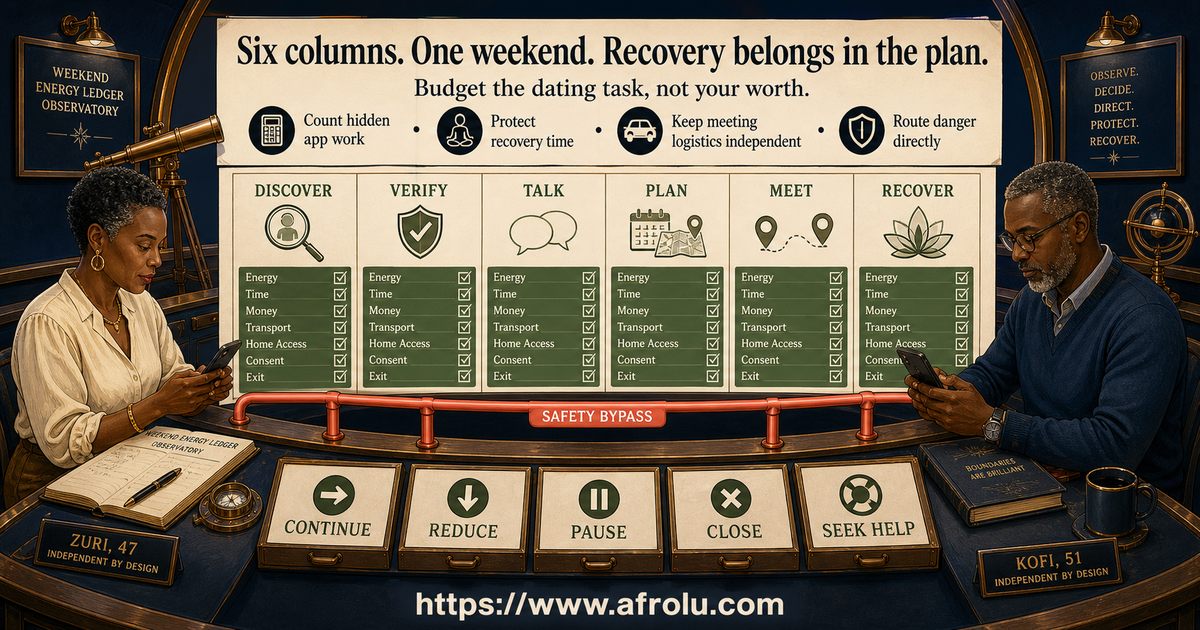
Budget the dating task, not your worth.
Written and edited by Jean-Claude Mukendi · Relationship Guides Editor
Use six separate ledger columns: DISCOVER, VERIFY, TALK, PLAN, MEET and RECOVER. Give the weekend one chosen dating job, a clear ending and protected quiet time. Keep identity checks proportionate; never share codes, documents, accounts, money or live location as trust proof. Convert interest into a complete public meeting with ordinary separate payment, independent transport, a stated duration and specific consent. Choose CONTINUE, REDUCE, PAUSE, CLOSE, SEEK CARE or SEEK SAFETY HELP. There is no universal app schedule or return date. Persistent impairment belongs with qualified care; fraud, threats, tracking, coercion or blocked movement bypass ordinary energy review.
Dating wellbeing · Late Entrants
How can a later entrant use weekend dating apps seriously without treating constant availability as proof of readiness or overlooking privacy, financial and meeting safety?
Online-dating burnout is used here as a non-diagnostic description of accumulated profile, verification, conversation, planning and meeting work that an adult no longer freely wants at its current level. It is not the same as ordinary weekend rest, low interest, pace mismatch, re-entry learning, persistent impairment, fraud or unsafe control.
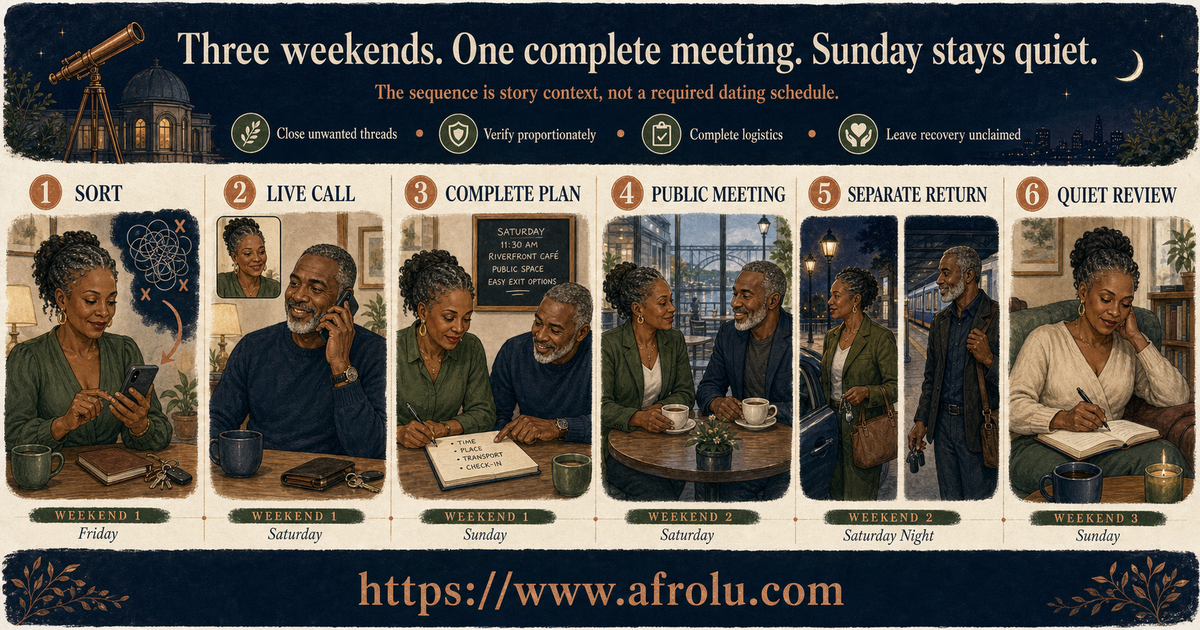
Across three fictional weekends, Zuri, 47, reduces browsing, keeps one reciprocal live call, accepts Kofi's complete public café plan and protects Sunday morning for recovery. Kofi, 51, prefers a faster meeting rhythm but accepts one smaller trial. Their choices provide current compatibility evidence without becoming a safety certificate or future promise.
The later-entry six-column weekend energy observatory
Budget the dating task, not your worth
Jean-Claude separates discovery, verification, talk, planning, meeting and recovery so a full adult life does not become evidence against romance.
Name one weekend job, complete only the access it needs, preserve recovery and route care, fraud or danger to the authority that fits.
Choose one dating job
A bounded task gives novelty and administration an ending.
Verify without exposure
One reciprocal step never needs documents, codes, money or live location.
Complete the public plan
Place, time, duration, cost, transport and exit become answerable.
Leave recovery unclaimed
A promising meeting does not purchase the hours that follow.
A full life meets a crowded interface
Define the dating task before donating an entire weekend to it
Starting online dating at 47 or 51 can contain genuine excitement and an unfamiliar layer of administration. Profiles must be interpreted, identity clues checked, conversations advanced, invitations completed and exits managed. None of that means a later entrant is fragile or behind. It means the work should be visible enough to choose rather than silently occupying every open hour.
Weekend availability is especially easy to misread. A free Saturday may already carry errands, faith, friends, exercise, family responsibilities, solitude or recovery from paid work. Dating does not automatically outrank those uses. The honest question is not whether a serious person would make time, but which specific adult route is offered and whether the other person freely accepts it.
Begin by naming one purpose for the weekend: discover two profiles, hold one live call, finish one public plan, meet one person or deliberately rest. Combining every task creates avoidable switching costs and makes ordinary disappointment feel larger. A smaller plan can still be serious because seriousness is shown through truthful scope, safe logistics and completed agreements rather than constant availability.
Keep the plan descriptive rather than punitive. Do not withhold replies to make a match prove pursuit, schedule an unwanted date to prove courage or remain online to avoid seeming difficult. Say what the weekend can hold, let the other adult answer and treat their answer as present compatibility evidence. Both people retain an equal right to decline without being cast as unserious.
The six-column weekend ledger
Separate discovery, verification, conversation, planning, meeting and recovery
DISCOVER is profile browsing and initial sorting. It returns energy when the filters match a real intention and the session has an ending. It leaks energy when novelty keeps extending the session after attention has faded. A timer may help, but the stronger boundary is a chosen task: review a small number, save none or one, and close the interface when that task is complete.
VERIFY and TALK are separate. Verification asks for proportionate ordinary evidence while documents, codes, accounts, workplace records and live location remain private. Conversation asks whether each adult can answer, ask and disagree. A live call can serve both adults; a demand for sensitive proof does not become safe merely because someone describes it as protection from scams.
PLAN and MEET convert interest into leaveable logistics: public place, date, start, duration, ordinary cost, separate transport and an ending. RECOVER protects unscheduled attention after the meeting. A pleasant date does not purchase the rest of Sunday, immediate evaluation, constant messages or a second plan. Each adult may review privately and answer when they actually have an answer.
Write only observable entries in the ledger. 'Forty minutes browsing, one wanted conversation' is useful; 'too old for apps' is an identity verdict. 'The invitation still lacks a place' is useful; 'nobody is serious' overgeneralises from incomplete evidence. Concrete entries reveal which task can be changed and prevent one disappointing interaction from becoming a judgment about an entire future.
Three weekends and one complete meeting
Follow Zuri and Kofi as curiosity becomes a smaller, safer route
During the first weekend Zuri notices that browsing has spread across Friday evening and Saturday morning. She closes conversations she does not want and keeps Kofi's because he answers direct questions. She offers a Sunday live call through a familiar channel. Kofi agrees without requesting documents, employer proof or an explanation of why she joined dating later than friends expected.
The next weekend they complete a public meeting plan: a staffed café, ninety minutes, ordinary separate payment and independent transport. Kofi suggests dinner afterward; Zuri says she is protecting the rest of the evening. He accepts the smaller plan. Their conversation includes relationship intention, sexual-health expectations and the fact that neither adult is offering home access or financial help.
Afterward Zuri keeps Sunday morning free rather than performing immediate enthusiasm. She later says she would accept another date in two weeks. Kofi prefers weekly meetings but decides the offered rhythm is workable for one more step. That is compatibility evidence, not a future contract. If either adult later wants a different pace, the route can be renegotiated or closed.
The story would also remain complete if Zuri declined another meeting or Kofi rejected the slower rhythm. Success here is not a second date. It is an adult route in which identity exposure stayed proportionate, logistics were complete, money and transport remained independent, consent was not bundled and each person could give an honest answer without losing access to ordinary life.
Twelve signals without a stamina score
Read what returns energy, what leaks it and what bypasses ordinary review
DISCOVER returns value when filters reflect a real intention and unwanted options can be dismissed without rumination. VERIFY returns value when one proportionate step reduces uncertainty for both adults. Energy leaks when browsing becomes endless comparison or when verification expands into documents, passwords, money, live location or invasive history presented as the price of trust.
TALK returns value through reciprocal questions, tolerable rhythm and clean disagreement. PLAN returns value when an invitation becomes a complete proposal. Leaks appear through repeated greetings, unfinished invitations, late changes and emotional reassurance that never resolves logistics. Message volume is not evidence of effort when every answerable question remains open.
MEET returns value when both adults control place, cost, body, transport and ending. RECOVER returns value when the weekend still contains sleep, friends, ordinary responsibilities and unallocated time. Threats, tracking, impersonation, financial exploitation, coercion, image abuse or channel bypass do not belong in an energy calculation; they move directly to protective action.
Read patterns across several chosen tasks without building a total score. One tiring call may simply be a poor conversation. Repeated dread before every app window may support reducing or pausing the format. One money demand can be enough to stop exposure even when earlier exchanges felt easy. The strongest present fact selects the immediate route; quieter capacity questions can be revisited after access is protected.

No green tile cancels fraud, coercion or unsafe conduct.
Words that protect a later entrant's weekend
Make purpose, pace, verification, logistics, recovery and closure answerable
Purpose and pace can be simple: 'I am looking for a serious relationship, and I use the app in two planned windows.' This avoids apologising for a full life or promising future availability. A compatible adult can accept, counter or decline. A person who wants daily access may be mismatched without being malicious; repeated monitoring or punishment changes the evidence.
Verification language should stay proportionate: 'I can do one live call here, but I do not share documents, workplace records, codes or live location.' Meeting language completes the ordinary plan: public place, time, duration, separate payment and transport. A vague invitation should not gain home access merely because arranging another place feels tiring.
Recovery and closure deserve complete sentences too. 'I am keeping Sunday quiet and will reply Monday' is an offer, not a chase test. 'This rhythm does not fit me, so I am closing the romantic contact' is enough when communication remains safe. An adult does not owe a return date, diagnosis, detailed history or consolation relationship.
A boundary can be warm without becoming negotiable by default. Avoid long explanations that expose grief, health, finances, family conflict or loneliness merely to make a normal limit seem legitimate. The practical test is whether the other adult can understand the offer and choose freely. More biography rarely fixes a person who has decided that access should override the stated answer.

A clear limit protects interest from becoming weekend debt.
Choose the smallest supported action
Continue, reduce, pause, close, seek care or seek safety help
CONTINUE means the present task remains wanted and bounded. REDUCE means fewer profiles, one conversation, a slower reply window or one complete meeting plan. Reduction should be stated rather than performed as a secret test. The other adult remains free to decide that the smaller route does not meet their needs.
PAUSE may be private or communicated, depending on what is safe and useful, and it needs no promised return date. CLOSE ends a specific profile, conversation or romantic route. Neither choice proves failure. A kind exchange can end because the format is costly; a promising match can be declined because the offered weekend no longer fits.
SEEK CARE addresses persistent impairment in the affected adult. SEEK SAFETY HELP addresses threats, tracking, coercion, fraud, impersonation, image abuse, account compromise or blocked movement. Care and safety can coexist, but they answer different questions. Never average a concrete danger against several pleasant dates before protecting access.
Review the choice after its real effect, not after an imagined deadline. Reduction may restore curiosity, or it may reveal that no current app task is wanted. A pause may remain a pause, become closure or end without announcement. The board protects voluntary action; it does not push every adult back toward dating or present partnership as the required resolution.

A pause needs no promised return date.
Compare eight nearby explanations
Separate app load, ordinary rest, low interest, mismatch, learning, impairment, fraud and control
APP ADMINISTRATION LOAD concerns profiles, messages, verification and plans. NORMAL WEEKEND REST is chosen recovery and needs no pathology. LOW INTEREST may be specific to one connection. PACE MISMATCH means adults want different frequency or availability while each remains free to leave. All four can be answered through design or closure rather than clinical language.
RE-ENTRY LEARNING concerns unfamiliar norms, controls or expectations and improves through bounded practice and reliable information. PERSISTENT IMPAIRMENT concerns wider changes in sleep, concentration, appetite, enjoyment or functioning and belongs with qualified assessment. One cannot be diagnosed from app use, age, delayed replies or a difficult weekend.
ROMANCE FRAUD concerns deceptive access to money, credentials, identity or commercial opportunity. UNSAFE CONTROL concerns threats, tracking, coercion, retaliation, isolation or blocked movement. These routes call for the relevant platform, provider, legal, health or emergency authority. They should not wait for a burnout score or be explained away as later-life dating nerves.
Precision also protects other adults from remote diagnosis. Slow replies do not prove burnout, low interest does not prove avoidance and unfamiliarity does not prove incapacity. Ask the answerable question, respect the delivered response and decide whether the offered route fits. Use stronger language only when stronger observable facts support it, especially around money, technology access, consent and physical safety.
Eight later-entry weekend moments where dating load becomes visible
Browsing quietly consumes the evening
Zuri intended to review profiles for twenty minutes and notices she is comparing strangers long after curiosity has gone.
End the discovery task, record nothing about personal worth and leave the remaining profiles for another chosen window.A safety question expands into documents
Kofi accepts a live call, while another contact asks for employer evidence and an identity image before meeting.
Use proportionate reciprocal verification and keep documents, codes, accounts and workplace details private.Warm messages never become logistics
A contact repeatedly says they should meet but avoids place, time, duration and transport questions.
Ask once for a complete public plan; archive or close if the route remains unfinished.One meeting becomes an entire-day claim
The proposed coffee expands into lunch, errands and a private evening before the adults have met.
Return to the offered duration and protect separate transport, payment and exit.Quiet Sunday feels like insufficient interest
Zuri wants an unallocated morning after a good date and feels pressure to provide immediate reassurance.
State the reply window if useful and keep recovery free of performance debt.Kofi would prefer weekly dates
Zuri offers every other weekend. Both proposals are honest, and neither adult monitors or punishes the other.
Test the smaller route once or close as a respectful pace mismatch.Fatigue continues away from dating
Sleep, concentration and enjoyment remain affected across work, friendship and quiet weekends.
Seek qualified local assessment rather than asking an app checklist to identify cause.Affection becomes an urgent transfer request
A new contact asks for travel funds and discourages independent verification through the provider.
Stop financial exposure, contact the relevant provider independently and use platform or fraud-reporting routes.Fourteen signals across discovery, verification, talk, planning, meeting and recovery
Discovery sessions have a defined task and ending rather than extending through novelty alone.
Identity checks stay proportionate, reciprocal and free of documents, codes or live location.
Conversation rhythm leaves room for sleep, friends, work, faith, family and quiet time.
A promising thread can tolerate an answer on the stated day without repeated reopening.
Invitations become complete public plans with place, time, duration, cost and exit.
Each adult controls ordinary payment, transport, accommodation and home access.
Sexual-health and consent questions are specific, unhurried and separate from affection.
A good meeting does not purchase the remainder of the weekend or immediate certainty.
Recovery time is protected without being used as a secret pursuit test.
A reduced rhythm can be accepted, countered or declined without punishment.
A pause or closure works across every channel without retaliation or bypass.
Persistent impairment is taken to qualified care rather than converted into a dating score.
Money and identity claims are checked through independently found providers and controls.
Threats, tracking, coercion, fraud or blocked movement bypass ordinary energy review.
Review the weekend through ten independent questions
| Situation | What it may mean | What to do next |
|---|---|---|
| Is this weekend task chosen? | Fits: One bounded purpose remains wanted. Needs review: The task needs reduction. Stop: App work feels compulsory or unsafe. | Continue one task, reduce it, pause or close. |
| Does discovery have an ending? | Fits: The session closes after its stated job. Needs review: Novelty extends attention. Stop: Browsing displaces sleep or essential responsibilities. | Choose a smaller count or leave discovery for another window. |
| Is verification proportionate? | Fits: One reciprocal step answers the current need. Needs review: The request can be reduced. Stop: Documents, codes, money or location are demanded. | Protect sensitive records and use independently found controls. |
| Does conversation progress? | Fits: Questions are reciprocal and answerable. Needs review: The rhythm needs naming. Stop: Monitoring or punishment replaces dialogue. | Offer a sustainable window and judge the response. |
| Is the invitation complete? | Fits: Place, time, duration, cost and exit are clear. Needs review: One logistical fact is missing. Stop: Pressure seeks private or dependent access. | Complete a public plan or decline it. |
| Does the meeting remain independent? | Fits: Each adult controls body, money and departure. Needs review: A practical dependency needs repair. Stop: Consent, funds or movement are constrained. | Restore independent control or use appropriate help. |
| Is recovery still available? | Fits: Unallocated time remains protected. Needs review: A reply window needs stating. Stop: Contact consumes sleep or wider functioning. | Keep the block, reduce contact and consider care for persistent impairment. |
| Can pace be countered? | Fits: Both adults may accept or decline. Needs review: One trial rhythm could clarify fit. Stop: A smaller offer triggers retaliation. | Name mismatch precisely and close if wanted. |
| Does the exit work? | Fits: Contact closes across channels. Needs review: One clear ending may help. Stop: New channels defeat a boundary. | Protect access and use platform or local safety routes. |
| Which authority fits the strongest fact? | Fits: Ordinary load stays in adult choice. Needs review: Persistent impairment may need care. Stop: Fraud or danger needs direct protection. | Route the strongest fact without averaging it against warmth. |
Ten lines for pace, verification, meeting logistics, rest and closure
“I am looking for a serious relationship, and this weekend I am only deciding whether one conversation should continue.”
“I read messages Saturday morning and Monday evening; silence between those windows is not a test.”
“I can do one live call here, but I do not share documents, workplace records, codes or live location.”
“I have twenty minutes for the call and will decide afterward whether another step fits.”
“Please suggest a public place, start time and duration so I can answer the invitation.”
“I will cover my ordinary cost and will not send fees, tickets or emergency money.”
“I am arranging my own arrival and return and am not changing that plan today.”
“I can meet for ninety minutes; I am not offering the rest of Saturday.”
“I enjoyed meeting you and am keeping Sunday quiet; I will reply Monday.”
“This rhythm does not fit me, so I am ending the romantic contact and closing the channel.”
Know the difference
Online-dating burnout and ordinary weekend rest are not the same problem
Discovery, verification, conversation and planning repeatedly consume more attention than the adult freely wants to give.
An adult protects quiet time because recovery, friendship or ordinary life is the preferred use of that block.
Rest needs no diagnosis; persistent impairment, fraud and unsafe control each require their own route.

Name the narrowest supported problem before choosing help.
Separate app load, rest, low interest, mismatch, learning, impairment, fraud and control
| Type or dimension | What it describes | Best next question |
|---|---|---|
| App administration load | The dating tasks consume unwanted attention. | Reduce tasks, redesign windows, pause or close. |
| Normal weekend rest | Quiet time is freely chosen and restorative. | Protect it without inventing a deficit. |
| Low interest | One connection is not compelling enough to continue. | Close that route honestly. |
| Pace mismatch | Adults want different frequency while exit stays free. | Counter once, test a smaller rhythm or close. |
| Re-entry learning | Interfaces or norms are unfamiliar rather than pathological. | Use bounded practice and reliable guidance. |
| Persistent impairment | Wider sleep, focus or enjoyment remains affected. | Seek qualified local assessment. |
| Romance fraud | Affection seeks money, identity or account access. | Stop exposure and use provider, platform and reporting routes. |
| Unsafe control | Threats, tracking, coercion or blocked movement changes the problem. | Protect access and use current local safety help. |
Use the six-column weekend ledger in deliberate moves
Name one weekend job
Choose discovery, verification, conversation, planning, meeting or recovery rather than carrying all six.
Count hidden administration
Treat sorting, replies and unfinished plans as real attention costs.
Complete logistics early
A public place, duration, ordinary cost and independent exit make invitations answerable.
Protect recovery
A good date does not purchase the unallocated hours that follow.
Keep closure ordinary
An unwanted rhythm may end without a diagnosis or moral trial.
Route problems precisely
Care, fraud and unsafe control belong to different authorities.
Questions for purpose, identity, plans, recovery and the right route
Choose a few prompts that fit the moment. This is a reference library, not a list to complete.
Weekend purpose
Choose one job before opening the interface.
- What do I want to finish?
- What can wait?
- When does this close?
- What recovery stays protected?
Identity and talk
Use proportionate evidence and a sustainable rhythm.
- What fact matters now?
- What stays private?
- Which reply windows fit?
- Can disagreement remain ordinary?
Plan and meeting
Complete logistics before expanding access.
- Where is public?
- How long?
- Who controls cost?
- How does each adult leave?
Review and route
Match the next move to the strongest fact.
- Continue or reduce?
- Pause or close?
- Does care fit?
- Does danger bypass review?
What official wellbeing, online-safety, privacy, fraud and consent guidance supports
WHO describes mental health as part of wellbeing and functioning
The framework supports distinguishing ordinary dating load from persistent effects across life.
Evidence limit: A fact sheet cannot diagnose an individual or prescribe a dating schedule.
eSafety covers privacy, suspicious conduct and safer meetings
The guidance supports limited personal data, platform controls and leaveable public plans.
Evidence limit: No checklist can certify another adult or eliminate risk.
FTC guidance describes common transfer and investment requests
The material supports stopping payments and verifying through independently found institutions.
Evidence limit: U.S. reporting routes do not replace current local remedies.
Kenya ODPC explains personal-data scope
The material supports protecting identity, contact, workplace and location information.
Evidence limit: General guidance is not personalised legal advice or a background check.
eSafety explains free, voluntary and informed agreement
The guidance supports keeping each physical choice separate and reversible.
Evidence limit: It does not replace local law, health care or emergency help.
eSafety describes technology-facilitated coercive control
The material supports treating tracking, account abuse and repeated channel bypass as concrete concerns.
Evidence limit: Australian terminology and services may differ from local law and support.
Six ways weekend dating quietly becomes compulsory administration
Turning seriousness into availability
A relationship goal becomes constant access. Repair: name the actual weekend offer.
Browsing for reassurance
Novelty replaces a bounded task. Repair: give discovery an ending.
Over-verifying
Safety language opens documents or location. Repair: request one proportionate reciprocal step.
Rewarding unfinished plans
Warmth substitutes for logistics. Repair: ask once for a complete public invitation.
Apologising for recovery
Quiet time becomes debt. Repair: protect it as a normal adult choice.
Scoring concrete danger
Fraud or control enters an energy ledger. Repair: route it directly to protection.
Use a reviewed resource that matches the decision
This guide focuses on the relationship decision, so it does not rank dating apps. Check current prices, safety tools, and local availability before choosing a service.
Explore the guide library
Show more related guides
Continue with Afrolu
Show more Afrolu guides
Current wellbeing, safety, privacy, fraud, consent and coercive-control guidance
Afrolu reviewed these health, research, safety, or public guidance resources while editing this page. They support the behaviour and safety guidance; they do not diagnose any individual described by a reader.
Later-entry weekend questions about app load, rest and safety
Is needing a quiet weekend a sign of online-dating burnout?
Not by itself. Quiet time may be ordinary chosen recovery. Burnout is used here only as a non-diagnostic description of accumulated dating administration. Look at the exact tasks, repeated impact and whether a smaller route remains wanted. Persistent impairment across life deserves qualified assessment.
Am I too old to learn online dating without feeling exhausted?
No. Unfamiliar interfaces, verification habits and communication norms create learnable work at any age. Choose one bounded task at a time, protect sensitive data and keep exits usable. Age does not establish stamina, compatibility, vulnerability or a required pace.
How much time should I spend on dating apps each weekend?
There is no universal amount. Start with one purpose and an ending: review a small set, hold one call or finish one plan. Continue only while the work remains chosen and wider life still functions. A timer helps only when it serves a real boundary rather than a performance target.
Can I want a serious relationship but reply slowly?
Yes. Relationship intention and contact frequency are different agreements. State the rhythm you can sustain and let another adult accept, counter or decline. Repeated monitoring or punishment is different from an ordinary pace mismatch and should be addressed through the conduct it creates.
What is a proportionate identity check?
It is an ordinary reciprocal step suited to the next decision, such as one live call through a familiar service. It does not require passwords, codes, identity documents, workplace records, money or live location. No single check certifies safety, so retain public logistics and independent exit.
Should I schedule several dates to make the weekend efficient?
Only if you genuinely want that arrangement and each plan stays complete and leaveable. Efficiency is not a publication requirement for your private life. Stacking meetings can erase recovery and increase switching pressure. One date or no date can be a complete weekend decision.
What if someone dislikes my protected Sunday?
They may decide your rhythm does not fit, and that can be respectful incompatibility. You do not owe the rest of the weekend because a date went well. If the person monitors, punishes or repeatedly defeats the limit, treat that as evidence about conduct rather than a request for a better explanation.
Can I pause without giving a return date?
Yes. A pause can be complete and may have no promised restart. Communicate it when doing so is safe and useful, or protect access directly when another message would increase risk. You do not need a diagnosis, detailed history or future waitlist to stop optional romantic contact.
When should app fatigue go to a health professional?
Consider qualified local assessment when changes in sleep, concentration, appetite, enjoyment or ordinary functioning are severe, persistent or present across settings. A dating pause may remove one source of load but cannot identify cause or prescribe treatment. Immediate safety concerns use the relevant urgent route.
What should bypass an ordinary burnout review?
Threats, tracking, coercion, impersonation, financial exploitation, image abuse, compromised accounts, repeated channel bypass or blocked movement should move directly to appropriate protection. Preserve useful evidence where safe and use current platform, financial, legal, health or emergency resources for the location and urgency.
One thing to do now
Keep the connection only while the weekend route remains freely chosen
Continue only while the chosen task remains wanted, identity and money stay protected, invitations become complete public plans, consent is specific, recovery survives and every exit works. Reduce, pause or close without grading yourself. Use qualified care for persistent wider impairment and the appropriate platform, financial, legal, health or emergency route for fraud or unsafe conduct.