Two-weekend evidence desk · professional serious dating
Keep Love Bombing Out of Work and Serious Dating
A sourced guide to love bombing for professionals: assess intense weekends, protect work and money, state serious intent, set boundaries and choose action.

Warm words belong in one folder; your whole life does not.
Written and edited by Adwoa Boateng · Dating Safety Editor
Use seven independent folders: WORDS, TIME, WORK, NETWORK, MONEY, BODY and EXIT. Enjoy wanted affection, slow one real request and record only what follows NOT YET. Serious intention opens no other folder. Then ENJOY WARMTH, SLOW ONE REQUEST, CLARIFY SERIOUS FIT, KEEP BOUNDARY, CLOSE, SECURE SYSTEMS, REPORT FRAUD or SEEK SAFETY HELP according to the conduct.
Emotional safety · Professionals
How can a professional serious dater respond to intense affection using observable evidence, while keeping weekend pace and every protected part of life voluntary?
Love bombing is used here as a non-diagnostic label for intense attention that becomes connected to influence, obligation, accelerated access or control. Speed, gifts and warmth alone cannot prove motive. Professional context covers protected work systems and networks, serious dating is only a long-term direction, and a bright weekend never creates consent, debt or commitment.
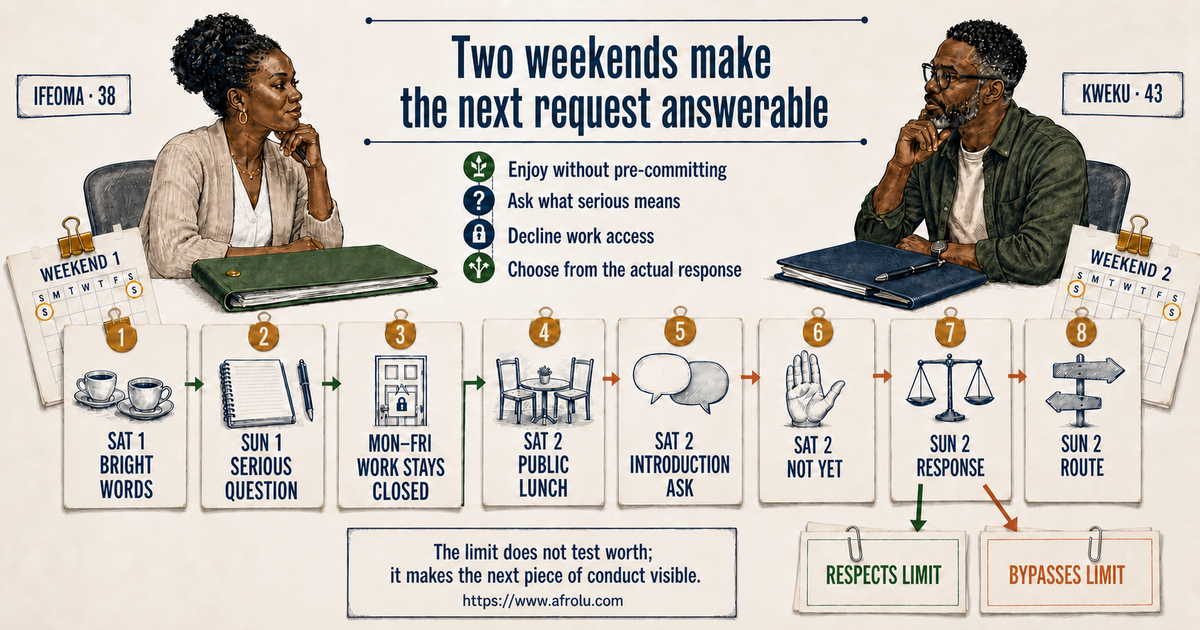
Ifeoma, 38, enjoys a bright first weekend with Kweku, 43, and shares a serious relationship direction. On their second public weekend she declines a workplace introduction. The story pauses at his possible response so the observable conduct—not an invented motive—determines the route. Both adults and events are fictional.
The professional serious-weekend evidence desk
Keep warm words, serious hope and protected access in different folders
Adwoa treats love bombing as a limited behaviour label, professional status as context and serious intention as direction rather than automatic trust.
Record the request and response, close the exact protected folder, distinguish fit from harm and route fraud or coercion directly.
Describe the moment
Write the request, your answer and the observable response without motive.
Separate access
Work, networks, money, body, devices and exit keep different keys.
Read the repair
Notice whether not yet is respected, repaired, punished or bypassed.
Choose the tool
Clarify, close, secure, report or seek safety help from the current fact.
Put Saturday's intensity in one folder
Describe attention without claiming you can read motive or diagnose personality
Love bombing commonly describes unusually intense attention, praise, communication, gifts or future language that becomes connected to influence, obligation or control. The term is not a clinical diagnosis and cannot reveal motive from one weekend. Early affection can be sincere, awkward, mismatched or manipulative. The safer editorial question is what was requested, what answer was given and what happened next.
Professional means a working adult in this guide, not an executive class or a signal of wealth, intelligence or safety. A polished biography, public title or confident meeting style does not verify character. The relevant professional boundaries are practical: employer, calendar, colleagues, clients, referrals, devices, reputation and daily route should remain under the adult's control.
Serious dating means an intention to explore a committed long-term relationship. Two adults can share that direction and still need time to learn fit. The label does not create exclusivity, public announcement, a workplace introduction, financial partnership, sexual consent or a future. Weekend-only dating can also be serious; limited time should not be exploited to compress several trust decisions into forty-eight hours.
Start an evidence note with neutral nouns and verbs: three calls, a gift offered, an introduction requested, a boundary stated, a response observed. Do not write ‘narcissist,’ ‘soulmate’ or ‘safe person’ as if these were findings. If threats, monitoring, impersonation, image abuse, workplace intrusion or contact after closure appears, stop gathering ordinary dating evidence and seek protection suited to the location.
Open the seven-folder evidence desk
Keep words, time, work, networks, money, body and exit independently answerable
WORDS holds compliments, declarations and future stories. TIME holds calls, messages, meetings and demands for access. Enjoyment can live in either folder. A limit can too: ‘I like hearing that, and I am not naming our future yet.’ The next evidence is not whether the other adult sounds disappointed; it is whether the stated pace remains possible without punishment or bypass.
WORK and NETWORK are separate because professional identity and professional access are not the same. You may name your field and still withhold the employer. You may discuss a project and decline a referral, client contact or colleague introduction. Serious romantic interest does not make career capital communal, and privacy does not prove that the dater is deceptive or ashamed.
MONEY contains gifts, fares, subscriptions, loans, investments and shared accounts. BODY contains touch, sex, sexual health, images and physical location. A gift cannot migrate into BODY as a debt. A serious conversation cannot migrate into MONEY as proof. Every transfer between folders requires a fresh, freely given decision, and either adult may decide the current relationship is not a fit.
EXIT remains reachable from every folder. Ordinary exit may be a slower pace, a declined request or clear closure. Protective exit may include new passwords, two-factor authentication, alerting workplace security, preserving useful records or using survivor and emergency support. Do not announce protective steps to someone who may escalate; a personalised safety plan should follow current local expertise.
Ifeoma records two weekends, not a personality
A fictional serious connection becomes clearer when one workplace request meets not yet
Ifeoma, 38, and Kweku, 43, are fictional working adults who meet online. Their first Saturday includes long conversation and unusually bright praise. Ifeoma enjoys it. On Sunday they agree that each is dating with a long-term partnership in mind, while exclusivity and the future remain open. Neither phrase makes the attention true, false, safe or manipulative by itself.
During the workweek, Kweku messages often. Ifeoma says she keeps dating contact outside working hours. He adjusts to an evening reply rather than asking for her calendar. They arrange public Saturday lunch from 13:00 to 14:15 and travel separately. Ifeoma tells a trusted person the plan. These actions reduce specific uncertainties but do not certify either adult.
At lunch, Kweku asks whether Ifeoma can introduce him to someone in her field. She says, ‘I do not make professional introductions through a new romantic connection.’ A respectful route would be to accept the limit and return to the date. A concerning route would be to shame her, send a résumé anyway, contact colleagues or argue that his attention purchased access.
The story deliberately stops before choosing which route Kweku takes. On Sunday, Ifeoma will use only the observed response. Respect may support another bounded date. One awkward but repaired question may need no dramatic label. Repeated bypass may justify closure and work protection. Direct threats or intrusion move immediately to safety help. Motive is not required for any of those decisions.
Sort sixteen slips without reaching a verdict
Notice pace, serious meaning, professional access, body and exit as conduct
WORDS + PACE slips note how soon future labels arrive, how much contact is requested, whether gifts were invited and whether quiet time remains available. Frequency has no universal danger threshold. The more useful contrast is response: can the connection survive ‘not yet,’ a missed call or a declined gift without withdrawal, humiliation, pressure or a new route around the answer?
SERIOUS MEANING slips compare stated relationship direction with current agreements. Does ‘serious’ permit honest questions and different timelines, or is it used to declare exclusivity, marriage, cohabitation or family involvement before discussion? Two serious daters can be mismatched. Refusing a deadline is not emotional unavailability, and accepting a slower pace does not prove lasting safety.
WORK + NETWORK slips track requests for employer names, calendars, workplace visits, referrals, introductions, confidential information or public relationship displays. A request may be merely clumsy; the answer matters. Repair means the request stops and access remains private. Bypass means new messages, colleague contact, pressure, reputation threats or an attempt to turn romantic affection into professional debt.
BODY + EXIT slips keep gifts, spending, touch, sex, images and endings separately voluntary. Direct risk belongs in the coral envelope: threats, tracking, impersonation, image abuse, money loss and contact after closure. Do not trade several green slips against one dangerous act. Secure what is exposed and use current specialist support rather than waiting for the label to feel certain.

A crossed boundary is conduct; a charming explanation does not erase it.
Use twelve lines that close the correct folder
Keep serious warmth possible while work, money, devices, consent and exit stay yours
For warmth, try, ‘I enjoy hearing that, and I am not naming our future yet.’ For serious intent: ‘I want a committed relationship eventually; we are still learning fit.’ For pace: ‘I am not ready for daily contact or exclusivity.’ None accuses the other adult of love bombing. Each turns a vague unease into one answerable present boundary.
For weekend planning, say, ‘I can meet in public on Saturday from 13:00 to 14:15.’ For work: ‘My employer, calendar and workplace stay outside dating.’ For networks: ‘I do not make introductions or referrals through a new romantic connection.’ A respectful response is useful for one next step; it is never proof that later access must be granted.
Gifts and money need separate words. Ask people to check before buying anything, then state that a gift creates no obligation. Decline fares, fees, investments and account access. Protect devices with a direct refusal of passwords, codes, private files and live location. Romance scams and technology-facilitated abuse require more than a conversation when protected information or funds are already at risk.
For consent, name that affection and serious intent do not replace a yes to this particular act. A pause can specify one week without contact and close routes through friends or colleagues. Closure should cover workplace and alternate accounts. If saying this may increase danger, do not test the other person's response; use a safer exit and specialist support.

A boundary does not accuse; it states which folder stays closed.
Build three firewalls before the next bright weekend
Separate professional systems, serious relationship decisions and physical intimacy
The professional firewall keeps employer details, internal calendars, client information, referrals, access passes, travel routes and work devices outside early romance. Broad context is enough for conversation. Follow workplace policy if contact crosses into professional systems. Unexpected workplace visits, colleague messages or reputation threats after a limit are not romantic persistence; document and escalate according to current risk.
The serious-decision firewall separates intention from present agreements. Ask about values and future hopes, then make exclusivity, public visibility, family contact, travel and cohabitation explicit only when relevant. An intense weekend cannot supply the ordinary experience needed to evaluate long-term fit. A person may be sincere and still be incompatible; closure does not require proving manipulation.
The intimacy firewall covers money, gifts, body, images and sexual health. Discuss protection, testing and current agreements before sex using suitable local clinical guidance. Consent stays specific and reversible. A costly dinner, romantic declaration, exclusivity discussion or professional favour does not purchase touch, sex, an image or another date. Never trade credentials or funds for reassurance.
Verification should be proportionate to the next step. A live conversation may reduce one uncertainty but does not prove identity, intentions or safety. Independently check claims that affect money or physical access. Romance fraud can use professional biographies and serious-future language, while coercive behaviour can use monitoring or workplace intrusion. Choose fraud and safety tools for those facts.
File the weekend under one proportionate route
Continue warmth, slow a request, clarify fit, close or protect without a motive trial
ENJOY WARMTH when affection is wanted and no additional access is assumed. SLOW ONE REQUEST when the connection may be welcome but a gift, label, meeting or communication pace is too much. CLARIFY SERIOUS FIT when long-term directions or timelines remain unclear. KEEP BOUNDARY when the answer was heard and one more ordinary observation is freely wanted.
CLOSE when interest, pace, values or practical fit has ended. You may close without naming love bombing, diagnosing a personality or winning agreement. SECURE SYSTEMS when work accounts, devices, passwords, reputation or location data may be exposed. Change access from a safe device where appropriate and follow current organisational and specialist advice.
REPORT FRAUD when romance is tied to money, investments, identity documents, codes or fabricated professional opportunities. Contact the payment provider quickly if funds moved and use country-appropriate reporting. SEEK SAFETY HELP for threats, stalking, tracking, impersonation, image abuse, isolation, workplace intrusion or contact after closure. Immediate danger calls for urgent local services.
Review whether the selected route worked: the request slowed, serious fit became clearer, the boundary held, contact ended or access was secured. Do not reopen contact simply to gather more proof. A professional can protect work without being cold. A serious dater can leave intensity without abandoning long-term hope. The completed result is restored choice.

Choose the route that matches the conduct, not the most romantic explanation.
Eight moments when bright attention reaches for time, work, money, body or exit
The future-filled Saturday
A first long conversation includes soulmate language, holiday plans and claims that nobody else has understood you this well.
Enjoy what is wanted and leave every future decision open.The Monday access demand
Weekend warmth becomes calls throughout the workday and guilt when one is unanswered.
State personal contact hours and observe whether the limit holds.The employer reveal
A match says serious partners should share exact workplaces immediately to prove honesty.
Offer broad context only and protect the employer and routine.The introduction debt
Gifts and praise are followed by a request for a client, referral or influential colleague.
Decline the introduction and separate romance from professional access.The unasked delivery
An expensive item arrives at work after you asked to keep both gifts and the office outside dating.
Do not treat delivery as consent; protect the workplace route.The polished opportunity
A convincing professional story turns into an urgent investment, travel fee or shared-account proposal.
Transfer nothing and verify independently through official channels.The serious-intent claim
A shared desire for commitment is used to argue that sexual caution means you do not trust the relationship.
Pause the act and require freely given, specific consent.The colleague relay
After closure, a colleague receives messages asking them to convince you to explain or return.
Preserve useful evidence, alert work and seek fitting safety support.Sixteen evidence slips for pace, serious meaning, professional access and consent
Warm words remain optional — compliments can be received without confirming their future meaning.
Contact can slow — a missed or delayed reply brings no punishment, accusation or channel switch.
Gifts require permission — an unwanted gift can be declined without debt, humiliation or retaliation.
Not yet survives — a future label or next step can wait while ordinary warmth remains possible.
Serious has a present meaning — long-term direction is discussed without declaring this match the outcome.
Exclusivity is explicit — intense attention never silently closes either adult's other choices.
Weekend boundaries hold — weekday work time is not treated as proof of affection or loyalty.
Different timing is allowed — a fair mismatch can end without blame or a campaign to persuade.
Employer details stay chosen — broad professional context is enough for early conversation.
Networks stay independent — referrals, clients and colleagues are not romantic consideration.
Money remains separate — gifts, fares, investments and accounts buy no trust or bodily access.
Devices remain private — passwords, codes, files and live location are never proof of commitment.
Consent renews — serious intent, exclusivity and earlier affection do not authorise the next act.
Repair changes conduct — an overstep is acknowledged, stops and is not reframed as your defect.
Closure remains closed — no new account, colleague, friend or workplace is used to reopen contact.
Direct danger takes priority — threats, tracking, impersonation or image abuse bypass ordinary review.
Ten questions that turn observed conduct into one proportionate route
| Situation | What it may mean | What to do next |
|---|---|---|
| Can warm words remain only words? | Fits: Affection is enjoyed without implied access. Needs review: Meaning needs clarification. Stop: Praise is used as an obligation. | Separate the compliment from the request. |
| Can contact slow? | Fits: The stated rhythm is respected. Needs review: One counteroffer is discussable. Stop: Delay triggers guilt or bypass. | Keep the limit or close. |
| Can a gift be declined? | Fits: Permission is asked and no debt appears. Needs review: A surprise needs one conversation. Stop: Spending is exchanged for access. | Refuse obligation and protect access. |
| Is serious intent still an intention? | Fits: Direction is clear while the future stays open. Needs review: One timeline needs discussion. Stop: A future is declared without agreement. | Return to present commitments. |
| Does work stay outside romance? | Fits: Employer and systems remain private. Needs review: One request needs redirecting. Stop: Work is contacted or threatened. | Secure and escalate the work route. |
| Do professional networks stay independent? | Fits: No referral or introduction is expected. Needs review: A clumsy ask stops after no. Stop: Affection is treated as networking debt. | Decline access and watch for bypass. |
| Are money and devices protected? | Fits: No funds, codes or private files move. Needs review: One verification request is excessive. Stop: Transfer or account access is pressured. | Stop, secure and report as appropriate. |
| Is consent specific and reversible? | Fits: Each step has a free current yes. Needs review: One assumption needs correcting. Stop: Seriousness or spending is used as consent. | Stop the step and protect autonomy. |
| Does repair change behaviour? | Fits: The overstep is acknowledged and stops. Needs review: More observation may be safe and wanted. Stop: Blame, repetition or punishment follows. | Close or strengthen protection. |
| Is a direct safety route needed? | Fits: Ordinary fit review remains voluntary. Needs review: Fraud or system exposure needs action. Stop: Threat, stalking or blocked exit appears. | Use direct specialist or urgent help. |
Twelve lines that keep warmth possible and every protected folder closed
“I enjoy hearing that, and I am not naming our future yet.”
“I want a committed relationship eventually; we are still learning fit.”
“I am not ready for daily contact or exclusivity.”
“I can meet in public on Saturday from 13:00 to 14:15.”
“My employer, calendar and workplace stay outside dating.”
“I do not make introductions or referrals through a new romantic connection.”
“Please ask before buying anything; a gift creates no obligation.”
“I do not send fares, fees, investments or account access.”
“I do not share passwords, codes, private files or live location.”
“Affection and serious intent do not replace my yes to this specific step.”
“I am taking one week without contact; do not use colleagues or friends to reach me.”
“I am ending romantic contact; do not contact my workplace or use another account.”
Know the difference
Love-bombing behaviour is not a synonym for every bright or fast beginning
Praise, contact, gifts or future language becomes connected to obligation, accelerated access, punishment, repeated bypass or control.
Both adults enjoy warmth while not yet, separate work, money, body, networks and exit remain possible without penalty.
Responsive speed, serious alignment, fit mismatch, networking pressure, romance fraud, coercive control and stalking each require different evidence and tools.

The narrowest accurate route tells you which tool to use next.
Do not confuse mutual enthusiasm, fit mismatch, fraud, control and stalking
| Type or dimension | What it describes | Best next question |
|---|---|---|
| Mutual enthusiasm | Strong affection is wanted by both adults and no additional access is assumed. | Enjoy it while agreements stay explicit. |
| Responsive speed | The connection moves quickly but slows or changes when either adult says not yet. | Keep observing only if the pace is freely wanted. |
| Serious alignment | Both adults seek long-term partnership, while this relationship and its timetable remain undecided. | Ask present fit questions without accelerating trust. |
| Love-bombing behaviour | Intense attention is linked to influence, obligation, punishment or repeated attempts to accelerate access. | Slow or close based on conduct, without diagnosing motive. |
| Fit mismatch | Warmth may be sincere, but relationship direction, time, values or pace is incompatible. | Decline without turning mismatch into an abuse claim. |
| Networking pressure | Romantic attention is used to seek employer information, referrals, clients or public professional access. | Close the work route and escalate bypass if needed. |
| Romance fraud | A fabricated romantic or professional story aims to obtain funds, credentials, codes or investment access. | Stop transfers, secure accounts and report appropriately. |
| Coercive control | A repeated pattern restricts autonomy through monitoring, isolation, threats, money or work interference. | Use specialist safety planning and local legal guidance. |
| Stalking | Repeated unwanted following, monitoring or contact continues across locations or channels. | Preserve useful evidence and seek current local safety help. |
Open the seven-folder desk before assigning meaning to intensity
Request-response pair
Record what was asked, the answer given and whether the conduct changed; leave motive blank.
Serious-intent divider
Keep long-term direction separate from exclusivity, public status, work access and a promised future.
Professional firewall
Hold employer, calendar, colleagues, clients, referrals, devices and daily route outside early romance.
Gift-and-money split
Require permission for gifts and refuse any claim that spending purchases attention, sex or career access.
Body-and-device consent
Ask separately for each physical or digital act and protect passwords, files, images and location.
Proportionate route
Choose ordinary clarification, closure, system security, fraud reporting or safety help from the current fact.
Questions for the record, the folders, the response and the protection route
Choose a few prompts that fit the moment. This is a reference library, not a list to complete.
Record
Describe the moment without motive.
- What was offered or asked?
- What did I answer?
- What changed next?
- Which fact remains unknown?
Separate
Keep each folder independently chosen.
- What does serious mean now?
- Which work access stays closed?
- Did money create pressure?
- Is this physical step separately wanted?
Respond
Use the smallest fitting boundary.
- Enjoy or slow?
- Clarify or decline?
- Did repair stop the conduct?
- Can closure remain closed?
Protect
Bypass ordinary review when risk requires it.
- Are funds or credentials exposed?
- Is a device monitored?
- Has work been contacted?
- Which local help fits now?
What limited research and official survivor, legal and fraud guidance actually supports
A 2017 U.S. student study examined love-bombing tendencies
Strutzenberg and colleagues reported associations among love-bombing measures, attachment, self-esteem, narcissistic tendencies and text or media use in 484 students aged 18 to 30 at one large southern U.S. university.
Evidence limit: A correlational student-journal study cannot diagnose a partner, establish motive or causation, or represent African professionals, older adults or all relationships.
The U.S. National Domestic Violence Hotline describes four common presentations
Its current love-bombing page discusses early soulmate labels, exaggerated compliments, gifts and communication overload, with attention to comfort and boundaries.
Evidence limit: The undated support article is not a diagnostic instrument, prevalence study or rule that every intense beginning is abuse; Hotline services and referrals are U.S.-specific.
England and Wales guidance treats coercion as context and pattern
The Home Office framework issued in April 2023 and updated 27 July 2023 lists repeated or continuous conduct, serious effect, digital monitoring, economic abuse, isolation and workplace interference within its legal context.
Evidence limit: Those offence elements and legal remedies apply to England and Wales, not automatically elsewhere, and the document does not define every love-bombing experience as coercive control.
1800RESPECT describes coercive control as persistent domination and isolation
The national service identifies repeated restrictions involving money, transport, healthcare, phone use, social connection, threats, rules and independence, including behaviour covered as concern or love.
Evidence limit: This is Australian survivor-support guidance rather than a love-bombing test or global legal definition; local services and laws differ.
1800RESPECT maps device-based monitoring and impersonation
Its device guidance covers control of phone service or data, monitoring, spyware, changed settings, messages to colleagues, impersonation and threats to publish private material.
Evidence limit: The page supports recognising and protecting technology exposure but cannot determine who accessed a device or prescribe a universally safe response.
RAINN gives current options when someone pressures a boundary
The U.S. page last updated 31 May 2026 supports trusting discomfort, rejecting self-blame, using a safety signal, planning an exit and seeking support after pressure or coercion.
Evidence limit: Risk-reduction cannot guarantee safety, and its hotline and emergency routes are U.S.-specific; a personalised local plan may require different actions.
The FTC separates romantic attention from requests for money
Its February 2025 U.S. alert describes frequent contact, off-platform movement, inability to meet and eventual travel, medical or investment requests, with independent checks and reporting.
Evidence limit: Attention alone is not proof of fraud, and the FTC cannot provide the reporting, legal or recovery route for every African jurisdiction.
Six ways a useful behaviour label can become diagnosis, testing or delay
Diagnosing from intensity
A fast weekend becomes a personality verdict. Describe requests, responses and impact instead.
Treating seriousness as access
Long-term intention silently unlocks exclusivity, work, money or sex. Make every agreement separate.
Running a secret test
A boundary is staged to provoke a reaction. State a real need and act on the actual response.
Trading networks for affection
Praise or gifts create pressure for referrals. Keep romantic and professional consideration apart.
Averaging away danger
Many charming slips are scored against one threat or bypass. Route direct risk first.
Seeking one last confession
Closure is reopened to obtain motive certainty. Protect access without needing an admission.
Respond to the observed conduct without waiting for a motive verdict
Use the route that matches today's fact: understand the behaviour label, state one real boundary or respond to a concerning pattern. These options preserve serious intent while keeping professional and personal access voluntary.
Explore the guide library
Show more related guides
Continue with Afrolu
Show more Afrolu guides
Live primary and official sources with dates, jurisdictions and limits
Afrolu reviewed these health, research, safety, or public guidance resources while editing this page. They support the behaviour and safety guidance; they do not diagnose any individual described by a reader.
Professional questions about intensity, serious intent, weekends and safer exit
Is love bombing a mental-health diagnosis?
No. It is a popular behaviour label, not a diagnosis you can assign from messages, gifts or a fast weekend. The limited research does not let a reader identify another person's disorder or motive. Describe what happened, how a stated limit was answered and what access or safety action is needed now.
Can sincere people move quickly in serious dating?
Yes. Speed alone does not prove manipulation. Look for whether both adults freely want the pace, can ask questions, can say not yet and can slow down without punishment or bypass. Serious alignment is a direction, not evidence that this match should become exclusive, public, financially connected or physically intimate immediately.
Should I set a boundary to test whether someone is love bombing?
Set a boundary because it reflects a real need, not as a hidden trap. State the limit plainly and judge only the observable response. Respect can support one more small choice; blame, repetition or bypass can support distance or closure. Direct danger should go to protection without another test.
What professional information can I safely share?
Share only what the next personal choice needs. A broad field or general availability may be enough. Keep employer, internal calendar, clients, access passes, confidential work, live route, referrals and colleague contacts private. Follow workplace policy, and alert appropriate work support if romantic contact enters professional channels without permission.
Does an expensive gift mean I owe more attention?
No. A gift creates no right to time, affection, sex, professional access or another date. Ask people to check before buying anything and decline or return items when safe and practical. If a gift is used with threats, financial control, workplace delivery after a refusal or pressure for access, choose stronger boundaries or protection.
How do I discuss serious intention without encouraging future talk?
Say what you eventually hope to build and what remains undecided. For example, you may want a committed partnership while still learning fit and not agreeing exclusivity. Ask present questions about values, time and relationship structure. Do not let long-term direction substitute for observed conduct, adult consent or a sustainable pace.
Can I keep dating to weekends and still be serious?
Yes, if the rhythm is genuine and the other adult can accept or decline it. Give meetings and contact clear edges, then notice whether work time remains protected. A mismatch in availability may be enough reason not to continue; it does not prove that either adult is unserious, avoidant or manipulative.
What if affection is followed by a referral or investment request?
Decline the request and evaluate any real professional or financial matter outside romance through independently found official channels. Do not send money, codes, documents, account access or confidential work. If funds or credentials moved, contact the provider quickly and use current workplace, bank, platform and fraud-reporting routes for your country.
Does a committed relationship make consent automatic?
No. Relationship status, exclusivity, affection, gifts and prior sexual contact are not consent to the next act. Adults need a freely given current yes and should discuss sexual health, protection, testing and relevant agreements using qualified local guidance. Anyone may pause or change their mind without owing continued intimacy.
When should I use a safety route instead of another conversation?
Use a safety route when threats, stalking, tracking, impersonation, image abuse, workplace intrusion, isolation, money control or contact after closure appears, especially when discussion could increase danger. Preserve useful evidence where safe, secure exposed systems and reach current specialist survivor, legal or emergency help appropriate to your location.
One thing to do now
Close the evidence file when the next safe action is already clear
Continue only while warmth remains wanted, not yet survives, serious intention stays separate from commitment, weekend contact respects work, professional networks and money remain independent, each consent is specific and closure works. Close without diagnosing motive; secure exposed systems, report fraud and use specialist safety help for coercion, stalking or direct danger.