Four-lens observatory · new distance connection
Keep a Bright Long-Distance Beginning Low Pressure
A sourced new-journey guide to distant love-bombing behaviour: assess intensity, verify independently, protect money and consent, set pace and exit safely.
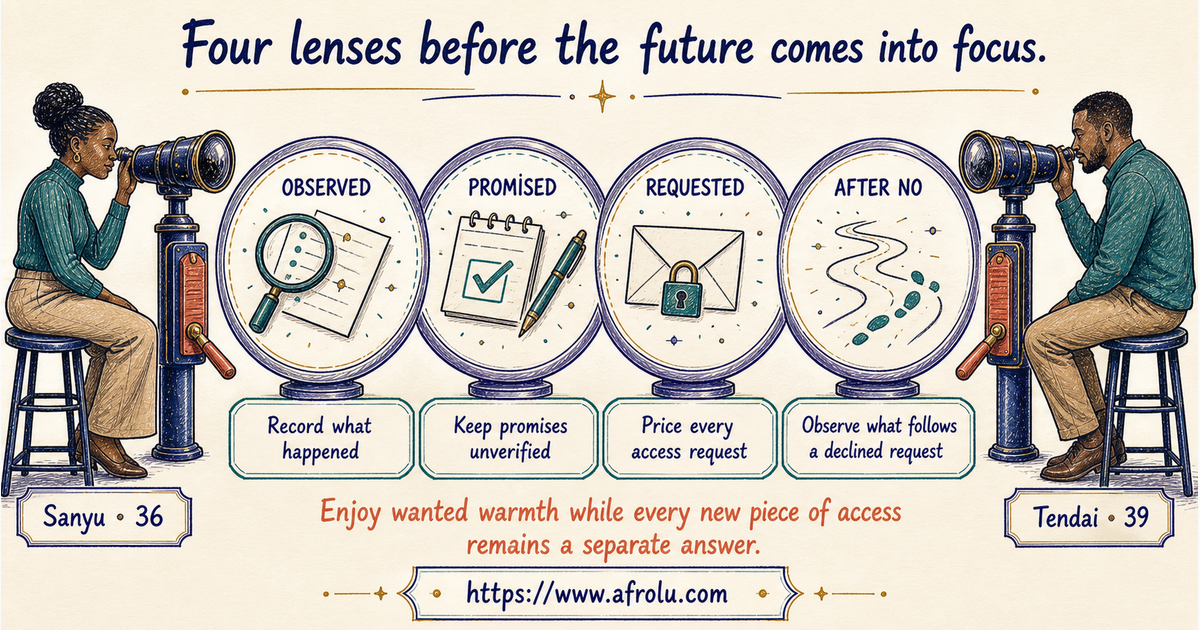
Distance enlarges a message; it does not enlarge the evidence.
Written and edited by Adwoa Boateng · Dating Safety Editor
Use four lenses: OBSERVED records conduct, PROMISED holds future language, REQUESTED names the exact access or value at stake, and AFTER NO records acceptance, repair, punishment or bypass. Keep verification independent; send no romantic money, codes or documents; separate travel, lodging, exclusivity and intimacy. Then ENJOY WARMTH, SLOW ONE REQUEST, CLARIFY FIT, CLOSE, SECURE ACCOUNTS, REPORT FRAUD, SEEK SUPPORT or SEEK PROTECTION from current evidence.
Emotional safety · New Relationship Starters
How can a new dater welcome strong distant affection while distinguishing mutual enthusiasm, pace mismatch and idealisation from access pressure, identity deception, romance fraud or coercive control?
Love bombing is used here as a non-diagnostic label for intense affection, attention, praise, gifts or future language that becomes linked to influence, obligation, accelerated access, punishment or control. A new journey is private adult context, low pressure keeps every request answerable, and distance magnifies communication without verifying the person or future.
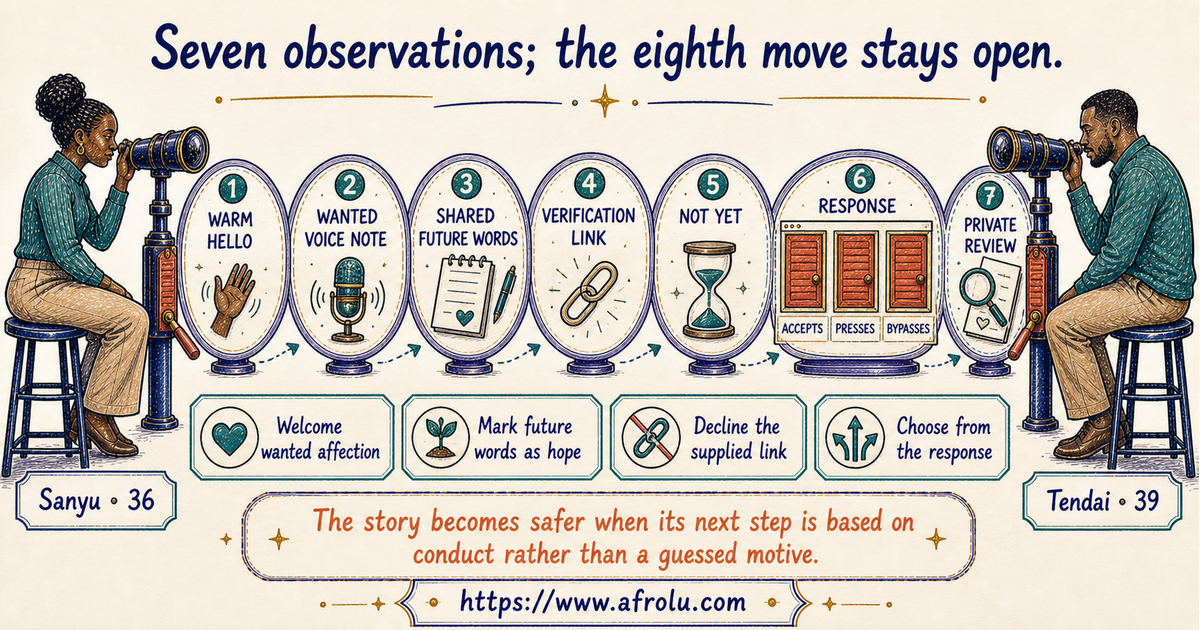
Sanyu, 36 in Kampala, and Tendai, 39 in Harare, are fictional adults. Warm voice notes and future talk remain welcome until Tendai sends a supposed verification link asking for sensitive data. Sanyu declines and independently protects her accounts; the story pauses across acceptance, pressure or bypass so observable response—not invented motive—selects the next route.
The new-journey distance observatory
Keep bright affection, future language and requested access in separate lenses
Adwoa treats love bombing as a behaviour label, a new chapter as private context and low pressure as the continuing right to choose each distant step.
Record the event, price the requested access, read what follows not yet and move fraud or coercion directly to the fitting tool.
Observed
Write the event and your feeling without assigning motive.
Promised
Keep future words as hope until conduct can support them.
Requested
Name the channel, data, money, travel, intimacy or status at stake.
After no
Choose from acceptance, repair, punishment, bypass or direct danger.
Begin with the enlarged message
Let distant affection feel bright without treating it as knowledge, access or destiny
A long voice note can feel unusually intimate when two adults cannot share ordinary space. So can constant messages, early praise or a detailed imagined future. None proves manipulation by itself. This guide uses love bombing as a non-diagnostic behaviour label when intense attention becomes connected to influence, obligation, rushed access, punishment or control. It cannot identify a personality disorder, read motive or predict what any one admirer will do.
New journey means an adult is starting or restarting a dating chapter after a change they may keep private. It does not mean naive, damaged, healed, lonely, inexperienced or ready on a schedule. Sanyu and Tendai are given ages to make adulthood explicit, not to stand for a generation. No timetable is offered for disclosure, trust, travel, sex, exclusivity or deciding whether the chapter continues.
Low pressure means each request remains an independent question. An adult can welcome affection and decline a daily call, enjoy future talk and refuse exclusivity, accept a voice note and reject sexual content, or like someone and send no money. Long distance adds identity, time-zone, travel, accommodation, cost and digital-intimacy decisions. It never makes those answers automatic or turns urgency into proof of devotion.
Start a four-column note: what was OBSERVED, what was PROMISED, what was REQUESTED and what happened AFTER NO or NOT YET. Leave motive blank. A warm observation can remain warm; a promise can remain hope; a request can receive a separate answer. Threats, stalking, tracking, image abuse, financial extraction or a blocked exit bypass the notebook and call for current protection suited to the location.
Focus four lenses instead of one romantic story
Separate observed conduct, future language, requested access and the response to a limit
OBSERVED holds only events: a call occurred, a detail stayed consistent, a gift arrived, a question was answered, a boundary was stated. Feelings belong too, clearly marked as feelings. ‘I felt delighted’ and ‘I felt crowded’ are real experiences without proving another person's motive. Record enough to choose your next action, not enough to turn dating into private surveillance.
PROMISED holds soulmate language, planned visits, future homes, commitment claims and descriptions of who the person says they are. A promise may be sincere and still premature, incompatible or never completed. Long distance supplies fewer ordinary observations, so imagination can fill gaps. Let time and independently checked conduct add evidence without requiring a universal number of weeks or a cynical assumption that hope is false.
REQUESTED names the price of the next step: more messages, a new channel, an identity link, a gift, money, a code, a passport image, travel, lodging, sexual content, exclusivity or social isolation. Keep each request divisible. ‘No’ to one item is not rejection of every feeling; ‘yes’ to one item authorises nothing else. A safety claim supplied by the match does not make their link or document trustworthy.
AFTER NO receives the greatest practical weight. Acceptance may support another small choice. Awkwardness followed by accountable repair may be observable. Repeated persuasion, blame, withdrawal used as punishment, alternate-channel contact or bypass of the boundary supports reduced access or closure. Direct threats, monitoring and defeated exit move to specialist help. The response matters without requiring the reader to stage a dangerous test.
Pause the story at the first declined link
Sanyu and Tendai show how one distant request can produce three very different evidence paths
Sanyu, 36, is beginning a new dating chapter and matches with Tendai, 39, who lives in another city and also says he prefers low-pressure contact. Their first exchanges are warm and wanted. They send voice notes on no fixed schedule. Tendai imagines a future visit, and Sanyu enjoys the possibility while writing it under PROMISED rather than treating it as a booking or commitment.
After several conversations, Tendai sends a website that he says will verify both adults before they continue. The page asks for personal and card information. Sanyu does not accuse him of fraud or submit details to prove trust. She says she will check identity independently and will not use a link supplied by a match. The boundary is real, not a secret loyalty test.
The story pauses at three possible responses. Tendai may accept the limit and continue without the link. He may press, shame or repeat the request. He may bypass Sanyu by sending new links, changing channels or claiming that refusal threatens their future. Those paths supply different evidence. Even acceptance cannot certify his identity or safety; it merely makes another small, independently checked decision possible.
Sanyu reviews privately and tells a trusted adult about the request. She checks her device and accounts because opening any unfamiliar link can create exposure. She remains free to enjoy, slow or end the connection. The useful ending is not romantic certainty. It is that the new journey keeps its steering: affection was acknowledged, access was declined, and the next action belongs to the observable response.
Read sixteen markers without inventing a motive meter
Compare intensity, reciprocity, access and consequence before choosing a route
SCALE markers note whether contact expands, praise outruns shared knowledge, a joint future appears early and gifts feel disproportionate. High scale may feel welcome, awkward or exhausting. It is context, not proof. Ask whether the intensity fits what both adults know and want. Someone may move quickly and remain responsive; another may use modest language while still seeking invasive access.
RECIPROCITY asks whether both adults can initiate, both can rest, the pace can change and a no needs no defence. Equal interest does not require identical message counts or emotion. Low pressure becomes real when either adult can counter a channel or rhythm without punishment. A person may also end simply because the intensity does not fit, with no need to prove manipulation or wait for a repeated pattern.
ACCESS markers identify what the warmth is being asked to open: a channel switch, match-supplied verification link, money or code, travel, lodging, intimate image, exclusivity or isolation from support. Break the bundle apart. Future language cannot verify a payment. A video call cannot authorise location tracking. A purchased ticket cannot create home access, sex or a duty to continue.
CONSEQUENCE markers record acceptance, repair, punishment or bypass. A direct safety arc sits outside the rings: threats, stalking, tracking, image abuse, fraud and blocked exit. Use independent account and device security, preserve useful evidence when safe, and reach current platform, bank, survivor, legal or urgent help for the location. Do not confront privately to make the pattern easier to name.

Never average a threat or fraud request into an affection score.
Use twelve sentences that leave every shutter independent
Speak about a new chapter, warmth, distance, money, intimacy and exit without a strategy performance
JOURNEY can say, ‘I am starting a new chapter and deciding at my own pace what I share.’ WARMTH can say, ‘I enjoy the affection and still want each step to stay separate.’ FUTURE can hold uncertainty: ‘I enjoy imagining this; I am not promising it.’ None apologises for openness, and none invites the other adult to interrogate the private past.
RHYTHM names the low-pressure offer and allows a decline: ‘I want fewer messages and one planned call. Does that fit?’ CHANNEL can keep conversation on the platform or another chosen service without providing every account. VERIFY is decisive: ‘I verify independently; I will not use your link.’ No paid badge, form or profile can certify character or consent.
GIFT can require permission before purchase and reject debt afterward. MONEY can close fares, visa fees, emergencies, investments, cryptocurrency, gift cards and codes. TRAVEL keeps bookings, lodging and return independent. CONSENT makes every adult physical and digital act specific and reversible. Distant longing, an expensive trip, exclusivity language or an earlier sexual exchange supplies no later yes.
PAUSE can name reduced or stopped contact without a return promise. CLOSE can cover channels: ‘I am ending our contact; do not approach me through another channel.’ A closing statement does not need to litigate love bombing. When a person threatens, stalks, impersonates, monitors, shares images or defeats the exit, prioritise system security and a risk-aware support plan over perfect wording.

Low pressure keeps each new answer separate from the brightness around it.
Give nearby bright beginnings different names
Distinguish mutual enthusiasm, idealisation, identity deception, fraud and coercive control
MUTUAL ENTHUSIASM means affection is wanted both ways and creates no automatic access. INFATUATION is strong feeling alongside limited knowledge. RESPONSIVE SPEED means the connection moves quickly but can slow when either adult asks. These may coexist with uncertainty. Keep agreements explicit and observe conduct rather than treating slow as morally superior or fast as automatically manipulative.
LOVE-BOMBING BEHAVIOUR is used here when intensity becomes linked to influence, obligation, rushed access, punishment or control. PACE MISMATCH is simpler: the adults want different amounts or speeds of contact. IDEALISATION means the inferred person or future exceeds available facts. Any of these may justify slowing or ending, but only observable conduct supports the stronger safety routes.
CATFISHING is identity misrepresentation, which may seek attention, images, access or other aims. ROMANCE FRAUD uses deception to obtain money, credentials, codes or value. An FBI warning describes fake verification links that collect identity and card information or create recurring charges; the alert is U.S.-specific and does not prove that every identity-check request is criminal. Verify through routes you find independently.
COERCIVE CONTROL is a repeated pattern that narrows autonomy through monitoring, isolation, threats, economic abuse or other restrictions. Legal definitions vary by country. The England-and-Wales statutory framework is useful pattern guidance but not global legal advice. Respond to direct risk with local specialist support; do not wait for the long-distance relationship to become in-person or for the popular love-bombing label to be accepted.
Close or open one shutter from the evidence you have
Let enjoyment, slower access, closure, fraud action and protection remain equal outcomes
ENJOY WARMTH when affection is wanted, requests remain separate and a changed pace survives. SLOW ONE REQUEST when interest continues but one channel, gift, verification step, visit or intimacy decision needs more evidence. CLARIFY FIT when low-pressure rhythm, relationship direction or geography may be incompatible. Each route preserves the right to revise later.
CLOSE when the intensity is unwanted, fit has ended or uncertainty is more than the adult chooses to carry. Closure needs no abuse finding. SECURE ACCOUNTS when a link was opened, a password reused, a code shared, a device exposed or financial details entered. Navigate to providers independently, change access from a safer device where appropriate and monitor for unfamiliar activity.
REPORT FRAUD when deception seeks money, identity or account value; contact financial providers quickly and use current platform and official reporting routes for the country. SEEK SUPPORT when the experience is confusing or wider care would help. Support may be a trusted person, qualified clinician, survivor advocate, technology-safety service or legal adviser suited to the actual need.
SEEK PROTECTION for threats, stalking, tracking, image abuse, coercion or a blocked exit. Consider how confrontation, blocking or reporting may change risk, and use urgent help when danger is immediate. Then stop observing. The adult does not owe another experiment, another message or a universal recovery schedule. A new journey remains valid even when this view closes permanently.

The next safe move is allowed to close the view.
Eight distant moments where affection, access and consequence separate
The wanted voice-note morning
Frequent affectionate voice notes feel mutual, and neither adult asks for faster access or punishes a delayed answer.
Enjoy the contact while keeping each agreement explicit.The home that exists only in words
A shared city, home and daily life are described before identity, values, travel or ordinary conflict has been observed.
Mark the future as hope and return to present facts.The all-day proof
Low-pressure contact is replaced by a demand for constant messages to prove this new chapter is serious.
Offer the real rhythm once; close pressure if it repeats.The safety-branded link
A match sends a supposed verification page asking for a name, phone, card or identity document.
Do not use it; verify independently and secure any exposure.The delivered obligation
A surprise ticket, device or expensive gift arrives and is later used to claim time, travel, sex or exclusivity.
Reject the debt and reduce access according to conduct.The future visit emergency
Affection and a planned reunion are paired with a fare, visa, medical, investment or account-code request.
Send nothing; secure funds and report suspected fraud appropriately.The distance-only image test
Sexual content or a recorded call is demanded as proof that attraction and identity are real.
Decline; respond directly to threats, retention or sharing.The new account under the shutter
After closure, the person returns through another number, profile, friend, workplace or physical location.
Preserve useful evidence, protect routes and seek fitting safety help.Sixteen markers across intensity, reciprocity, access and what follows not yet
Contact expands — message volume grows quickly; ask whether both adults still choose it.
Praise outruns knowledge — specific facts remain few while certainty becomes absolute; keep the gap visible.
Future arrives early — visits, homes or commitment are described before agreement; label them hope.
Gifts feel disproportionate — cost or symbolism exceeds the relationship evidence; permission and debt stay separate.
Both can initiate — attention does not rely on pursuit by one adult; avoid gendered role assumptions.
Both can rest — sleep, work and existing support continue without guilt or retaliation.
Pace can change — fewer messages or a later visit can be proposed; watch the observable response.
No needs no defence — a limit is enough; refusal does not require private history or diagnosis.
Channel switch is optional — staying on-platform or withholding another account remains a valid choice.
Verification is independent — no match-supplied link, form, document or fee becomes proof of safety.
Money and codes remain closed — affection authorises no fare, visa, emergency, investment or account access.
Travel and intimacy stay separate — a visit, room, image, call and physical act each need their own yes.
Acceptance is observable — the request stops and ordinary warmth does not become a reward system.
Repair changes conduct — an overstep is acknowledged without blame, repetition or an instant-trust demand.
Punishment follows a limit — affection is withdrawn, blame escalates or guilt is applied; reduce access.
Bypass defeats exit — threats, stalking, tracking, image abuse, fraud or new channels appear; seek protection.
Ten questions that move from a bright message to one proportionate action
| Situation | What it may mean | What to do next |
|---|---|---|
| Is the intensity wanted by both adults? | Fits: Warmth remains mutual and optional. Needs review: One person needs less contact. Stop: Attention overwhelms a stated limit. | Enjoy, resize or close from consent. |
| Do words match current knowledge? | Fits: Hope is labelled as hope. Needs review: One assumption needs checking. Stop: A shared destiny is treated as fact. | Return promises to the promise column. |
| Can the contact rhythm slow? | Fits: A counteroffer is accepted. Needs review: One awkward repair is possible. Stop: Delay is punished or surveilled. | Reduce access or close the route. |
| Does verification stay independent? | Fits: Each adult uses self-found channels. Needs review: One claim remains unresolved. Stop: A supplied link demands sensitive data. | Do not use it; secure any exposure. |
| Can gifts remain free of debt? | Fits: Permission and refusal are respected. Needs review: A surprise needs a boundary. Stop: Spending is used to claim access. | Reject the obligation and reassess. |
| Do money and future plans stay separate? | Fits: No transfer supports the romance. Needs review: One cost assumption needs correcting. Stop: Fare, visa, emergency or investment is urgent. | Stop payment and verify independently. |
| Are travel and intimacy separately voluntary? | Fits: Lodging, return and each act have free answers. Needs review: One plan needs clearer edges. Stop: Travel cost or distance is treated as consent. | Pause the plan and restore exit. |
| What follows not yet? | Fits: The request stops without penalty. Needs review: An apology needs changed behaviour. Stop: Blame, repetition or bypass follows. | Choose closure or stronger protection. |
| Are accounts or identity exposed? | Fits: Devices, codes and funds remain controlled. Needs review: One security check is needed. Stop: Data, payment or access has moved. | Secure providers and report promptly. |
| Is a direct safety route needed? | Fits: Ordinary fit review remains safe and voluntary. Needs review: Specialist planning may be useful. Stop: Threat, stalking, coercion or blocked exit appears. | Use current local safety or urgent help. |
Twelve low-pressure lines for warmth, verification, money, travel and exit
“I am starting a new chapter and deciding at my own pace what I share.”
“I enjoy the affection and still want each step to stay separate.”
“I enjoy imagining this; I am not promising it.”
“I want fewer messages and one planned call. Does that fit?”
“I am staying on this channel and will not add another account now.”
“I verify independently; I will not use your link.”
“Please ask before buying anything; a gift creates no right to time or access.”
“I do not send fares, fees, investments, codes or emergency funds to a match.”
“If we ever visit, I control my booking, lodging, money and return.”
“Messages, gifts, travel and a prior yes do not decide this intimate step.”
“I am taking space without promising when or whether I will return.”
“I am ending our contact; do not approach me through another channel.”
Know the difference
Love-bombing behaviour is not a synonym for every intense distant beginning
Affection, praise, gifts or future language becomes connected to obligation, rushed access, punishment, repeated persuasion or control.
Both adults enjoy warmth while messages can slow, promises remain hope, access stays divisible and not yet carries no penalty.
Infatuation, responsive speed, pace mismatch, idealisation, catfishing, romance fraud and coercive control require distinct evidence and tools.

Name the orbit from evidence; never diagnose it from brightness alone.
Do not confuse enthusiasm, idealisation, identity deception, fraud and control
| Type or dimension | What it describes | Best next question |
|---|---|---|
| Mutual enthusiasm | Strong affection is wanted by both adults and creates no automatic access or debt. | Enjoy it while each agreement remains separate. |
| Infatuation | Powerful feeling develops alongside limited knowledge without necessarily seeking control. | Keep facts, support and independent decisions visible. |
| Responsive speed | The connection moves quickly but genuinely slows or changes when either adult asks. | Agree the pace and continue only while it remains free. |
| Love-bombing behaviour | Intensity is connected to influence, obligation, accelerated access, punishment or repeated bypass. | Reduce or close access without diagnosing motive. |
| Pace mismatch | Warmth may be sincere, but message frequency, visits or relationship speed do not fit both adults. | Counter once or accept incompatibility. |
| Idealisation | A detailed distant person or future is inferred from selective, limited evidence. | Slow decisions and verify important claims independently. |
| Catfishing | Someone misrepresents identity, images or biography, with motives that may vary. | Stop sensitive sharing, preserve useful evidence and report appropriately. |
| Romance fraud | Deception is used to obtain money, credentials, codes, identity material or another valuable asset. | Secure providers quickly and use official reporting routes. |
| Coercive control | A pattern of monitoring, isolation, threats, economic abuse or defeated exit narrows autonomy. | Protect access, consult a specialist service and escalate immediate danger locally. |
Focus four lenses before adding another kind of access
Four-column record
Keep observed facts, promises, requests and responses to not yet separate; leave motive blank.
Access price tag
Name exactly what the next step opens: channel, data, money, travel, home, body, status or support network.
Independent verification
Use official or public routes you find yourself; never let a match's safety story select the link.
Low-pressure counter
Offer the real message rhythm or visit boundary and let the other adult accept or decline without persuasion.
Consequence lens
Give more practical weight to acceptance, repair, punishment or bypass than to the size of the original gesture.
Risk-specific route
Keep ordinary mismatch, identity deception, financial fraud and coercive control on different action paths.
Questions for observation, access, consequence and protection
Choose a few prompts that fit the moment. This is a reference library, not a list to complete.
Observe
Record the event without a motive story.
- What actually happened?
- Which feeling belongs to me?
- What fact remains unknown?
- What would one small choice require?
Price access
Name what the next request would open.
- Another channel or location?
- Identity data or money?
- Travel, lodging or home?
- Intimacy, status or isolation?
Read after no
Give consequence more weight than sparkle.
- Did the request stop?
- Did repair change conduct?
- Did affection become punishment?
- Was another route used?
Choose protection
Bypass ordinary fit review when risk requires it.
- Are accounts exposed?
- Did fraud seek value?
- Is monitoring present?
- Which current local help fits?
What limited research and current survivor, legal, digital and fraud guidance supports
The first empirical love-bombing study was narrow and correlational
The 2017 University of Arkansas study examined love-bombing tendencies alongside attachment, self-esteem, narcissism and media use among 484 college students aged 18–30 at one southern U.S. university.
Evidence limit: It cannot establish causation, diagnose another adult, reveal motive or represent older, African or long-distance daters.
The Hotline describes attention, praise, gifts and communication overload
The current U.S. survivor-support page discusses early soulmate labels, exaggerated compliments, disproportionate gifts and overwhelming contact, while encouraging attention to comfort and boundaries.
Evidence limit: It is not a prevalence study, diagnostic instrument or global service directory; its hotline and emergency routes are U.S.-specific.
UK statutory guidance focuses on repeated control and cumulative context
The England-and-Wales framework describes monitoring, isolation, economic abuse, technology-facilitated abuse, threats, workplace interference and post-separation conduct as part of coercive-control assessment.
Evidence limit: Its offence tests, evidence framework and legal routes apply to England and Wales, not automatically to any African jurisdiction or early dating event.
eSafety separates technology-facilitated abuse from ordinary online contact
Australia's official page lists online threats, cyberstalking, intimate-image abuse, activity monitoring, account restriction, financial abuse, password pressure and unexplained location knowledge.
Evidence limit: The page is Australian guidance rather than an individual risk assessment; its services and legal powers do not transfer unchanged across countries.
The FTC shows how distant affection can become a money request
The February 2025 U.S. alert describes movement off-platform, frequent contact, inability to meet and eventual travel, medical or investment requests, with independent checking and provider reporting.
Evidence limit: Affection, distance or one cancelled visit alone proves no fraud, and U.S. reporting and recovery routes may not fit another country.
FBI IC3 warns about match-supplied verification links
The April 2024 U.S. alert describes supposed free safety checks that collect names, phone numbers and card details or create recurring charges after an off-platform move.
Evidence limit: It is a U.S. fraud warning, not proof that every verification request is criminal; official reporting, consumer protection and payment remedies vary by location.
Six ways a warning label can become diagnosis, testing or delayed action
Diagnosing from intensity
Fast warmth becomes a personality verdict. Repair: record conduct, access and consequence without remote diagnosis.
Setting a fake boundary test
A hidden experiment replaces a real need. Repair: state only limits that genuinely belong to you.
Using their verification route
A safety claim controls the link and data. Repair: navigate independently and share no sensitive proof.
Repaying a distant gift
Cost becomes debt for calls, travel or intimacy. Repair: keep generosity, gratitude and consent separate.
Waiting for motive certainty
Closure or protection is delayed until intent is confessed. Repair: choose from current observable risk.
Treating mismatch as abuse
Different rhythms are forced into a harm label. Repair: accept incompatibility unless stronger conduct supports another route.
Respond to what happened without waiting to solve another person's motive
Use the route that fits today's fact: understand the behaviour label, choose a proportionate response to concerning conduct, or organise safety observations privately. None sells verification or turns a score into permission.
Explore the guide library
Show more related guides
Continue with Afrolu
Show more Afrolu guides
Six live sources with sample, jurisdiction and service limits
Afrolu reviewed these health, research, safety, or public guidance resources while editing this page. They support the behaviour and safety guidance; they do not diagnose any individual described by a reader.
New-journey questions about distant intensity, verification and safer closure
Is love bombing a mental-health diagnosis?
No. It is a popular behaviour label, and the limited primary research cannot let a reader diagnose another person or infer a personality disorder from messages. Describe intensity, the access requested and the observable response to a real limit. Choose closure or protection without waiting for a clinical or motive verdict.
Can genuine long-distance enthusiasm feel intense?
Yes. Voice notes, frequent messages and imagined visits may be mutually welcome. Speed alone does not prove manipulation. Ask whether both adults choose the contact, can slow it, keep independent support, decline money and access, and change consent without punishment. Either person can also leave because the pace simply does not fit.
What does low pressure mean in a new connection?
It means each request is answerable on its own and either adult may accept, counter, pause or decline. It does not mean vague intentions or endless waiting. State the actual message rhythm, call offer and relationship direction. A mismatch can end respectfully without becoming a love-bombing accusation.
Should I set a boundary to test the person?
State a boundary because it reflects a real need, not as a hidden trap. Observe only what follows. Acceptance or changed behaviour can support one small decision; repeated pressure or bypass supports less access. Do not stage another test when threats, stalking or coercion make direct contact risky.
How should I verify a long-distance match?
Use live interaction and independently found public or official sources in proportion to the decision. Do not use a link, form or app supplied by the match when it requests sensitive details. No check proves future conduct. Unresolved identity questions may justify waiting or ending without conducting a private investigation.
Can a surprise ticket or gift create an obligation?
No. A gift or booking creates no right to calls, exclusivity, home access, travel, lodging, sex or continued contact. Ask people to obtain permission before spending. If money is used with guilt, threats or pressure, reject the debt and choose stronger access, fraud or safety action from the conduct.
Should I send money for a visit, visa or emergency?
Do not send funds under romantic urgency. Verify any real process through official channels you navigate to independently, not documents or links the match supplies. If money, card information or codes moved, contact the provider quickly, secure the account and use current platform and official fraud-reporting routes for your country.
Does a video call prove the person is genuine?
It can reduce one uncertainty but does not prove a name, location, job, financial story, intent or future conduct. Recorded video can also create privacy risk. Share no passport, banking record, code or sexual content as reciprocal proof. Keep each later decision reversible and supported by its own evidence.
Can I end the connection even if I cannot prove love bombing?
Yes. Consent to continue is enough. You may end because the pace, geography, uncertainty or feeling no longer fits. State closure briefly where safe. You do not owe a debate about the label. If contact returns through new accounts or routes, protect access and use support matched to the behaviour.
When is direct safety action more useful than another discussion?
Use a safety route for threats, stalking, tracking, intimate-image abuse, coercion, financial extraction or an exit being defeated. Preserve useful evidence when safe, secure devices and funds, tell trusted support and reach current specialist, legal or urgent help for your location. A perfect final message is not required.
One thing to do now
Close the observatory when the next safe action is already visible
Continue only while intensity remains wanted, the contact rhythm can slow, promises stay separate from agreements, verification uses independent routes, gifts create no debt, funds and codes stay closed, travel and intimacy remain separately voluntary, support stays visible and exit works. Close without diagnosis; secure exposure, report fraud and seek specialist help for threats, stalking, tracking, coercion or defeated exit.