Eight gates · bright arrival, independent access
Welcome Early Excitement Without Clearing Every Access Gate
A casual-dating guide to early intensity: verify identity, separate praise, gifts, money and consent, define scope, and keep every exit usable.
Early excitement is a greeting, not a customs clearance for the whole relationship.
Written and edited by Adwoa Boateng · Dating Safety Editor
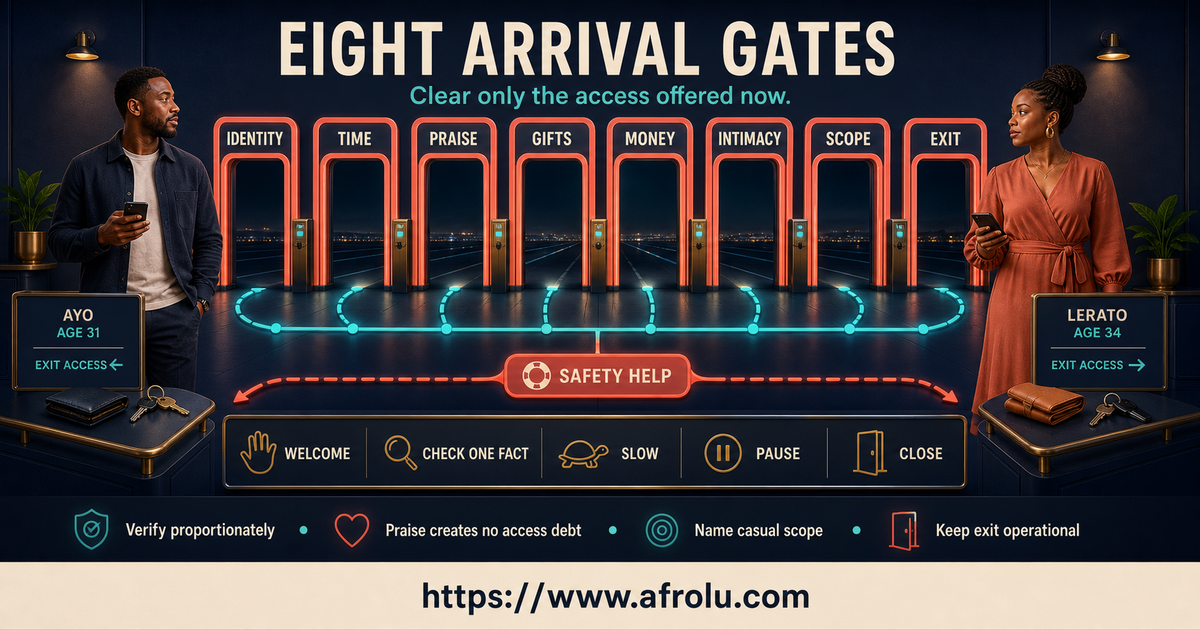
Use eight independent arrival gates: IDENTITY, TIME, PRAISE, GIFTS, MONEY, INTIMACY, SCOPE and EXIT. Describe exact conduct before applying a pattern label. State one real boundary rather than running a secret test, then observe whether behaviour changes. Keep identity checks proportionate, gifts freely declineable, money independent, sexual health and consent explicit, casual scope mutual and every channel and meeting leaveable. Choose WELCOME, CHECK ONE FACT, SLOW, PAUSE, CLOSE, SEEK CARE or SEEK SAFETY HELP. No universal early-dating deadline exists. Persistent impairment needs qualified assessment; threats, tracking, coercion, fraud, image abuse or blocked movement bypass ordinary review.
Emotional safety · New Relationship Starters
How can a new relationship starter enjoy bright early attention without diagnosing enthusiasm or allowing praise and future talk to clear access that was never agreed?
Love bombing is used here as a tentative non-diagnostic pattern label for intense warmth that may accompany access pressure, isolation, monitoring, debt or control. Mutual excitement, fast casual interest, pace mismatch, anxiety, persistent impairment, fraud and unsafe conduct are different possible routes. The arrival terminal organises observable evidence; it cannot determine motive, diagnose a person or certify safety.
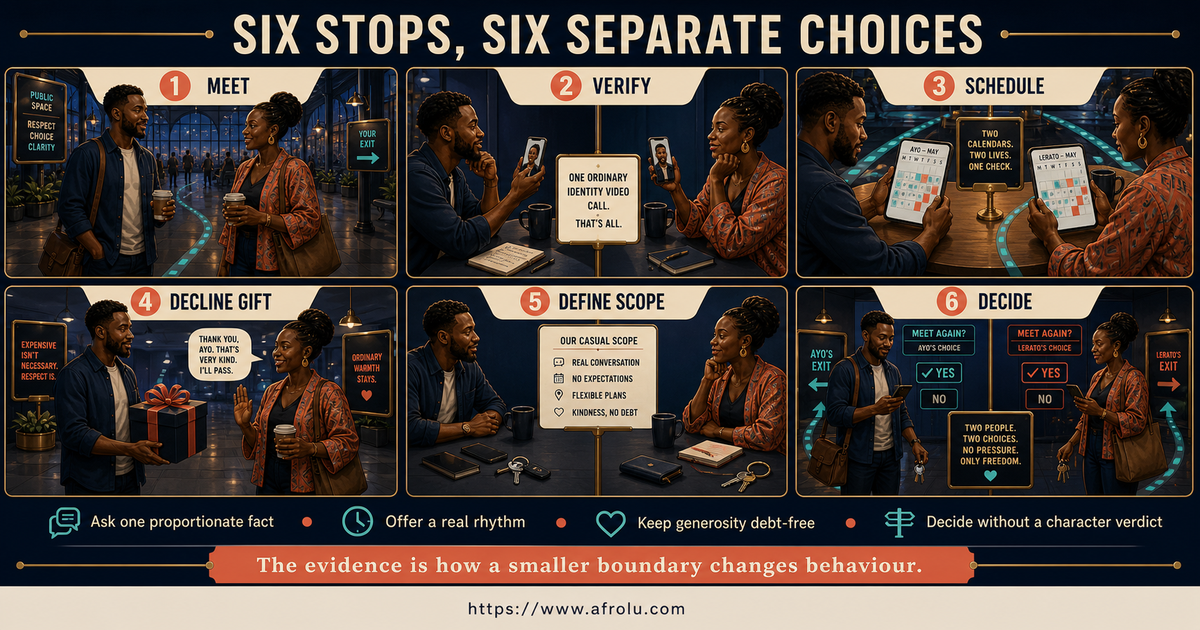
Lerato, a fictional 34-year-old adult, enjoys Ayo's bright attention across six invented stops while requesting one ordinary identity call, offering a smaller contact rhythm, declining an expensive gift and defining non-exclusive casual scope. Ayo respects those gates, so they choose another public date without treating the result as a trust certificate, relationship promotion or forecast.
The new-journey eight-gate casual arrival terminal
Welcome only the warmth that leaves every access gate independent
Adwoa reads identity, time, praise, gifts, money, intimacy, casual scope and exit as separate arrival gates rather than one trust verdict.
Describe conduct, state one genuine boundary, observe delivered change and route mismatch, care, fraud or danger precisely.
Verify without handing over records
Use one ordinary reciprocal step while documents, codes and location stay private.
Welcome praise, not access debt
Warm words never purchase time, gifts, money, home or status.
Name the casual route
Frequency, non-exclusivity, health and closure receive present answers.
Keep the exit illuminated
A no, pause or close changes the route without retaliation.
Welcome without surrender
Let early excitement enter while identity, time, money, intimacy and exit keep separate gates
A new connection can feel unusually bright because both adults are relieved to meet someone interesting. Frequent messages, compliments and confident future language may be mutual and welcome. The editorial problem begins when those signals are treated as automatic permission for time, identity data, money, home access, exclusivity or intimacy that was never separately offered.
Casual-but-honest scope does not make intensity harmless or dishonest by definition. It requires a present agreement: what kind of contact is wanted, whether either adult is dating others, what communication rhythm fits and how physical choices will be discussed. A person can enjoy fast attention and still decline gifts, daily calls, private meetings or future promises.
The clearest test is not disappearing, provoking jealousy or inventing a delay. State a boundary you genuinely need. Ask for one ordinary identity call, offer two contact windows, decline an expensive item or keep the next meeting public. Then observe whether the request changes without punishment, bargaining, isolation or a new channel designed to bypass the answer.
No single warm act produces a character verdict. Repeated behaviour across gates matters. At the same time, concrete threats, tracking, impersonation, financial exploitation, image abuse, coercion or blocked movement do not need a perfect love-bombing label before an adult protects access and seeks appropriate help.
The eight-gate arrival terminal
Clear identity, time, praise, gifts, money, intimacy, scope and exit one gate at a time
IDENTITY asks for proportionate ordinary evidence while protecting documents, codes, accounts and live location. TIME asks which contact windows are actually offered. Ayo can want frequent calls; Lerato can offer fewer. Their difference becomes a pace question only after each proposal is visible, not after one adult guesses what enthusiasm should mean.
PRAISE may be sincere, exaggerated or strategically useful; words alone cannot settle motive. Ask what the praise actually knows and whether it leaves room for correction. GIFTS remain separate. A freely declineable small item is not a contract. An expensive or unwanted gift that creates urgency, debt or retaliation changes the evidence even if its presentation is romantic.
MONEY has its own closed gate. New contacts should not send or request fees, investments, emergency transfers, ticket money, credentials, one-time codes or account access. INTIMACY also requires specific consent. An affectionate exchange, accepted gift, casual label, paid date or private disclosure cannot pre-authorise any physical act.
SCOPE names the current arrangement without borrowing a future relationship. EXIT keeps profile, channel, meeting, home and physical access independently closable. A respectful adult may decide the proposed route does not fit. Unsafe conduct bypasses the terminal because bargaining over labels can increase exposure when the problem is threats, tracking, fraud or control.
Six stops through a bright beginning
Watch Lerato welcome Ayo's attention while testing one ordinary boundary at a time
At their first public meeting, Ayo is animated and says that the connection feels unusually easy. Lerato enjoys the attention but does not agree that ease means a relationship. She says she is exploring casual-but-honest dating and wants to see how ordinary plans feel before discussing exclusivity. Ayo accepts that description without trying to rename it.
Before moving channels, Lerato requests one live call through a familiar service. Ayo agrees without asking for identity documents. He then proposes daily evening calls. She counters with Tuesday and Saturday because daily contact would crowd other parts of her life. He sounds disappointed but uses the two windows rather than repeatedly reopening the request.
Ayo offers an expensive weekend gift before their second date. Lerato declines and suggests they each cover their own ordinary costs. He keeps the date, does not deliver the item anyway and does not withdraw affection as punishment. They discuss non-exclusivity, sexual health, consent and home boundaries without treating the casual label as blanket access.
After six stops, Lerato chooses another public date and keeps the smaller call rhythm. This does not certify Ayo or prove the future. It is simply evidence that several stated limits were respected. If pressure, monitoring or retaliation later appeared, current conduct would control the decision; earlier warmth would not become a permanent trust deposit.
Read sixteen signals without a trust total
Separate welcome warmth, access pressure, ordinary mismatch and conduct that changes the problem
At the IDENTITY and TIME gates, welcome conduct is proportionate and reciprocal. Each adult offers ordinary evidence and workable windows while keeping sensitive data private. Pressure appears when one person demands documents, constant availability, live location or workplace access and presents refusal as proof of dishonesty or insufficient interest.
At PRAISE and GIFTS, welcome conduct leaves the recipient free to disagree, decline or slow down. Pressure turns admiration into a debt ledger: compliments claim special insight, items arrive after refusal or generosity is cited as a reason for time, money, intimacy or exclusivity. The object matters less than what the giver says it purchases.
At MONEY, INTIMACY and SCOPE, every step needs its own agreement. Casual interest never authorises a transfer, shared account, private accommodation or physical act. A relationship label should reflect the same present answer from both adults. Future language can remain a proposal without being mocked or promoted into status.
At EXIT, respectful mismatch allows a clean ending. Danger appears through threats, stalking, impersonation, financial exploitation, image abuse, coercion, non-consensual tracking, retaliation, channel bypass or blocked movement. These facts route directly to appropriate protective support rather than waiting for all sixteen cards to form a pattern.

The strongest current fact selects a route; positive gates never cancel danger.
Conversation cards with independent gates
Use twelve complete lines for intention, identity, pace, gifts, money, scope, consent and closure
A clarity-first sentence begins with the present. Lerato can say that she is open to casual-but-honest dating and not agreeing to exclusivity today. She can appreciate Ayo's warmth while keeping a smaller contact rhythm. This is not mixed messaging when the offer, limit and freedom to decline are stated together.
Identity and channel lines should request only the next proportionate step. One live call may be useful; a passport, employer record, account credential or location history is not. If a verification request arrives as a link, code demand or urgent instruction, use the service's own independently found controls rather than transmitting sensitive data through the romantic thread.
Gift and money lines remove debt before it forms. Declining an item should not require a substitute favour. Each adult can cover ordinary date costs and control transport. Sexual-health and consent lines belong before pressure makes the question immediate; they can name partners, testing, prevention and choices without assuming intimacy will occur.
Closure does not require proof that someone is a love bomber. Pace, scope or format can simply be unwanted. State that the romantic contact is ending when a message is safe and useful. When conduct becomes threatening or persistent, protecting access and using the right platform or local safety route may be safer than offering another explanation.

Clarity is low pressure only when a no changes the route.
Choose the smallest supported gate decision
Welcome, check one fact, slow, pause, close, seek care or seek safety help
WELCOME means accepting the warmth that is actually wanted without expanding access. CHECK ONE FACT requests a proportionate answer, such as a live call or a complete meeting plan. SLOW states a smaller rhythm. Each choice should be transparent rather than used as a secret test designed to provoke pursuit or expose character.
PAUSE stops the route without guaranteeing a return date. CLOSE ends it without requiring a diagnosis. A respectful mismatch may lead directly to either choice. The adult does not owe continued access because the opening was intense, gifts were offered or future language sounded sincere. Past enthusiasm is not a prepaid subscription to contact.
SEEK CARE belongs to persistent impairment in the affected adult, not remote diagnosis of the other person. Changes in sleep, concentration, appetite, enjoyment or ordinary functioning across settings deserve qualified local assessment. Care and safety can coexist, but they answer different questions and should not be collapsed into a relationship label.
SEEK SAFETY HELP is direct when there are threats, tracking, fraud, coercion, image abuse, account compromise, retaliation or blocked movement. Protect devices, accounts and physical access; preserve useful evidence where safe; and use appropriate platform, financial, legal, health or emergency support for the current location and urgency.

Slowing, pausing and closing are complete choices, not failed arrivals.
Compare eight nearby arrival routes
Name mutual excitement, fast casual interest, a pattern, mismatch, anxiety, impairment, fraud and control precisely
MUTUAL EXCITEMENT is warm, reciprocal and easily slowed. FAST CASUAL INTEREST may include frequent contact while present scope remains honest. Neither requires a love-bombing label. The useful practical question is whether each gate remains independently controlled and whether a declined request actually changes the route.
A LOVE-BOMBING PATTERN becomes more plausible when intense praise or future language repeatedly precedes isolation, monitoring, debt, access pressure or punishment. PACE MISMATCH is narrower: the adults want different frequency or speed but can end respectfully. ORDINARY ANXIETY may create uncertainty without granting another person a diagnosis or excuse for pressure.
PERSISTENT IMPAIRMENT belongs with qualified care. ROMANCE FRAUD belongs with financial institutions, platform processes and current local reporting. UNSAFE CONTROL belongs with immediate protective planning and relevant local authorities or specialist services. A pattern label should never delay action on concrete fraud, threats, tracking or blocked movement.
Several panels may coexist. An adult may be excited, anxious and mismatched while also seeing one financial request. The most safety-relevant current fact determines the immediate route; ordinary dating questions can wait. If no danger exists, the adults can still slow or close because the present arrangement is unwanted.
Eight new-journey moments where warmth and access use different gates
A second date is described as inevitable partnership
The words may be excitement, performance or pressure; they do not create status. Lerato likes Ayo and still wants the present arrangement named accurately.
Acknowledge the feeling, state today's casual scope and watch whether the future speech stops directing access.Verification expands into sensitive proof
Ayo asks for an ordinary call, which fits the next step. A request for identification, workplace data or codes would cross the proportionate gate.
Use one familiar live channel and keep documents, accounts and location evidence private.One adult wants a faster rhythm
Daily contact can be a preference rather than control. It becomes pressure when the smaller answer is repeatedly reopened or punished.
Offer two sustainable windows and let compatibility be decided from the response.Generosity arrives before ordinary trust
Lerato does not want the item. The evidence is whether refusal remains free, not the retail value or romantic explanation.
Decline directly, keep ordinary costs separate and observe whether the plan continues without debt.A label is used to skip exclusivity and health questions
Both adults say casual, but one assumes non-exclusivity and the other assumes focus. The label hides rather than solves the difference.
Ask the same present question and discuss partners, testing, prevention and consent separately.Intensity pulls the next meeting toward a home
Ayo says privacy will make the date more meaningful. Lerato wants public space and her own transport while the route is new.
Keep place, duration, payment, arrival and exit independent.Ayo decides the slower rhythm does not fit
He says so once and ends contact without bargaining or retaliation. The outcome is mismatch, not evidence that the warmth was fraudulent.
Accept the closure and avoid rewriting an ordinary incompatibility as a character verdict.A blocked contact appears on new accounts
The problem is no longer a pace discussion. New channels are being used to defeat a clear exit and increase access.
Protect accounts, preserve useful evidence where safe and use appropriate platform or local safety routes.Sixteen signals across identity, time, praise, gifts, money, intimacy, scope and exit
Identity checking stays proportionate and reciprocal without documents, passwords, codes or live location.
Contact windows are proposed and countered rather than monitored or treated as proof of affection.
Praise can be enjoyed, corrected or declined without escalating into a claim of special ownership.
A gift remains freely declineable and does not purchase time, exclusivity, home access or intimacy.
Money, tickets, fees, emergencies, investments and account access remain outside early affection.
Every physical choice receives specific, unhurried and reversible consent.
Casual scope names frequency, non-exclusivity if relevant, health expectations and closure.
Future language remains a proposal until both adults explicitly agree the present relationship.
A smaller boundary changes practical behaviour rather than triggering softer repeated persuasion.
Work, friendships, rest and ordinary routines stay available rather than being framed as competition.
Public meetings preserve separate payment, transport, accommodation and exit.
An apology includes changed conduct instead of another declaration of intensity.
A pace mismatch can end without diagnosis, punishment or a demand for one more chance.
Persistent impairment is routed to qualified care without diagnosing the other adult.
Financial claims are verified through independently found providers and platform controls.
Threats, tracking, coercion, impersonation, image abuse or blocked movement bypass pattern scoring.
Review eight arrival gates through ten independent questions
| Situation | What it may mean | What to do next |
|---|---|---|
| Is identity evidence proportionate? | Fits: One ordinary reciprocal step answers the current need. Needs review: A request can be reduced. Stop: Documents, codes, accounts or location are demanded. | Use a familiar channel and protect sensitive records. |
| Does the time proposal remain negotiable? | Fits: Both adults offer workable windows. Needs review: Frequency needs a counterproposal. Stop: Availability is monitored or punished. | State a sustainable rhythm and judge the delivered response. |
| Can praise survive disagreement? | Fits: Correction and boundaries remain welcome. Needs review: The language outruns knowledge. Stop: Admiration becomes a claim of ownership. | Accept only wanted warmth and keep access unchanged. |
| Can the gift be declined? | Fits: No debt, punishment or substitute follows. Needs review: Scale or timing needs clarification. Stop: The item purchases time, money or intimacy. | Decline and keep ordinary costs independently controlled. |
| Is money outside affection? | Fits: No transfer or account access is involved. Needs review: A practical offer needs verification. Stop: Fees, emergencies or investments create urgency. | Stop exposure and verify through independently found providers. |
| Is intimacy separately chosen? | Fits: Every step is specific and reversible. Needs review: Health or consent needs discussion. Stop: Pressure, intoxication or retaliation affects choice. | Pause the physical plan and use care or safety help as needed. |
| Is casual scope mutual? | Fits: Both adults name the same present arrangement. Needs review: Frequency or exclusivity needs one answer. Stop: A label is imposed through intensity. | Ask directly and keep the prior status until agreement. |
| Does repair change behaviour? | Fits: The boundary is acknowledged and delivered. Needs review: One replacement action is pending. Stop: Reassurance substitutes for change. | Credit delivery only, then welcome, slow, pause or close. |
| Can the route close cleanly? | Fits: Either adult can end contact without pursuit. Needs review: One closing sentence may help. Stop: Accounts or offline access bypass the exit. | Close if safe and protect access when boundaries are defeated. |
| Which authority fits the strongest fact? | Fits: Ordinary excitement or mismatch stays in adult choice. Needs review: Persistent impairment may need care. Stop: Fraud, threats or control needs direct protection. | Do not average danger against warmth; route precisely. |
Twelve clarity lines for early excitement, casual scope, money, consent and closure
“I like the energy here, and I am exploring casual but honest dating rather than agreeing a relationship today.”
“Before private disclosure, I would like one live call through a channel we both already trust.”
“I can call Tuesday or Saturday; daily contact is not a rhythm I am offering.”
“I am staying on this service until we both choose another familiar channel.”
“That was kind to hear; it does not change the contact pace I offered.”
“I am not accepting this item, and I do not owe a substitute favour.”
“I will cover my ordinary costs and will not send fees, emergency money or account access.”
“I am keeping our next meeting public and arranging my own arrival and return.”
“Are we both describing non-exclusive casual dating right now?”
“Nothing we have said or exchanged decides a physical step; I will choose each one separately.”
“I need the declined request to stay closed, not to return in softer words.”
“This pace no longer works for me, so I am ending the romantic contact and closing the channel.”
Know the difference
Mutual fast casual interest and an access-pressure pattern require different responses
Both adults welcome a quick rhythm, define the same present scope and can slow, disagree or leave without punishment.
Intense warmth repeatedly accompanies isolation, monitoring, debt, access pressure, retaliation or a defeated exit.
Keep the pattern label tentative, describe conduct precisely and act directly on concrete fraud or unsafe control.

Several panels can coexist; the most safety-relevant current fact determines the route.
Separate eight nearby excitement, pattern, mismatch, care, fraud and control routes
| Type or dimension | What it describes | Best next question |
|---|---|---|
| Mutual excitement | Warmth is reciprocal, informed and freely reversible. | Enjoy only wanted access and keep each gate independent. |
| Fast casual interest | Frequent contact fits both adults while present scope stays clear. | Review frequency, non-exclusivity, health and closure directly. |
| Love-bombing pattern | Intensity repeatedly precedes isolation, debt, monitoring or punishment. | Protect access, document conduct where safe and use fitting support. |
| Pace mismatch | The adults want different contact rhythms without coercion. | Counter once, redesign or close without diagnosis. |
| Ordinary anxiety | Uncertainty creates worry without proving motive or danger. | Use a bounded question and avoid secret tests. |
| Persistent impairment | Sleep, focus, appetite, enjoyment or ordinary function remains affected. | Seek qualified local assessment for the affected adult. |
| Romance fraud | Affection is used for money, accounts, identity data or false commercial access. | Stop exposure and use platform, provider and fraud routes. |
| Unsafe control | Threats, tracking, coercion, retaliation or blocked movement changes the problem. | Protect access and use current local legal, health or emergency help. |
Use the eight-gate arrival terminal in deliberate moves
Clear eight gates
Keep identity, time, praise, gifts, money, intimacy, scope and exit independently selectable.
Describe conduct first
Use exact requests and responses before applying a motive label.
State one real boundary
Offer a genuine smaller route instead of engineering a secret test.
Keep generosity debt-free
A declined gift or paid cost never purchases access.
Name casual scope
Frequency, non-exclusivity, health and closure require present agreement.
Route problems precisely
Mismatch, care, fraud and unsafe control use different authorities.
Questions for identity, pace, gifts, money, intimacy, scope and exit
Choose a few prompts that fit the moment. This is a reference library, not a list to complete.
Identity and time gates
Verify proportionately and make pace answerable.
- What is needed now?
- What stays private?
- Which windows fit?
- Can this be countered?
- What closes the request?
Praise and gift gates
Keep warmth debt-free.
- What does the praise know?
- Can correction remain welcome?
- Can the gift be declined?
- What expectation follows?
- Does behaviour change?
Money and intimacy gates
Keep every access decision independent.
- Who controls ordinary costs?
- Is any transfer requested?
- Which health question matters?
- What has not been agreed?
- Can each adult leave?
Scope and exit gates
Name the present route and its ending.
- Is this casual?
- Is it exclusive?
- What frequency fits?
- How is repair shown?
- Which safety route applies?
What current official coercive-control, privacy, fraud, consent and care guidance can support
eSafety explains love bombing within patterns that can support coercive control
The material supports examining isolation, monitoring, pressure and restricted autonomy beyond affectionate wording.
Evidence limit: It cannot diagnose a person from a message or provide a universal waiting period.
eSafety describes technology-facilitated control and patterns that limit freedom
The guidance supports treating tracking, account abuse, threats and repeated access bypasses as concrete concerns.
Evidence limit: Australian definitions and reporting routes do not replace local law or legal advice.
Current eSafety guidance covers privacy, suspicious conduct, meetings and evidence
The resource supports limiting personal information, using platform controls and keeping meetings public and leaveable.
Evidence limit: No safety practice can certify another person or eliminate risk.
Kenya ODPC material identifies identity, contact, location and online identifiers as personal data
The context supports asking why identity, workplace and location information is needed before sharing it.
Evidence limit: An official FAQ is not personalised legal advice or a dating background check.
FTC guidance describes common money requests and independent reporting
The resource supports refusing transfers, tickets and investments and contacting providers independently.
Evidence limit: It is U.S. guidance; readers should use current local institutions and remedies.
eSafety consent guidance emphasises free, voluntary and informed agreement
The resource supports treating every disclosure and physical step as specific and reversible.
Evidence limit: It is general education and does not replace local law, emergency help or health advice.
WHO guidance describes mental health as more than the absence of a disorder
The context supports seeking qualified assessment for persistent impairment without diagnosing a dating partner.
Evidence limit: A public-health fact sheet cannot explain an individual's cause or prescribe treatment.
Six ways a bright beginning can silently merge access
Promoting warmth into status
A bright opening becomes a relationship. Repair: name today's agreement.
Running a secret pace test
Delay is engineered to provoke pursuit. Repair: state the real boundary.
Letting praise merge access
Admiration opens data or time. Repair: keep every gate separate.
Treating gifts as harmless
An item creates debt. Repair: test whether refusal remains free.
Diagnosing a mismatch
Different rhythms become a disorder. Repair: counter or close precisely.
Waiting for a perfect label
Concrete danger is debated. Repair: route fraud and control directly.
Use a reviewed resource that matches the decision
This guide focuses on the relationship decision, so it does not rank dating apps. Check current prices, safety tools, and local availability before choosing a service.
Explore the guide library
Show more related guides
Continue with Afrolu
Show more Afrolu guides
Current love-bombing, coercive-control, privacy, fraud, consent and care guidance
Afrolu reviewed these health, research, safety, or public guidance resources while editing this page. They support the behaviour and safety guidance; they do not diagnose any individual described by a reader.
Clarity-first casual questions about early dating intensity
Is strong early excitement always love bombing?
No. Warmth, frequent messages, compliments or confident future language do not establish a harmful pattern by themselves. Describe the exact request and response to limits. Mutual fast interest can remain freely reversible. Keep the label tentative, while concrete threats, fraud, tracking, coercion, image abuse or blocked movement can still require direct protective action.
Can casual dating still involve love bombing?
Yes, because a casual label does not prevent isolation, monitoring, debt, access pressure or retaliation. It also does not prove those behaviours exist. Define frequency, non-exclusivity, gifts, money, health, home access and closure separately, then judge whether stated limits change practical conduct.
How do I test pace without playing games?
State a real boundary rather than disappearing or provoking jealousy. Offer two call windows, request one live identity check, decline a gift or keep a meeting public. Observe whether the route changes. The response is one piece of evidence, not a complete character certificate or guaranteed safety result.
Can I appreciate compliments but decline more contact?
Yes. Appreciation and access are separate gates. You can say that the words were kind and the contact rhythm remains smaller. The other adult may accept, counter or decide the route does not fit. Repeated persuasion after a clear no is evidence about conduct even when the wording remains affectionate.
Are expensive gifts proof of manipulation?
Not automatically. Consider scale, timing, expectation and what happens after refusal. A freely declineable item does not create consent or debt. If a gift is used to demand time, money, intimacy, home access or exclusivity, reject that claim and close the route if wanted.
What if the other person wants daily calls and I do not?
Name the frequency you can sustain. This may be a simple pace mismatch. Respectful conduct does not require either adult to accept an unsuitable rhythm. If daily access is monitored, enforced or tied to punishment, address the concrete control rather than negotiating only the dating label.
Should I share money or documents with someone intense?
No romantic intensity makes transfers, credentials, codes, identity documents or account access necessary. Keep financial and commercial opportunities independent from affection and verify any legitimate proposal through independently found channels. Contact the relevant provider directly if information or money has already moved.
Can I end contact without proving love bombing?
Yes. You may close because the pace, frequency, format or connection is unwanted. A clear ending does not need a diagnosis or consensus. If the situation is merely unsuitable, a short sentence may be enough. If there is harassment, stalking or danger, protection and reporting may be safer than another explanation.
When does early intensity become a safety issue?
Take concrete conduct seriously: threats, isolation, monitoring, account abuse, impersonation, financial exploitation, image abuse, non-consensual tracking, retaliation or blocked movement. You do not need a perfect pattern label before protecting access. Use the appropriate platform, financial, legal, health or emergency route for the location and urgency.
What if distress continues after the contact ends?
Persistent changes in sleep, concentration, appetite, enjoyment or ordinary functioning deserve qualified local assessment. Care can support the affected adult without remotely diagnosing the other person. Immediate safety concerns still use the relevant urgent route. A dating checklist cannot determine cause, treatment or future course.
One thing to do now
Welcome the warmth and clear only the gates both adults choose
Continue only while each gate remains separately chosen, stated limits change behaviour, gifts and money create no debt, scope is mutual, consent is specific and exit remains usable. Slow, pause or close whenever the route is unwanted. Use qualified local care for severe or persistent impairment and appropriate platform, financial, legal, health or emergency authority for fraud or unsafe conduct.