Diaspora dating · pace and independence
Love Bombing, Pace and Safety for Diaspora Daters
A diaspora dating guide to early intensity: keep serious intentions clear, protect money, documents and travel, and let trust grow at a pace you choose.

Warmth can grow without taking over your choices.
Written and edited by Nia Kato · Profile Advice Editor
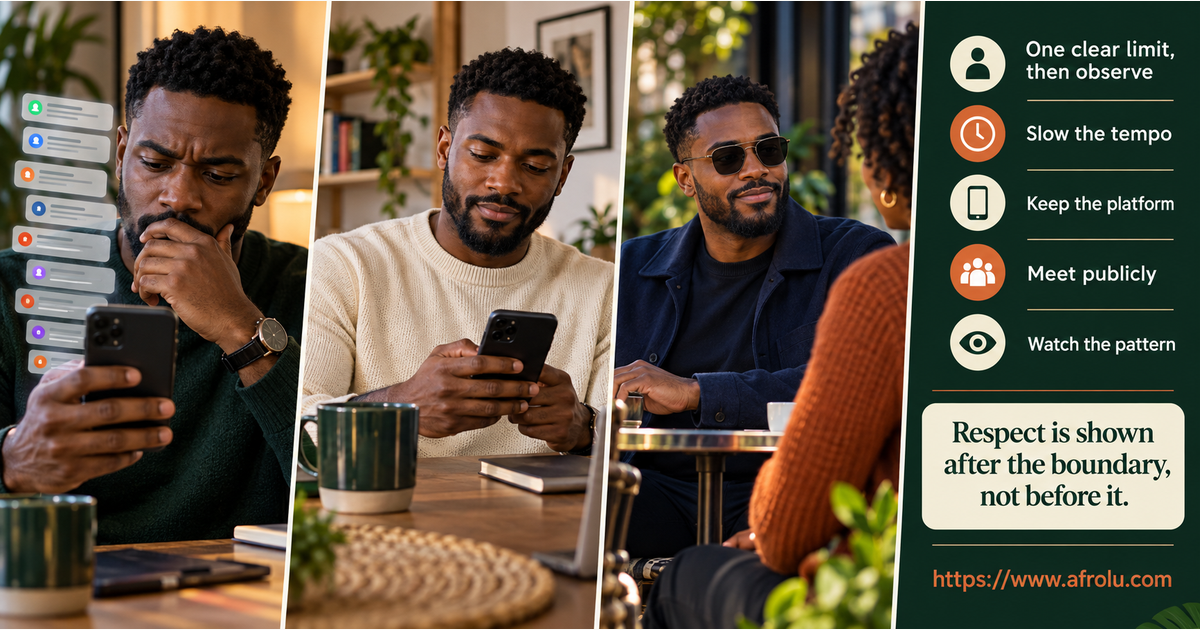
Treat early intensity as information to observe, not a verdict to diagnose. State one clear pace, money, privacy, or travel boundary; keep casual early plans public and independent; and watch whether the person respects it over time. A serious relationship goal never requires money, documents, secrecy, dependent travel, or a rushed yes.
Emotional safety · Diaspora Daters
How can a diaspora dater respond to early intensity without confusing a serious goal, shared background, or travel hope with a reason to surrender independent choice?
Love bombing is commonly used to describe intense early attention that may be paired with pressure for speed, access, money, secrecy, or commitment. This guide does not diagnose people. It focuses on observable conduct and on keeping a diaspora dater's time, identity records, finances, travel, privacy, consent, and free no under their own control.
Kwame enjoys a new match's warmth and shared cultural references, then notices that future talk is followed by a request for travel money. He does not decide who the person is. He keeps the chat on-platform, states that he does not send money or share documents, and asks for one calm call instead. The response to that boundary gives him clearer evidence than the original declarations did.
diaspora dating · pace and independence
Kwame lets warmth remain warm without allowing it to make every decision
Early attention can feel especially powerful when a new match shares a language, city, family story, or long-distance future. This guide helps a diaspora dater keep connection human while making pace, privacy, money, travel, and consent choices independently.
Observe conduct rather than diagnose, share identity in layers, separate a serious goal from rushed commitment, use one explicit boundary, treat travel as logistics, protect digital access, and keep support outside the connection.
Watch the response to a limit
A boundary can show whether warmth leaves your choices intact.
Share context in layers
A shared background can be meaningful without granting access to documents or family.
Keep every dependency separate
Tickets, lodging, funds, documents, consent, and exits stay independent.
Keep the next step small
Pause, support, reporting, and closure are valid outcomes too.
Start with conduct, not a label
Early enthusiasm is not proof of either safety or danger
Kwame meets someone online who writes long messages before breakfast, calls him unusually special, and talks about a future visit within a few days. He enjoys the attention after a lonely stretch abroad, and he also notices that the pace leaves little room to think. The question is not whether every affectionate message is a warning sign. It is whether the connection still has room for his work, friends, privacy, money, and changing mind.
Love bombing is often used as a shortcut label for intense early behaviour, but a label cannot tell Kwame what another person intends or diagnose them. A calmer approach is to observe specific facts: Are compliments paired with a request for speed? Does future talk become pressure for a ticket, a secret, a document, or access to his daily life? Does the person accept a no without sulking, bargaining, or returning through another channel?
A genuinely interested adult can be enthusiastic and still make room for uncertainty. They can hear, 'I prefer a slower pace,' without treating it as an insult. They can accept that a first date is short, that a call has to fit both time zones, and that financial, travel, and intimate decisions stay separate from attraction. Those responses do not guarantee safety, but they give Kwame more useful evidence than a large declaration ever could.
Kwame's first move is deliberately small. He limits the chat to one planned call, keeps it on the platform while he decides what he wants to share, and tells a friend he is getting to know someone new. He is not testing the other person with hidden rules. He is giving himself enough space to notice whether their warmth remains respectful when access, speed, and certainty are not immediately available.
Keep diaspora context broad until trust has time to grow
A shared background can feel familiar without proving identity or compatibility
Diaspora dating can make a quick sense of recognition especially powerful. A shared language, food, family story, or memory of a particular place may feel like an instant shortcut through loneliness. Kwame can enjoy that recognition while remembering that it does not prove a profile is accurate, that a person is compatible, or that they deserve access to relatives, travel routines, immigration documents, or private cultural spaces.
He decides what he is comfortable sharing in layers. Early on, he may say that family matters to him or that he grew up between more than one place. He does not share passports, visa records, money-transfer details, a parent’s phone number, live location, or exact travel dates. A person who respects him can be curious without treating private facts as a test of authenticity or devotion.
Distance also changes how stories can be checked. A photo, a fluent message, or a video call can be part of a real conversation, but none should be treated as full identity verification. Kwame avoids sending money, receiving funds, opening unfamiliar investment links, or making travel arrangements because someone says a family emergency makes time critical. He can independently research a claim, ask someone he trusts for a second view, or simply choose not to take on the risk.
When a match invokes community pressure—'If you understood our culture, you would trust me'—Kwame does not need to argue about culture at all. He can say that his financial, document, and travel boundaries apply to everyone. A boundary that only works with people outside a shared background is not a dependable boundary. Respect is shown by how someone responds to his limit, not by how closely they can describe his heritage.

Attention and pressure are not the same signal.
Keep serious intention separate from rushed commitment
A long-term hope can be direct without becoming a deadline
Kwame is not looking for a permanent pen pal, and he does not want to hide that. He can say he is open to a serious relationship and wants to learn whether values, communication, and real-life logistics fit. That sentence differs from agreeing to exclusivity, moving money, planning a cross-border visit, or treating a few days of intense contact as evidence that either person knows what a future relationship will require.
A casual first plan can be a truthful part of intentional dating. A short video call, a daytime public coffee, or a meal with a clear end time creates a shared experience without placing one person inside the other’s private world. Kwame does not use casual to mean vague or disposable; he uses it to keep cost, time, access, and expectation proportionate while both adults decide what they actually want.
He watches for a difference between disappointment and punishment. A match may reasonably say that a slower pace does not work for them. That is information. It becomes concerning when they respond with guilt, withdrawal designed to provoke panic, repeated pressure, threats, claims that a boundary proves a lack of love, or a demand that Kwame prove intent through money, travel, secrecy, or immediate intimacy.
A practical question helps: What is the next small action that would give both people more real evidence? It might be a call at a reasonable hour, an in-person meeting in a public place, or a week of respectful conversation that does not consume either person’s work and rest. If no small action is enough and only a dramatic gesture will satisfy the connection, slowing down is a reasonable answer.
Use an observation window rather than a private test
A boundary is useful because it protects your choices and reveals the response
Kwame chooses four early boundaries that matter to him: he does not move off-platform immediately, he does not send or receive money, he does not share documents or live location, and he does not make dependent travel plans. He names them when relevant rather than presenting them as a suspicious checklist. A person who wants to know him can continue the conversation without access to any of those things.
The first response is useful but not final. Someone may say, 'Of course,' and later reintroduce the same request with a sad story, a deadline, a gift, or a joke. Kwame looks at the pattern. Does the person accept a limit once, or do they keep making him manage their disappointment? Do they take responsibility for their own travel and money, or do they make their emergency his proof of care?
He also makes room for ordinary incompatibility. A match might want faster communication, an earlier visit, or a level of disclosure that Kwame does not want. They are allowed to decide that is not a fit, and so is he. The important distinction is that neither adult gets to turn disagreement into coercion, insult, isolation, or a reason to punish the other person for retaining independence.
If a boundary produces threats, blackmail, impersonation, account pressure, repeated unwanted contact, or fear for his safety, Kwame moves out of relationship interpretation. He preserves relevant evidence, uses reporting and blocking tools, tells someone trusted, and seeks appropriate local emergency or support help. It is not his job to convince a pressuring person that the boundary was reasonable before protecting himself.
Treat a visit as logistics before treating it as romance
Distance makes transport, accommodation, cost, and exit plans part of consent
The first time Kwame considers meeting someone who lives elsewhere, he slows the conversation down to facts. Where would they meet? Is the venue public? Who is paying for travel and accommodation? Does each person have their own transport, room, money, identification, and way to leave? These questions are not unromantic; they are the practical conditions that make a yes meaningful rather than expensive or trapped.
He avoids a plan in which one person funds the other’s travel, holds their documents, expects them to stay in a private home, or says a visit proves exclusivity. A promise to reimburse later can create the same pressure as an outright demand. Kwame may choose not to travel at all until more trust exists. If he does travel, he keeps bookings, payment, lodging, and an emergency route under his own control.
A shared background does not remove the need for this independence. Someone may say that a family home, a friend’s room, or a familiar city makes separate accommodation unnecessary. Kwame can appreciate the invitation and still choose a different plan. Privacy, consent, and an easy exit are not accusations against a host. They are part of how adults keep a new relationship voluntary on both sides.
Plans can change at the last minute for ordinary reasons. If the public venue is suddenly unavailable, a respectful match can suggest another public option or accept a postponement. Pressure to enter a private space, stay later than planned, pay an unexpected fee, hand over a passport, or ignore a change of mind is not a logistics problem to solve through politeness. It is a reason to leave or cancel.

A clear boundary can hold even when feelings are strong.
Protect digital access as carefully as physical access
An intense connection can make small requests feel harmless before they are easy to reverse
Kwame notices how quickly a new match can request a different channel, a personal number, a live location, a screenshot of travel documents, a private photo, or a link click. Each request may be framed as convenience, intimacy, verification, or proof. He slows the request down by asking what he is actually being asked to give and whether he would still be comfortable if the connection ended tomorrow.
He keeps platform reporting available until he has a reason to move elsewhere, and he never shares passwords, codes, bank details, government documents, employer systems, or intimate images because a new match asks. If he chooses to share a phone number later, he can still protect other identifying details. Privacy is not all or nothing; it can be built in layers that match time, evidence, and his own comfort.
Digital pressure can become severe quickly. Threats to expose an image, claims that someone has accessed an account, impersonation, or requests to move money require a different response from ordinary relationship uncertainty. Kwame should save what is safe to save, stop sending material, contact the relevant platform or financial institution promptly when appropriate, and seek local professional or emergency support if he feels at risk.
He avoids using surveillance in response. Checking a person’s location, demanding passwords, contacting every friend, or trying to force proof of identity can create its own harm and does not build a healthy connection. His job is to decide what access he will give and what he will do when someone crosses a limit. He does not need to become an investigator in order to choose distance.
Let the next decision stay small and yours
A connection can be meaningful without becoming the centre of every choice
Kwame reviews the connection after a few weeks instead of after every dramatic message. He asks whether he still has room for work, sleep, friends, family, and quiet thought. He notices whether boundaries have become easier to state or harder. He looks for consistency between affectionate words and ordinary behaviour: punctuality, respectful repair, acceptance of no, independent money decisions, and a willingness to make practical plans without a crisis.
If the answers are mixed, he can slow the pace rather than force a verdict. He might keep contact to one planned call, decline travel, or wait before sharing more personal information. If the answers are clearly harmful, he can end contact, block, report, and seek help. The decision does not require a final diagnosis of the other person. It requires enough attention to what the connection is asking him to give up.
He also protects support outside the relationship. Telling one trusted person about an intense new match is not a request for them to choose for him. It is a way to reduce isolation and make it easier to notice pressure that has started to feel normal. Friends and community can offer perspective; qualified professionals and local services can help when fear, distress, or harm needs more than a dating conversation.
Kwame keeps the core rule simple: no future promise, shared origin, gift, or dramatic story is worth surrendering the ability to decide freely. A safe serious relationship can tolerate ordinary time. A healthy casual first phase can tolerate boundaries. The people who fit his life will not require him to make it smaller in order to prove that he cares.

Choose the smallest action that protects your freedom.
Eight ordinary diaspora dating moments
A match mentions marriage after two days
The words may be hopeful, but there is not yet shared evidence about everyday fit.
Keep the conversation present and choose one small next plan.A profile claims the same hometown and wants identity documents
Familiarity does not make documents, relatives, or private history early-dating material.
Share only broad context and keep records private.A new match says a fare will prove commitment
Travel cost can manufacture obligation before trust exists.
Do not fund it; keep travel independent or postpone.A match asks to leave the platform immediately
They may prefer another channel, or they may be reducing your reporting options.
Stay where you are until moving feels voluntary and safe.A person apologises after crossing a boundary
An apology matters only if the conduct changes and the request does not return.
Observe the pattern rather than arguing about intent.A match says cultural understanding requires faster disclosure
Community language can be used to make a personal boundary feel disloyal.
Repeat that your privacy and money rules apply to everyone.A public plan changes to their home after travel is booked
A changed setting can remove the easy exit you planned.
Keep the public plan, arrange your own lodging, or cancel.A person threatens to expose a private image after a no
This is coercive conduct, not a relationship disagreement.
Stop sending material, preserve evidence, report, and seek appropriate local support.Signals that a request is narrowing pace, privacy, money or travel choices
Affection arrives with a request for speed, secrecy, money, documents, access, or a dramatic promise.
A person treats a slower reply or a stated limit as proof that you do not care.
Future talk is used to make a current financial or travel decision feel unavoidable.
A shared city, language, or cultural reference is presented as proof that you should trust without evidence.
Your boundary is accepted once but returned through a sad story, joke, gift, or deadline.
A match asks you to receive, move, invest, borrow, or send money for them.
They seek passwords, codes, identity records, live location, work access, or private family contacts.
A public first plan is repeatedly changed to a private setting or dependent transport.
They make you feel responsible for calming their anger when you say no.
The connection consumes sleep, work, friends, family, or quiet time within a few days.
They threaten to expose information, impersonate you, or return after you block them.
You start hiding the connection from people who could offer perspective because explaining it feels uncomfortable.
A ticket, gift, or promise makes you feel that cancelling would be cruel or impossible.
You feel more afraid of their reaction than free to state what you want.
Choose a next move from the actual request
| Situation | What it may mean | What to do next |
|---|---|---|
| A match sends intense praise early | Warmth may be genuine, but it is not evidence of compatibility by itself. | Receive it without increasing access; observe conduct over time. |
| They ask to move off-platform | The request can be ordinary, but the timing and response to a no matter. | Stay on-platform until another channel is a free choice. |
| They discuss a future together | A hope can be pleasant without requiring a current promise. | Bring the conversation back to one present, practical next step. |
| They want a serious relationship quickly | They may want fast certainty or may use seriousness to pressure pace. | Name your direction and keep commitment decisions gradual. |
| They ask for travel money | This is a money and fraud concern, not a romantic test. | Do not send it; preserve the request, report, and block. |
| They invite you to stay privately | Hospitality can be genuine but may remove independent accommodation and exit. | Book your own lodging or postpone the visit. |
| They ask for a document | A claimed identity problem does not require you to share private records. | Decline and verify nothing through money or documents. |
| They apologise after pressure | A repair is possible only if the conduct actually changes. | Keep the boundary and watch whether the request returns. |
| You want to slow the connection | Your wish for time is enough even if the person dislikes it. | State a smaller rhythm and do not debate the reason. |
| They threaten, blackmail, or stalk | The situation has moved beyond compatibility interpretation. | Prioritise safety, preserve evidence, report, and seek appropriate local help. |
Twelve short lines for pace, privacy, money and travel
“I enjoy talking with you, and I am keeping the pace slower while I get to know someone.”
“I am open to a serious relationship, but I do not make big promises before we have ordinary experience together.”
“I prefer to keep this conversation here for now.”
“I do not send, receive, lend, invest, or move money for people I meet online.”
“I do not share passports, identity records, codes, or private travel details early in dating.”
“If we ever meet, I will arrange my own transport and accommodation.”
“A short public plan works for me before anything more private.”
“I have already answered that request, and I am not changing my decision.”
“I can offer this call time; I do not stay available all day.”
“I share personal information gradually, when trust and time make it feel right to me.”
“I need a few days away from this conversation to decide whether the pace works for me.”
“This connection is asking for more access than I am comfortable giving, so I am ending it.”
Know the difference
Warmth, serious intent, shared background and direct pressure are different facts
Enthusiasm, a long-term hope, a shared origin, and an independent public plan can coexist with limits, privacy, time, and a free no.
Money, identity records, secrecy, dependent travel, ignored boundaries, threats, or punishment for slowing down require a firm stop, evidence preservation, reporting, and appropriate support.
Do not let a powerful feeling choose the response. Name the request and decide whether it leaves your independence intact.

Warmth, shared history and access pressure require different boundaries.
Separate warmth, intent, recognition, logistics and pressure
| Type or dimension | What it describes | Best next question |
|---|---|---|
| Early enthusiasm | Warm messages and plans can be enjoyable when they leave room for limits and ordinary life. | Accept the warmth and keep decisions small. |
| Intensity with pressure | Affection is paired with secrecy, urgency, money, access, or punishment for a no. | Slow down, preserve evidence, and reduce access. |
| Serious intention | Names a long-term direction without predicting commitment before shared experience. | Ask for a realistic next step rather than a promise. |
| Rushed commitment | Treats exclusivity, travel, or intimacy as proof that love is real. | Keep the present agreement clear and voluntary. |
| Shared background | Can create recognition and useful conversation without proving identity. | Enjoy it while keeping documents and private details protected. |
| Identity claim | Uses culture, travel, or a hometown to demand trust, money, or records. | Verify independently or decline the request entirely. |
| Independent visit | Each adult controls transport, accommodation, cost, documents, and exit. | Discuss logistics before booking anything. |
| Dependent trip | A ticket, housing, or reimbursement creates pressure to accept a plan. | Postpone or choose a fully independent arrangement. |
| Respectful mismatch | A person accepts that a different pace or goal is not a fit. | End or reduce contact without punishment. |
A slower pace before a larger promise
Intensity is not evidence
Attention can feel powerful without telling you whether a person will respect independence over time.
Boundaries create information
A calm response to a limit is more useful than a perfect early speech about trust.
Background is not verification
Shared culture, language, city, or history can be meaningful without proving identity or compatibility.
Travel needs its own plan
Transport, lodging, cost, documents, consent, and an exit are logistics before they are romance.
Privacy can be layered
You can share broad context while keeping money, records, locations, images, and accounts private.
Support reduces isolation
A trusted person can offer perspective without taking over your decisions.
Questions organised by purpose and depth
Choose a few prompts that fit the moment. This is a reference library, not a list to complete.
Pace check
Use these after a burst of early attention.
- What decision am I being invited to make right now?
- Would I choose it after a quiet day?
- What pace still leaves room for work, sleep, and friends?
Access check
Use these before sharing more personal information.
- Is this request easy to reverse?
- Would I share this if the connection ended tomorrow?
- Do I still control accounts, money, documents, and location?
Travel check
Use these before discussing a visit.
- Can each adult arrange transport and lodging independently?
- Can either person cancel without a financial penalty from the other?
- Is there a public plan and an easy exit?
Pattern check
Use these after you state a boundary.
- Was the limit accepted without punishment?
- Did the same request return in a different form?
- What action protects my choice if it happens again?
Look more closely at boundaries, travel, access and support
Watch the response to one clear limit
Choose a time, money, privacy, or venue boundary and notice whether it is honoured without punishment or repeated bargaining.
Evidence limit: One response cannot prove a person's character or future conduct.
Share broad context in layers
You can speak about family, culture, and place while protecting documents, contacts, migration details, and live travel routines.
Evidence limit: Shared background is not a verification method.
Keep a hope present-tense
State that you are open to a long-term relationship, then choose a small date or call that gives both adults more real evidence.
Evidence limit: A clear goal cannot make a stranger compatible or safe.
Separate every practical dependency
Keep ticket, lodging, money, documents, location, and exit under each adult's independent control before a visit.
Evidence limit: Planning can reduce risk but cannot guarantee safety.
Slow down any request that is difficult to reverse
Do not share codes, accounts, identity records, intimate images, financial details, or live location because a new match asks.
Evidence limit: This guide cannot provide individual cyber, legal, or financial advice.
Move direct risk out of dating analysis
Preserve evidence, use reporting tools, and contact trusted or local professional support when threats, coercion, or fear appear.
Evidence limit: Seek urgent local help if you believe you are in immediate danger.
Common shortcuts that make intensity harder to assess
Diagnosing instead of observing
A label can become an argument that distracts from concrete access, money, travel, or consent boundaries.
Treating a future promise as a present obligation
Hopeful language does not require a ticket, a secret, or a faster commitment.
Using shared culture as verification
Familiar details can be real or copied and never replace independent judgment.
Letting transport decide consent
A paid fare or private lodging can make leaving feel harder than it needs to be.
Trading privacy for reassurance
Documents, locations, images, codes, and accounts can be difficult to take back once shared.
Responding to every pressure message
Repeated explanations can give a boundary tester more opportunities to negotiate.
Choose one resource for the open question
Start with the guide that matches the current fact: a slower pace, a long-distance plan, or conduct that needs a private safety review rather than more relationship interpretation.
Explore the guide library
Show more related guides
Continue with Afrolu
Show more Afrolu guides
Sources used for this guide
Afrolu reviewed these health, research, safety, or public guidance resources while editing this page. They support the behaviour and safety guidance; they do not diagnose any individual described by a reader.
Questions about early intensity and diaspora dating
Is every intense new connection love bombing?
No. Early enthusiasm is not enough to diagnose a person or predict harm. Watch whether warmth leaves your time, money, privacy, travel, and free no intact.
Can I want a serious relationship and still slow the pace?
Yes. A long-term hope describes direction, not a deadline for exclusivity, travel, intimacy, money, or personal disclosure.
Does shared culture mean I should trust someone more quickly?
No. It can create genuine recognition, but it does not verify identity, compatibility, intentions, or the safety of a request.
Should I send a ticket to someone I met online?
Do not send money or travel funds to a new online match. Keep travel independent and postpone if the plan cannot work without financial pressure.
What if a match wants proof of my identity?
Do not share documents, codes, private records, or financial information because a new match asks. Verification that costs you privacy or money is not a safe relationship test.
Can I move a chat off the app?
You can choose another channel when it feels voluntary, but moving early can reduce reporting options and increase privacy exposure. Keep the choice yours.
How do I know whether an apology is real?
Do not rely on words alone. Keep the boundary and observe whether the same request, pressure, or punishment returns.
What makes a long-distance first visit safer?
Keep transport, accommodation, funds, documents, activities, and an exit independent. A ticket should never decide consent or commitment.
What if a person threatens to share an image or private information?
Stop sending material, preserve relevant evidence where safe, use platform reporting, and seek appropriate local professional, legal, or emergency support if you are at risk.
Do I need to explain why I am slowing down?
No. A concise statement about your pace is enough. You are not required to win agreement before retaining a boundary.
One thing to do now
Let time reveal whether the connection fits your whole life
Choose the smallest next step that keeps your money, records, travel, privacy, consent, relationships, and right to leave independent from the new connection.